U1 · The Nature of Ecology
Contents
Reading map 2
Learning objectives 2
Part 1: What ecology is 3
1.1 The definition, and the two questions 3
1.2 Levels of organization 3
1.3 One example carried through every level 5
1.4 The two physical principles under everything 5
Part 2: Kaspari ten principles of ecology 7
The list, with the explanations 7
The ten, compressed 11
Part 3: How ecologists know things 12
3.1 The scientific method, stated precisely 12
3.2 The four ways to do ecology 12
3.3 Reporting and peer review 13
Part 4: A short history of ecology 14
Part 5: The subdisciplines 15
Condensed review 16
The eight things most likely to appear on the exam 16
Mnemonic set 16
Self-test 16
Questions 16
Answer key 17
This first lecture does three things at once: it defines what ecology is, it hands you Kaspari ten principles as a scaffold you will hang the whole semester on, and it establishes how ecologists actually generate knowledge. Do not treat the ten principles as trivia to memorize once. They are the index of the course.
Reading map
Learning objectives
- Define ecology and distinguish it from environmentalism.
- Name and order the levels of ecological organization, and give a research question appropriate to each.
- State all ten of Kaspari principles and give one concrete example of each.
- Interpret dN/dt = B — X + I and dS/dt = D — X + I, and say what each letter means.
- Distinguish hypothesis, prediction, theory, and law, and explain why hypotheses must be falsifiable.
- Compare observational, natural-experiment, manipulative-experiment, and modelling approaches on control and realism.
- Identify a subdiscipline of ecology from a described study, and name the axis it is defined on.
Part 1: What ecology is
1.1 The definition, and the two questions
- Ecology is the scientific study of the interactions between organisms and their environment, and of the consequences of those interactions for distribution and abundance.
- Distribution: where organisms are, and where they are not.
- Abundance: how many there are.
- Almost every ecological question reduces to one of those two, or to why they change over time and space.
- Environment has two halves. Biotic factors are the other living things: predators, competitors, mutualists, parasites, food. Abiotic factors are the non-living conditions: temperature, water, light, nutrients, soil, salinity, disturbance.
Ecology is not environmentalism
- Confusing them is the most common error in an intro course. An ecologist can produce a finding that is politically inconvenient in any direction; that is the point of doing it as a science. Ecology is also interdisciplinary by necessity, borrowing from chemistry, physics, geology, climatology, evolution, physiology, statistics, and economics.
1.2 Levels of organization
- Ecology is organized by the scale of the thing being studied. Each level asks different questions and uses different methods, and a good exam answer names the level before it answers.
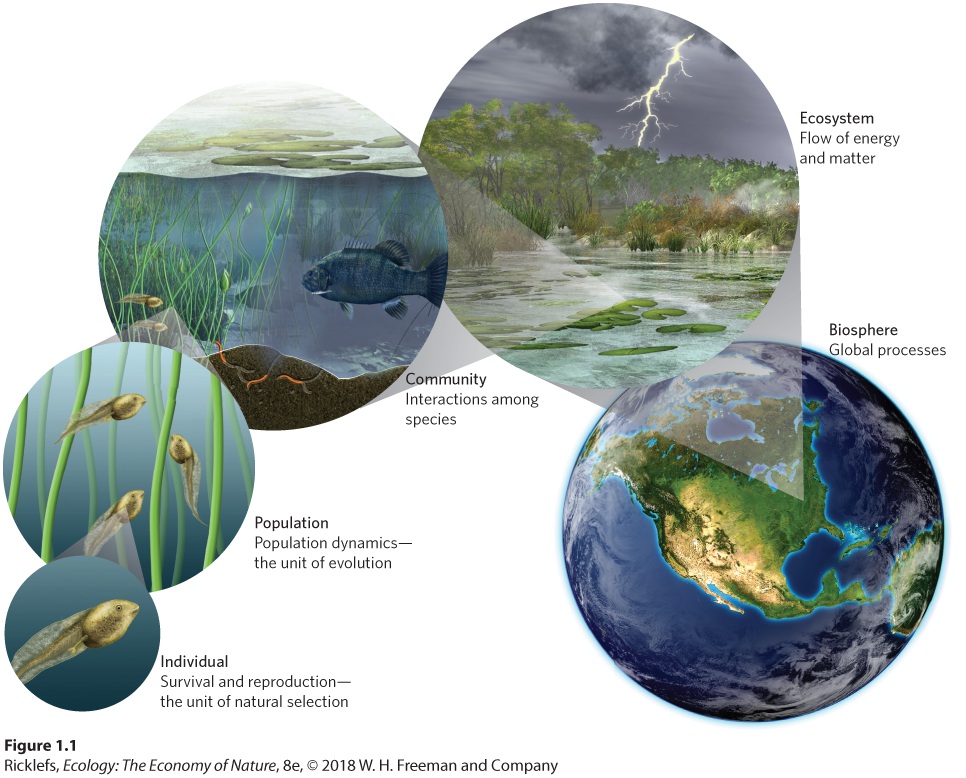
- Figure 1. The hierarchy of organization in ecological systems.
- Source: Ricklefs & Relyea, Ecology: The Economy of Nature 8e, Fig. 1.1
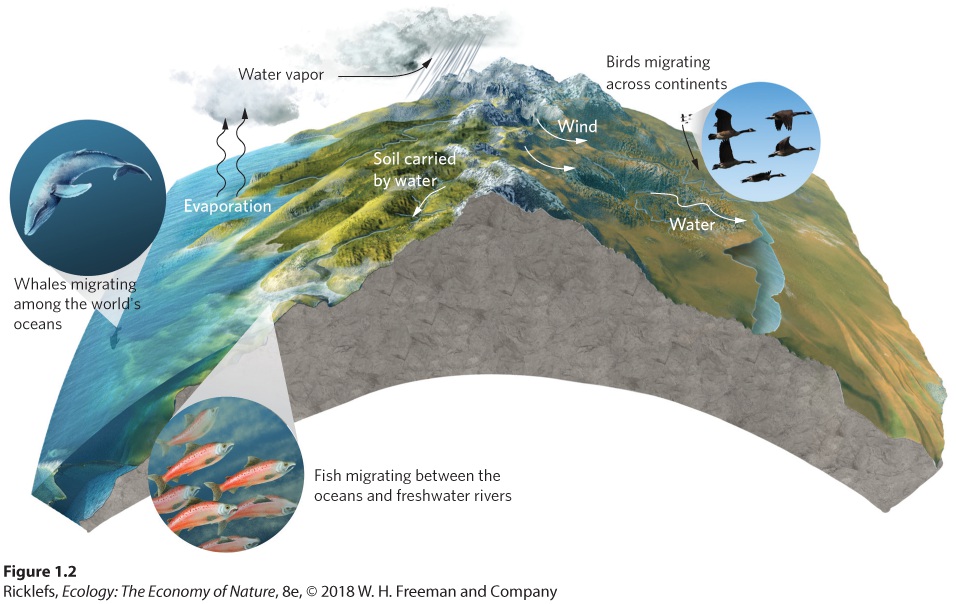
- Figure 2. The biosphere: all ecosystems, linked by movements of air and water.
- Source: Ricklefs & Relyea, Ecology: The Economy of Nature 8e, Fig. 1.2
- Vocabulary that gets tested: conspecifics are members of the same species, heterospecifics are members of different species. A population boundary can be natural (a river, a mountain range) or arbitrary (a road, a study plot edge), and the choice changes your answer, which is the first hint of why scale matters.
1.3 One example carried through every level
- The Karner blue butterfly is the worked example in EFA 1.2, and it is worth learning because a single system can be studied at all four core levels.
- Note how the conservation answer only appears at the ecosystem level. You cannot save the butterfly by protecting butterflies; you have to restore the disturbance regime that keeps lupine on the landscape. Manning’s fire ecology emphasis in this course is the same argument applied to tallgrass prairie.
1.4 The two physical principles under everything
- Conservation of matter and energy. Matter and energy are neither created nor destroyed, so every input to an ecological system has to be accounted for as storage, transformation, or output. This is why ecologists can write budgets.
- Dynamic steady state. A system is in steady state when inputs equal outputs, so the amount stored does not change even though material is constantly flowing through. A lake at constant volume with a river in and a river out is the model. The water is entirely replaced, and the level never moves.
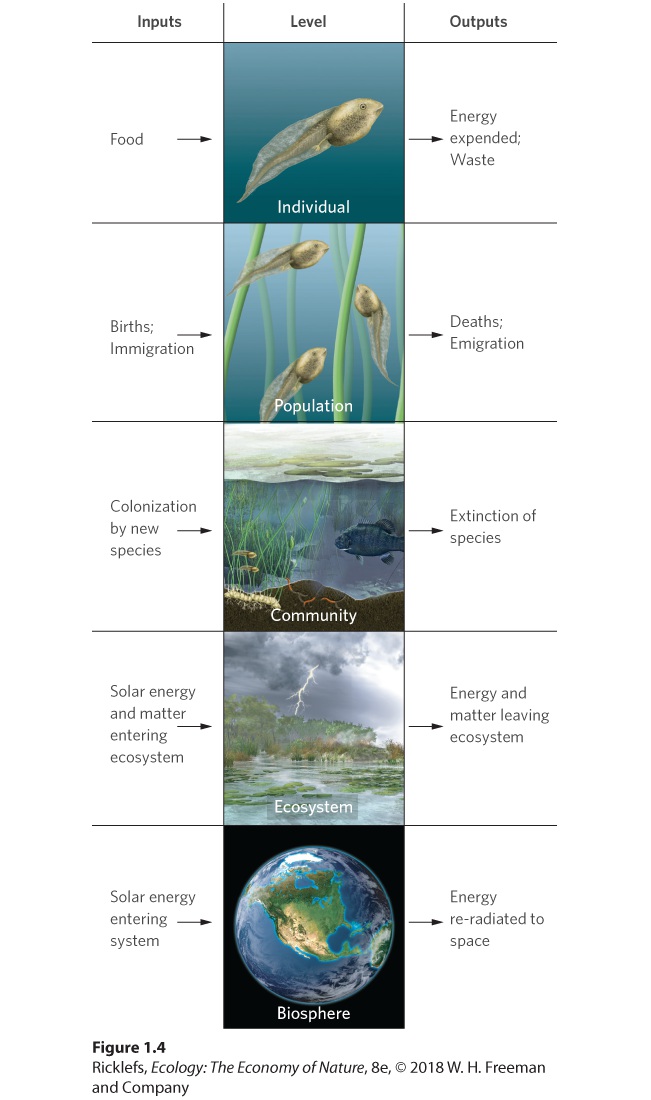
- Figure 3. Dynamic steady states: at every level of organization, inputs must equal outputs.
- Source: Ricklefs & Relyea, Ecology: The Economy of Nature 8e, Fig. 1.4
- Test hook: “unchanging” does not mean “static.” A steady state is maintained by continuous flux, which is exactly why it can be pushed out of balance by changing either the input or the output rate.
Part 2: Kaspari ten principles of ecology
- Michael Kaspari teaches Principles of Ecology at the University of Oklahoma and published this list in 2017 as the scaffold he hands students in week one, so that the rest of the semester can recombine and revisit them rather than unveil them one at a time. His stated inspirations were Eugene Odum Fundamentals of Ecology (which is organized as Statement, Explanation, Examples) and a discussion by Meghan Duffy and colleagues on organizing intro ecology.
- Why this matters for your exam: any ecological phenomenon in this course can be traced back to one or more of these ten. When you get an unfamiliar question, ask which principles are in play. That is the whole point of having a list.
The list, with the explanations
Principle 1: Evolution organizes ecological systems into hierarchies.
- Individual organisms combine into populations, populations into species, species into higher taxa such as genera and phyla.
- Each level can be characterized by abundance (how many) and diversity (how many kinds) in a given ecosystem or plot.
- How and why abundance and diversity vary in time and space is, in Kaspari framing, the basic question of ecology.
- Link: this is the same hierarchy as Part 1 of this guide, but justified evolutionarily rather than administratively.
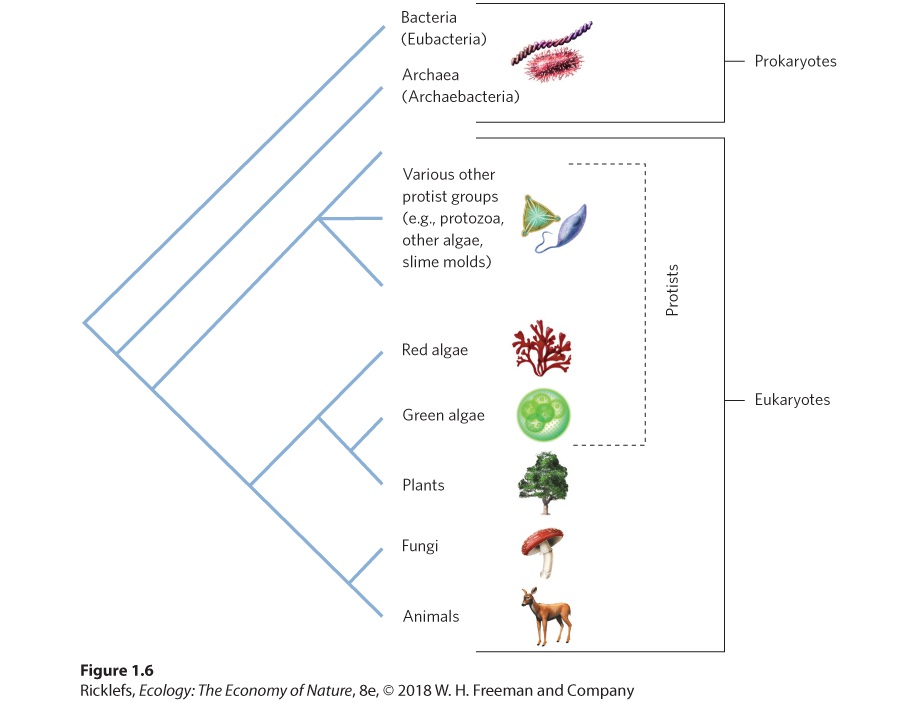
- Figure 4. The evolution of life on Earth: the history that produced the hierarchy.
- Source: Ricklefs & Relyea, Ecology: The Economy of Nature 8e, Fig. 1.6
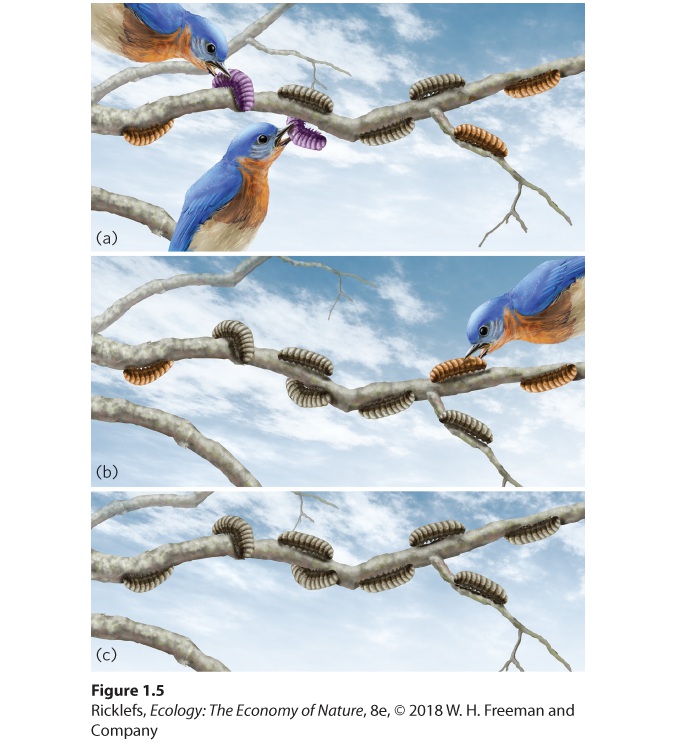
- Figure 5. Natural selection in action: camouflage variation within a caterpillar population.
- Source: Ricklefs & Relyea, Ecology: The Economy of Nature 8e, Fig. 1.5
Principle 2: The sun is the ultimate source of energy for most ecosystems.
- Life runs on the carbon-rich sugars produced by photosynthesis.
- Every ecosystem sugar output depends on how much solar energy and precipitation it receives.
- The word “most” is doing real work: deep-sea hydrothermal vent communities run on chemosynthesis, oxidizing reduced sulfur compounds instead. Ricklefs opens Chapter 1 with exactly that example, because it is the exception that defines the rule.
- Link forward: this principle is what makes the global climate lecture (temperature and precipitation) a productivity lecture in disguise.
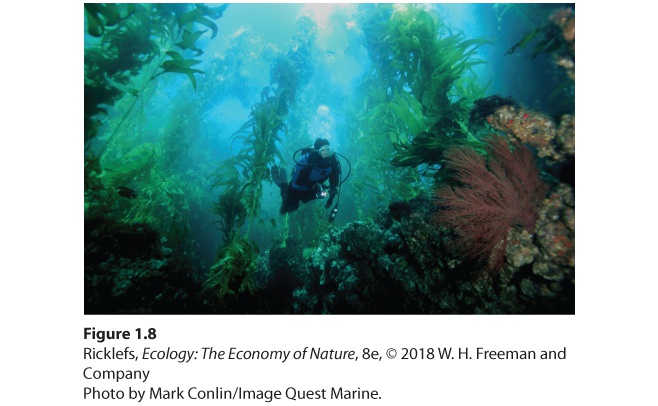
- Figure 6. Kelp forests: photosynthesis at the base of a marine ecosystem.
- Source: Ricklefs & Relyea, Ecology: The Economy of Nature 8e, Fig. 1.8
Principle 3: Organisms are chemical machines that run on energy.
- The laws of chemistry and physics limit the ways each organism can make a living, and provide the basic framework for ecology.
- The supply of chemical elements, and of the sugars needed to assemble them into organisms, limits the abundance and diversity of life.
- This is the foundation of ecological stoichiometry: organisms have characteristic C:N:P ratios, and whichever element is in shortest supply relative to demand becomes limiting.
Principle 4: Chemical nutrients cycle repeatedly while energy flows through an ecosystem.
- Atoms of C, N, P, Na and the rest move back and forth between living and dead parts of an ecosystem, indefinitely.
- Photons of solar energy can be used only once before they are lost to the universe as heat.
- Mnemonic: “Nutrients cycle, energy flows.” It is the single most reliably tested distinction in an intro ecology course, and it follows directly from the second law of thermodynamics.
Principle 5: dN/dt = B — X + I
- The rate at which a population abundance in a given area increases or decreases reflects the balance of births (B), deaths (X), and net migration into the area (I).
- Individuals with features that improve their ability to survive (that is, not die) and to make copies of themselves will tend to increase in that population.
- Everything in population ecology is an elaboration of this: exponential growth, logistic growth, life tables, source-sink dynamics, and metapopulations all just specify what B, X, and I depend on.
Principle 6: dS/dt = D — X + I
- The rate at which the diversity of species in an area changes reflects the balance of new forms arising (D, diversification or speciation), those going extinct (X), and those migrating in (I).
- Individuals and species with features allowing them to survive and reproduce in a local environment will tend to persist there.
- Notice the deliberate parallel with Principle 5. The same accounting logic that governs how many individuals there are also governs how many kinds there are. Island biogeography theory is this equation with I and X made explicit functions of island size and distance.
- Learn these two equations as a pair. If an exam asks about abundance, use B, X, I. If it asks about diversity, use D, X, I. The only change is that births become origination.
Principle 7: Organisms interact, do things to each other, in ways that influence their abundance.
- Individual organisms can eat one another, compete for shared resources, and help each other survive.
- Each pair of species in an ecosystem can be characterized by the kind and strength of these interactions, measured as their contribution to dN/dt.
- The formal move here is important: an interaction is defined by its measurable effect on dN/dt, not by a story about who is helping whom. That makes it quantitative and testable.
Principle 8: Ecosystems are organized into webs of interactions.
- The abundance of a population is influenced by the chains of interactions connecting it to every other species in its ecosystem.
- This often produces complex behavior, and a key challenge in ecology is determining which patterns of abundance and diversity can actually be predicted.
- Consequences you will meet later: trophic cascades, keystone species, indirect effects that are opposite in sign to the direct ones, and the reason removal experiments so often surprise people.
Principle 9: Human populations have an outsized role in competing with, preying upon, and helping other organisms.
- Humans are one of millions of species embedded in Earth ecosystems.
- Our large population size and technological capability increase our ability to shape the biosphere future.
- Through principles 1 to 8, humans are currently changing the climate, rearranging its chemistry, decreasing populations of food species, moving species around, and decreasing diversity.
- Note the structure of the claim: humans are not a separate force acting on ecology, they are an ordinary species whose effects run through the same eight principles at unusual magnitude.
Principle 10: Ecosystems provide essential services to human populations.
- Provisioning services: timber, fiber, food.
- Regulating services: water quality, air quality, flood control, pollination, climate regulation.
- Cultural services: recreation, aesthetics, identity.
- A key goal of ecology is to use principles 1 to 9 to preserve those services.
The ten, compressed
- Mnemonic: “Hierarchies Soak Sun, Cycle Chemicals; Numbers and Species rise and fall; Interactions Weave Webs; Humans Take and Owe.” Ugly, but it walks 1 through 10 in order.
Part 3: How ecologists know things
3.1 The scientific method, stated precisely
- Observation. Notice a pattern or problem in the natural world.
- Question. Ask why or how.
- Hypothesis. Propose a suggested explanation for an event, one that can be tested.
- Prediction. Restate the hypothesis as an if-then statement about a specific measurable outcome.
- Experiment or further observation. Test it, with variables and controls.
- Analysis. Evaluate the results and accept or reject the hypothesis.
- Report. Publish so others can check and build on it.
The distinctions that get tested
- A hypothesis must be both testable and falsifiable. If no conceivable observation could contradict it, it is not scientific.
- Inductive reasoning uses many related observations to reach a general conclusion, moving from specific to general. This is how descriptive science works.
- Deductive reasoning uses a general principle to forecast a specific result, moving from general to specific. This is how hypothesis-based science works.
- Basic science pursues knowledge regardless of short-term application. Applied science aims to solve real-world problems. Applied results almost always depend on prior basic research, which is the standard argument for funding curiosity-driven work.
3.2 The four ways to do ecology
- The trade-off to state on an exam: control and realism pull against each other. Strong inference in ecology usually comes from doing more than one of these on the same question and seeing whether they agree.
Design vocabulary
- Replication: repeating the treatment on independent units so you can separate signal from noise.
- Pseudoreplication: treating subsamples from one experimental unit as if they were independent replicates. The classic ecological sin.
- Randomization: assigning treatments at random so unmeasured differences are distributed evenly.
- Blocking: grouping similar units together before assigning treatments, to remove a known source of variation.
- A single manipulated plot with 50 measurements inside it is one replicate, not fifty.
3.3 Reporting and peer review
- Papers follow IMRaD: Introduction (background and rationale), Materials and Methods (enough detail to replicate), Results (findings without interpretation), Discussion (interpretation in context).
- Peer review means independent experts assess originality, significance, logic, and rigor before publication. It filters, but it does not guarantee correctness, which is why replication matters.
Part 4: A short history of ecology
- Two names to be able to place instantly: Haeckel named the field in 1866, and Tansley named the ecosystem in 1935. Odum then organized teaching around principles, which is the tradition Kaspari list belongs to.
Part 5: The subdisciplines
- EFA 1.4 catalogues the field. The useful insight is not the list itself, it is that the field is carved along several independent axes at once, so one study can belong to several subdisciplines.
Definitions worth having exactly
- Autecology: the study of individual organisms of a single species in relation to their environment.
- Synecology: the study of groups of organisms, homogeneous or heterogeneous, in relation to their environment.
- Macroecology: relationships between organisms and environment at large spatial scales.
- Ecophysiology: adaptation of an organism physiology to environmental conditions.
- Fire ecology: the role of fire in the environment of plants and animals. This is Manning’s specialty and the reason tallgrass prairie recurs all semester.
- Landscape ecology: relationships between ecological processes and particular ecosystems across a spatial mosaic.
- Restoration ecology: the scientific basis for renewing and repairing damaged ecosystems.
- Paleoecology: interactions between organisms and their environments across geologic timescales.
- Exam form: you will be given a described study and asked to name the subdiscipline. Read for the axis. “Measuring how leaf temperature affects photosynthesis in one shrub species” is ecophysiology plus autecology. “Mapping bird diversity against island size across the Caribbean” is macroecology plus biogeography.
Condensed review
The eight things most likely to appear on the exam
- Ecology is the study of interactions between organisms and their environment, and it explains distribution and abundance.
- Ecology is a science; environmentalism is a movement.
- Levels: individual, population, community, ecosystem, landscape, biome, biosphere.
- Nutrients cycle; energy flows and is lost as heat.
- dN/dt = B — X + I for abundance; dS/dt = D — X + I for diversity.
- A hypothesis is testable and falsifiable; a prediction is its if-then consequence; a theory is a well-supported explanation, not a guess.
- Control and realism trade off across observation, natural experiment, manipulation, and modelling.
- Haeckel coined ecology in 1866; Tansley coined ecosystem in 1935.
Mnemonic set
- “Nutrients cycle, energy flows.”
- “B, X, I for numbers; D, X, I for kinds.”
- “Control and realism pull opposite ways.”
- “One plot, fifty samples, still one replicate” -- pseudoreplication.
- “Haeckel Hatched the word, Tansley Tied in the abiotic.”
Self-test
- A study finds that prairie plots burned every three years hold more plant species than unburned plots. Name the level of organization, the subdiscipline, and the study type.
- Rewrite this as a proper hypothesis and prediction: “Fire is good for prairies.”
- Explain, using Kaspari Principle 4, why a food chain rarely has more than four or five links.
- A population has 40 births, 25 deaths, 10 immigrants, and 5 emigrants in a year. Compute dN/dt and state whether the population is growing.
- An island loses two species to extinction and gains three by colonization in a decade, with no speciation. What is dS/dt, and which term is zero?
- Why is a hydrothermal vent community a problem for Principle 2 as literally stated, and how does Kaspari wording handle it?
- A researcher measures nitrogen in 30 soil cores from one fertilized plot and 30 from one control plot, then runs a t-test with n = 30 per group. What is wrong?
- Give an example of an interaction that is + / — and one that is + / +, and state how each would appear in the dN/dt of both species.
- A lake receives 1000 L per day and discharges 1000 L per day, and its volume has not changed in a decade. Is it static? Explain using the correct term.
- Name the subdiscipline: a team sequences DNA from pond water to determine which amphibians are present without catching any.
- Explain why “ecosystem services” (Principle 10) is a claim about humans rather than about ecosystems.
- Distinguish autecology from synecology, and give one research question for each about the same species.
Show answer key — try the questions first
- Level: community (species richness across populations in an area). Subdiscipline: fire ecology, and community ecology. Study type: manipulative experiment if the burns were assigned by the researcher, natural experiment if the burn history was pre-existing.
- Hypothesis: periodic fire maintains prairie plant diversity by suppressing woody encroachment. Prediction: if that is true, then plots burned on a three-year cycle will have higher forb species richness and lower woody stem density after ten years than unburned control plots.
- Energy flows through and is lost as heat at each transfer, with only roughly 10% passed to the next level, so after four or five transfers there is not enough energy left to support another level. Nutrients are not the limit, because they cycle.
- dN/dt = B — X + I = 40 — 25 + (10 — 5) = +20. The population is growing.
- dS/dt = D — X + I = 0 — 2 + 3 = +1. D (diversification) is zero, because no new species arose in place.
- Vent communities are powered by chemosynthesis using reduced sulfur compounds, not sunlight. Kaspari says “most ecosystems,” which explicitly leaves room for the exception rather than claiming universality.
- Pseudoreplication. There is one fertilized unit and one control unit, so n = 1 per treatment. The 30 cores are subsamples measuring within-plot variation, not independent replicates of the treatment.
- Predation is + / -: the predator dN/dt gains, the prey dN/dt loses. Mutualism is + / +: both dN/dt terms increase, usually by lowering the death term or raising the birth term of the partner.
- No, it is in dynamic steady state. Inputs equal outputs, so the stock is constant while material turns over completely.
- Molecular ecology (environmental DNA), which is also a method within community ecology and, if the goal is species monitoring, applied or conservation ecology.
- Because a service is defined by benefit to a beneficiary. The ecosystem processes exist regardless; calling them services adds a human valuation. That is why Principle 10 is where ecology hands off to policy.
- Autecology studies one species in relation to its environment; synecology studies groups of species together. For the Karner blue: autecology asks what temperature range the caterpillar tolerates; synecology asks how the butterfly, its lupine host, and its tending ants co-occur across a barren.
- Assigned reading | What it gives you | Covered in
- Kaspari, Ten Principles of Ecology | The conceptual scaffold: ten statements that generate the rest of the course | Part 2
- Stiling Ch. 1.1 | What ecology is, and what it is not | Part 1
- Stiling Ch. 1.2 | Levels of organization and the scales ecologists work at | Part 1
- Stiling Ch. 1.4 | How ecologists do science: observation, experiment, model | Part 3
- EFA 1.1 Biology and the Scientific Method | Hypothesis, prediction, theory, controls, inductive vs deductive | Part 3
- EFA 1.2 What is Ecology? | Four levels of ecological study, the Karner blue example | Part 1
- EFA 1.3 History of Ecology | Where the ideas came from and who named them | Part 4
- EFA 1.4 Subdisciplines of Ecology | How the field is carved up, and why | Part 5
- | Ecology | Environmentalism
- What it is | A science | A social and political movement
- Produces | Testable explanations and predictions | Advocacy and policy positions
- Value stance | Describes what is | Argues for what ought to be
- Relationship | Supplies the evidence | Uses the evidence to argue
- Level | What it is | Typical question | Typical method
- Individual / organismal | One organism and its morphology, physiology, and behavior | How does this species tolerate freezing? Where does it choose to lay eggs? | Physiological measurement, behavioral observation, common-garden experiments
- Population | All individuals of one species in one area at one time | Is this population growing, and what limits it? | Mark-recapture, life tables, population models
- Community | All the populations of different species interacting in one area | Why are there this many species here? Who eats whom? | Species inventories, removal experiments, food-web analysis
- Ecosystem | The community plus its abiotic environment, treated as one system | How much carbon does this system fix, and where does the nitrogen go? | Flux measurement, nutrient budgets, isotope tracing
- Landscape | A mosaic of ecosystems, and the flows between them | How does fragmentation change what lives here? | Remote sensing, GIS, spatial modelling
- Biome | A global-scale vegetation type defined by climate | Why is grassland here and forest there? | Climate-vegetation correlation, climate diagrams
- Biosphere | All ecosystems on Earth, linked by the atmosphere and oceans | How is the global carbon cycle changing? | Global models, satellite data, ice cores
- Level | The Karner blue question
- Organismal | Females lay eggs preferentially on wild lupine; caterpillars feed on that one host plant for four to six weeks. Why that plant, and what physiological constraint enforces it?
- Population | How large is the population in a given lupine patch, how dense, and is it growing or shrinking?
- Community | Caterpillars secrete carbohydrate that ants harvest, and the ants defend them. That is mutualism, a coevolved long-term relationship in which both species benefit.
- Ecosystem | Lupine needs open, disturbed, sandy habitat. Fire suppression closes the canopy, lupine disappears, and so does the butterfly. Now the question is about disturbance regimes and nutrient flows.
- Interaction | Effect on species 1 | Effect on species 2 | Example
- Predation / herbivory / parasitism | + | — | Wolf and elk; bison and prairie grass
- Competition | — | — | Two grasses drawing on the same soil nitrogen
- Mutualism | + | + | Karner blue caterpillars and their tending ants
- Commensalism | + | 0 | Epiphyte on a tree trunk
- Amensalism | — | 0 | Trampling by a large grazer
- # | Statement | One-word handle
- 1 | Evolution organizes ecological systems into hierarchies | Hierarchy
- 2 | The sun is the ultimate source of energy for most ecosystems | Sunlight
- 3 | Organisms are chemical machines that run on energy | Stoichiometry
- 4 | Nutrients cycle repeatedly while energy flows through | Cycles vs flows
- 5 | dN/dt = B — X + I | Abundance
- 6 | dS/dt = D — X + I | Diversity
- 7 | Organisms interact in ways that influence abundance | Interactions
- 8 | Ecosystems are organized into webs of interactions | Webs
- 9 | Humans have an outsized role | Humans
- 10 | Ecosystems provide essential services to humans | Services
- Term | Definition | Example | Common error
- Hypothesis | A testable, falsifiable proposed explanation | Lupine decline is caused by canopy closure | Calling an untestable statement a hypothesis
- Prediction | An if-then consequence of the hypothesis | If canopy closure causes decline, then plots we thin will gain lupine cover | Confusing the prediction with the hypothesis
- Theory | A tested and confirmed explanation supported by a large body of evidence | Evolution by natural selection | Using “theory” to mean “guess”
- Law | A description of a consistently observed relationship, usually mathematical | Conservation of mass | Assuming a law outranks a theory; they answer different questions
- Variable | Any part of the experiment that can change | Light level |
- Control | A group identical in every way except the manipulated factor | Unthinned plots in the same sand barren | Choosing a control that differs in more than one way
- Approach | What you do | Control | Realism | Main weakness
- Observation / survey | Measure pattern in nature without intervening | None | Highest | Correlation only; confounded variables everywhere
- Natural experiment | Compare sites or times where nature has already varied the factor of interest, such as a wildfire or a hurricane | Low | High | You did not assign treatments, so sites may differ in other ways
- Manipulative experiment | Assign treatments and controls yourself, ideally randomized and replicated | Highest | Often low | Small plots and short durations may not scale to real landscapes
- Mathematical / simulation model | Formalize the hypothesis and compute its consequences | Total | Depends entirely on assumptions | A model can only be as good as what you put in it
- When | Who | Contribution
- 4th century BCE | Theophrastus (and Aristotle before him) | First written descriptions of relationships between organisms and their environment
- 1707–1778 | Carl Linnaeus | Binomial nomenclature and Systema Naturae, which made it possible to talk about species consistently
- 18th century | Gilbert White | Natural-history observation of a single parish, the Arcadian tradition
- 1798 | Thomas Malthus | Essay on the Principle of Population: populations grow geometrically, resources do not
- 1769–1859 | Alexander von Humboldt | Botanical geography: vegetation tracks climate, not just latitude
- 1859 | Charles Darwin | On the Origin of Species, which supplies the mechanism behind Kaspari Principle 1
- 1866 | Ernst Haeckel | Coined the word ecology
- 1875 / 1926 | Eduard Suess / Vladimir Vernadsky | Proposed and then developed the concept of the biosphere
- 1877 | Karl Mobius | Coined biocoenosis, the ancestor of the community concept
- 1841–1924 | Eugenius Warming | Founded ecological plant geography as a discipline
- early 1900s | Henry Chandler Cowles | Ecological succession, studied on the Indiana Dunes
- 1935 | Arthur Tansley | Coined ecosystem, explicitly to include the abiotic environment
- 1900–1991 | Charles Elton | Animal Ecology; food chains, niches, invasions
- 1903–1991 | G. Evelyn Hutchinson | Formalized the niche; trained a generation of theoretical ecologists
- 1953 | Eugene P. Odum | Fundamentals of Ecology, the book that organized the field around principles
- 1962 | Rachel Carson | Silent Spring, which moved ecology into public policy
- 1969 onward | NEPA, Stockholm 1972, Rio 1992, Kyoto 1997 | Ecology becomes an input to law and international agreement
- Axis | Subdisciplines | Defining question
- Methodology | Field ecology, quantitative ecology, theoretical ecology | How is the knowledge produced: outside, with statistics, or with models?
- Spatial scale | Microecology, macroecology, global ecology | How big is the study system?
- Level of organization | Autecology (one species), synecology (groups), population, community, and ecosystem ecology | Which rung of the hierarchy?
- Taxon studied | Plant, animal, insect, microbial, human ecology | Which organisms?
- Biome or habitat | Forest, grassland, desert, marine, benthic, aquatic, urban ecology | Which physical setting?
- Biogeographic realm | Arctic, polar, tropical ecology | Which region of the planet?
- Phenomenon studied | Behavioral, chemical, disease, evolutionary, fire, functional, landscape, molecular, paleo-, spatial, thermal ecology, ecophysiology, ecotoxicology | Which process?
- Applied and interdisciplinary | Agroecology, applied ecology, conservation ecology, restoration ecology, biogeochemistry, biogeography, ecological economics, systems ecology | What problem is it solving, and with which other field?
Levels of organization
| Level | Definition | Example |
|---|---|---|
| Individual / Organism | One living thing, the unit of natural selection. | A single bison. |
| Population | Group of conspecifics in a defined area at one time. | Bison herd of Wind Cave NP. |
| Community | All populations interacting in one place. | Tallgrass prairie community. |
| Ecosystem | Community + abiotic environment + energy/matter flow. | Glacier Creek Preserve. |
| Biome | Major regional vegetation type defined by climate. | Temperate grassland. |
| Biosphere | All life + its physical environment globally. | Earth's living envelope. |
Doing ecology
Ecologists use observation, field experiments (manipulate variables in nature), laboratory experiments (high control, low realism), and modeling (quantitative predictions). Hypothesis testing relies on the scientific method, but ecology often deals in natural variation rather than controlled treatments.
Adaptation = inherited trait that improves fitness in a given environment, produced by natural selection. Acclimation = reversible physiological change within a lifetime (e.g., fur thickening in winter). Plasticity = ability of one genotype to produce different phenotypes in different environments.
Lecture 1 · Ten Principles of Ecology (Kaspari)
Lecture 1 does three things at once: defines what ecology is, hands you Kaspari's ten principles as the scaffold the whole semester hangs on, and establishes how ecologists actually generate knowledge. Don't treat the ten as trivia to memorize once — they are the index of the course. When you meet an unfamiliar question, ask which principles are in play.
Ecology explains two things above all: distribution (where organisms are, and where they are not) and abundance (how many there are). Environment has two halves: biotic factors (predators, competitors, mutualists, parasites, food) and abiotic factors (temperature, water, light, nutrients, soil, salinity, disturbance). And ecology is not environmentalism: ecology is a science that produces testable explanations and supplies the evidence; environmentalism is a social and political movement that uses the evidence to argue for what ought to be.
The two physical principles under everything
Conservation of matter and energy — neither is created nor destroyed, so every input to an ecological system must be accounted for as storage, transformation, or output (this is why ecologists can write budgets). Dynamic steady state — inputs equal outputs, so the amount stored doesn't change even though material constantly flows through (a lake at constant volume with a river in and a river out). Test hook: "unchanging" does not mean "static" — a steady state is maintained by continuous flux, which is exactly why it can be pushed out of balance by changing either the input or the output rate.
The ten, compressed
| # | Statement | Handle |
|---|---|---|
| 1 | Evolution organizes ecological systems into hierarchies — each level characterized by abundance (how many) and diversity (how many kinds) | Hierarchy |
| 2 | The sun is the ultimate energy source for most ecosystems ("most" = hydrothermal vents run on chemosynthesis) | Sunlight |
| 3 | Organisms are chemical machines that run on energy — element supply limits life (C:N:P, the limiting element) | Stoichiometry |
| 4 | Nutrients cycle repeatedly; energy flows through and is lost as heat (2nd law) | Cycles vs flows |
| 5 | dN/dt = B − X + I — abundance = births − deaths + net migration | Abundance |
| 6 | dS/dt = D − X + I — diversity = speciation − extinction + immigration | Diversity |
| 7 | Organisms interact (eat, compete, help) — each pair characterized by its measurable effect on dN/dt | Interactions |
| 8 | Ecosystems are webs of interactions → trophic cascades, keystone species, indirect effects | Webs |
| 9 | Humans: an ordinary species with outsized effects, running through principles 1–8 at unusual magnitude | Humans |
| 10 | Ecosystems provide essential services: provisioning, regulating, cultural | Services |
Learn 5 and 6 as a pair: abundance question → B, X, I; diversity question → D, X, I. The only change is that births become origination. Island biogeography is Principle 6 with I and X made explicit functions of island size and distance.
Interaction signs (Principle 7)
| Interaction | Sp. 1 | Sp. 2 | Example |
|---|---|---|---|
| Predation / herbivory / parasitism | + | − | Wolf & elk; bison & prairie grass |
| Competition | − | − | Two grasses on the same soil nitrogen |
| Mutualism | + | + | Karner blue caterpillars & tending ants |
| Commensalism | + | 0 | Epiphyte on a tree trunk |
| Amensalism | − | 0 | Trampling by a large grazer |
The Karner blue, carried through every level
| Level | The question |
|---|---|
| Organismal | Eggs laid preferentially on wild lupine; caterpillars eat only that host for 4–6 weeks. Why that plant? |
| Population | How large, how dense, growing or shrinking in a given lupine patch? |
| Community | Caterpillars feed ants carbohydrate; ants defend them — mutualism. |
| Ecosystem | Lupine needs open, disturbed, sandy habitat. Fire suppression → canopy closes → lupine gone → butterfly gone. |
The conservation answer only appears at the ecosystem level: you cannot save the butterfly by protecting butterflies — you must restore the disturbance regime. The course's tallgrass-prairie fire emphasis is the same argument.
How ecologists know things
Scientific method, stated precisely: Observation → Question → Hypothesis → Prediction → Experiment/observation → Analysis → Report.
| Term | Definition | Common error |
|---|---|---|
| Hypothesis | Testable, falsifiable proposed explanation ("lupine decline is caused by canopy closure") | Calling an untestable statement a hypothesis |
| Prediction | If-then consequence about a measurable outcome ("thinned plots will gain lupine cover") | Confusing it with the hypothesis |
| Theory | Tested, confirmed explanation with a large evidence body (evolution by natural selection) | Using "theory" to mean "guess" |
| Law | Consistently observed relationship, usually mathematical (conservation of mass) | Assuming a law outranks a theory — different questions |
| Control | Group identical in every way except the manipulated factor | A control that differs in more than one way |
Inductive reasoning: many observations → general conclusion (descriptive science). Deductive: general principle → specific forecast (hypothesis-based science). Basic science pursues knowledge for its own sake; applied science solves problems — and almost always depends on prior basic research.
The four ways to do ecology — control vs realism
| Approach | Control | Realism | Main weakness |
|---|---|---|---|
| Observation / survey | None | Highest | Correlation only; confounds everywhere |
| Natural experiment | Low | High | Nature assigned the treatments — sites may differ in other ways |
| Manipulative experiment | Highest | Often low | Small plots + short durations may not scale |
| Model | Total | Depends on assumptions | Only as good as what you put in |
Exam line: control and realism pull against each other; strong inference comes from doing more than one on the same question and seeing whether they agree. Design vocabulary: replication (independent units), pseudoreplication ("one plot, fifty samples, still one replicate"), randomization, blocking. Papers follow IMRaD; peer review filters but does not guarantee correctness — hence replication.
History in one breath
Theophrastus (first organism–environment descriptions) → Linnaeus (binomial names) → Malthus 1798 (geometric growth vs resources) → Humboldt (vegetation tracks climate) → Darwin 1859 (mechanism behind Principle 1) → Haeckel 1866 (coined ecology) → Möbius 1877 (biocoenosis) → Cowles (succession, Indiana Dunes) → Tansley 1935 (coined ecosystem) → Elton (food chains, niches) → Hutchinson (formalized the niche) → Odum 1953 (organized the field around principles) → Carson 1962 (ecology → policy) → NEPA/Stockholm/Rio/Kyoto. "Haeckel Hatched the word, Tansley Tied in the abiotic."
Subdisciplines — read for the axis
The field is carved along several independent axes at once (methodology, spatial scale, level of organization, taxon, habitat, realm, phenomenon, application), so one study can belong to several subdisciplines. Definitions worth having exactly: autecology (one species vs its environment), synecology (groups of organisms together), macroecology (large spatial scales), ecophysiology (physiology vs environment), fire ecology (role of fire — the course's prairie emphasis), landscape ecology (processes across a spatial mosaic), restoration ecology (renewing damaged ecosystems), paleoecology (geologic timescales). Exam form: "leaf temperature vs photosynthesis in one shrub" = ecophysiology + autecology; "bird diversity vs island size across the Caribbean" = macroecology + biogeography.
The eight things most likely to appear on the exam
- Ecology = study of organism–environment interactions; explains distribution and abundance.
- Ecology is a science; environmentalism is a movement.
- Levels: individual → population → community → ecosystem → landscape → biome → biosphere.
- Nutrients cycle; energy flows and is lost as heat.
- dN/dt = B − X + I for abundance; dS/dt = D − X + I for diversity.
- Hypothesis = testable + falsifiable; prediction = its if-then; theory ≠ guess.
- Control and realism trade off across observation, natural experiment, manipulation, model.
- Haeckel coined ecology 1866; Tansley coined ecosystem 1935.
U2 · Climate
Contents
Reading map 3
Learning objectives 3
Part 1: Why scale is the first question 4
1.1 The two dimensions of scale 4
1.2 Scale dependence, with worked examples 4
1.3 The species-area relationship, the cleanest scale law in ecology 4
1.4 Fragmentation: what happens when you change the scale of the habitat itself 6
Part 2: Earth energy balance 8
2.1 Where the incoming radiation goes 8
2.2 Getting the heat back out, and the greenhouse effect 8
Part 3: Unequal heating and the seasons 10
3.1 Why the tropics get more energy: two independent reasons 10
3.2 The seasons 10
Part 4: The atmosphere itself 12
4.1 Composition 12
4.2 The vertical structure 12
Part 5: Atmospheric circulation 13
5.1 Why air rises at the equator, and what happens next 13
5.2 The three-cell model 13
5.3 The Coriolis effect and the prevailing winds 15
5.4 Regional overrides: the rain shadow 16
Part 6: Ocean circulation 18
6.1 Surface currents and gyres 18
6.2 Thermohaline circulation, the deep conveyor 18
6.3 Upwelling, downwelling, and productivity 19
6.4 ENSO 19
Part 7: From climate to biomes 21
Part 8: Climate change, past and present 24
8.1 Forcing versus feedback 24
8.2 Natural forcings, sorted by timescale 24
8.3 Reading the past: proxies 25
8.4 What the record shows 25
Condensed review 27
Numbers worth memorizing 27
Mnemonic set 27
The chain, in one paragraph 27
Self-test 27
Questions 27
Answer key 28
Two ideas in one lecture, and they are connected. The first is that the answer you get in ecology depends on the scale you asked the question at. The second is the biggest example of that principle: the physics of a rotating, tilted, unevenly heated planet produces a predictable global pattern of temperature and moisture, and that pattern is why deserts sit at 30 degrees, why rainforests sit on the equator, and why the same species can be common at one scale and rare at another.
Reading map
Learning objectives
- Define grain and extent, and explain what it means for a pattern to be scale-dependent.
- Give an example where a relationship reverses sign when the scale of observation changes.
- Trace incoming solar radiation through reflection, absorption, and re-radiation, with numbers.
- Explain the greenhouse effect quantitatively enough to state what Earth temperature would be without it.
- Explain why the equator is hotter than the poles using two independent geometric arguments.
- Explain the seasons using axial tilt, and say why distance from the sun is not the cause.
- Draw the three-cell circulation model and predict where wet and dry belts fall.
- Explain the Coriolis effect and use it to predict wind and gyre direction in each hemisphere.
- Explain the rain shadow effect and name two deserts it produces.
- Describe thermohaline circulation and predict what slowing it would do.
- Predict which biome occurs at a given combination of mean annual temperature and precipitation.
- Distinguish a climate forcing from a feedback, and classify the three Milankovitch cycles.
Part 1: Why scale is the first question
1.1 The two dimensions of scale
- Spatial scale: how much area the study covers, and how finely it is resolved.
- Temporal scale: how long the study runs, and how often it samples.
- Grain is the size of the smallest unit you measure: a 1 m quadrat, a daily reading, one pixel of a satellite image.
- Extent is the total span of the study: a 10-hectare prairie, a 30-year record, a whole continent.
- Change the grain and you change what counts as “present.” Change the extent and you change what counts as “the population.” Both changes can flip a conclusion, and neither is a mistake, which is why you must state your scale.
1.2 Scale dependence, with worked examples
- Pattern and process are linked but not identical. A pattern visible at one scale is usually generated by a process operating at a different, often smaller, scale.
- Hierarchy theory formalizes this: fast, small-scale processes are constrained by slow, large-scale ones, so you can often treat the larger level as a fixed context.
- The ecological fallacy is inferring something about individuals from a pattern measured on groups. Counties with more of species A also having more of species B does not mean individual sites do.
1.3 The species-area relationship, the cleanest scale law in ecology
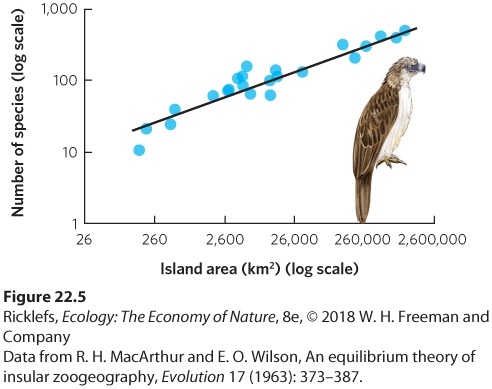
- Larger areas hold more species, and the relationship is close to a power law: S = cA^z, which plots as a straight line on log-log axes.
- z is typically about 0.25 for islands and lower, around 0.15, for nested samples within a continent.
- Three reasons area works: larger areas sample more individuals, contain more habitat types, and support larger populations that go extinct less often.
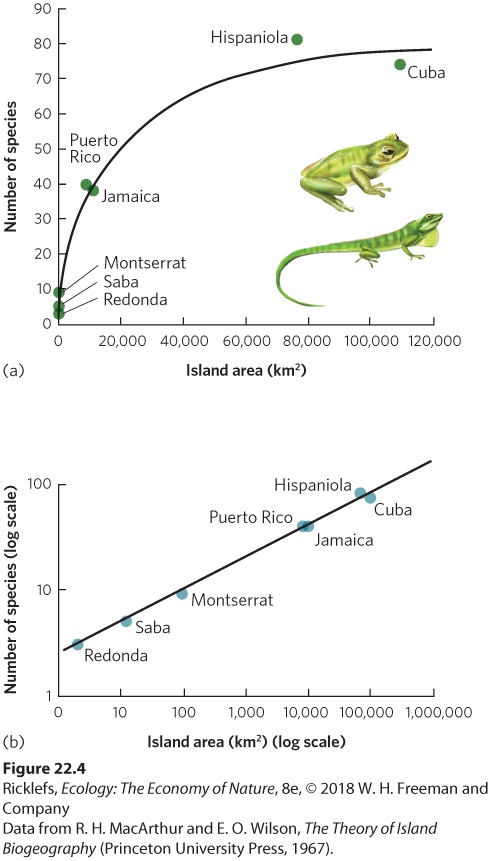
- Figure 1. A species-area curve for amphibians and reptiles on West Indian islands.
- Source: Ricklefs & Relyea, Ecology: The Economy of Nature 8e, Fig. 22.4
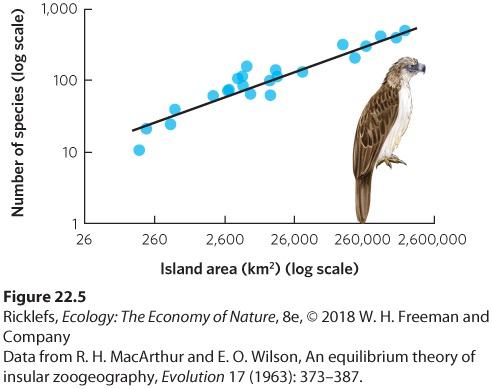
- Figure 2. A species-area curve for birds across the Sunda Islands.
- Source: Ricklefs & Relyea, Ecology: The Economy of Nature 8e, Fig. 22.5
- This is the empirical backbone of Kaspari Principle 6 (dS/dt = D — X + I). Area changes the extinction term; isolation changes the immigration term. That is island biogeography in one sentence.
1.4 Fragmentation: what happens when you change the scale of the habitat itself
- Habitat fragmentation converts one large continuous patch into several small, isolated ones. Total area falls and edge increases.
- Edge effects: conditions near a boundary differ from the interior in light, wind, temperature, humidity, and predation pressure. Small patches are all edge.
- For the same total area, many small patches have far more edge than one large patch. That is a pure geometry result, and it drives the design of reserves.
- Concrete consequence: brood parasites and generalist predators concentrate at edges, so forest songbird nests near edges fail more often.
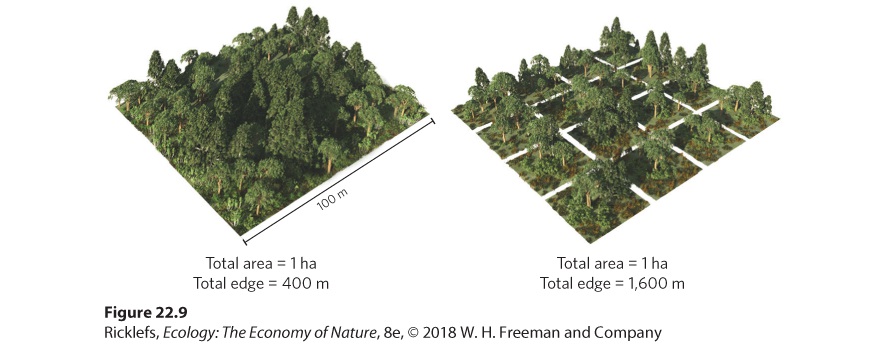
- Figure 3. Two habitats of equal total area, very different amounts of edge.
- Source: Ricklefs & Relyea, Ecology: The Economy of Nature 8e, Fig. 22.9
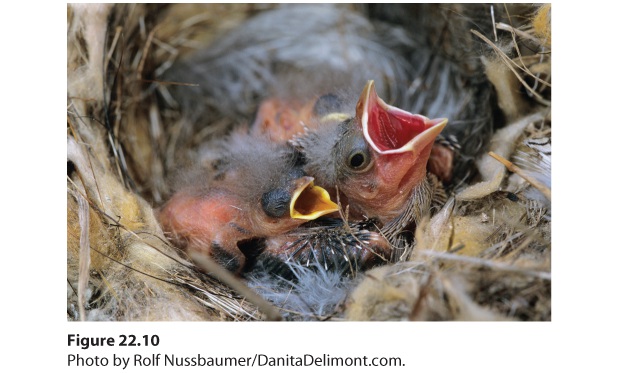
- Figure 4. Edge habitat and nest parasitism.
- Source: Ricklefs & Relyea, Ecology: The Economy of Nature 8e, Fig. 22.10
- Legacy effects: what happened on a landscape long ago still shapes it. Ricklefs uses both natural legacies, such as glacial eskers, and human ones, such as the footprint of Roman farms still visible in European vegetation.
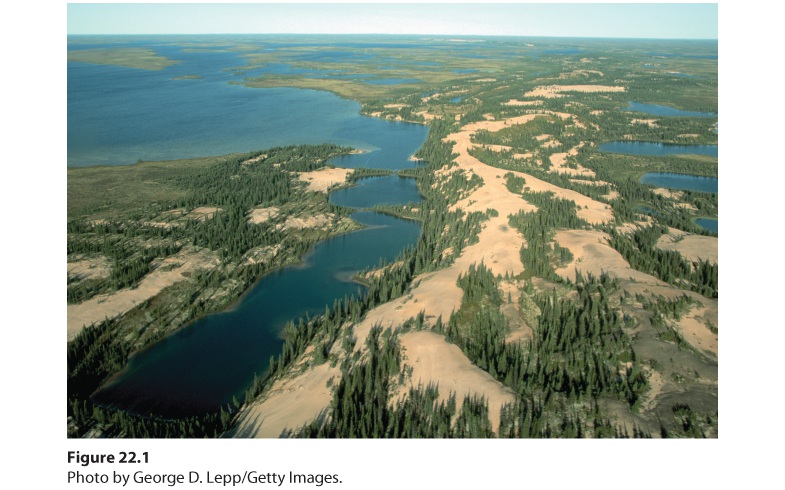
- Figure 5. A natural legacy effect: a glacial esker still structuring the modern landscape.
- Source: Ricklefs & Relyea, Ecology: The Economy of Nature 8e, Fig. 22.1
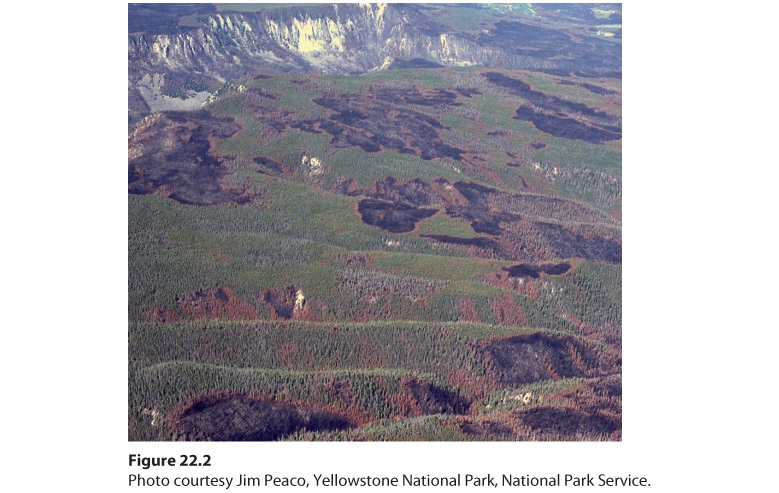
- Figure 6. A legacy effect still visible on a modern landscape.
- Source: Ricklefs & Relyea, Ecology: The Economy of Nature 8e, Fig. 22.2
Part 2: Earth energy balance
2.1 Where the incoming radiation goes
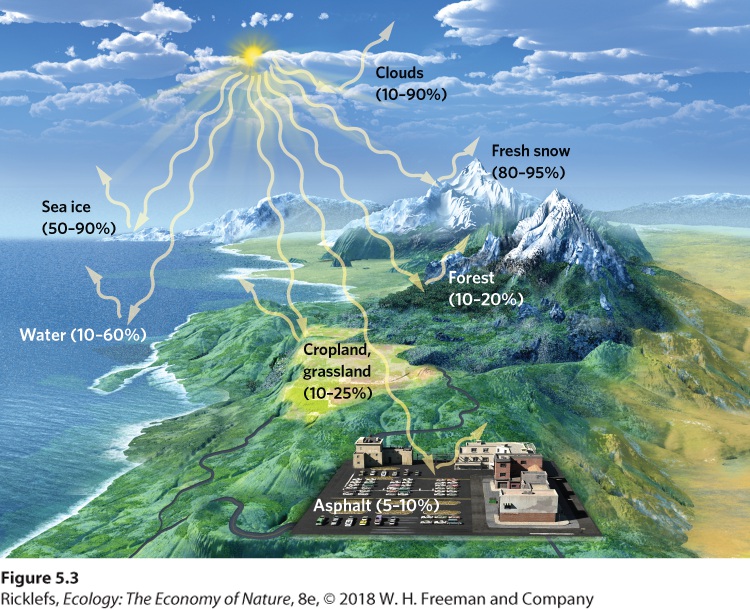
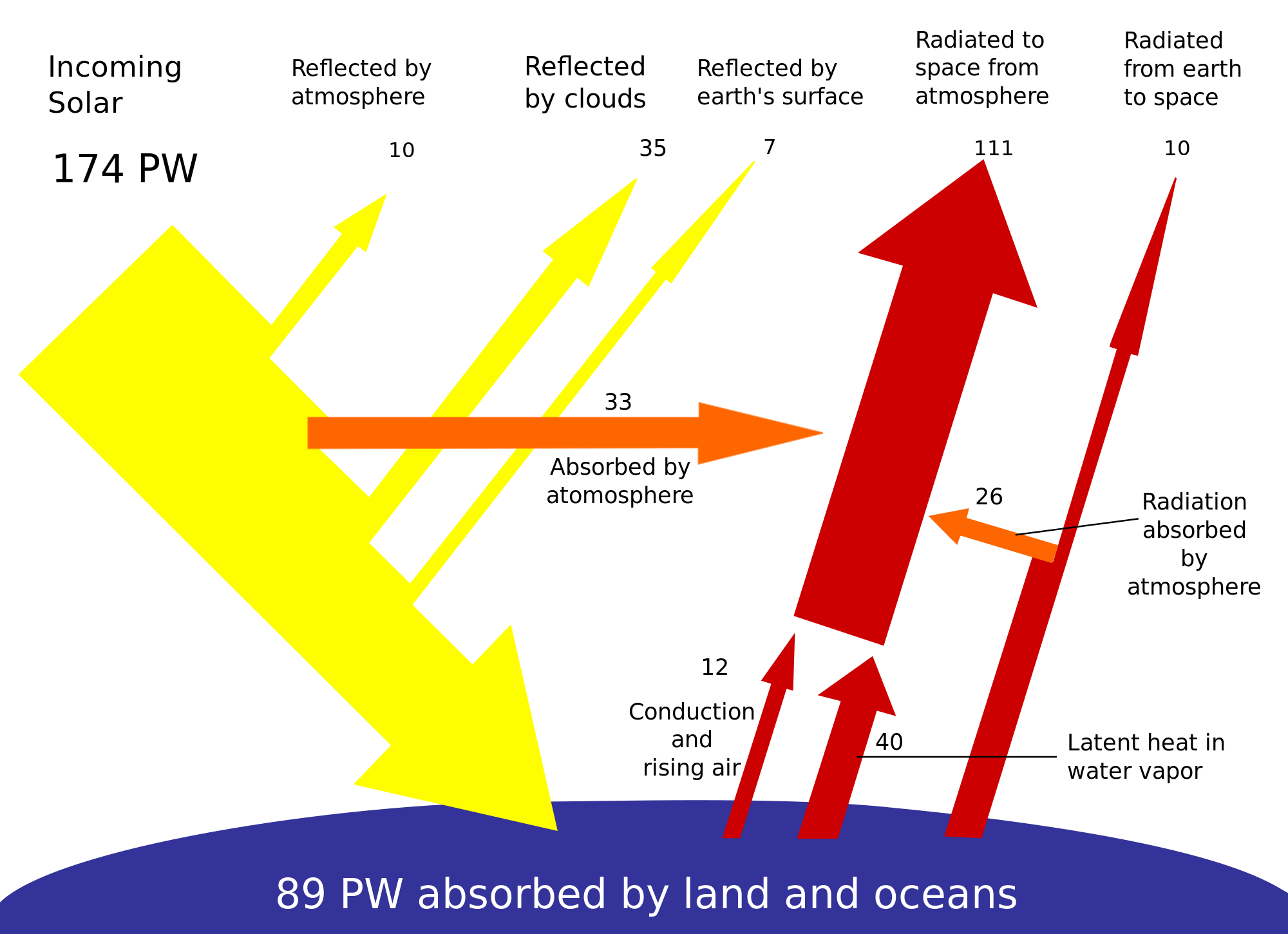
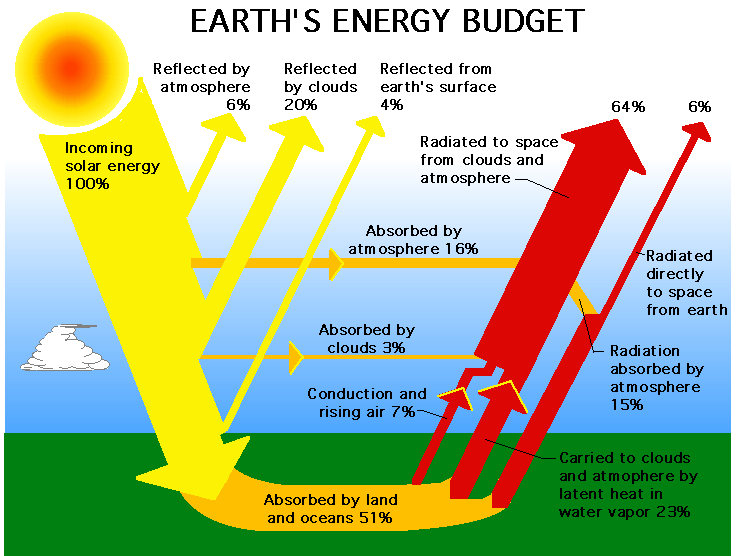
- Of the solar radiation arriving at Earth, about 30% is reflected back to space and about 70% is absorbed: roughly 47% by the surface and roughly 23% by the atmosphere.
- The 30% that leaves is the planetary albedo. Albedo is the fraction of incoming radiation a surface reflects.
- The ice-albedo feedback, the single most important positive feedback in the climate system: warming melts ice, exposing dark water or ground, which lowers albedo, which absorbs more energy, which causes more warming. It runs in reverse too, which is the basis of the Snowball Earth hypothesis.
2.2 Getting the heat back out, and the greenhouse effect
- Energy absorbed at the surface returns to the atmosphere three ways: latent heat from evaporation and condensation (the largest pathway), radiation (about 16% of the original solar input), and conduction (about 7%).
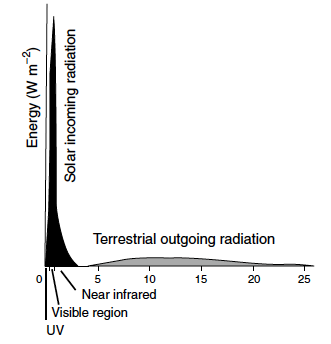
- The sun emits mostly shortwave radiation, which passes through the atmosphere easily. Earth, being much cooler, re-emits longwave infrared.
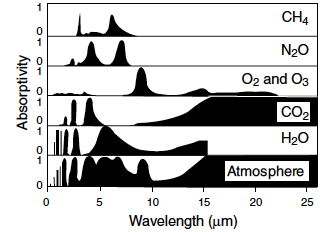
- Greenhouse gases (water vapor, CO2, methane, nitrous oxide) are nearly transparent to shortwave and strongly absorbing at longwave wavelengths. They absorb the outgoing infrared and re-radiate it in all directions, including back down.
- Without any greenhouse effect, Earth mean surface temperature would be about -18 °C. The actual figure is about +15 °C. The roughly 33 °C difference is the greenhouse effect, and it is entirely natural. The anthropogenic issue is a change in its strength, not its existence.
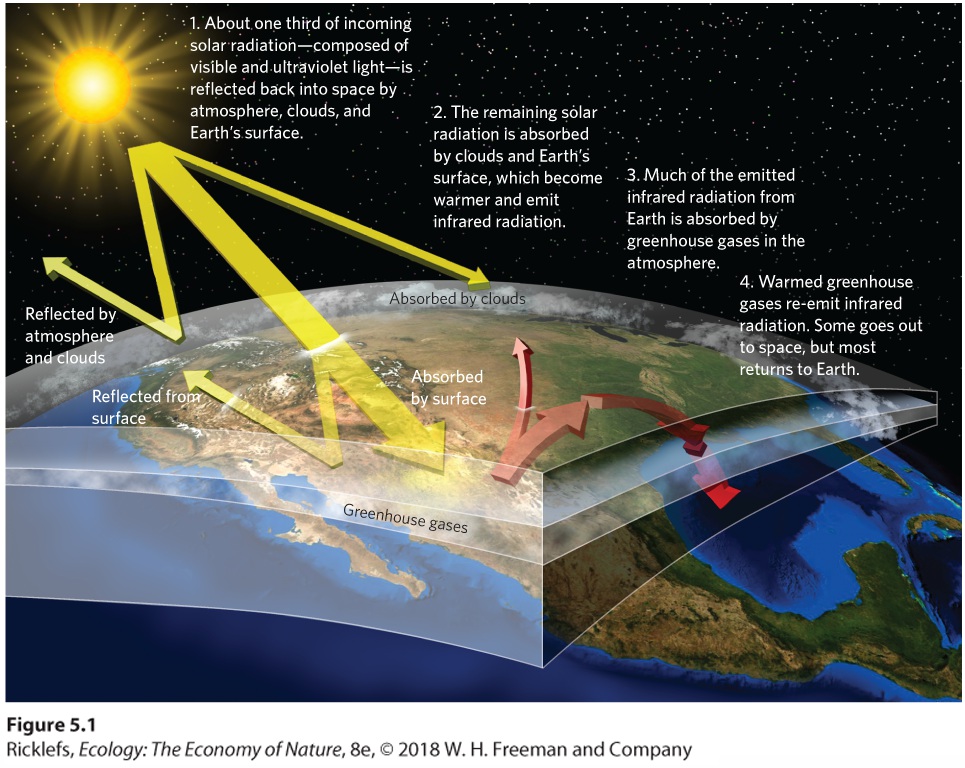
- Figure 7. The greenhouse effect: shortwave in, longwave trapped.
- Source: Ricklefs & Relyea, Ecology: The Economy of Nature 8e, Fig. 5.1
- Precision matters here. The greenhouse effect is not “heat trapped like a blanket,” it is wavelength-selective absorption. State it that way and you will not lose the point.
Part 3: Unequal heating and the seasons
3.1 Why the tropics get more energy: two independent reasons
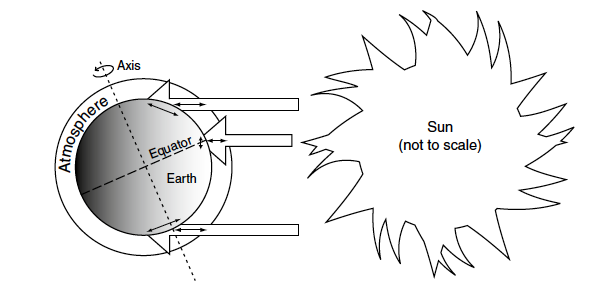
- Angle of incidence. Near the equator the sun is close to overhead, so a given beam of sunlight is spread over a small patch of surface. Near the poles the same beam strikes at a shallow angle and is spread over a much larger area, so energy per square metre is lower.
- Atmospheric path length. A shallow-angle beam passes through more atmosphere, so more of it is scattered, absorbed, and reflected before it reaches the ground.
- Both effects work in the same direction, which is why the latitudinal temperature gradient is so strong and so reliable.
- Add the albedo difference (ice-covered poles reflect, dark tropical vegetation and ocean absorb) and you have a third reinforcing effect.
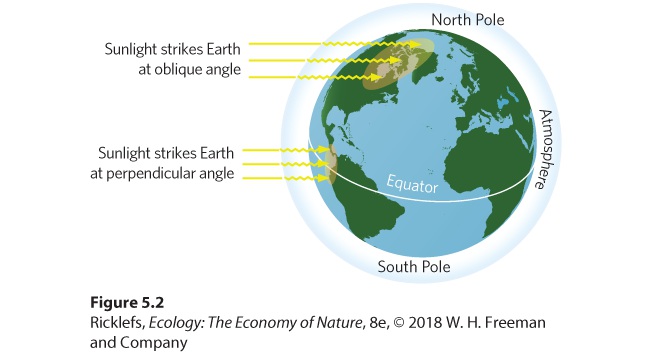
- Figure 8. Unequal heating: beam spreading and atmospheric path length as a function of latitude.
- Source: Ricklefs & Relyea, Ecology: The Economy of Nature 8e, Fig. 5.2
3.2 The seasons
- Earth axis is tilted about 23.5 degrees from the perpendicular to its orbital plane, and that tilt keeps a constant orientation in space as Earth orbits.
- That is the entire cause. Distance from the sun is not: Earth is actually closest to the sun in early January, during Northern Hemisphere winter.
- Seasonality increases with latitude. At the equator day length and solar angle barely change, so the seasons are wet and dry rather than warm and cold. Above the Arctic Circle (66.5 N) there is at least one day of 24-hour sun and one of 24-hour darkness.
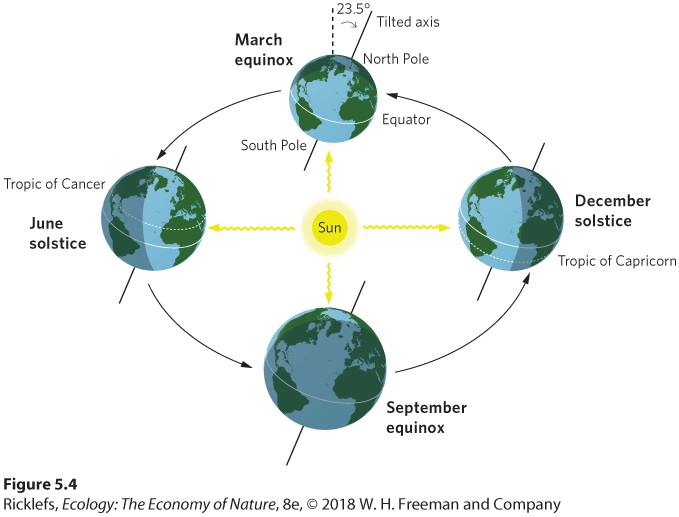
- Figure 9. How axial tilt produces the seasonal march of the sun between the tropics.
- Source: Ricklefs & Relyea, Ecology: The Economy of Nature 8e, Fig. 5.4
- Ecological payoff: the tropics are aseasonal and reliably productive, which supports specialists and high diversity. Temperate and polar systems are strongly seasonal, which favors generalists, migration, dormancy, and storage.
Part 4: The atmosphere itself
4.1 Composition
4.2 The vertical structure
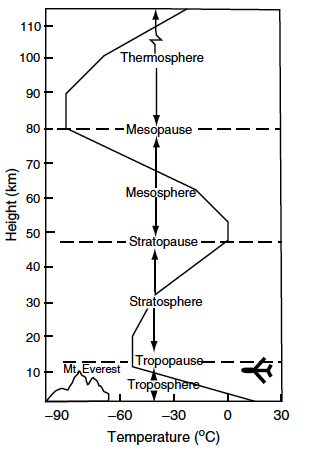
- Air pressure and density fall with altitude, which is why partial pressure of oxygen limits animals at elevation even though the percentage of oxygen is unchanged.
- Climate is the long-term, predictable atmospheric condition of an area. Weather is the short-term state, hours to days. Ecologists explain distributions with climate and explain mortality events with weather.
Part 5: Atmospheric circulation
5.1 Why air rises at the equator, and what happens next
- Intense equatorial heating warms surface air, which expands, becomes less dense, and rises.
- Warm air holds far more water vapor than cold air. The saturation point rises steeply with temperature, which is why the same absolute humidity can be dry at 30 °C and saturated at 10 °C.
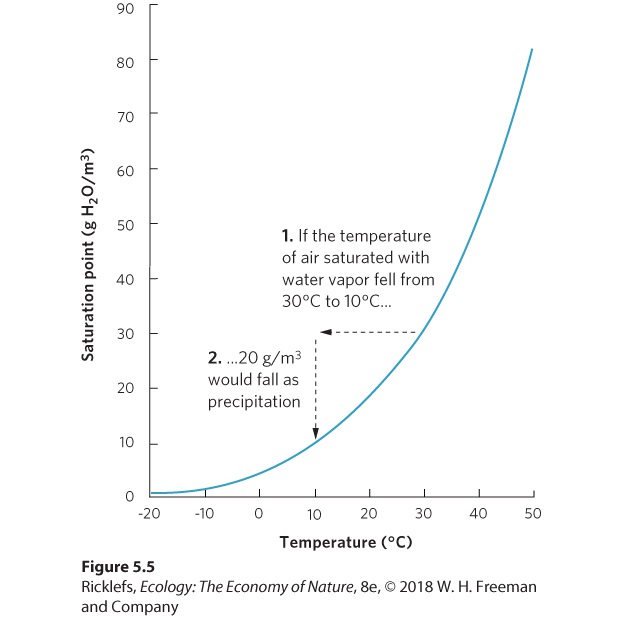
- Figure 10. Saturation point of water vapor as a function of air temperature.
- Source: Ricklefs & Relyea, Ecology: The Economy of Nature 8e, Fig. 5.5
- As the rising air ascends it cools adiabatically (by expansion, not by losing heat), passes its saturation point, and the excess water condenses and falls. That is why the equator is wet.
- The air, now dry, moves poleward aloft, cools further, and descends around 30 degrees latitude. Descending air compresses and warms, so its saturation point rises and it takes up moisture rather than releasing it. That is why 30 degrees is dry.
5.2 The three-cell model
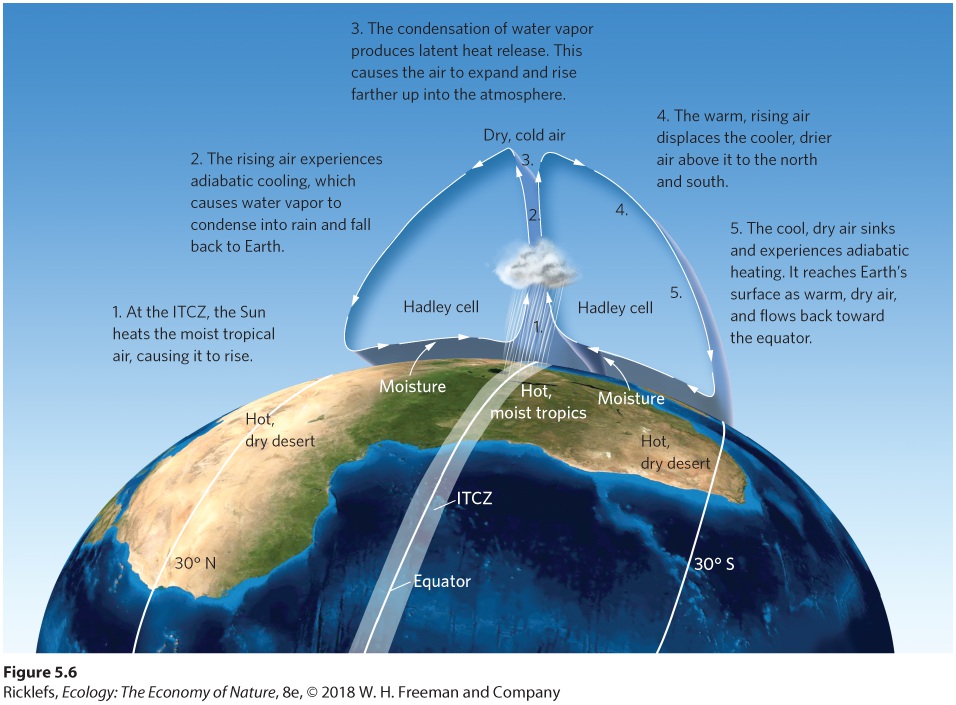
- Figure 11. Circulation of air in Hadley cells.
- Source: Ricklefs & Relyea, Ecology: The Economy of Nature 8e, Fig. 5.6
- One sentence to remember: rising air makes rain, sinking air makes deserts. Every major desert belt and every major rainforest belt on Earth is an output of that rule plus the three-cell geometry.
- The Intertropical Convergence Zone (ITCZ) is the band where the trade winds of both hemispheres converge and air rises. It migrates north and south with the sun through the year, which produces tropical wet and dry seasons and the monsoon.
- The horse latitudes at about 30 degrees and the doldrums at the equator are the historic sailing names for the descending high and the rising low.
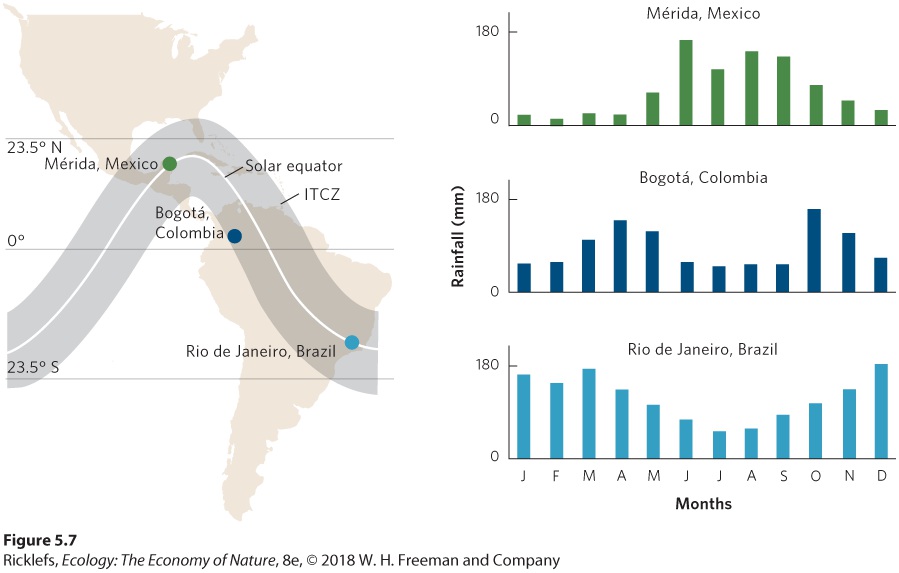
- Figure 12. The ITCZ migrates with the sun, producing tropical wet and dry seasons.
- Source: Ricklefs & Relyea, Ecology: The Economy of Nature 8e, Fig. 5.7
5.3 The Coriolis effect and the prevailing winds
- Different latitudes travel at different speeds as Earth rotates: about 1600 km/h at the equator, about 1400 km/h at 30 degrees, about 800 km/h at 60 degrees.
- Air moving poleward retains the higher eastward speed of its origin and outruns the ground beneath it, so it is deflected. Air moving equatorward lags behind and is deflected the other way.
- Net rule: deflection to the right in the Northern Hemisphere, to the left in the Southern Hemisphere. The effect is strongest near the poles and vanishes at the equator.
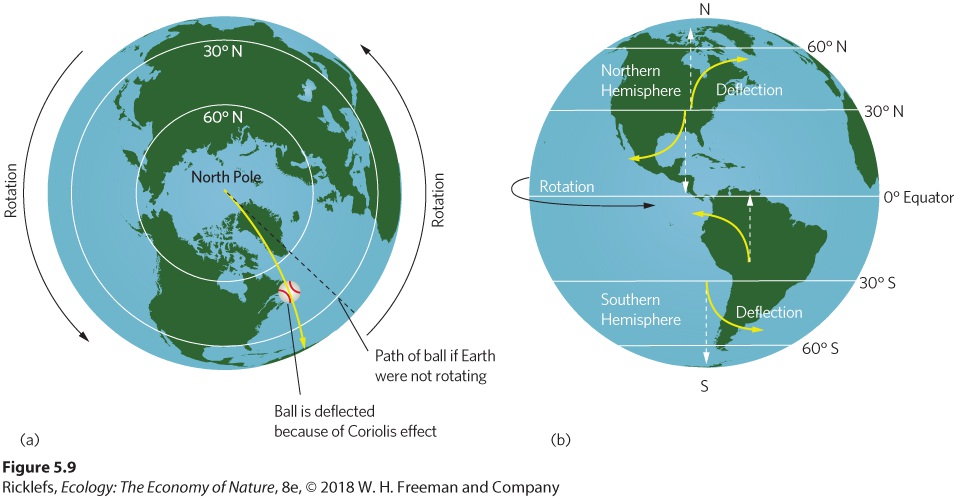
- Figure 13. The Coriolis effect: why a straight path over a rotating Earth curves.
- Source: Ricklefs & Relyea, Ecology: The Economy of Nature 8e, Fig. 5.9
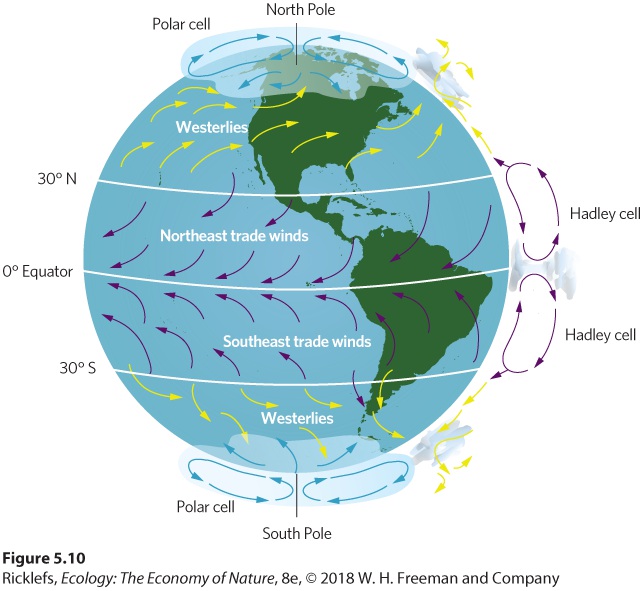
- Figure 14. Global air circulation: convection cells plus Coriolis deflection produce the prevailing wind belts.
- Source: Ricklefs & Relyea, Ecology: The Economy of Nature 8e, Fig. 5.10
5.4 Regional overrides: the rain shadow
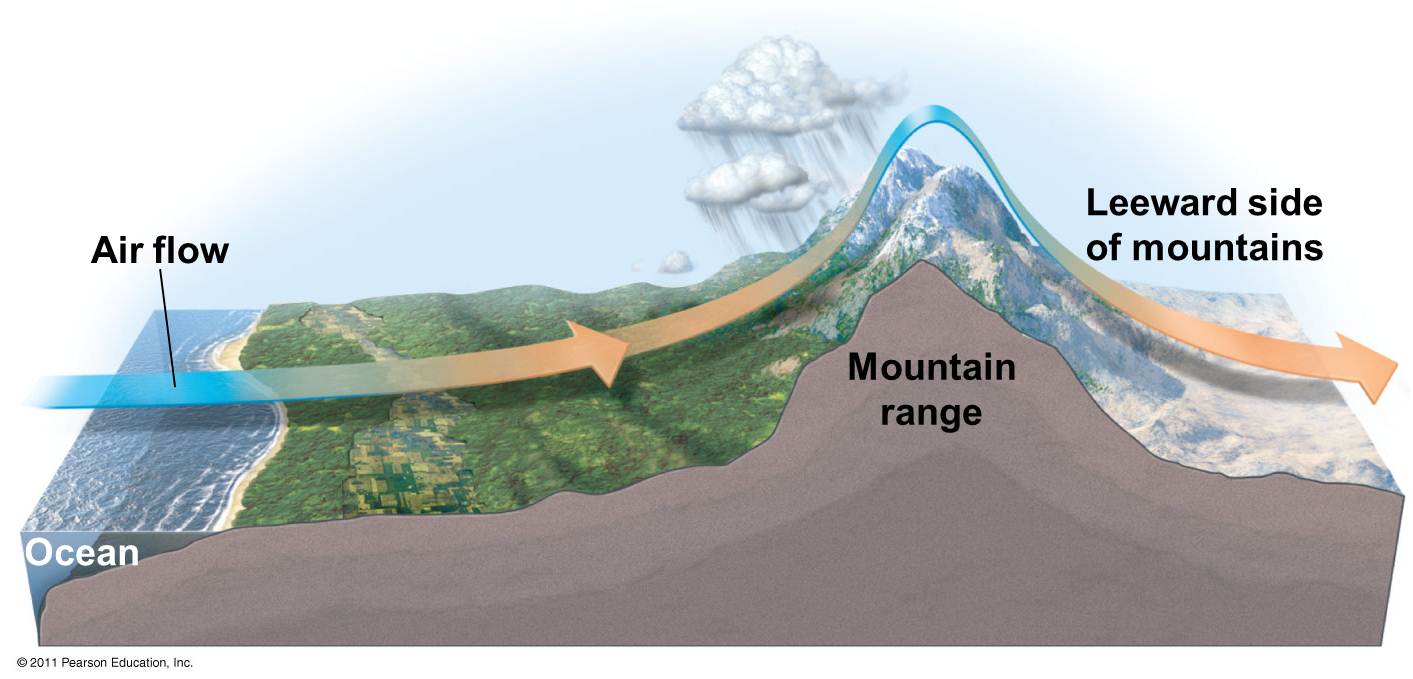
- Moist air forced up a mountain range expands and cools, condenses its moisture, and drops it on the windward slope.
- The now-dry air descends the leeward side, compresses, warms, and takes up moisture. The leeward side is arid.
- Classic cases: Death Valley behind the Sierra Nevada; the Gobi behind the Himalaya; the Great Basin behind the Cascades; the Patagonian steppe behind the Andes.
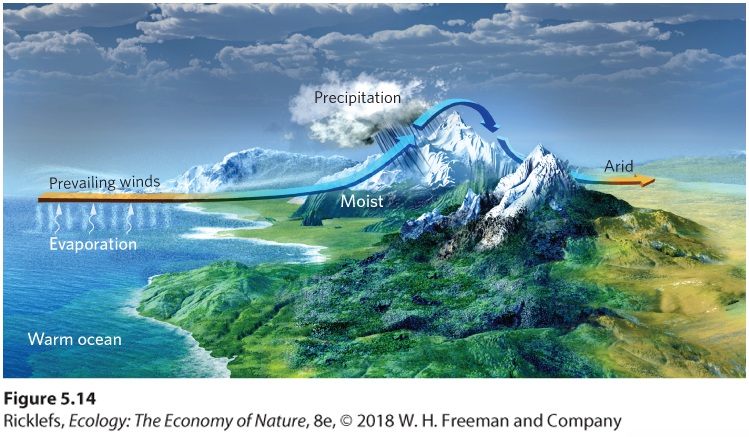
- Figure 15. Rain shadows: wet windward slope, arid leeward side.
- Source: Ricklefs & Relyea, Ecology: The Economy of Nature 8e, Fig. 5.14
- The rain shadow is the same adiabatic physics as the Hadley cell, run over topography instead of over latitude. If you can explain one, you can explain the other.
Part 6: Ocean circulation
6.1 Surface currents and gyres
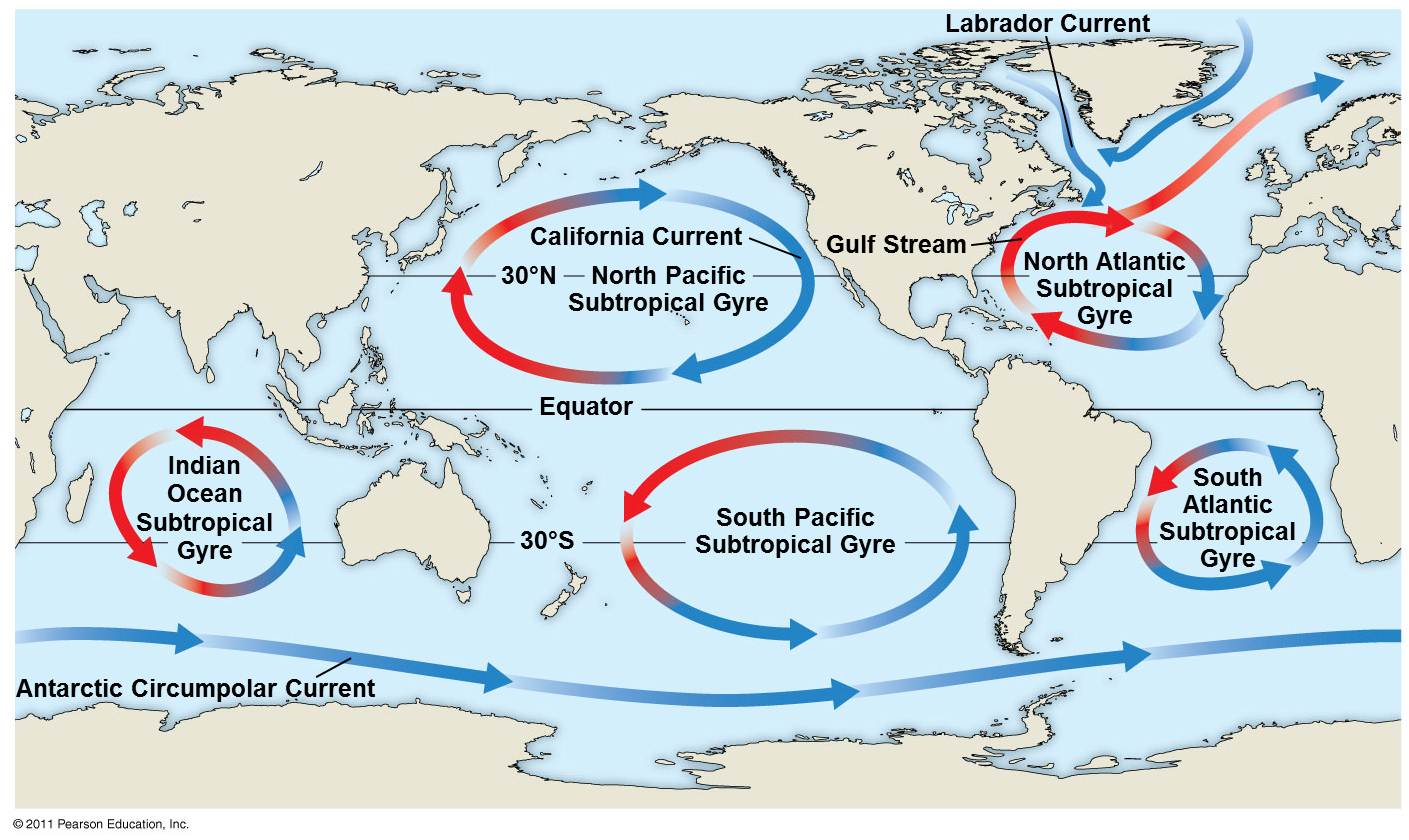
- Prevailing winds drag surface water, and Coriolis deflection bends the flow into closed loops called gyres: clockwise in the Northern Hemisphere, counterclockwise in the Southern.
- Gyres move enormous amounts of heat. The Gulf Stream carries warm tropical water northeast toward Europe, which is why Britain is far milder than Labrador at the same latitude. The Labrador Current does the reverse, carrying cold water and icebergs south.
- Sea surface temperature ranges from about 25–30 °C near the equator to about 0 °C at the poles; seawater stays liquid to about -2 °C because of dissolved salt.
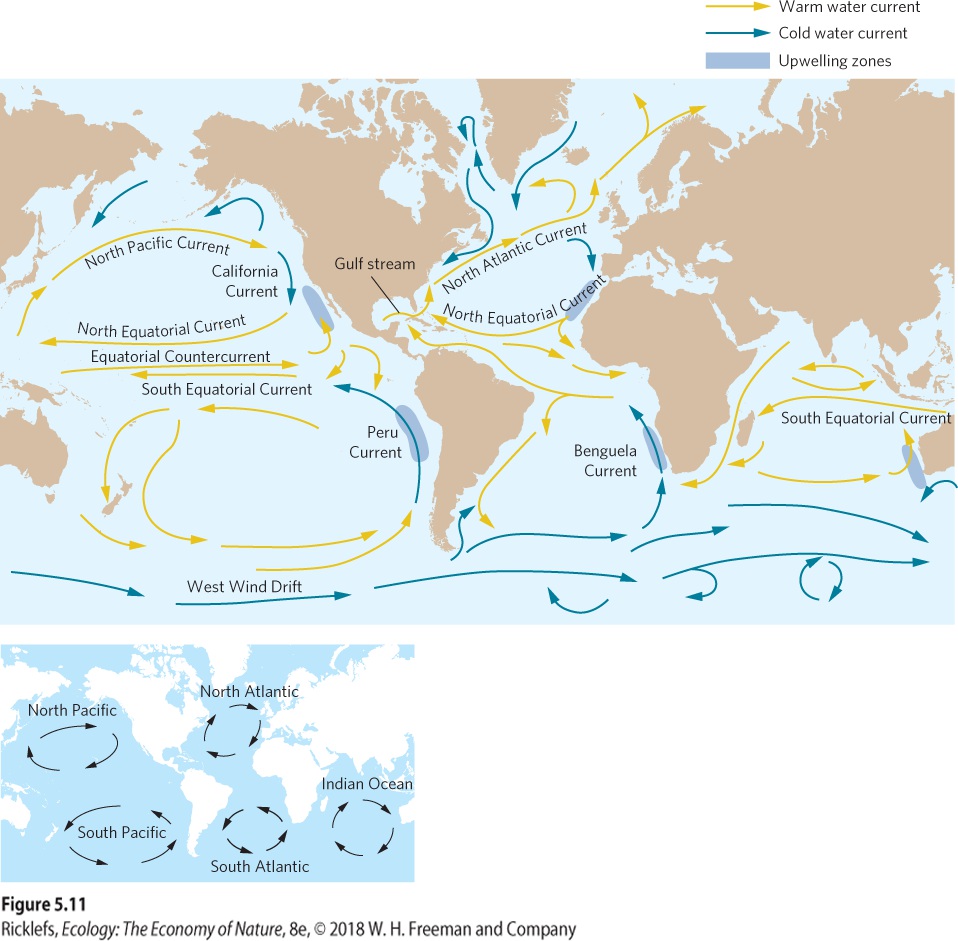
- Figure 16. Ocean surface circulation: warm water poleward on western boundaries, cold water equatorward on eastern boundaries.
- Source: Ricklefs & Relyea, Ecology: The Economy of Nature 8e, Fig. 5.11
6.2 Thermohaline circulation, the deep conveyor
- Density of seawater rises with salinity and falls with temperature. Cold, salty water sinks.
- North Atlantic Deep Water forms as the Gulf Stream cools in the Norwegian Sea, becomes dense, and sinks.
- Antarctic Bottom Water forms beside Antarctica as sea ice forms and excludes salt, and it flows northward underneath NADW.
- The circuit carries warm water toward the poles and cold water toward the tropics, and it takes roughly a thousand years to complete.
- Slowing it is a live concern: adding fresh meltwater to the North Atlantic lowers salinity, reduces sinking, and could weaken the conveyor, which has its own positive feedback because a weaker conveyor delivers less salt.
6.3 Upwelling, downwelling, and productivity
- Upwelling brings cold, nutrient-rich deep water to the surface. Combined with light, that produces the most productive fisheries on Earth, along the coasts of Peru, California, Namibia, and northwest Africa.
- Downwelling pushes nutrient-poor surface water down and extends unproductive zones.
- Open tropical ocean is warm, brightly lit, strongly stratified, and therefore nutrient-starved. It is a biological desert despite ideal light and temperature, which is a clean demonstration that nutrients, not energy, limit marine production.
6.4 ENSO
- The El Nino Southern Oscillation is the most important ocean-atmosphere interaction producing cyclic global climate variability, on a two to seven year cycle.
- Normal (La Nina-like) conditions: strong trade winds pile warm water in the western Pacific, and cold nutrient-rich water upwells off South America.
- El Nino: trade winds weaken, warm water sloshes east, upwelling shuts down off Peru, fisheries collapse, and rainfall patterns shift across the Pacific basin and beyond.
- Global effect: 1983 and 1998 were very warm years globally, and both were strong El Nino years.
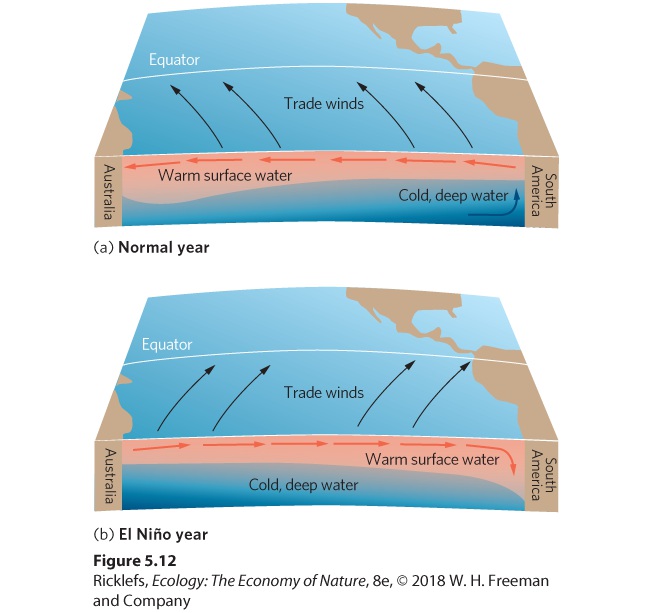
- Figure 17. The El Nino Southern Oscillation: normal versus El Nino year.
- Source: Ricklefs & Relyea, Ecology: The Economy of Nature 8e, Fig. 5.12
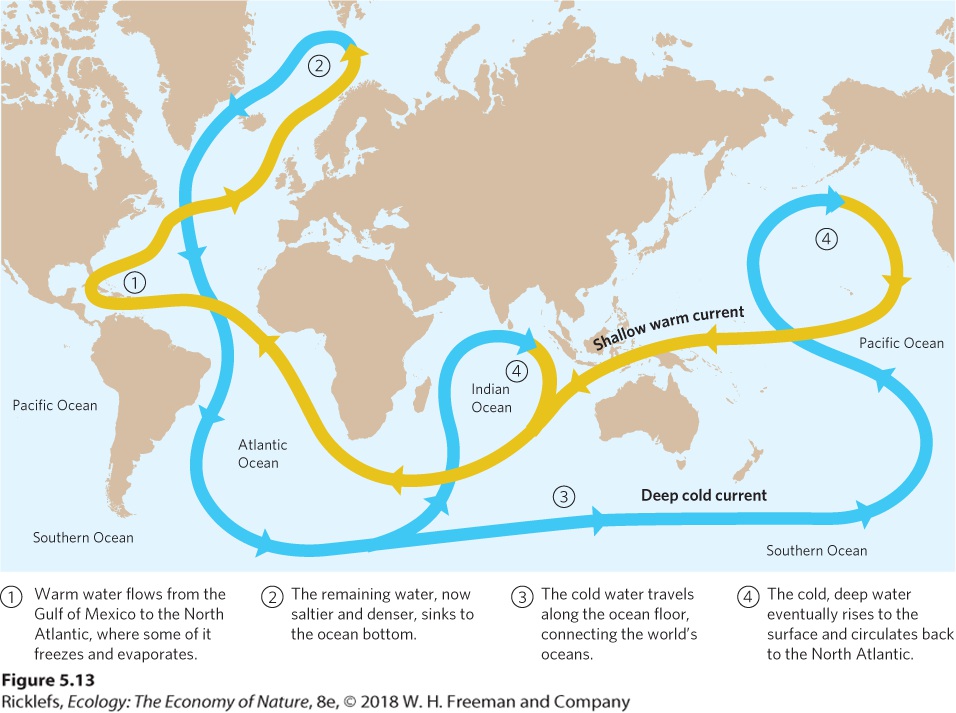
- Figure 18. Thermohaline circulation, the deep global conveyor.
- Source: Ricklefs & Relyea, Ecology: The Economy of Nature 8e, Fig. 5.13
Part 7: From climate to biomes
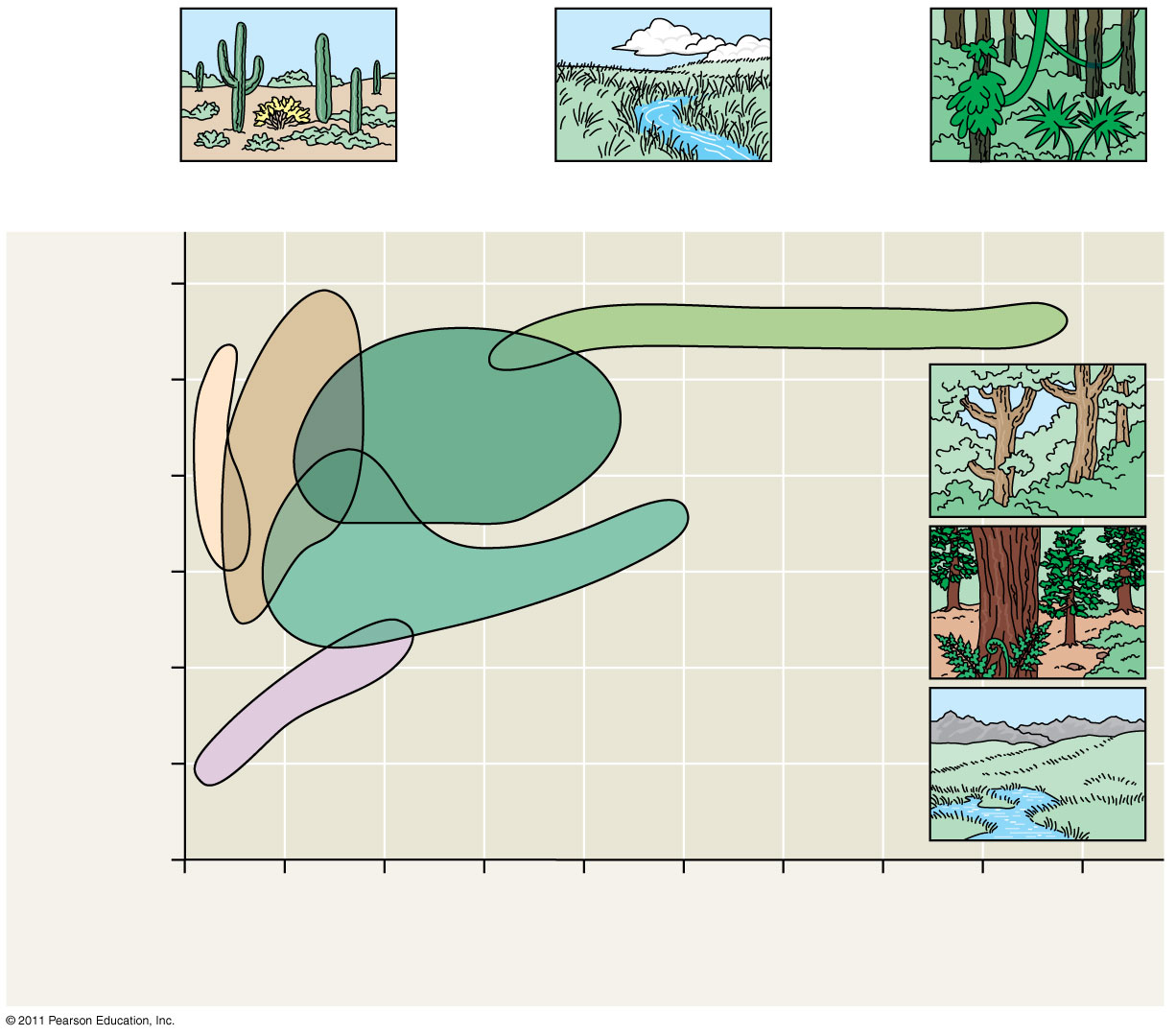
- A biome is a large-scale terrestrial community type defined by its dominant plant growth form, and that growth form is predicted almost entirely by two variables: mean annual temperature and mean annual precipitation.
- That prediction works because plant form is a solution to a physical problem. Broad evergreen leaves are viable where it never freezes and never dries; small tough leaves where it is dry; deciduous leaves where the bad season is predictable and short; grasses where fire and grazing are frequent.
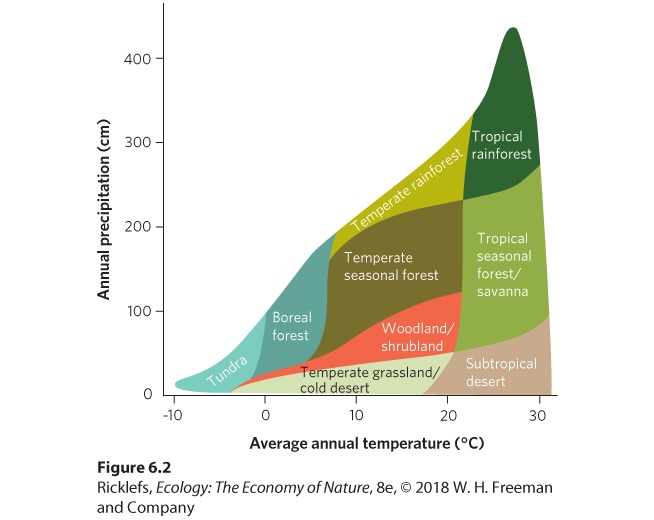
- Figure 19. Terrestrial biomes plotted against mean annual temperature and precipitation.
- Source: Ricklefs & Relyea, Ecology: The Economy of Nature 8e, Fig. 6.2
- A climate diagram plots mean monthly temperature and precipitation on the same axes for one location, so you can read seasonality and identify the limiting season at a glance. When the precipitation curve falls below the temperature curve, that month is water-limited.
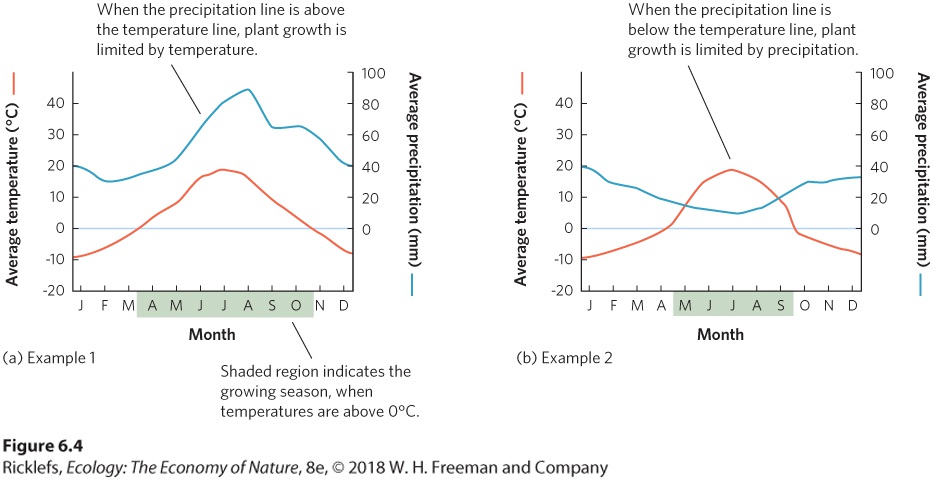
- Figure 20. Climate diagrams: reading seasonality and the limiting season from one plot.
- Source: Ricklefs & Relyea, Ecology: The Economy of Nature 8e, Fig. 6.4
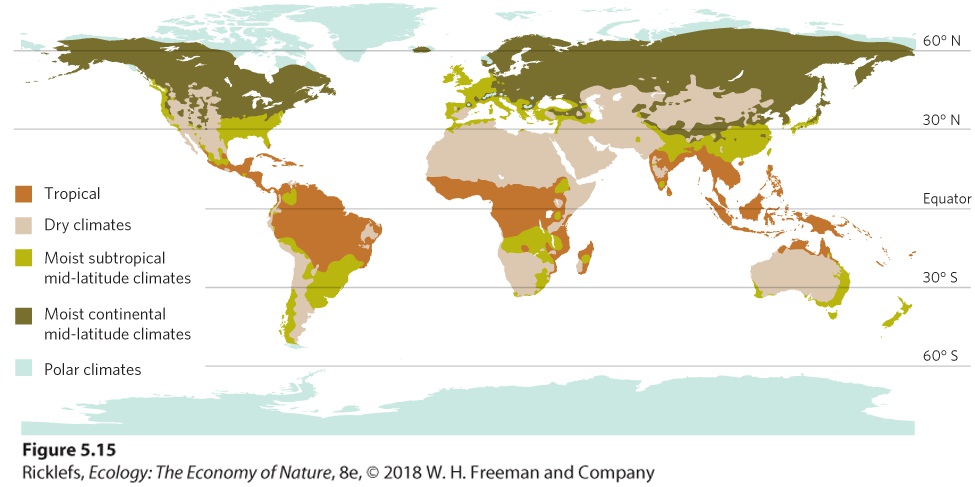
- Figure 21. Broad climate patterns around the world.
- Source: Ricklefs & Relyea, Ecology: The Economy of Nature 8e, Fig. 5.15
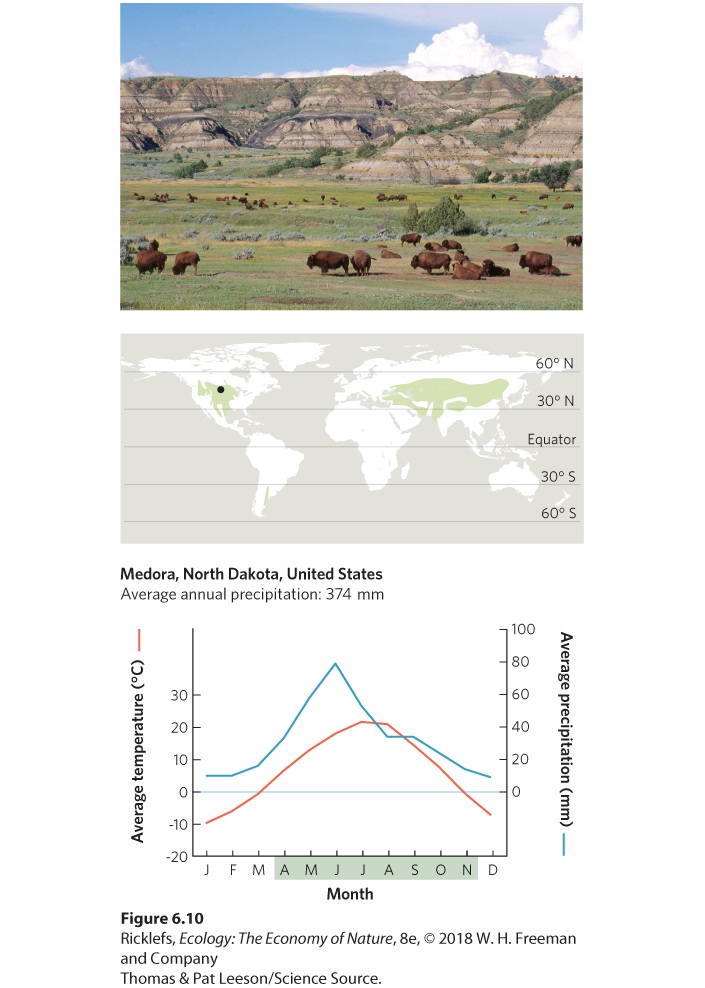
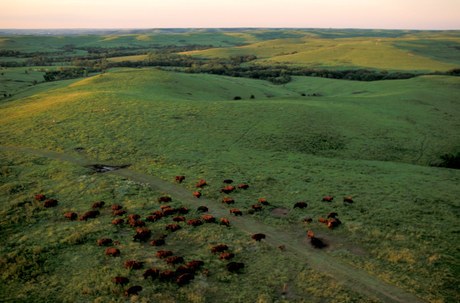
- Figure 22. Temperate grassland and cold desert biome, the type this course focuses on.
- Source: Ricklefs & Relyea, Ecology: The Economy of Nature 8e, Fig. 6.10
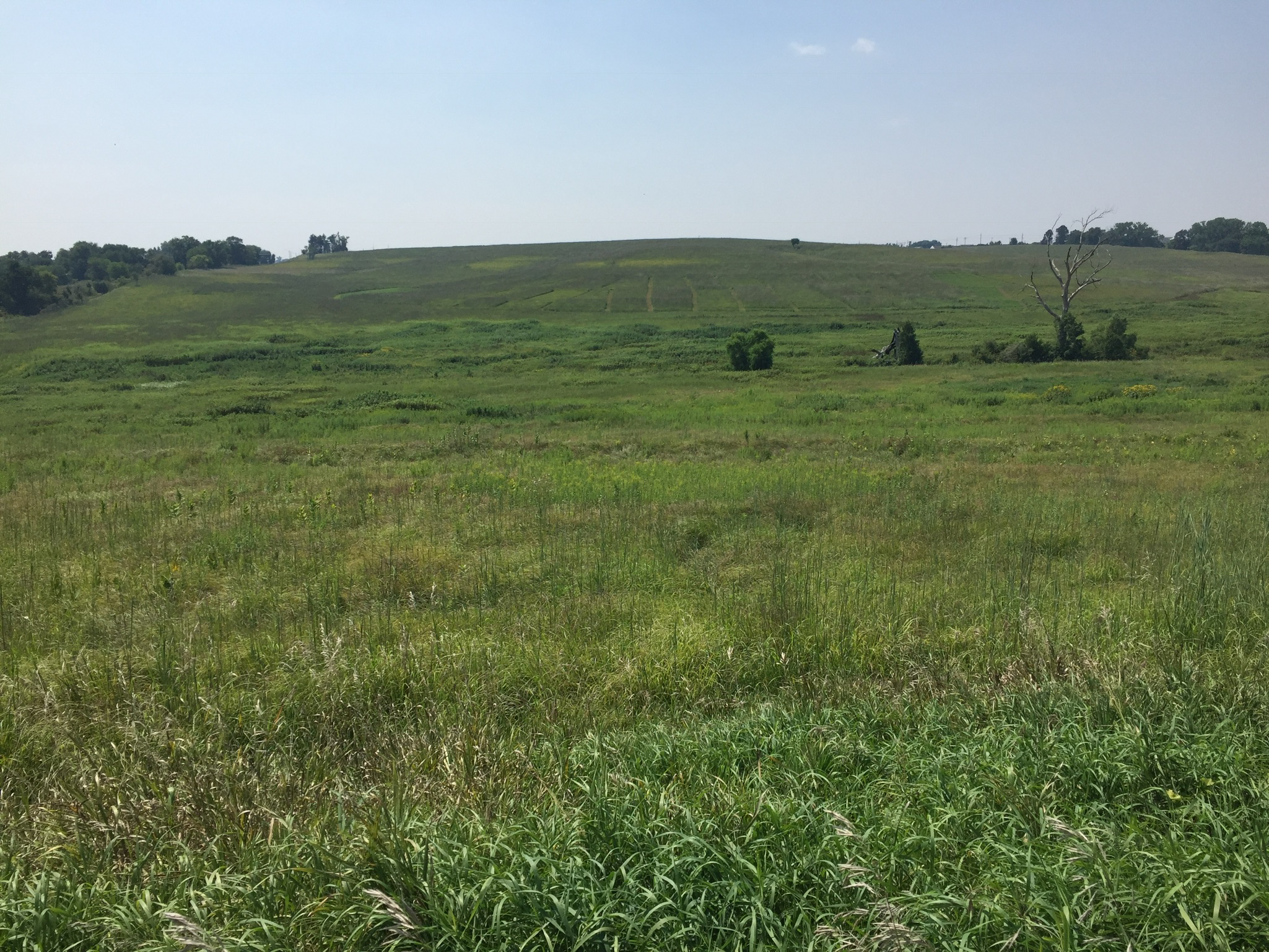
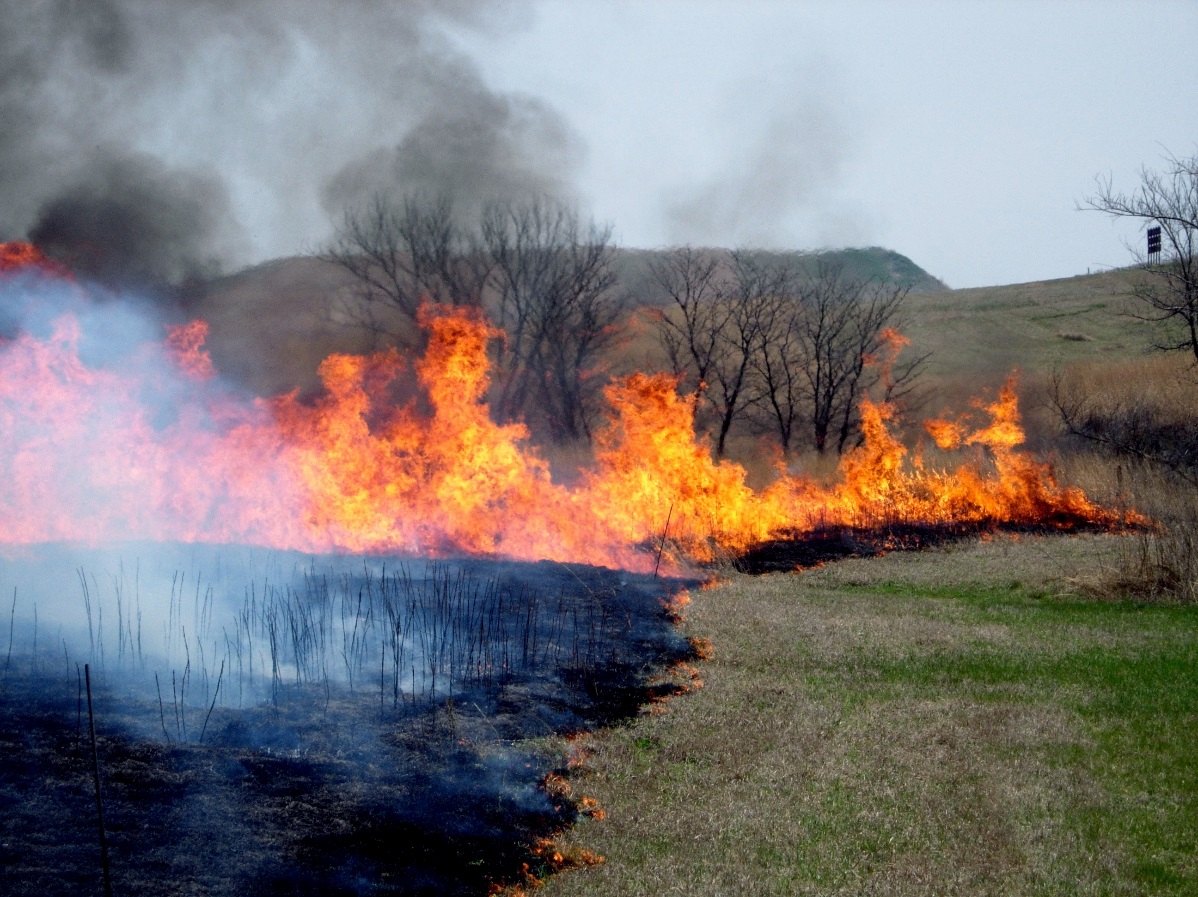
- Manning-specific angle: tallgrass prairie sits in a climate band that could support forest at its eastern edge. It stays grassland because of fire and grazing, not because of climate alone. That is the standing exception to “climate predicts biome,” and it is exactly the kind of thing this course will test.
Part 8: Climate change, past and present
8.1 Forcing versus feedback
- A forcing is something that initiates a change in the energy balance. A feedback is a response to that change that either amplifies it (positive) or damps it (negative).
- Positive feedback example: warming thaws permafrost, which releases CO2 and methane, which causes more warming.
- Negative feedback example: warming and higher CO2 increase plant growth, which draws down CO2.
- Milankovitch published his orbital hypothesis in 1924 and it was dismissed, because the orbital changes are too weak on their own to drive ice ages. It was accepted after 1973 once high-resolution data showed the predicted periodicities and once feedbacks were recognized as the amplifier. The lesson: a small forcing plus strong positive feedback equals a large change.
8.2 Natural forcings, sorted by timescale
The three Milankovitch cycles
- The counterintuitive result to remember: ice ages are built by cool summers, not by cold winters. Winters are already cold enough to snow; what matters is whether the snow survives the summer. Maximum glaciation occurs when northern summer coincides with maximum Earth-Sun distance during high eccentricity.
8.3 Reading the past: proxies
8.4 What the record shows
- Earth has had several major glaciations: the Huronian about 2.5 billion years ago, possibly triggered by the great oxygenation event; a Snowball Earth episode around 700 million years ago in which runaway ice-albedo feedback may have frozen the surface; and the Pliocene-Quaternary glaciation beginning roughly 5 million years ago.
- The last million years of the Pleistocene show temperature swings of nearly 10 °C on 40,000 to 100,000 year cycles.
- Ice cores show that CO2 oscillated between about 170–180 ppm in glacials and about 300 ppm in interglacials for the last 800,000 years, and that temperature tracked it closely.
- Current atmospheric CO2 is above 400 ppm, outside the entire range of that record, and it got there in about two centuries rather than over millennia.
- Recent smaller anomalies: the Medieval Warm Period (about 900–1300 CE, roughly 0.10–0.20 °C above normal) and the Little Ice Age (about 1550–1850 CE, roughly 1 °C cooling with documented harsh winters).
- The exam-relevant point is not that climate has changed before. It is the rate and the starting point: the current change is faster than the proxy record shows for comparable magnitude, and it begins from a CO2 concentration already outside the 800,000-year envelope.
Condensed review
Numbers worth memorizing
Mnemonic set
- “Rising air rains, sinking air dries.”
- “Wet at 0 and 60, dry at 30 and 90.”
- “Right in the North, Left in the South” -- Coriolis deflection.
- “Tilt, not distance” -- the cause of the seasons.
- “Cool summers build ice sheets.”
- “Forcing starts it, feedback finishes it.”
- “Grain is the pixel, extent is the picture.”
The chain, in one paragraph
- The sun heats a sphere unevenly, so the tropics receive more energy per unit area than the poles. Warm equatorial air rises, cools, drops its moisture as tropical rain, travels poleward aloft, and descends near 30 degrees, where the warming, drying air produces the world desert belt. Earth rotation deflects the resulting surface flows into trade winds, westerlies, and polar easterlies, and drags the ocean surface into gyres that redistribute heat, while density differences drive a slow deep conveyor beneath them. Mountains impose rain shadows on top of this pattern. The resulting map of temperature and precipitation predicts the world biomes, with fire and grazing as the main exceptions. Over long timescales, orbital geometry, tectonics, volcanism, and greenhouse gas concentration change the whole energy balance, amplified by feedbacks such as ice-albedo, and the ice-core and isotope record lets us read what happened.
Self-test
- Define grain and extent, and give one example of a conclusion that would change if you increased only the grain.
- Two species are negatively associated within quadrats but positively associated across a region. Explain both results without contradiction.
- Two reserves have the same total area: one 100-ha block, or four 25-ha blocks. Which has more edge habitat, and name one taxon that would be hurt by the fragmented design.
- Compute what fraction of incoming solar radiation is absorbed by the surface, and state where the rest goes.
- Explain the greenhouse effect in terms of wavelength, not blankets.
- Give two independent geometric reasons the equator receives more energy per square metre than 60 degrees N.
- Earth is closest to the sun in early January. Why is the Northern Hemisphere in winter?
- Explain why deserts cluster at about 30 degrees latitude, using the Hadley cell and adiabatic processes.
- A wind blows from the north toward the equator in the Northern Hemisphere. Which way is it deflected, and what is the resulting wind called?
- Death Valley and the Gobi are both deserts, but not for the 30-degree reason. Explain the mechanism they share.
- Predict what a large influx of Greenland meltwater would do to North Atlantic Deep Water formation, and give the feedback sign.
- Tropical open ocean has abundant light and warm water but very low productivity. Explain.
- A site has a mean annual temperature of 10 °C and 60 cm of precipitation, mostly in summer, and burns every few years. Predict the biome, and say what it would become without fire.
- Classify each as forcing or feedback: an increase in atmospheric CO2 from volcanism; loss of Arctic sea ice; a change in Earth axial tilt; permafrost methane release.
- Why do ice ages depend on summer temperature rather than winter temperature?
- An ice core shows CO2 at 190 ppm and a depleted deuterium ratio. Glacial or interglacial? What would foraminiferal O-18 be doing at the same time?
Show answer key — try the questions first
- Grain is the resolution of the smallest sampling unit; extent is the total area or time span. Increasing grain from 1 m to 100 m quadrats while holding extent constant would erase fine-scale negative associations between competing plants and might make them appear positively associated, because both occur somewhere within each large quadrat.
- Within a quadrat they compete for the same limited resource, so where one is abundant the other is suppressed, giving a negative association. Across the region both are filtered by the same climate and soil, so they occur in the same places, giving a positive association. Local process, regional filter.
- The four 25-ha blocks have far more edge. Forest-interior songbirds would be hurt, because edges concentrate nest predators and brood parasites such as cowbirds.
- About 47% is absorbed by the surface. About 23% is absorbed by the atmosphere and about 30% is reflected back to space.
- The atmosphere is largely transparent to incoming shortwave solar radiation, which reaches and warms the surface. The surface re-emits at longwave infrared wavelengths, which CO2, water vapor, and methane absorb strongly and re-radiate in all directions, including downward. It is wavelength-selective absorption, not physical trapping of air.
- First, at the equator the beam strikes near-perpendicular so its energy is concentrated on a small area, while at 60 degrees the same beam is smeared over a larger area. Second, the oblique beam travels through a longer atmospheric path, so more is scattered and absorbed before reaching the surface.
- Because the seasons are caused by axial tilt, not orbital distance. In January the Northern Hemisphere is tilted away from the sun, so it receives sunlight at a shallow angle and for fewer hours. The distance effect is real but far too small to overcome the tilt effect.
- Air rising at the equator cools adiabatically, condenses its moisture, and rains it out. That dry air moves poleward aloft and descends at about 30 degrees. Descending air is compressed and warms, which raises its saturation point, so it absorbs moisture instead of releasing it. Persistent high pressure and dry descending air produce the desert belt.
- It is deflected to the right, which turns a north wind into a northeast wind. These are the northeast trade winds.
- Both are rain shadow deserts. Moist air is forced up a mountain barrier (the Sierra Nevada, the Himalaya), cools, and drops its moisture on the windward side. The descending leeward air is warm and dry.
- Fresh water lowers surface salinity and therefore density, so less water sinks in the Norwegian Sea and NADW formation weakens. This is a positive feedback, because a weaker conveyor delivers less salty tropical water northward, lowering salinity further.
- It is strongly stratified. Warm, low-density surface water does not mix with the cold, nutrient-rich deep water, so nutrients are never resupplied to the lit surface layer. Production is nutrient-limited, not energy-limited, which is why upwelling zones are so much more productive.
- Temperate grassland (tallgrass prairie). Without fire, and without grazing, woody species would invade and it would succeed to temperate seasonal forest at the moist end of that range.
- Volcanic CO2: forcing. Loss of Arctic sea ice: feedback (positive, via albedo). Change in axial tilt: forcing. Permafrost methane release: feedback (positive).
- Snow accumulates in winter regardless; whether an ice sheet grows depends on whether that snow survives the melt season. Cool summers leave a net surplus year after year, so obliquity and precession states that reduce summer insolation at high northern latitudes are what start glaciation.
- Glacial. Depleted deuterium indicates colder conditions and 190 ppm is within the glacial range. At the same time foraminiferal shells would be enriched in O-18, because lighter O-16 is preferentially locked up in continental ice.
Lecture 2 Companion — Dr. Manning’s Actual Slides (Aug 27)
- Complete companion to the posted BIOL3340_FA26_Lecture 2 deck: every content slide’s text, with the slide figures embedded. Sources he cited: Molles 2005, Chapin 2011, Holden et al. 2018.
His two “key ideas” slides (the frame for everything)
- The physical (abiotic) aspects of the planet set the template for ecological interactions.
- Principle 3: organisms are chemical machines that run on energy.
- Global climatic patterns are driven by interactions between the sun, the atmosphere, ocean currents, and land surfaces.
- Today’s four topics: 1) how the atmosphere modifies incoming solar radiation, 2) solar energy pole-to-pole and the seasons, 3) global air and ocean currents, 4) how solar energy creates the terrestrial biomes.
Levels of ecological organization (Molles 2005) — with each level’s question
- Individuals: how do adaptations affect individual reproduction and survival? Sub-areas: evolutionary, behavioral, physiological ecology.
- Population: what factors influence the growth of a population’s density? A population = a group of interbreeding individuals in the same place at the same time; built on understanding species interactions (mutualisms, herbivory, etc.).
- Community: what factors influence the number of species in an area? A community = an assemblage of many populations living in the same place at the same time.
- Ecosystem: how do communities affect the exchange of energy and nutrients in a given area? Includes the living AND non-living components of a bounded area and their interactions.
- Landscape: how are materials, energy, and organisms transferred among ecosystems? Ecosystems are studied in isolation but are OPEN to exchange with neighbors. Sub-field: landscape ecology.
- Region: how are landscapes connected via transfers of energy, materials, and organisms? Groups of landscapes may share common geology or large-scale, long-term processes — example: glaciation.
- Biosphere: how do the effects of interactions at lower levels Accumulate to affect global patterns and processes? Examples: the global carbon cycle, the hydrologic cycle.
- "Thinking about scale is an important aspect of ecology — interactions can occur between and among these levels of organization." (his slide, verbatim)
Topic 1: How the atmosphere modifies incoming solar radiation
- The sun is the major source of energy that drives Earth’s climate system (Chapin 2011).
- Sunlight arrives as Shortwave radiation, wavelength ≈0.2–4 um.
- Earth re-emits low-energy Longwave radiation — which is absorbed by heat-trapping gases in the atmosphere.
Where does all the energy go?
- The solar energy hitting Earth’s surface in 1 HOUR is more than all human energy use in 1 YEAR.
- Only ≈50% of incoming energy reaches the surface, and MUCH less than 1% of surface energy is used in photosynthesis.
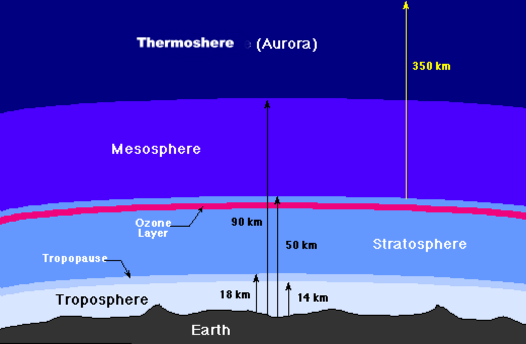
- Troposphere: 75% of atmospheric mass, heated From the bottom (longwave re-emission).
- Stratosphere: heated From the top by UV absorption — the ozone layer lives here.
- Mesosphere & thermosphere: the thin upper layers.
Topic 2: Solar energy pole-to-pole and the seasons
- Q from the slide: is sunlight less or more intense at the poles? A: LESS intense — the same beam spreads over more surface and crosses more atmosphere.
- Solstices: northern hemisphere longest day / southern shortest, and vice versa; equinoxes: the equator faces the sun directly.
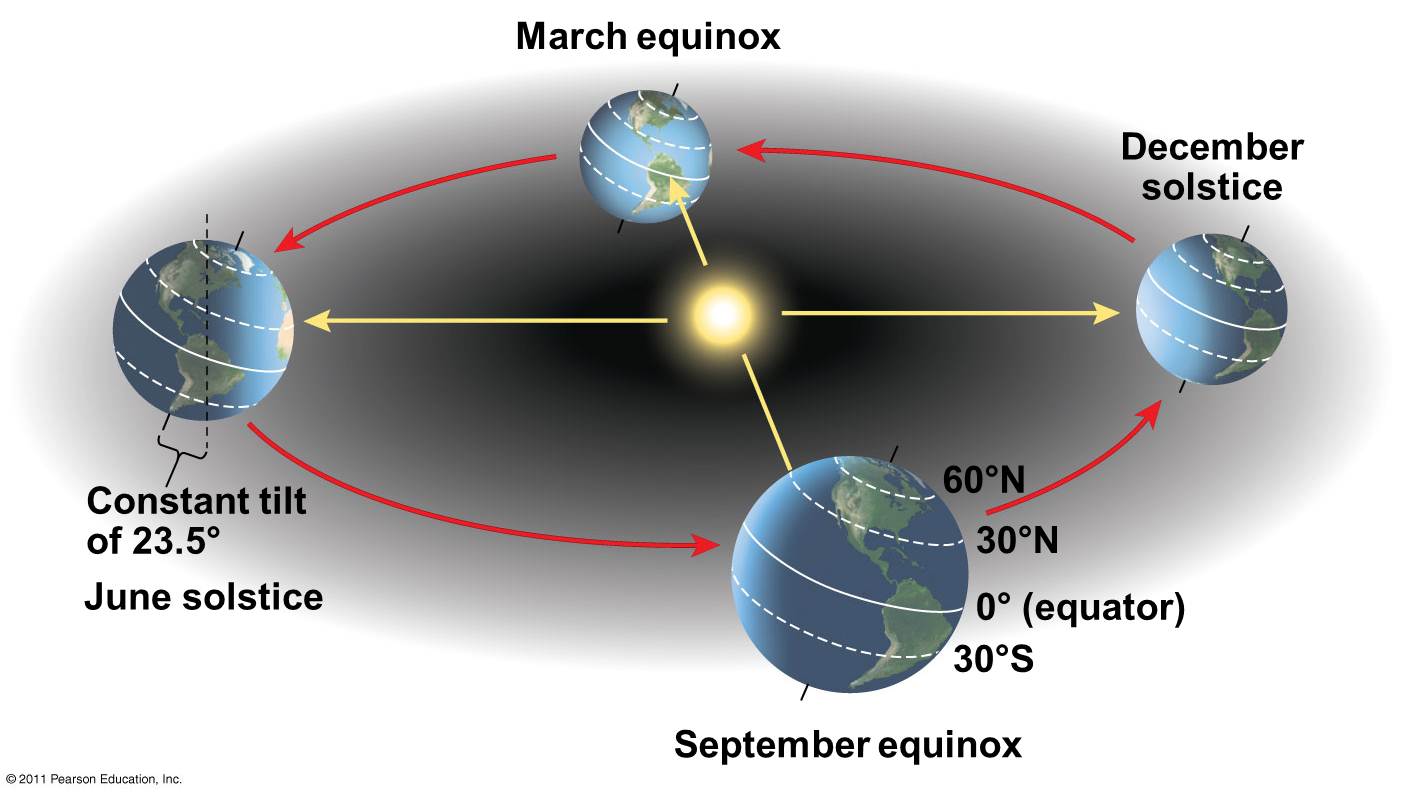
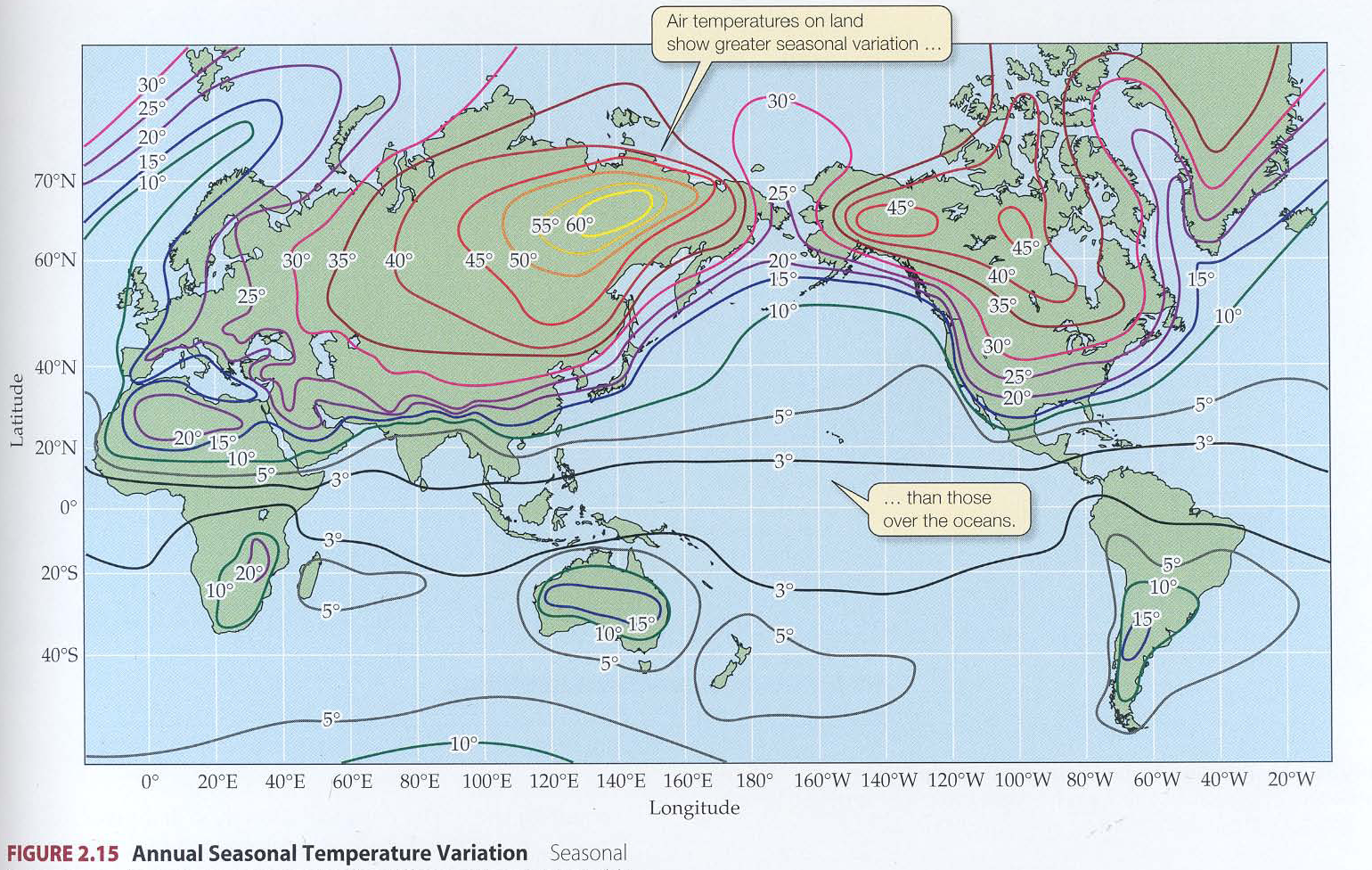
- Variation in air temperature Increases away from the equator (seasonality grows with latitude).
Topic 3: Global air and ocean currents
- Circulation patterns are also controlled by the sun: alternating bands of rising and subsiding air.
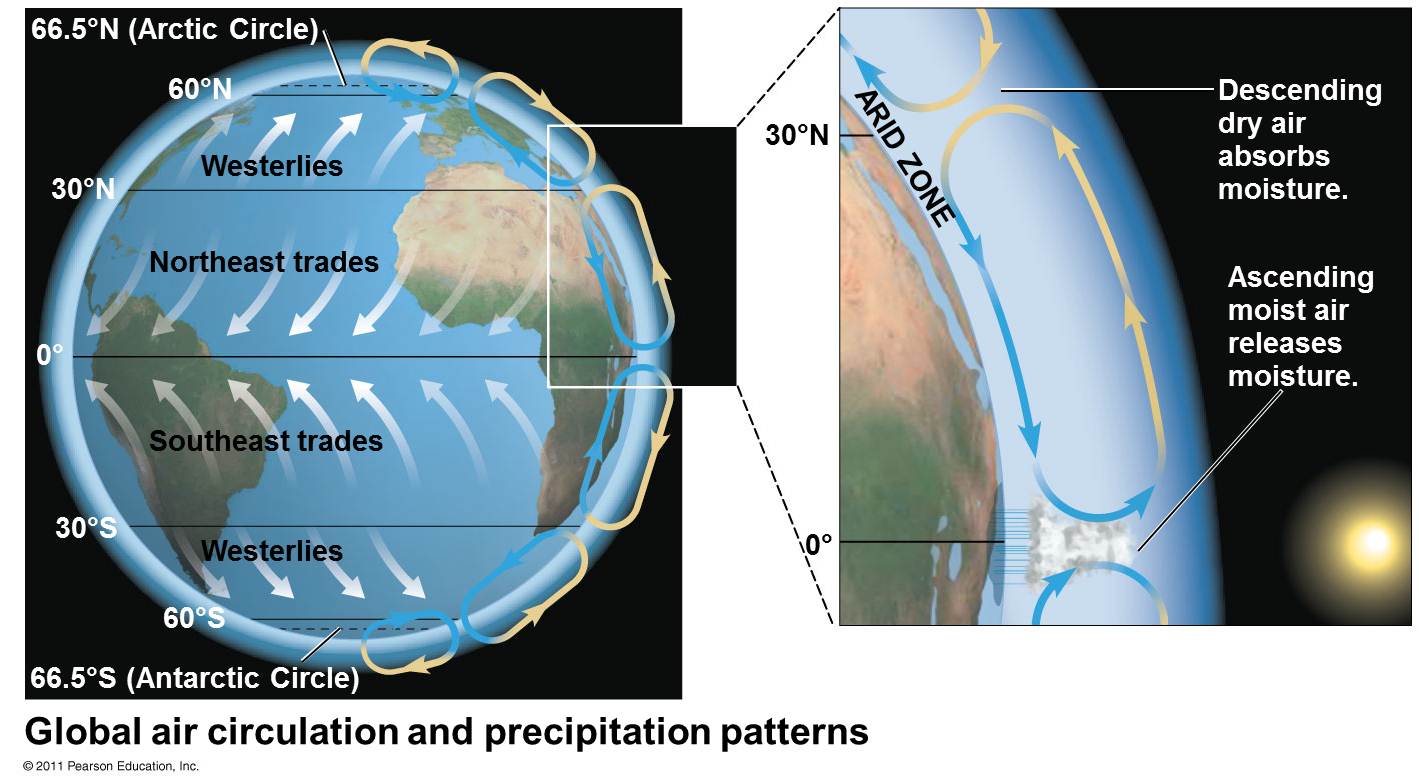
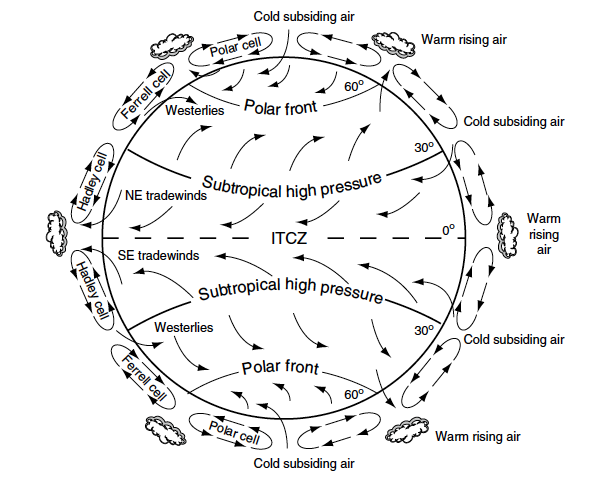
- You can SEE the precipitation pattern on a world map: wet at 0 degrees, dry at 30 N and 30 S — but more than air circulation controls precipitation.
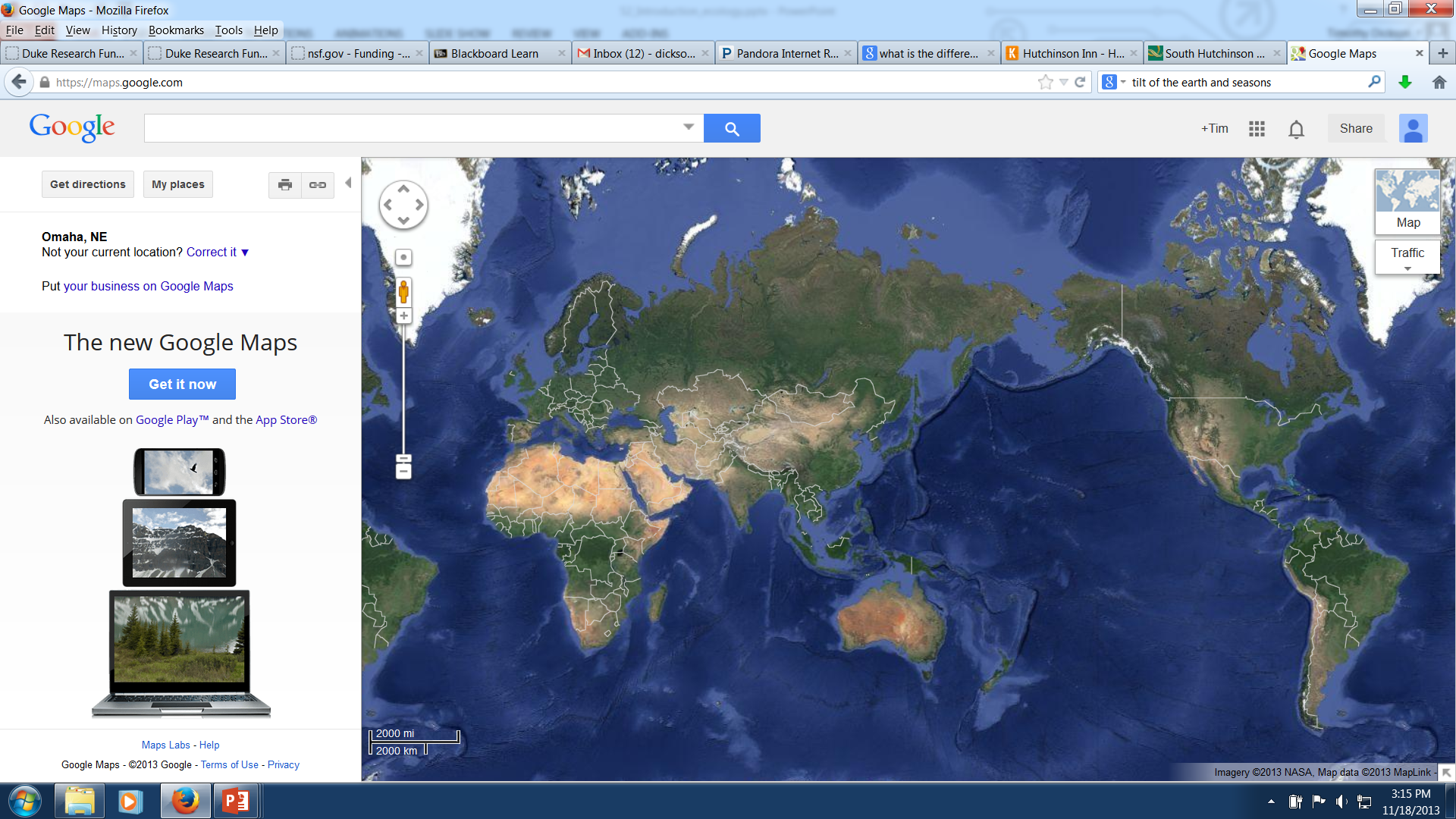
- Ocean surface currents are largely sun-driven; terrestrial climate is moderated by proximity to large water bodies.
Rain shadows — where geology beats the sun
- Cool air flows inland from the water, moderating coastal temperatures; air meets mountains, rises, cools, and rains on the windward side; the dry leeward side is the Rain shadow.
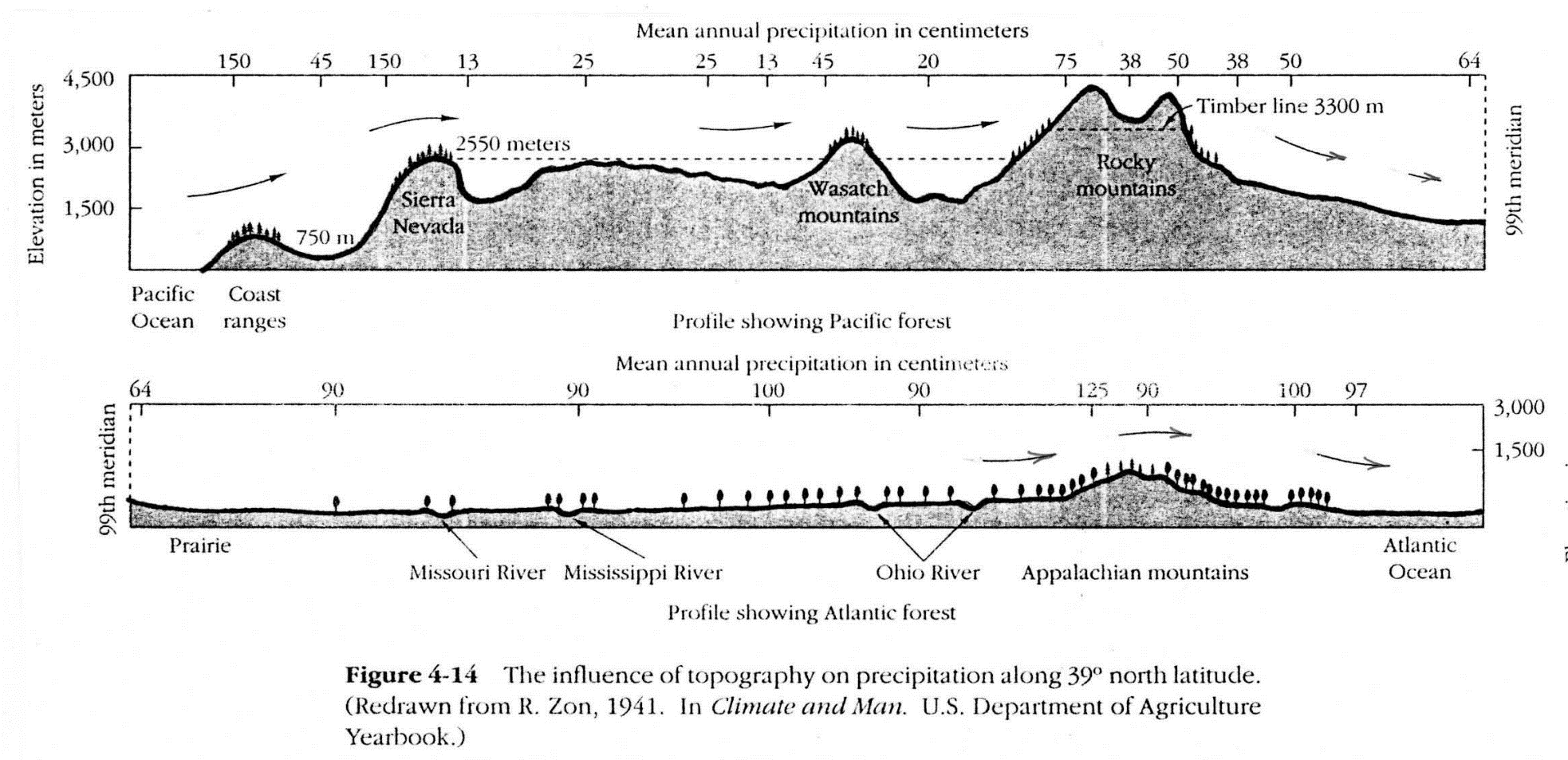
- The 39 N transect (northern California — Kansas City — Washington DC) shows the US rain shadow. Nebraska and the Great Plains are in the rain shadow of the Rockies.
Wind — his three effects
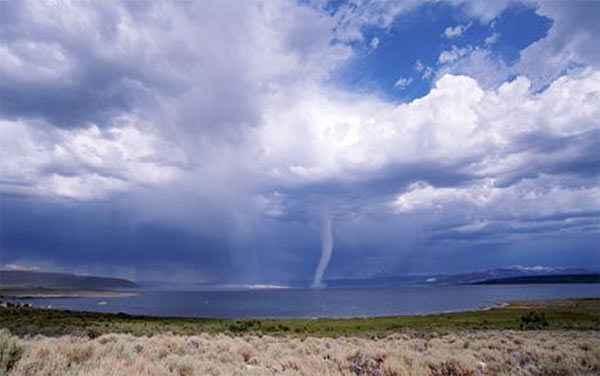
- Mixes atmospheric gases (replenishes CO2 at the leaf surface as photosynthesis depletes it).
- Disperses pollen, seeds, spores, and small animals (e.g., ballooning spiders).
- Affects temperature: enhances evaporative cooling and mixes the atmosphere.
Topic 4: Solar energy creates the terrestrial biomes
- Biomass production (g/m2/yr) is Mostly controlled by precipitation, with temperature secondary.
- Precipitation + temperature largely control the locations of Earth’s terrestrial biomes — major life zones characterized by vegetation type.
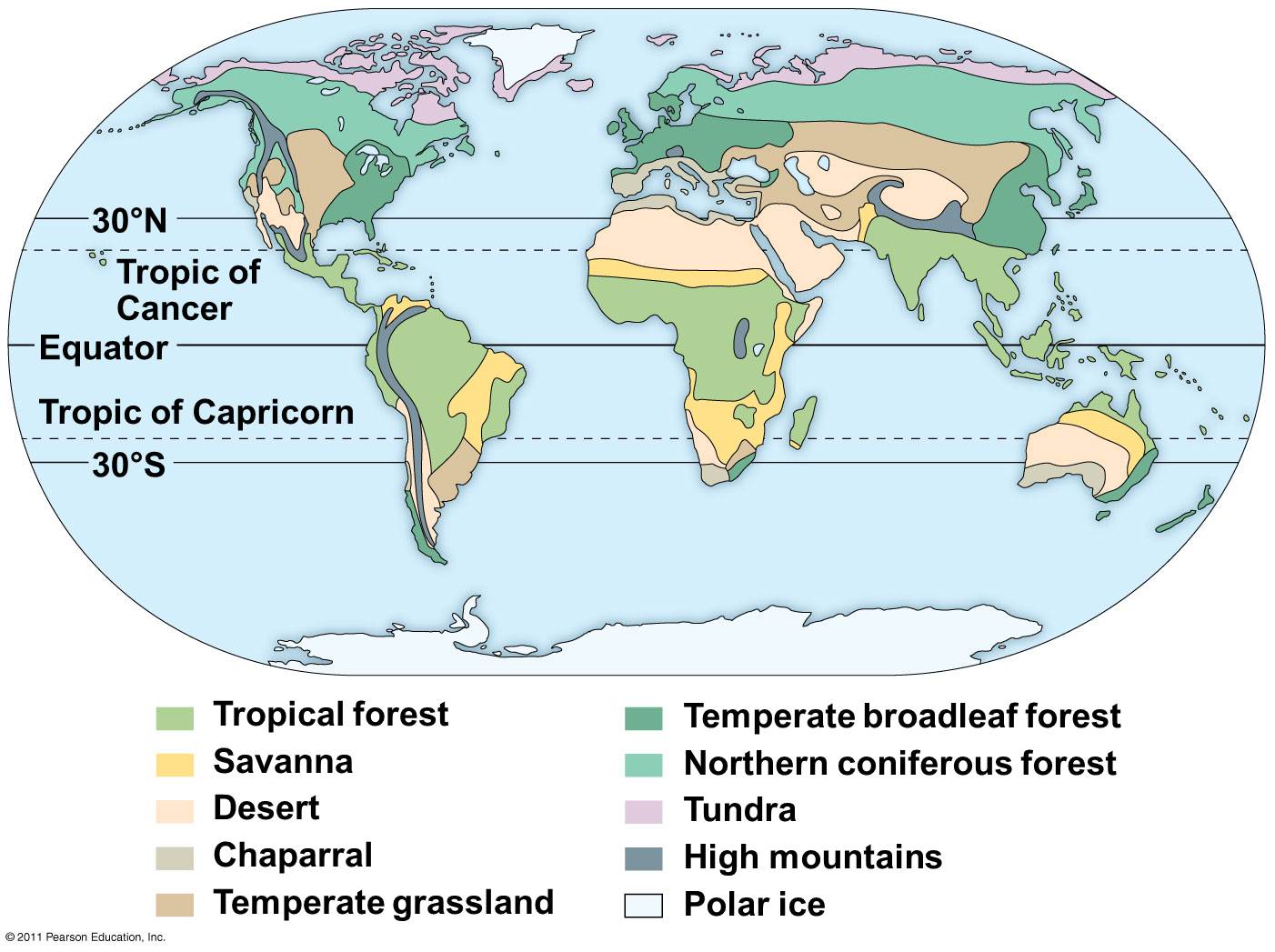
- Sometimes the control is Indirect — fire: historical North American temperate grassland kept trees only near rivers; fires every few years killed trees and maintained open grassland.
Case study: Holden et al. 2018 — western US wildfire
- Observation + question: wildfire activity is increasing in the western United States. Why?
- Hypothesis 1: warming temperatures — higher temps = drier fuels.
- Hypothesis 2: decreased snowpack — lower snowpack = drier fuels.
- Hypothesis 3: decreased precipitation — lower summer (May-Sept) moisture = drier fuels.
- Evidence line 1: have wildfires increased? YES.
- Evidence line 2: has May-September precipitation decreased? YES — measured three ways: total precipitation, number of rain days, longest rain-free period.
- Evidence line 3: wetting rain days are decreasing while area burned increases.
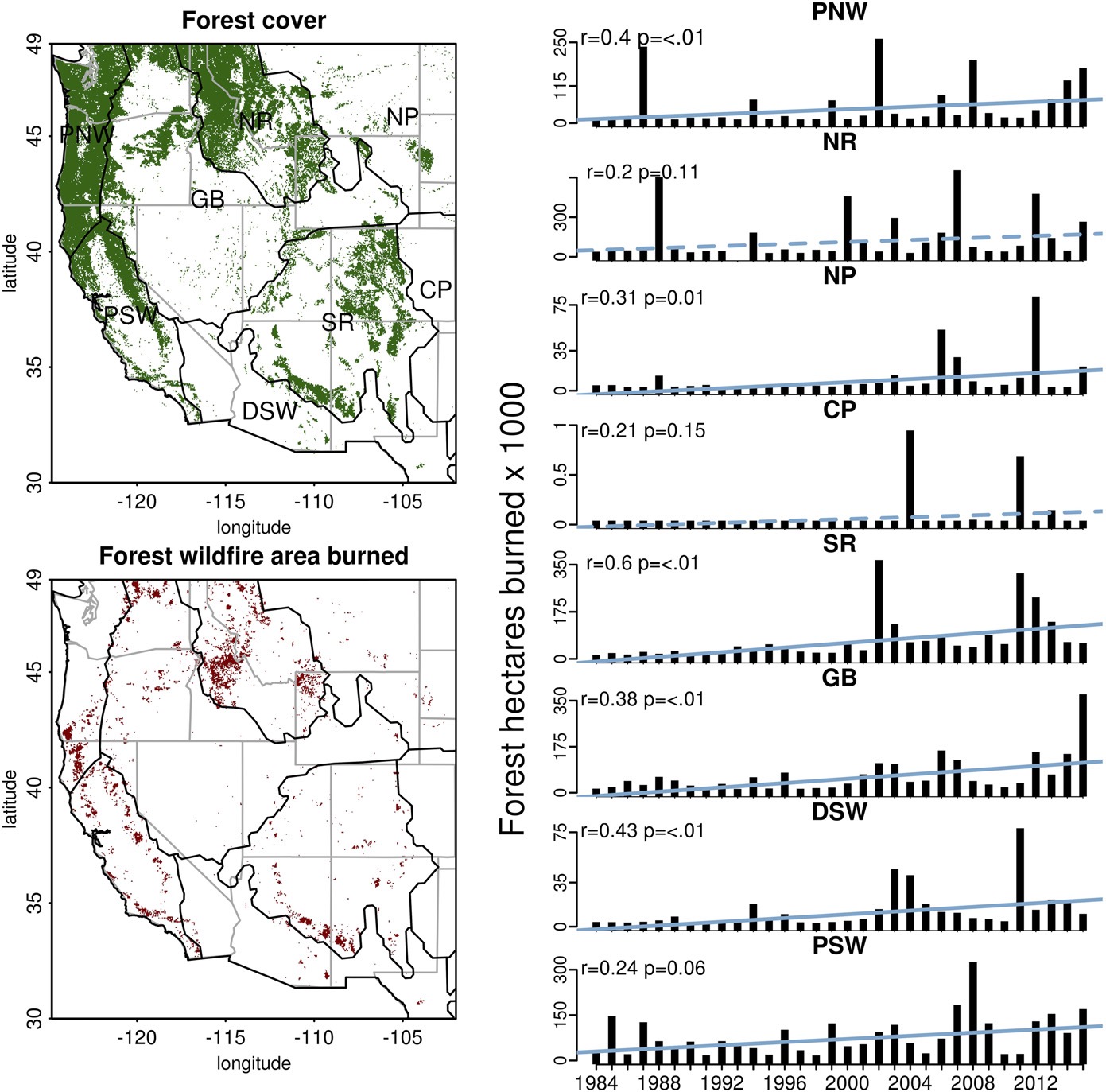

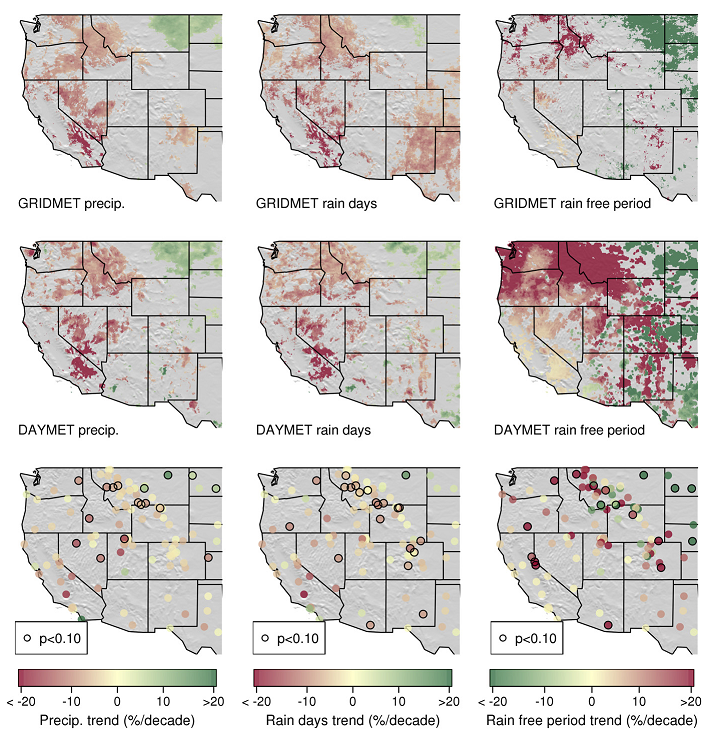
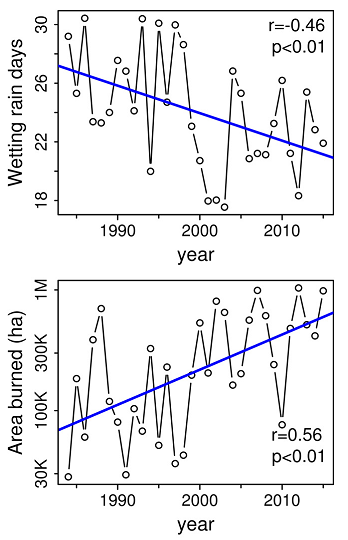
- Why this case study lives in THIS lecture: it is the L01 scientific method (observation -> hypotheses -> multiple lines of evidence) running on L02 climate machinery.
His recap slide (verbatim — memorize)
- The sun is the primary source of energy that drives earth’s climate system
- Heat-trapping gases absorb long-wave radiation
- The earth’s rotation around the sun affects seasonal climate.
- Rotation and rain-shadows also important for air and ocean currents, distribution of terrestrial biomes.
- Precipitation can influence wildfire activity and vegetation
Full Class Recording Companion — Everything Dr. Manning Said Out Loud (Aug 27)
- Reconstructed from the complete in-class recording, in the order he taught it. These are the spoken explanations, the numbers he read off the graphs, the student exchanges, and the asides that the slides alone do not give you — prime exam material.
How he opened — the globe, the quote, and the question behind the course
- He put up a full-disc photo of Earth and narrated it: you can see the aurora borealis at the top, and space dust being backlit by the sun. His line: "just a really cool image of where we live, our home... and so in ecology, we’re studying our home, us and the animals that live in this place we call home."
- He is currently reading a book about water and pulled a quote from it, then ran a think-pair-share. The answer he endorsed (from a student, Omi): it is a question of SCALE — "how do we zoom way in at something that’s really detailed, high resolution, but then still take a step back and get the big picture?"
- A second answer he liked: it implies you have to think of yourself first, but then think beyond yourself in a bigger way.
- He called this one of the key unresolved questions of the field, and asked the class to carry it through the whole semester: we have to think super-detailed — down to the machinery of individual cells — and then scale that up to what is happening at a planetary scale. Everything in Lecture 2 is that question applied to the physical environment.
The three principles he flagged for today
- Principle 1: evolution organizes ecological systems into hierarchies. (This is what the levels-of-organization ladder is doing.)
- Principle 2: the sun is the ultimate source of energy — driving not just ecosystems but the Climate patterns ecologists have to care about.
- Principle 3: organisms are chemical machines that run on that energy.
- His synthesis, stated out loud: take 2 and 3 together and what you are really talking about is how the Physical environment shapes the way organisms respond — and that drives their distribution and abundance across the planet.
The two take-home key ideas (spoken version)
- 1. The physical or abiotic aspects of the planet set up what he calls a Template — the stage for ecological interactions. This is Principle 3 in action: where energy and water are plentiful, the chemical machinery of these organisms can run, and they can survive.
- 2. Global climate patterns are driven by the interactions between the sun, the atmosphere, ocean currents, and land surfaces.
- “If you don’t remember anything else, take these two things.” Expect one of these as a short-answer framing question.
The four questions the lecture answers (his roadmap)
- 1) How does Earth’s atmosphere modify incoming solar radiation?
- 2) How does solar energy change latitudinally — Arctic to tropics and back to the Antarctic?
- 3) How do seasonal changes affect solar energy — our position in Earth’s orbit, plus the tilt of the axis?
- 4) How do those together drive global air and ocean currents, set up terrestrial biomes, and create microclimates?
- His caveat, worth remembering for how he writes exams: UNO has entire courses in climatology, global climate change, and meteorology — "what I’m telling you today is very much surface level, and goes at the theme of our class, which is we have to know a little bit about a lot of things." He tests breadth and mechanism, not derivations.
Levels of ecological organization — what he added out loud
- You can go BELOW the individual and still be doing ecology: the individual cells within a single grasshopper, or the microbes living on top of it and within its gut. “We could talk about all those things ecologically.”
- Individual: how do the adaptations of this particular grasshopper — its Phenotype — affect individual reproduction and survival, and what does that mean from an evolutionary standpoint (what is being passed on)? Subfields: evolutionary ecology, behavioral ecology, physiological ecology.
- Population: all the grasshoppers you would find at Glacier Creek. His definition, verbatim: “a group of interbreeding individuals that occur in the same place at the same time.” The question: what factors influence the growth of a population’s Density (numbers per unit area)? His concrete version: why can you not go five feet at Glacier Creek without grasshoppers jumping everywhere, while their density on campus is much lower? “This is where a lot of our foundational ideas in ecology have come from.”
- Species interactions — the bridge between population and community: mutualisms, herbivory (grasshoppers eating plants), predation (grasshoppers eaten by a bird). “All those interactions together can shape the population density as well.”
- Community: multiple species / multiple populations forming an assemblage in a given area, interacting at the same place at the same time. His build: not just the grasshoppers, but the plants they eat, all of their predators, and all the other insects at Glacier Creek. The question: what factors influence the Number of species in a given area?
- Ecosystem (“this is where I like to hang out and think”): how do all these communities interact — exchanging energy, nutrients, and other physical and chemical aspects of the area? How do the living and non-living parts of Glacier Creek affect nutrient cycling and energy flow? Usually scaled up and drawn as a Food web.
- Landscape: how are materials, energy, organisms — and information — transferred AMONG the ecosystems within a given area?
- Region: how are landscapes connected to each other? Grouped by similarities, common geology, or processes that operate at a regional scale — and over Longer timescales: not months, but multiple years or decades.
- Biosphere: all of it at once — global-scale patterns showing how life on Earth plays out seasonally, annually, decadally, and on century scales or longer.
His landscape argument: why studying an ecosystem “in isolation” is a convenient fiction
- "We usually study ecosystems and their communities in isolation... it’s much easier for us to go out to Glacier Creek and just say, okay, here’s the arbitrary boundary of Glacier Creek, we’re going to call it an ecosystem, and then study it by itself."
- But Glacier Creek is OPEN: it is connected downstream to Big papio creek, and its restored prairie is one of several restored prairies in Omaha — all part of the Omaha landscape.
- It also sits next to a rapidly developing area near Bennington: new neighborhoods, new industrial buildings. “If you haven’t been out there in a while, it really has changed quite a bit in the last eight years.” Studying at the landscape scale means being aware of those changes.
His region example: glaciation, and our home ecoregion
- Certain regions of North America were Glaciated about 10,000 years ago. The glaciers receded but left behind a Legacy — similar geology and other shared characteristics — which is what lets us group those landscapes into one region. Because of that common geology, we expect the ecology of the area to be somewhat similar, and we can make predictions from it.
- Our home region: the Great plains, and within it the Tallgrass prairie ecoregion, which used to stretch basically from Canada to Texas. "It still does technically, but the extent of the tallgrass prairie ecoregion is greatly reduced, because it’s been converted to agriculture for the most part."
His biosphere argument: accumulation
- Examples he named for global-scale study: the Global carbon cycle and the Hydrologic cycle (which the water book he is reading discusses at length).
- The argument: how do all the interactions happening beneath the surface, at the more detailed and intimate levels, Accumulate into a planetary effect we can actually detect? One grasshopper’s physiological response, behavior, and evolutionary ecology has some tiny, minuscule effect — "but all of those things wrapped up together, building and accumulating at a huge scale, is something that we can show has an effect at the biosphere level."
- His own honest hedge, worth quoting back: “that’s not always the case for every single population.” Moving up and down the scale is the skill; assuming everything scales is the error.
The atmosphere: the dimensions he actually said
- “The Earth’s atmosphere has layers like a cake, and we hang out down here in the troposphere” — a super-thin layer only about 14–18 km high.
- The rest of the atmosphere — roughly 350 km of it — is stacked above us and “weighing down on us right now, at a weight of one atmosphere.” His invitation: go stand outside and think about that.
- The troposphere holds about 75% of the mass of the atmosphere (his figure) and is where all the weather happens.
Incoming versus outgoing radiation (the paired spectra graph)
- Incoming from the sun: mostly UV, some in the visible region, and near-infrared. "Or more simply, it’s mostly Shortwave radiation, super high energy. That’s what burns your skin — but it also allows us to see things."
- Outgoing terrestrial radiation: much Longer wavelengths — low energy Longwave radiation.
- The numbers he put on it: incoming radiation is about 0.2 to 4 micrometers (shortwave); the wavelength emitted by Earth’s surface is low-energy longwave.
The gas-absorption panel — and the question he asked off it
- Gases plotted: methane, nitrous oxide, oxygen and ozone, carbon dioxide, and water vapor. The bottom panel of the figure sums them into total atmospheric absorption.
- He specifically pointed out that Nitrogen gas is not on the chart — N2 is 78% of the atmosphere but does not absorb infrared, so it is not a heat-trapping gas. Good discriminator question material.
- His question to the class: are these gases mostly good at absorbing LONG or SHORT wave radiation? Answer: LONG. "So if they’re mostly absorbing the long wave radiation, what they’re absorbing is NOT the radiation coming in — it’s what’s being reflected back by Earth’s surface."
- Final point he told you to take home from this set of graphs: the gases in the atmosphere absorb more of the LONG wave radiation — the low-energy stuff coming back out.
The total energy budget — every number he read out
- Incoming solar radiation is estimated at about 174 Petawatts. His scale statement: the amount of solar energy arriving in One hour is more energy than all humans use in One year.
- On the way in, energy is lost three ways: reflected back by the atmosphere itself, reflected by clouds in the troposphere, and reflected directly by Earth’s surface. About 33 PW is Absorbed by the atmosphere.
- What is left: about 51% of incoming solar radiation is Absorbed by land and oceans.
- But it does not stay there — it is re-emitted as longwave. On the way back out: about two-thirds is radiated to space from clouds and the atmosphere; about 6% goes directly to space from the surface; about 15% is absorbed by the atmosphere.
- His two bottom lines, stated twice: only about 50% of the energy coming to Earth actually reaches the surface, and Less than 1% of the energy reaching the surface is used for anything like photosynthesis.
The vertical temperature profile — plus a correction worth knowing
- Setup: temperature on the x-axis, altitude (the atmospheric layers) on the y-axis. The profile makes a “squiggly S shape” — it Reverses direction at every layer boundary. That reversal pattern is the exam-relevant point.
- He walked it as: very cold in the upper layers, but not uniformly — warming back toward about 0 degrees Celsius at one boundary, cooling again, and then normal, familiar temperatures down in the troposphere where all the weather is.
- Accuracy note (his spoken layer labels slipped mid-sentence, so learn the standard version): troposphere cools with height to the tropopause; the Stratosphere warms with height because ozone absorbs UV, peaking near 0 degrees C at the Stratopause; the mesosphere cools with height to the Mesopause, the coldest point in the atmosphere at roughly -90 degrees C; the thermosphere then warms again. Pattern and mechanism are what he tests.
His key point: the troposphere is heated from the Bottom
- "What’s interesting here is that it’s heated from the bottom — instead of being heated from the top, we’re getting heat from the bottom."
- He asked the class what drives that, and took the answer: Longwave radiation. All the gases in the troposphere trap the energy re-emitted by the surface and heat the layer from below. (The stratosphere is the mirror image — heated from the TOP by ozone absorbing UV.)
Why the poles get less energy — the two reasons he accepted
- His question: based on the sphere diagram, is sunlight LESS or MORE intense at the poles? Answer: Less intense.
- Reason 1 — Path length: at that angle, the beam has to travel farther through the entire set of atmospheric layers.
- Reason 2 — Spreading: as it hits the sphere it is also striking a wider swath of surface. "So the angle is more oblique, more tangential — almost, not quite. It’s less energy, it’s less direct. It’s more of an indirect hit."
- At the equator the beam travels less distance through the atmosphere and impacts more directly.
- Consequences he named: this is one of the big reasons we have polar ice caps — “and then it’s really nice to go hang out in the tropics in the wintertime.”
The seasons, walked around the orbit
- Cause: the TILT of Earth’s axis, combined with where we are in Earth’s orbit in a given year.
- December solstice: here in the Northern Hemisphere we are angled AWAY from the sun, so sunlight is even less intense than latitude alone would make it.
- Equinoxes: sunlight is more direct across the entire globe. (He noted we are getting close to the September equinox.)
- NH Summer: we are angled Toward the sun, and sunlight has a more direct path to the Northern Hemisphere.
- His framing: “seasonal changes in sunlight have a big impact on the ecology of the northern and southern hemispheres.” Latitude and season are the two knobs on the same dial.
The isocline map: annual temperature RANGE, not mean
- Each line on the map is an Isocline showing the annual air-temperature RANGE you expect at that location — how much a place swings in a year.
- Lowest variation is near the tropics (30 N to 30 S): only about 3–5 degrees C of annual swing, sitting around 24–27 degrees C all year round — because sunlight intensity barely changes there across the seasons.
- Moving toward the Arctic: fluctuations more like 30–45 degrees C in a given year. He gave about 10 degrees C for the Antarctic (ocean-buffered) — “the general pattern still emerges.”
- Second pattern — Inland exceeds coastal: land surfaces amplify seasonal temperature fluctuation. Some of the largest temperature fluctuations anywhere on Earth are in Asia, in the Siberian region of Russia.
- And close to home: “we’re no slouches when it comes to temperature variation” — the central US and Nebraska see 25–30 degrees C of fluctuation in any given year.
Global air circulation, in the order he built it
- A stark pattern emerges at very specific latitudes: 30 degrees south, the equator, 30 degrees north, and 60 degrees north and south.
- Mechanism, his sequence: direct sunlight at the equator warms the atmosphere Including all the water vapor within it, which causes warm moist air to RISE at the equator; it travels northward or southward; that air then COOLS and Loses all of its moisture, becoming much drier; and the cool dry air Subsides at 30 degrees.
- The pattern in one line: warm moist air rising in one place, cool dry air subsiding in another — at 30 N, 60 N, 30 S, 60 S.
- Names: Hadley cell and Ferrel cell, depending on your latitude.
- These also develop the Trade winds, which interact with the fact that the Earth is Spinning on its axis. His summary: the circulation comes from the spin of the Earth PLUS the temperature differences PLUS the moisture differences.
Reading desert and rainforest geography off a satellite image
- Put the equator and the tropic lines on a satellite image of the planet and the geography is stark: big swaths of GREEN — the major rainforests — fall around the equator or between the tropics.
- The really dry areas mostly occur where all that cold, subsiding, dry air lands: 30 degrees north and 30 degrees south.
- The deserts he named: Sahara, Australian Outback, Kalahari, GOBI, Mojave, Sonoran, and Atacama — “all these tend to occur about 30 degrees north or 30 degrees south, depending on where the land is.”
- His caveat: there ARE exceptions, and part of the reason is the oceans, which play a big role in where deserts and rainforests actually sit.
Ocean currents — the ones he named and what they do
- Ocean currents are ALSO driven by sunlight intensity and how it changes pole to pole: the sun hitting the landforms and the ocean drives temperature changes, which drive movement in both the oceans and the air currents.
- The currents on his map: the Indian Ocean subtropical gyre, the South Pacific subtropical gyre, the California Current, the North Pacific subtropical gyre, the South Atlantic gyre — plus the North Atlantic gyre, the Labrador Current, and the Gulf Stream.
- What they do to land: where there is Warmer water, it warms up the land next to it; where there is Colder water, it cools the land next to it. And in general they have an Attenuating effect on the temperature variation seen at any given location.
- His superlative: "if you live close to the ocean, near the equator, those are some of the most stable temperatures you’re going to find anywhere."
- Takeaway he stated: a lot of terrestrial climate is set by proximity to large bodies of water and by which current is moving warmer or colder water past you.
Rain shadow, built from the coast inland
- His construction: an ocean, then some low-lying areas next to it, then a mountain range. Moist air travels Upslope; as it cools it loses its moisture on the Windward side of the range; on the Leeward side, sheltered from that ocean airflow, the air is colder and drier.
- International example: CHILE (the Atacama).
- The US example: an elevation profile taken at one latitude — 39 degrees N. He asked the class what latitude Omaha is and took 42 degrees N, so the transect runs “just a little bit south of us.”
- Moving east to west across the United States there is a big elevation change across several mountain ranges: on the Leeward side of the Rockies you get far less rain than on the windward side, and it stays dry until you reach the Appalachian Mountains near the east coast.
Climate versus weather — the scale hand-off
- Everything to this point has been Climate: decades to centuries, and in some cases longer.
- But an animal or plant living in an ocean, a desert, or a grassland experiences Weather — what is happening today. Climate is one aspect of an ecological response, but a lot of ecology is concerned with the day-to-day.
- Weather is driven by climate, but local conditions are driven by solar energy driving wind and weather. This is the opening scale argument again, now applied to the physical template.
Wind — his three ecological effects
- 1) Mixing of atmospheric gases. His worked example: “I’m a tree, I’m trying to photosynthesize, and I need that CO2 to flow into my leaves.” Mixing from wind makes sure there is fresh CO2 at the stomata on the leaf surface. A very small-scale example of how wind can affect Primary production.
- 2) Dispersal — “a big idea in ecology.” How do animals and plants move around? Wind is one way pollen, seeds, spores, and even small animals move from place to place.
- 3) Temperature, especially at local scale: wind enhances Evaporative cooling, and it mixes water as well as air — in the Great Lakes, the ocean, or a smaller lake.
Nebraska, the rain shadow, and primary production
- Because of our location next to the Rockies, rainfall is MUCH lower in western Nebraska than eastern Nebraska — and you can watch that play out in primary production (grams of plant material produced per m2 per time).
- The production map’s isolines: closest to the Rockies = least plant production (least precipitation); moving Eastward, the rain shadow dissipates, rainfall rises, and primary production climbs — through eastern Nebraska into Missouri and Arkansas.
- The takeaway he stated: combine global air patterns + ocean currents + their interactions with landforms (mountains) and you can predict where and when different biomes occur.
How to read a climograph (he walked the whole graph)
- Definition: annual mean Precipitation on the x-axis, annual mean Temperature on the y-axis; group biomes by where they fall — the geographic map redrawn climatologically.
- Arctic/alpine tundra: cold + low precipitation.
- Deserts: higher temperature but LOW mean precipitation.
- Tropical forests: very Stable temperatures (near the equator) but much more Variability in rainfall — which is how you get temperate rainforests AND tropical dry forests with seasonal/monsoon precipitation.
- Coniferous + temperate broadleaf forests: occupy the Largest area of the climograph — the highest variability in BOTH temperature and precipitation.
Biome geography he emphasized on the map
- Tropical forest biomes: almost exclusively within 30 N — 30 S (direct sunlight + heavy precipitation).
- Deserts: just north and south of that band (the 30-degree belts).
- Temperate broadleaf forests: mostly 30–60 degrees N (and 30–60 S).
- Temperate rainforests: near oceans, on the Windward side of mountain ranges — elevation patterns overlay the latitude bands.
What keeps the Great Plains treeless — TWO agents
- Bison: grazing pressure interacting with the vegetation (his historical image: bison roaming a treeless plain).
- Fire: every few years a fire large enough to kill Saplings maintains open grassland — the regeneration factor of our home biome for centuries.
- Exam frame: the slide said fire; the lecture said fire AND grazing. Give both.
Holden et al. 2018 — the Verdict (he was explicit)
- H1, warming temperatures drying fuels: NO evidence found.
- H2, decreased snowpack (he stressed: snowpack IS precipitation, not just rain): NO evidence found.
- H3, decreased Summer precipitation (May-September): Supported — the mechanism driving larger, more intense burns.
The numbers he read off the graphs
- Wetting rain days (rain enough to actually wet the dead wood/vegetation): average ≈27 in 1985 down to ≈20–21 now — about A WEEK fewer wetting rain days per season.
- Forest area burned: from an average of ≈90,000 hectares to over ≈300,000 hectares per year — and he warned: that graph is on a Log scale, be careful.
- Area burned increased across All eight western regions analyzed (bars = area burned per year; trend lines all rising; PNW = Pacific Northwest).
- Summer drying was shown three ways: total precipitation DOWN, number of rainy days DOWN, rain-free period UP — all three agree.
The graph he drew on the board
- Axes: area burned (hectares) vs number of wetting rain days in a given year — Time is not on this graph (he stressed this).
- The relationship: Negative — area burned is higher in years with fewer wetting rain days. It combines the two trend graphs into one mechanism plot.
- Note: the version on the posted slides is mis-plotted; he said he will fix it and repost — expect the corrected negative-slope figure.
His closing recap (spoken version)
- The sun is the primary source of energy in the system; heat-trapping gases absorb longwave radiation — that is what warms the troposphere From the bottom up.
- Earth’s rotation around the sun affects seasonal climate.
- Earth’s rotation, rain shadows, and sun angle from pole to pole drive air and ocean currents — which set the location and distribution of terrestrial biomes.
- Precipitation in turn influences fire, with implications for vegetation across landscapes.
- Assigned reading | What it gives you | Covered in
- Stiling Ch. 1.2 | Levels of organization and the scales ecologists work at | Part 1
- Stiling Ch. 22 (Terrestrial Biomes) | Global climatic patterns and the biomes they produce | Parts 3–7
- EFA 2.4 The Atmosphere | Composition and vertical structure of the atmosphere | Part 4
- EFA 2.5 Earth Energy Balance | Albedo, the 30/70 split, the greenhouse effect, latitudinal heating, seasons | Parts 2–3
- EFA 2.6 Atmospheric and Oceanic Circulation | Hadley, Ferrel and Polar cells, Coriolis, winds, gyres, thermohaline, ENSO | Parts 5–6
- EFA 2.7 What Makes the Climate Change | Forcings and feedbacks, Milankovitch, tectonics, volcanism, CO2 | Part 8
- EFA 2.8 Past Climate Change | Proxies, glaciations, the ice-core record | Part 8
- Question | Answer at a small scale | Answer at a large scale | Why it flips
- Are these two plant species positively or negatively associated? | Negative: within a single quadrat they compete for the same soil patch | Positive: across a region both prefer the same soil type and climate | Competition operates locally; habitat filtering operates regionally
- Is this population stable? | A single patch may go extinct repeatedly | The metapopulation persists because patches are recolonized | Extinction is local, dispersal is regional
- What limits plant growth here? | Light, in a shaded understory square metre | Precipitation, across a continent | Different factors are the binding constraint at different extents
- Does fire increase diversity? | A single burned quadrat may lose species immediately | Landscape burned in a patchy mosaic gains species | Diversity accumulates across patches at different times since fire
- Surface | Approximate albedo | Consequence
- Fresh snow and ice | 70–90% | Polar regions reflect most of what reaches them
- Clouds | 70–90% | Cloud cover is the largest short-term control on albedo
- Sand and desert | Moderate to high | Deserts reflect more than the vegetation they replaced
- Forest | Moderate to low | Dark canopies absorb; this is why deforestation changes local climate
- Open water | Under 10% | Oceans absorb almost everything that reaches them
- Date | Sun directly over | Northern Hemisphere | Southern Hemisphere
- About March 20, equinox | Equator (0 degrees) | Spring begins; 12 h day everywhere | Autumn begins
- About June 21, solstice | Tropic of Cancer (23.5 N) | Summer; longest day; sun highest | Winter
- About September 22, equinox | Equator (0 degrees) | Autumn begins | Spring begins
- About December 21, solstice | Tropic of Capricorn (23.5 S) | Winter; shortest day; sun lowest | Summer
- Gas | Proportion of dry air | Note
- Nitrogen (N2) | About 78% | Inert to most organisms; must be fixed to be usable
- Oxygen (O2) | About 21% | Biologically produced; supports aerobic respiration
- Argon (Ar) | About 0.9% | Inert
- Carbon dioxide (CO2) | About 0.04% (400+ ppm) | Tiny fraction, enormous climatic and biological leverage
- Water vapor | 0.01% (arctic) to 5% (tropics) | Highly variable; the strongest greenhouse gas by total effect
- Trace: helium, neon, methane, ozone | Trace | Methane and ozone matter far beyond their concentration
- Layer | Altitude | Temperature behavior | Why it matters
- Troposphere | 0 to about 20 km | Decreases with altitude, about 6.5 °C per km | Holds 85–90% of atmospheric mass; all weather and essentially all life happens here
- Stratosphere | About 12 to 50 km | Increases with altitude | Contains the ozone layer at roughly 20–30 km, which absorbs UV; the warming is caused by that absorption
- Mesosphere | About 50 to 85 km | Decreases sharply | Little ozone or water vapor to absorb energy
- Thermosphere | Above about 85 km | Rises to 1500 °C or more | Very few molecules, so the high temperature carries almost no heat
- Cell | Latitude band | Air motion | Surface pressure | Climate produced | Examples
- Hadley | 0 to 30 degrees | Rises at the equator, sinks at 30 | Low at 0, high at 30 | Wet at the equator, arid at 30 | Amazon and Congo rainforest; Sahara, Arabian, Australian and Kalahari deserts
- Ferrel | 30 to 60 degrees | Sinks at 30, rises at 60 | High at 30, low at 60 | Variable, storm-track weather | Temperate North America and Europe
- Polar | 60 to 90 degrees | Rises at 60, sinks at the pole | Low at 60, high at 90 | Moist boreal at 60, polar desert at 90 | Boreal forest; Antarctic Dry Valleys
- Wind belt | Latitude | Direction it blows from | Note
- Trade winds | 0 to 30 degrees | Northeast in the N hemisphere, southeast in the S | Converge at the ITCZ; carried the sailing trade routes
- Westerlies | 30 to 60 degrees | From the west | Why North American weather generally moves west to east
- Polar easterlies | 60 to 90 degrees | From the east | Meet the westerlies at the polar front
- Biome | Temperature | Precipitation | Where the circulation puts it
- Tropical rainforest | Warm, aseasonal | Very high, year-round | ITCZ, rising limb of the Hadley cell
- Tropical seasonal forest / savanna | Warm | High but strongly seasonal | Edge of the ITCZ migration
- Subtropical desert | Hot days, cold nights | Very low | Descending limb of the Hadley cell, about 30 degrees
- Woodland / shrubland (Mediterranean) | Hot dry summer, mild wet winter | Moderate, winter-concentrated | Between the 30-degree high and the westerlies, on west coasts
- Temperate grassland / cold desert | Cold winter, hot summer | Low to moderate | Continental interiors, often in rain shadow. This is the tallgrass prairie
- Temperate seasonal forest | Warm summer, cold winter | Moderate to high | Westerlies, mid-latitude east coasts and continental east sides
- Temperate rainforest | Mild, small annual range | Very high | Windward mid-latitude coasts
- Boreal forest (taiga) | Cold, short growing season | Low to moderate | Rising limb at 60 degrees, polar front
- Tundra | Very cold, permafrost | Low | Above the boreal, toward the polar high
- Forcing | Timescale | Mechanism | Evidence
- Solar evolution | Billions of years | The sun emits about 40% more energy than at Earth formation | Earth stayed habitable because CO2 declined over the same interval, a long-term negative feedback
- Plate tectonics | Tens to hundreds of millions of years | Continental position, mountain building, ocean gateways | Gondwana over the pole drove the Andean-Saharan and Karoo glaciations; the India-Asia collision from about 50 Ma raised the Himalaya and accelerated CO2-consuming weathering; the Drake Passage opening near 35 Ma created the Antarctic Circumpolar Current and isolated Antarctica
- Milankovitch cycles | 20,000 to 100,000 years | Orbital geometry redistributes where and when sunlight falls | Matches the periodicity of Pleistocene glacial cycles
- Volcanism | Years to millions of years | Short term: SO2 aerosols cause haze-effect cooling. Long term: sustained CO2 release warms | The 1783 Icelandic eruptions produced some of the lowest recorded winter temperatures in Europe and North America in 1783–84; the Siberian Traps at about 250 Ma drove long-term warming
- Ocean circulation shifts | About 1500 years for thermohaline, 2–7 years for ENSO | Redistributes heat | Glacial-era thermohaline shifts; 1983 and 1998 El Nino warmth
- Greenhouse gas concentration | Any | Changes longwave absorption | Ice cores; see below
- Cycle | Period | What varies | Effect
- Eccentricity | About 100,000 years | Orbit shape, from nearly circular to more elliptical | Changes how much Earth-Sun distance varies across the year
- Obliquity (tilt) | About 41,000 years | Axial tilt between 22.1 and 24.5 degrees | Lower tilt means cooler summers, which favors glaciation
- Precession | About 20,000 years | Direction the axis points | Determines whether northern summer coincides with the near or far point of the orbit
- Proxy | What it records | Range | How it works
- Ice cores (Greenland, Antarctica) | Atmospheric composition and temperature | About 800,000 years | Trapped air bubbles are direct samples of the ancient atmosphere; isotope ratios in the ice give temperature
- Oxygen isotopes in foraminifera | Global ice volume and ocean temperature | Tens of millions of years | During glaciations lighter O-16 is preferentially locked up in ice, so seawater and shells become enriched in O-18
- Tree rings (dendrochronology) | Annual growing conditions | Thousands of years | Narrower rings indicate colder and drier years
- Pollen in lake sediment | Past vegetation, hence past climate | Tens of thousands of years | Pollen is durable and identifiable to genus; vegetation tracks climate
- Corals, speleothems, varves | Temperature, precipitation, seasonality | Varies | Annual banding plus geochemistry
- Quantity | Value
- Planetary albedo | About 30% reflected, 70% absorbed (47% surface, 23% atmosphere)
- Earth temperature without greenhouse effect | About -18 °C, versus about +15 °C actual
- Axial tilt | 23.5 degrees
- Tropospheric lapse rate | About 6.5 °C per km
- Atmosphere composition | 78% N2, 21% O2, 0.9% Ar, 0.04% CO2
- Troposphere mass fraction | 85–90% of the atmosphere
- Rotational speed at equator / 30 / 60 degrees | About 1600 / 1400 / 800 km/h
- Ice-core CO2 range, last 800,000 years | About 170–300 ppm; today above 400 ppm
- Milankovitch periods | Eccentricity 100 kyr, obliquity 41 kyr, precession 20 kyr
- Species-area exponent z | About 0.25 for islands, about 0.15 for mainland samples
- How he OPENED the class (the framing question)
- Full-disc photo of Earth — aurora visible at the top, space dust backlit by the sun. His line: “a really cool image of where we live, our home… in ecology we’re studying our home.” Then a quote from a book on water he is reading, and a think-pair-share. The answer he endorsed (from Omi): it is a question of SCALE — how do you zoom all the way in at high resolution and still step back for the big picture? He called this the key unresolved question of ecology: we must think at the scale of the machinery of individual cells AND scale that up to the planet. Second student answer he liked: you think of yourself first, then beyond yourself.
- The three principles he flagged for L02
- He opens every class by naming which of the Ten Principles apply. Today: P1 evolution organizes ecological systems into hierarchies; P2 the sun is the ultimate source of energy driving not just ecosystems but the climate patterns ecologists care about; P3 organisms are chemical machines that run on that energy. P2 + P3 together = the physical environment shapes how organisms respond, which drives their distribution and abundance.
- The two take-home key ideas (his words)
- 1) The physical/abiotic aspects of the planet set up a TEMPLATE — the stage for ecological interactions. Where energy and water are plentiful, the chemical machinery (P3) can run and organisms can survive. 2) Global climate patterns are driven by the interactions between the sun, the atmosphere, ocean currents, and land surfaces. “If you don’t remember anything else, take these two things.”
- The four questions L02 answers
- (1) How does Earth’s atmosphere modify incoming solar radiation? (2) How does solar energy change latitudinally (Arctic → tropics → Antarctic)? (3) How do seasonal changes (Earth’s orbit + axial tilt) affect solar energy? (4) How do those together drive air and ocean currents, terrestrial biomes, and microclimates? His caveat: UNO has whole courses in climatology, global climate change, and meteorology — this is deliberately surface level, because the course theme is “know a little bit about a lot of things.”
- Below the individual (he went lower than the slide)
- You can go below the individual grasshopper and still be doing ecology: the individual cells within it, and the microbes living on it and in its gut. The ladder does not start at “organism” by necessity — it starts wherever your question starts.
- The Glacier Creek grasshopper — every level with his example
- Individual: how do this grasshopper’s adaptations — its phenotype — affect its reproduction and survival, and what is passed on (evolutionary, behavioral, physiological ecology)? Population: all the grasshoppers at Glacier Creek. Community: add the plants they eat, their bird predators, and every other insect at Glacier Creek. Ecosystem (“where I like to hang out and think”): living + non-living together — nutrient cycling and energy flow, usually drawn as a food web. Landscape: Glacier Creek connects downstream to Big Papio Creek, and its restored prairie is one of several restored prairies around Omaha.
- Population — his definition and his density question
- “A group of interbreeding individuals that occur in the same place at the same time.” The question: what factors influence the growth of a population’s density (numbers per unit area)? His concrete version: why can’t you walk five feet at Glacier Creek without grasshoppers jumping everywhere, while on campus their density is far lower? Much of ecology’s foundational theory came from this level.
- Species interactions = the BRIDGE level
- He inserted interactions between population and community: mutualism, herbivory (grasshopper eating plants), predation (bird eating grasshopper). These interactions are what shape population density — and they are why community ecology gets “more complicated.”
- Why we study ecosystems in isolation — and why that’s a fiction
- “It’s much easier to go out to Glacier Creek and say, okay, here’s the arbitrary boundary… and study it by itself.” But Glacier Creek is open — it flows into Big Papio Creek and sits in a rapidly developing landscape near Bennington (new neighborhoods, industrial buildings; “really has changed quite a bit in the last eight years”). Studying at landscape scale means tracking those changes. Landscape question: how are materials, energy, organisms, and information transferred among ecosystems?
- Region — glaciation as his worked example
- Regions group landscapes by shared geology or shared processes, over longer timescales (years to decades, not months). His example: parts of North America were glaciated ~10,000 years ago; the glaciers receded but left a legacy of similar geology, so we expect similar ecology and can make predictions from it. Our region: the Great Plains — specifically the tallgrass prairie ecoregion, which historically ran Canada → Texas and technically still does, but is greatly reduced by conversion to agriculture.
- Biosphere — the accumulation argument
- Global-scale signals (the global carbon cycle, the hydrologic cycle) play out seasonally, annually, decadally, and over centuries. His framing: how do all the interactions happening at the fine, intimate levels accumulate into a planetary effect we can actually detect? One grasshopper’s physiology, behavior, and evolution is a minuscule effect — wrapped together at scale it becomes measurable at the biosphere level. His own hedge: “that’s not always the case for every single population.”
- Troposphere dimensions he actually said
- “The atmosphere has layers like a cake” and we live in the thin bottom one: the troposphere is only ~14–18 km high, and the remaining ~350 km of atmosphere is stacked above us, pressing down at one atmosphere, right now. Troposphere = 75% of the atmosphere’s mass (his number) and all the weather.
- Incoming vs outgoing spectra (the paired graph)
- Incoming (solar): mostly UV, some visible, some near-infrared — i.e. shortwave, high energy, ~0.2–4 µm. “This is what burns your skin — and also what lets us see.” Outgoing (terrestrial): much longer wavelengths, low energy = longwave. That difference is the whole greenhouse mechanism.
- The gas-absorption panel — and his exam question off it
- Gases plotted: methane, nitrous oxide, oxygen & ozone, carbon dioxide, water vapor; the bottom panel sums them into total atmospheric absorption. He pointed out that N₂ gas is NOT on the chart (it does not absorb IR). His question — do these gases mainly absorb long or short wave? Answer: LONG. So what the atmosphere absorbs is not the incoming solar beam; it is the longwave energy re-emitted by Earth’s surface.
- Energy budget — every number he read out
- Incoming solar radiation ≈ 174 petawatts; one hour of it exceeds all human energy use in a year. Losses on the way in: reflected by the atmosphere, reflected by clouds, reflected directly by Earth’s surface; ~33 PW absorbed by the atmosphere; ~51% absorbed by land and oceans. On the way back out (as longwave): ~two-thirds radiated to space from clouds/atmosphere, ~6% radiated directly to space from the surface, ~15% absorbed by the atmosphere. Bottom line he stated twice: only ~50% of incoming energy reaches the surface, and less than 1% of that drives photosynthesis.
- The vertical temperature profile (and a correction worth knowing)
- Temperature on the x-axis, altitude on the y — the profile makes a squiggly S shape: it reverses direction at each layer boundary. He walked it as: very cold in the upper layers, warming back toward ~0 °C at one boundary, cold again, then normal surface temperatures in the troposphere. Accuracy note for the exam: the standard profile is troposphere cooling with height → stratopause ≈ 0 °C (ozone heating from the top) → mesosphere cooling to the mesopause, the coldest point (≈ −90 °C) → thermosphere heating again. His spoken layer labels slipped; the pattern (alternating reversals) and his key point are what matter.
- His key point about the troposphere: heated from the BOTTOM
- Unlike the stratosphere (heated from the top by ozone absorbing UV), the troposphere is heated from the bottom up. He asked the class what drives that; the answer he took: longwave radiation — the gases in the troposphere trap the energy re-emitted by the surface and heat the layer from below.
- Why the poles get less energy — the two reasons he accepted
- His clicker-style question: is sunlight less or more intense at the poles? Less. The student answer he repeated: because of the angle at which it strikes the sphere, the beam (1) must travel farther through the atmospheric layers, and (2) spreads across a wider swath of surface. “More oblique, more tangential — almost. It’s less direct, more of an indirect hit.” At the equator the beam crosses less atmosphere and strikes more directly. Consequence: this is one of the big reasons we have polar ice caps — “and why it’s really nice to hang out in the tropics in wintertime.”
- Seasons, walked around the orbit
- Because of Earth’s axial tilt: at the December solstice the Northern Hemisphere is angled away — sunlight even less intense than the latitude alone would give. At the equinoxes sunlight is most direct across the whole globe. In NH summer we are angled toward the sun and the beam takes a more direct path. (He noted we’re coming up on the September equinox.) Seasonal sunlight change has a big impact on the ecology of both hemispheres.
- The isocline map — annual temperature RANGE
- Each line is an isocline of annual air-temperature range at a location. Lowest variation is in the tropics (30°N–30°S): only ~3–5 °C of annual swing, sitting near 24–27 °C all year, because sunlight intensity barely changes there. Moving toward the Arctic: 30–45 °C swings. He gave ~10 °C for the Antarctic (ocean-buffered) — the general pattern still holds. Second pattern: INLAND > coastal. Largest swings on Earth: Siberia, Russia. And “we’re no slouches” — central US / Nebraska: 25–30 °C annual fluctuation.
- Circulation the way he built it
- Stark banding emerges at 30°S, the equator, 30°N, and 60°N/S. Mechanism in his order: direct equatorial sunlight warms the atmosphere and the water vapor in it → warm moist air rises at the equator → travels poleward → cools and loses all its moisture → cool dry air subsides at 30°. Names: Hadley cell and Ferrel cell depending on latitude. These also generate the trade winds, which interact with the spin of the Earth — so circulation comes from rotation plus temperature differences plus moisture differences.
- Reading the deserts off a satellite image
- Put the equator and the tropics on a satellite map and the geography is stark: big swaths of green (rainforest) at/between the tropics; dry belts where cold subsiding dry air lands, at 30°N and 30°S. His named list: Sahara, Australian Outback, Kalahari, Gobi, Mojave, Sonoran, Atacama. He flagged that exceptions exist — the oceans also decide where deserts and rainforests sit.
- The ocean currents he named
- Also sun-driven: unequal heating of land and ocean pole-to-pole drives both ocean movement and air currents. His map: Indian Ocean subtropical gyre, South Pacific subtropical gyre, California Current, North Pacific subtropical gyre, South Atlantic gyre, plus the North Atlantic gyre, Labrador Current, and Gulf Stream.
- What currents do to the land next door
- Warm water warms the adjacent land; cold water cools it — and in general currents have an attenuating effect on temperature variation. His superlative: living near the ocean at the equator gives you some of the most stable temperatures found anywhere on Earth. So terrestrial climate depends on proximity to large water bodies and on which current is running past.
- Rain shadow, built from the coast inland
- Ocean → low-lying land → mountain range. Moist air travels upslope, cools, and drops its moisture on the windward side; on the leeward side the air is colder and drier. His examples: Chile (Atacama), and the US transect. The elevation profile he showed was taken at 39°N — he asked the class what latitude Omaha is and took 42°N, so the transect is “just a little bit south of us.” East→west across the US: several mountain ranges; on the leeward side of the Rockies you get far less rain than on the windward side, and it stays dry until you reach the Appalachians near the east coast.
- Climate vs weather — the scale hand-off
- Everything up to here is climate: decades, centuries, longer. But an animal or plant lives in weather — what is happening today. Weather is driven by climate, yet local conditions are set by solar energy driving wind. This is the same scale argument he opened the class with, applied to the physical template.
- Wind, at ecological scale (his three effects, expanded)
- 1) Mixes atmospheric gases — his worked example: “I’m a tree trying to photosynthesize and I need CO₂ to flow into my leaves”; wind mixing keeps fresh CO₂ at the stomata. A very small-scale mechanism with a primary-production consequence. 2) Dispersal — “a big idea in ecology”: pollen, seeds, spores, even small animals move on wind. 3) Temperature — enhances evaporative cooling at local scale, and mixes water bodies (Great Lakes, ocean, small lakes) as well as air.
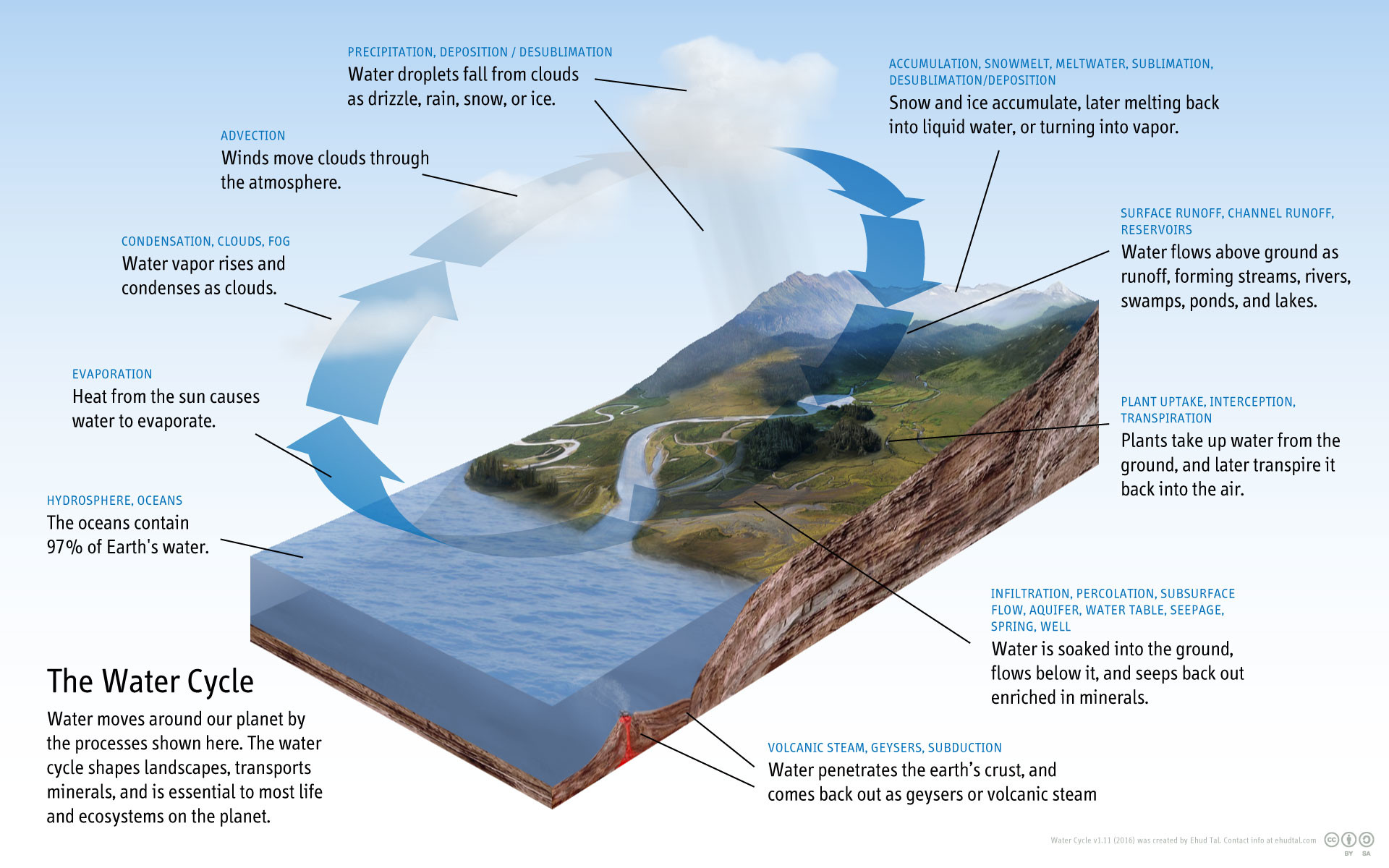
Climate is the long-term average of weather. Driven by solar radiation, latitude (angle of incidence), and Earth's tilt (23.5°), giving us seasons.
- Insolation
- Incoming solar radiation per unit area, peaks at the equator, falls toward poles.
- Albedo
- Fraction of insolation reflected. Snow ~0.8, dark forest ~0.1.
- Hadley cell
- Atmospheric circulation: warm air rises at equator, sinks at ~30° latitude → tropical rainforests at equator, deserts at 30°.
- Coriolis effect
- Rotation deflects winds right in N. Hemisphere, left in S. → trade winds, westerlies.
- Rain shadow
- Air rises over a mountain, cools, drops rain on the windward side; descends dry on the leeward side.
- El Niño / La Niña (ENSO)
- Periodic warming/cooling of equatorial Pacific that shifts global precipitation.
- Microclimate
- Small-scale climate variation due to topography, vegetation, or substrate; matters more to small organisms than regional climate.
Earth's energy budget
~30% of incoming solar radiation is reflected (albedo); ~70% absorbed. Re-radiated as longwave IR. Greenhouse gases (CO₂, CH₄, H₂O vapor) absorb that IR and warm the lower atmosphere — the greenhouse effect is what keeps Earth ~33 °C warmer than it would be otherwise.
Temperature is the master abiotic variable: it sets reaction rates, water availability, and the geographic limits of nearly every species. This lecture covers how organisms experience and manage heat, and how a changing climate rewrites those rules in real time.
Learning objectives
- Explain how temperature limits species distributions, with examples of both cold and heat limits.
- Distinguish ectotherms from endotherms and poikilotherms from homeotherms, and give the costs of each strategy.
- Write and interpret the heat-balance equation (radiation, conduction, convection, evaporation, metabolism).
- Describe Q10, thermal performance curves, and why performance falls faster above the optimum than below it.
- List the main physiological and behavioral responses to extreme heat and cold (torpor, hibernation, supercooling, antifreeze proteins).
- Summarize the fingerprints of recent climate change on species: range shifts, phenology shifts, and mismatches.
Part 1: How temperature limits life
- Every species has a thermal tolerance range; distribution maps often track isotherms (e.g., the saguaro cactus is limited by frost — it dies where freezing lasts more than ≈36 h; kangaroo rats by heat + water).
- Thermal performance curve: performance rises gradually with temperature to an optimum (Topt), then Crashes steeply — proteins denature and membranes destabilize faster than enzymes slow. The asymmetry is the exam point: warming past Topt is far more dangerous than cooling below it.
- Q10 = the factor a rate increases per 10 °C rise; typical biological Q10 is 2–3 (rates double or triple).
- Critical thermal maximum/minimum (CTmax/CTmin) bracket the tolerance range; acclimation can shift them a few degrees, evolution can shift them more, but upper limits evolve Slowly — most heat tolerance is behaviorally managed.
Part 2: Heat balance and thermal strategies
- Heat balance: heat stored = metabolism + radiation absorbed — radiation emitted ± conduction ± convection — evaporation. Each term is an ecological lever (basking = radiation; burrowing = conduction; wind = convection; panting/sweating = evaporation).
- Ectotherm: body temperature set by external sources (most fish, amphibians, reptiles, invertebrates). Cheap to run (≈10% the energy budget of a same-size mammal) but activity is temperature-hostage.
- Endotherm: metabolic heat regulates body temperature (birds, mammals). Expensive — most of the energy budget goes to staying warm — but buys temperature-independent activity.
- Poikilotherm = variable body temperature; homeotherm = constant. The axes are independent: a deep-sea fish is a poikilotherm-by-definition but effectively homeothermic because the water never changes.
- Cold coping: torpor (short controlled drops in body temperature — hummingbirds nightly), hibernation (seasonal deep torpor), supercooling (body fluids below 0 °C without freezing), antifreeze proteins (polar fish, some insects), freeze Tolerance (wood frogs survive partial freezing with glucose cryoprotectant).
- Heat coping: evaporative cooling (sweating, panting, gular fluttering), behavioral shifts to nocturnality, aestivation (summer dormancy), counter-current heat exchangers in limbs (also used to KEEP heat in cold — same plumbing, both directions).
- Bergmann’s rule: within warm-blooded clades, bodies are larger in colder climates (lower surface:volume ratio conserves heat). Allen’s rule: appendages are shorter in cold climates. Both are surface-area arguments.
Part 3: Climate change — the ecological fingerprints
- Warming since ≈1900 is about +1.1 to +1.2 °C globally, but amplified at high latitudes (Arctic warming 2–4x the global mean) and at night more than day.
- Range shifts: species move poleward (≈17 km/decade average) and upslope (≈11 m/decade). Mountaintop and poleward-edge species have nowhere to go (“escalator to extinction”).
- Phenology shifts: spring events (leaf-out, migration, egg-laying) advance ≈2–5 days/decade.
- Phenological Mismatch: interacting species shift at different rates — great tits now hatch chicks after the caterpillar peak they depend on; pollinators emerge before or after their flowers. Mismatch, not warmth itself, is often the damage.
- Extreme events matter more than means: a single heat wave or late frost kills; distributions track the Extremes a site delivers (recall the saguaro 36-hour frost rule).
- Tie to Kaspari P3: organisms are chemical machines — temperature is the rate knob on every machine in the ecosystem at once.
Condensed review — most likely to be tested
- Thermal performance curves are asymmetric: gradual rise to Topt, steep crash above it.
- Q10 of 2–3: biological rates double-triple per 10 °C.
- Heat balance = metabolism + radiation ± conduction ± convection — evaporation.
- Ectotherm/endotherm = heat Source; poikilo/homeotherm = heat Variability — independent axes.
- Endothermy costs ≈10x more energy than ectothermy at the same size.
- Bergmann and Allen rules are both surface-area:volume arguments.
- Climate fingerprints: poleward ≈17 km/decade, upslope ≈11 m/decade, spring ≈2–5 days/decade earlier.
- Phenological mismatch (consumer vs resource timing) is the characteristic modern failure mode.
Mnemonic set
- “Above the optimum, cliffs; below it, hills — thermal curves are asymmetric.”
- “MR CCE: Metabolism, Radiation, Conduction, Convection, Evaporation — the heat-balance terms.”
- “Source vs steadiness: ecto/endo is where heat comes FROM, poikilo/homeo is whether it MOVES.”
- “Bigger in the cold (Bergmann), stubbier in the cold (Allen).”
- “Poleward, upslope, earlier — the three fingerprints of warming.”
Self-test
- A lizard basks on a rock at dawn, flattens its body against it, and orients broadside to the sun. Name the heat-balance terms it is manipulating.
- Two enzymes have Q10 = 2. If a stream warms from 15 °C to 25 °C, what happens to metabolic demand, and why can this starve a fish that has plenty of food?
- Why is a 2 °C rise past Topt worse than a 2 °C drop below it?
- Wood frogs freeze solid in winter and hop away in spring. Supercooling or freeze tolerance? What is the chemistry?
- Great tit chicks now hatch after the caterpillar biomass peak. Explain why warming produced this even though both species responded to temperature.
- Predict, with reasons, which species is more threatened by warming: a mountaintop salamander or a widespread lowland weed.
Show answer key — try the questions first
- Radiation (broadside to sun = more absorbed), conduction (belly on warm rock), and implicitly convection (staying low, out of wind). It is an ectotherm using behavior instead of metabolism.
- Demand doubles. If oxygen solubility falls in warmer water while demand doubles, aerobic scope shrinks — the fish cannot process food fast enough even when food is abundant. Warm water holds LESS oxygen precisely when the fish needs MORE.
- The performance curve is asymmetric: below Topt rates decline gently (kinetics), above it proteins denature and membranes fail — a steep, often lethal decline.
- Freeze tolerance: they permit extracellular ice while flooding cells with glucose as a cryoprotectant, preventing intracellular ice. Supercooling is the opposite strategy — staying liquid below 0 °C and avoiding ice nucleation entirely.
- Different cues and different sensitivities: caterpillar development tracks spring temperature directly, while the birds’ laying date is cued partly by photoperiod, which does not change. Both shifted earlier, but at different rates — a phenological mismatch.
- The salamander: upslope shifting has a ceiling (escalator to extinction), montane species have narrow thermal ranges, and low dispersal. The weed is broad-ranged, disperses well, and benefits from disturbance.
Lecture 3 Companion — Dr. Manning’s Actual Slides (Sep 1)
- Complete companion to the posted BIOL3340_FA26_Lecture 3 deck, 53 slides. Sources he cited: Ege and Krogh 1914, Clarke and Fraser 2004, O’Connor et al. 2006, Scranton and Amarasekare 2017, Kemp et al. 2011, Root 1988, Sand et al. 1995, Lindstedt and Boyce 1985, Kaspari and Vargo 1995, Chapin 2011, Conway et al. 1998, Bartomeus et al. 2011.
- Assigned reading: Stiling Ch. 5. He returns to his six targets four times across the deck, which is a fair guide to what the exam asks.
His stated targets (the roadmap he repeats)
- Temperature affects physiology and therefore distribution.
- Both cold and hot extremes limit distributions.
- Key terms: isotherm, homeotherm, heterotherm. Note he says heterotherm, not poikilotherm.
- Diverse adaptations to cold and heat.
- Climate change is driven by rising greenhouse gases.
- Predicted warming will shift species distributions and behaviour.
- He frames the hour as Kaspari’s Principle 3: organisms are chemical machines that run on energy.
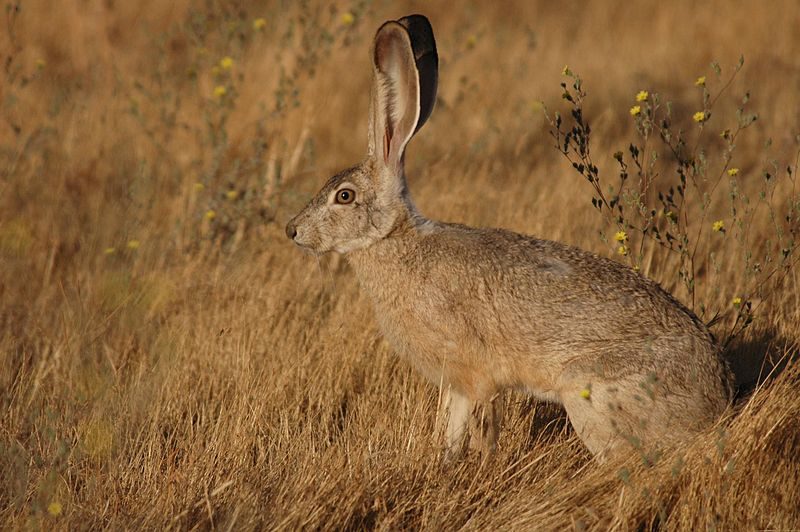
Temperature sets rate, and rate sets everything downstream
- Ege and Krogh 1914 / Clarke and Fraser 2004: temperature determines metabolic rate. The slide pairs one goldfish with 68 fish species — the same relationship within an individual and across a clade, which is what makes it a law.
- O’Connor et al. 2006: planktonic larval development time falls as temperature rises. Because development time sets drift duration, it predicts larval dispersal and survival, and hence distribution and abundance.
- Scranton and Amarasekare 2017 (PNAS): life-history traits vs temperature for temperate Apolygus lucorum, Mediterranean Murgantia histrionica and tropical Clavigralla shadabi. The relationships are non-linear with clear thresholds, and can predict abundance through the year.
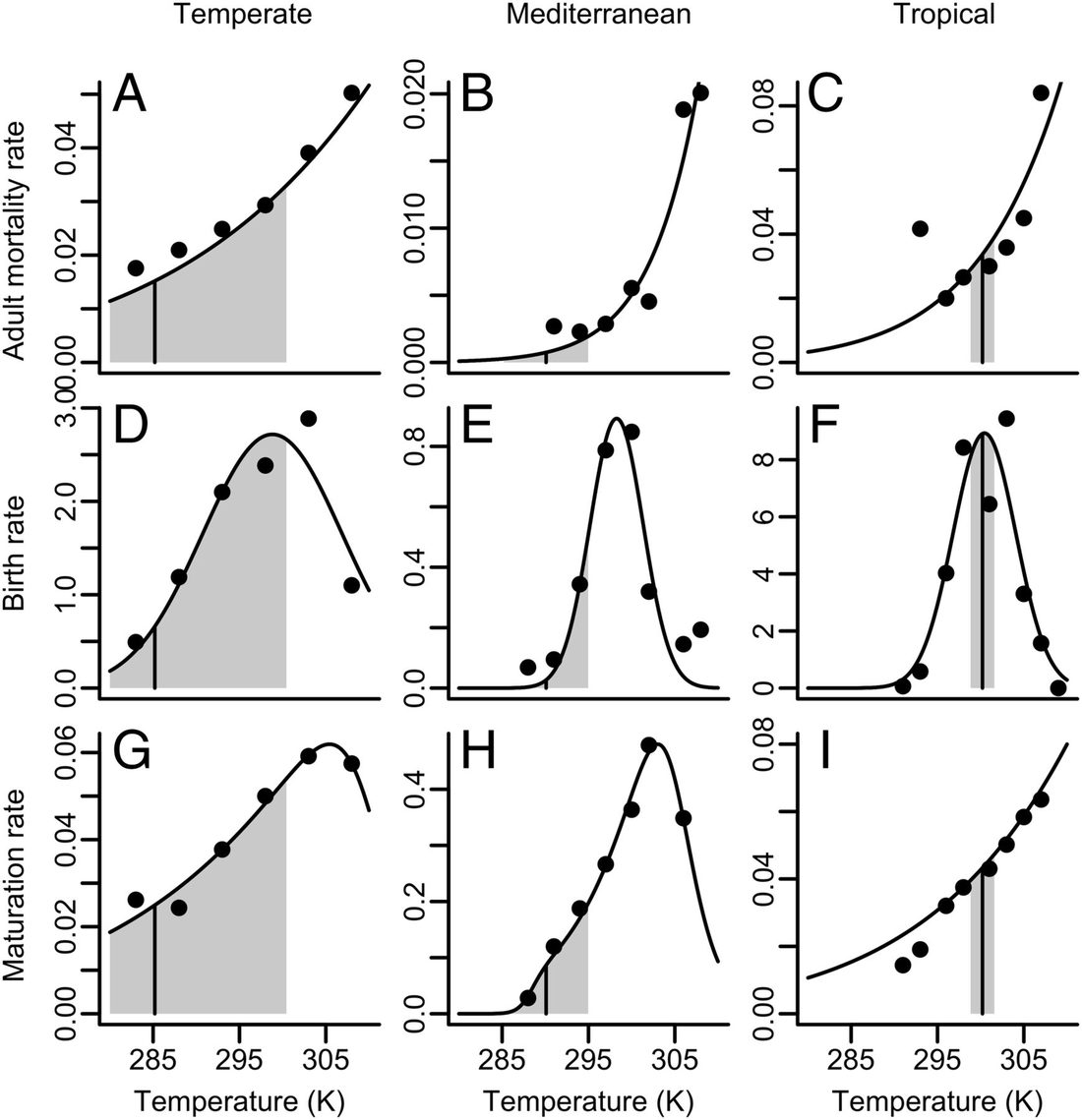
Both ends of the range are lethal
- Kemp et al. 2011: extended cold caused inshore coral mortality. The control that makes it convincing is the offshore Little Grecian reef, where no mass-mortality event occurred.
- Shell formation accelerates when warm and is suppressed when cold, so coral distributions follow the 20 °C isotherm, between 30 N and 30 S (text p. 106).
- The northern limit of the Eastern phoebe (Sayornis phoebe) US winter range follows the −4 °C isotherm (Root 1988) — the cleanest physiology-to-map example in the course.
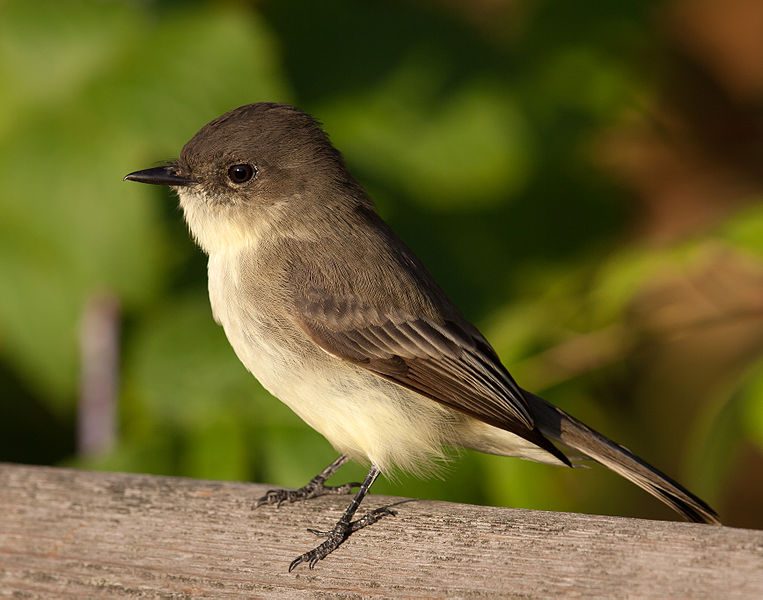
Bergmann, Allen, and the argument he adds
- Allen’s rule: shorter appendages in colder environments; his stated mechanism is that lower surface area minimises heat dissipation (text p. 110).
- Bergmann’s rule: among close relatives, the largest species occur at higher latitudes — polar bear north, Malayan sun bear in the tropics (text p. 109).
- Both are the surface-area-to-volume ratio in different anatomy, not two separate principles.
- It also applies within a species: moose body size increases with latitude (Sand et al. 1995).
- Two competing hypotheses, and he wants both. Heat conservation (Bergmann 1947): less surface per volume, slower heat loss. Energy reserves (Lindstedt and Boyce 1985): more stored fat, longer survival of food scarcity. Both predict the same pattern, so only evidence about starvation separates them.
- Kaspari and Vargo 1995 extend the rule to social insect colony size: temperate colonies run about 10% larger, hypothesised as buffering against seasonality and tested by mimicking a winter food shortage.
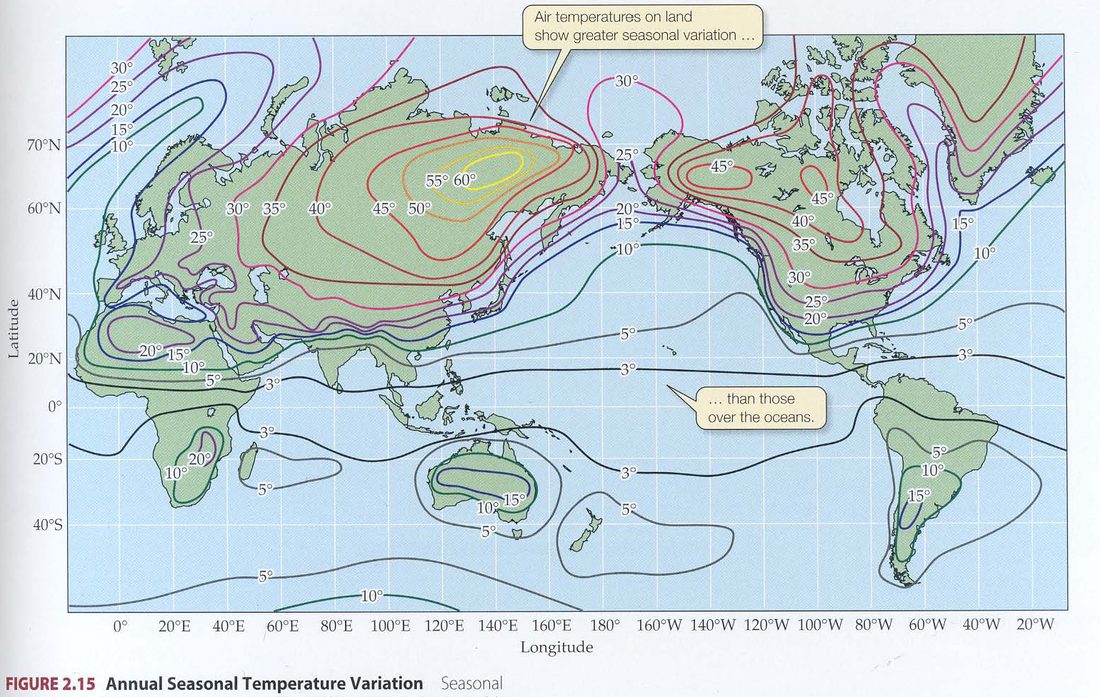
Greenhouse gases and the carbon record
- Key atmospheric gases absorb long-wave infrared radiation (Chapin 2011). Without the greenhouse effect Earth would sit near −17 °C rather than a balmy +15.
- Keeling curve: CO2 dips May–October because northern plants take it up through the growing season; the rest of the year is net release via respiration. The swing is largest in the Northern Hemisphere because that is where most of the land is (Conway et al. 1998; Schlesinger and Bernhardt 2013).
- Human sources add a net 4 gigatonnes of carbon a year — roughly one twentieth the mass of all living things on Earth.
- Greenhouse gases differ in potency and source (text p. 115), which is why methane and nitrous oxide matter out of proportion to their concentration.
What the anomalies actually say
- Warming is about +1.19 °C on the 20th-century average. The 2025 anomaly was +1.20 above the 1951–1980 average, second warmest on record; 2024 holds the record at +1.29.
- Two asymmetries: stronger in winter than summer, and stronger in the Northern hemisphere than the Southern.
- Arctic amplification runs 2–4× the global mean; recent work attributes it to large weather systems.
- The counterintuitive half: oceans are warming less than the air, but ecological responses there are predicted to be more drastic than on land.
Forecasting what warming does to ranges
- The logic is a conditional: if we know species-specific requirements for water, temperature and light, then we can predict where and when distributions shift. ForeCASTS is his worked example at scale.
- Ranges move: poleward ~17 km/decade and upslope ~11 m/decade. The pika (Ochotona princeps, USGS 2010) is the montane case; winter bird ranges have moved steadily north since mid-century (EPA / National Audubon Society 2014).
- Phenology shifts: first leaf and bloom arrive earlier in northern regions (USA National Phenology Network).
- Mismatch: shifts are not synchronised, so pollinators and plants decouple (Bartomeus et al. 2011). Mismatch, not warmth itself, is often where the damage is.
- False spring: earlier springs raise the chance plants break dormancy and are then caught by a later frost. Warming does damage through variance and timing, not only the mean.
- Escalator to extinction: a species retreating upslope eventually runs out of mountain.
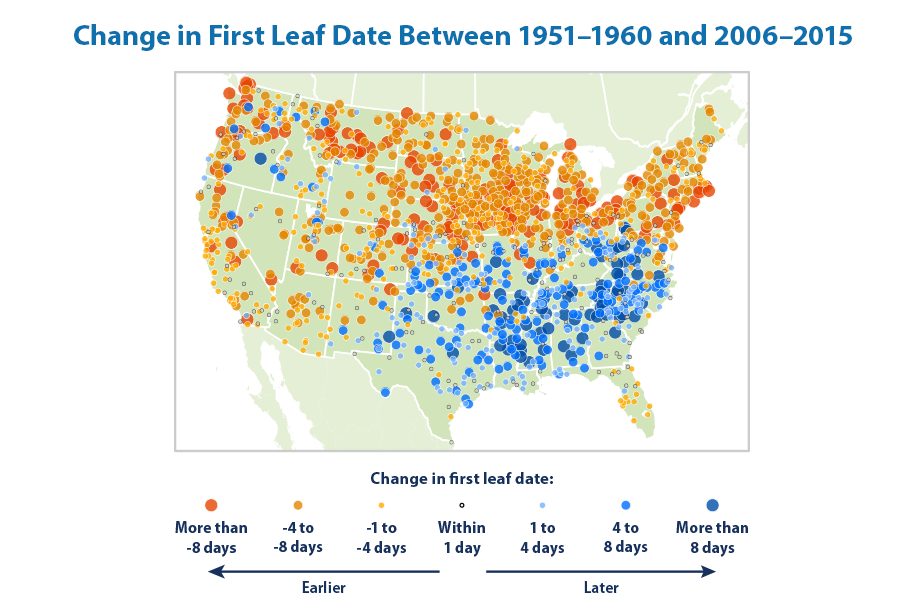
Lecture 3 as delivered — the 1 September session
The companion above follows the posted deck. This one follows the recording, and covers what he said in the room that the slides do not carry: the numbers he read out, the three visualisations, the design of the ant experiment, and one summary point he flagged himself as missing from his own slide.
How he runs the room now
- He opens with graphical analysis: a graph with every axis label stripped off, thirty to sixty seconds talking to your neighbour, then observations from the floor.
- He wants observations, not interpretations. He stopped a student who named what the graph was with “you are kind of jumping two steps ahead — I just want what you see.” Expect that distinction to matter on figure questions.
- From week two he calls on people at random. You are allowed to pass.
- The warm-up graph was CO2 against latitude and time: three axes, flatter at the front, hillier towards the back, and repeating. That is the seasonal cycle, with a much larger amplitude at northern latitudes.
The Keeling curve, with the numbers he read out
- The record begins in 1958 and runs to today, with a few gaps he pointed at — a volcanic eruption made the observatory hard to keep running.
- The latest reading he quoted was 427.03 ppm. It was about 380 ppm when he started undergraduate study, so roughly 40 to 50 ppm in a little over twenty years.
- Against the 800,000-year reconstruction, nothing in that record approaches today's level. Current CO2 is genuinely unprecedented on that timescale.
- Within a year: a net decrease from about April through August as the growing season draws CO2 down, and a net increase through autumn, winter and early spring driven by respiration.
- Why the swing is larger in the north is a land-area argument: more land, more plants responding to seasonality, therefore a bigger annual fluctuation. The Southern Hemisphere is comparatively stable.
- His framing is worth keeping: these are cellular processes detectable at a global scale.
The carbon cycle, as pools and fluxes
- Photosynthesis draws roughly 120 petagrams of carbon per year into plants. Plant respiration returns about 60, and microbial respiration and decomposition of soil carbon returns about another 60. Plant biomass itself he put near 150 petagrams.
- Photosynthesis and respiration very nearly balance. The point of the diagram is that they no longer balance exactly.
- The imbalance is a net 4 gigatonnes of carbon per year — four billion metric tonnes, or about one twentieth the mass of all living things on Earth.
- His phrase for the source: we are digging up ancient photosynthesis out of the fossil pool and putting it back into the atmosphere.
Greenhouse potency, read as a table
- The table gives relative absorption per one ppm increase, with carbon dioxide set to 1.
- Methane: 32×. Nitrous oxide: 150×. CFCs: greater than 10,000×.
- That is why gases present at tiny concentrations still matter out of all proportion to their abundance.
The three visualisations he used
- Climate stripes. Each vertical line is one year's temperature against the 20th-century average; cool colours dominate the first half of the century and warm colours the recent decades. Green and brown stripes mark wetter and drier years. His own reading of the moisture record is honest: no clean drought trend to his eye, but more extremes at both ends — very dry or very wet, with less in between. He notes the graphic has been printed on flip-flops and ties.
- Anomaly maps. Reds indicate changes above 3 °C, with anomalies of 4, 5 and 6 °C concentrated over Greenland, Canada, northern North America and Siberia.
- The climate spiral. One loop per year; the green circle is the 20th-century average and anything outside it is warmer. The track now runs near 1 to 1.5 °C.
His summary — including the line that is not on his slide
- Global temperatures have increased about 1.2 °C above the 20th-century average. The 2025 anomaly is 1.2 above the 1951–1980 average. 2024 is the warmest year on record and 2025 is second.
- Warming is stronger in winter than in summer.
- Warming is stronger in the Northern Hemisphere than the Southern.
- Nighttime temperatures are warming faster than daytime temperatures. He flagged this himself as “the point that I didn't put on here”, which makes it precisely the sort of thing worth remembering.
- Oceans are warming less than the air, but the ecological responses there may be more drastic, because marine organisms are adapted to far more stable temperatures and have less tolerance for change.
Coral, with the story attached
- Dusty Kemp, a friend of the instructor, did his dissertation on coral in the Florida Keys. Temperature loggers placed for a different part of the project happened to capture an extended cold snap in December 2010 into January.
- Before-and-after photographs across several coral species show a bleaching event caused by cold — the same outcome normally associated with heat. He is candid that the finding was captured by accident, which is part of why it is a good example.
- The mechanism: coral is a symbiosis between a heterotroph and an autotroph. The autotrophs are zooxanthellae; they photosynthesise and they supply the colour. Stress at either extreme makes the coral expel them, which is what bleaching is, and an extended bleaching eventually kills the coral.
- Distribution follows from physiology: shell formation accelerates when warm and is suppressed when cold, so corals track the 20 °C isotherm, between 30°N and 30°S, where sunlight is most intense and temperatures most stable.
Isotherms on land, and the question the whole course is asking
- Eastern phoebe: the −4 °C winter isotherm runs along the Appalachians and down into Texas, and the bird's winter range sits south of it. Pull up a field guide and the range map reproduces that line.
- Trumpeter swan, from the Cornell Lab of Ornithology: non-breeding in the central Great Plains, migrating through the northern and central Plains into Canada, breeding from Alaska across to eastern Canada. Behaviour and temperature together explain the map. He also mentioned ornithology is being offered in the spring.
- All of this serves the central question: what explains the distribution and abundance of animals and plants across the globe.
Allen and Bergmann, with his actual examples
- Allen's rule: shorter appendages in colder climates. The jackrabbit you would see in Nebraska, Kansas or Texas has large ears; the snowshoe hare, at comparable body size, has noticeably shorter ones. Less surface area means less heat dissipation.
- Plants get the same treatment, which the deck does not do: leaf shape varies with climate, a southern maple in South Carolina against a bigleaf maple in Oregon temperate rainforest, trading heat dissipation against capturing as much light as possible.
- Two more plant strategies for cold: some species up-regulate antifreeze proteins over winter (cold acclimation) so their cells do not freeze, and deciduous species simply drop their leaves in autumn.
- Bergmann's rule: among closely related animals the largest species occur at higher latitudes. Polar bear in the Arctic is the largest; the Malayan sun bear in the tropics is the smallest.
- It also holds within a species: moose body mass rises with latitude, plotted separately for males and females.
- He gives two hypotheses and does not pick one: heat conservation (a bulkier animal conserves heat better) and energy reserves (a bigger animal carries more fat and survives scarcity longer), the latter from the 1985 paper. He is explicit that we do not have a concrete picture of which is right.
The ant experiment, in the detail he gave it
- Kaspari and Vargo asked whether Bergmann's rule could apply to a colony rather than a body. They excavated colonies in the tropics (Kaspari works largely in Central America, around Panama) and in temperate areas.
- The graph is read against a one-to-one line: if temperate and tropical colonies were the same size, every point would fall on it. Almost all the points sit above it, so temperate colonies are larger. The axis runs 100, 1,000, 10,000 and in some cases up to about 100,000 individuals.
- The hypothesis: a larger colony is buffered against the seasonal shortage of food and water that a temperate zone imposes every year.
- The test was experimental, not just correlational — a paired design comparing colonies of about 100 workers against about 10,000, deprived of food, and deprived of food and water.
- The readout is queen survival. Queens in the large colonies survived food deprivation far better than those in small ones, which supports the buffering hypothesis.
- A student asked whether individual ant mass also increased, and he said plainly that he did not know and would have to go and check. Worth copying as a model for answering at the edge of the evidence.
The physiology evidence, as he walked it
- One goldfish across a range of temperatures, measured by respiration rate, sits beside 68 fish species at their resting oxygen consumption. The same relationship holds within one individual and across a whole clade, which is what makes it a general rule rather than a quirk.
- Marine invertebrate larvae: warming cuts planktonic development from roughly two and a half to three months down to about two weeks.
- Two consequences follow. Warmer larvae disperse shorter distances, because they spend less time drifting; and survival is lower when it is colder.
- Scranton and Amarasekare: three insects — temperate, Mediterranean and tropical — across nine panels, with temperature on the x-axis in Kelvin. Maturation rate, birth rate and adult mortality are all plotted.
- The relationships are non-linear with thresholds. Rates rise, rise, and then drop off a cliff past a threshold temperature. Those thresholds are exactly what makes prediction possible: above X degrees, expect this population to crash.
- Homeothermy versus heterothermy: a jackrabbit holds its internal temperature no matter the weather; a lizard's tracks the environment, which is why it must bask and hibernate to regulate behaviourally.
Where this goes next
- Temperature and precipitation together set the terrestrial biomes, which is why both get their own treatment.
- He ran out of time and stopped early. Thursday picks up with what all of this means ecologically, and water is the next topic.
U3 · The Aquatic Environment
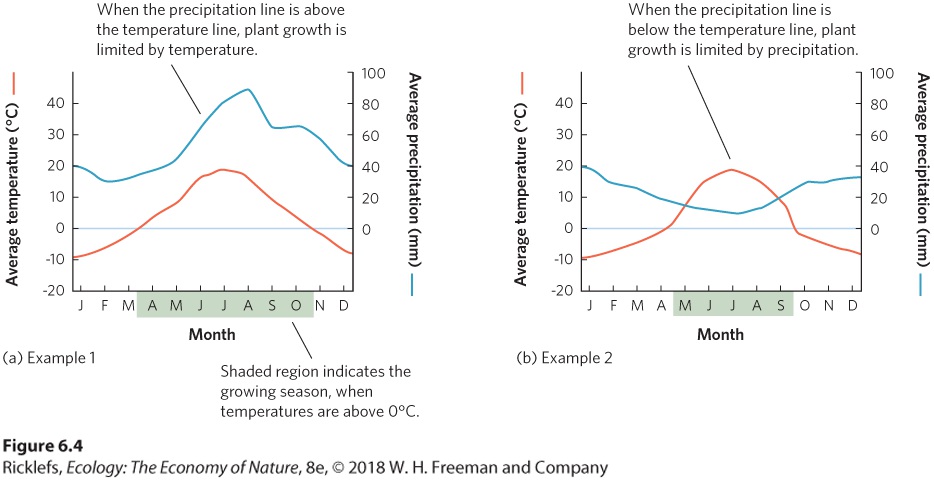
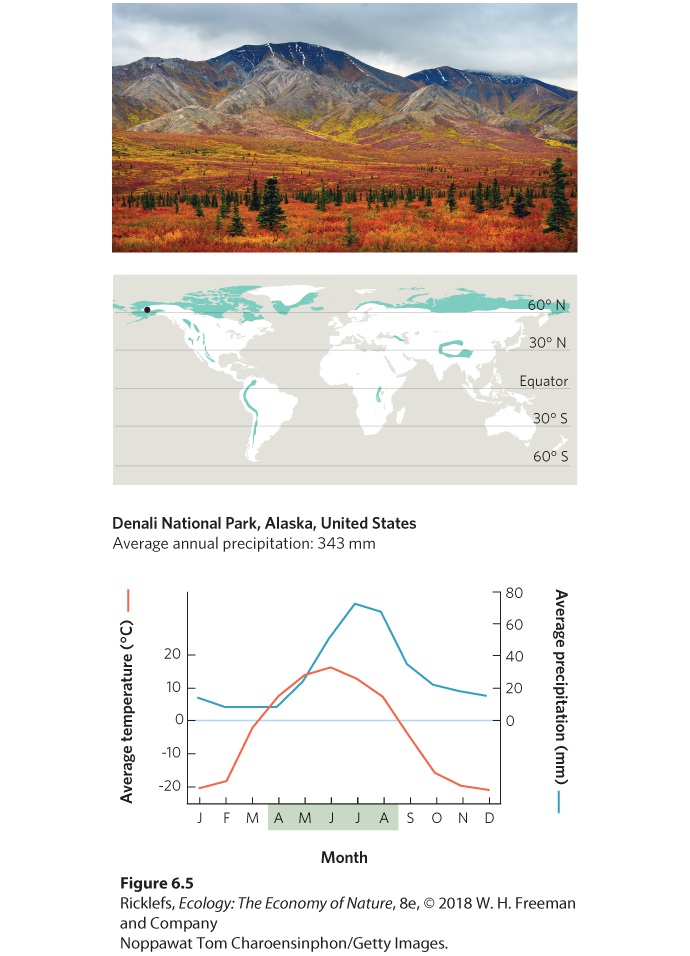
Water has unique properties critical for life: high specific heat, high heat of vaporization, density maximum at 4 °C, and ability to dissolve polar/ionic substances. Water is densest at 4 °C, so ice floats — protecting aquatic life beneath winter ice.
Lake stratification
| Layer | Description |
|---|---|
| Epilimnion | Warm, well-mixed surface layer; high O₂, high light. |
| Thermocline (metalimnion) | Sharp temperature drop with depth — barrier to mixing. |
| Hypolimnion | Cold, dense bottom layer; low O₂, accumulates nutrients. |
Spring + fall turnover: when surface water cools/warms to 4 °C, the layers equalize in density and wind mixes the lake top to bottom — bringing nutrients up + oxygen down.
- Oligotrophic
- Nutrient-poor, deep, clear, cold lake (e.g., Crater Lake).
- Eutrophic
- Nutrient-rich, shallow, warm, often algal-bloom-prone lake.
- Lotic vs lentic
- Flowing (rivers, streams) vs still (lakes, ponds) freshwater systems.
- Salinity
- Dissolved salts; freshwater <0.5 ppt, brackish 0.5–30 ppt, marine 30–37 ppt.
- Estuary
- Where freshwater rivers meet the sea — productive, salinity gradient.
Ocean chemistry
The carbonate buffer system (CO₂ + H₂O ⇌ H₂CO₃ ⇌ HCO₃⁻ + H⁺ ⇌ CO₃²⁻ + 2H⁺) keeps seawater near pH 8.1. Rising atmospheric CO₂ → ocean acidification → lower carbonate ion availability → harder for corals and shellfish to build CaCO₃ shells.
After temperature, water and nutrients are the abiotic factors that most limit life. This lecture covers water balance in plants and animals, osmoregulation, soils, and the nutrient side of Kaspari Principle 3: organisms are chemical machines, and whichever element runs short first controls the machine.
Learning objectives
- Define water potential and trace water movement through the soil-plant-atmosphere continuum.
- Compare osmoregulation in freshwater, marine, and terrestrial animals.
- Contrast C3, C4, and CAM photosynthesis as water-economy strategies.
- Describe soil horizons, texture, cation exchange capacity, and why they set nutrient supply.
- Explain Liebig’s law of the minimum and its modern co-limitation refinement.
- State why nitrogen and phosphorus are THE limiting nutrients, and where each mostly comes from.
Part 1: Water balance
- Water moves down water-potential gradients (from less negative to more negative psi): soil -> root -> stem -> leaf -> atmosphere. Transpiration from leaves generates the pull (cohesion-tension).
- Plants manage the budget with stomata: open = CO2 in but water out; closed = water saved but photosynthesis stops. Every plant strategy is a position on this trade-off.
- C3 (most plants): rubisco fixes CO2 directly; wasteful photorespiration when hot/dry. C4 (corn, prairie grasses): spatially concentrates CO2 — efficient in hot, high-light, dry conditions. CAM (cacti, agaves): opens stomata at NIGHT, stores CO2 as acid — extreme water economy at the cost of slow growth.
- Freshwater animals: water floods in, salts leak out -> excrete copious dilute urine, actively uptake ions at the gills. Marine bony fish: water leaks out -> drink seawater, secrete salt at the gills. Terrestrial: conserve — loop of Henle (concentrated urine), uric acid excretion (birds, reptiles, insects), waterproof integuments.
- The kangaroo rat closes the budget on metabolic water alone: no drinking, ultra-concentrated urine, nocturnality, and dry-seed diet — the benchmark desert osmoregulator.
Part 2: Soils — the nutrient bank
- Horizons: O (organic litter), A (topsoil — humus + minerals, most roots), B (subsoil — accumulation of leached material), C (weathered parent material), R (bedrock).
- Texture triangle: sand (drains, poor retention), silt, clay (holds water and Cations but poorly aerated). Loam = the fertile mix.
- Cation exchange capacity (CEC): negatively charged clay + humus surfaces hold Ca2+, Mg2+, K+, NH4+ against leaching — the soil’s nutrient bank account. Sandy, low-organic soils have low CEC = poor bank.
- pH controls availability: acid soils leach cations and free toxic Al3+; alkaline soils lock up Fe and P. Most crops and prairie plants peak near pH 6–7.
- Prairie soils (mollisols) are deep, dark, organic-rich — why the Great Plains feed continents and why so little tallgrass prairie is left (plowed).
Part 3: Limiting nutrients
- Liebig’s law of the minimum: growth is limited by the scarcest resource relative to demand (the shortest barrel stave), not by the total.
- Modern refinement: co-limitation — adding N AND P together often stimulates more than either alone; limitation can switch seasonally and successionally.
- Nitrogen: 78% of air but inert; usable N enters via N-fixation (rhizobia, free-living cyanobacteria, lightning) — biologically expensive (16 ATP per N2). Terrestrial systems and young soils are typically N-limited.
- Phosphorus: no atmospheric phase; comes from rock weathering, so old weathered soils (tropics) and many lakes are P-limited. Redfield ratio ≈106 °C:16N:1P benchmarks aquatic stoichiometry.
- Stiling 27.6 hook (eutrophication preview): human N and P loading (fertilizer, sewage) removes the limit -> algal blooms -> decomposition -> hypoxic dead zones (Gulf of Mexico). The limiting-nutrient logic run in reverse.
- Micronutrients matter at trace doses: iron limitation over huge ocean areas (HNLC zones) — iron-addition experiments bloom phytoplankton.
Condensed review — most likely to be tested
- Water flows toward more negative water potential; transpiration pull drives the column.
- Stomata trade CO2 for water; C3/C4/CAM are three positions on that trade-off.
- Freshwater fish pump ions IN and excrete dilute urine; marine fish drink and pump salt OUT.
- CEC = clay + humus surfaces holding cations; the soil nutrient bank.
- Liebig: the scarcest resource relative to demand limits growth; co-limitation is the modern refinement.
- N-limitation: young soils, temperate/terrestrial; P-limitation: old tropical soils, many lakes (P has no gas phase).
- Redfield ratio 106:16:1 (C:N:P).
- Eutrophication = removing the nutrient limit: blooms, decomposition, hypoxia.
Mnemonic set
- “O-A-B-C-R: Only A Big Cat Rests — soil horizons top to bottom.”
- “C4 concentrates, CAM calendars — space vs time solutions to the same problem.”
- “Freshwater fish pee, marine fish drink.”
- “The shortest stave sets the water line — Liebig’s barrel.”
- “N from air (fixed), P from rock (weathered).”
Self-test
- Rank at midday, driest to wettest in water potential: atmosphere, leaf, soil, root.
- Why do C4 grasses dominate the hot, high-light tallgrass prairie while C3 plants dominate cool spring months?
- A marine bony fish and a freshwater fish are swapped between tanks. Predict each failure.
- Two soils: deep clay loam with 6% organic matter vs sand with 0.5%. Which supports higher CEC, and what does that mean after fertilization?
- A lake receives sewage for a decade. Trace the chain from nutrient to dead fish.
- Ocean regions with plenty of N and P but little chlorophyll (HNLC) bloom when dosed with iron. Explain via Liebig.
Show answer key — try the questions first
- Atmosphere (most negative, often -100 MPa) < leaf < root < soil (least negative). Water flows soil -> root -> leaf -> atmosphere down this gradient.
- C4 spends ATP to concentrate CO2, eliminating photorespiration — a win when hot and bright, a waste when cool. Hence warm-season C4 dominance and cool-season C3 activity — temporal niche partitioning on photosynthetic pathway.
- Marine fish in freshwater: floods with water and loses ions (it drinks and pumps salt out — exactly backwards) — cells swell. Freshwater fish in seawater: dehydrates and salt-loads (it pumps ions in and pees copiously — also backwards).
- The clay loam: clay + humus carry the negative exchange surfaces. After fertilization it retains NH4+, K+, Ca2+ against leaching; the sandy soil lets them wash to groundwater.
- P (and N) loading removes the limiting-nutrient brake -> algal bloom -> algae die -> bacterial decomposition consumes dissolved O2 -> hypolimnetic hypoxia -> fish kills. Eutrophication is Liebig in reverse.
- The limiting factor was not N or P but the micronutrient iron; adding the scarcest resource relative to demand releases growth regardless of how abundant the others are.
U4 · The Terrestrial Environment
Soil = mineral particles + organic matter + water + air + living organisms. Forms over thousands of years from weathering of bedrock by physical, chemical, and biological agents.
- Soil horizons
- O (organic litter) → A (topsoil, dark, humic) → E (eluviated, leached) → B (subsoil, accumulation) → C (parent material) → R (bedrock).
- Soil texture
- Relative % of sand / silt / clay. Loam = best balance for water + air + nutrients.
- Cation exchange capacity (CEC)
- Ability of soil particles (esp. clay + humus) to hold cations like Ca²⁺, K⁺, NH₄⁺ for plant uptake.
- Field capacity
- Water held in soil after gravity drainage — available to plants.
- Wilting point
- Soil moisture below which plants cannot extract water.
- Five soil-forming factors
- Climate, organisms, relief (topography), parent material, time (Jenny's CLORPT).
U5 · Plant & Animal Adaptations
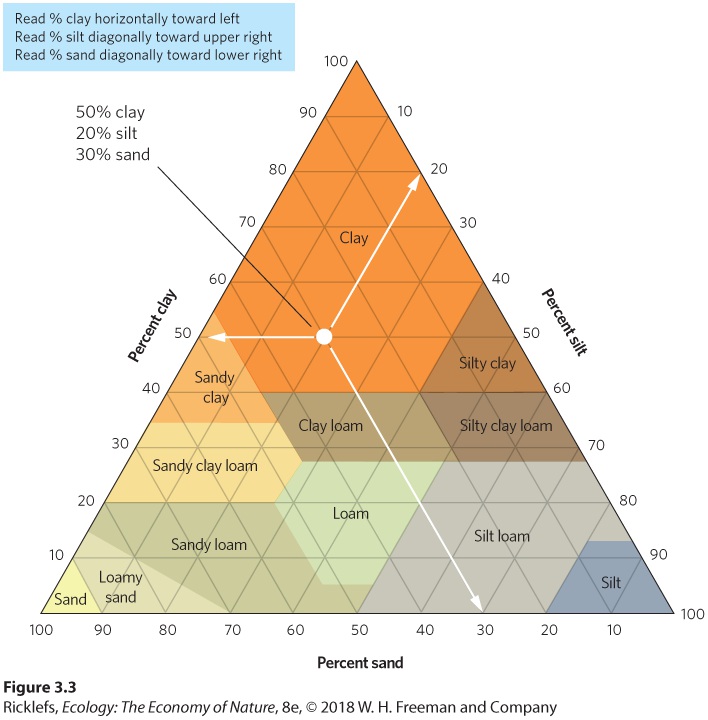
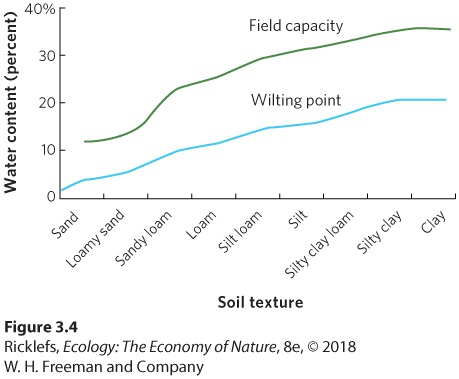
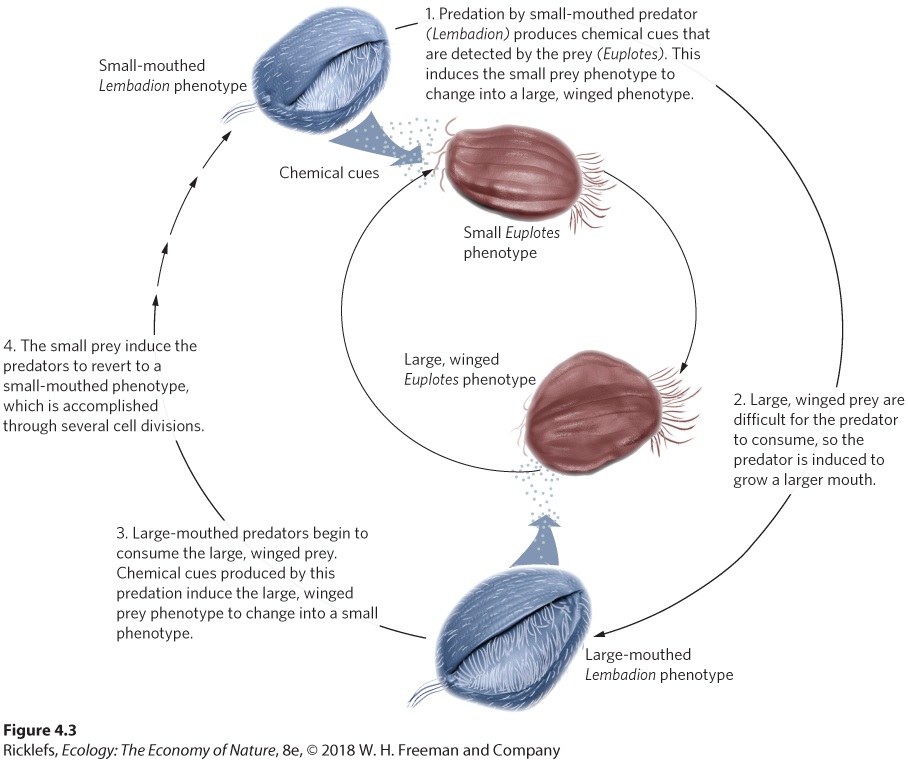
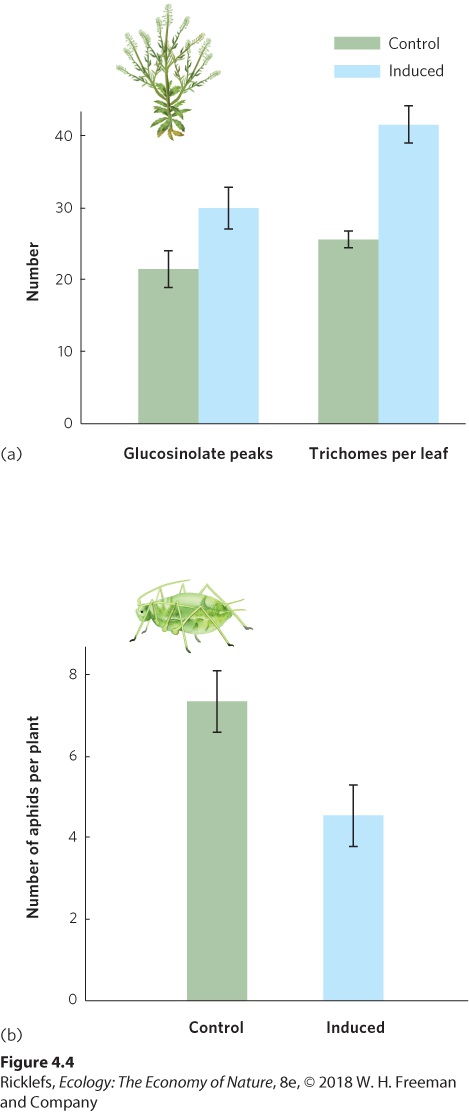
Plant adaptations
| Photosynthesis pathway | Where | Trade-off |
|---|---|---|
| C3 | Most temperate plants | Cool/wet conditions; loses CO₂ to photorespiration in heat. |
| C4 | Tropical grasses, corn, sugarcane | Concentrates CO₂ with PEP carboxylase → efficient in hot/sunny. |
| CAM | Succulents (cacti, agave) | Stomata open at night → minimal water loss in deserts. |
Animal thermal strategies
- Ectotherm
- Body T set by environment (reptiles, fish). Low metabolic cost; behavior-based thermoregulation.
- Endotherm
- Generates heat metabolically (mammals, birds). High food cost; constant body T.
- Heterotherm
- Switches modes — bats, hummingbirds (torpor); ground squirrels (hibernation).
- Bergmann's rule
- Endotherms tend to be larger in colder climates (lower SA:V → less heat loss).
- Allen's rule
- Appendages tend to be shorter in colder climates (less SA for heat loss).
- Countercurrent heat exchange
- Arteries and veins run antiparallel → heat transferred back to body before reaching cold extremities.
Ecology and evolution are one subject on two timescales: ecological interactions generate selection, and evolutionary change feeds back into ecology. This lecture is the toolkit — variation, selection, drift, gene flow — and the evidence that adaptation is observable in real time.
Learning objectives
- State the three conditions for evolution by natural selection and connect them to dN/dt = B — X + I.
- Distinguish directional, stabilizing, and disruptive selection with examples.
- Define genetic drift, founder effects, and bottlenecks, and say when drift beats selection.
- Explain gene flow’s two faces: rescue and swamping.
- Interpret heritability and the breeder’s equation R = h2 x S.
- Describe rapid evolution examples relevant to this course (Darwin’s finches, industrial melanism, urban evolution, resistance).
Part 1: The engine
- Natural selection requires exactly three things: variation in a trait, heritability of the trait, and differential survival/reproduction tied to it. Nothing else. Fitness = contribution of offspring to the next generation — the B and X of Kaspari P5.
- Selection acts on Phenotypes; evolution is change in Allele frequencies. Individuals do not evolve, populations do.
- Three modes: directional (one tail favored — finch beak depth in drought), stabilizing (mean favored — human birth weight), disruptive (both tails — African seedcracker bill sizes matching two seed types).
- The breeder’s equation: response R = heritability (h2) x selection differential (S). High selection with zero heritability = zero evolution; that is why the heritability condition matters.
Part 2: The non-selective forces
- Genetic drift: random allele-frequency change from sampling error; strong in SMALL populations (probability of fixation of a neutral allele = its frequency). Drift beats weak selection when Ne is small.
- Bottleneck: population crash strips variation (northern elephant seals — hunted to ≈20, now genetically uniform; cheetahs). Founder effect: new population carries only the founders’ alleles (island endemics, Amish polydactyly).
- Gene flow homogenizes populations. Rescue: immigrants restore variation and mask inbreeding (Florida panther x Texas cougars — genetic rescue). Swamping: immigration of maladapted alleles prevents local adaptation at range edges.
- Inbreeding depression: small closed populations expose deleterious recessives — lower fitness without any allele-frequency direction. The conservation triad: small N -> drift + inbreeding -> less variation -> less adaptability.
Part 3: Evolution you can watch
- Darwin’s finches (Grants, Daphne Major): 1977 drought killed small-seeded plants; only large-beaked Geospiza fortis cracked the remaining seeds; mean beak depth increased in ONE generation — and reversed in wet years. Selection oscillates.
- Industrial melanism (Biston betularia): soot removed lichens -> dark morphs camouflaged from birds -> frequency rose; clean-air acts reversed it. Kettlewell’s predation experiments confirmed the agent.
- Resistance evolution: antibiotics, herbicides (Roundup-resistant Amaranthus), insecticides — directional selection humans impose, at economically painful speed.
- Urban evolution: Cliff swallows near roads evolved shorter wings (roadkill selection); city Anolis lizards longer limbs and stickier toes; urban heat islands select thermal tolerance — “ecological time” and “evolutionary time” are the same time.
- Eco-evo feedback: evolution is fast enough to change ecology (beak change alters seed dynamics; resistance changes pest control), which changes selection again. This is why an ecology course starts with evolution.
Condensed review — most likely to be tested
- Three conditions: variation, heritability, differential reproduction — nothing more.
- Selection sees phenotypes; evolution is allele-frequency change in populations.
- Directional / stabilizing / disruptive — know one example each.
- R = h2 x S: no heritability, no response.
- Drift rules small populations; bottlenecks and founder effects are drift’s signatures.
- Gene flow rescues (Florida panther) or swamps (range-edge maladaptation).
- Finch beaks changed in one generation and reversed — selection oscillates.
- Resistance and urban evolution: humans are the strongest selective agent (Kaspari P9).
Mnemonic set
- “VHD: Variation, Heritability, Differential reproduction — the whole engine.”
- “Direction moves the mean, stability squeezes it, disruption splits it.”
- “Small N, drift wins.”
- “Rescue or swamp — gene flow has two faces.”
- “R = h2S — the breeder’s one-liner.”
Self-test
- Bacteria in a hospital evolve antibiotic resistance in months. Name the three conditions being met.
- Human birth weight historically clustered near 7.5 lb, with higher mortality at both extremes. Mode of selection, and what does modern medicine do to it?
- Northern elephant seals recovered from ≈20 individuals to >100,000 but remain genetically uniform. Explain the mismatch between census recovery and genetic recovery.
- Florida panthers showed kinked tails and heart defects until Texas cougars were introduced. What was wrong and what did the introduction do?
- The Grants measured beak depth rising after the 1977 drought and falling after wet 1983. Why does this argue Against evolution being slow and directional?
- Write the breeder’s equation and use it: h2 = 0.6, parents selected 2 mm above the mean. Expected offspring response?
Show answer key — try the questions first
- Variation (resistance mutations exist), heritability (vertical + horizontal transmission), differential reproduction (antibiotic kills susceptibles). Enormous S plus short generations = fast R.
- Stabilizing selection. Caesareans and neonatal care weaken mortality at the extremes, relaxing the squeeze — the selection differential shrinks.
- The bottleneck stripped allelic variation; drift fixed what remained. Population SIZE recovers in decades; variation only re-accumulates by mutation over far longer timescales. Big N today, small-Ne legacy.
- Inbreeding depression exposed deleterious recessives in a tiny closed population. Gene flow (genetic rescue) masked the recessives and restored heterozygosity; fitness and population growth rose.
- Selection tracked the food environment year to year: oscillating, sometimes reversing, and measurable within single generations. Evolution runs at ecological speed when selection is strong.
- R = h2 x S = 0.6×2 = 1.2 mm above the original mean.
Two halves with one theme — how individual-level processes generate the diversity ecology studies. First: how one species becomes two (and how species are lost). Second: behavioral ecology — foraging, fighting, mating — as economics, where fitness is the currency.
Learning objectives
- Compare species concepts (biological, morphological, phylogenetic) and their failure cases.
- Distinguish allopatric, peripatric, parapatric, and sympatric speciation with examples.
- Classify pre- vs postzygotic isolating barriers.
- Explain reinforcement, hybrid zones, and adaptive radiation.
- Apply optimal foraging theory and the marginal value theorem qualitatively.
- Contrast mating systems and explain sexual selection’s two mechanisms.
Part 1: Making species
- Biological species concept: reproductively isolated interbreeding groups — fails for asexuals, fossils, and hybridizing plants. Morphological: look-alike grouping — fails for cryptic species. Phylogenetic: smallest diagnosable clade — inflates counts. Use the right tool for the organism.
- Allopatric speciation (the default): a geographic barrier splits a population; drift + divergent selection accumulate incompatibilities (Grand Canyon squirrels; snapping shrimp split by the Isthmus of Panama — sister pairs on each side).
- Peripatric: small edge isolate diverges fast (founder + drift). Parapatric: adjacent zones with a selection gradient (mine-tailing grasses evolving metal tolerance next to pasture). Sympatric: divergence without geography — host shifts (apple maggot fly Rhagoletis moving from hawthorn to apple), polyploidy in plants (instant speciation — a major plant mode).
- Prezygotic barriers: habitat, temporal (fields crickets breeding in different seasons), behavioral (song, courtship), mechanical, gametic. Postzygotic: hybrid inviability, hybrid sterility (mule), hybrid breakdown (F2 collapse).
- Reinforcement: where ranges overlap, selection strengthens prezygotic barriers because hybrids waste effort — displacement of mating traits in sympatry.
- Adaptive radiation: one lineage, many niches, fast — Galapagos finches, Hawaiian silverswords, African cichlids (500+ species in Lake Victoria, partly by sensory-drive sexual selection).
Part 2: Behavioral economics
- Behavioral ecology treats behavior as a trait under selection: benefits and costs in fitness currency.
- Optimal foraging theory: maximize energy gain per time. Diet model: specialize when profitable prey are common; broaden when they are rare. Crows dropping whelks from ≈5 m (the height minimizing total flight cost) are the classic test.
- Marginal value theorem: leave a depleting patch when instantaneous gain drops to the habitat average; longer travel times between patches -> stay longer per patch.
- Risk changes the optimum: foraging under predation risk shifts animals to safer, poorer patches (“ecology of fear” — preview of the predation lectures).
- Territoriality pays only when resources are economically defendable: benefit (exclusive food/mates) > cost (patrol, fights, conspicuousness). Sunbirds defend flower patches only at intermediate nectar levels.
- Sexual selection: intrasexual (male-male combat — antlers, elephant seal beachmasters) and intersexual (female choice — peacock trains, bower quality). Why choosy females? Good genes, direct benefits, runaway. The handicap logic: only honest signals stay informative.
- Mating systems follow resource dispersion: monogamy (biparental care needed), polygyny (defendable clumped resources or females), polyandry (rare — jacanas), promiscuity/leks (sage grouse — females choose among displaying males).
- Altruism preview: helping kin pays via inclusive fitness — Hamilton’s rule rb > c (bee workers, helper birds). Reciprocity works with repeated interactions (vampire bat blood sharing).
Condensed review — most likely to be tested
- Species concepts: biological / morphological / phylogenetic, and where each breaks.
- Allopatric is the default; sympatric needs host shifts or polyploidy; polyploidy = instant plant speciation.
- Pre- vs postzygotic barriers; mule = hybrid sterility; reinforcement sharpens prezygotic barriers in sympatry.
- Adaptive radiation: finches, silverswords, cichlids.
- Optimal foraging: maximize gain per time; MVT: leave at the habitat-average gain rate.
- Economically defendable territory: benefit > cost, at intermediate resource levels.
- Sexual selection: combat (intrasexual) vs choice (intersexual); honest handicaps.
- Hamilton’s rule rb > c explains kin altruism.
Mnemonic set
- “Allo splits, peri buds, para borders, sym stays home — the four speciation geographies.”
- “Before the zygote: HTBMG (Habitat, Temporal, Behavioral, Mechanical, Gametic).”
- “Leave at the average — the marginal value theorem in four words.”
- “Fight or charm — the two sexual selections.”
- “rb > c — help kin when the math works.”
Self-test
- Snapping shrimp on either side of the Isthmus of Panama are morphologically similar sister species that no longer interbreed. Which speciation mode, and what is the evidence?
- Apple maggot flies shifted from hawthorn to apple ≈150 years ago; host preference and breeding time now differ. Why is this called incipient Sympatric speciation?
- A mule is vigorous but sterile. Classify the barrier, and explain why horse and donkey are still good biological species.
- Crows drop whelks from about 5 m even though higher drops break shells more reliably. Explain with optimal foraging.
- Using the marginal value theorem, predict patch residence when travel time between flower patches doubles.
- Sage grouse males display on leks and provide nothing but sperm; females are extremely choosy. Which sexual-selection mechanism, and why so choosy here?
Show answer key — try the questions first
- Allopatric: the isthmus (closed ≈3 Mya) is the vicariant barrier; sister pairs straddle it, and divergence time matches the closure. Similar morphology shows isolation preceded much visible change.
- No geographic barrier: host choice itself creates assortative mating (flies mate on their host fruit) plus temporal isolation (apple ripens earlier). Divergence in the same landscape.
- Postzygotic — hybrid sterility. Gene flow is blocked (hybrids are dead ends), so the two gene pools stay separate, satisfying the BSC.
- Total cost = flights x height. ≈5 m minimizes cumulative flight height per opened whelk; higher single drops save attempts but cost more per flight. They optimize energy per success, not success per drop.
- Residence increases: longer travel lowers the habitat-wide average gain rate, so the leaving threshold drops and each patch is depleted further before departure.
- Intersexual selection (female choice). With no resources or care on offer, genes are the only benefit — choice concentrates on displays as (handicap-honest) indicators, producing extreme male ornament and skewed mating success.
U6 · Population Properties & Growth
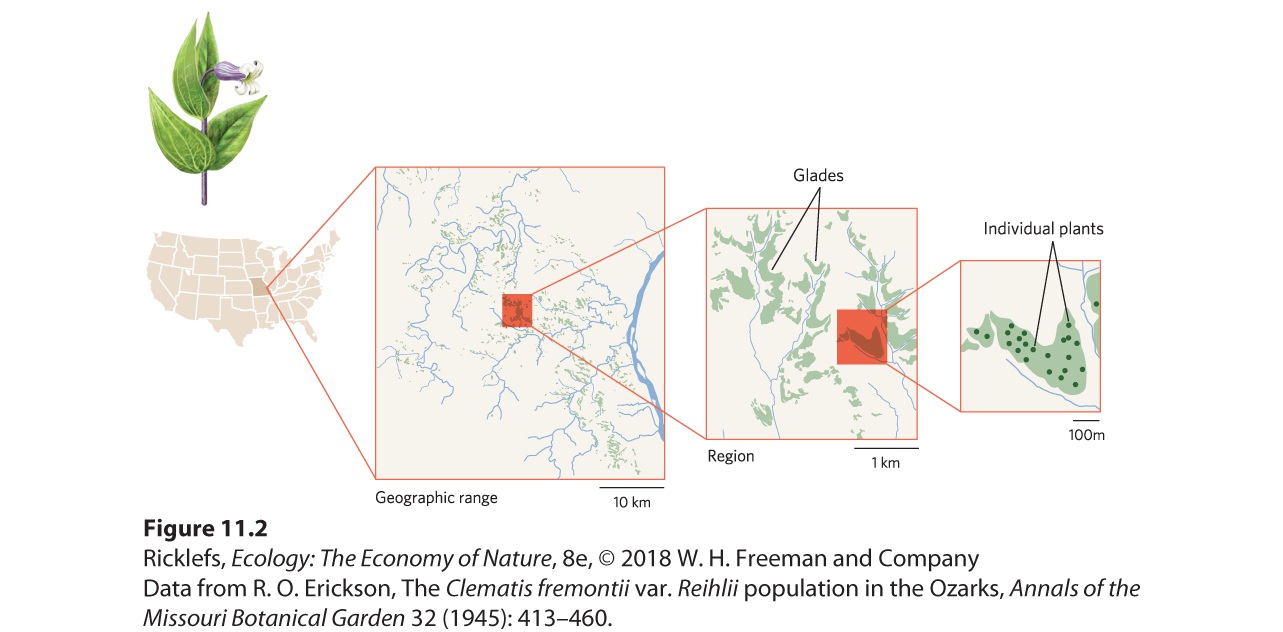
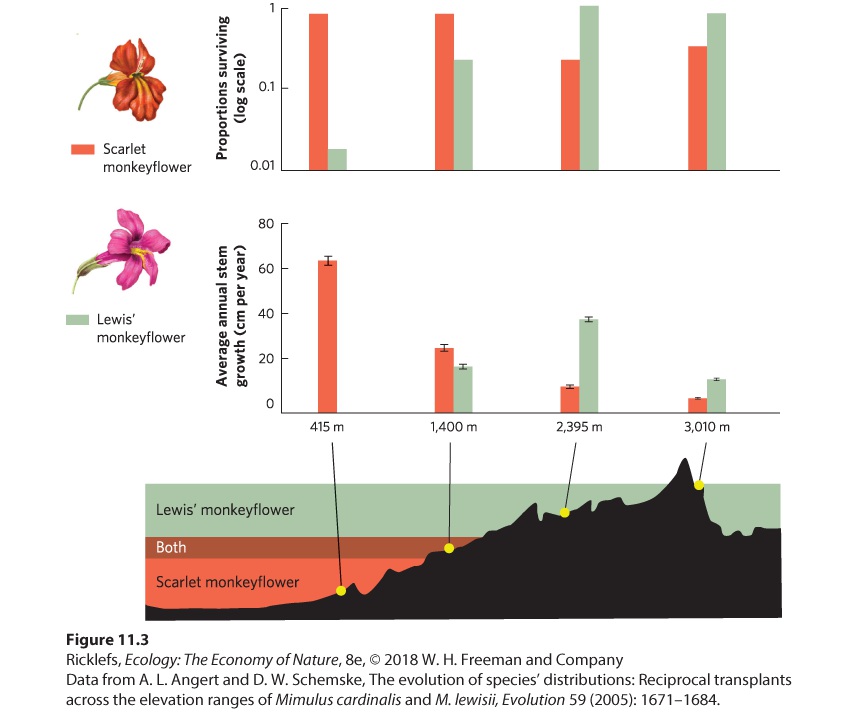
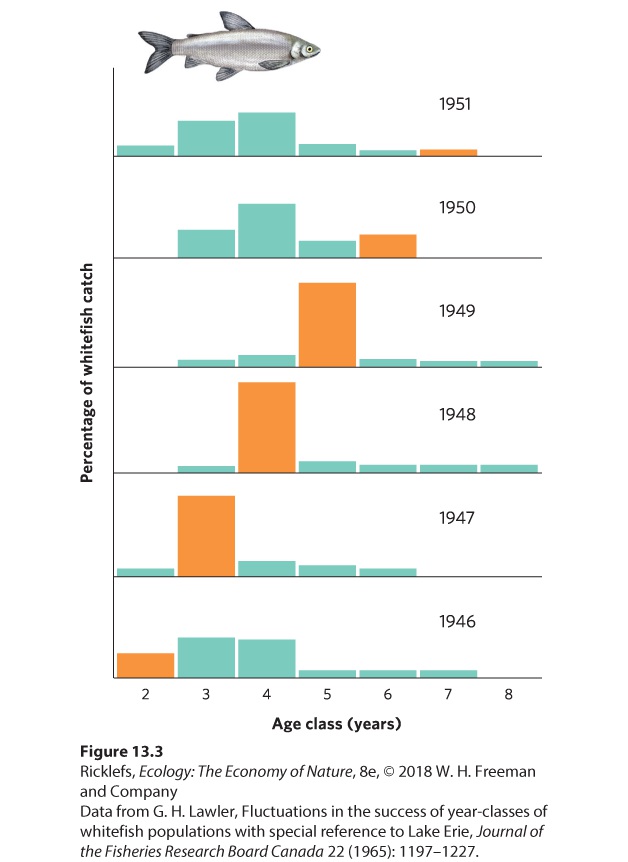
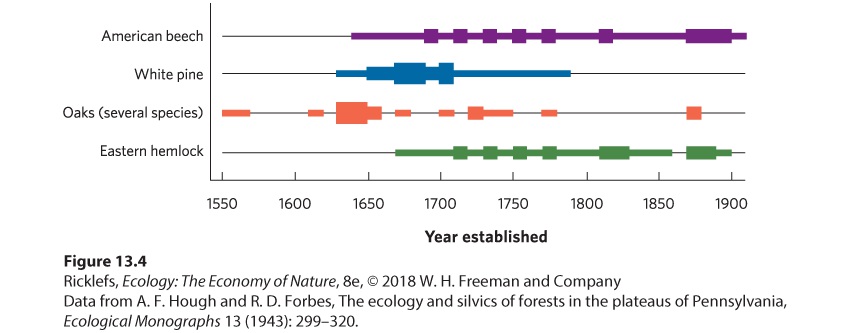
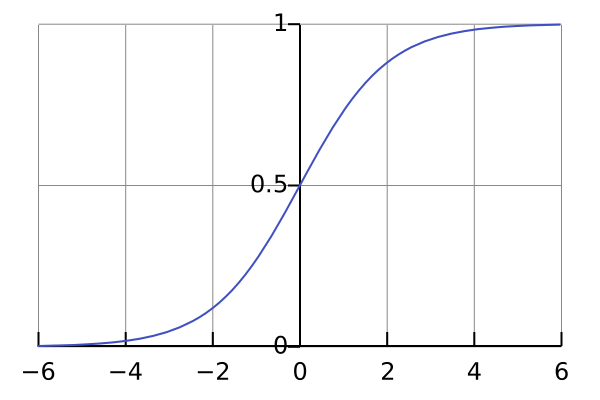
- Population density
- Number of individuals per unit area / volume.
- Dispersion
- Pattern of spacing: uniform (territorial), random (rare in nature), clumped (most common — patchy resources).
- Survivorship curves
- Type I high juvenile survival, mortality late (humans, elephants); Type II constant mortality (birds, small mammals); Type III high juvenile mortality (fish, plants).
- Cohort vs static life table
- Cohort follows one birth group through life; static is a snapshot of all ages now.
- Net reproductive rate (R₀)
- Average number of offspring per female per generation. R₀ = 1 → stable.
Population growth models
Exponential growth: dN/dt = rN. Unlimited resources → J-shaped curve.
Logistic growth: dN/dt = rN(1 − N/K). Resource-limited → S-shaped curve approaching carrying capacity (K).
| Strategy | r-selected | K-selected |
|---|---|---|
| Body size | Small | Large |
| Lifespan | Short | Long |
| Reproduction | Many, small offspring; once or early | Few, large offspring; repeated |
| Habitat | Disturbed, unpredictable | Stable, predictable |
| Examples | Insects, dandelions | Whales, oaks |
Before population ecology can ask why numbers change, it has to count. This lecture is the measurement toolkit — abundance, density, distribution, and the spatial structure (patches, corridors, metapopulations) that L02 said would matter.
Learning objectives
- Define abundance, density (crude vs ecological), and the three small-scale dispersion patterns.
- Choose the right census tool: quadrats, transects, mark-recapture, distance sampling, eDNA.
- Compute a Lincoln-Petersen estimate and list its assumptions and their failure modes.
- Explain range vs occupancy, and why abundance and occupancy correlate.
- Describe metapopulation dynamics (Levins model logic) and source-sink structure.
- Connect fragmentation, edge effects, and corridors to population persistence (SLOSS debate).
Part 1: What we measure
- Abundance (N) vs density (N per area). Crude density = N over the whole map; ecological density = N over Usable habitat — the biologically honest number.
- Dispersion at small scales: clumped (most common — resources and sociality), uniform (territoriality, allelopathy — creosote spacing), random (rare — neutral settling).
- Distribution (range) = where the species occurs; occupancy = fraction of suitable patches occupied. Widespread species tend to be locally abundant too (the abundance-occupancy relationship).
Part 2: The counting toolkit
- Complete census: rare — only for big, visible, sedentary things (nesting colonies, trees).
- Quadrats for plants and sessile animals: many small beats few large; randomize placement; count-per-area scales up.
- Line transects and distance sampling: record perpendicular distances, model detection decay — birds, whales, desert ungulates.
- Mark-recapture, Lincoln-Petersen: N = (M x C) / R, where M marked in sample 1, C caught in sample 2, R recaptures. Assumptions: closed population, equal catchability, marks permanent, marks harmless.
- Assumption failures: trap-happy animals inflate R (underestimates N); trap-shy deflate R (overestimates N); births/deaths/movement violate closure — use Jolly-Seber open-population models instead.
- Modern tools: camera traps, acoustic monitoring, environmental DNA (a water sample reveals the fish community — the molecular ecology subdiscipline from L01).
- Exam calculation: mark 200 fish, later net 150 with 30 marked -> N = 200×150 / 30 = 1000.
Part 3: Spatial structure — the landscape lecture within the lecture
- Populations live in Patches connected by dispersal; the landscape level (Manning L02 ladder) asks how transfers among ecosystems shape them.
- Metapopulation: a population of populations. Patches wink out (local extinction) and are recolonized; persistence requires colonization rate > extinction rate (Levins logic). Classic: Glanville fritillary butterflies in Finnish meadows.
- Source-sink: sources (births > deaths) export dispersers; sinks (deaths > births) persist only by immigration — the I in dN/dt = B — X + I doing real work. Removing a source can crash sinks that looked healthy.
- Rescue effect: immigration prevents winking patches from going dark — occupancy rises with connectivity.
- Fragmentation (L02 recap, now with population consequences): smaller patches = smaller N = more drift, inbreeding, and extinction risk; more edge = more cowbirds/predators.
- Corridors reconnect: movement, gene flow, recolonization (Florida panther underpasses; hedgerows). Risks (disease spread, predator highways) exist but benefits usually win.
- SLOSS (Single Large Or Several Small): single large favors interior species and low extinction; several small spreads catastrophe risk and samples more habitats — answer is taxon- and question-dependent.
Condensed review — most likely to be tested
- Ecological density uses usable habitat — the honest denominator.
- Clumped is the default dispersion; uniform implies antagonism; random implies neither.
- Lincoln-Petersen: N = MC/R + four assumptions (closed, equal catchability, permanent, harmless).
- Trap-happy -> underestimate; trap-shy -> overestimate.
- Metapopulation persistence: colonization > extinction; rescue effect via connectivity.
- Source-sink: sinks live on immigration; protect the sources.
- Corridors restore movement and gene flow; SLOSS has no universal winner.
Mnemonic set
- “MC over R — the mark-recapture one-liner.”
- “Happy traps shrink N, shy traps grow N — recapture bias directions.”
- “Sources export, sinks import.”
- “Patches wink; dispersal relights them.”
Self-test
- You mark 80 turtles; a month later you capture 60, of which 12 are marked. Estimate N and name two assumptions most at risk in a month-long turtle study.
- Creosote bushes in the Mojave are spaced almost like an orchard. Dispersion type and mechanism?
- A prairie-dog town census gives 5/ha across the county but 50/ha within colonies. Which number is which, and which predicts disease spread?
- A butterfly occupies 40 of 100 meadows each year, but WHICH 40 changes. A developer argues the 60 empty meadows are expendable. Counter with metapopulation logic.
- A riverside forest has births < deaths for 20 years yet stable numbers. Explain, and predict what logging the upstream forest does.
- Give one argument for Single Large and one for Several Small reserves.
Show answer key — try the questions first
- N = 80×60 / 12 = 400. At risk: closure (turtles move in/out, hatch, die over a month) and equal catchability (basking traps re-catch bold individuals).
- Uniform — allelopathy and root competition for water create spacing; antagonistic interactions are the standard cause of uniformity.
- Crude density 5/ha (whole map); ecological density 50/ha (occupied habitat). Disease transmission tracks ecological density — contacts happen where animals actually are.
- Occupancy turns over: empty patches are tomorrow’s occupied patches and vice versa. Persistence requires the full patch network (colonization > extinction); destroying “empty” patches raises effective extinction and can collapse the whole metapopulation.
- It is a sink sustained by immigration (I in dN/dt). Logging the source removes the subsidy; the sink declines toward extinction despite no local change.
- Single Large: interior habitat for edge-sensitive species, larger N, lower extinction. Several Small: spreads risk of fire/disease, samples more habitat types, may capture more total species.
Population dynamics begins with bookkeeping: who survives each age, who reproduces, and what that schedule implies. Life tables turn demography into prediction — and they are where exam calculations live.
Learning objectives
- Build and read a cohort (dynamic) vs static life table, and know the pitfalls of each.
- Define lx, mx, R0, generation time T, and approximate r = ln(R0)/T.
- Draw and interpret Type I, II, III survivorship curves with taxa.
- Explain age-structure pyramids and population momentum.
- Define life-history trade-offs: semelparity vs iteroparity, offspring size vs number.
- Connect r- vs K-selection (and its modern fast-slow continuum critique) to survivorship.
Part 1: Life tables
- Cohort (dynamic) life table: follow one birth cohort until the last dies — accurate but slow and impossible for long-lived species. Static (time-specific): age everyone now — fast, but assumes constant age-specific rates.
- Columns: x (age class), nx (alive at x), lx (proportion surviving from birth = nx/n0), dx (deaths), qx (mortality rate), mx (per-female births at x).
- Net reproductive rate R0 = sum(lx mx): daughters per female per lifetime. R0 > 1 growing, = 1 stable, < 1 shrinking.
- Generation time T = sum(x lx mx)/R0; intrinsic rate r ≈ ln(R0)/T — small creatures with short T can have huge r with modest R0.
- The exam move: fill lx mx column, sum for R0, then say what R0 means in words.
Part 2: Survivorship curves
- Plot log(lx) vs age. Type I: flat then cliff — most die old (humans, large mammals, heavy parental care). Type II: straight line — constant mortality rate (many birds, squirrels). Type III: cliff then flat — massive juvenile mortality, survivors persist (oysters, fish, most plants, sea turtles).
- Type III pairs with huge fecundity and no care; Type I with few offspring and heavy care — the survivorship curve and the reproductive strategy are one decision.
- Age structure: pyramids wide at the base predict growth (momentum: even at replacement fertility, a young population keeps growing as cohorts reach reproduction); urn shapes predict decline (Japan).
- Sex ratio and operational sex ratio matter for B; life tables usually track females only.
Part 3: Life-history trade-offs
- The budget is finite: energy to reproduction now vs growth/survival for reproduction later (cost of reproduction — kestrels with enlarged broods survive winter worse).
- Semelparity (big bang — Pacific salmon, agaves, cicadas): one shot, everything spent, favored when adult survival between attempts is low or first breeding requires huge preparation. Iteroparity: repeated breeding, hedges variable juvenile survival.
- Offspring size vs number: the smile curve — many small (Type III) vs few large (Type I). Lack clutch size: the intermediate optimum where fledged (not laid) offspring peak.
- r-selection: disturbed/empty habitats favor high r — many cheap offspring, early maturity, short life. K-selection: crowded stable habitats favor competitive ability — few, large, well-provisioned offspring. Modern view: a fast-slow continuum with more axes, but the vocabulary persists.
- Senescence evolves because selection weakens with age: mutation accumulation + antagonistic pleiotropy (genes good early, bad late are favored).
Condensed review — most likely to be tested
- R0 = sum(lx mx): daughters per female lifetime; 1 is replacement.
- r ≈ ln(R0)/T — short generations amplify growth.
- Type I flat-then-cliff (care), Type II straight (constant rate), Type III cliff-then-flat (fecundity).
- Static tables assume constant rates; cohort tables take a lifetime.
- Momentum: young age structures grow even at replacement fertility.
- Semelparity when repeat attempts are unlikely; iteroparity hedges.
- Lack: optimal clutch maximizes Fledged offspring, not eggs.
- r vs K = fast vs slow life histories on a continuum.
Mnemonic set
- “lx times mx, summed — that is R0.”
- “I: die late. II: die anytime. III: die young (mostly).”
- “Salmon spend it all; robins keep a savings account — semel vs itero.”
- “Wide base, growing race — age-pyramid momentum.”
Self-test
- A life table gives l1m1 = 0.8, l2m2 = 0.6, l3m3 = 0.2 (zero elsewhere). Compute R0 and interpret.
- Sea turtles lay ≈100 eggs per nest and provide zero care; ≈1 in 1000 hatchlings reaches adulthood, but adults live decades. Survivorship type, and why headstarting hatchlings is less effective than protecting adults.
- Why can a static life table of a growing population misestimate mortality?
- Pacific salmon are semelparous; Atlantic salmon are (weakly) iteroparous. What difference in adult return survival would predict this?
- A country reaches exactly replacement fertility today but its median age is 19. Predict population trajectory and name the phenomenon.
- Kestrels given experimentally enlarged broods fledge more chicks but show lower overwinter survival. What trade-off is demonstrated?
Show answer key — try the questions first
- R0 = 1.6 daughters per female per lifetime — the population grows (60% increase per generation).
- Type III. Population growth is most sensitive to ADULT survival (the rare, high-value stage); adding hatchlings feeds the mortality cliff, while each adult saved carries decades of reproduction. Elasticity analysis says protect the breeders (turtle-excluder devices beat hatcheries).
- It converts today’s age distribution into survival rates assuming stationarity; in a growing population young cohorts are inflated, mimicking high early survival and biasing qx estimates.
- Semelparity is favored when surviving to breed again is improbable (exhausting upstream migrations, high post-spawn mortality). Where return survival is higher, holding reserves back (iteroparity) pays.
- It keeps growing for decades — population momentum: the outsized young cohorts have not yet passed through reproductive ages.
- The cost of reproduction: current effort is paid from the same budget as parental survival (future reproduction) — the central life-history trade-off.
The last pre-exam lecture assembles the machinery: exponential growth when nothing limits, logistic growth when crowding bites, and the real-world wrinkles — lags, cycles, and Allee effects — that make populations more interesting than either equation.
Learning objectives
- Use dN/dt = rN and N(t) = N0 e^(rt); compute doubling time.
- Explain every piece of the logistic dN/dt = rN(1 — N/K) and its predictions.
- Say where growth rate and harvest yield peak on the logistic (K/2) and why MSY is risky.
- Describe density-dependent vs density-independent limitation with examples.
- Define Allee effects and their conservation consequences.
- Explain time-lag oscillations and real population trajectories (reindeer, Daphnia).
Part 1: Exponential growth
- dN/dt = rN; N(t) = N0 e^rt. r = b — d (instantaneous). Doubling time t2 = ln2/r ≈ 0.693/r.
- J-curve: growth proportional to N — the more there are, the faster it grows. Real cases: invasions, reintroductions, recovering whales, human population historically.
- The St. Matthew Island reindeer: 29 introduced (1944) -> ≈6000 (1963) -> crash to 42 after the 1963–64 winter ate the lichen capital. Exponential growth meets a hard wall: overshoot and collapse.
- r vs λ: λ = N(t+1)/N(t) (discrete); r = ln(λ). λ > 1 == r > 0.
Part 2: Logistic growth
- dN/dt = rN(1 — N/K): the brake term (1 — N/K) scales growth from full (N ≈ 0) to zero (N = K) to negative (N > K).
- K = carrying capacity: the equilibrium set by resources — not a constant of nature; K moves with seasons, disturbance, and human subsidy.
- S-curve: near-exponential start, inflection at K/2 where dN/dt is Maximal, saturation at K.
- Maximum sustainable yield sits at K/2 — which is why fisheries aim there and why it is dangerous: K is estimated with error, environments vary, and holding a stock at half-size leaves no buffer (Peruvian anchoveta collapse 1972; Grand Banks cod 1992).
- Density dependence: per-capita birth falls or death rises with crowding — food, space, disease transmission, territoriality. Signature: per-capita growth declining with N. Density independence: weather, fire — mortality unrelated to N (often sets the stage rather than regulating).
- Lab confirmations: Gause’s Paramecium and yeast follow clean logistics; Daphnia overshoot then oscillate because energy reserves create a LAG.
Part 3: Wrinkles that matter
- Time lags: dN/dt responds to density tau ago -> overshoot, damped oscillations, or stable limit cycles when r*tau is large.
- Allee effect: per-capita growth RISES with density at low N (mate finding, group defense, cooperative breeding) -> a critical threshold below which decline is self-reinforcing. Passenger pigeon (social breeder collapsed from millions), cod recovery failure, pack hunters.
- Conservation consequence: small populations face drift + inbreeding (L05) AND Allee undertow — the extinction vortex.
- Human population: ≈8.1 billion; growth rate peaked ≈2.1%/yr (1960s), now ≈0.9% and falling; demographic transition (death rates fall first, birth rates follow) explains the arc; momentum (L08) keeps growth going despite falling fertility.
Condensed review — most likely to be tested
- Doubling time = 0.693/r.
- Logistic brake: (1 — N/K); growth peaks at K/2.
- MSY at K/2 is theoretically optimal and practically fragile (anchoveta, cod).
- Density dependence = per-capita rates changing with N; independence = weather/fire.
- Reindeer: overshoot K, destroy the resource capital, crash.
- Lags -> oscillations; big r*tau -> cycles.
- Allee: low-density undertow; extinction vortex when combined with genetics.
- Human growth: transition + momentum, rate falling since the 1960s.
Mnemonic set
- “0.693 over r — the doubling clock.”
- “Fastest in the middle — logistic growth peaks at K/2.”
- “Weather does not count heads — density independence.”
- “Too few is also too bad — the Allee undertow.”
Self-test
- An invasive beetle population grows at r = 0.35/yr. Doubling time? Years to go from 1,000 to ≈16,000?
- Sketch the logistic curve and mark where dN/dt is greatest, and where per-capita growth is greatest. They differ — explain.
- Why did the St. Matthew reindeer crash to 42 instead of settling at K?
- A fishery manager sets harvest at the computed MSY. List three reasons this routinely ends badly.
- Cod collapsed in 1992 and has barely recovered despite a moratorium. Give two Allee-type mechanisms.
- Classify: (a) a hurricane removes 90% of a lizard population; (b) fledging success falls as nest density rises; (c) flu spreads faster in dense cities.
Show answer key — try the questions first
- t2 = 0.693/0.35 ≈ 2 yr. 16,000/1,000 = 16 = 2^4 -> four doublings ≈ 8 years.
- dN/dt (total) peaks at K/2 — many individuals each still growing decently. Per-capita growth r(1 — N/K) is greatest as N -> 0 — each individual has maximal resources; total is small because there are few of them.
- They consumed the lichen Capital (slow-renewing resource), so K itself collapsed beneath them; a brutal winter then applied density-independent mortality to a resource-exhausted herd. Overshoot + falling K = crash, not equilibrium.
- K and r are estimated with error; environmental variation moves the true surplus year to year; holding the stock at K/2 leaves no buffer against bad years; harvest often continues during declines (economics), and Allee effects can prevent recovery after overshoot — anchoveta 1972, cod 1992.
- Mate-finding/spawning aggregation failure at low density, and possibly predation saturation reversal (juveniles now minor prey but predators abundant); also ecosystem reorganization holding the low state. Per-capita growth stays low precisely because N is low.
- (a) density-independent; (b) density-dependent (birth side); (c) density-dependent (death/transmission side).
U7 · Population Regulation & Life History
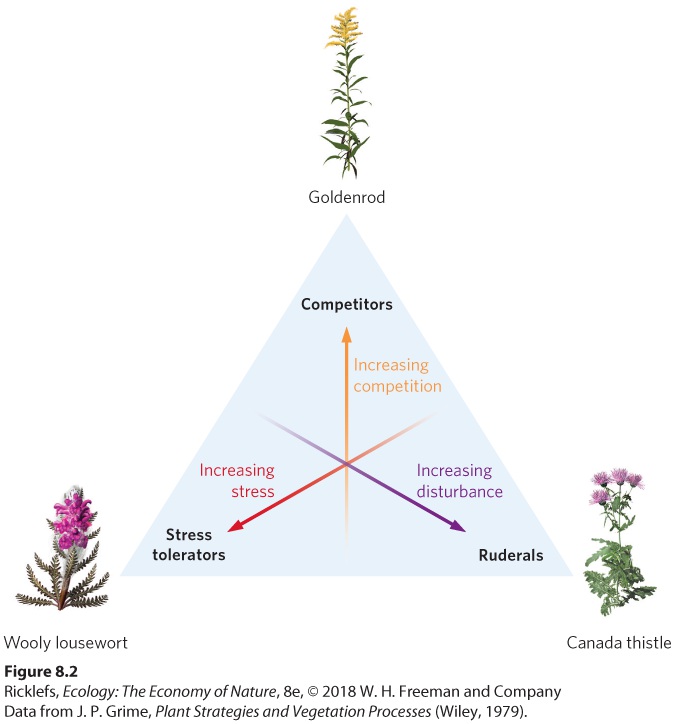
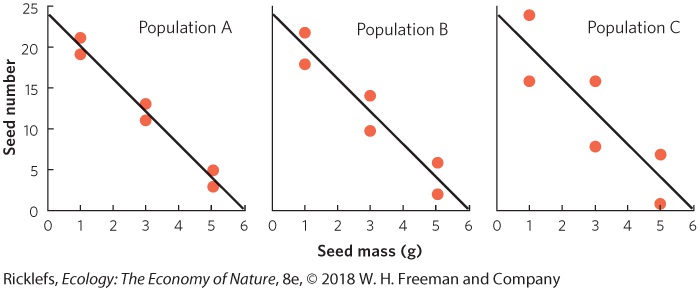
- Density-dependent factors
- Effects intensify as N rises: competition, disease, predation. Stabilize populations.
- Density-independent factors
- Effects don't scale with N: weather, fire, floods. Cause crashes regardless of density.
- Allee effect
- Per-capita growth rate decreases at very low densities (mate finding, group defense fails).
- Metapopulation
- Set of local populations connected by dispersal. Source-sink dynamics: source populations have surplus dispersers; sink populations need immigration to persist.
- Semelparity
- One reproductive event then die (salmon, agave).
- Iteroparity
- Multiple reproductive events over a lifetime (most mammals).
What actually keeps populations in check — food from below or enemies from above? This lecture assembles competition, predation, and parasitism into the regulation debate: HSS, exploitation ecosystems, trophic cascades, and the experiments that measure who controls whom.
Learning objectives
- Distinguish regulation (density-dependent) from limitation (any cap).
- State HSS/green world and the exploitation ecosystems hypothesis (EEH).
- Define trophic cascades with the classic cases (otters, wolves, Bassett).
- Explain when bottom-up dominates (productivity, stoichiometry).
- Interpret factorial food x predator experiments.
- Describe alternative stable states and regime shifts.
Part 1: The debate
- Regulation requires Density-Dependent feedback (L09); limitation is any factor capping N. Weather limits; competition and enemies regulate.
- HSS (1960) green world: plants are abundant because predators suppress herbivores — the world is green from the top down.
- Bottom-up reply: the world is not as edible as it looks — plant defense and low nutritional quality (N-poor tissue) cap herbivores from below; White’s “inadequate environment”.
- Exploitation ecosystems hypothesis (Oksanen): the number of Effective trophic levels rises with productivity — unproductive systems support plants only (plant-limited); mid support herbivores that suppress plants (grazed); productive support predators that release plants (green again). Control alternates down the chain with each added level.
Part 2: Trophic cascades — the evidence
- Sea otter-urchin-kelp: otters eat urchins; where otters were hunted out, urchin barrens replaced kelp forests; otter recovery restored kelp (and killer-whale switching to otters re-collapsed local patches). A three-level cascade with a fourth-level twist.
- Yellowstone wolves (1995 reintroduction): elk numbers AND fearscape behavior changed; willow/aspen recruitment rose in risky sites, beavers returned — a density- AND trait-mediated cascade (with honest debate about magnitude vs other factors).
- Experiments beat stories: exclosures and factorial food x predator manipulations (Krebs hares, L11) separate the forces; in lakes, piscivore addition cascades to clearer water (biomanipulation: bass -> fewer minnows -> more zooplankton -> less algae).
- Cascade strength varies predictably: stronger in aquatic/low-diversity systems (algal turnover, linear chains), weaker where webs are reticulate, herbivores defended, or omnivory blurs levels.
Part 3: Synthesis and states
- Meta-answer: BOTH. Productivity (bottom-up) sets the stage size; enemies (top-down) set the casting within it. Stoichiometry (C:N:P, L04) rules the plant-herbivore junction.
- Donor control: detritus-based chains (in most of every food web) cannot be top-down regulated — consumers cannot speed the supply of dead matter.
- Alternative stable states: kelp forest vs urchin barren; clear vs turbid lakes (submerged plants vs phytoplankton); grassland vs shrubland. Each state self-reinforces (hysteresis) — flipping back requires overshooting the original threshold, not just returning to it.
- Regime shifts triggered by removing apex consumers (defaunation), nutrient loading (eutrophication reprise), or climate — management implication: prevention is cheaper than restoration.
Condensed review — most likely to be tested
- Regulate = density-dependent feedback; limit = any cap.
- HSS: top-down green world; White: bottom-up inedible world.
- EEH: effective trophic levels track productivity; control alternates.
- Otters-urchins-kelp and wolves-elk-willows: the flagship cascades.
- Cascades strongest in aquatic, linear, low-diversity chains.
- Donor control: detritus chains have no top-down lever.
- Alternative stable states + hysteresis: restoration must overshoot.
Mnemonic set
- “Green from above (HSS), inedible from below (White).”
- “Otter eats urchin, kelp thanks otter.”
- “Levels alternate: whoever is one step above the plants decides.”
- “States have memory — hysteresis.”
Self-test
- Define regulation vs limitation with one example each.
- Use EEH to predict who controls plant biomass in: (a) arctic desert, (b) two-level tundra, (c) three-level boreal system.
- Killer whales began eating sea otters in the 1990s Aleutians. Predict the cascade and name the levels.
- A lake manager wants clearer water without chemicals. Design the biomanipulation and its cascade logic.
- Why are trophic cascades typically stronger in lakes than in tropical forests?
- A shallow lake stays turbid after nutrient inputs are cut back to historical levels. Explain via alternative stable states.
Show answer key — try the questions first
- Regulation: density-dependent feedback returning N toward equilibrium (food competition intensifying with density). Limitation: any factor capping N regardless of density (a late frost). Weather limits but cannot regulate.
- (a) Too unproductive for herbivore populations — plants limited by resources (bottom-up). (b) Herbivores unchecked — plants grazed down, herbivores food-limited. (c) Predators suppress herbivores — plants released and resource-limited again. Control alternates with each level added.
- Orca (4) suppresses otter (3) -> urchins (2) erupt -> kelp (1) collapses to barrens. Adding a fourth level flips control on every level below — the alternation rule in action.
- Stock piscivores (bass/pike): they suppress planktivorous minnows -> large zooplankton (Daphnia) recover -> grazing reduces phytoplankton -> water clears. Top-down control exploited deliberately; works best alongside nutrient (bottom-up) reduction.
- Lakes: fast algal turnover, few dominant species, linear chains, strong size-structured predation. Forests: reticulate webs, defended long-lived plants, omnivory, and diversity dilute any single top-down lever.
- The turbid state self-stabilizes: phytoplankton + resuspending fish shade out submerged plants that would anchor sediment and shelter grazers. Hysteresis means recovery requires pushing well past the original threshold (deep nutrient cuts plus fish removal) — the return path is not the entry path.
U8 · Competition
Intraspecific competition — among members of the same species — is the strongest form because resource needs overlap completely. Interspecific competition involves two or more species competing for shared resources.
- Exploitation competition
- Indirect — one consumer reduces the resource available to another.
- Interference competition
- Direct — aggression, allelopathy, territoriality.
- Competitive exclusion principle (Gause)
- Two species with identical niches cannot coexist; one will outcompete the other.
- Fundamental niche
- Full range of conditions a species can tolerate without competition.
- Realized niche
- Niche actually occupied after competition (subset of fundamental).
- Resource partitioning
- Species divide resources by time, space, or type (e.g., MacArthur's warblers feeding in different parts of spruce trees).
- Character displacement
- Trait differences exaggerated in sympatry (where species overlap) reducing competition.
Lotka-Volterra competition equations
dN₁/dt = r₁N₁(K₁ − N₁ − α₁₂N₂)/K₁
dN₂/dt = r₂N₂(K₂ − N₂ − α₂₁N₁)/K₂
αij = competition coefficient (effect of species j on species i). Coexistence requires each species to limit itself more than it limits the other.
After Exam 1 the course turns to interactions — Kaspari P7 made quantitative. First the minus-minus interaction (competition) and its overlooked positive twin (facilitation), including the classic experiments every ecology exam loves.
Learning objectives
- Distinguish intraspecific vs interspecific, exploitation vs interference competition.
- State the competitive exclusion principle and the conditions that soften it.
- Use Lotka-Volterra competition logic: coefficients, isoclines, four outcomes.
- Define fundamental vs realized niche with Connell’s barnacles.
- Explain resource partitioning, character displacement, and ghost of competition past.
- Define facilitation and the stress-gradient hypothesis with examples.
Part 1: Competition fundamentals
- Intraspecific (within species) drives logistic density dependence; interspecific (between) shapes communities. Exploitation: consuming shared resources first (scramble). Interference: direct antagonism — territories, allelopathy, ant wars.
- Competitive exclusion (Gause): two species on ONE limiting resource cannot coexist indefinitely; the better converter wins. P. aurelia excludes P. caudatum in mixed culture though both thrive alone.
- Tilman’s R*: the species that survives on the Lowest equilibrium resource level wins — mechanistic competition theory (diatoms on silica).
- Lotka-Volterra: dN1/dt = r1N1(1 — (N1 + a12N2)/K1); α converts species 2 into species-1 equivalents. Outcomes: species 1 wins, 2 wins, unstable coexistence (priority effects), stable coexistence when INTRAspecific competition exceeds INTERspecific (each species limits itself more).
- Modern coexistence phrasing: stabilizing niche differences (self-limitation) must exceed fitness differences.
Part 2: Niches and the classic experiments
- Fundamental niche: where a species COULD live (physiology); realized niche: where it DOES live after interactions compress it.
- Connell’s barnacles (the exam classic): Chthamalus lives high intertidal, Balanus mid-low. Remove Balanus -> Chthamalus fills the low zone (fundamental > realized; competition compresses it). Balanus cannot survive high-zone desiccation (physiology, not competition, sets ITS upper limit). Asymmetry is the point.
- Resource partitioning: MacArthur’s five warblers foraging in different spruce zones; Anolis lizards splitting perch height/diameter — coexistence by slicing the niche.
- Character displacement: traits diverge more in sympatry than allopatry (Galapagos finch beaks on shared vs solo islands) — evolution reduces competition.
- Ghost of competition past: present-day partitioning may reflect competition that already resolved — absence of current fighting is not absence of its history.
Part 3: Facilitation — the plus side (Ch. 12)
- Facilitation: one species improves conditions or resources for another — nurse plants shading cactus seedlings, Spartina stabilizing marsh sediment, mycorrhizae extending roots (mutualism preview).
- Stress-gradient hypothesis (Bertness-Callaway): interactions shift from competition in benign conditions to facilitation under stress — alpine cushion plants harbor whole communities at high altitude but compete at low; marsh plants facilitate in salty zones, compete in mild ones.
- Foundation species (Spartina, corals, kelp) facilitate entire communities by building habitat — a bridge to community ecology.
- Invasion angle: escaped competitors/enemies (enemy release) plus disturbance often explain invader success; novel weapons (garlic mustard allelopathy vs North American mycorrhizae) are interference competition by chemistry.
Condensed review — most likely to be tested
- Exploitation vs interference; intra- vs interspecific.
- Gause: one resource, one winner; Tilman: lowest R* wins.
- L-V stable coexistence requires self-limitation > cross-limitation.
- Connell: competition compresses Chthamalus (realized < fundamental); desiccation limits Balanus — asymmetric mechanisms.
- Partitioning (warblers), displacement (sympatric beak divergence), ghost of competition past.
- Facilitation grows with stress (stress-gradient hypothesis).
- Foundation species build the stage others live on.
Mnemonic set
- “One dish, one winner — competitive exclusion.”
- “Lowest R* takes the table.”
- “Could vs does — fundamental vs realized niche.”
- “Hard places make helpers — the stress gradient.”
Self-test
- In Gause’s mixed cultures, P. aurelia excluded P. caudatum, but adding regular medium changes let both persist. Why does disturbance soften exclusion?
- Two grasses: A persists at 2 uM nitrate, B at 5 uM. Predict the winner in N-limited soil, and the mechanism class.
- Removing Balanus lets Chthamalus colonize the low intertidal, but removing Chthamalus does NOT let Balanus climb higher. Interpret both results.
- Two finch species have identical beaks on separate islands but divergent beaks where they co-occur. Name and explain the pattern.
- On an alpine gradient, cushion-plant neighbors increase survival of other species at high (harsh) sites and decrease it at low (mild) sites. Which hypothesis, and the general rule?
- Garlic mustard suppresses North American tree seedlings via chemicals that kill mycorrhizal fungi harmless to European neighbors. Name the mechanism and its competition class.
Show answer key — try the questions first
- Exclusion needs equilibrium on a single limiting resource; disturbance resets densities before exclusion completes and can alternate which species is favored — coexistence by interruption (preview of the intermediate disturbance hypothesis).
- A wins — the lower R* draws nitrate below B’s survival level. Exploitation competition, Tilman-style.
- Chthamalus’s low limit is competitive (realized niche compressed by Balanus — crushing/overgrowing); Balanus’s high limit is physiological (desiccation). Different forces set different edges — the asymmetry is Connell’s lesson.
- Character displacement: sympatric competition selects against overlap, so traits diverge where the species meet; allopatric populations reveal the undisplaced baseline.
- Stress-gradient hypothesis: net interactions shift from competition in benign environments to facilitation under stress — amelioration of stress outweighs resource costs when stress dominates.
- Novel weapons — allelopathy the invaded community has not evolved to resist; interference competition (chemical), amplified by disrupting a facilitation (mycorrhizae).
U9 · Predation, Herbivory, Parasitism
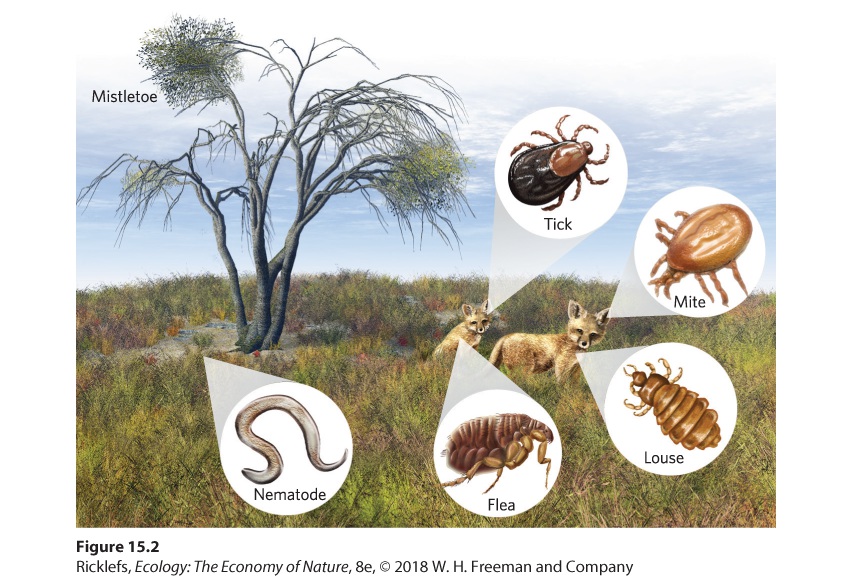
- Functional response
- Predator's per-capita kill rate vs prey density. Type I linear; Type II saturating (handling time); Type III sigmoidal (prey switching).
- Numerical response
- Predator population growth in response to prey abundance.
- Optimal foraging theory
- Foragers maximize energy gained per unit time, balancing search and handling.
- Predator-prey cycles
- Lotka-Volterra: prey peak → predator peak (lag) → prey crash → predator crash (lag). Classic example: lynx + snowshoe hare 10-year cycle.
- Aposematism
- Warning coloration of toxic prey (monarch butterfly).
- Batesian mimicry
- Edible mimic of toxic model (viceroy butterfly).
- Müllerian mimicry
- Multiple toxic species converge on similar warning signals (Heliconius butterflies).
- Plant chemical defenses
- Tannins, alkaloids, glucosinolates — induced or constitutive.
- Parasitism
- + / − interaction; parasite benefits at host's expense without (immediately) killing.
- Parasitoid
- Lays eggs in/on host; larvae kill host (parasitic wasps).
The plus-minus interactions: one eats (part of) the other. This lecture covers predator-prey dynamics and cycles, the arms races they fuel, and herbivory — where the victim usually survives and fights back with chemistry.
Learning objectives
- Write the Lotka-Volterra predator-prey model and explain why it cycles.
- Interpret the lynx-hare cycle and the experiments that dissected it.
- Distinguish functional response types I-III and their stability consequences.
- Catalog prey defenses: crypsis, aposematism, Batesian vs Mullerian mimicry, ecology of fear.
- Explain plant defenses: constitutive vs induced, qualitative vs quantitative chemistry, tolerance.
- Describe overcompensation, the green world hypothesis, and predator removal consequences.
Part 1: Predator-prey dynamics
- L-V predator-prey: dN/dt = rN — aNP; dP/dt = caNP — mP. Prey grow, predators convert prey into predators, predators die. Prediction: coupled oscillations with predator peaks Lagging prey peaks (quarter cycle).
- Neutral cycles are fragile in the model; real stability comes from prey refuges, patchiness, and density dependence. Huffaker’s mites: extinction in simple arenas, persistent cycles in complex orange-landscapes with dispersal — space stabilizes.
- Lynx-hare: ≈10-year cycles in Hudson’s Bay pelt records. Krebs’ factorial experiments (food addition x predator exclusion): food alone x3 hare density, exclusion alone x2; Together x11 — the cycle is a food-predation interaction, plus fear-driven stress reducing reproduction (sublethal effects).
- Paradox of enrichment: fertilizing prey can DEstabilize cycles into extinction swings — more is not safer.
Part 2: Functional responses and prey defense
- Functional response = per-predator kill rate vs prey density. Type I: linear (filter feeders). Type II: saturating (handling time) — most predators; destabilizing at high prey density because predation RATE per prey falls. Type III: S-shaped (switching, search images, refuges) — stabilizing at low prey density because rare prey are ignored.
- Prey toolkit: crypsis (stick insects), masquerade, aposematism (warning colors — monarchs, dart frogs), startle displays, spines/armor, chemical defense, group vigilance (many eyes), satiation (cicada emergences, mast years).
- Batesian mimicry: harmless mimics honest model (hoverflies as wasps) — parasitic on the signal; frequency-dependent (fails if mimics get common). Mullerian: multiple defended species converge (Heliconius rings) — mutual reinforcement.
- Ecology of fear: predation risk alone changes prey behavior, habitat use, and physiology — Yellowstone elk avoiding wolf-risky valleys released willows/aspen (trait-mediated cascade preview).
Part 3: Herbivory (Ch. 14)
- Herbivory is usually nonlethal consumption — grazers (grass), browsers (woody), granivores (seeds = predation on plant babies), frugivores (often mutualists).
- Green world hypothesis (HSS 1960): the world stays green because predators keep herbivores in check — top-down control; bottom-up answer: plants are heavily defended and nutritionally poor (low N — the stoichiometric barrier). Both are true in places — the tension organizes L13.
- Constitutive defenses always on (thorns, tannins); induced defenses deployed after attack (jasmonate signaling, protease inhibitors, volatile SOS calls recruiting parasitoid bodyguards).
- Qualitative chemistry: cheap toxins (alkaloids, cyanogenic glycosides) effective vs generalists, breached by adapted specialists (monarch/milkweed — sequestration turns defense into the herbivore’s own aposematism). Quantitative: dosage-dependent digestibility reducers (tannins, lignin, silica) — expensive, harder to beat.
- Tolerance instead of resistance: regrow fast, bank reserves underground (grasses + grazing lawns). Overcompensation: some plants produce MORE after moderate herbivory (scarlet gilia) — grazing-adapted growth.
- Coevolutionary arms race: milkweed cardenolides up -> monarch target-site insensitivity -> new toxins; escape-and-radiate diversification.
Condensed review — most likely to be tested
- L-V predator-prey predicts lagged cycles; space and refuges stabilize (Huffaker).
- Krebs: food x predation interaction (x11) drives the hare cycle — with fear effects.
- Type II saturates (destabilizing); Type III S-shaped (stabilizing via switching/refuges).
- Batesian = bluff (frequency-dependent); Mullerian = shared honest warning.
- Fear alone reshapes prey distributions (Yellowstone).
- Plant defense: constitutive/induced, qualitative/quantitative, plus tolerance.
- Green world: top-down vs bottom-up tension — carried into L13.
- Monarch-milkweed: sequestration flips plant defense into herbivore defense.
Mnemonic set
- “Predators chase from a quarter-cycle behind.”
- “Two saturates, Three switches — functional responses.”
- “Bates bluffs, Muller means it.”
- “Cheap poisons for generalists, heavy fiber for everyone.”
Self-test
- In L-V predator-prey cycles, why do predator peaks lag prey peaks by a quarter cycle?
- Huffaker’s mites went extinct in simple arenas but cycled for months in complex ones. What does this say about real-world predator-prey persistence?
- Krebs found food addition x3, predator exclusion x2, both x11. Why does the interaction exceed the product of main effects, and what third mechanism contributes?
- Explain why a Type III functional response can regulate prey at low density while Type II cannot.
- Hoverflies (harmless) resemble wasps. Predict what happens to their protection as hoverflies become very common relative to wasps, and name the mimicry.
- Monarchs sequester milkweed cardenolides. Trace the levels of this interaction from plant defense to bird education.
Show answer key — try the questions first
- Predator growth depends on Current prey abundance: predators still increase while prey are abundant-but-declining, peaking only after prey have fallen — the numerical response takes time.
- Spatial structure (patches, refuges, dispersal asymmetries) rescues the interaction: prey win locally by hiding/colonizing, predators win locally by catching up — the metapopulation mosaic persists where any single patch collapses (ties to L07).
- Food and predation interact: well-fed hares take more risks and support more predators; released hares deplete food. Fear itself (chronic stress) suppresses reproduction — a sublethal, trait-mediated effect beyond direct killing.
- Type III predation RATE rises with density at low N (switching, search image formation) — mortality is density-dependent and stabilizing. Type II mortality per prey is highest at LOW density (inverse density dependence) — it digs rare prey deeper.
- Batesian mimicry. Protection erodes: predators increasingly sample mimics, learn the signal is unreliable, and attack both — frequency-dependent bluffing.
- Milkweed evolves cardenolides (defense) -> monarchs evolve insensitivity + sequestration (counter-defense) -> stored toxins make monarchs emetic -> aposematic coloration honestly warns birds -> naive jays vomit and learn -> viceroys share the ring (Mullerian, as they are also unpalatable). Defense chemistry cascades into mimicry ecology.
Parasitism is the most common lifestyle on Earth — the plus-minus interaction where the consumer lives on or in its victim. This lecture covers parasite diversity, transmission and virulence evolution, host defense and manipulation, and parasites as hidden ecological players.
Learning objectives
- Classify parasites: micro vs macro, ecto vs endo, parasitoids; define definitive vs intermediate hosts.
- Explain transmission modes and R0 for infections; density- vs frequency-dependent transmission.
- Describe the trade-off model of virulence evolution with the myxoma case.
- Give examples of host manipulation and behavioral defense.
- Explain the dilution effect and parasite roles in food webs and invasions (enemy release).
- Summarize coevolution: Red Queen dynamics and sex.
Part 1: The parasite bestiary
- Microparasites (viruses, bacteria, protozoa): multiply IN the host; infection intensity matters little — presence/absence epidemiology. Macroparasites (helminths, arthropods): grow on/in host, reproduce via free-living stages; burden (worm count) matters — aggregated distributions (most hosts few, few hosts many — negative binomial).
- Ectoparasites (ticks, lice, mistletoe) vs endoparasites (tapeworms, malaria). Parasitoids (wasps laying eggs in hosts) always kill — predator-parasite hybrids and biocontrol workhorses.
- Complex life cycles: definitive host (sexual reproduction) vs intermediate hosts (asexual/larval). Malaria: mosquito definitive, human intermediate. Trematodes may need three hosts — each transfer a transmission bottleneck.
- Parasitism is the most common consumer strategy: most free-living species host multiple specialists; food webs including parasites gain ≈75% more links.
Part 2: Transmission and virulence
- R0 for microparasites = new infections per infected host in a susceptible population; epidemic if R0 > 1. Herd immunity threshold ≈ 1 — 1/R0 (measles R0 ≈ 15 -> ≈93% coverage).
- Density-dependent transmission (contact rate rises with density — most wildlife disease): epidemics fade below a threshold host density. Frequency-dependent (contact rate fixed — vector-borne, sexually transmitted): NO threshold density — can drive hosts extinct.
- Virulence trade-off: transmission requires host exploitation; too much kills the host (and the ride), too little loses to competitors. Prediction: intermediate virulence, tuned by transmission mode — vector-borne and waterborne diseases can stay nastier (sick hosts still transmit), directly-transmitted diseases moderate.
- Myxoma virus in Australian rabbits (the classic): released 1950, ≈99.8% lethal; within years intermediate-virulence strains dominated (killed too fast = fewer mosquito bites; too mild = cleared) AND rabbits evolved resistance — coevolution measured in real time.
Part 3: Hosts fight back — and get driven
- Immune defense is the obvious layer; behavioral defense is ecological: grooming, avoidance of infected conspecifics and feces-contaminated patches, self-medication (parasitized monarchs prefer toxic milkweed; chimps swallow bristly leaves).
- Host manipulation: Toxoplasma makes rodents attracted to cat odor (completing the cycle); Dicrocoelium zombifies ants onto grass tips; hairworms drive crickets into water; Ophiocordyceps positions ant death-grips. Extended phenotypes of the parasite.
- Dilution effect: diverse host communities can dilute transmission when many hosts are poor reservoirs (Lyme disease: opossums are tick vacuums; biodiversity loss concentrates ticks on competent white-footed mice) — debated but influential.
- Enemy release: invaders leave specialist parasites behind — part of invasion success; biocontrol reintroduces them (with host-specificity testing after cautionary tales like cane toads — a Predator introduction gone wrong).
- Red Queen: host-parasite coevolution favors rare genotypes -> negative frequency dependence -> maintains genetic diversity and (hypothesis) sex itself. New Zealand snails: sexual lineages persist where trematode pressure is high.
Condensed review — most likely to be tested
- Micro vs macro (presence vs burden; aggregation is the macroparasite signature).
- Definitive host = sex; intermediate = larval stages.
- R0 > 1 epidemic; herd immunity ≈ 1 — 1/R0.
- Frequency-dependent transmission has no rescue threshold — extinction-capable.
- Virulence evolves to a transmission-tuned intermediate (myxoma).
- Manipulation: Toxo, hairworms, Ophiocordyceps — parasite extended phenotypes.
- Dilution effect and enemy release connect disease to biodiversity and invasion.
- Red Queen: rare-genotype advantage maintains diversity and possibly sex.
Mnemonic set
- “Micro multiplies, macro accumulates.”
- “Sex happens in the definitive host.”
- “One minus one-over-R0 — the herd immunity line.”
- “Kill too fast, lose the ride — the virulence trade-off.”
Self-test
- Worm burdens in a deer herd: most deer carry 0–2 worms, a few carry hundreds. Name the distribution and give two consequences for control.
- Measles has R0 ≈ 15. What fraction must be immune to block epidemics, and why do small coverage dips cause outbreaks?
- Why can a sexually transmitted or vector-borne pathogen drive its host extinct when a directly-transmitted one usually cannot?
- Trace the myxoma story as a test of the virulence trade-off.
- Toxoplasma-infected rodents lose fear of cat odor. Explain why this is adaptive For the parasite and the term for such traits.
- Lyme risk is lower in forests with high vertebrate diversity. Give the dilution-effect mechanism and its main caveat.
Show answer key — try the questions first
- Aggregated (negative binomial) — the macroparasite signature. Control: treating the few heavily-infected hosts removes most transmission; mean burden misleads — target the tail.
- Threshold ≈ 1 — 1/15 ≈ 93%. Above it, each case infects <1 susceptible; slipping a few percent below lets R_effective exceed 1 — outbreaks return disproportionately fast.
- Direct transmission is density-dependent: below a threshold density contacts are too rare and the epidemic dies first. Frequency-dependent contact rates (mating, mosquito bites) stay high at low density — no refuge threshold.
- Grade I strains (99.8% lethal) killed rabbits before mosquitoes could bite; avirulent strains were cleared. Intermediate grades maximized infectious-bite-days and took over within years; rabbits simultaneously evolved resistance. Virulence is an evolving, transmission-tuned trait — not a fixed property.
- Sexual reproduction occurs only in cats (definitive host); manipulating the intermediate host into predation completes the cycle. An extended phenotype of the parasite expressed in host behavior.
- Many hosts (opossums) are incompetent reservoirs that kill ticks — diverse communities waste bites; degraded communities leave competent white-footed mice dominating. Caveat: dilution is context-dependent — diversity can also amplify some diseases (more hosts overall).
U10 · Mutualism & Coevolution
- Mutualism
- +/+ interaction. Obligate (one or both can't survive alone) or facultative.
- Commensalism
- +/0 (one benefits, other unaffected) — very rare; most "commensals" turn out subtly costly.
- Mycorrhizae
- Fungi-root mutualism. Arbuscular (endomycorrhizal) fungi penetrate root cortex (~80% plants); Ectomycorrhizal fungi sheath roots (mostly trees).
- Pollination syndrome
- Flower traits matched to pollinator: bee (UV pattern, sweet scent), hummingbird (red, tubular), bat (white, night-opening, musky), wind (no petals).
- Coevolution
- Reciprocal evolutionary change between interacting species (predator-prey, host-parasite, plant-pollinator).
- Coral-zooxanthellae
- Photosynthetic dinoflagellates inside coral cells provide ~90% coral energy. Stress → bleaching (loss of zoox).
- Gut symbionts
- Termite gut protists digest cellulose; ruminant rumen bacteria ferment plant material.
U11 · Community Structure & Diversity
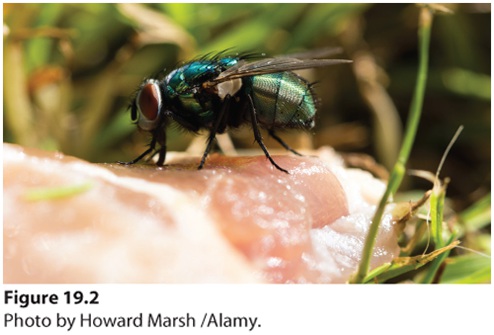
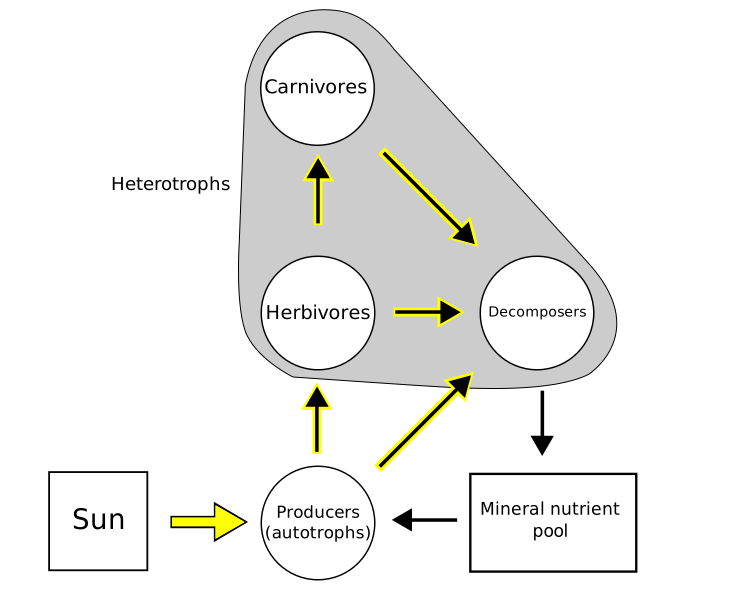
- Species richness (S)
- Number of species present.
- Species evenness
- How equally abundance is distributed across species.
- Shannon-Wiener index (H')
- H' = −Σ pi ln(pi); combines richness + evenness.
- Simpson's index
- Probability that two randomly drawn individuals are different species.
- α / β / γ diversity
- α = within-site; β = turnover between sites; γ = total regional. γ = α × β (approx).
- Rank-abundance curve
- Plot of log abundance vs species rank; steeper slope = lower evenness.
- Dominant species
- Most abundant or highest biomass; may not control community.
- Keystone species
- Disproportionate effect relative to abundance (e.g., Pisaster sea star — Paine's classic experiment).
- Ecosystem engineer
- Modifies habitat physically (beavers, prairie dogs, corals).
- Food web
- Network of feeding relationships. Bottom-up control = primary producers limit higher trophic levels; top-down = predators control prey, cascading down (trophic cascade).
Community ecology starts with its currency: diversity. This lecture defines and measures it — richness, evenness, diversity indices, rank-abundance, α/β/gamma — and asks what niches and neutrality each predict about who lives together.
Learning objectives
- Distinguish richness, evenness, and diversity; compute Shannon and Simpson indices.
- Read rank-abundance (Whittaker) plots and abundance distributions.
- Partition diversity: α, β, gamma; use β to compare turnover.
- Explain rarefaction and why raw counts mislead.
- Contrast niche-based (limiting similarity) vs neutral theory of coexistence.
- Define keystone species and foundation species with evidence.
Part 1: Measuring diversity
- Richness (S): count of species. Evenness: equality of abundances. Diversity = both: 5 species at 20% each beats 5 species at 96–1-1–1-1.
- Shannon H = -sum(pi ln pi): information-theoretic, sensitive to rare species; effective species number = e^H. Simpson D = sum(pi^2) is the probability two random draws match; report 1-D or 1/D — dominance-sensitive.
- Worked habit: community A (0.96, 0.01×4) vs B (0.2×5): B wins on any index despite equal S.
- Rank-abundance (Whittaker) plots: steep line = low evenness (dominance); long shallow tail = even community. Most communities: few commons, many rares (lognormal-ish).
- Sampling truth: richness climbs with effort (species-accumulation curves); Rarefy to equal sample size before comparing sites — a wetland with 400 individuals counted will “beat” one with 40 by effort alone.
Part 2: Partitioning and patterns
- Alpha = within-site; gamma = regional; β = turnover between sites (multiplicative gamma = α x β or additive). High β = distinct site communities — reserve networks should then cover many sites (SLOSS reprise from L07).
- Beta diversity falls with homogenization (invasives + generalists spreading) — a biodiversity loss invisible to any single site’s α.
- Preview of L15: richness patterns (latitude, area, energy) run on these measures.
Part 3: Why do species coexist at all?
- Niche-based view: coexistence requires niche differences (L10 — stabilizing differences > fitness differences); limiting similarity caps how alike neighbors can be.
- Neutral theory (Hubbell): assume all individuals demographically identical; diversity = balance of speciation, extinction, dispersal (drift at community scale). Reproduces many abundance distributions — a null model that fits patterns without niches.
- Resolution: neutrality as null hypothesis; niches proven by invasibility/removal experiments and by stabilizing responses (species do better when rare — the signature of niche coexistence).
- Keystone species: impact >> biomass share (Paine’s Pisaster removal: mussels monopolized, richness 15 -> 8; otters L13). Foundation species: impact Through biomass — habitat builders (Spartina, corals, prairie grasses). Dominants vs keystones: know the axis (biomass vs per-capita effect).
Condensed review — most likely to be tested
- Diversity = richness x evenness; indices weight them differently.
- Shannon (rare-sensitive), Simpson (dominance-sensitive); effective numbers e^H, 1/D.
- Rank-abundance steepness reads evenness at a glance.
- Rarefaction first, comparison second.
- Alpha x β = gamma; homogenization erodes β silently.
- Niche coexistence shows rare-species advantage; neutral theory is the null.
- Keystone = per-capita giant (Pisaster); foundation = biomass giant (Spartina).
Mnemonic set
- “Count and balance — richness and evenness.”
- “Shannon hears the rare, Simpson sees the common.”
- “Alpha here, gamma everywhere, β the difference.”
- “Keystones punch above their weight.”
Self-test
- Compute Simpson’s 1-D for community A (0.96, 0.01, 0.01, 0.01, 0.01) and B (0.2×5), and interpret.
- Site X yields 25 species from 500 insects; site Y yields 18 species from 60 insects. Why is “X is richer” premature, and what fixes it?
- Two landscapes each have gamma = 60 species. In P, every wetland holds the same 30; in Q, wetlands hold distinct sets of 15. Compare α and β and the conservation design each implies.
- What observation distinguishes niche-stabilized coexistence from neutral drift, and why?
- Paine removed Pisaster and richness fell 15 -> 8 while mussel cover exploded. Why keystone and not merely important?
- Invasive generalists raise several sites’ α richness yet conservationists mourn. What is being lost?
Show answer key — try the questions first
- A: D = 0.9216 + 4(0.0001) = 0.9220 -> 1-D = 0.078. B: D = 5(0.04) = 0.2 -> 1-D = 0.8. Same richness, B is vastly more diverse — evenness is the difference.
- Richness scales with sampling effort; X had 8x the individuals. Rarefy X to 60 individuals (or use coverage-based rarefaction/Chao estimators) — Y may match or exceed X at equal effort.
- P: α 30, β = 2 — one big reserve captures most diversity. Q: α 15, β = 4 — high turnover demands MANY sites across the landscape. Beta diversity is the reserve-design variable.
- Rare-species advantage: under niche coexistence, species grow faster when rare (released from self-limitation). Neutral dynamics show no density-dependent rescue — rarity predicts nothing. Invasion-from-rare experiments test it.
- Its effect was wildly disproportionate to its biomass (a per-capita giant): predation on the dominant competitor (mussels) kept space open for everyone else. Dominants matter through biomass; keystones through per-capita interaction strength.
- Beta diversity: sites converge on the same cosmopolitan set — biotic homogenization. Regional (gamma) distinctiveness erodes even as local counts tick up.
Where are the species? Richness is not sprinkled evenly: it climbs toward the equator, grows with area and energy, and bends with disturbance and productivity. This lecture maps the grand patterns and the competing explanations.
Learning objectives
- Describe the latitudinal diversity gradient and evaluate its main hypotheses.
- Apply the species-area relationship (L02 reprise) to habitat loss estimates.
- Explain species-energy and productivity-diversity relationships (and the hump debate).
- State the intermediate disturbance hypothesis with the Sousa boulders test.
- Explain why the tropics: time, area, energy, speciation-extinction accounting (dS/dt).
- Connect richness patterns to conservation prioritization (hotspots).
Part 1: The grand gradient
- Latitudinal diversity gradient (LDG): richness rises from poles to tropics in nearly every taxon — trees (a few dozen per temperate hectare vs 300+ in Amazonia), birds, amphibians, marine groups. The oldest pattern in ecology (documented since Wallace).
- Hypothesis families (not mutually exclusive): TIME (tropics older + unglaciated — more time to speciate and accumulate); AREA (tropical biome belt is vast and connected — bigger target for speciation, lower extinction); Energy (more solar input + water -> more productivity -> more individuals -> more species maintained); Stability (aseasonality permits narrower niches, tighter packing — recall L02 seasonality logic); Biotic interactions (stronger predation/parasitism/competition in the tropics drives faster coevolutionary diversification — Red Queen reprise).
- Accounting version (Kaspari P6): tropical dS/dt has run at higher D (speciation) and lower X (extinction) for longer — the tropics are both cradle (high origination) and museum (low extinction).
- Exceptions matter: seabirds, aphids, ichneumonid wasps peak at temperate latitudes — test any hypothesis against the misfits.
Part 2: Area and energy
- Species-area (S = cA^z, L02) is the workhorse: within-province z ≈ 0.15, islands ≈ 0.25, between provinces ≈ 0.9. Application: habitat-loss extinction estimates — losing 90% of area with z = 0.25 predicts losing ≈ 44% of species (0.1^0.25 ≈ 0.56 remain).
- Species-energy: richness tracks available energy (evapotranspiration, NPP) at broad scales — more energy supports more individuals (the more-individuals hypothesis) and more rare species above their minimum viable populations.
- Productivity-diversity at local scales is often HUMP-Shaped: low productivity = too few resources; high productivity = competitive exclusion by fast dominants (recall R*, L10 — enrichment collapses coexistence); diversity peaks in the middle. The hump is real but noisy — meta-analyses find it in about half of studies (know the debate exists).
- Paradox of enrichment echo: fertilization experiments (Park Grass, 150+ years) consistently LOSE plant species as biomass rises — light competition replaces nutrient partitioning.
Part 3: Disturbance
- Intermediate disturbance hypothesis (IDH, Connell): low disturbance -> competitive dominants exclude; high disturbance -> only fast colonizers persist; Intermediate frequency/intensity -> both guilds coexist, richness peaks.
- Sousa’s boulders (the test): small boulders roll often (early-successional algae only), large ones rarely (dominant mussel/algal monopolies), MID-SIZE boulders host the most species. Experimental anchoring beat correlation.
- Prairie relevance (Manning): fire every few years is the intermediate disturbance maintaining tallgrass richness — too rare = woody encroachment, too frequent = only fire-tolerant grasses.
- IDH caveats: meta-analyses find peaked patterns a minority of the time; coexistence theory says disturbance alone (without niche differences) cannot stabilize — treat IDH as a pattern-generator, not a law.
- Conservation synthesis: richness maps (LDG + hotspots — 36 regions with >1500 endemic plants on 2.5% of land holding ≈half of endemic species) target where protection buys most diversity; β diversity (L14) decides how to spread it.
Condensed review — most likely to be tested
- LDG: near-universal poleward decline; tropics = cradle AND museum.
- Hypothesis families: time, area, energy, stability, biotic interactions — complementary, not rivals.
- z-values: ≈0.15 mainland, ≈0.25 islands, ≈0.9 between provinces.
- 90% habitat loss with z=0.25 -> ≈44% species loss — the back-of-envelope that runs conservation.
- Species-energy: more energy, more individuals, more species.
- Local productivity-diversity is often hump-shaped; enrichment loses species (Park Grass).
- IDH peaks richness at intermediate disturbance (Sousa boulders; prairie fire).
- Hotspots: ≈2.5% of land, ≈50% of endemic plants.
Mnemonic set
- “Cradle and museum — the tropics do both.”
- “Time, Area, Energy, Stability, Interactions — TAESI, the LDG stack.”
- “Point-two-five and the fourth root — island z and the loss estimate.”
- “Middle boulders, most species — Sousa in four words.”
Self-test
- A country will clear 90% of a forest. Using S = cA^z with z = 0.25, estimate the fraction of species eventually lost, and name one reason reality could be worse and one reason better.
- Give the more-individuals chain from solar energy to species richness, and one observation that supports it.
- Fertilizing grassland plots for decades raises biomass and lowers plant richness. Reconcile with species-energy.
- Explain the IDH prediction and how Sousa’s boulder field tested it experimentally rather than correlatively.
- Tallgrass prairie burned annually loses forbs; unburned it becomes shrubland. Apply IDH and name the management sweet spot.
- The tropics are called both cradle and museum. Translate into dS/dt terms and give one line of evidence for each half.
Show answer key — try the questions first
- Remaining S proportion = 0.1^0.25 ≈ 0.56 -> ≈44% lost. Worse: extinction debt pays out over decades, fragmentation adds edge effects and isolation (L07). Better: survivors persist in secondary habitat/matrix; targeted retention of hotspots saves disproportionate richness.
- More energy -> higher NPP -> more total individuals supportable -> rare species stay above minimum viable populations -> lower extinction -> higher S. Support: richness tracks evapotranspiration/NPP across continents at broad grains.
- Scale and mechanism differ: broad-scale energy adds individuals and species; local enrichment shifts limitation to LIGHT — a single contested axis — letting tall dominants exclude (R* logic). Energy across regions adds niches; enrichment within plots removes them.
- Low disturbance -> exclusion by dominants; high -> only colonizers; intermediate -> coexistence peak. Sousa used boulder size as a disturbance-frequency proxy AND stabilized boulders experimentally (cementing them), showing succession toward dominance when rolling stopped — manipulative confirmation.
- Fire is the disturbance axis: annual burning is “too frequent” (grass-dominated), fire suppression “too rare” (woody exclusion); the traditional 3–5 year return interval is the intermediate regime maximizing forb + grass coexistence.
- Cradle: higher D (origination) — young species pairs concentrate at low latitudes in phylogenies. Museum: lower X (extinction) — old lineages persist (fossil + phylogenetic longevity). Both raise standing S under dS/dt = D — X + I.
Does diversity DO anything? This lecture covers the biodiversity-ecosystem function (BEF) research program — the experiments showing richer communities produce more, hold nutrients better, and buffer variation — and the ecosystem-services frame (Kaspari P10) that converts those functions into human stakes.
Learning objectives
- Define ecosystem function and ecosystem services (four MEA categories).
- Describe the flagship BEF experiments (Cedar Creek; Tilman) and their designs.
- Explain complementarity vs selection (sampling) effects.
- Define the portfolio/insurance effect and functional redundancy.
- Explain why function saturates with richness and why redundancy still matters.
- Connect BEF to services valuation (pollination, water purification) and to prairie restoration.
Part 1: The BEF experiments
- Question: hold environment constant, vary richness experimentally — does function change? Function = productivity, nutrient retention, invasion resistance, stability.
- Cedar Creek (Tilman, Minnesota): hundreds of prairie plots seeded with 1–16 species. Results: higher richness -> higher biomass, lower soil nitrate leakage (fuller nutrient use), fewer invaders, and smaller biomass swings in drought years.
- Biodepth (Europe, 8 sites) generalized the pattern; grassland results replicate across continents.
- The function-richness curve Saturates: steep gains from 1 -> ≈8 species, flattening beyond — each added species overlaps more with what is already present.
Part 2: Mechanisms — why richness works
- Complementarity: species differ in rooting depth, phenology, N-form use (niche partitioning, L10-L14) -> together they use MORE total resources than any monoculture (overyielding). Legume + C4 grass + cool-season forb = a fuller pipe.
- Selection (sampling) effect: diverse plots are more likely to Contain the single best performer, which comes to dominate — a statistical, not interactive, benefit. Additive-partitioning statistics separate the two; long-term Cedar Creek data show complementarity GROWS with time.
- Insurance/portfolio effect: species respond asynchronously to environmental variation; aggregate function varies less (variance-damping like a diversified portfolio). Drought years at Cedar Creek: high-diversity plots lost proportionally less biomass and recovered faster (resistance + resilience).
- Functional redundancy: multiple species per functional group seem “extra” until conditions change — redundancy is latent insurance, and losing “redundant” species narrows the response portfolio.
- Facilitation contributes too (L10): legumes fix N that grasses use — complementarity with a plus sign.
Part 3: Services — the human ledger (Kaspari P10 made explicit)
- MEA categories: provisioning (food, timber, water), regulating (pollination, purification, flood control, climate), cultural (recreation, identity), supporting (soil formation, nutrient cycling — the substrate of the rest).
- Pollination: ≈75% of crop species benefit from animal pollination; wild-bee richness raises fruit set beyond honeybees alone (complementary foraging niches).
- Water: NYC pays for Catskills watershed protection instead of a filtration plant — nature as cheaper infrastructure; wetlands as nutrient sponges (denitrification service, ties to L04 eutrophication).
- Stability services: diverse grasslands yield more reliable forage; diverse fisheries portfolios (Bristol Bay salmon stocks) damp year-to-year catch swings.
- Prairie angle: restoration seed mixes trade cost vs function — high-diversity mixes cost more but deliver more biomass, more pollinators, better N retention, and greater drought reliability. BEF is the scientific case for the expensive mix.
Condensed review — most likely to be tested
- BEF: experimental richness gradients change function — productivity up, leakage down, invasion down, stability up.
- Curve saturates: steep to ≈8 species, flat later — but redundancy is insurance, not waste.
- Complementarity = fuller resource use (grows with time); selection effect = lottery for the best species.
- Portfolio effect: asynchrony damps aggregate variance.
- MEA services: provisioning, regulating, cultural, supporting.
- Wild-bee richness beats honeybees alone; Catskills beat the filtration plant.
- Restoration mixes: diversity is a functional investment.
Mnemonic set
- “Fuller pipes and lucky draws — complementarity vs selection.”
- “Different bets, steadier returns — the portfolio effect.”
- “PRCS: Provisioning, Regulating, Cultural, Supporting.”
- “Redundant today, essential in the drought.”
Self-test
- At Cedar Creek, 16-species plots outproduce the average monoculture AND leak less nitrate. Give the mechanism for each result.
- Design the analysis that distinguishes complementarity from the selection effect, conceptually.
- Why do high-diversity plots lose less biomass in a drought year and recover faster?
- Function saturates by ≈8 species. A manager concludes 8 is enough for restoration. Give two counterarguments.
- Explain the Catskills decision as an ecosystem-services calculation.
- Orchards near diverse wild-bee communities set more fruit than those relying on honeybees alone. Which BEF mechanisms map onto this service?
Show answer key — try the questions first
- Overyielding via complementarity: different rooting depths/phenologies/N-forms use more total resources. Lower nitrate leakage is the same mechanism read from the soil side — a fuller resource pipe leaves less to leach.
- Additive partitioning: compare each species’ yield in mixture vs its monoculture. Selection effect appears as dominance by species that were already the best monocultures; complementarity appears as broad overyielding across members — mixtures beating even the best monoculture is its strongest signature.
- Asynchronous responses: drought-tolerant members compensate while sensitive ones fail (resistance), and multiple recovery pathways speed the rebound (resilience) — the insurance/portfolio effect.
- Saturation is measured for ONE function in ONE environment: different functions (pollination, N retention, forage timing) saturate at different compositions (multifunctionality needs more species), and redundancy is the insurance that pays in extreme years and future conditions.
- Protecting/restoring the watershed (≈$1–1.5B) delivered purification that a filtration plant would provide at ≈$6–8B plus operating costs — the regulating service was the cheaper infrastructure. Valuation made conservation the winning bid.
- Complementarity: bee species differ in foraging times, weather tolerance, and flower handling — together covering the pollination niche space. Portfolio: wild-bee asynchrony insures against honeybee colony failure — service stability, not just magnitude.
U12 · Succession & Disturbance
Succession = directional, predictable change in community composition over time following disturbance.
- Primary succession
- On bare substrate with no soil (volcanic flow, glacial retreat, sand dunes). Slow — pioneers like lichens build soil.
- Secondary succession
- Soil intact, propagules present (after fire, agriculture, logging). Faster.
- Pioneer species
- Early colonizers — fast growth, wind-dispersed, stress-tolerant (e.g., fireweed, lichens).
- Climax community
- Theoretical end-state in stable equilibrium — challenged by modern non-equilibrium thinking.
- Facilitation
- Earlier species make conditions better for later (alder fixes N → spruce can grow).
- Inhibition
- Earlier species prevent later from establishing.
- Tolerance
- Later species establish despite earlier — depends on tolerating low light/nutrients.
- Intermediate Disturbance Hypothesis (IDH)
- Diversity peaks at moderate disturbance frequency/intensity. Too little = competitive exclusion; too much = only ruderals survive.
Fire ecology & disturbance regimes
- Fire regime
- Characteristic frequency, intensity, season, and patchiness of fire in an ecosystem.
- Crown fire vs surface fire
- Crown burns canopy (catastrophic, conifers); surface burns understory + litter (typical of grasslands).
- Pyrogenic species
- Adapted to or dependent on fire: serotinous cones (jack pine, lodgepole pine open only after fire), thick bark (oak, ponderosa pine), basal sprouting.
- Tallgrass prairie
- Maintained by frequent fire (~3–5 yr return). Fire suppresses woody invasion, recycles nutrients, stimulates C4 grass productivity.
- Fire return interval
- Years between fires at a site.
- Prescribed burning
- Management tool — season and frequency of burning drive prairie species composition. UNomaha's Glacier Creek Preserve is a long-running local example.
- Loess Hills prairie
- Western Iowa wind-deposited silt prairie — fire-dependent, threatened.
Communities are movies, not photographs. Succession is the plot: how bare substrate becomes forest, how mechanisms (facilitation, tolerance, inhibition) drive the sequence, and why the “climax” gave way to a shifting-mosaic, disturbance-embedded view — with the prairie as the standing counterexample.
Learning objectives
- Distinguish primary vs secondary succession with classic chronosequences.
- Describe Connell-Slatyer mechanisms: facilitation, tolerance, inhibition.
- Trace Glacier Bay and dune successions; explain soil development trajectories.
- Contrast Clements’ superorganism vs Gleason’s individualistic view and the modern verdict.
- Explain the shifting-mosaic steady state and old-field succession.
- Apply succession to restoration and to fire-maintained prairie (arrested succession).
Part 1: Kinds and cases
- Primary succession: from NEW substrate with no soil legacy — lava (Krakatau, Surtsey), glacial forelands (Glacier Bay), dunes (Cowles’ Indiana Dunes, L01 history). Centuries-scale because soil must be BUILT.
- Secondary succession: after disturbance that leaves soil + seed bank + survivors — old fields, burns, hurricanes. Decades-scale; the legacy (L02) does the head start.
- Glacier Bay chronosequence: pioneer Dryas + fireweed on till -> alder thickets Fix nitrogen (soil N climbs) -> spruce overtops using that N -> spruce-hemlock forest; soil acidifies and, in wet basins, sphagnum paludification can end in muskeg — succession does not always “improve”.
- Old-field (eastern US): crabgrass/ragweed year 1 -> perennial grasses + goldenrod -> shrubs/brambles -> pines -> shade-tolerant hardwoods through the pine understory. Each stage sets its own replacement up.
- Chronosequence caution: space-for-time substitution assumes sites differ only in age — test with permanent plots where possible.
Part 2: Mechanisms and models
- Connell-Slatyer three mechanisms: Facilitation — early species make conditions better for later ones (alder N-fixation; dune-grass stabilization; lichens making first soil). Tolerance — later species simply endure lower resources and win the long game (shade-tolerant hardwoods growing beneath pines). Inhibition — incumbents Resist replacement until disturbance or death frees space (dense shrub monopolies, allelopathy; priority effects, L10).
- All three usually operate in one sequence at different stages — identify the mechanism from the interaction sign, not the stage name.
- Traits turnover predictably: early = r-ish (small seeds, dispersal, fast growth, shade-intolerant); late = K-ish (large seeds, shade tolerance, longevity) — L08 life histories mapped onto time.
- Animal succession follows the vegetation structure (grassland sparrows -> shrub warblers -> forest interior birds).
Part 3: Endpoints — or not
- Clements: community as superorganism marching to a single climatic Climax. Gleason: individualistic — species respond independently along gradients; “communities” are coincidences of overlap. Modern data (pollen records showing species migrating at different rates post-glacially; continuous gradient turnover) side mostly with Gleason — with real interactions embedded.
- Shifting-mosaic steady state: at landscape scale, patches of all successional ages coexist as disturbance keeps striking; the Landscape is in equilibrium while every point is transient (ties to IDH, L15, and landscape level, L02).
- Arrested succession: grazing, fire, waterlogging hold systems short of woody dominance — tallgrass prairie is fire-arrested succession (Manning’s theme): stop burning and eastern redcedar + deciduous species close in within decades.
- Restoration = directed succession: pick the mechanism lever — plant facilitators (N-fixers on mine spoil), remove inhibitors (shrub monopolies, invasive sod), add propagules (seed limitation is real — L07 dispersal), and restore the disturbance regime rather than fight it.
Condensed review — most likely to be tested
- Primary = build soil from scratch (centuries); secondary = legacy head start (decades).
- Glacier Bay: Dryas -> alder (N-fixer) -> spruce -> hemlock/muskeg; alder is the facilitation engine.
- Connell-Slatyer: facilitation, tolerance, inhibition — identify by interaction sign.
- Early r-traits -> late K-traits; animals track vegetation structure.
- Gleason mostly beat Clements: individualistic responses, real interactions.
- Shifting mosaic: landscape equilibrium of transient patches.
- Prairie = fire-arrested succession; restoration = managing the mechanisms.
Mnemonic set
- “Soil first, forest later — primary succession’s bottleneck.”
- “FTI: Facilitate, Tolerate, Inhibit — the three motors.”
- “Alder pays the nitrogen bill at Glacier Bay.”
- “Every patch is temporary; the mosaic is forever.”
Self-test
- Lava field vs abandoned cornfield: classify the succession types and predict which reaches forest sooner and why.
- At Glacier Bay, spruce cannot establish on fresh till but thrives after alder. Name the mechanism and the currency.
- Shade-tolerant hardwoods establish under a pine canopy and eventually replace it without the pines “helping”. Which Connell-Slatyer pathway?
- A dense shrub thicket stalls old-field succession for decades until a fire. Which mechanism, and what freed the sequence?
- Post-glacial pollen cores show oak, pine, and hemlock migrating north at different rates and assembling in no fixed order. Whose model does this support and why?
- Explain why tallgrass prairie is called an arrested succession, and predict 30 years of fire suppression.
Show answer key — try the questions first
- Lava = primary (no soil — centuries: weathering + lichen/moss soil building first). Cornfield = secondary (intact soil, seed bank, sprouters — decades). Legacy is the difference.
- Facilitation; the currency is nitrogen — alder’s symbiotic fixation (Frankia) raises soil N from near zero to levels supporting spruce. Early species change the environment in later species’ favor.
- Tolerance: hardwoods neither need nor benefit from pines — they endure low light and win by longevity as shade-intolerant pines fail to self-replace.
- Inhibition — incumbents monopolize space/light (perhaps allelopathically) and resist invasion; disturbance (fire) removed the inhibitor and released the next stage. Priority effects at successional scale.
- Gleason’s individualistic view: species tracked climate independently; “communities” are overlapping distributions, not superorganisms moving as units.
- Climate there could support woodland (L02); recurrent fire kills woody invaders while grasses resprout from protected meristems — fire holds the system at the grass stage. Suppression: eastern redcedar and deciduous encroachment converts prairie to closed woodland within decades.
U13 · Ecosystem Energy & Nutrient Cycling
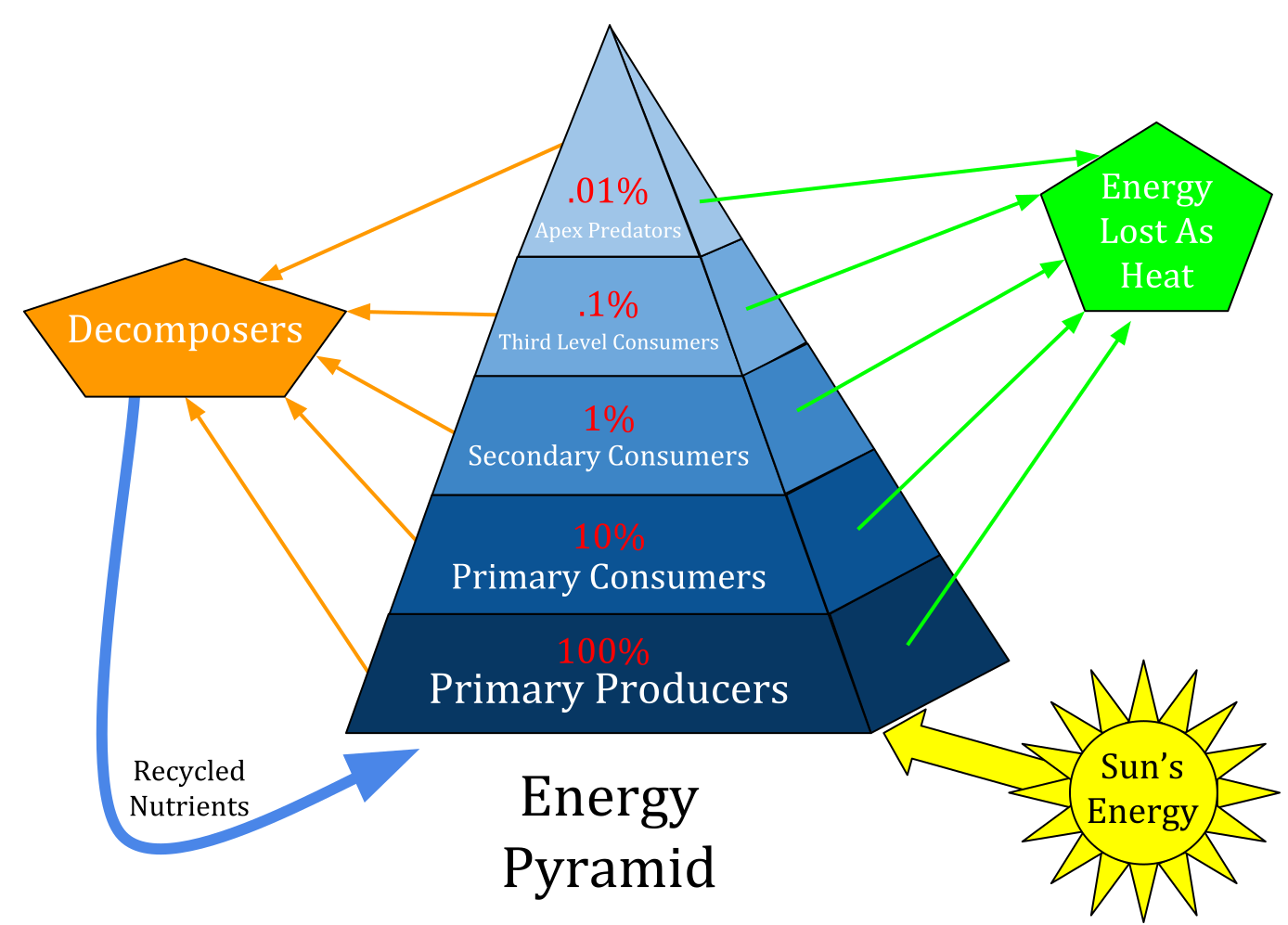
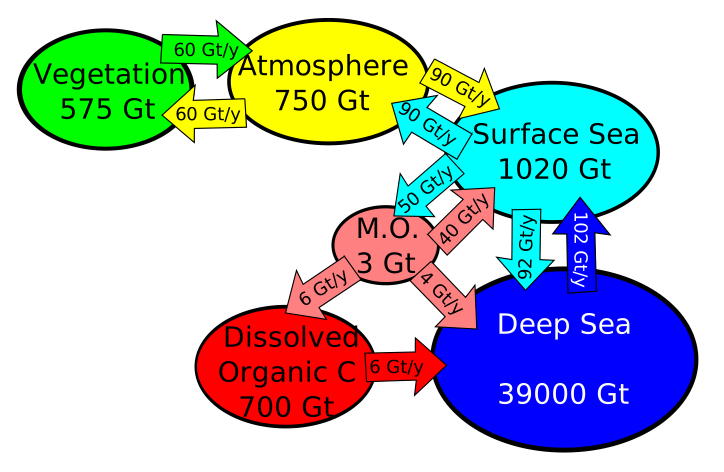
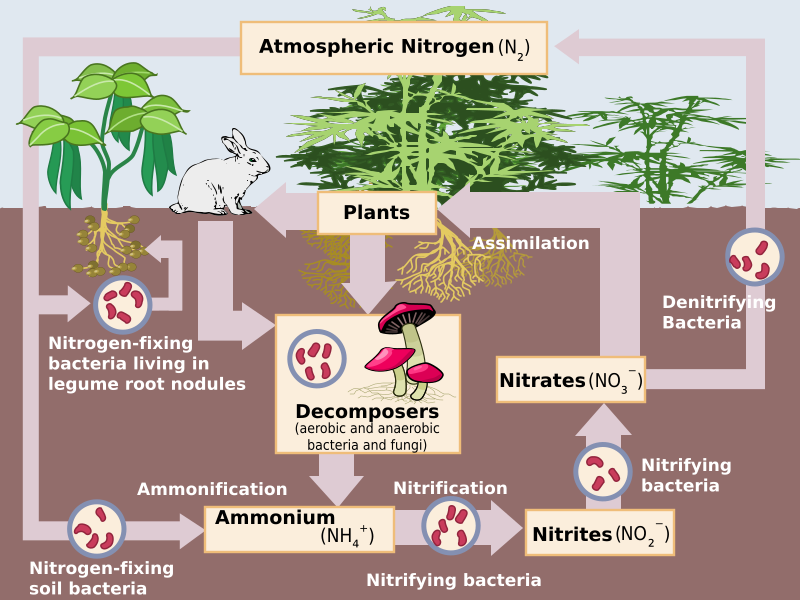
- Gross primary productivity (GPP)
- Total photosynthesis per unit time per area.
- Net primary productivity (NPP)
- GPP − plant respiration. Energy available to consumers.
- Trophic level
- Position in food chain: producers (1°), primary consumers (2°), etc.
- 10% rule
- Only ~10% of energy at one trophic level is incorporated into the next; rest lost as heat (2nd law). Limits chain length to ~4–5 levels.
- Eltonian pyramid
- Pyramid of energy, biomass, or numbers — energy always pyramidal; biomass occasionally inverted (open ocean — fast turnover phytoplankton).
- Detritus food chain
- Decomposers + detritivores process dead matter — often >50% of community energy flow.
Biogeochemical cycles
| Cycle | Atmospheric pool? | Key fluxes |
|---|---|---|
| Carbon | Yes (CO₂) | Photosynthesis ↔ respiration; combustion of fossil fuels adds. |
| Nitrogen | Yes (N₂, ~78%) | N-fixation (Rhizobium, lightning, Haber-Bosch) → ammonification → nitrification (NH₄⁺→NO₂⁻→NO₃⁻) → denitrification (NO₃⁻→N₂). |
| Phosphorus | NO atmospheric pool | Weathering of rock → soil → plants → animals → return via decomposition. Often limiting. |
| Water | Yes (vapor) | Evaporation, transpiration, precipitation, runoff. Solar-driven. |
- Limiting nutrient
- Element that constrains productivity. Liebig's Law of the Minimum.
- Eutrophication
- Nutrient enrichment (often N, P from fertilizer runoff) → algal bloom → death + decomposition → hypoxic dead zone.
- Bioaccumulation / biomagnification
- Persistent pollutants (DDT, mercury) concentrate up food chains; top predators get hit hardest.
Post-Exam-2 the course goes thermodynamic: communities become ecosystems when you follow the energy. This lecture covers trophic structure, the 10% rule and why it exists, food-web architecture, and how energy constraints explain chain length and pyramid shapes.
Learning objectives
- Define trophic levels, food chains vs webs, and interaction vs energy-flow webs.
- Trace energy from GPP through consumers; define assimilation and production efficiencies.
- Explain the ≈10% trophic transfer rule and its three component inefficiencies.
- Compare pyramids of energy, biomass, and numbers — including inverted cases.
- Evaluate hypotheses for food-chain length (energy, stability, ecosystem size).
- Describe web metrics (connectance, omnivory) and the brown web’s dominance.
Part 1: Trophic architecture
- Levels: producers (autotrophs) -> primary consumers (herbivores) -> secondary -> tertiary; decomposers and detritivores process everything’s leavings. Most species are omnivores at fractional levels — webs, not chains.
- Energy-flow webs (arrow thickness = flux) differ from interaction webs (who affects whom, incl. keystones — a thin arrow can carry a huge interaction, L14/Pisaster).
- Connectance C = L/S^2: realized fraction of possible links; niche-model architecture; most webs show short paths (2 degrees of separation between species on average).
- The BROWN web: in most ecosystems the majority of NPP is never grazed alive — it dies and enters detritus. Forests: >90% of energy flows through the brown (decomposer) channel; the green (grazing) channel dominates only in some aquatic systems (phytoplankton grazed at 50–90%). Donor control (L13) rules the brown side.
Part 2: The 10% rule, decomposed
- Trophic transfer efficiency = P(n)/P(n-1) ≈ 5–20%, canonically 10%. It is the Product of three efficiencies:
- Consumption efficiency (what fraction of available production is eaten): grasslands ≈10–25% grazed, forests ≈1–5%; zooplankton on phytoplankton up to 50–90%.
- Assimilation efficiency (fraction of ingested energy absorbed, not egested): carnivores 60–90% (meat digests well); herbivores 20–50% (cellulose, lignin — L11 quantitative defense working); detritivores lower still.
- Production efficiency (fraction of assimilated energy becoming new tissue vs respiration): ectotherm invertebrates 10–40%; fish ≈10%; mammals and birds 1–3% (endothermy’s fuel bill, L03) — which is why food chains of endotherms are energetically brutal.
- Consequences: usable energy shrinks ≈an order of magnitude per level -> few levels (L01’s food-chain answer), rare top predators with huge ranges, and the trophic argument for eating lower on the food chain (10x more humans fed per hectare of grain than of grain-fed beef).
Part 3: Pyramids and chain length
- Pyramid of Energy: always upright (thermodynamics — each level dissipates).
- Pyramid of Biomass: usually upright; Inverted in open ocean — phytoplankton standing crop < zooplankton because turnover is days (P/B ratio huge): a small, fast-spinning base supports a larger, slower stack. Snapshot vs flux.
- Pyramid of Numbers: freely inverts (one tree, thousands of caterpillars).
- Chain-length hypotheses: Energy limitation (more productive systems -> longer chains — EEH kinship, L13); Dynamic stability (long chains recover slowly from shocks — disturbance trims them); Ecosystem size (bigger habitat volume -> longer chains; lakes: chain length tracks lake SIZE better than productivity — Post’s isotope work).
- Measurement: stable isotopes (d15N enriches ≈3–4 per mil per level) turned chain length into data — webs run 3–5 levels, rarely 6.
- Human angle: mean trophic level of fisheries catch declined for decades (“fishing down the food web”) — mining the pyramid’s top.
Condensed review — most likely to be tested
- Webs not chains; omnivory makes levels fractional.
- Brown web carries most energy in most systems; grazing dominates only in plankton systems.
- 10% rule = consumption x assimilation x production efficiencies.
- Endotherm production efficiency 1–3% (the L03 fuel bill).
- Energy pyramids always upright; ocean biomass pyramids invert via turnover.
- Chain length: energy, stability, and SIZE hypotheses — lakes favor size.
- d15N +3–4 per mil per level — isotopes measure trophic position.
- Eating lower feeds ≈10x more people per hectare.
Mnemonic set
- “CAP: Consumption x Assimilation x Production = the 10%.”
- “Meat digests, grass resists — assimilation efficiencies.”
- “Warm bodies waste watts — endotherm production efficiency.”
- “Fast small base, tall slow stack — the inverted ocean pyramid.”
Self-test
- Grass NPP is 20,000 kJ/m2/yr. With 10% transfers, how much reaches secondary consumers (level 3), and why might grassland do better than forest?
- Break the 10% rule into its three component efficiencies for a lion eating wildebeest, with rough values.
- Open-ocean biomass pyramids are inverted, yet no thermodynamic law is violated. Explain.
- Post found food-chain length in lakes tracks lake volume better than productivity. Interpret against the energy-limitation hypothesis.
- Explain “fishing down the food web” and its pyramid logic.
- Why does the brown web resist top-down control, and what does that imply for cascades (L13)?
Show answer key — try the questions first
- Level 2 ≈2,000, level 3 ≈200 kJ/m2/yr. Grassland consumption efficiency is higher (10–25% grazed vs 1–5% in forests; no wood), so realized transfers can beat the canonical 10%.
- Consumption: fraction of wildebeest production lions actually eat (≈10–20%). Assimilation: meat digests well, ≈80–90%. Production: lions are endotherms — only ≈2–3% of assimilated energy becomes lion. Product lands near 2–5%: the endotherm tax.
- Energy FLUX pyramids remain upright: phytoplankton turn over in days (enormous production per biomass), so a small standing crop generates more energy per time than the larger, slower zooplankton stock consumes. The snapshot inverts; the flux does not.
- Energy sets an upper bound but is rarely the binding constraint: larger ecosystems support bigger, more stable populations of top predators (space, prey diversity, refuge from disturbance — L07/L09 logic), so SIZE predicts where the extra level actually persists.
- Fisheries serially deplete high-trophic-level stocks (tuna, cod) then target lower levels (smaller fish, invertebrates); mean catch trophic level falls. The pyramid’s top is small (10% rule) and slow to rebuild — mining it first is energetically inevitable and ecologically destabilizing (L13 cascades).
- Detritus supply is donor-controlled — consumers cannot make dead matter appear faster. Cascades propagate weakly through decomposer channels, which buffers whole-ecosystem responses where the brown web dominates (most terrestrial systems).
One energy-and-nutrients logic, three arenas. This lecture tours the major terrestrial biomes (L02’s climate machine cashed out), then the freshwater and marine realms — lake structure, streams, and the ocean’s productive edges — asking in each: what limits production and who processes it?
Learning objectives
- Place major terrestrial biomes from temperature x precipitation (and fire/soil modifiers).
- Describe lake zonation, thermal stratification, and turnover.
- Classify lakes: oligotrophic vs eutrophic; explain the river continuum concept.
- Describe marine zonation and why margins and upwellings outproduce the open ocean.
- Compare limitation: water/N on land, N (+Fe) at sea, P in lakes.
- Identify the productivity champions (reefs, wetlands, forests) and their mechanisms.
Part 1: Terrestrial biomes — the climate machine’s output (Ch. 22)
- The biome plot (L02): temperature x precipitation places tropical rainforest (warm-wet), savanna (warm, seasonal), desert (30-degree belts + rain shadows), Mediterranean shrubland (winter-wet coasts), temperate grassland (continental interiors — fire/grazing maintained, L17 arrested succession), temperate forest, boreal forest (largest terrestrial biome), tundra (permafrost).
- Modifiers on climate: FIRE (prairie, chaparral, savanna), SOILS (mollisols under grassland vs thin acidic spodosols under boreal; deeply weathered oxisols under tropical forest — fertility inversely related to standing biomass!), Grazers (Serengeti), and now humans (croplands replacing mollisol grasslands).
- Tropical paradox: massive biomass on poor soils — nutrients live IN the biomass, cycling tightly (mycorrhizae recapture, L04/L22 preview); clearing exports the capital.
- NPP league table (g/m2/yr, rough): tropical forest 2200; swamps/marshes 2000+; temperate forest 1200; savanna 900; boreal 800; grassland 600; tundra 140; desert <90; open ocean ≈125 but vast area.
Part 2: Freshwater (Ch. 23)
- Lake zones: littoral (nearshore, rooted plants), limnetic (open lit water), profundal (dark depths), benthic (bottom).
- Thermal stratification: summer epilimnion (warm, lit, mixed) over metalimnion/thermocline over hypolimnion (cold, dark, cut off from O2 resupply). Spring and fall Turnover (temperate dimictic lakes): when the column hits ≈4 °C (water’s density maximum), wind mixes top to bottom — resupplying deep O2 and surface nutrients. The twice-yearly reset that structures lake ecology.
- Oligotrophic lakes: deep, clear, nutrient-poor, O2-rich hypolimnion (trout). Eutrophic: shallow, nutrient-rich, productive, summer hypolimnetic O2 sags (L04 chain when human P arrives). P is the canonical freshwater limiter (Schindler’s whole-lake Experimental Lakes: split-lake 226 — the P side bloomed; the photo that ended phosphate detergents).
- River continuum concept: headwaters — shaded, allochthonous leaf inputs, shredder invertebrates, P/R < 1 (heterotrophic); mid-order — lit, algae + grazers, P/R > 1; large rivers — turbid, fine-particle collectors, back to P/R < 1. A downstream gradient of energy sources and guilds; dams and levees interrupt it (serial discontinuity, lost floodplain connectivity).
- Wetlands: hydric soils, anoxic sediments -> denitrification + carbon burial — the service organs of the landscape (L16).
Part 3: Marine (Ch. 24)
- Zonation: intertidal (Connell’s barnacles, L10) -> neritic (over shelf — most fisheries) -> oceanic; photic (≈0–200 m) vs aphotic; benthic vs pelagic.
- The open ocean is a nutrient desert (L02): stratification starves the lit layer of N (+Fe in HNLC zones, L04). Production concentrates at EDGES: coastal margins, Estuaries (river nutrients + light + marsh subsidy — among the most productive habitats on Earth), and Upwellings (Peru, Benguela, California — deep nutrients into light; anchoveta and the L09 collapse).
- Coral reefs: high GROSS productivity in nutrient-poor water via tight symbiotic recycling (zooxanthellae — mutualism preview) — the marine version of the tropical-soil paradox; bleaching = symbiosis failing under heat (L03 thermal limits).
- Kelp forests (L13 otter cascade), seagrass meadows, mangroves: structure-forming margins with outsized nursery + carbon services.
- Deep sea: detritus-funded (marine snow — the brown web at its purest, L19) except chemosynthetic vents (L01’s exception to Principle 2).
Condensed review — most likely to be tested
- Biome = temperature x precipitation, modified by fire, soil, grazing (prairie = fire).
- Tropical paradox: rich biomass, poor soil — nutrients cycle in the canopy.
- Dimictic lakes turn over at 4 °C, spring and fall — O2 down, nutrients up.
- P limits lakes (Schindler 226); N (+Fe) limits the sea; water/N limit land.
- River continuum: shredders -> grazers -> collectors; P/R crosses 1 and back.
- Marine production lives at edges: estuaries, upwellings, reefs (tight recycling).
- NPP champions: tropical forest, wetlands, reefs; open ocean is dilute but vast.
Mnemonic set
- “Climate proposes, fire and soil dispose — biome placement.”
- “Four degrees, twice a year — lake turnover.”
- “Schindler split the lake; phosphorus turned it green.”
- “Edges feed the ocean.”
Self-test
- Why do temperate lakes mix in spring and fall specifically, and what does each turnover deliver?
- Schindler fertilized half of Lake 226 with carbon+nitrogen and the other half with carbon+nitrogen+Phosphorus. Describe the result and its policy consequence.
- A shaded headwater stream has P/R < 1. Where does its energy come from, which invertebrate guild dominates, and how does this change downstream?
- Coral reefs are hyperproductive in nutrient-desert water. Resolve the paradox and connect it to tropical soils.
- Rank for NPP per m2 and for global total NPP: open ocean, tropical forest, estuary. Explain the discrepancy.
- Why are estuaries and upwellings the fisheries engines rather than the open sea?
Show answer key — try the questions first
- Water is densest at 4 °C: when the whole column reaches ≈4 °C (warming in spring, cooling in fall) density differences vanish and wind mixes it fully. Delivery: oxygen to the hypolimnion (staving off deep anoxia) and nutrients to the surface (fueling diatom blooms).
- Only the P side bloomed (visibly green in the aerial photo); the C+N side stayed clear. Definitive whole-ecosystem evidence that P limits temperate lakes — driving phosphate bans in detergents and P-focused sewage control.
- Allochthonous leaf litter (terrestrial subsidy) — shredders dominate; respiration exceeds in-stream photosynthesis. Mid-order: canopy opens, algae drive P/R > 1, grazers rise; large rivers: turbidity returns P/R < 1, fine-particle collectors dominate — the river continuum.
- Tight internal recycling: zooxanthellae photosynthesize within coral tissue, nutrients loop between partners with minimal leakage — like tropical forests holding nutrients in biomass over poor soils. Both are capital-in-the-organisms systems, and both export their wealth when broken (bleaching; deforestation).
- Per m2: estuary ≈ tropical forest >> open ocean. Global total: open ocean rivals land’s biggest contributors because its area is enormous — dilute but vast (L02 scale lesson: the answer depends on the denominator).
- Both re-supply the lit layer with nutrients (rivers + tides; wind-driven deep water), breaking the stratification starvation that caps oceanic NPP — production concentrates where nutrients meet light (L04 Liebig at ocean scale).
Production is the ecosystem’s payroll. This lecture defines the GPP/NPP/NEP ledger, how production is measured from bottles to satellites, what controls it on land and at sea, and how secondary (animal) production follows the efficiencies of L19.
Learning objectives
- Define GPP, NPP, R, NEP and their relationships.
- Describe measurement: harvest, gas exchange, eddy flux, light-dark bottles, 14 °C, satellites.
- State the global controls: light, water, temperature, nutrients (land) and nutrients + light (sea).
- Interpret global NPP maps and seasonal cycles.
- Define secondary production and its efficiency stack (L19 reprise).
- Explain NEP’s role in the carbon cycle (preview of L23) and carbon sinks.
Part 1: The production ledger
- GPP: total photosynthesis. NPP = GPP — autotroph respiration (Ra): what plants bank — typically ≈50% of GPP. NEP = NPP — heterotroph respiration (Rh): what the Ecosystem banks — small difference of large numbers, positive in growing forests (carbon sink), negative during decomposition pulses (source).
- Standing crop (biomass) is a stock; production is a flux — the ocean lesson (L19): never infer flux from stock.
- Global NPP ≈ 105 Pg C/yr, split ≈54 land / ≈46 ocean despite the ocean’s 71% area share — the dilution reprise.
Part 2: Measuring production
- Harvest methods: clip, dry, weigh over time (grasslands, crops) — plus belowground cores (roots are ≈half of grassland NPP; the prairie’s hidden bank, L04 mollisols).
- Gas exchange: chambers to whole-ecosystem Eddy covariance towers (CO2 flux by turbulence statistics; Fluxnet’s global network) — NEP measured directly, day and night.
- Aquatic: light-dark bottle O2 (light bottle = NPP, dark = R, sum = GPP); 14 °C uptake for sensitive oceanic rates.
- Satellites: chlorophyll (ocean color) and NDVI/fAPAR on land scale production to the globe — the biosphere’s breathing measured from orbit (seasonal CO2 sawtooth at Mauna Loa: the Northern Hemisphere growing season inhale/exhale).
Part 3: Controls and secondary production
- Land: NPP tracks precipitation and temperature (AET — actual evapotranspiration — integrates both; L02/Manning: mostly precipitation); nutrient additions (N in temperate, P in tropics) raise it further — co-limitation everywhere (L04).
- Ocean: nutrients + light (L20 edges); iron in HNLC zones.
- Seasonality: temperate spring diatom bloom (light returns to mixed nutrients after winter turnover — L20), fall secondary bloom; tropics aseasonal or rain-tracking.
- Secondary production = new heterotroph biomass; stacked efficiencies (L19 CAP) mean herbivore production is a few % of NPP and predator production a fraction of that.
- Human appropriation of NPP (HANPP): humanity uses/co-opts ≈25–30% of terrestrial NPP — Kaspari P9 with a number attached.
- NEP and sinks: intact forests + oceans absorb ≈half of fossil CO2 emissions (the land + ocean sinks); disturbance (fire, harvest, thaw) flips NEP’s sign — why the carbon cycle lecture (L23) follows this one.
Condensed review — most likely to be tested
- NPP = GPP — Ra (≈50%); NEP = NPP — Rh (the ecosystem’s bank statement).
- Stocks are not fluxes — measure production, not biomass.
- Global NPP ≈105 Pg C/yr, roughly half land, half ocean.
- Tools: harvest + root cores, eddy towers, light-dark bottles, 14 °C, satellites.
- Land controls: water + temperature (AET) + nutrients; ocean: nutrients + light.
- Mauna Loa sawtooth = the biosphere breathing.
- HANPP ≈25–30% of land NPP.
- Sinks absorb ≈half our CO2 — NEP is the climate-relevant number.
Mnemonic set
- “Gross minus plant breath is net; minus everyone’s breath is the ecosystem’s.”
- “Light bottle nets, dark bottle breathes.”
- “Roots are half the prairie.”
- “The planet inhales in June (Mauna Loa).”
Self-test
- A forest has GPP 2000 g C/m2/yr, Ra 1100, Rh 800. Compute NPP and NEP and state what the forest is doing for the atmosphere.
- Light-dark bottles: light bottle O2 rises 6 mg/L, dark falls 2 mg/L in a day. Compute NPP, R, GPP.
- Why must grassland NPP studies core the soil, and what fraction do they find?
- Explain the Mauna Loa CO2 sawtooth as a production signal.
- Ocean and land split global NPP nearly evenly, yet ocean biomass is a tiny fraction of land’s. Reconcile.
- Define HANPP and give two of its components.
Show answer key — try the questions first
- NPP = 900; NEP = +100 g C/m2/yr — a modest carbon sink. Note the small-difference-of-big-numbers fragility: a drought or beetle outbreak raising Rh flips the sign.
- NPP = +6 (net O2 gain in light), R = 2 (dark loss), GPP = NPP + R = 8 mg O2/L/day.
- Roughly half of grassland production is belowground (roots, rhizomes — the fire/grazing-proof bank, L17): clip-only harvests halve the estimate and misread mollisol carbon building (L04).
- Northern-hemisphere land dominates seasonal NPP: spring-summer photosynthesis draws CO2 down (≈6 ppm trough), fall-winter respiration exceeds and CO2 rebounds — the biosphere breathing once a year on top of the anthropogenic climb.
- Turnover (L19/L20): phytoplankton replace themselves in days versus decades for trees — equal FLUX from vastly unequal Stocks. Production is payroll, biomass is savings.
- Human appropriation of NPP: the fraction harvested (crops, timber, grazing) plus NPP foregone via land conversion (pavement, degradation) — together ≈25–30% of terrestrial NPP routed through one species (P9 quantified).
Everything the payroll produced eventually crosses the desk of the decomposers. This lecture covers the brown web’s machinery: who decomposes, what controls the rate, litter quality and the litany of C:N, mineralization vs immobilization, and soil carbon — the slowest, biggest bank in the biosphere.
Learning objectives
- Trace the fates of detritus: fragmentation, leaching, catabolism, humification.
- Name the actors: microbes, fungi, detritivores, and their division of labor.
- State the controls: temperature, moisture, litter quality (C:N, lignin), decomposer community.
- Explain mineralization vs immobilization via C:N thresholds.
- Interpret decay constants (k) and mass-loss curves; litterbag methods.
- Connect decomposition to soil organic matter, peat, and climate feedbacks.
Part 1: The process and the actors
- Three interleaved processes: Leaching (soluble compounds wash out — fast, first), Fragmentation (detritivores shred — surface area for microbes), Catabolism (bacteria + fungi chemically oxidize). End states: CO2, mineral nutrients, and humus (recalcitrant organo-mineral matter).
- Division of labor: earthworms/millipedes/isopods shred and mix (ecosystem engineers — worm invasion of northern forests is remaking them); fungi (hyphae penetrate, ONLY major players able to digest lignin — white rot) vs bacteria (fast, labile substrates, wet films); protozoa/nematodes graze the microbes (the soil microloop).
- Succession on a leaf: sugars/leachables go in weeks (bacteria), cellulose in months-years (fungi + shredders), lignin over years (white-rot fungi) — quality declines as decay proceeds, so rate slows continuously.
- Litterbag method: mesh bags of known litter mass staked out and reweighed — mass loss fits roughly exponential decay, M(t) = M0 e^(-kt); k summarizes it all (tropical forest k > 1/yr — litter gone in a year; boreal/tundra k ≈ 0.05–0.2 — decades; the basis of cross-site LIDET-style comparisons).
Part 2: The controls
- Climate: warm + moist = fast (tropics); cold or dry = slow (tundra, desert — though UV photodegradation surprises in drylands). Temperature sensitivity (Q10 ≈ 2, L03) makes decomposition MORE climate-responsive than photosynthesis in the cold — the thaw problem.
- Litter quality: C:N ratio and lignin content are the master variables. Low C:N (clover ≈15) decays fast; high C:N (oak leaves 50+, wood 300+) slowly. Lignin:N is often the best single predictor.
- Mineralization vs immobilization: microbes need C:N ≈ 25–30 for balance. Litter BELOW that releases N (net mineralization — plant-available!); above it, microbes Import N from soil (net immobilization) — why plowing in straw (C:N ≈80) starves a crop of N short-term, and why compost recipes target ≈30:1.
- Decomposer community: home-field advantage (litter decays faster under its own species), soil fauna exclusion slows decay measurably; invasive earthworms flip forest floors from mor (thick organic mat) to mull (mixed mineral) states.
Part 3: Soil carbon and the feedback
- Soil holds ≈1500–2400 Pg C — more than atmosphere (≈880) and vegetation (≈550) combined; peatlands (3% of land) hold ≈30% of soil carbon; permafrost ≈1500 Pg alone (frozen brown-web backlog).
- Carbon persists not mainly by molecular recalcitrance but by Protection: mineral association, aggregates, anoxia (peat, L20 wetlands), and freezing — remove the protection and microbes finish the job.
- Climate feedback: warming accelerates decomposition (Q10) faster than production in cold biomes -> thawing permafrost and drying peat release CO2 and CH4 -> more warming. The L02 forcing-feedback lesson with the brown web as the amplifier.
- Management: no-till farming, residue return, cover crops rebuild soil C (mollisol restoration, L04); draining peatlands is a carbon bomb (Indonesian peat fires).
- NEP bookkeeping closes: ecosystems where decomposition < production accumulate carbon (young forests, peatlands = sinks); disturbance synchronizes the release (fire, plowing — the Great Plains lost ≈half their soil C to the plow).
Condensed review — most likely to be tested
- Leach, fragment, catabolize -> CO2 + minerals + humus.
- Fungi do lignin; bacteria do labile; shredders make surface area.
- M(t) = M0 e^(-kt): tropical k > 1, boreal k ≈ 0.1.
- C:N ≈25–30 is the microbial break-even: below mineralizes, above immobilizes.
- Lignin:N is the best litter-quality predictor.
- Soil C (≈1500–2400 Pg) > atmosphere + vegetation; permafrost ≈1500 Pg.
- Persistence = protection (minerals, aggregates, anoxia, ice), not just chemistry.
- Warming feeds back through the brown web (thaw, peat).
Mnemonic set
- “Wash, shred, burn — the three decays.”
- “Fungi eat the wood, bacteria eat the sugar.”
- “Twenty-five to thirty — the C:N tipping point.”
- “Cold soils are full pantries with the door frozen shut.”
Self-test
- A litterbag starts at 10 g and holds 3.7 g after 1 year. Estimate k and the biome this suggests.
- Farmers plowing in wheat straw (C:N ≈ 80) see crop N deficiency for weeks. Explain with the microbial C:N budget, and give the fix.
- Rank for decay rate and justify: clover leaves (C:N 15, low lignin), oak leaves (C:N 55, moderate lignin), spruce needles (C:N 60, high lignin + waxes), oak wood (C:N 300+, high lignin).
- Why does warming threaten more carbon release from tundra than from tropical forest soils?
- Soil carbon was long attributed to “recalcitrant humus.” State the modern revision and its management implication.
- Invasive earthworms in northern hardwood forests consume the organic mat. Predict consequences across trophic and carbon ledgers.
Show answer key — try the questions first
- M/M0 = 0.37 = e^(-k*1) -> k ≈ 1.0/yr — near-complete turnover in ≈3 years: warm, moist — tropical or productive temperate forest.
- Microbes decomposing C-rich straw need more N than the straw supplies (break-even ≈25–30), so they Immobilize soil mineral N into biomass — out-competing the crop short-term. Fix: add N fertilizer with the straw, compost first, or use low C:N residues (legumes).
- Clover >> oak leaves > spruce needles > wood. Quality axis: N availability and lignin shielding — lignin:N integrates both; wood’s C:N and lignin put it on the decades track (fungal specialists only).
- Tundra: enormous protected stocks (frozen, waterlogged — permafrost ≈1500 Pg) where decomposition, not production, is temperature-limited; Q10 responses unlock a backlog. Tropical soils are already fast-cycling with modest protected stocks — little pantry left to unlock.
- Persistence is mostly Protection — mineral association, aggregation, anoxia, freezing — not intrinsic undecomposability; even old carbon burns fast when disturbed. Implication: management that preserves aggregates and cover (no-till, residue, wetland hydrology) guards the stock; plowing and draining detonate it.
- Forest-floor carbon drops (mat mixed and respired), nutrient mineralization briefly rises then leaches, mycorrhizal + seedling microsites vanish, ground-nesting birds and salamanders lose habitat — an engineer species rewriting the brown web (L17 legacy in reverse).
Kaspari P4 becomes bookkeeping: nutrients cycle while energy flows. This lecture follows carbon, nitrogen, phosphorus, sulfur, and the trace elements around their loops — pools, fluxes, residence times — and marks exactly where humans have bent each cycle.
Learning objectives
- Use pool-flux-residence time vocabulary for any cycle.
- Diagram the carbon cycle with approximate pool sizes and the fossil perturbation.
- Diagram the nitrogen cycle: fixation, nitrification, denitrification, anammox, and the Haber doubling.
- Contrast the sedimentary P cycle with gaseous cycles; connect to eutrophication and peak phosphorus.
- Describe the sulfur cycle and acid rain’s rise and regulatory fall.
- Explain the Hubbard Brook watershed experiments and what they proved.
Part 1: The accounting rules + carbon
- Pools (Pg), fluxes (Pg/yr), residence time = pool/flux: atmosphere CO2 ≈880 Pg C, vegetation ≈550, soil 1500–2400 (L22), ocean ≈38,000 (the giant), fossil reserves thousands.
- Natural fluxes are huge and Balanced: photosynthesis ≈120 Pg C/yr down, respiration ≈120 up; ocean exchange ≈90 each way. The fossil flux (≈10 Pg C/yr) is small against these but Unbalanced — a persistent thumb on the scale; ≈45% stays airborne, the rest splits into land and ocean sinks (L21).
- Ocean carbon machinery: solubility pump (cold water absorbs CO2 and sinks — thermohaline, L02) + biological pump (sinking detritus — marine snow, L20); byproduct: acidification (≈0.1 pH drop so far; carbonate stress for reefs, L20).
- Residence-time intuition: atmospheric CO2 ≈ 5 yr against gross exchange but the Perturbation persists centuries (the slow sinks set the clock).
Part 2: Nitrogen — the gatekept cycle
- The gates: N2 (inert, 78% of air) -> Fixation (biological: rhizobia/cyanobacteria/free-livers, 16 ATP, L04; lightning; industrial Haber-Bosch) -> ammonium -> Nitrification (NH4+ -> NO2- -> NO3−, aerobic chemolithotrophs) -> plant uptake / -> Denitrification (NO3− -> N2O -> N2, anaerobic, wetlands the champions L16/L20) + anammox in sediments. Ammonification recycles organic N.
- The human bend: Haber-Bosch + legume agriculture + fossil combustion have roughly Doubled annual N fixation — the most altered of all cycles. Consequences: eutrophication + dead zones (L04 Gulf), N2O (a potent long-lived greenhouse gas — the third lever after CO2/CH4), soil acidification, nitrate in groundwater (Nebraska’s well problem), biodiversity loss via enrichment (Park Grass, L15).
- Nitrogen cascade: one fixed N atom does serial damage (smog -> deposition -> eutrophication -> N2O) before finally denitrifying home to N2.
Part 3: P, S, trace metals, and the watershed proof
- Phosphorus: NO atmospheric gas phase (L04) — a sedimentary, one-way cycle at human timescales: rock weathering -> soils -> rivers -> marine sediments -> (tectonic uplift, millions of years). Consequences: P limits lakes (Schindler, L20), mined phosphate is finite (Morocco holds ≈70% of reserves — “peak phosphorus” debates), and P recycling (manure, struvite from wastewater) is the frontier. Guano islands were the 19th-century P rush.
- Sulfur: volcanic + biogenic (DMS from plankton — cloud seeds) + weathering; fossil combustion put SO2 -> H2SO4 = Acid rain: killed lakes and forests (Adirondacks, Black Triangle), answered by cap-and-trade (US 1990 CAA amendments — the policy success template; L02 haze-cooling volcanism is the natural analog).
- Trace elements: iron limits HNLC oceans (L04); mercury Biomagnifies up food chains as methylmercury (why top-predator fish carry advisories — the L19 pyramid concentrating a poison); micronutrient cycles (Zn, Mo) gate N-fixation enzymes.
- Hubbard Brook (the watershed experiment): forested catchments as giant flux meters — stream chemistry integrates the ecosystem budget. Deforestation experiment: nitrate export jumped ≈40-fold, cations followed, stream flow rose — Vegetation is the nutrient-retention machine. Also documented acid rain’s calcium depletion. The methodological point: whole-ecosystem experiments (Schindler’s lakes, Hubbard Brook’s watersheds) settle what plots cannot.
Condensed review — most likely to be tested
- Pool / flux / residence time — the units of every cycle.
- Carbon: balanced 120s + unbalanced fossil ≈10; ocean holds 38,000 Pg; sinks take ≈55%.
- N gates: fixation, nitrification (aerobic), denitrification (anaerobic); Haber Doubled fixation.
- N cascade: one atom, serial damages, ending as N2.
- P has no gas phase: sedimentary, minable, finite, lake-limiting.
- S: DMS clouds and acid rain — the solved pollution (cap-and-trade).
- Mercury biomagnifies; iron fertilizes HNLC.
- Hubbard Brook: cut the forest, nitrate x40 — vegetation retains nutrients.
Mnemonic set
- “Pools sit, fluxes move, residence = pool over flux.”
- “Fix, nitrify, uptake, denitrify — N’s lap.”
- “No gas phase, no shortcut — phosphorus walks.”
- “What the forest holds, the stream reveals — Hubbard Brook.”
Self-test
- Atmospheric CO2 ≈880 Pg C with gross uptake ≈210 Pg/yr gives a ≈4-yr residence time — yet fossil CO2 perturbs climate for centuries. Reconcile.
- Trace one Haber-Bosch N atom through the nitrogen cascade with at least four stations.
- Why is phosphorus both the canonical lake limiter AND a geopolitical resource issue, when nitrogen is neither scarce nor concentrated?
- Acid rain is called the environmental policy success story. Give the mechanism, the damage, and the fix.
- Predict which fish carry mercury advisories and why, using L19 machinery.
- At Hubbard Brook, deforestation raised stream nitrate ≈40-fold. Explain the mechanism and the general principle.
Show answer key — try the questions first
- Residence time of a Molecule (fast exchange with leaves and surface ocean) differs from adjustment time of the Perturbation: the net removal into slow reservoirs (deep ocean mixing, weathering) takes centuries-millennia. Fast cycling, slow drainage.
- Fertilizer NH4+ -> volatilized/nitrified; NOx/smog or leached NO3− -> groundwater (well contamination) -> river -> coastal eutrophication + hypoxia (Gulf) -> sediment denitrification emits some N2O (greenhouse) -> finally N2. One atom, serial harms.
- No gas phase: P moves only by weathering, water, and mining — supply is rock-bound (Morocco ≈70% of reserves) and additions persist in sediments (legacy P). N2 is infinitely fixable from air anywhere (at energy cost), so N is a flow problem while P is a stock problem.
- Fossil SO2 (+NOx) oxidize to strong acids deposited far downwind; damages: lake acidification (fish loss), forest calcium depletion (Hubbard Brook), building corrosion. Fix: 1990 SO2 cap-and-trade — emissions fell faster and cheaper than projected; deposition and lakes recovering (slowly, Ca is still low).
- Long-lived top predators (tuna, swordfish, walleye in some lakes): methylmercury is assimilated efficiently, excreted slowly, so it Biomagnifies multiplicatively up each trophic transfer — the energy pyramid run backwards as a poison concentrator; old fish at high trophic position carry the max.
- No uptake: mineralization and nitrification continued in warm moist soils while the vegetation demand vanished; mobile nitrate (with cations) leached to the stream. Principle: the vegetation-soil-microbe loop is the retention machinery — break the loop and the watershed hemorrhages nutrients; the stream is the ecosystem’s ledger line.
U14 · Biomes, Biogeography, Conservation
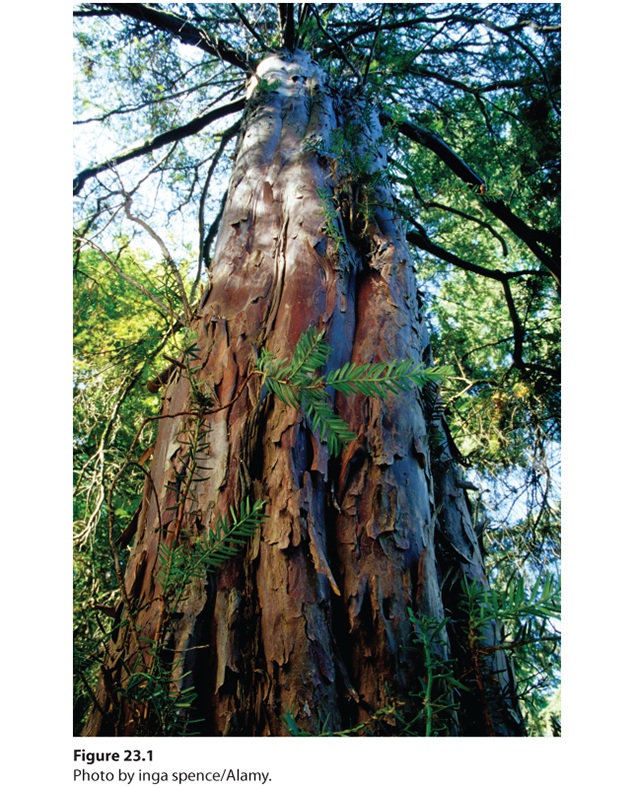
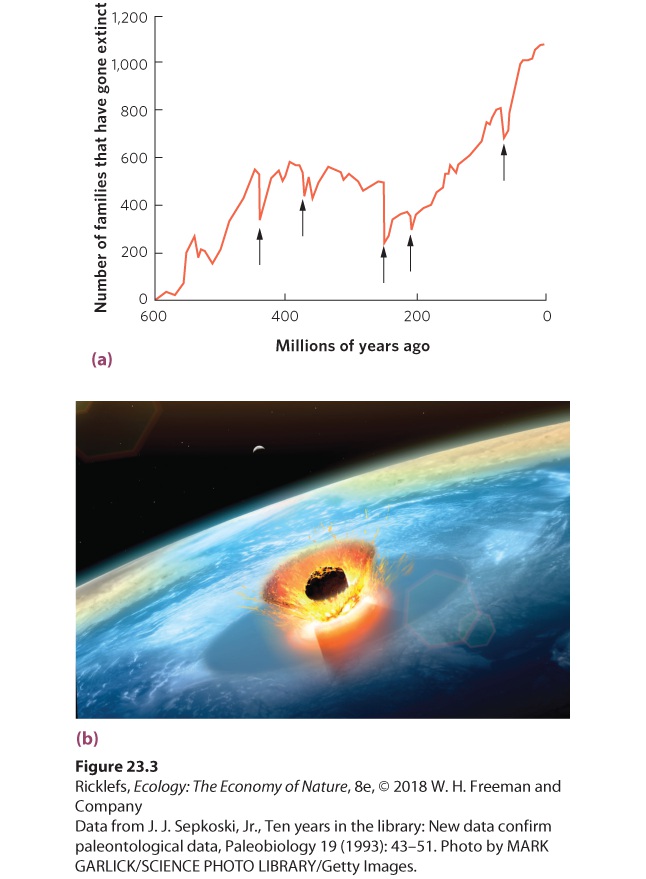
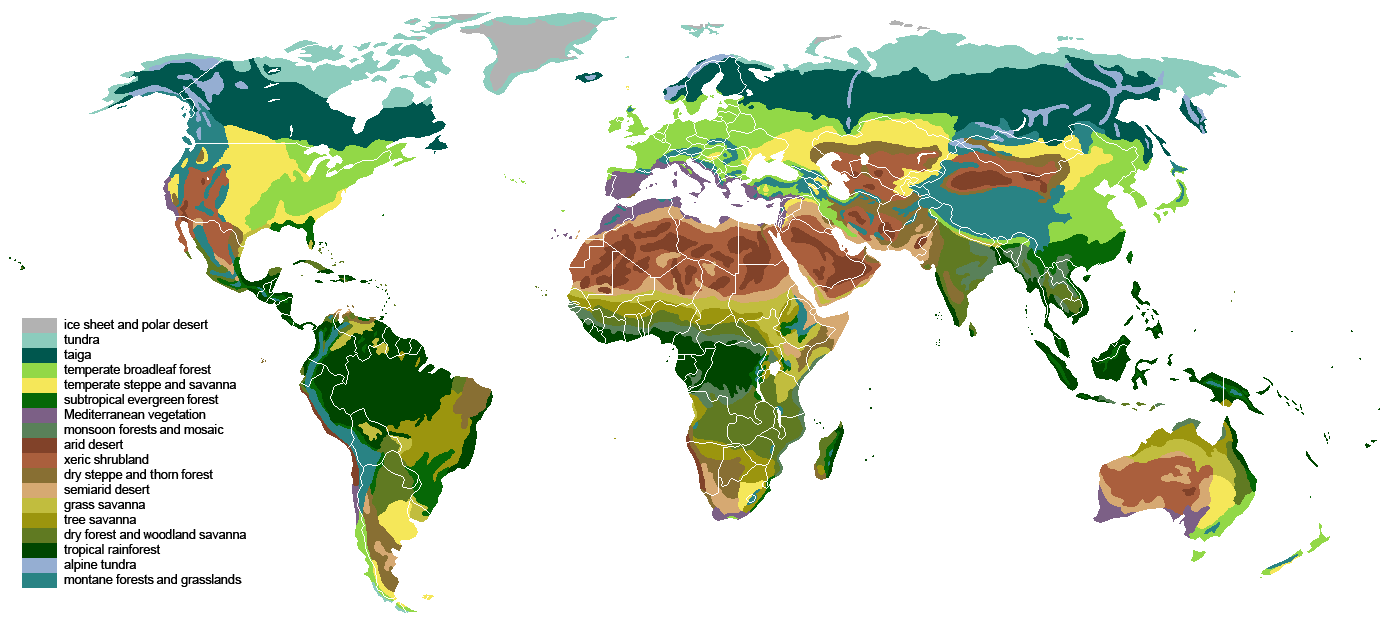
Major biomes (climate-defined)
| Biome | Climate | Notes |
|---|---|---|
| Tropical rainforest | Warm, wet year-round | Highest biodiversity, low-fertility soils. |
| Tropical savanna | Warm, seasonal rain | Grass + scattered trees; fire-maintained. |
| Desert | Low precipitation | Hot or cold; CAM plants, ectotherms. |
| Temperate grassland | Hot summer, cold winter, moderate rain | Tallgrass prairie (Nebraska!), shortgrass steppe — fire-maintained. |
| Temperate deciduous forest | 4 seasons, ~75-150 cm rain | Eastern US — oak, hickory, maple. |
| Boreal forest (taiga) | Long cold winter | Conifers — spruce, fir, pine. |
| Tundra | Permafrost, short growing season | Mosses, lichens, dwarf shrubs. |
| Mediterranean (chaparral) | Hot dry summer, mild wet winter | California, Mediterranean basin; fire-maintained. |
Biogeography & conservation
- Island biogeography (MacArthur & Wilson)
- Species number on island = balance of immigration (decreases with distance to mainland) and extinction (decreases with island area). Larger + closer = more species.
- Species-area relationship
- S = cAz. Doubling area roughly increases S by 10-25%.
- Habitat fragmentation
- Continuous habitat broken into smaller patches → edge effects, reduced gene flow, smaller populations.
- Edge effect
- Different conditions at habitat boundaries — wind, light, predators penetrate.
- Minimum viable population (MVP)
- Smallest population likely to persist (~95% probability) for some interval (often 100 years).
- Restoration ecology
- Active reassembly of degraded ecosystems — prairie reconstruction, stream/riparian restoration, dam removal, wetland re-creation.
- Biodiversity hotspot
- Region with high endemism + high threat (Myers et al.).
- Sixth extinction
- Current human-driven mass extinction; rate ~100–1000× background.
Manning-targeted exam tips
- Processes over terms. He says it outright. For any concept, be able to write the mechanism as a short causal chain — that is exactly what the short-answer and essay questions are testing.
- Expect real weight on aquatic systems and nutrient cycling. He is a freshwater/ecosystem ecologist working on N and P dynamics in streams, detrital breakdown, and watershed land-use effects. Streams, lakes, eutrophication, and C/N/P cycling deserve more of your time than a generic ecology course would suggest.
- The readings are examinable. Primary and popular readings posted to Canvas go beyond the textbook and lecture and are usually discussed in class. Take notes on them like lecture material.
- Do the end-of-chapter conceptual questions in Stiling — he names these specifically as exam practice.
- Assume closed-note. The syllabus does not promise open-note exams, and there is no "lowest exam dropped." Use the cheat sheet to study from, not to lean on during the exam.
- Lab is not separate. Lab material can appear on lecture exams and lecture material can appear in lab — so review lab handouts before each exam.
- In-class exercises are graded. Missing class costs points directly, plus the hints he drops about what will be on exams.
MacArthur and Wilson turned island species counts into a dynamic equilibrium: immigration filling, extinction draining, richness as the balance point. This lecture covers the theory, its experimental test with fumigated mangroves, and its reach into fragments, reserves, and any habitat island.
Learning objectives
- State the equilibrium theory of island biogeography (ETIB) and its two rate curves.
- Predict richness from area and isolation; explain the rescue and target effects.
- Describe the Simberloff-Wilson mangrove experiment and Krakatau recolonization.
- Explain species turnover at equilibrium and its evidence.
- Apply ETIB to habitat islands, fragments, and reserve design (SLOSS reprise).
- Connect to dS/dt accounting and to modern extensions (speciation on old islands).
Part 1: The theory
- Islands show two grand regularities: bigger islands hold more species (species-area, z ≈ 0.25 — L02/L15) and remote islands hold fewer.
- ETIB (MacArthur-Wilson 1963/67): richness S is a Dynamic equilibrium where immigration rate = extinction rate. Immigration declines with S (later arrivals are more likely already present) and with Distance (fewer propagules arrive). Extinction rises with S (smaller average populations, more competition) and falls with AREA (bigger populations resist extinction — L07/L09 logic).
- Four predictions: near-large islands richest; far-small poorest; equilibrium is a Balance, not a fixed list — composition Turns over while S stays roughly constant.
- Rescue effect (near islands): continued immigration props up sinking populations — lowers extinction too (blurring the curves). Target effect: bigger islands intercept more dispersers — raises immigration with area.
- dS/dt = D — X + I framing (Kaspari P6): ETIB is the equation with I and X made explicit functions of distance and area; D (in-situ speciation) joins on old, remote archipelagos (Hawaii — silverswords, honeycreepers; Galapagos finches, L06) where isolation outpaces immigration.
Part 2: The evidence
- Simberloff & Wilson (1969): fumigated entire mangrove islets in the Florida Keys, then censused arthropod recolonization. Result: S returned to ≈pre-defaunation levels within a year, scaled by distance (near recovered faster/higher) — but Species composition differed and kept churning. Equilibrium S with turnover: the theory’s core, demonstrated experimentally.
- Krakatau (1883 eruption sterilized it): spiders ballooning in within months; 100+ bird/plant species within 50 years; richness approaching equilibrium while composition still shifts — a natural defaunation experiment at island scale.
- Turnover evidence from repeated bird censuses (California Channel Islands): annual colonizations and extinctions with roughly stable totals.
- Caveats: turnover rates are lower and composition more structured (nestedness, assembly rules) than the neutral-ish theory implies; habitat diversity co-varies with area — area is partly a proxy.
Part 3: Applications — islands are everywhere
- Habitat islands: mountaintops (sky islands), lakes, springs, caves, city parks, prairie remnants in cropland — anything surrounded by inhospitable matrix obeys island rules.
- Fragmentation (L07 reprise): fragments = islands in a human matrix — small, far fragments lose species over time (relaxation/extinction debt: faunal collapse in Barro Colorado and Thai reservoir islands after isolation).
- Reserve design from ETIB: bigger better than smaller, connected better than isolated, round better than elongated (edge, L02), closer-together better than scattered — with SLOSS (L07/L14) as the standing argument and corridors/stepping stones as the fixes.
- Matrix quality softens island rules: a permeable matrix (shade coffee vs pavement) raises effective immigration — modern countryside biogeography.
- Prairie remnants: small isolated remnants lose specialist plants and butterflies over decades exactly on schedule — the local application of relaxation.
Condensed review — most likely to be tested
- ETIB: S where immigration (falls with S, distance) crosses extinction (rises with S, falls with area).
- Near-large richest; far-small poorest; equilibrium with Turnover.
- Rescue effect (near) and target effect (large) modify the curves.
- Simberloff-Wilson: fumigation -> recovery of S (distance-ranked) with different composition.
- Krakatau: recolonization arc at natural scale.
- Fragments relax toward island equilibria — extinction debt.
- Design: big, close, connected, round; matrix quality matters.
- Old remote islands add D: in-situ radiation (Hawaii).
Mnemonic set
- “Filling from the mainland, draining by extinction — S is the waterline.”
- “Near fills fast, big drains slow.”
- “Same count, changing cast — turnover at equilibrium.”
- “Every remnant is an island.”
Self-test
- Draw (in words) the ETIB graph for a near-large vs far-small island and locate their equilibria.
- In Simberloff-Wilson, why is recovery of species Number but not species Identity the key theoretical result?
- A land bridge island (connected at glacial lowstand) has MORE species than ETIB predicts for its area. Name the phenomenon and its trajectory.
- Two prairie remnants have equal area; one sits 100 m from a large preserve, the other 20 km away in row crops. Predict their butterfly richness and name the effects.
- Hawaiian honeycreepers (50+ species from one finch) violate which ETIB simplification, and what island properties enabled it?
- Use ETIB to argue for corridors even when total protected area is fixed.
Show answer key — try the questions first
- Immigration curves start high and fall with S (near island’s curve sits above far’s); extinction curves rise with S (small island’s sits above large’s). Near-large: high immigration x low extinction -> high S equilibrium. Far-small: low x high -> low S. Crossing points are the predicted richness.
- ETIB predicts S as a dynamic balance of rates, not a deterministic species list: any adequate colonists can fill the equilibrium. Identity churn (turnover) with stable S is precisely what distinguishes the dynamic theory from a static “who belongs here” view.
- Supersaturation: it inherited a mainland biota at connection; after isolation it Relaxes — losing species over millennia toward the island equilibrium. Fragment faunal collapse is the same process compressed.
- The near remnant holds more: higher immigration (distance) plus the rescue effect propping up small populations; the far one relaxes toward a lower equilibrium. Matrix hostility (row crops) further cuts effective immigration.
- ETIB ignores in-situ speciation (D). Extreme isolation (immigration rare enough not to swamp divergence — L05 gene flow) plus old, topographically diverse islands let D dominate the dS/dt ledger — adaptive radiation (L06).
- Corridors raise effective immigration among fragments (moving each toward a nearer-island curve), enable rescue effects, and re-knit metapopulations (L07) — lowering extinction at constant area. Connectivity buys equilibrium richness that area alone cannot.
The first global-change lecture: pollutants as ecological actors. Fate and transport, bioaccumulation vs biomagnification, the DDT and eagle story, endocrine disruption, plastics, and the frameworks — dose-response, indicators, remediation — for thinking about any contaminant.
Learning objectives
- Define contaminant fate: transport, persistence, partitioning (fat vs water).
- Distinguish bioaccumulation from biomagnification and predict which chemicals do each.
- Tell the DDT-raptor story and its policy arc as the template case.
- Describe endocrine disruptors and low-dose/nonmonotonic effects (atrazine, EE2).
- Summarize plastic, oil, and emerging contaminant ecology.
- Explain bioindicators, dose-response (LD50/LC50), and bioremediation.
Part 1: The rules of contaminant behavior
- Fate = source -> transport (air, water, sediment; grasshopper-effect distillation moves volatiles poleward — Arctic animals carry industrial chemicals they never met) -> transformation (photolysis, metabolism, microbial breakdown) -> sinks (sediments, ice, fat).
- Persistence: half-life spans hours (many modern pesticides) to decades (organochlorines, PCBs) to geologic (metals never degrade — only move and change species: mercury methylation by sulfate-reducing bacteria in wetlands, L23).
- Partitioning: lipophilic (fat-loving, high Kow) chemicals enter membranes and STORE in fat — the prerequisite for food-web magnification; water-soluble ones excrete but re-expose continuously.
- Bioaccumulation: one organism concentrates a chemical above its environment over its lifetime (uptake > elimination). Biomagnification: concentration Multiplies across trophic levels (L19 pyramid as amplifier) — requires persistence + lipophilicity + efficient assimilation. Mercury and organochlorines magnify; most modern pesticides accumulate at worst.
Part 2: The template cases
- DDT (the founding story, Carson 1962 — L01 history): sprayed broadly post-WWII; persistent + lipophilic -> magnified 10^5–10^6 fold from water to fish-eating birds; DDE thinned eggshells (calcium metabolism) -> bald eagle, osprey, peregrine, brown pelican crashes; 1972 US ban -> multi-decade recoveries (eagle delisted 2007). Template: diffuse source, food-web amplification, sublethal mechanism, delayed recovery.
- PCBs: industrial insulators, banned 1979, still cycling through sediments and orcas (transferred to calves in milk — the most PCB-loaded animals on Earth); sediment legacy = the long tail.
- Endocrine disruption: chemicals mimicking/blocking hormones at TRACE doses — atrazine feminizing frogs (contested but influential), EE2 (synthetic estrogen) collapsing a whole-lake fathead minnow population at ng/L (Kidd’s Experimental Lakes — the Schindler method applied to pharmaceuticals, L20/L23); nonmonotonic dose-response challenges “the dose makes the poison”.
- Oil: acute smothering + chronic PAH toxicity; Exxon Valdez herring and orca legacies; microbes eat much of it (bioremediation’s star: Deepwater Horizon plume degraders).
- Plastics: macro (entanglement, gut blockage) -> MICROplastics (<5 mm) now in every sampled ocean, soil, and organism; vector questions (sorbed chemicals hitchhiking) still open; loads growing exponentially.
- Pharmaceuticals + PFAS: diclofenac killed 95%+ of South Asian vultures (renal failure — a pharmaceutical extinction event); PFAS “forever chemicals” — persistence without precedent, global blood samples positive.
Part 3: Tools and responses
- Dose-response: LD50/LC50 rank acute toxicity; chronic and sublethal endpoints (behavior, reproduction) usually bind ecology first (L11 fear-logic parallels: sublethal beats lethal).
- Bioindicators: lichens (SO2), mayflies/EPT indices (stream quality), eggshell archives, mussels as monitoring stations (Mussel Watch).
- Biomonitoring beats chemistry alone: organisms integrate exposure over time and space.
- Remediation: bioremediation (oil-eating microbes, N-cycling wetlands — L16 services), phytoremediation (hyperaccumulator plants mining metals), capping/dredging sediments (PCB dilemmas), and above all Source control — the DDT/SO2 lesson: turn off the tap and food webs recover, slowly.
- Frameworks: precaution for persistent+lipophilic+toxic (PBT screening), and the pollution version of Kaspari P9 — humans as the outsized biogeochemical agent.
Condensed review — most likely to be tested
- Fate: transport, transformation, partitioning; grasshopper effect sends volatiles poleward.
- Bioaccumulation = within a life; biomagnification = across levels (needs persistence + lipophilicity).
- DDT -> DDE eggshells -> raptor crashes -> 1972 ban -> slow recovery: the template.
- EE2 whole-lake: ng/L estrogen collapsed minnows — trace doses, ecosystem proof.
- Vulture-diclofenac: a pharmaceutical nearly erased three species.
- Metals never degrade — methylation makes mercury worse (L23).
- Tools: LC50, bioindicators, bioremediation — but source control wins.
Mnemonic set
- “Fat-loving and long-lived = ladder-climbing (biomagnification screen).”
- “One body concentrates; a food chain multiplies.”
- “Thin shells told the tale — DDE.”
- “Turn off the tap first — source control.”
Self-test
- Water 0.000003 ppm DDT; zooplankton 0.04; small fish 0.5; large fish 2; osprey 25 ppm. Compute the overall magnification factor and name the two chemical properties responsible.
- Why do orca calves carry higher PCB burdens than their mothers?
- Kidd added 5–6 ng/L of synthetic estrogen (EE2) to an entire lake. Result, and why the whole-lake design mattered?
- Diclofenac and vultures: reconstruct the exposure pathway and the ecological aftermath.
- A chemical is water-soluble and has a 2-day half-life. Predict its food-web behavior and monitoring strategy.
- Design a remediation plan for a PCB-contaminated river reach, noting the central dilemma.
Show answer key — try the questions first
- ≈8 million-fold water-to-osprey. Persistence (survives passage up the chain) + lipophilicity (stored in fat, transferred with every meal, L19 pyramid as amplifier).
- Lipophilic PCBs concentrate in milk fat: lactation transfers the mother’s lifetime accumulation to the calf — maternal offloading. First-born calves get the largest dose (decades of storage).
- Fathead minnow males feminized (vitellogenin, intersex); the population Collapsed within two seasons; recovery followed cessation. Whole-lake exposure captured chronic, multigenerational, food-web-embedded effects no beaker assay could — the Schindler method applied to pharmaceuticals.
- Cattle treated with the NSAID die; obligate scavenger vultures consume carcasses; renal failure kills them — 95–99% declines in three Gyps species within a decade. Aftermath: carcasses persisted, feral dog populations (and rabies exposure) rose — a sanitation service (L16) lost to a trace pharmaceutical.
- No biomagnification (excreted, degraded); risk is PRESS exposure near continuous sources (pulse-chronic). Monitor water at source outfalls and use short-integration bioindicators, not top-predator tissue.
- Options: cap sediments (leaves legacy in place), dredge (removes but resuspends — short-term spike for long-term removal: the Hudson dilemma), monitored natural attenuation (microbial dechlorination is slow), plus fish advisories meanwhile. Source is already off; the sediment IS the source now — the long tail of persistence.
If earlier lectures diagnosed, this one treats. Restoration ecology applies succession, soils, hydrology, and species interactions to rebuild damaged systems — from prairie reconstructions out the back door to the Everglades and dam removals — and asks how we know when restoration has worked.
Learning objectives
- Define restoration, rehabilitation, reclamation, and novel ecosystems (SER framing).
- Apply succession theory to restoration practice (L17 levers).
- Describe prairie reconstruction: seed mixes, site prep, fire management, outcomes.
- Summarize flagship projects: Everglades, Elwha dam removal, oyster reefs, rewilding.
- Explain reference conditions, success metrics, and the field-of-dreams caveat.
- Connect restoration to services (L16) and climate adaptation.
Part 1: Frames and levers
- Vocabulary ladder: Restoration (return toward a reference state: structure + function + composition), Rehabilitation (recover function, composition partial), Reclamation (stabilize/detoxify — mine spoil to grass), Novel ecosystems (accept no-analog mixes where return is impossible — the honest frontier).
- Succession levers (L17): accelerate facilitation (plant N-fixers, nurse shrubs), remove inhibitors (invasive sod, shrub monopolies, drainage tiles), supply propagules (seed + soil inoculum — dispersal limitation is real, L07), and restore the Regime (fire, flood pulses, grazing) rather than freeze a snapshot.
- Field of dreams hypothesis (“build it and they will come”): plant structure and assume function + fauna follow — often false for soil microbiomes, specialist insects, and slow dispersers; active reintroduction and inoculation frequently required.
- Reference conditions: historical baselines drift (shifting-baseline syndrome — each generation accepts a degraded normal); modern practice sets Functional targets (nutrient retention, fire-carrying, pollinator support) plus composition ranges, not museum replicas — especially under climate change (restore for the future, not 1850).
Part 2: The prairie case (the course’s home biome)
- Why prairie: >99% of tallgrass prairie is gone (the most-converted biome on Earth — mollisols became corn, L04/L20); remnants are islands (L18) bleeding species (L07).
- Reconstruction recipe: site prep (kill sod — herbicide/smother/plow), Seed mix design (the L16 lesson: high diversity costs more, delivers more — warm+cool season grasses, forbs across bloom seasons, legumes for N), planting (drill vs broadcast, dormant-season seeding mimics natural stratification), then Management as disturbance: fire every 2–4 years (L15/L17 arrested succession maintained on purpose), sometimes grazing/mowing patches for heterogeneity (shifting mosaic, L17).
- Trajectories: grasses establish in 2–3 years; conservative forbs and specialist insects lag decades; soil carbon and mycorrhizal networks rebuild over 50+ years (L22) — reconstructions approach but rarely match remnant composition. Remnants are irreplaceable; reconstruction complements, never substitutes.
- Local anchor: UNO sits in the tallgrass ecotone — Glacier Creek Preserve (UNO’s own restored prairie) and Nebraska’s Sandhills (the largest intact grassland in North America) are the living labs.
Part 3: Flagships and verdicts
- Everglades (CERP, ≈$20B+): re-deliver the sheet-flow Water regime (quantity, quality, timing, distribution) — the world’s largest hydrologic restoration; progress real (Kissimmee River re-meandered: wading birds returned) but slow against sea level and phosphorus legacies (L23 legacy nutrients).
- Elwha River dam removals (2011–14, largest to date): sediment pulse rebuilt the delta; salmon recolonized upstream reaches within YEARS — rivers remember (L20 continuum reconnected).
- Oyster reefs (Chesapeake): substrate + larvae + harvest closures -> water filtration and reef fish returning — services-first restoration (L16).
- Rewilding: restore top-down processes (L13) — wolves as the famous case; Knepp and European rewilding accept novel, process-driven outcomes.
- Verdict metrics: meta-analyses find restored wetlands/prairies reach ≈70–80% of reference function after decades — better than nothing, slower than promises: restoration justifies repair, never destruction (“we can rebuild it” is not a permit).
Condensed review — most likely to be tested
- Ladder: restore -> rehabilitate -> reclaim; novel ecosystems when return is impossible.
- Levers = succession management: facilitate, de-inhibit, add propagules, restore regimes.
- Field of dreams fails for soil biota and specialists — inoculate and reintroduce.
- Shifting baselines corrupt references; set functional targets for the future.
- Prairie: >99% gone; recipe = kill sod, diverse mix, dormant seeding, fire 2–4 yr.
- Reconstructions lag remnants for decades — remnants are irreplaceable.
- Everglades = water regime; Elwha = rivers remember; oysters = services-first.
- ≈70–80% of function after decades: repair, not license.
Mnemonic set
- “Facilitate, liberate, inoculate, perturbate — the restoration levers.”
- “Build it AND bring them — against the field of dreams.”
- “Fire is a management tool wearing a disaster costume.”
- “Remnants are originals; reconstructions are covers.”
Self-test
- Distinguish restoration, rehabilitation, and reclamation with a mine-site example.
- A prairie reconstruction gets grasses in year 2 but almost no conservative forbs or specialist bees by year 10. Diagnose with two mechanisms and prescribe.
- Why do restorationists manage prairie WITH fire rather than protecting it FROM fire?
- The Elwha and Everglades both restore “regimes” — which regime each, and why regime-restoration beats species-planting?
- Explain shifting-baseline syndrome and its restoration consequence.
- A developer argues wetland destruction is acceptable because mitigation will “restore” equivalent wetlands elsewhere. Give the two-part ecological rebuttal.
Show answer key — try the questions first
- Reclamation: stabilize and detoxify spoil, establish any cover (grass). Rehabilitation: recover functions (erosion control, some habitat) with partial composition. Restoration: return toward reference structure+function+composition of the pre-mining community — often impossible, hence the ladder.
- Dispersal limitation (L07 — conservative forbs do not arrive on their own) and missing partners/conditions (mycorrhizae, host plants, bare-ground nesting sites). Prescribe: overseed forbs, add soil/mycorrhizal inoculum, plant host-plant patches, vary fire/mow timing for heterogeneity — build it AND bring them.
- Tallgrass prairie is fire-arrested succession (L17): the disturbance IS the maintenance regime — burning every 2–4 years kills woody invaders, recycles litter, and sustains the forb-grass coexistence (L15 IDH). Protection-from-fire delivers redcedar woodland.
- Elwha: the sediment-and-flow regime (dam removal reconnected the river continuum — salmon self-recolonized). Everglades: the sheet-flow water regime (timing, quantity, distribution). Regimes rebuild the conditions that assemble communities continuously; planting without the regime is gardening against physics.
- Each generation takes its own degraded childhood state as “natural,” so references ratchet downward (fisheries the classic). Consequence: targets set too low; fixes: historical ecology (records, cores, archives — L02 proxies) and functional rather than nostalgic targets.
- Performance: created/restored wetlands average ≈70–80% of reference function after decades, and some attributes (soil profiles, specialist assemblages) never converge. Asymmetry: certain immediate loss traded for uncertain delayed partial recovery — restoration justifies repairing past damage, not licensing new damage.
The capstone: the crisis discipline that runs on everything before it. Extinction rates and drivers (HIPPO), small-population genetics, viability analysis, protected areas and beyond, and the tools — from corridors to conservation triage — for keeping Kaspari P10 payable.
Learning objectives
- Quantify the extinction crisis: background vs current rates, defaunation.
- Rank threats with HIPPO and give examples of each.
- Explain small-population perils: vortex, Ne, 50/500, inbreeding rescue (L05/L09).
- Describe PVA, MVP, IUCN categories, and triage logic.
- Evaluate area-based tools (reserves, SLOSS/corridors, 30×30) and beyond-reserve tools.
- Connect conservation to services, climate adaptation, and the course’s arc.
Part 1: The crisis quantified
- Background extinction ≈0.1–1 species per million species-years; current vertebrate rates ≈100–1000x background — the case for a sixth mass extinction in progress (fossil record’s five prior).
- Defaunation: beyond extinctions, Abundance has collapsed — wild mammal biomass now a small fraction of livestock + humans; insect declines; vertebrate population indices down ≈70% since 1970 (know the metric’s caveats).
- Extinction is uneven: islands (L18 — naive faunas, invasives), freshwater (dams, L20), large-bodied + slow life histories (L08 — low r cannot absorb added mortality), endemics with small ranges (L15 hotspots).
Part 2: Threats and small-population biology
- HIPPO: Habitat loss/fragmentation (the #1 — L07/L18 machinery), Invasives (enemy release L12, novel weapons L10; island bird catastrophes — brown tree snake on Guam), Pollution (L24), Population (human — P9, HANPP L21), Overharvest (fishing down L19, bushmeat, passenger pigeon L09’s Allee lesson). Climate change now threads through all five (L03 fingerprints).
- Declining-population paradigm (find and cut the external cause) vs small-population paradigm (manage the genetics/demography of rarity) — both needed.
- Small-N perils (the L05/L09 reprise): demographic stochasticity, environmental stochasticity + catastrophes, Allee effects, drift eroding variation, inbreeding depression -> the Extinction vortex. Effective population size Ne << census N (skewed sex ratios, variance in reproduction, fluctuations — harmonic mean rules).
- Rules of thumb: 50/500 (short-term inbreeding avoidance / long-term adaptive potential; modern updates argue 100/1000) — guidelines, not laws.
- Genetic rescue works: Florida panther (L05) — the template; Isle Royale wolves the cautionary sequel.
Part 3: Tools and triage
- Population viability analysis (PVA): stochastic projection of extinction probability under scenarios (the L08 life table + L09 variance machinery aimed at management); MVP = N for e.g. 95% persistence over 100 yr.
- IUCN Red List: quantitative criteria (decline rate, range size, population size) -> LC to CR to EX; the global scoreboard.
- Area tools: reserves sited by hotspots + complementarity (L15), designed by island rules (L18: big, close, connected, round); corridors (L07); 30×30 targets; OECMs and working lands (countryside biogeography) because most biodiversity lives Outside reserves; climate-smart: protect gradients and refugia so species can move (L03 range shifts need runways).
- Species tools: reintroduction (wolves L13; ferrets), headstarting (with the L08 elasticity caveat — protect adults), captive insurance populations (condor from 22 -> soaring), de-extinction debates (triage’s opportunity cost writ large).
- Triage logic: finite funds force prioritization — cost-effectiveness (project prioritization protocols), evolutionary distinctiveness (EDGE), and honesty about sunk-cost species. Controversial and unavoidable.
- The course’s arc closes: P1-P8 explain the systems, P9 names the pressure, P10 states the stakes — conservation is ecology with a deadline.
Condensed review — most likely to be tested
- Current rates ≈100–1000x background; defaunation is abundance collapse, not just extinction.
- HIPPO ranks threats; habitat leads; climate threads all.
- Vortex: stochasticity + Allee + drift + inbreeding compounding (L05/L09).
- Ne << N; 50/500 (or 100/1000) rules of thumb.
- PVA -> MVP; IUCN criteria are quantitative.
- Reserves: hotspots + island rules + corridors; most biodiversity is outside them.
- Genetic rescue and reintroduction work; triage allocates honestly.
- Elasticity: protect the adults (turtles, L08).
Mnemonic set
- “HIPPO tramples habitats first.”
- “Small N spins the vortex.”
- “Fifty to found, five hundred to future — the rule of thumb.”
- “Ecology with a deadline — conservation biology.”
Self-test
- Justify the “sixth mass extinction” claim and give one honest caveat.
- A reserve holds 300 crows: 30 breeding males, 90 breeding females, the rest nonbreeders. Estimate breeding Ne and name the depressors at work.
- Apply HIPPO to the Guam rails/kingfishers collapse and name the compounding island factor.
- A PVA gives species A 40% extinction risk (decliner — cause: nest predation) and species B 60% (small stable relict). Match each to its paradigm and first action.
- Defend and critique headstarting sea turtles using L08 elasticity.
- “Most biodiversity lives outside protected areas.” Give two consequences for strategy.
Show answer key — try the questions first
- Current rates estimated 100–1000x the fossil background, with accelerating defaunation — comparable in RATE to the Big Five. Caveats: rate comparisons depend on incomplete taxonomy and short observation windows; total losses (so far) remain far below the Big Five’s ≈75% — it is a trajectory claim, not a completed event.
- Unequal sex ratio: Ne = 4NmNf/(Nm+Nf) = 4×30×90/120 = 90 — far below census 300. Add reproductive variance and year-to-year fluctuation (harmonic mean) and Ne falls further — the census flatters the genetics.
- I — invasive brown tree snake (post-WWII cargo) consumed naive birds; island endemism (L18 — small ranges, no anti-snake behavior, low Ne) made recovery impossible without captivity. Habitat, pollution etc. were secondary; one invader sufficed.
- A: declining-population paradigm — diagnose and cut the agent (predator control, habitat fix). B: small-population paradigm — manage rarity itself (genetic rescue, insurance population, multiple sites against catastrophes). Different diseases, different medicine.
- Defense: raises juvenile survival past the Type III cliff, engages publics. Critique: λ is most sensitive to ADULT survival — TEDs and bycatch reduction buy more recovery per dollar; headstarting alone treats the least influential vital rate (the life-table lesson applied).
- Working-lands conservation (countryside biogeography, matrix quality L18) and OECMs become essential — reserves are cores, not the whole answer; and connectivity across private/production land (corridors, easements) determines whether climate-driven range shifts (L03) succeed.
📚 Textbook companion · Ecology for All!
Each unit above maps to chapters in Ecology for All! (Gettysburg College / LibreTexts), the open-access text listed on the syllabus alongside the recommended Stiling. Click a chapter to read it here: