Chapter 1: Kinematics and Dynamics

Chapter 1: Kinematics and Dynamics
Science Mastery Assessment
Every pre-med knows this feeling: there is so much content I have to know for the MCAT! How do I know what to do first or what’s important?
While the high-yield badges throughout this book will help you identify the most important topics, this Science Mastery Assessment is another tool in your MCAT prep arsenal. This quiz (which can also be taken in your online resources) and the guidance below will help ensure that you are spending the appropriate amount of time on this chapter based on your personal strengths and weaknesses. Don’t worry though— skipping something now does not mean you’ll never study it. Later on in your prep, as you complete full-length tests, you’ll uncover specific pieces of content that you need to review and can come back to these chapters as appropriate.
How to Use This Assessment
If you answer 0–7 questions correctly:
Spend about 1 hour to read this chapter in full and take limited notes throughout. Follow up by reviewing all quiz questions to ensure that you now understand how to solve each one.
If you answer 8–11 questions correctly:
Spend 20–40 minutes reviewing the quiz questions. Beginning with the questions you missed, read and take notes on the corresponding subchapters. For questions you answered correctly, ensure your thinking matches that of the explanation and you understand why each choice was correct or incorrect.
If you answer 12–15 questions correctly:
Spend less than 20 minutes reviewing all questions from the quiz. If you missed any, then include a quick read-through of the corresponding subchapters, or even just the relevant content within a subchapter, as part of your question review. For questions you got correct, ensure your thinking matches that of the explanation and review the Concept Summary at the end of the chapter.
- A person walks 30 m east and then 40 m north. What is the difference between the traveled distance and the displacement?
- 0 m
- 20 m
- 50 m
- 70 m
- A 1000 kg rocket ship, travelling at 100 ms, is acted upon by an average force of 20 kN applied in the direction of its motion for 8 s. What is the change in velocity of the rocket?
- 160 ms
- 260 ms
- 160,000 ms
- 260,000 ms
- A car is traveling at 40 kmhr and the driver puts on the brakes, bringing the car to rest in a time of 6 s. What is the magnitude of the average acceleration of the car?
- 240 kmhr2
- 12,000 kmhr2
- 24,000 kmhr2
- 30,000 kmhr2
- An elevator is designed to carry a maximum weight of 9800 N (including its own weight), and to move upward at a speed of 5 ms after an initial period of acceleration. What is the relationship between the maximum tension in the elevator cable and the maximum weight of the elevator while the elevator is accelerating upward?
- The tension is greater than 9800 N.
- The tension is less than 9800 N.
- The tension equals 9800 N.
- It cannot be determined from the information given.
- A student must lift a mass of 4 kg a distance of 0.5 m. The ambient temperature is 298 K and the student must lift the mass in 30 seconds. Which of the following values is NOT necessary to calculate power?
- Mass
- Distance
- Temperature
- Time
- A firefighter jumps horizontally from a burning building with an initial speed of 1.5 ms. At what time is the angle between the firefighter’s velocity and acceleration vectors the greatest?
- The instant the firefighter jumps
- When the firefighter reaches terminal velocity
- Halfway through the firefighter’s fall
- Right before the firefighter lands on the ground
- A 10 kg wagon rests on an inclined plane. The plane makes an angle of 30° with the horizontal. Approximately how large is the force required to keep the wagon from sliding down the plane (Note: sin 30° = 0.5, cos30° = 0.866)?
- 10 N
- 49 N
- 85 N
- 98 N
- Which of the following expressions correctly illustrates the SI base units for each of the variables in the formula below?
mΔv = FΔt
- lb × mph = ft × lb × s
- kg×ms=N×s
- kg×ms = kg⋅ms2×s
- g×ms = g⋅ms2×s
- The diagram below shows two vectors.
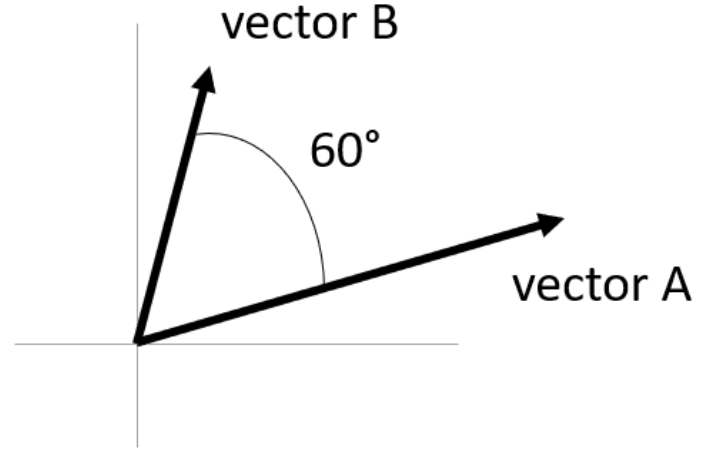
If a student uses the formula ab ∙ sin (60o), where a and b are the magnitudes of the respective vectors A and B, then which of the following best describes the computed value?
- Positive scalar
- Negative scalar
- Vector into the page
- Vector out of the page
- Which of the following quantities is NOT a vector?
- Velocity
- Force
- Displacement
- Distance
- A 30 kg child sits on a seesaw at a distance of 2 m from the fulcrum. Where must the child’s parent sit to balance the seesaw if the parent has a mass of 90 kg?
- 67 cm from the child
- 67 cm from the fulcrum
- 133 cm from the child
- 267 cm from the fulcrum
- A physics major builds a potato launcher and tests it in an open field. The student launches a potato with a velocity of 12 m/s at an angle of 30°. The potato is found 60 meters from the launch site. Which of the following represents the maximum height achieved by the potato? (Note: cos(60°) = 0.86)
- 0.3 m
- 1.8 m
- 5 m
- 18 m
- A rock (m = 2 kg) is shot up vertically at the same time that a ball (m = 0.5 kg) is projected horizontally. If both start from the same height:
- the rock and ball will reach the ground at the same time.
- the rock will reach the ground first.
- the ball will reach the ground first.
- the rock and ball will collide in the air before reaching the ground.
- Centrifugal force is an apparent outward force during circular motion. It has been described as a reaction force according to Newton’s third law. Which of the following statements is most likely to be correct regarding centrifugal force?
- Centrifugal force exists only for uniform circular motion, not nonuniform circular motion.
- Centrifugal force exists only when tension or a normal force provides centripetal acceleration.
- Centrifugal force always acts antiparallel to the centripetal force vector.
- Centrifugal force is result of repulsive electrostatic interactions.
- Which of the following statements is true of movement on a plane with friction?
- Acceleration is a function of applied force only.
- More force is needed to accelerate a stationary object than an identical moving object.
- The force of friction is independent of the mass of objects.
- I only
- II only
- I and II only
- I and III only
Answer Key
- B
- A
- C
- A
- C
- A
- B
- C
- D
- D
- B
- B
- C
- C
- B
Chapter 1: Kinematics and Dynamics
CHAPTER 1
KINEMATICS AND DYNAMICS
In This Chapter
1.1 Units
Fundamental Measurements
1.2 Vectors and Scalars
Vector Addition
Vector Subtraction
Multiplying Vectors by Scalars
Multiplying Vectors by Other Vectors
1.3 Displacement and Velocity
Displacement
Velocity
1.4 Forces and Acceleration
Forces
Mass and Weight
Acceleration
1.5 Newton’s Laws
First Law
Second Law
Third Law
1.6 Motion with Constant Acceleration
Linear Motion
Projectile Motion
Inclined Planes
Circular Motion
1.7 Mechanical Equilibrium
Free Body Diagrams
Translational Equilibrium
Rotational Equilibrium
Concept Summary
CHAPTER PROFILE
The content in this chapter should be relevant to about 6% of all questions about physics on the MCAT.
This chapter covers material from the following AAMC content category:
4A: Translational motion, forces, work, energy, and equilibrium in living systems
Introduction
A professor once said: Biology is chemistry. Chemistry is physics. Physics is life. Not surprisingly, this was the claim of a physics professor.
Walking into MCAT preparation, many students think of physics as the least applicable science to medicine, reflecting on calculus-heavy premedical classes. But even in the medical field, physics is all around us. When we treat patients at a rehab hospital, we often talk about motion, forces, and bone strength. An ophthalmologist may draw diagrams to help students better understand myopia and hyperopia. When we talk about mitochondria functioning as the batteries of the cell, we mean that fairly literally.
This first chapter reviews the three systems of units encountered on the MCAT: MKS (meter–kilogram–second), CGS (centimeter–gram–second), and SI (International System of Units). We’ll take a few moments to review the geometry of physics questions, especially vector mathematics. Next, we’ll move into true physics content as we consider kinematics—the equations that deal with the motion of objects—and Newtonian mechanics and dynamics—the study of forces and their effects.
1.1 Units
LEARNING OBJECTIVES
After Chapter 1.1, you will be able to:
- Recall the fundamental measurements and their units
- Order a given set of units that measure the same type of quantity from smallest to largest
Before we begin our discussion of motion, we must define a consistent vocabulary for our discussion of physics throughout this book. Physics relies on the language of mathematics to convey important descriptions and explanations of the world around us. Yet those numbers would themselves be meaningless—or vague at best—without the labels of units.
REAL WORLD
Natural phenomena occur on many scales, as shown in Figure 1.1. We often assume that the fine details have little bearing on the larger scale of the universe, but the rapid inflation of the universe allows the infinitesimally small to affect the astronomically big.
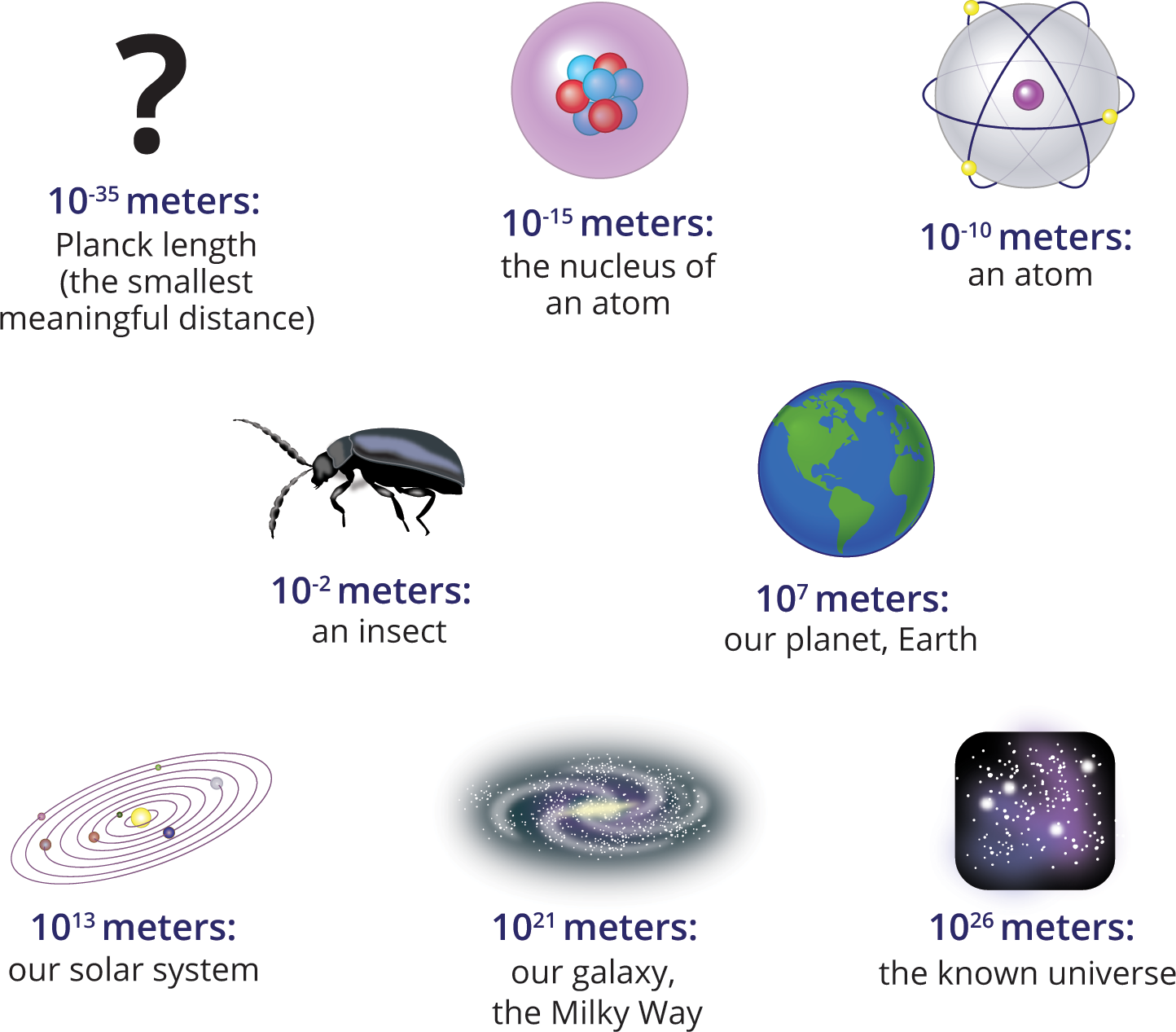
Figure 1.1. Size of Natural Phenomena
Fundamental Measurements
Over the years, various systems of units have been developed for specific purposes. Some of these systems are commonly used in everyday life but rarely in science. The British or Imperial system (foot–pound–second or FPS) is used commonly in the United States but virtually nowhere else—not even in Britain. Basic units for length, weight, and time are the foot (ft), the pound (lb), and the second (s), respectively. Because weight, and not mass, is used, the British system later derived the slug as a unit of mass. The MCAT rarely—if ever—utilizes FPS in passages or questions.
The most common system of units is the metric system, which is the basis for the SI units used on the MCAT. Depending on the context of a passage or question, the metric system may be given in meters, kilograms, and seconds (MKS) or centimeters, grams, and seconds (CGS). SI units include the MKS system as well as four other base units, as shown in Table 1.1.
Table 1.1 SI Units
QUANTITY UNIT SYMBOL
Length meter m
Mass (not weight) kilogram kg
Time second s
Current ampère (coulomb/second) A
Amount of Substance mole mol
Temperature kelvin K
Luminous Intensity candela cd
In each measurement system, there are base units and derived units. Base units are the standard units around which the system itself is designed. Derived units, as the name implies, are created by associating base units with each other. For example, the newton—a unit of force—is derived from kilograms, meters, and seconds: 1 N = 1 kg ⋅ ms2. Table 1.2 contains examples of important derived units from each of the systems described above. Prefixes for metric units and conversions between metric and Imperial units are discussed in Chapter 10 of MCAT Physics and Math Review.
Table 1.2 Derived Units in Various Systems of Measurement
QUANTITY FPS CGS MKS (SI)
Mass slug (lb⋅s2ft) or blob (lb⋅s2in)
Force
dyne (g⋅cms2) newton (kg⋅ms2)
Work and Energy foot–pound (ft · lb) erg (g⋅cm2s2) joule (kg⋅m2s2)
Power foot–pound per second erg per second watt (kg⋅m2s3)
At the molecular, atomic, or subatomic level, different units may be given that are easier to work with at such a small scale. For example, length may be given in ångströms (1 Å = 10–10 m) or nanometers (1 nm = 10–9 m). Energy on the atomic scale can be expressed in electron–volts (1 eV = 1.6 × 10⁻¹⁹ J), which represent the amount of energy gained by an electron accelerating through a potential difference of one volt.
MCAT EXPERTISE
While it is good to be aware of the various systems of measurement, the only system that you are required to memorize for the MCAT is the SI system.
BRIDGE
Solutions to concept checks for a given chapter in MCAT Physics and Math Review can be found near the end of the chapter in which the concept check is located, following the Concept Summary for that chapter.
MCAT CONCEPT CHECK 1.1
Before you move on, assess your understanding of the material with these questions.
- If the newton is the product of kilograms and meters/second2, what units comprise the pound?
_________________________________
- Order the following units from smallest to largest: centimeter, angstrom, inch, mile, foot.
___< _< _< _< ___
1.2 Vectors and Scalars
LEARNING OBJECTIVES
After Chapter 1.2, you will be able to:
- Explain the importance of order when performing vector calculations
- Calculate a scalar or a vector as a product of two vectors, using the right-hand rule when applicable:
Vectors are numbers that have magnitude and direction. Vector quantities include displacement, velocity, acceleration, and force. Scalars are numbers that have magnitude only and no direction. Scalar quantities include distance, speed, energy, pressure, and mass. The difference between a vector and scalar quantity can be quite pronounced when there is a nonlinear path involved. For example, in the course of a year, the Earth travels a distance of roughly 940 million kilometers. However, because this is a circular path, the displacement of the Earth in one year is zero kilometers. This difference between distance and displacement can be further illustrated with vector representations.
Vectors may be represented by arrows; the direction of the arrow indicates the direction of the vector. The length of the arrow is usually proportional to the magnitude of the vector quantity. Common notations for a vector quantity are either an arrow or boldface. For example, the straight-line path from here to there might be represented by a vector identified as A⇀ or A. The magnitude of the displacement between the two positions can be represented as | A⇀ |, |A|, or A. Scalar quantities are generally represented with italic type: the distance between two points could be represented by d.
In this book (and all books of the Kaplan MCAT Review series), we will consistently use boldface to represent a vector quantity and italic to represent the magnitude of a vector or a scalar quantity.
Vector Addition
The sum or difference of two or more vectors is called the resultant of the vectors. One way to find the sum or resultant of two vectors A and B is to place the tail of B at the tip of A without changing either the length or the direction of either arrow. In this tip-to-tail method, the lengths of the arrows must be proportional to the magnitudes of the vectors. The vector sum A + B is the vector joining the tail of A to the tip of B and pointing toward the tip of B. Vector addition is demonstrated in Figure 1.2 below.
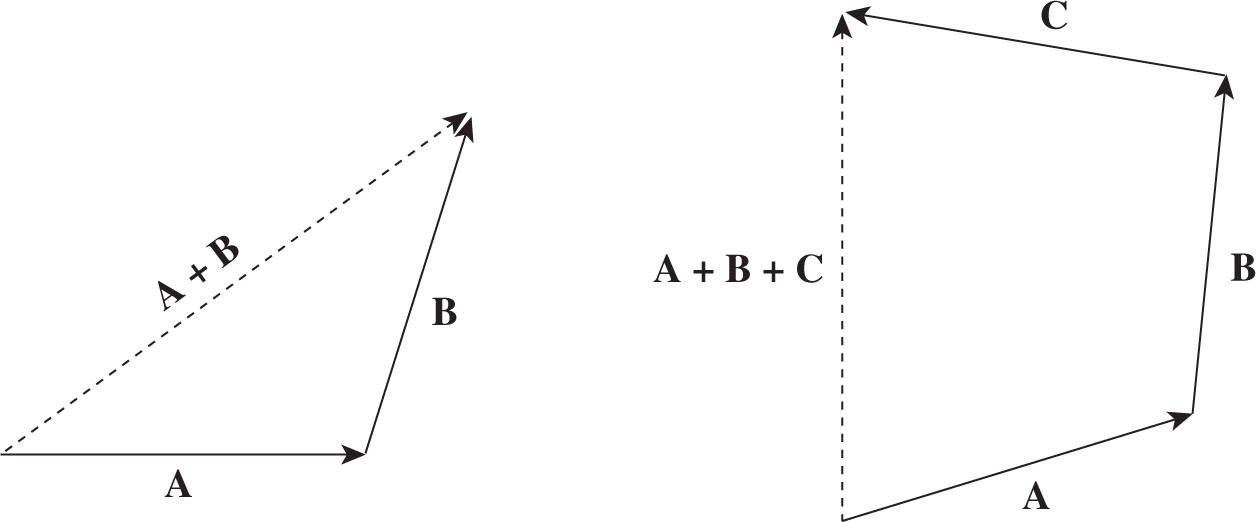
Figure 1.2. The Tip-to-Tail Method of Vector Addition (left) Vectors A and B with resultant A + B; (right) Vectors A, B, and C with resultant A + B + C
KEY CONCEPT
When adding vectors, always add tip-to-tail!
Another method for finding the resultant of several vectors involves breaking each vector into perpendicular components. In most cases, these components are horizontal and vertical (x- and y-components, respectively); however, in some instances—such as inclined planes—it may make more sense to define the components as parallel and perpendicular (|| and ⊥, respectively) to some other surface.
Given any vector V, we can find the x- and y-components (X and Y) by drawing a right triangle with V as the hypotenuse, as shown in Figure 1.3.
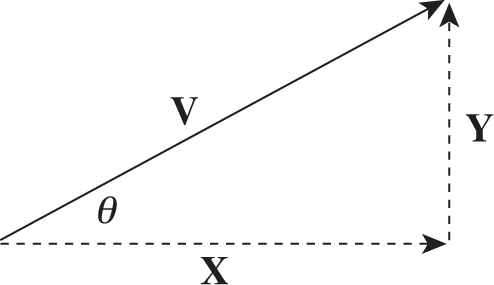
Figure 1.3. Splitting a Vector into Components
If θ is the angle between V and the x-component, then cosθ=XV and sinθ=YV. In other words:
X=V cos θY=V sin θ
Equation 1.1 Example: Find the x- and y-components of the following vector
V=10 msθ=30°
Solution:
X=Vcosθ=10cos30°=10 × 32 = 5 3 msY=Vsinθ=10sin30°=10 × 12 = 5 ms
Conversely, if we know X and Y, we can find V, as shown in Figure 1.4 below.
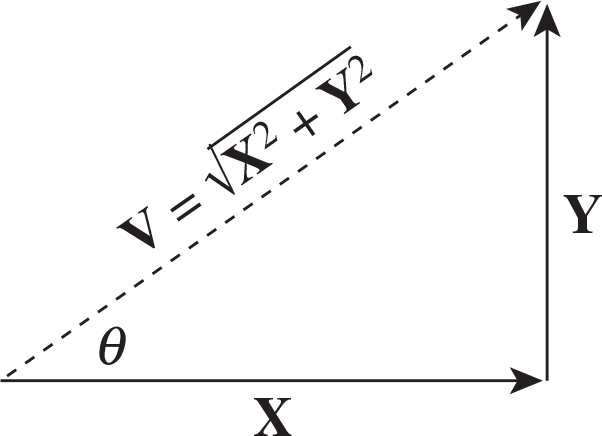
Figure 1.4. Using the Pythagorean Theorem to Determine the Magnitude of the Resultant Vector
Calculating the magnitude of V requires use of the Pythagorean theorem:
X2+Y2=V2 or V=X2+Y2
Equation 1.2
The angle of the resultant vector can also be calculated by knowing inverse trigonometric functions, discussed in Chapter 10 of MCAT Physics and Math Review (Note: This inverse tangent calculation is beyond the scope of the MCAT):
θ=tan−1YX
Equation 1.3 Example: What is the magnitude of the vector with the following components?
X=3 msY=4 ms
Solution:
V=32+42=25=5 ms
The x-component of a resultant vector is simply the sum of the x-components of the vectors being added. Similarly, the y-component of a resultant vector is simply the sum of the y-components of the vectors being added. This is illustrated in Figure 1.5.
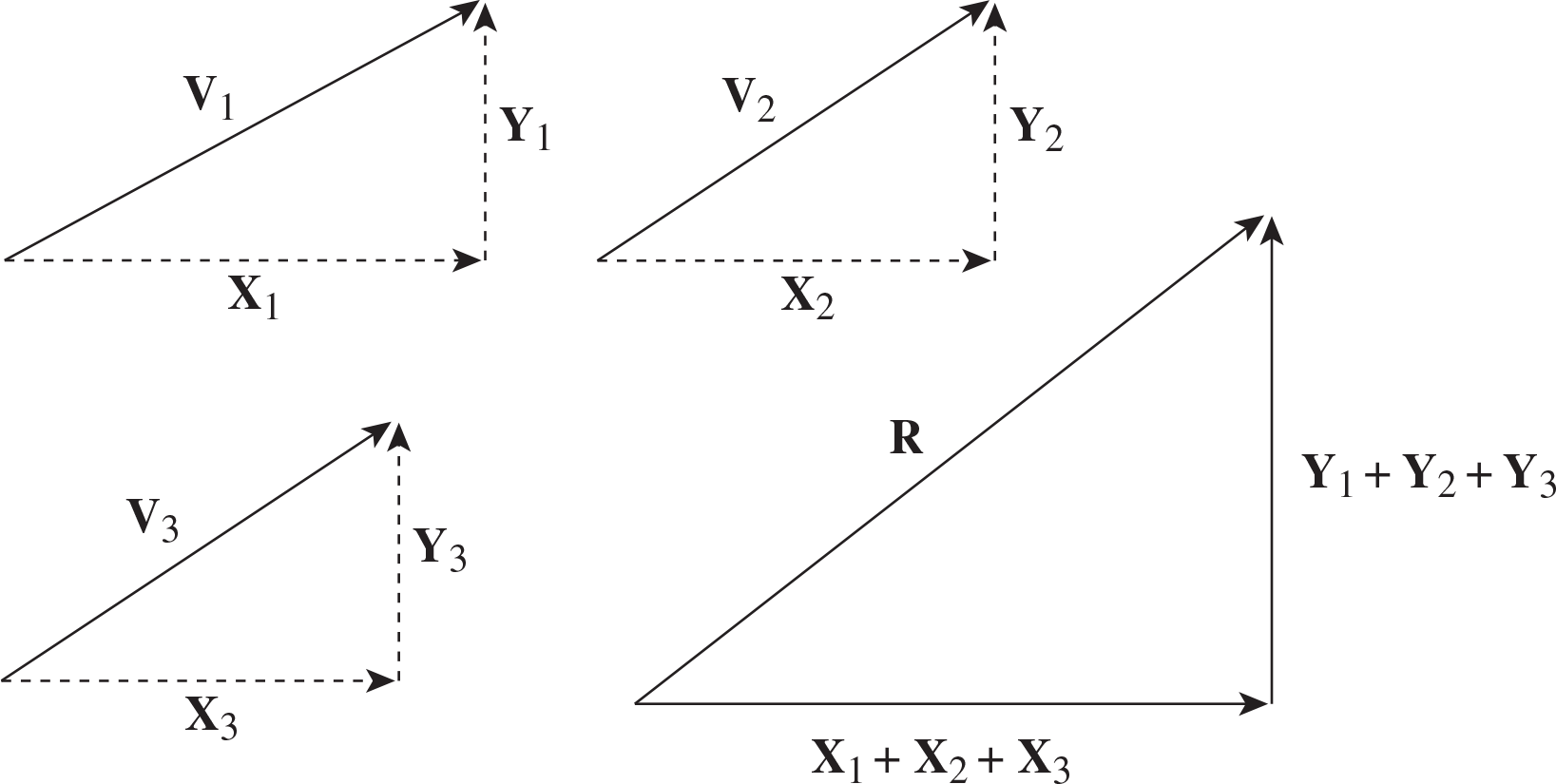
Figure 1.5. Finding the Resultant (R) of V1 + V2 + V3
To find the resultant (R) using the components method, follow these steps:
- Resolve the vectors to be added into their x- and y-components.
- Add the x-components to get the x-component of the resultant (Rx). Add the y-components to get the y-component of the resultant (Ry).
Ry are the components of the resultant, then R =
- Find the magnitude of the resultant by using the Pythagorean theorem. If Rx and
R x 2
+
R y 2
.
- Find the direction (θ) of the resultant by using the relationship θ=tan−1RyRx.
Vector Subtraction
Subtracting one vector from another can be accomplished by adding a vector with equal magnitude—but opposite direction—to the first vector. This can be expressed mathematically as A – B = A + (–B), where –B represents a vector with the same magnitude as B, but pointing in the opposite direction. Vector subtraction may also be performed on the component vectors first and then combined to create a final vector. As with vector addition, the x-component of the resultant vector is the difference of the x-components of the vectors being subtracted. Similarly, the y-component of the resultant vector is the difference of the y-components of the vectors being subtracted.
KEY CONCEPT
Notice that when you subtract vectors, you are simply flipping the direction of the vector being subtracted and then following the same rules as normal: adding tip-to-tail.
Multiplying Vectors by Scalars
When a vector is multiplied by a scalar, its magnitude will change. Its direction will be either parallel or antiparallel to its original direction. If a vector A is multiplied by the scalar value n, a new vector, B, is created such that B = nA. To find the magnitude of the new vector, B, simply multiply the magnitude of A by |n|, the absolute value of n. To determine the direction of the vector B, we must look at the sign on n. If n is a positive number, then B and A are in the same direction. However, if n is a negative number, then B and A point in opposite directions. For example, if vector A is multiplied by the scalar +3, then the new vector B is three times as long as A, and points in the same direction. If vector A is multiplied by the scalar –3, then B would still be three times as long as A but would now point in the opposite direction.
Multiplying Vectors by Other Vectors
In some circumstances, we want to be able to use two vector quantities to generate a third vector or a scalar by multiplication. To generate a scalar quantity like work, we multiply the magnitudes of the two vectors of interest (force and displacement) and the cosine of the angle between the two vectors. In vector calculus, this is called the dot product (A · B):
A · B = |A| |B| cosθ
Equation 1.4
In contrast, when generating a third vector like torque, we need to determine both its magnitude and direction. To do so, we multiply the magnitudes of the two vectors of interest (force and lever arm) and the sine of the angle between the two vectors. Once we have the magnitude, we use the right-hand rule to determine its direction. In vector calculus, this is called the cross product (A × B):
A × B = n|A| |B| sin θ
Equation 1.5
In Equation 1.5, n represents the unit vector, which provides the direction of the resultant vector. The resultant of a cross product will always be perpendicular to the plane created by the two vectors. Because the MCAT is a two-dimensional test, this usually means that the vector of interest will be going into or out of the page (or screen).
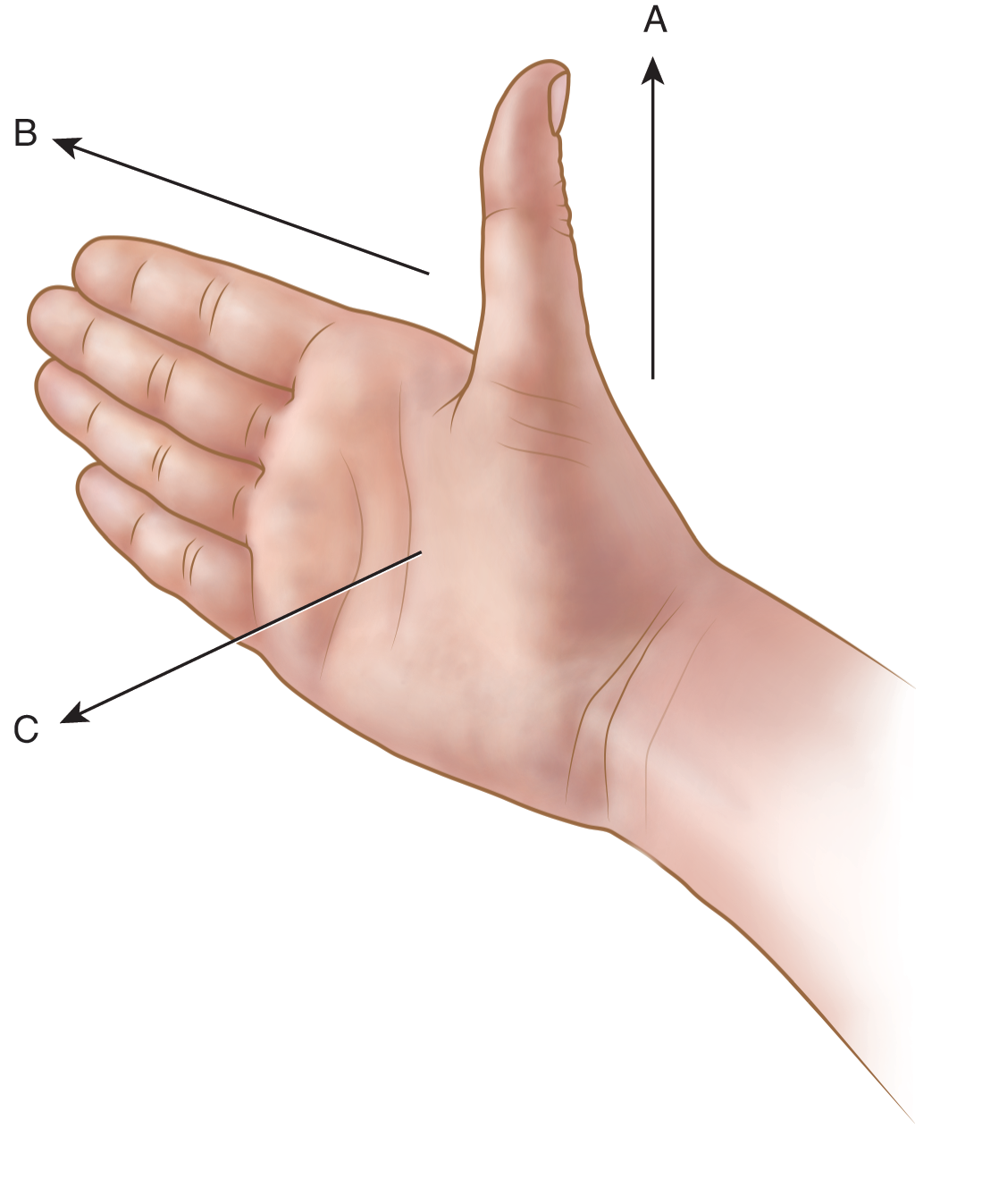
There are multiple versions of the right-hand rule that can be used to determine the direction of a cross product resultant vector. Figure 1.6 shows one method considering a resultant C where C = A × B:
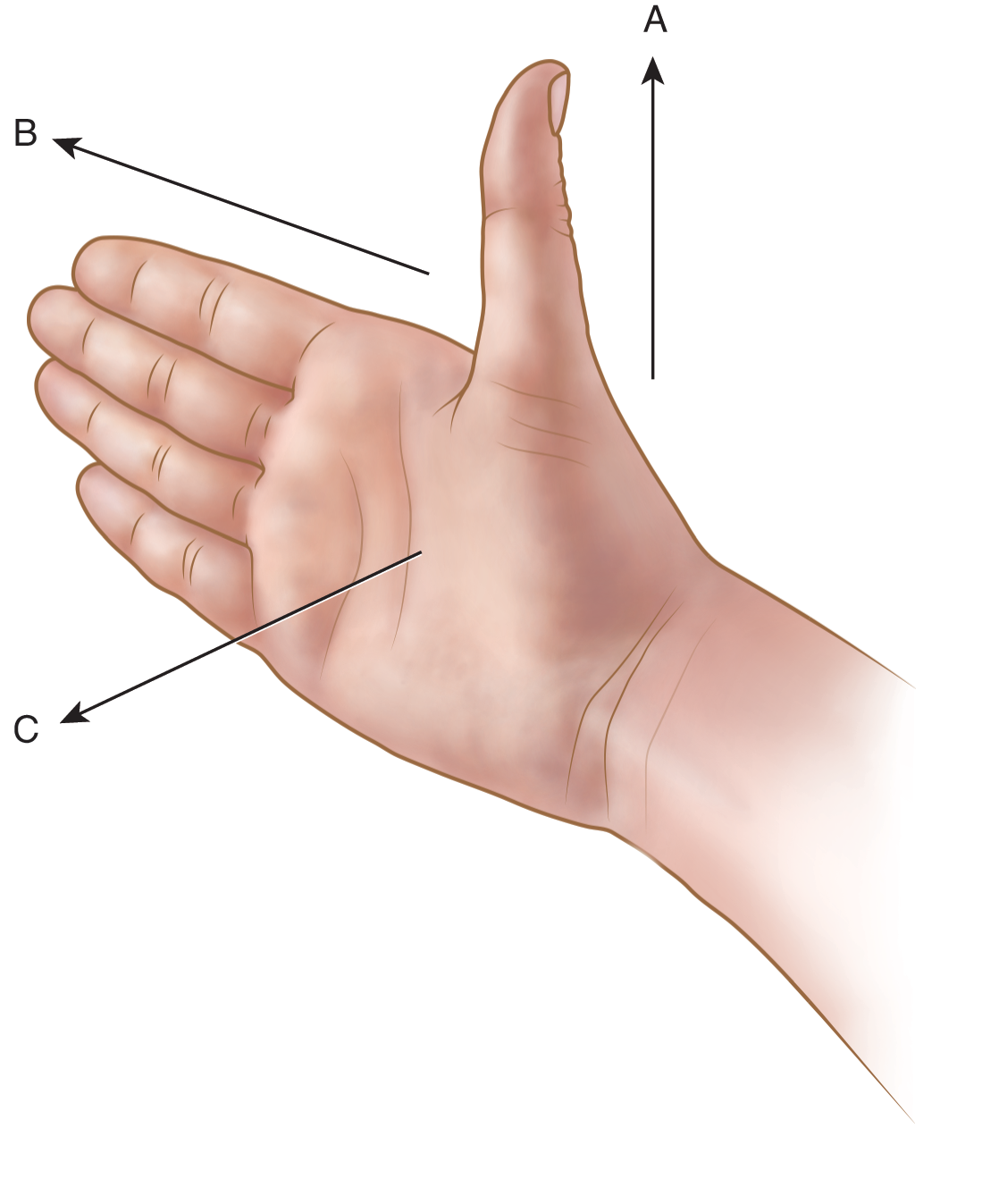
Figure 1.6. Applying the Right-Hand Rule
- Start by pointing your thumb in the direction of vector A.
- Extend your fingers in the direction of vector B. You may need to rotate your wrist to get the correct configuration of thumb and fingers.
- Your palm establishes the plane between the two vectors. The direction your palm points is the direction of the resultant C.
Note that you may have learned a version of the right-hand rule that is different from what is described here. For example, some students learn to point the right index finger in the direction of A and the right middle finger in the direction of B; when one holds the thumb perpendicular to these two fingers, it points in the direction of C. It makes no difference which version of the right-hand rule you use, as long as you are comfortable with it and are skilled in its proper use.
MCAT EXPERTISE
There are several different methods for determining the direction of a cross product resultant vector. Choose whichever method you prefer and stick with it—it’s more important to be skilled in using one method than to be only somewhat familiar with multiple methods.
Example: What are the magnitudes and directions of the resultant vectors from the following cross products: C = A × B and D = B × A?
A: X = –3 N, Y = 0 B: X = 0, Y = +4 m
Solution: The magnitude of the resultant vector is simply the product of the magnitudes of the factor vectors and the sine of the angle between them. In this case, because one is oriented in the x-direction and the other is in the y-direction, the angle between them is 90°.
|A| × |B| × sin 90° = 3 N × 4 m × 1 = 12 N·m
The magnitude is therefore 12 N·m.
Now, to determine the direction of C, start by pointing your right thumb toward the left (negative x-direction). Your fingers will point toward the top of the page (positive y-direction). Your palm is therefore pointing into the page.
Now, to determine the direction of D, start by pointing your right thumb toward the top of the page (positive y-direction). Your fingers will point toward the left (negative x-direction). Your palm is therefore pointing out of the page.
Therefore, C is 12 N·m [⊗ (into the page)] and D is 12 N·m [⊙ (out of the page)].
KEY CONCEPT
For cross products and the right-hand rule, order matters! Unlike scalar multiplication, which is commutative (3 × 4 = 4 × 3), vector multiplication is not commutative (A × B ≠ B × A)!
MCAT CONCEPT CHECK 1.2
Before you move on, assess your understanding of the material with these questions.
- When calculating the sum of vectors A and B (A + B), we put the tail of B at the tip of A. What would be the effect of reversing this order (B + A)?
_________________________________
- When calculating the difference of vectors A and B (A – B), we invert B and put the tail of this new vector at the tip of A. What would be the effect of reversing this order (B – A)?
_________________________________
- How is a scalar calculated from the product of two vectors? How is a vector calculated?
- Scalar:
_________________________________
- Vector:
_________________________________
- True or False: If C = A × B, where A is directed toward the right side of the page and B is directed to the top of the page, then C is directed midway between A and B at a 45° angle.
1.3 Displacement and Velocity
LEARNING OBJECTIVES
After Chapter 1.3, you will be able to:
- Describe the relationship between the average and instantaneous versions of velocity and speed
- Distinguish between total distance and total displacement
- Connect displacement and velocity with an equation
Now that we’ve covered the basic geometry that serves as the foundation of physics, we can examine the related physical quantities. The basic quantities that relate to kinematics are displacement, velocity, and acceleration.
Displacement
An object in motion may experience a change in its position in space, known as displacement (x or d). This is a vector quantity and, as such, has both magnitude and direction. The displacement vector connects (in a straight line) the object’s initial position and its final position. Understand that displacement does not account for the actual pathway taken between the initial and the final positions—only the net change in position from initial to final. Distance (d) traveled, on the other hand, considers the pathway taken and is a scalar quantity.
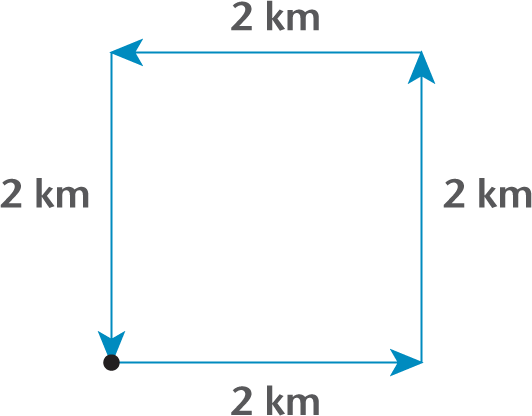
Example: What is the displacement of a person who walks 2 km east, then 2 km north, then 2 km west, and then 2 km south?
Solution: While the total distance traveled is 8 km, the displacement is a vector quantity that represents the change in position. In this case, the displacement is zero because the person ends up back at the start, as shown below.
Velocity
As was mentioned earlier, velocity (v) is a vector. Its magnitude is measured as the rate of change of displacement in a given unit of time, and its SI units are meters per second. The direction of the velocity vector is necessarily the same as the direction of the displacement vector. Speed (v) is the rate of actual distance traveled in a given unit of time.
The distinction is subtle, so let’s examine this a little more carefully. The instantaneous speed of an object will always be equal to the magnitude of the object’s instantaneous velocity, which is a measure of the average velocity as the change in time (Δt) approaches zero:
v=limΔt→0 ΔxΔt
Equation 1.6
where v is the instantaneous velocity, Δx is the change in position, and Δt is the change in time. As a measure of speed, instantaneous speed is a scalar number. Average speed will not necessarily always be equal to the magnitude of the average velocity. This is because average velocity is the ratio of the displacement vector over the change in time (and is a vector), whereas average speed (which is scalar) is the ratio of the total distance traveled over the change in time. Average speed accounts for actual distance traveled, whereas average velocity does not:
v¯=ΔxΔt
Equation 1.7
where v¯ is the average velocity, Δx is the change in position, and Δt is the change in time.
Consider the example given earlier regarding the Earth’s orbit. In one year, the Earth travels roughly 940 million kilometers, but its displacement is zero:
d=9.4×10⁸ kmx=0 km
The average speed is a measure of distance traveled in a given period of time; the average velocity is a measure of the displacement of an object over a given period of time. While the average speed of the Earth over a year is about 30 kilometers per second, its average velocity is again zero:
ν=9.4×10⁸ km3.16×107 s=29.8 kms¯v=0 km3.16×107 s=0 kms
MCAT CONCEPT CHECK 1.3
Before you move on, assess your understanding of the material with these questions.
- What is the relationship between instantaneous velocity and instantaneous speed? Between average velocity and average speed?
_________________________________
- True or False: Total distance traveled can never be less than the total displacement.
- Provide a definition for displacement or velocity in terms of the other variable.
_________________________________
1.4 Forces and Acceleration
LEARNING OBJECTIVES
After Chapter 1.4, you will be able to:
- Calculate a frictional force and predict its direction
- Describe the relationship between force, velocity, and acceleration
- Identify common forces, including frictional and gravitational forces
- Explain the concept of normal forces and how they impact a system
Every change in velocity is motivated by a push or a pull—a force. In this section, we’ll examine how forces interact with one another, as well as how acceleration results from those forces.
Forces
Force (F) is a vector quantity that is experienced as pushing or pulling on objects. Forces can exist between objects that are not even touching. While it is common for forces to be exerted by one object pushing on another, there are even more instances in which forces exist between objects nowhere near each other, such as gravity or electrostatic forces between point charges. The SI unit for force is the newton (N), which is equivalent to one kg⋅ms2.
Gravity
When Newton observed apples falling out of trees, he was struck by the fact that they always fell perpendicularly to the ground, rather than sideways or even away from the ground. Furthermore, Newton began to wonder about the farthest reaches of gravity. If the apple feels this attractive pull toward the Earth, then what about the Moon? This force is what Newton would later term “universal gravitation.”
MCAT EXPERTISE
Acceleration due to gravity, g, decreases with height above the Earth and increases the closer one gets to the Earth’s center of mass. Near the Earth’s surface, use g = 10 ms2.
Gravity is an attractive force that is felt by all forms of matter. We usually think of gravity as acting on us to keep us from floating off of the Earth’s surface, or for holding the planets of our solar system in orbit. However, all objects exert gravitational forces on each other; there is a small (but measurable) force of gravity between you and this MCAT Physics and Math Review book, the chair you’re sitting on, and all the objects around you. Gravitational forces usually do not have much significance on a small scale because other forces tend to be much larger in magnitude. Only on the planetary level do gravitational forces really take on a significant value.
REAL WORLD
Newton’s third law states that the force of gravity on m1 from m2 is equal and opposite to the force of gravity on m2 from m1. This means that the force of gravity on you from the Earth is equal and opposite to the force of gravity from you on the Earth. Because the forces are equal but the masses are very different, the accelerations must also be very different, from F = ma (discussed later in this chapter). Because your mass is very small compared to the Earth, you experience a large acceleration from it. In contrast, because the Earth is massive, it experiences a tiny acceleration from the same magnitude of force.
The magnitude of the gravitational force between two objects is
Fg=Gm1m2r2
Equation 1.8
where G is the universal gravitational constant (6.67×10⁻¹¹ N⋅m2kg2), m1 and m2 are the masses of the two objects, and r is the distance between their centers of mass. This equation is commonly tested in the context of proportionalities. For instance, the magnitude of the gravitational force is inversely related to the square of the distance (that is, if r is halved, then Fg will quadruple). The magnitude of the gravitational force is also directly related to the masses of the objects (that is, if m1 is tripled, then Fg will triple).
Example: Find the gravitational force between an electron and a proton that are 10–11 m apart. (Note: Mass of a proton = 1.67 × 10⁻²⁷ kg; mass of an electron = 9.11 × 10⁻³¹ kg)
Solution: Use Newton’s law of gravitation:
Fg=Gm1m2r2=(6.67×10⁻¹¹ N⋅m2kg2)(1.67×10⁻²⁷ kg)(9.11×10⁻³¹ kg)(10−11 m)2Fg≈(203×10−11)(53×10−27)(9×10⁻³¹)10−22=100×99×10−6910−22=10-6710-22=10−45 N(actual=1.02×10−45 N)
Friction
Friction is a type of force that opposes the movement of objects. Unlike other kinds of forces, such as gravity or electromagnetic force, which can cause objects either to speed up or slow down, friction forces always oppose an object’s motion and cause it to slow down or become stationary. There are two types of friction: static and kinetic.
Static friction (fs) exists between a stationary object and the surface upon which it rests. The inequality that describes the magnitude of static friction is
0 ≤ fs ≤ μsN
Equation 1.9
where μs is the coefficient of static friction and N is the magnitude of the normal force. The coefficient of static friction is a unitless quantity that is dependent on the two materials in contact. The normal force is the component of the force between two objects in contact that is perpendicular to the plane of contact between the object and the surface upon which it rests.
Note the less-than-or-equal-to signs in the equation. These signify that there is a range of possible values for static friction. The minimum, of course, is zero. This would be the case if an object were resting on a surface with no applied forces. The maximum value of static friction can be calculated from the right side of the previous equation. One should not assume that objects that are stationary are experiencing a maximal static force of friction.
Consider trying to push a heavy piece of luggage. When a 25 N force is applied, the bag does not move. When a 50 N force is applied, the bag still does not move. When a 100 N force is applied, the bag slides a meter or so and slows to a rest. This setup implies that the maximal value of static friction is somewhere between 50 and 100 N; any applied force less than this threshold will not be sufficient to move the bag as there will be an equal but opposite force of static friction opposing the bag’s motion.
KEY CONCEPT
Contact points are the places where friction occurs between two rough surfaces sliding past each other. If the normal load—the force that squeezes the two together—rises, the total area of contact increases. That increase, more than the surface’s roughness, governs the degree of friction. This is illustrated in Figure 1.7 below.

Figure 1.7. Increases in Contact Area Increase Frictional Forces
Kinetic friction (fk) exists between a sliding object and the surface over which the object slides. Sometimes, students misidentify the presence of kinetic friction. A wheel, for example, that is rolling along a road does not experience kinetic friction because the tire is not actually sliding against the pavement. The tire maintains an instantaneous point of static contact with the road and, therefore, experiences static friction. Only when the tire begins to slide on, say, an icy patch will kinetic friction come into play. Any time two surfaces slide against each other, kinetic friction will be present and its magnitude can be measured according to this equation:
fk = μkN
Equation 1.10
where μk is the coefficient of kinetic friction and N is the normal force. There are two important distinctions between this equation for kinetic friction and the previous equation for static friction. First, the kinetic friction equation has an equals sign. This means that kinetic friction will have a constant value for any given combination of a coefficient of kinetic friction and normal force. It does not matter how much surface area is in contact or even the velocity of the sliding object. Second, the two equations have a different coefficient of friction. The value of μs is always larger than the value of μk. Therefore, the maximum value for static friction will always be greater than the constant value for kinetic friction: objects will “stick” until they start moving, and then will slide more easily over one another.
KEY CONCEPT
The coefficient of static friction will always be larger than the coefficient of kinetic friction. It always requires more force to get an object to start sliding than it takes to keep an object sliding.
As previously mentioned in the discussion of static friction, pay close attention to the conditions set in an MCAT passage or question. Does it say that friction can be assumed to be negligible, or does it provide the coefficient of friction values, which will most likely need to be used in a calculation of friction? Friction will be incorporated into our examination of translational equilibrium later in this chapter.
Mass and Weight
Mass and weight are not the same. Mass (m) is a measure of a body’s inertia—the amount of matter in the object. Mass is a scalar quantity, and, as such, has magnitude only. The SI unit for mass is the kilogram, which is independent of gravity. One kilogram of material on Earth will have the same mass as one kilogram of material on the Moon. Weight (Fg), on the other hand, is a measure of gravitational force (usually that of the Earth) on an object’s mass. Because weight is a force, it is a vector quantity with units in newtons (N).
While mass and weight are not synonymous, they are related by the equation:
Fg = mg Equation 1.11
where Fg is the weight of the object, m is its mass, and g is acceleration due to gravity, 9.8 ms2 (usually rounded to 10 ms2).
The weight of an object can be thought of as being applied at a single point in that object called the center of mass or gravity. The MCAT will not directly test your ability to determine center of mass; however, such a calculation may be an important step in a problem with the larger focus of Newtonian mechanics.
To illustrate this concept and calculation, consider a tennis racket that has been thrown into the air. Each part of the racket moves in its own pathway, so it’s not possible to represent the motion of the whole racket as a single particle. However, one point within the racket moves in a simple parabolic path, very similar to the flight of a ball. It is this point within the racket that is known as the center of mass. This is clearly shown in Figure 1.8.
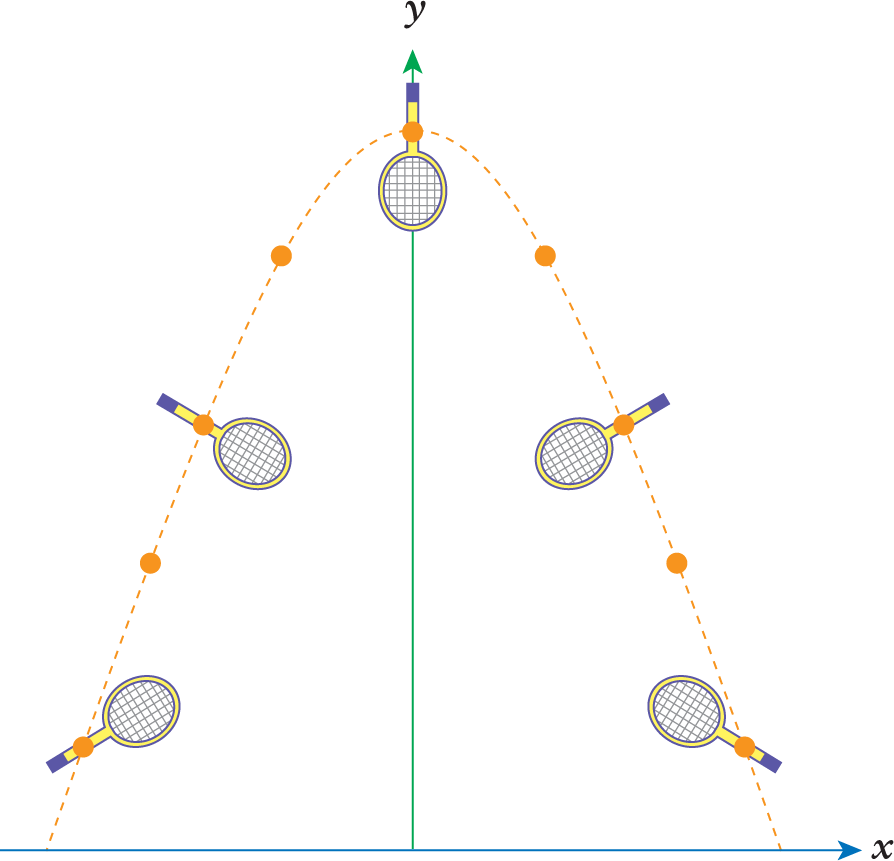
Figure 1.8. Center of Mass of a Tennis Racket The center of mass of a racket thrown into the air travels along a parabolic pathway.
For a system in which particles are distributed in all three dimensions, the center of mass is defined by the three coordinates:
x=m1x1+m2x2+m3x3+⋯m1+m2+m3+⋯y=m1y1+m2y2+m3y3+⋯m1+m2+m3+⋯z=m1z1+m2z2+m3z3+⋯m1+m2+m3+⋯
Equation 1.12
where m1, m2, and m3 are the three sample masses, and the x-, y-, and z-values are coordinates. The center of gravity is related and corresponds to the single point at which one can conceptualize gravity acting on an object. Only for a homogeneous body (with symmetrical shape and uniform density) should one expect the center of gravity to be located at its geometric center. For example, we can approximate the center of gravity for a metal ball as the geometric center of the sphere. The same cannot be said, however, for a human body, television, or any asymmetrical, non-uniform object.
KEY CONCEPT
The center of mass of a uniform object is at the geometric center of the object.
Acceleration
Acceleration (a) is the rate of change of velocity that an object experiences as a result of some applied force. Acceleration, like velocity, is a vector quantity and is measured in SI units of meters per second squared. Acceleration in the direction opposite the initial velocity may be called deceleration. Average acceleration is defined as
a¯=ΔvΔt
Equation 1.13
where a¯ is the average acceleration, Δv is the change in velocity, and Δt is the change in time.
Instantaneous acceleration is defined as the average acceleration as Δt approaches zero.
a=limΔt→0 ΔvΔt
Equation 1.14
On a graph of velocity vs. time, the tangent to the graph at any time t, which corresponds to the slope of the graph at that time, indicates the instantaneous acceleration. If the slope is positive, then the acceleration is positive and in the same direction as the velocity. If the slope is negative, then the acceleration is negative and in the opposite direction of the velocity (this is a deceleration).
MCAT CONCEPT CHECK 1.4
Before you move on, assess your understanding of the material with these questions.
- When calculating frictional forces, how is directionality assigned?
_________________________________
- When no force is being applied, the velocity must be:
_________________________________
- True or False: The Earth creates a larger force on you than you create on the Earth.
- Name two forces in addition to mechanical manipulation (pushing or pulling forces created by contact with an object):
- _________________________________
- _________________________________
1.5 Newton’s Laws
LEARNING OBJECTIVES
After Chapter 1.5, you will be able to:
- Describe Newton’s three laws of motion
Now that we have a clear understanding of force, mass, and acceleration, let’s examine how they relate to each other. While it is unlikely that Newton “discovered” gravity by having an apple fall on his head, he did record that he was indeed inspired by watching apples fall from trees. His observations about objects in motion and at rest are the basis for the branch of physics that we now know as mechanics. Newton’s laws, which are expressed as equations, concisely describe the effects forces have on objects that have mass.
First Law
Fnet = ma = 0
Equation 1.15
where Fnet is the net force, m is the mass, and a is the acceleration.
A body either at rest or in motion with constant velocity will remain that way unless a net force acts upon it. This is also known as the law of inertia. Newton’s first law ought to be thought of as a special case of his second law, which is described next.
Second Law
Fnet = ma Equation 1.16
where Fnet is the net force, m is the mass, and a is the acceleration.
What Newton’s second law states is actually a corollary of the first: An object of mass m will accelerate when the vector sum of the forces results in some nonzero resultant force vector. No acceleration will occur when the vector sum of the forces results in a cancellation of those forces. Note that the net force and acceleration vectors necessarily point in the same direction.
Third Law
FAB = –FBA
Equation 1.17
This law is also known as the law of action and reaction: To every action, there is always an opposed but equal reaction. More formally, the law states that for every force exerted by object A on object B, there is an equal but opposite force exerted by object B on object A. For example, when you hit your hand against your desk, your hand exerts a force on the desk. Simultaneously, the desk exerts a force of equal magnitude in the opposite direction on your hand. Physical contact is not necessary for Newton’s third law; the mutual gravitational pull between the Earth and the Moon traverses hundreds of thousands of kilometers of space.
MCAT CONCEPT CHECK 1.5
Before you move on, assess your understanding of the material with this question.
- In your own words, provide a description of Newton’s laws of motion:
_________________________________
- _________________________________
_________________________________
- _________________________________
_________________________________
- _________________________________
- During a test crash, a 500 kg car is driven at a constant velocity of 50 mph until it hits a wall without braking. Apply all three of Newton’s laws to this situation.
- _________________________________
- _________________________________
- _________________________________
1.6 Motion with Constant Acceleration
LEARNING OBJECTIVES
After Chapter 1.6, you will be able to:
- Identify which forces are active during different types of motion, including free fall and projectile motion
- Predict the angle of launch necessary to maximize horizontal or vertical displacement
- Recall the equation used to calculate centripetal acceleration
Objects can undergo only two types of motion—that which is constant (with no acceleration) or that which is changing (with acceleration). If an object’s motion is changing, as indicated by a change in velocity, then the object is experiencing acceleration, and that acceleration may be constant or itself changing. A moving object that experiences constant acceleration presents a relatively simple case for analysis. The MCAT tends to restrict kinematics problems to those that involve motion with constant acceleration.
Linear Motion
In linear motion, the object’s velocity and acceleration are along the line of motion, so the pathway of the moving object continues along a straight line. Linear motion does not need to be limited to vertical or horizontal paths; the inclined surface of a ramp will provide a path for linear motion at some angle. On the MCAT, the most common presentations of linear motion problems involve objects, such as balls, being dropped to the ground from some starting height.
Falling objects exhibit linear motion with constant acceleration. This one-dimensional motion can be fully described by the following equations:
v=v0+atx=v0t+at22v2=v02+2axx=v¯t
Equations 1.18 to 1.21
where x, v, and a are the displacement, velocity, and acceleration vectors, respectively; v0 is the initial velocity; v¯ is the average velocity; and t is time. When the motion is vertical, we often use y instead of x for displacement.
MCAT EXPERTISE
When dealing with free fall problems, you can choose to make down either positive or negative. However, for the sake of simplicity, get in the habit of always making up positive and down negative.
To demonstrate the typical setup of a kinematics problem on the MCAT, we will consider an object falling through the air. For now, we will assume air resistance to be negligible, meaning that the only force acting on the object would be the gravitational force causing it to fall. Consequently, the object would fall with constant acceleration—the acceleration due to gravity (g=9.8 ms2) —and would not reach terminal velocity. This is called free fall. Under these conditions of a free-falling object that has not reached terminal velocity, which are typical for Test Day, we could analyze the fall, using the relevant kinematics equations.
Example: A ball is thrown vertically up into the air from a window ledge 30 meters above the ground with an initial velocity of 10 ms.
- Find the velocity and position of the ball after two seconds.
- Find the distance and time at which the ball reaches its maximum height above the window ledge.
Solution:
- Remember that velocity and acceleration are vector quantities. For this question, let’s call the ball’s initial position, y0, zero. If we consider up to be positive, then the initial velocity, v0, is + 10 ms, and the acceleration, g, is −9.8 ms2. Note that g is negative because it’s oriented downward. Velocity after two seconds can be found using Equation 1.18:
v=v0+at=+10 ms+-9.8 ms22 s=10 ms-19.6 ms=-9.6 ms
After two seconds, the position of the ball is found using Equation 1.19:
y=v0t+at22=(10 ms) (2 s) +(−9.8 ms2) (2 s)22=20−19.6=0.4 m(abovetheledge)
- When the ball is at its maximum height, the velocity, which has been decreasing on the way up, is now zero. We can find the maximum height the ball reaches using Equation 1.20:
v2=v02+2 ay02=(10 ms)2+2(−9.8 ms2) (y)19.6y=100y≈5 m (actual=5.1 m)
The time at which the ball reaches its maximum height can be found from Equation 1.18:
v=v0+at0=(+10 ms)+(−9.8 ms2)(t)t≈1 s (actual=1.02 s)
Let’s now consider what happens when air resistance is not negligible. Air resistance, like friction, opposes the motion of an object. Its value increases as the speed of the object increases. Therefore, an object in free fall will experience a growing drag force as the magnitude of its velocity increases. Eventually, this drag force will be equal in magnitude to the weight of the object, and the object will fall with constant velocity according to Newton’s first law. This velocity is called the terminal velocity.
MCAT EXPERTISE
The amount of time that an object takes to get to its maximum height is the same time it takes for the object to fall back down to the starting height (assuming air resistance is negligible); this fact makes solving these problems much easier. Because you can solve for the time to reach maximum height by setting your final velocity to zero, you can then multiply your answer by two, getting the total time in flight—as long as the object ends at the same height at which it started. Because the only force acting on the object after it is launched is gravity, the velocity it has in the x-direction will remain constant throughout its time in flight. By multiplying the time by the velocity in the x-direction, one can find the horizontal distance traveled.
Projectile Motion
Projectile motion is motion that follows a path along two dimensions. The velocities and accelerations in the two directions (usually horizontal and vertical) are independent of each other and must, accordingly, be analyzed separately. Objects in projectile motion on Earth, such as cannonballs, baseballs, or footballs, experience the force and acceleration of gravity only in the vertical direction (along the y-axis). This means that vy will change at the rate of g but vx will remain constant. In fact, on the MCAT, you will generally be able to assume that the horizontal velocity, vx, will be constant because we usually assume that air resistance is negligible and, therefore, no measurable force is acting along the x-axis.
KEY CONCEPT
Note that gravity is set in bold, indicating it has a vector value. Gravity is unique in that it is used as both a constant and as a vector in calculations. Though gravity is not always bolded, you should recall for Test Day that gravity has a direction.
Example: A projectile is fired from ground level with an initial velocity of 50 ms and an initial angle of elevation of 37°, as shown below. Assuming g= –10 ms2, find the following: (Note: sin 37° = 0.6; cos 37° = 0.8)

- The projectile’s total time in flight
- The total horizontal distance traveled
Solution:
- Let y equal the vertical displacement, and up be the positive direction. If we are going to use the vertical displacement and acceleration due to gravity (which is also in the y-direction), we must use the y-component of velocity in this part of the problem:
v0y = v0sin37° = (50 ms) (0.6) = 30 ms
Now we can plug in:
y=v0yt+ayt220=30 mst+–10 ms2t220=30t-5t25t2=30tt2=6tt=0 s or 6 s
The height of the ball is zero at 0 seconds (its initial position) and 6 seconds (when it hits the ground again).
- Now that we know the time, we can find the horizontal distance traveled. Here, we will need to consider only the x-component of the velocity:
v0x = v0cos37° = (50 ms) (0.8) = 40 ms
Now we can plug in:
x = vx t + axt22 = (40 ms) (6 s) + 0 = 240 m
Note: There is only acceleration in the vertical direction due to gravity, ax = 0.
Inclined Planes
Inclined planes are another example of motion in two dimensions. When working with an inclined plane question, it is often best to divide force vectors into components that are parallel and perpendicular to the plane. Most often, gravity must be split into components for these calculations. These components can be defined as:
Fg,||=mgsinθFg,⊥=mgcosθ
Equation 1.22
where Fg,|| is the component of gravity parallel to the plane (oriented down the plane), Fg,⊥ is the component of gravity perpendicular to the plane (oriented into the plane), m is the mass, g is acceleration due to gravity, and θ is the angle of the incline. Otherwise, the same kinematics equations can be used in these problems.
Example: A 5 kg block slides down a frictionless incline at 30°. Find the normal force and acceleration of the block. (Note: sin 30° = 0.5, sin 60° = 0.866, cos30° = 0.866, cos 60° = 0.5)
Solution: The block in this example has two forces acting on it: the normal force, which is perpendicular to the surface, and gravity, which points straight down:
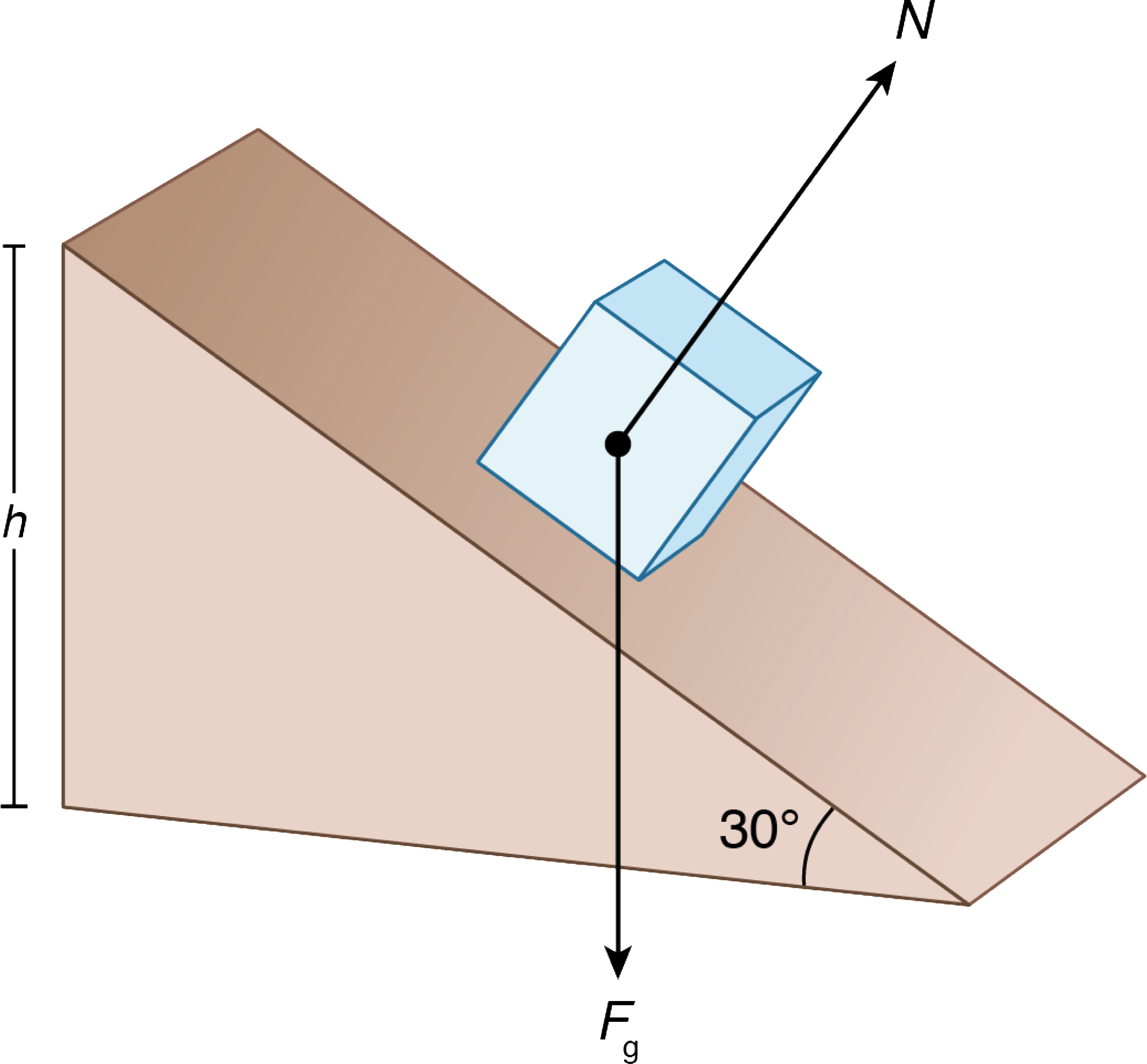
Because gravity is not in the same coordinate system as the normal force, one of the two forces must be split into components. In this case, because we are concerned with magnitude of the normal force (which is perpendicular to the plane) and the acceleration (which is parallel to the plane), we should split the force of gravity into parallel and perpendicular components:
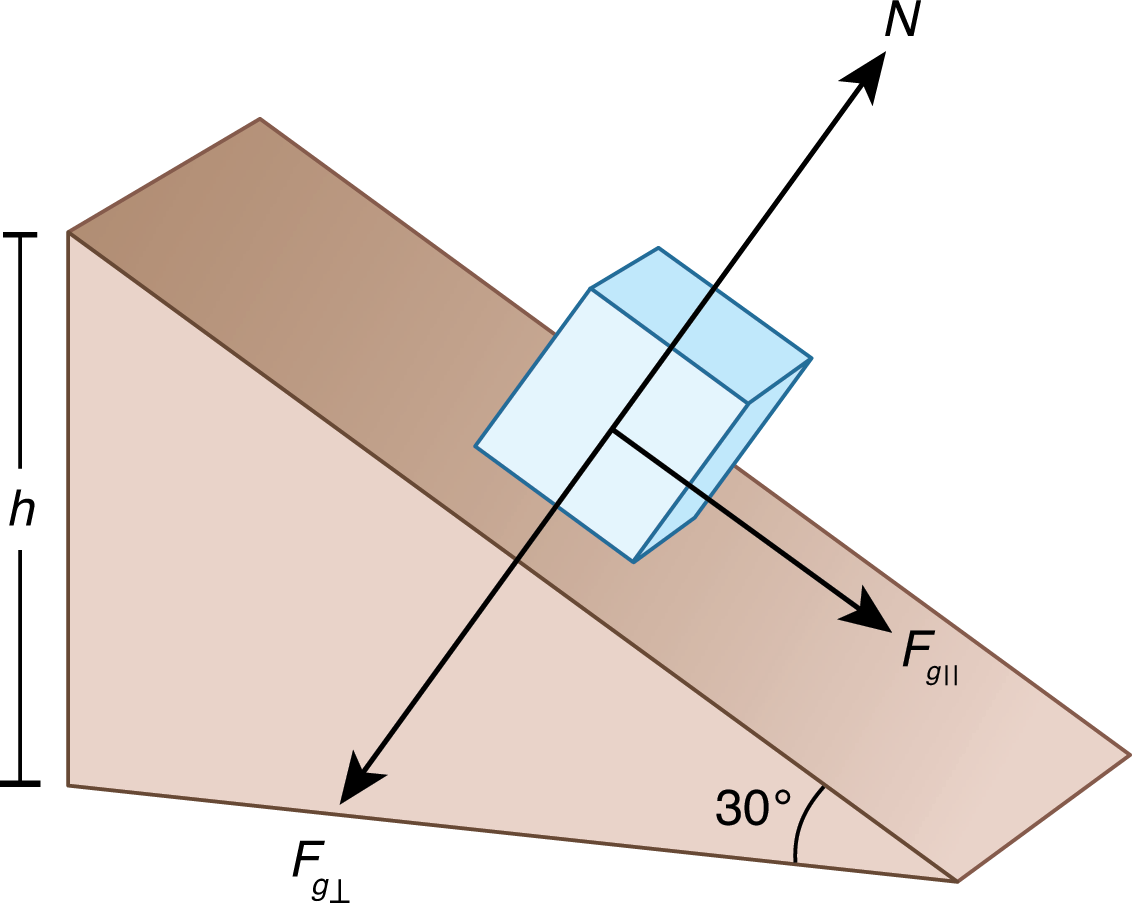
Because there is no acceleration in the perpendicular dimension, the magnitude of the normal force must be equal to that of the perpendicular component of gravity:
|N|=|Fg,⊥|=mg cosθ=(5 kg)(9.8 ms2)cos30°≈50(0.866)=43.3 N(actual=42.4 N)
The acceleration can then be determined in the parallel direction. Because the only force in this dimension is the parallel component of the force of gravity, it is the net force:
Fnet,∥=Fg,∥=ma∥mg sinθ=ma∥g sinθ=a∥=9.8 ms2sin30=9.8 ms20.5=4.9 ms2
Circular Motion
Circular motion occurs when forces cause an object to move in a circular pathway. Upon completion of one cycle, the displacement of the object is zero. Although the MCAT focuses on uniform circular motion, in which case the speed of the object is constant, recognize that there is also nonuniform circular motion.
In uniform circular motion, the instantaneous velocity vector is always tangent to the circular path, as shown in Figure 1.9. What this means is that the object moving in the circular path has a tendency (inertia) to break out of its circular pathway and move in a linear direction along the tangent. It is kept from doing so by a centripetal force, which always points radially inward. In all circular motion, we can resolve the forces into radial and tangential components. In uniform circular motion, the tangential force is zero because there is no change in the speed of the object.
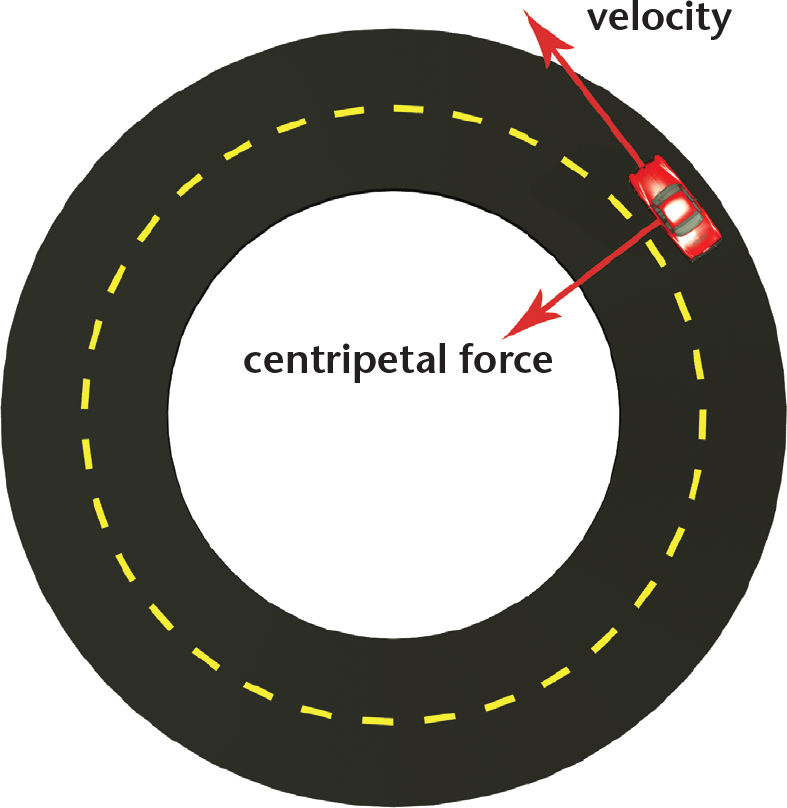
Figure 1.9. Uniform Circular Motion
As a force, the centripetal force generates centripetal acceleration. Remember from the discussion of Newton’s laws that both force and acceleration are vectors and the acceleration is always in the same direction as the net force. Thus, it is this acceleration generated by the centripetal force that keeps an object in its circular pathway. When the centripetal force is no longer acting on the object, it will simply exit the circular pathway and assume a path tangential to the circle at that point. The equation that describes circular motion is
Fc=mv2r
Equation 1.23
where Fc is the magnitude of the centripetal force, m is the mass, v is the speed, and r is the radius of the circular path. Note that the centripetal force can be caused by tension, gravity, electrostatic forces, or other forces.
MCAT CONCEPT CHECK 1.6
Before you move on, assess your understanding of the material with these questions.
- How do the forces acting in free fall and projectile motion differ?
_________________________________
- At what angle of launch is a projectile going to have the greatest horizontal displacement? What angle will result in the greatest vertical displacement, assuming a level surface?
- Greatest horizontal displacement:
_________________________________
- Greatest vertical displacement:
_________________________________
- What is the equation for centripetal acceleration?
_________________________________
1.7 Mechanical Equilibrium
LEARNING OBJECTIVES
After Chapter 1.7, you will be able to:
- Identify whether an object is in equilibrium
- Calculate torque within a system:
So far we’ve been paying attention to kinematics and the special cases of linear and projectile motion. However, many times the MCAT will require you to eliminate acceleration, or otherwise maintain a system in equilibrium. To accomplish this, you must be familiar with analyzing forces, especially with free body diagrams, as well as with the special conditions for translational and rotational equilibrium. The study of forces and torques is called dynamics.
Free Body Diagrams
While we all have an intuitive sense of forces (and their effects) in everyday life, students often struggle to represent them diagrammatically. Drawing free body diagrams takes some practice but will be a valuable tool on the MCAT. On Test Day, make sure to draw a free body diagram for any problem in which you must perform calculations on forces.
MCAT EXPERTISE
When dealing with dynamics questions, always draw a quick picture of what is happening in the problem; this will keep everything in its proper relative position and help prevent you from making simple mistakes.
Example: Three people are pulling on ropes tied to a tire with forces of 100 N, 125 N, and 125 N as shown below. Find the magnitude and direction of the resultant force. (Note: sin 30° = 0.5, cos 30° = 0.866, sin 37° = 0.6, cos 37° = 0.8)
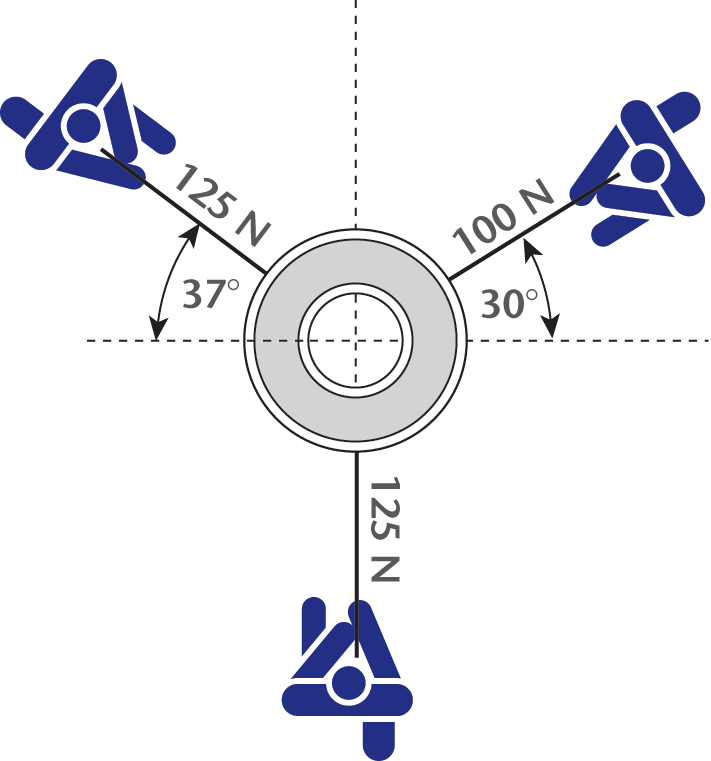
Solution: First, draw a free body diagram that shows the forces acting on the tire. Its purpose is to identify and visualize the acting forces.
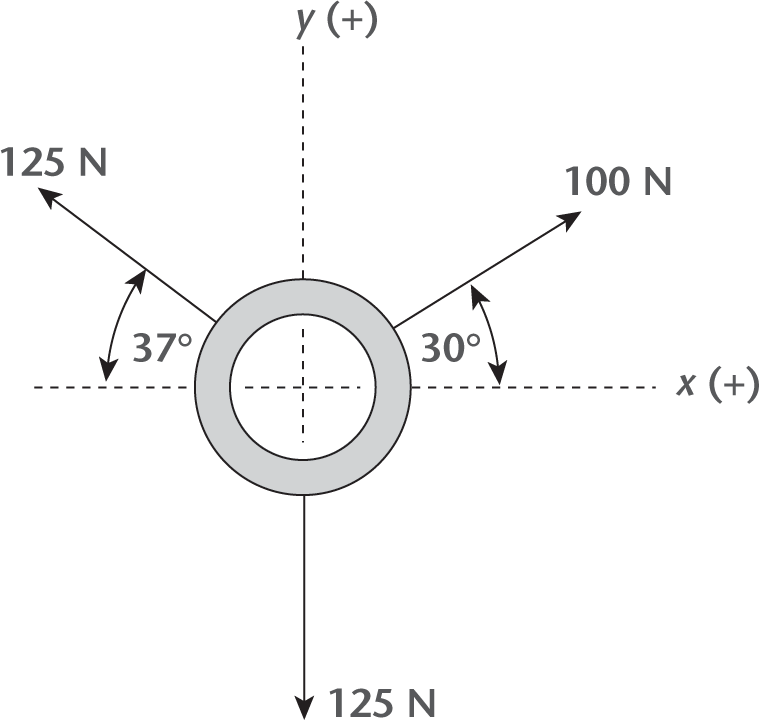
The resultant force is simply the sum of the forces. To find the resultant force vector, we need the sum of the force components, shown below.
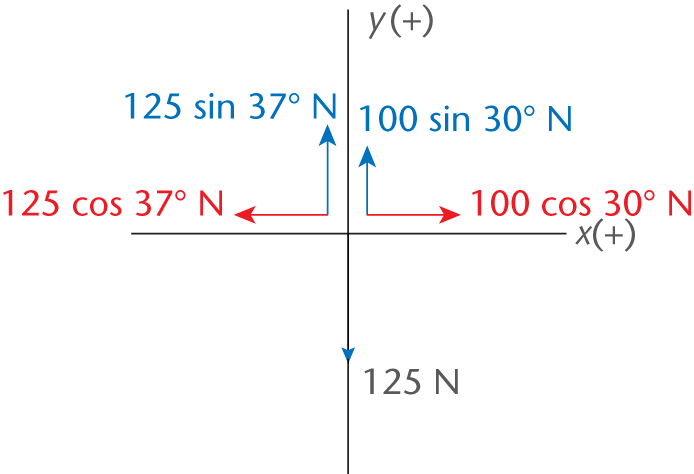
Fnet,x=∑Fx=100cos30°-125cos37=100(0.866)-125(0.8)=86.6-100=-13.4 NFnet,y=∑Fy=100sin30°+125sin37-125=100(0.5)+125(0.6)-125=50+75-125=0 N
The net component vectors are shown graphically below.
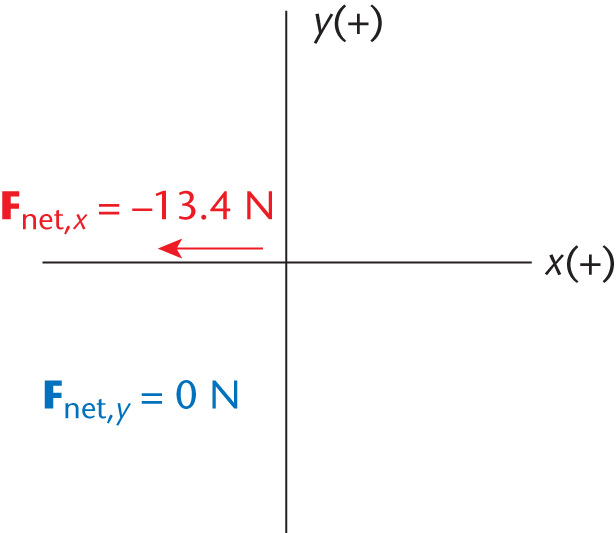
The resultant force will thus be 13.4 N to the left.
Translational Equilibrium
Translational motion occurs when forces cause an object to move without any rotation. The simplest pathways may be linear, such as when a child slides down a snowy hill on a sled, or parabolic, as in the case of a cannonball shot out of a cannon. Any problem regarding translational motion in the Chemical and Physical Foundations of Biological Systems section can be solved using free body diagrams and Newton’s three laws.
Equilibrium Conditions
Translational equilibrium exists only when the vector sum of all of the forces acting on an object is zero. This is called the first condition of equilibrium, and it is merely a reiteration of Newton’s first law. Remember that when the resultant force upon an object is zero, the object will not accelerate; that may mean that the object is stationary, but it could just as well mean that the object is moving with a constant nonzero velocity. Thus, an object experiencing translational equilibrium will have a constant velocity: both a constant speed (which could be zero or a nonzero value) and a constant direction.
KEY CONCEPT
If there is no acceleration, then there is no net force on the object. This means that any object with a constant velocity has no net force acting on it. However, just because the net force equals zero does not mean the velocity equals zero.
Example: Two blocks are in static equilibrium, as shown below:
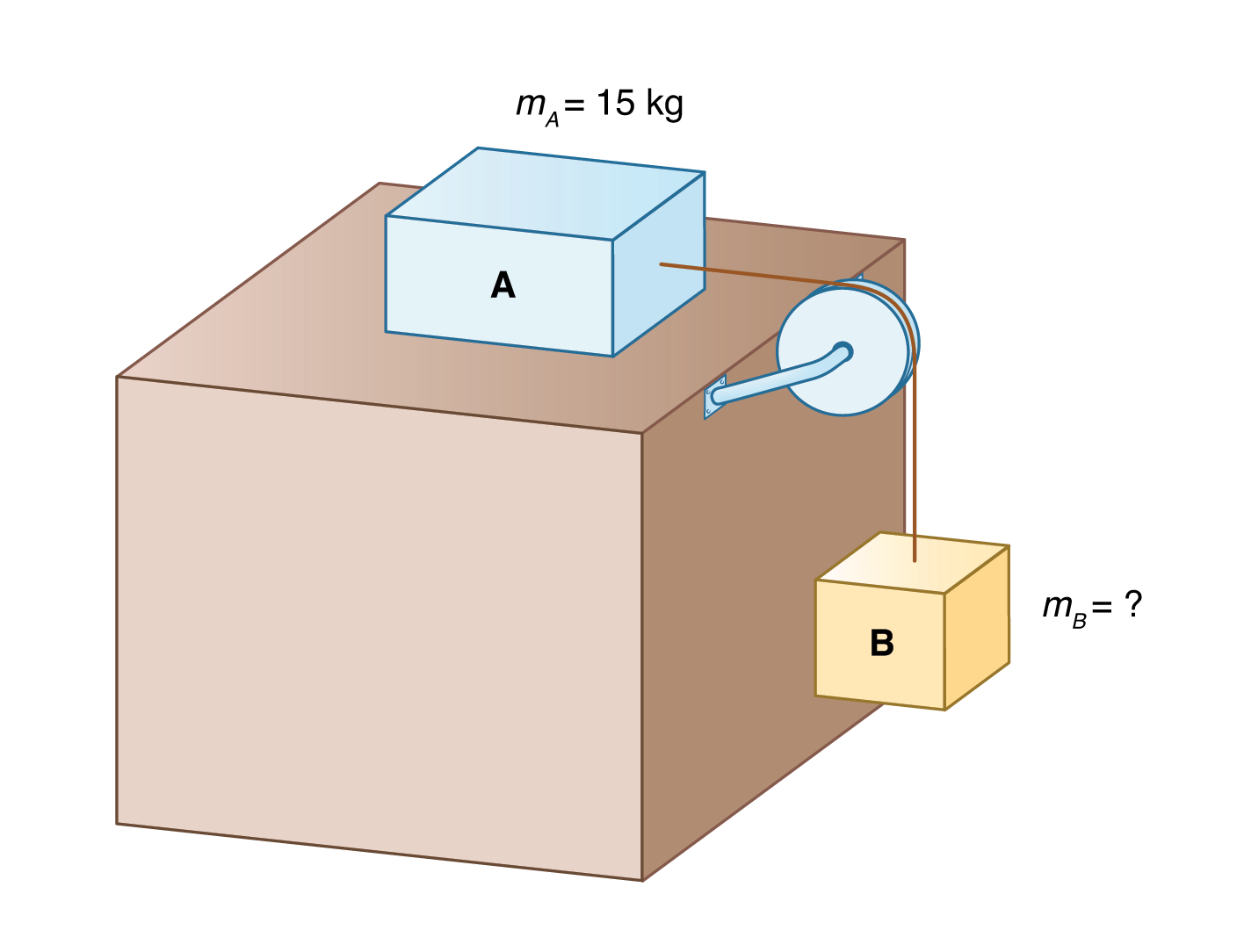
If block A has a mass of 15 kg and the coefficient of static friction between block A and the surface is 0.2, what is the maximum mass of block B?
Solution: Start by making a free body diagram of each block:
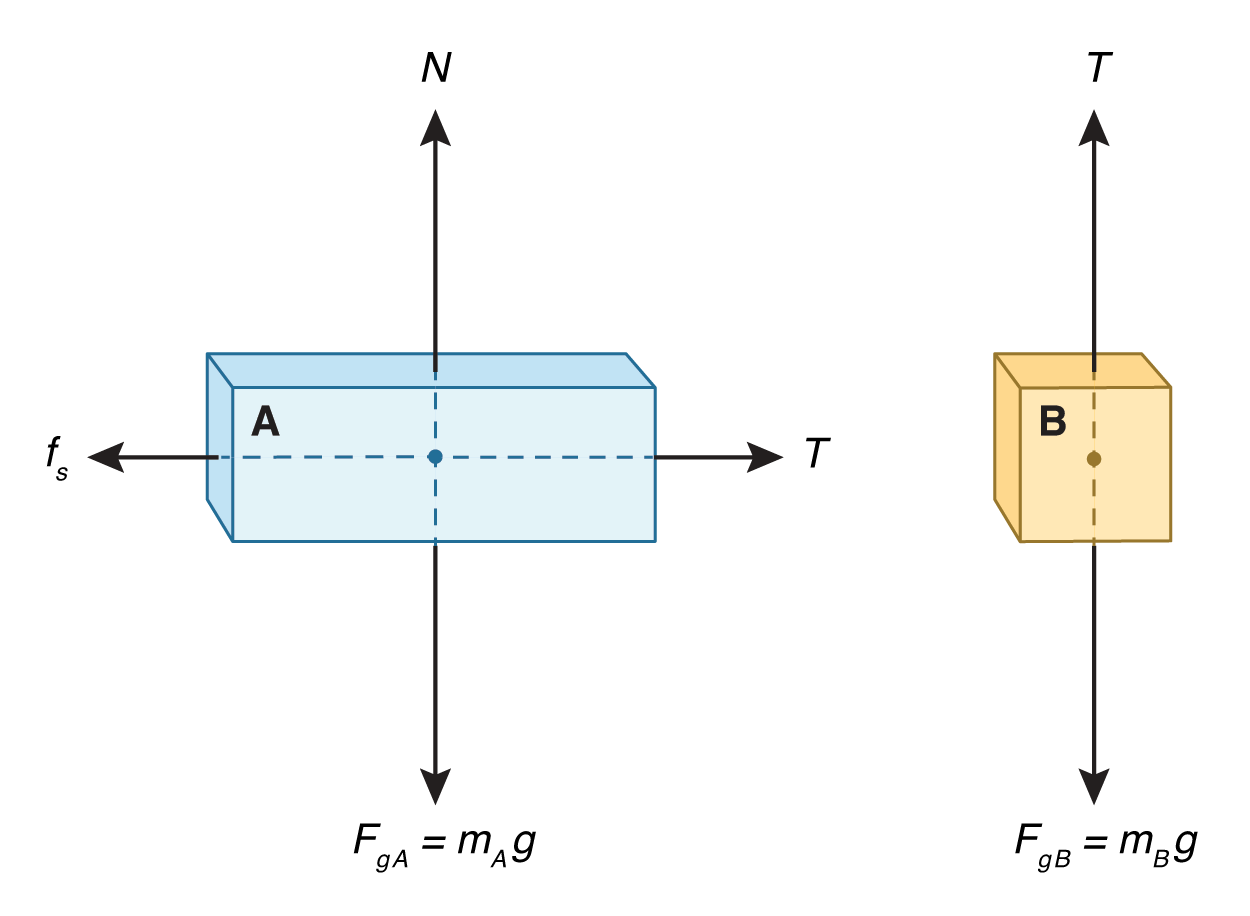
Both blocks have a net force of zero because they are in equilibrium. Therefore, the magnitude of T is equal to that of Fg,B. Asking for the maximum mass of block B means that the force of static friction is maximized (fs = μsN); further, because block A is in equilibrium, fs is equal in magnitude to T and Fg,A is equal in magnitude to N. Therefore:
fs = T and T = Fg,B fs=Fg,BμsN=mBgμsmAg=mBgμsmA=mB(0.2)(15 kg)=mB=3.0 kg
Rotational Equilibrium
Rotational motion occurs when forces are applied against an object in such a way as to cause the object to rotate around a fixed pivot point, also known as the fulcrum. Application of force at some distance from the fulcrum generates torque (τ) or the moment of force. The distance between the applied force and the fulcrum is termed the lever arm. It is the torque that generates rotational motion, not the mere application of the force itself. This is because torque depends not only on the magnitude of the force but also on the length of the lever arm and the angle at which the force is applied. The equation for torque is a cross product:
τ = r × F = rF sinθ
Equation 1.24
where r is the length of the lever arm, F is the magnitude of the force, and θ is the angle between the lever arm and force vectors.
KEY CONCEPT
Remember that sin 90° = 1. This means that torque is greatest when the force applied is 90 degrees (perpendicular) to the lever arm. Knowing that sin 0° = 0 tells us that there is no torque when the force applied is parallel to the lever arm.
Equilibrium Conditions
Rotational equilibrium exists only when the vector sum of all the torques acting on an object is zero. This is called the second condition of equilibrium. Torques that generate clockwise rotation are considered negative, while torques that generate counterclockwise rotation are positive. Thus, in rotational equilibrium, it must be that all of the positive torques exactly cancel out all of the negative torques. Similar to the behavior defined by translational equilibrium, there are two possibilities of motion in the case of rotational equilibrium.
Either the object is not rotating at all (that is, it is stationary), or it is rotating with a constant angular velocity. The MCAT almost always takes rotational equilibrium to mean that the object is not rotating at all.
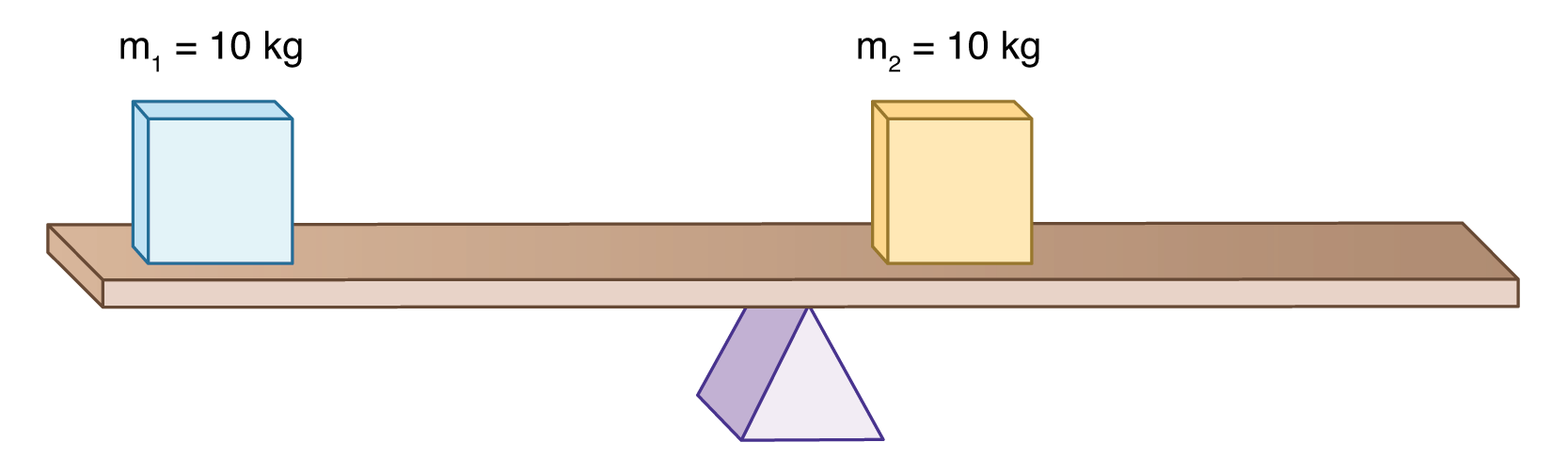
Example: A seesaw with a mass of 5 kg has one block of mass 10 kg two meters to the left of the fulcrum and another block 0.5 m to the right of the fulcrum, as shown below.
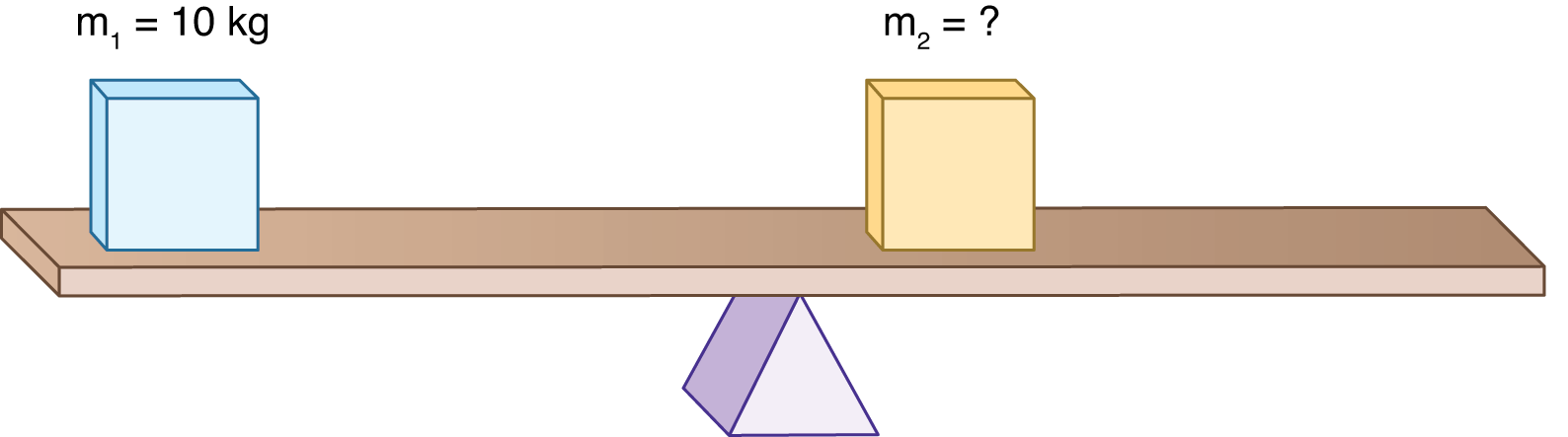
If the seesaw is in equilibrium, find the mass of block 2 and the force exerted by the fulcrum.
Solution: If the seesaw is balanced, this implies rotational equilibrium. Therefore, the positive (counterclockwise) torque exerted by block 1 is equal in magnitude to the negative (clockwise) torque exerted by block 2. Use the fulcrum as the pivot point; because the fulcrum is centered under the seesaw, both the normal force and the weight of the seesaw will be eliminated from the equation because their lever arms are 0.
τ1=τ2r1Fg1sin θ1=r2Fg2sin θ2r1(m1g) sin 90°=r2(m2g) sin 90°r1m1=r2 m2→m2=r1m1r2=(2 m)(10 kg)0.5 m=40 kg
To find the normal force exerted by the fulcrum, consider that the seesaw is not only in rotational equilibrium but also in translational equilibrium. Therefore, the combined weight of the seesaw and blocks (pointing down) is equal in magnitude to the normal force (pointing up):
N=Fg, seesaw + blocks=(mseesaw+m1+m2)g≈(5 kg+10 kg+40 kg) (10 ms2)=550 N (actual=539 N)
MCAT CONCEPT CHECK 1.7
Before you move on, assess your understanding of the material with these questions.
- Can a moving object be in equilibrium? Why or why not?
_________________________________
- If you have an object three times as heavy as you can lift, how could a lever be used to lift the object? Where would the fulcrum need to be placed?
_________________________________
Conclusion
In this chapter, we’ve equipped you with the math—the language of physics—necessary to understand our first important topic for the MCAT Chemical and Physical Foundations of Biological Systems section: kinematics and Newtonian mechanics. This study of objects in motion allows us to describe an object’s position, displacement, distance traveled, velocity, speed, and acceleration with respect to time. We now understand how to use the four key kinematics equations when objects experience constant acceleration, a relatively simple scenario presented on Test Day.
We also learned that different kinds of forces act on objects to cause them to move in certain ways. Application of forces may cause objects to accelerate or decelerate according to Newton’s second law. If the vector sum of all the forces acting on an object is equal to zero, the forces cancel out, and the object experiences no acceleration, a condition known as translational equilibrium. This is expressed in Newton’s first law. Even when objects aren’t touching, they can still exert forces between them, as described by Newton’s third law. We considered linear motion, projectile motion, inclined planes, and circular motion. We also considered the special conditions of translational and rotational equilibrium.
We hope that you will come to appreciate the relevance that these concepts and principles have for your performance not only on the MCAT but also in medical school, residency training, and your career as a physician. Your careful consideration of the discussion topics in this chapter and your practice with the kinds of problems demonstrated here will earn you many points on Test Day.
GO ONLINE
You’ve reviewed the content, now test your knowledge and critical thinking skills by completing a test-like passage set in your online resources!
CONCEPT SUMMARY
Units
- The MCAT will test the SI units that are related to the metric system. The SI units include meter, kilogram, second, ampère, mole, kelvin, and candela.
Vectors and Scalars
- Vectors are physical quantities that have both magnitude and direction. Vector quantities include displacement, velocity, acceleration, and force, among others.
- Scalars are quantities without direction. Scalar quantities may be the magnitude of vectors, like speed, or may be dimensionless, like coefficients of friction.
- Vector addition may be accomplished using the tip-to-tail method or by breaking a vector into its components and using the Pythagorean theorem.
- Vector subtraction is accomplished by changing the direction of the subtracted vector and then following the procedures for vector addition.
- Multiplying a vector by a scalar changes the magnitude and may reverse the direction.
- Multiplying two vectors using the dot product results in a scalar quantity. The dot product is the product of the vectors’ magnitudes and the cosine of the angle between them.
- Multiplying two vectors using the cross product results in a vector quantity. The cross product is the product of the vectors’ magnitudes and the sine of the angle between them. The right-hand rule is used to determine the resultant vector’s direction.
Displacement and Velocity
- Displacement is the vector representation of a change in position. It is path independent and is equivalent to the straight-line distance between the start and end locations.
- Distance is a scalar quantity that reflects the path traveled.
- Velocity is the vector representation of the change in displacement with respect to time.
- Average velocity is the total displacement divided by the total time.
- Average speed is the total distance traveled divided by the total time.
- Instantaneous velocity is the limit of the change in displacement over time as the change in time approaches zero.
- Instantaneous speed is the magnitude of the instantaneous velocity vector.
Forces and Acceleration
- A force is any push or pull that has the potential to result in an acceleration.
- Gravity is the attractive force between two objects as a result of their masses.
- Friction is a force that opposes motion as a function of electrostatic interactions at the surfaces of two objects.
- Static friction exists between two objects that are not in motion relative to each other.
- Kinetic friction exists between two objects that are in motion relative to each other.
- Whereas static friction can take on many values depending on the magnitude of an applied force, kinetic friction is a constant value.
- The coefficient of friction depends on the two materials in contact. The coefficient of static friction is always higher than the coefficient of kinetic friction.
- Mass and weight are not synonymous.
- Mass is a measure of the inertia of an object—its amount of material.
- Weight is the force experienced by a given mass due to its gravitational attraction to the Earth.
- Acceleration is the vector representation of the change in velocity over time. Average or instantaneous acceleration may both be considered, similar to velocity.
Newton’s Laws
- Newton’s first law, or the law of inertia, states that an object will remain at rest or move with a constant velocity if there is no net force on the object.
- Newton’s second law states that any acceleration is the result of the sum of the forces acting on the object and its mass.
- Newton’s third law states that any two objects interacting with one another experience equal and opposite forces as a result of their interaction.
Motion with Constant Acceleration
- Linear motion includes free fall and motion in which the velocity and acceleration vectors are parallel or antiparallel.
- Projectile motion contains both an x- and y-component. Assuming negligible air resistance, the only force acting on the object is gravity.
- Inclined planes are another example of two-dimensional movement. It is often easiest to consider the dimensions as being parallel and perpendicular to the surface of the plane.
- Circular motion is best thought of as having radial and tangential dimensions. In uniform circular motion, the only force is the centripetal force, pointing radially inward. The instantaneous velocity vector always points tangentially.
Mechanical Equilibrium
- Free body diagrams are representations of the forces acting on an object. They are useful for equilibrium and dynamics problems.
- Translational equilibrium occurs in the absence of any net forces acting on an object. An object in translational equilibrium has a constant velocity, and may or may not also be in rotational equilibrium.
- Rotational equilibrium occurs in the absence of any net torques acting on an object. Rotational motion may consider any pivot point, but the center of mass is most common. An object in rotational equilibrium has a constant angular velocity; on the MCAT, the angular velocity is usually zero.
ANSWERS TO CONCEPT CHECKS
**1.1**
- Force will obey the same relationship with mass and acceleration, regardless of the unit system. Force is always the product of mass and acceleration, so one pound (lb) must be equal to one slug⋅fts2.
- ångström < centimeter < inch < foot < mile
**1.2**
- Vector addition, unlike vector multiplication, is a commutative function. The resultant of A + B is the same as B + A, so there would be no difference between the two resultants.
- Vector subtraction, like vector multiplication, is not a commutative function. The resultant of A – B has the same magnitude as B – A, but is oriented in the opposite direction.
- A scalar is calculated from two vectors by using the dot product: A · B = |A| |B| cosθ. A vector is calculated by using the cross product: A × B = |A| |B| sinθ.
- False. This would be true of an addition problem in which both vectors have equal magnitude, but it is never true for vector multiplication. To find the direction of C, we must use the right-hand rule. If the thumb points in the direction of A, and the fingers point in the direction of B, then our palm, C, points out of the page.
**1.3**
- Instantaneous speed is the magnitude of the instantaneous velocity vector. Average speed and average velocity may be unrelated because speed does not depend on displacement, but is rather the total distance traveled divided by time.
- True. Displacement considers the most direct route between two points. Distance will always be equal to or larger in magnitude than displacement.
- Velocity is the rate of change of the displacement of an object. Displacement is a function of velocity acting over a period of time.
**1.4**
- The direction of the frictional force always opposes movement. Once the instantaneous velocity vector is known (or net force, in the case of static friction), the frictional force must be in the opposite direction.
- If there is no net force acting on an object, then that object is not experiencing an acceleration and it has a constant velocity.
- False. Forces are always reciprocal in nature. When the Earth exerts a force on a person, the person also exerts a force of the same magnitude on the Earth (in the opposite direction). The difference in masses gives the Earth an apparent acceleration of zero.
- Gravity and frictional forces were discussed in this chapter. Electrostatic, magnetic, elastic, weak nuclear, and strong nuclear forces are other examples of forces.
**1.5**
- Any answer which is similar to the following is acceptable:
- In the absence of any forces—or when the net force is zero—there will be no change in velocity.
- Acceleration results from the sum of the force vectors.
- For any two interacting objects, all forces acting on one object have an equal and opposing force acting on the other object.
- Any answer which is similar to the following is acceptable:
- Prior to the collision, the vehicle is travelling at constant velocity, which (according to Newton’s first law) indicates that there is no acceleration and no net force.
- The collision with the wall creates a sudden deceleration. Because there is acceleration, there must be a net force. The value of the net force can be calculated by multiplying the mass of the car times the acceleration.
- When the car collides with the wall, the car exerts a force on the wall. Simultaneously, the wall exerts a force of equal magnitude in the opposite direction on the car.
**1.6**
- The only force acting in both free fall and projectile motion is gravity.
- The product of sine and cosine is maximized when the angle is 45°. Because horizontal displacement relies on both measurements, the maximum horizontal displacement will also be achieved at this angle. Vertical displacement will always be zero as the object returns to the starting point. Objects launched vertically will experience the greatest vertical distance.
- If the equation for centripetal force is Fc=mv2r and force is simply mass times acceleration (from Newton’s second law), then ac=v2r.
**1.7**
- A moving object can be in either translational or rotational equilibrium (or both). Translational equilibrium only requires the net force on an object be zero—its velocity is constant. The corresponding condition in rotational equilibrium is that net torque equals zero—its angular velocity is constant.
- One could place the fulcrum one quarter of the way across the lever, closer to the object. The ratio of the lever arms would then be 3:1, which means that only one-third of the original force is necessary. (Alternatively, the fulcrum could be placed at the end with the object one-third of the way across the lever. This would again result in a 3:1 ratio of lever arms, meaning that only one-third of the original force is necessary.)
SCIENCE MASTERY ASSESSMENT EXPLANATIONS
1. B
Using the Pythagorean theorem, calculate the magnitude of the person’s displacement:
x=302+402=50 m
The total distance traveled is equal to 30 + 40 = 70 m. Therefore, the difference between these two is 20 m.
2. A
The average force on the rocket equals its mass times the average acceleration; the average acceleration equals the change in velocity divided by the time over which the change occurs. So, the change in velocity equals the average force times the time divided by the mass:
F=ma→a=Fma=ΔvΔt→Δv=aΔt=FΔtm=(20×103 N)(8 s)1000 kg=160 ms
(B) represents the new velocity of the rocket, not its change in velocity. (C) and (D) neglect dividing by the mass of the rocket.
3. C
The magnitude of the average acceleration is the change in velocity divided by the time. The velocity changes by −40 kmhr because the car comes to rest. The time, in hours, is 6 s×[1 hr3600 s]=1600 hr. The average acceleration is then
a¯=ΔvΔt=−40 kmhr1600 hr=−24,000 kmhr2
This question asked for the magnitude of this acceleration, which is 24,000 kmhr2.
4. A
The forces on the elevator are the tension upward and the weight downward, so the net force on the elevator is the difference between the two. For the elevator to accelerate upwards, the tension in the cable will have to be greater than the maximum weight so that there is a net force directed upwards.
5. C
The unit of power is the Watt, which breaks down to kg∙m2/s2. Because there is no unit of temperature in this formulation, the ambient temperature is extra information, supporting (C) as the correct answer. Note that mass, distance, and time are all used to compute power, eliminating (A), (B), and (D).
6. A
The firefighter’s acceleration is always directed downward, whereas the firefighter’s velocity starts out horizontal and gradually rotates downwards as the downward velocity increases. Therefore, as time progresses, the angle between the velocity and acceleration decreases, which means that the maximum angle occurs at the instant the firefighter jumps.
7. B
The static force of friction acts parallel to the plane and is in the opposite direction from the parallel component of gravity in this setup. Because the wagon is in equilibrium, these two forces are equal in magnitude. Remember that gravity is often split into components in inclined plane problems. Rather than splitting into x- and y-components, however, it is more convenient to split the gravity vector into parallel and perpendicular components. The parallel component of gravity is given by the expression mg sin θ. Plugging in the values from the question, both the parallel component of gravity and static force of friction must be equal to (10 kg)(9.8ms2) (sin 30°) = 49 N.
8. C
In SI units, mass is measured in kilograms (kg), velocity in meters per second (ms), and time in seconds (s). The newton is a derived unit, and is not considered to be a base unit of the SI system. A newton is equal to a kg⋅ms2.
9. D
Since the equation uses the sine of the angle, this equation computes a cross product. The output of the cross product is another vector quantity. To find the direction of the resultant vector, use the right hand rule. The thumb of the right hand points in the direction of vector A, the fingers point in the direction of vector B, and the palm reveals the direction of the vector product. In this problem, the right hand rule indicates that the direction of the resulting vector is out of the page, consistent with (D). Note that since the cross product always produces another vector, choices (A) and (B) can be immediately eliminated.
10. D
A vector is characterized by both magnitude and direction. From the given answer choices, all are vectors except for distance. Distance is a scalar because it has only a numerical value and lacks direction.
11. B
In order for the seesaw to be balanced, the torque due to the child (τc) must be exactly counteracted by the torque due to the parent (τp). In other words, the magnitudes of these torques must be equal (τc = τp):
rcFcsinθc=rpFpsinθprcmcgsin90°=rpmpgsin90°(2 m)(30 kg)=rp(90 kg)0.67 m=rp
Because r represents the distance of each person from the fulcrum, the parent must sit 67 cm from the fulcrum.
12. B
The maximum height depends only on the y-component of the velocity, so the horizontal distance can be ignored. The initial y-velocity can be calculated by: vf = 12∙sin(30o) = 6 m/s. To solve for max height, use the equation: vf2 = vi2 + 2ax, where, at the maximum height, the vertical velocity is equal to 0 m/s. Plugging in values yields the equation 0 = 36 - 20x. Solving for x gives x = 1.8 m, matching (B).
13. C
We only need to analyze the motion in the vertical dimension to answer this question. If both the rock and ball began with no vertical velocity, they would reach the ground at the same time. However, because the rock begins with an upward component of velocity, it will take time to reach a maximum height before falling back toward the ground. Functionally, the rock’s free fall thus starts higher and later than the ball’s. The rock will necessarily hit the ground after the ball.
14. C
Because the question stem indicates that centrifugal force is reactionary and acts outwardly away from the center of rotation, we can draw the conclusion that it is a reaction to the centripetal force. According to Newton’s third law, these forces must have equal magnitude and opposite directions (antiparallel).
15. B
The presence of friction does not change the impact of Newton’s laws. A net force must still be applied to cause motion. This net force is not necessarily equal to an applied force, as friction and gravity also act on the object; thus, statement I is eliminated. Static friction opposes the movement of stationary objects, and is necessarily greater than the force of kinetic friction; thus, statement II is correct. Statement III is false because the normal force is related to mass, and friction is related to the normal force.
GO ONLINE
Consult your online resources for additional practice.
EQUATIONS TO REMEMBER
(1.1) Component vectors: X=V cos θY=V sin θ
(1.2) Pythagorean theorem: X2 + Y2 = V2 or V=X2+Y2
(1.3) Determination of direction from component vectors: θ=tan−1YX
(1.4) Dot product: A · B = |A| |B| cosθ
(1.5) Cross product: A × B = n|A| |B| sinθ
(1.6) Instantaneous velocity: v=limΔt→0 ΔxΔt
(1.7) Average velocity: v¯ = ΔxΔt
(1.8) Universal gravitation equation: Fg=Gm1m2r2
(1.9) Static friction: 0 ≤ fs ≤ μsN
(1.10) Kinetic friction: fk = μkN
(1.11) Force of gravity (weight on Earth): Fg = mg
(1.12) Center of mass: x=m1x1 + m2x2 + m3x3 + ⋯m1 + m2+ m3 + ⋯y=m1y1 + m2y2 + m3y3 + ⋯m1 + m2 + m3 + ⋯z=m1z1 + m2z2 + m3z3 + ⋯m1 + m2 + m3 + ⋯
(1.13) Average acceleration: a¯=ΔvΔt
(1.14) Instantaneous acceleration: a=limΔt→0 ΔvΔt
(1.15) Newton’s first law: Fnet = ma = 0
(1.16) Newton’s second law: Fnet = ma
(1.17) Newton’s third law: FAB = –FBA
(1.18) Kinematics (no displacement): v = v0 + at
(1.19) Kinematics (no final velocity): x=v0t+at22
(1.20) Kinematics (no time): v2 = v02 + 2ax
(1.21) Kinematics (no acceleration): x=v¯t
(1.22) Components of gravity on an inclined plane: Fg,||=mgsin θFg,⊥=mgcos θ
(1.23) Centripetal force: Fc=mv2r
(1.24) **Torque: τ=r×F** = rF sinθ
SHARED CONCEPTS
General Chemistry Chapter 1
Atomic Structure
General Chemistry Chapter 3
Bonding and Chemical Interactions
Physics and Math Chapter 2
Work and Energy
Physics and Math Chapter 4
Fluids
Physics and Math Chapter 5
Electrostatics and Magnetism
Physics and Math Chapter 10
Mathematics