Chapter 2: Work and Energy

Chapter 2: Work and Energy
Science Mastery Assessment
Every pre-med knows this feeling: there is so much content I have to know for the MCAT! How do I know what to do first or what’s important?
While the high-yield badges throughout this book will help you identify the most important topics, this Science Mastery Assessment is another tool in your MCAT prep arsenal. This quiz (which can also be taken in your online resources) and the guidance below will help ensure that you are spending the appropriate amount of time on this chapter based on your personal strengths and weaknesses. Don’t worry though— skipping something now does not mean you’ll never study it. Later on in your prep, as you complete full-length tests, you’ll uncover specific pieces of content that you need to review and can come back to these chapters as appropriate.
How to Use This Assessment
If you answer 0–7 questions correctly:
Spend about 1 hour to read this chapter in full and take limited notes throughout. Follow up by reviewing all quiz questions to ensure that you now understand how to solve each one.
If you answer 8–11 questions correctly:
Spend 20–40 minutes reviewing the quiz questions. Beginning with the questions you missed, read and take notes on the corresponding subchapters. For questions you answered correctly, ensure your thinking matches that of the explanation and you understand why each choice was correct or incorrect.
If you answer 12–15 questions correctly:
Spend less than 20 minutes reviewing all questions from the quiz. If you missed any, then include a quick read-through of the corresponding subchapters, or even just the relevant content within a subchapter, as part of your question review. For questions you got correct, ensure your thinking matches that of the explanation and review the Concept Summary at the end of the chapter.
- A weightlifter lifts a 275 kg barbell from the ground to a height of 2.4 m. How much work has the weightlifter done in lifting the barbell, and how much work is required to hold the weight at that height?
- 3234 J and 0 J, respectively
- 3234 J and 3234 J, respectively
- 6468 J and 0 J, respectively
- 6468 J and 6468 J, respectively
- A tractor pulls a log with a mass of 500 kg along the ground for 100 m. The rope (between the tractor and the log) makes an angle of 30° with the ground and is acted on by a tensile force of 5000 N. How much work does the tractor perform in this scenario? (Note: sin 30° = 0.5, cos 30° = 0.866, tan 30° = 0.577)
- 250 kJ
- 289 kJ
- 433 kJ
- 500 kJ
- A 2000 kg experimental car can accelerate from 0 to 30 ms in 6 s. What is the average power of the engine needed to achieve this acceleration?
- 150 W
- 150 kW
- 900 W
- 900 kW
- A 40 kg block is resting at a height of 5 m off the ground. If the block is released and falls to the ground, which of the following is closest to its total mechanical energy at a height of 2 m, assuming negligible air resistance?
- 0 J
- 400 J
- 800 J
- 2000 J
- 5 m3 of a gas are brought from an initial pressure of 1 kPa to a pressure of 3 kPa through an isochoric process. During this process, the work performed by the gas is:
- –10 kJ
- –10 J
- 0 J
- +10 kJ
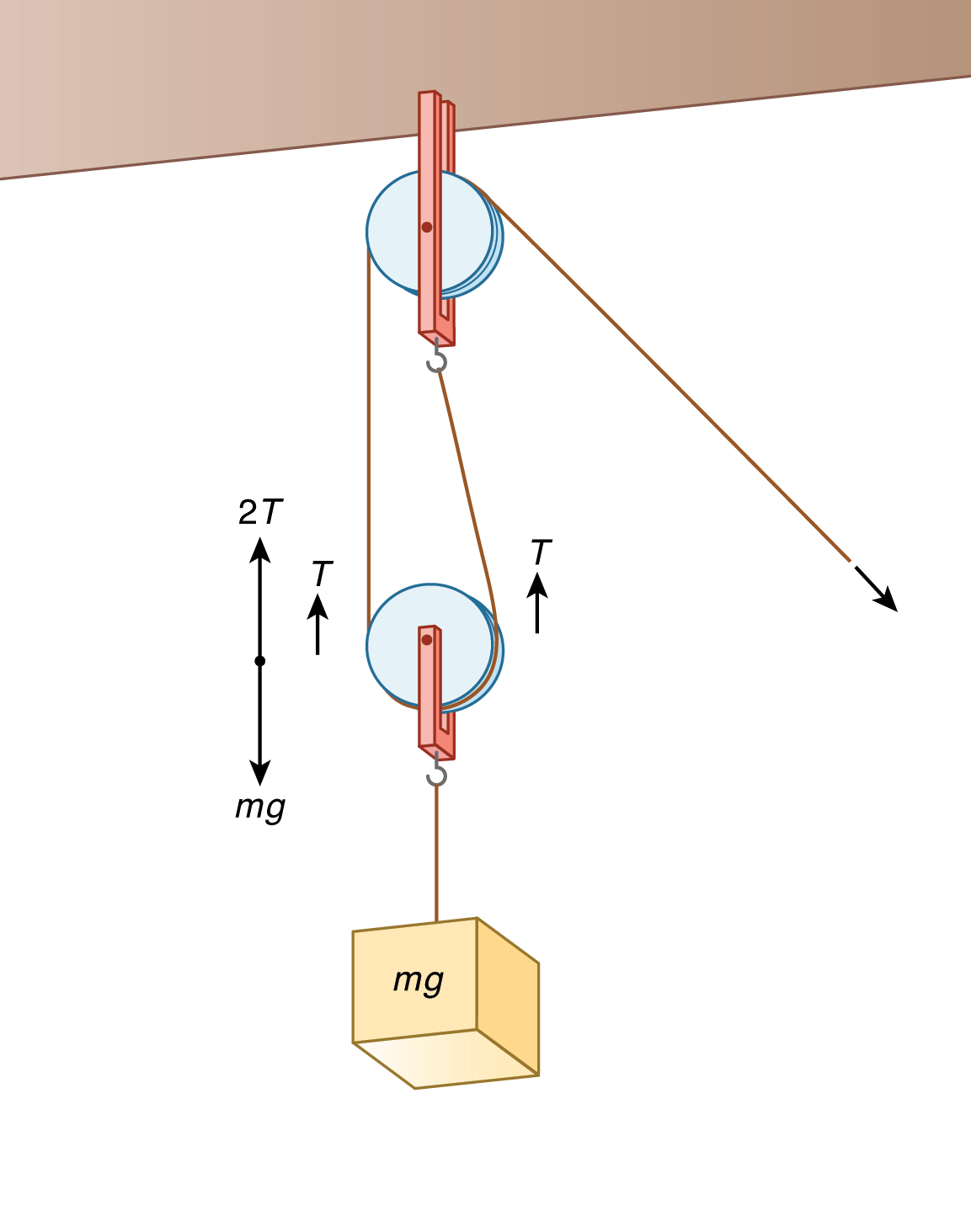
- In the pulley system shown below, which of the following is closest to the tension force in each rope if the mass of the object is 10 kg and the object is accelerating upwards at 2 ms2?
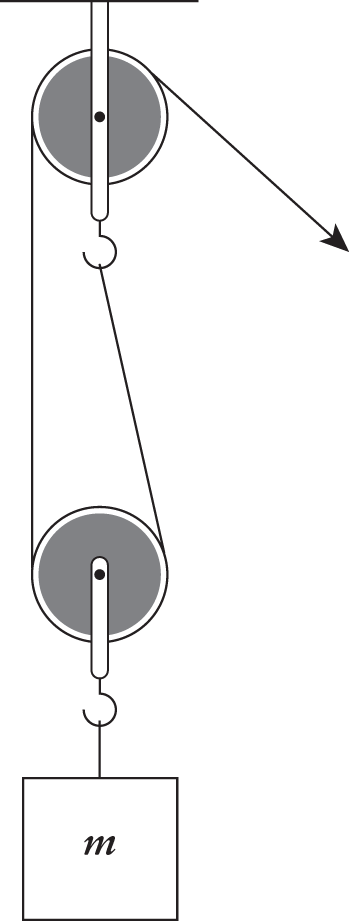
- 50 N
- 60 N
- 100 N
- 120 N
- Which of the following is a conservative force?
- Air resistance
- Friction
- Gravity
- Convection
- During uniform circular motion, which of the following relationships is necessarily true?
- No work is done.
- The centripetal force does work.
- The velocity does work.
- Potential energy depends on position of the object around the circle.
- Which of the following best characterizes the work–energy theorem?
- The work done by any force is proportional only to the magnitude of that force.
- The total work done on any object is equal to the change in kinetic energy for that object.
- The work done on an object by any force is proportional to the change in kinetic energy for that object.
- The work done by an applied force on an object is equal to the change in kinetic energy of that object.
- A massless spring initially compressed by a displacement of two centimeters is now compressed by four centimeters. How has the potential energy of this system changed?
- The potential energy has not changed.
- The potential energy has doubled.
- The potential energy has increased by two joules.
- The potential energy has quadrupled.
- Josh, who has a mass of 80 kg, and Sarah, who has a mass of 50 kg, jump off a 20 m tall building and land on a fire net. The net compresses, and they bounce back up at the same time. Which of the following statements is NOT true?
- Sarah will bounce higher than Josh.
- For Josh, the change in speed from the start of the jump to contacting the net is 20 ms.
- Josh will experience a greater force upon impact than Sarah.
- The energy in this event is converted from potential to kinetic to elastic to kinetic.
- A parachutist jumps from a plane. Beginning at the point when the jumper reaches terminal velocity (constant velocity during freefall), which of the following is/are true?
- The jumper is in translational equilibrium.
- The jumper is not being acted upon by any forces.
- There is an equal amount of work being done by gravity and air resistance.
- I only
- I and III only
- II and III only
- I, II, and III
- Mechanical advantage and efficiency are both ratios. Which of the following is true regarding the quantities used in these ratios?
- Mechanical advantage compares values of work; efficiency compares values of power.
- Mechanical advantage compares values of forces; efficiency compares values of work.
- Mechanical advantage compares values of power; efficiency compares values of energy.
- Mechanical advantage compares values of work; efficiency compares values of forces.
- If the gravitational potential energy of an object has doubled in the absence of nonconservative forces, which of the following must be true, assuming the total mechanical energy of the object is constant?
- The object has been lifted to twice its initial height.
- The kinetic energy of the object has been halved.
- The kinetic energy has decreased by the same quantity as the potential energy has increased.
- The mass of the object has doubled.
- A consumer is comparing two new cars. Car A exerts 250 horsepower, while Car B exerts 300 horsepower. The consumer is most concerned about the peak velocity that the car can reach. If nonconservative forces can be ignored, which of the following statements is true? (Note: 1 horsepower = 745.7 W)
- Car A and Car B both have unlimited velocities.
- Car A will reach its peak velocity more quickly than Car B.
- Car A will dissipate less energy to the surroundings than Car B.
- Car A will have a lower peak velocity than Car B.
Answer Key
- C
- C
- B
- D
- C
- B
- C
- A
- B
- D
- A
- B
- B
- C
- A
Chapter 2: Work and Energy
CHAPTER 2
WORK AND ENERGY
In This Chapter
2.1 Energy
Kinetic Energy
Potential Energy
Total Mechanical Energy
Conservation of Mechanical Energy
2.2 Work
Force and Displacement
Pressure and Volume
Power
Work–Energy Theorem
2.3 Mechanical Advantage
Pulleys
Concept Summary
CHAPTER PROFILE
The content in this chapter should be relevant to about 11% of all questions about physics on the MCAT.
This chapter covers material from the following AAMC content category:
4A: Translational motion, forces, work, energy, and equilibrium in living systems
Introduction
The Greek myth of Sisyphus is a tale of unending, pointless work. For eternity, Sisyphus was sentenced to roll a large, heavy rock up a steep hill as penance for his crimes. Just as Sisyphus would nearly reach the top of the hill, the rock would roll back again to the bottom. The cycle continued for eternity: Sisyphus would near the top of the hill, and the boulder—enchanted by Zeus—would roll back down, forcing Sisyphus to restart his task.
This is a story of work and mechanical energy transfer. Pushing that boulder up the hill, Sisyphus exerted forces that performed work on the rock, resulting in an increase in the rock’s gravitational potential energy. When the rock escaped from his grasp and rolled backwards, its energy changed from gravitational potential energy into kinetic energy. While Sisyphus’s punishment was futile work, it serves as a strong model of the exchange of mechanical energy between its two forms: potential and kinetic. Although a number of other forms of energy exist (thermal energy, sound, light, chemical potential energy, and electrical potential energy, to name a few), mechanical energy specifically focuses on objects in motion.
This chapter reviews the fundamental concepts of energy and work. The work–energy theorem is a powerful expression of the relationship between energy and work that is often a simpler approach to kinematics questions on Test Day. Finally, we’ll discuss the topic of mechanical advantage, and we’ll examine how a pulley or ramp might be helpful in raising heavy objects. We hope to convince you throughout the Kaplan MCAT program that your preparation for Test Day is in no way a Sisyphean task.
2.1 Energy
LEARNING OBJECTIVES
After Chapter 2.1, you will be able to:
- Describe kinetic energy and potential energy
- Compare and contrast conservative and nonconservative forces
Energy refers to a system’s ability to do work or—more broadly—to make something happen. This broad definition helps us understand that different forms of energy have the capacity to perform different actions. For example, mechanical energy can cause objects to move or accelerate. An ice cube sitting on the kitchen counter at room temperature will absorb thermal energy through heat transfer and eventually melt into water, undergoing a phase transformation from solid to liquid. Nuclear binding energy can be released during fission reactions to run power plants. Let’s turn our attention to the different forms that energy can take. After that, we will discuss the two ways in which energy can be transferred from one system to another.
Kinetic Energy
Kinetic energy is the energy of motion. Objects that have mass and that are moving with some speed will have an associated amount of kinetic energy, calculated as follows:
K=12 mv2
Equation 2.1
where K is kinetic energy, m is the mass in kilograms, and v is speed in meters per second. The SI unit for kinetic energy, as with all forms of energy, is the joule (J), which is equal to kg⋅m2s2.
KEY CONCEPT
Kinetic energy is incredibly important on the MCAT; any time an object has a speed, think about kinetic energy and link its kinetic energy to the related concepts of work and conservation of mechanical energy.
Recall the falling objects in Chapter 1. Such objects have kinetic energy while they fall. The faster they fall, the more kinetic energy they have. Be mindful of the fact that the MCAT is interested in testing students’ comprehension of the relationship between kinetic energy and speed. From the equation, we can see that the kinetic energy is a function of the square of the speed. If the speed doubles, the kinetic energy will quadruple, assuming the mass is constant. Also note that kinetic energy is related to speed—not velocity. An object has the same kinetic energy regardless of the direction of its velocity vector.
KEY CONCEPT
Kinetic energy is related to speed, not velocity. An object has the same kinetic energy regardless of the direction of its velocity vector.
Falling objects have kinetic energy, but so do objects that are moving in other ways. For example, the kinetic energy of a fluid flowing at some speed can be measured indirectly as the dynamic pressure, which is one of the terms in Bernoulli’s equation—discussed in Chapter 4 of MCAT Physics and Math Review. Objects that slide down inclined planes gain kinetic energy as their speeds increase down the ramp.
Example: A 15 kg block, initially at rest, slides down a frictionless incline and comes to the bottom with a speed of 7 ms, as shown below. What is the kinetic energy of the object at the top and bottom of the ramp?
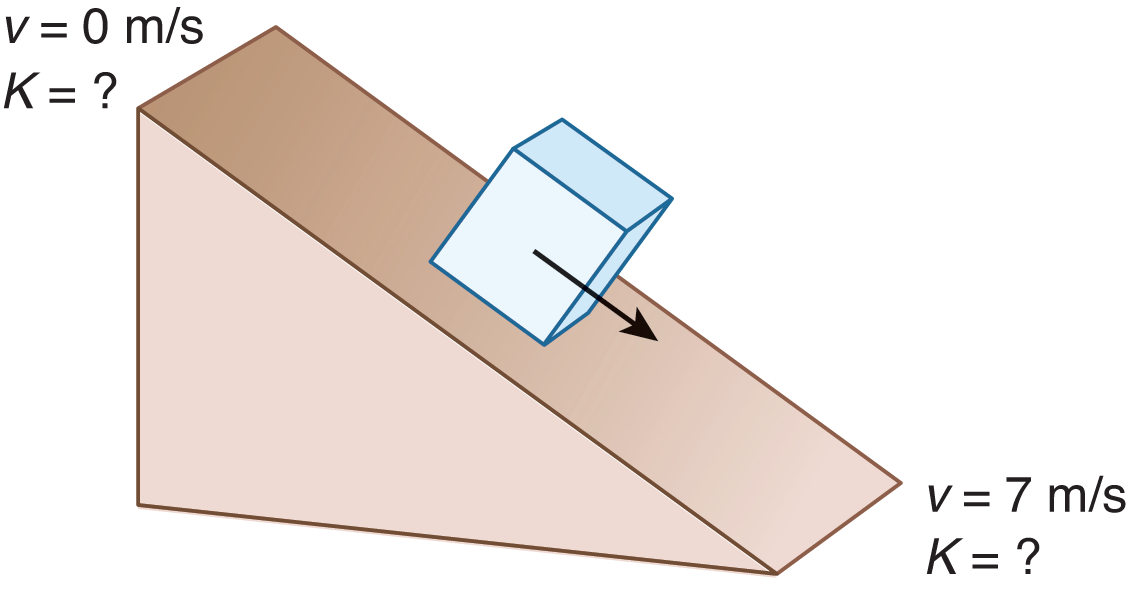
Solution: At the top, v = 0, so the kinetic energy is
K=12mv2=12(15 kg)(0 ms)2=0 J
At the bottom, the kinetic energy is
K=12mv2=12(15 kg)(7 ms)2≈15×25=375 J(actual=367.5 J)
Potential Energy
Potential energy refers to energy that is associated with a given object’s position in space or other intrinsic qualities of the system. Potential energy is often said to have the potential to do work, and can take named forms. Energy can be stored as chemical potential energy—this is the energy we absorb from the food we eat when we digest and metabolize it. Electrical potential energy, which is discussed in Chapter 5 of MCAT Physics and Math Review, is based on the electrostatic attractions between charged particles. In this chapter, we’ll examine the types of potential energy that are dissipated as movement: gravitational potential energy and elastic potential energy.
Gravitational Potential Energy
Gravitational potential energy depends on an object’s position with respect to some level identified as the datum (“ground” or the zero potential energy position). This zero potential energy position is usually chosen for convenience. For example, you may find it convenient to consider the potential energy of the pencil in your hand with respect to the floor if you are holding the pencil above the floor, or with respect to a desktop if you are holding the pencil over a desk. The equation that we use to calculate gravitational potential energy is
U = mgh
Equation 2.2
where U is the potential energy, m is the mass in kilograms, g is the acceleration due to gravity, and h is the height of the object above the datum.
MCAT EXPERTISE
The height used in the potential energy equation is relative to whatever the problem states is the ground level. It will often be simply the distance to the ground, but it doesn’t need to be. The zero potential energy position may be a ledge, a desktop, or a platform. Just pay attention to the question stem and use the height that is discussed.
Potential energy has a direct relationship with all three of the variables, so changing any one of them by some given factor will result in a change in the potential energy by the same factor. Tripling the height—or tripling the mass of the object—will increase the gravitational potential energy by a factor of three.
Example: An 80 kg diver leaps from a 10 m cliff into the sea, as shown below. Find the diver’s potential energy at the top of the cliff and when the diver is two meters underwater, using sea level as the datum.
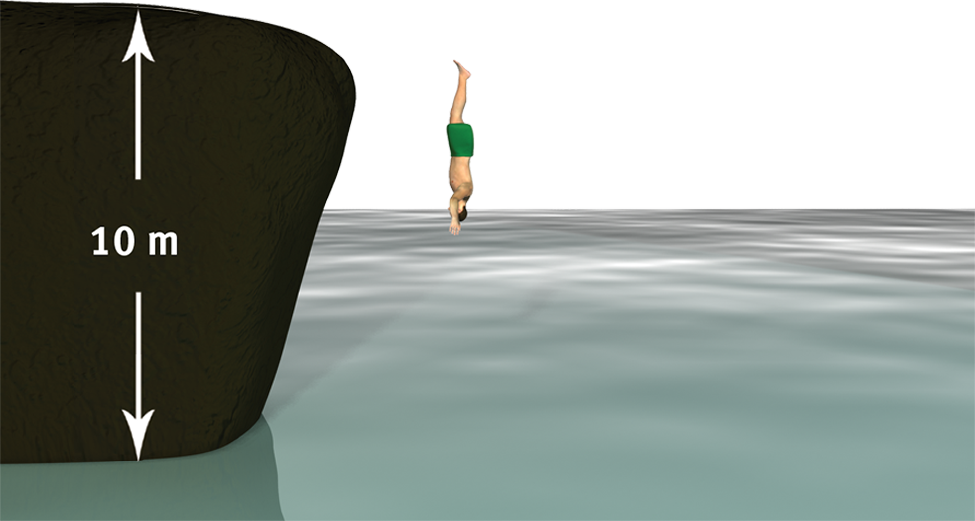
Solution: At the top of the cliff:
U=mgh=(80 kg)(9.8 ms2)(10 m)≈8000 J (actual=7840 J)
When the diver is two meters underwater:
U=mgh=(80 kg)(9.8ms2)(−2 m)≈−1600J (actual=−1568J)
Elastic Potential Energy
Springs and other elastic systems act to store energy. Every spring has a characteristic length at which it is considered relaxed, or in equilibrium. When a spring is stretched or compressed from its equilibrium length, the spring has elastic potential energy, which can be determined by
U=12 kx2
Equation 2.3
where U is the potential energy, k is the spring constant (a measure of the stiffness of the spring), and x is the magnitude of displacement from equilibrium. Note the similarities between this equation and the formula for kinetic energy.
Total Mechanical Energy
The sum of an object’s potential and kinetic energies is its total mechanical energy. The equation is
E = U + K
Equation 2.4
where E is total mechanical energy, U is potential energy, and K is kinetic energy. The first law of thermodynamics accounts for the conservation of mechanical energy, which posits that energy is never created nor destroyed—it is merely transferred from one form to another. This does not mean that the total mechanical energy will necessarily remain constant, though. You’ll notice that the total mechanical energy equation accounts for potential and kinetic energies but not for other forms of energy, such as thermal energy that is transferred as a result of friction (heat). If frictional forces are present, some of the mechanical energy will be transformed into thermal energy and will be “lost”—or, more accurately, dissipated from the system and not accounted for by the equation. Note that there is no violation of the first law of thermodynamics, as a full accounting of all the forms of energy (kinetic, potential, thermal, sound, light, and so on) would reveal no net gain or loss of total energy, but merely the transformation of some energy from one form to another.
Conservation of Mechanical Energy
In the absence of nonconservative forces, such as frictional forces, the sum of the kinetic and potential energies will be constant. Conservative forces are those that are path independent and that do not dissipate energy. Conservative forces also have potential energies associated with them. On the MCAT, the two most commonly encountered conservative forces are gravitational and electrostatic. Elastic forces can also be approximated to be conservative in many cases, although the MCAT may include spring problems in which frictional forces are not ignored (in actuality, springs heat up as they move back and forth due to the friction between the particles of the spring material). There are two equivalent ways to determine whether a force is conservative, as demonstrated in Figure 2.1.
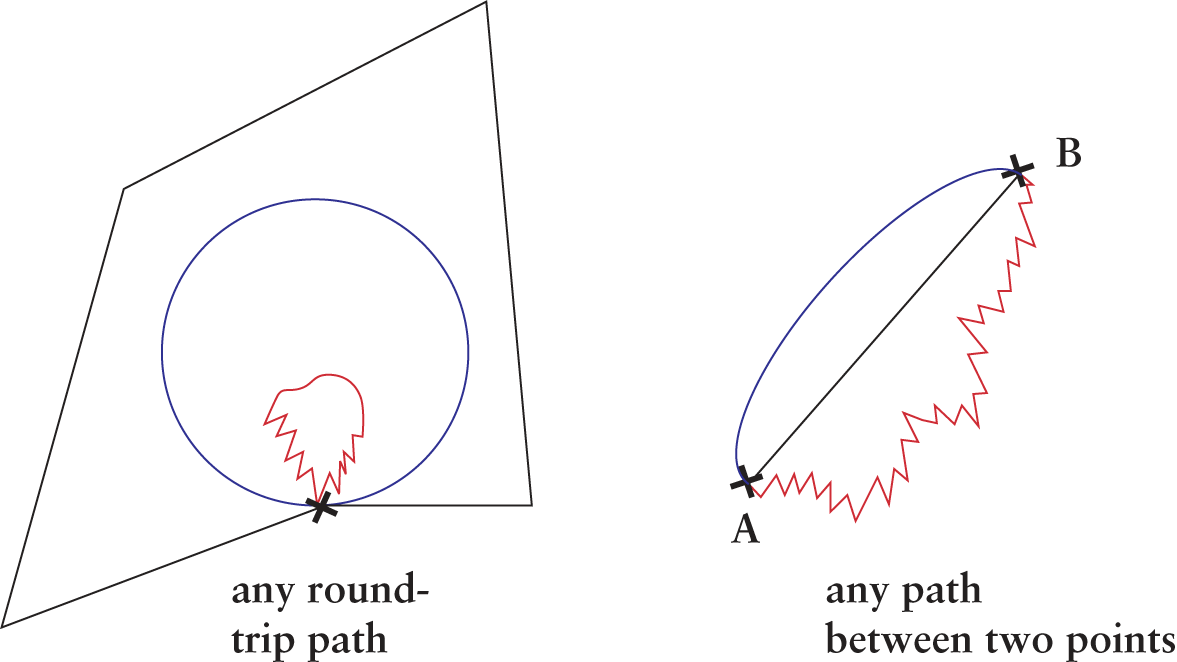
Figure 2.1. Determining if a Force is Conservative If the change in energy around any round-trip path is zero—or if the change in energy is equal despite taking any path between two points—then the force is conservative.
BRIDGE
The transfer of energy from one form to another is a key feature of bioenergetics and metabolism, discussed in Chapters 9 through 12 of MCAT Biochemistry Review. When looking at carbohydrate metabolism, one can see the chemical potential energy in the bonds in glucose being converted into electrical potential energy in the high-energy electrons of NADH and FADH2, which is dissipated along the electron transport chain to generate the proton-motive force (another example of electrical potential energy). This force fuels ATP synthase, trapping the energy in high-energy phosphate bonds in ATP.
One method is to consider the change in energy of a system in which the system is brought back to its original setup. In mechanical terms, this means that an object comes back to its starting position. If the net change in energy is zero regardless of the path taken to get back to the initial position, then the forces acting on the object are conservative. Basically, this means that a system that is experiencing only conservative forces will be “given back” an amount of usable energy equal to the amount that had been “taken away” from it in the course of a closed path. For example, an object that falls through a certain displacement in a vacuum will lose some measurable amount of potential energy but will gain exactly that same amount of potential energy when it is lifted back to its original height, regardless of whether the return pathway is the same as that of the initial descent. Furthermore, at all points during the fall through the vacuum, there will be a perfect conversion of potential energy into kinetic energy, with no energy lost to nonconservative forces such as air resistance. Of course, in real life, nonconservative forces are impossible to avoid.
The other method is to consider the change in energy of a system moving from one setup to another. In mechanical terms, this means an object undergoes a particular displacement. If the energy change is equal regardless of the path taken, then the forces acting on the object are again all conservative.
When the work done by nonconservative forces is zero, or when there are no nonconservative forces acting on the system, the total mechanical energy of the system (U + K) remains constant. The conservation of mechanical energy can be expressed as
ΔE = ΔU + ΔK = 0
Equation 2.5
where ΔE, ΔU, and ΔK are the changes in total mechanical energy, potential energy, and kinetic energy, respectively.
KEY CONCEPT
Conservative forces (such as gravity and electrostatic forces) conserve mechanical energy. Nonconservative forces (such as friction and air resistance) dissipate mechanical energy as thermal or chemical energy.
When nonconservative forces, such as friction, air resistance, or viscous drag (a resistance force created by fluid viscosity) are present, total mechanical energy is not conserved. The equation is
Wnonconservative = ΔE = ΔU + ΔK
Equation 2.6
where Wnonconservative is the work done by the nonconservative forces only. The work done by the nonconservative forces will be exactly equal to the amount of energy “lost” from the system. In reality, this energy is simply transformed into another form of energy, such as thermal energy, that is not accounted for in the mechanical energy equation. Nonconservative forces, unlike conservative forces, are path dependent. The longer the distance traveled, the larger the amount of energy dissipated.
Example: A baseball of mass 0.25 kg is thrown in the air with an initial speed of 30 ms, but because of air resistance, the ball returns to the ground with a speed of 27 ms. Find the work done by air resistance.
Solution: Air resistance is a nonconservative force. To solve this problem, the energy equation for a nonconservative system is needed. The work done by air resistance is:
Wnonconservative = ΔE = ΔU + ΔK
In this case, ΔU = 0 because the initial and final heights are the same. Therefore,
Wnonconservative=0+ΔK=12mvf2−12mvi2=12(0.25 kg)[(27 ms)2−(30 ms)2]=18(729−900)≈−1608=−20 J(actual=−21.4 J)
The negative sign in the answer indicates that energy is being dissipated from the system.
MCAT CONCEPT CHECK 2.1
Before you move on, assess your understanding of the material with these questions.
- Define kinetic energy and potential energy.
- Kinetic energy:
_________________________________
- Potential energy:
_________________________________
- Compare and contrast conservative and nonconservative forces:
Conservative Forces Nonconservative Forces What happens to total mechanical energy of the system? Does the path taken matter? What are some examples?
2.2 Work
LEARNING OBJECTIVES
After Chapter 2.2, you will be able to:
- Recall the units used for work
- Distinguish between work and energy
- Calculate the work done on or by a system
MCAT EXPERTISE
The “High-Yield” badge on this section indicates that the content is frequently tested on the MCAT.
Often, the term work is used erroneously to mean another form of energy. After all, the SI unit for work is the joule (J), which is the same SI unit for all forms of energy. Nevertheless, to say that work is just another form of energy is to miss something important: work is not actually a form of energy itself, but a process by which energy is transferred from one system to another. In fact, it is one of only two ways in which energy can be transferred. The other transfer of energy is called heat, which we will focus on quite a bit in Chapter 3 of MCAT Physics and Math Review.
KEY CONCEPT
Work is not energy but a measure of energy transfer. The other form of energy transfer is heat.
The transfer of energy by work or heat is the only way by which anything occurs. We are familiar with both processes from everyday life. For example, as discussed in the introduction to this chapter, every time King Sisyphus pushed the rock up the hill, the rock gained kinetic and potential energy. That energy came from Sisyphus’s muscles, in which the potential energy contained in the high-energy phosphate bonds of ATP molecules was converted to the mechanical energy of the contracting muscles, which exerted forces against the rock, causing it to accelerate and move up the hill.
On a chemical level, the potential energy in the ATP was harnessed by heat transfer. In fact, at the molecular level, this is no different from work because it involves the movement of molecules, atoms, and electrons, each of which exert forces that do work on other molecules and atoms. Like any transfer of energy, it’s not a perfectly efficient process, and some of the energy is lost as thermal energy. Our muscles quite literally warm up when we contract them repeatedly.
Force and Displacement
Energy is transferred through the process of work when something exerts forces on or against something else. This is expressed mathematically by the equation
W = F · d = Fd cos θ
Equation 2.7
where W is work, F is the magnitude of the applied force, d is the magnitude of the displacement through which the force is applied, and θ is the angle between the applied force vector and the displacement vector. You’ll notice that work is a dot product; as such, it is a function of the cosine of the angle between the vectors. This also means that only forces (or components of forces) parallel or antiparallel to the displacement vector will do work (that is, transfer energy). We’ve already said that the SI unit for work is the joule. While this suggests that work and energy are the same thing, remember they are not: work is the process by which a quantity of energy is moved from one system to another.
Pressure and Volume
As described above, work is a process of energy transfer. In mechanics, we think of work as application of force through some distance. We will learn in our discussion of fluids in Chapter 4 of MCAT Physics and Math Review that pressure can be thought of as an “energy density.” In systems of gases, we therefore approach work as a combination of pressure and volume changes. In Chapter 3 of MCAT Physics and Math Review, we’ll examine how these changes also relate to heat.
For a gas system contained in a cylinder with a movable piston, we can analyze the relationship between pressure, volume, and work. When the gas expands, it pushes up against the piston, exerting a force that causes the piston to move up and the volume of the system to increase. When the gas is compressed, the piston pushes down on the gas, exerting a force that decreases the volume of the system. We say that work has been done when the volume of the system has changed due to an applied pressure. Gas expansion and compression processes can be represented in graphical form with volume on the x-axis and pressure on the y-axis. Such graphs, as shown in Figure 2.2, are termed P–V graphs.
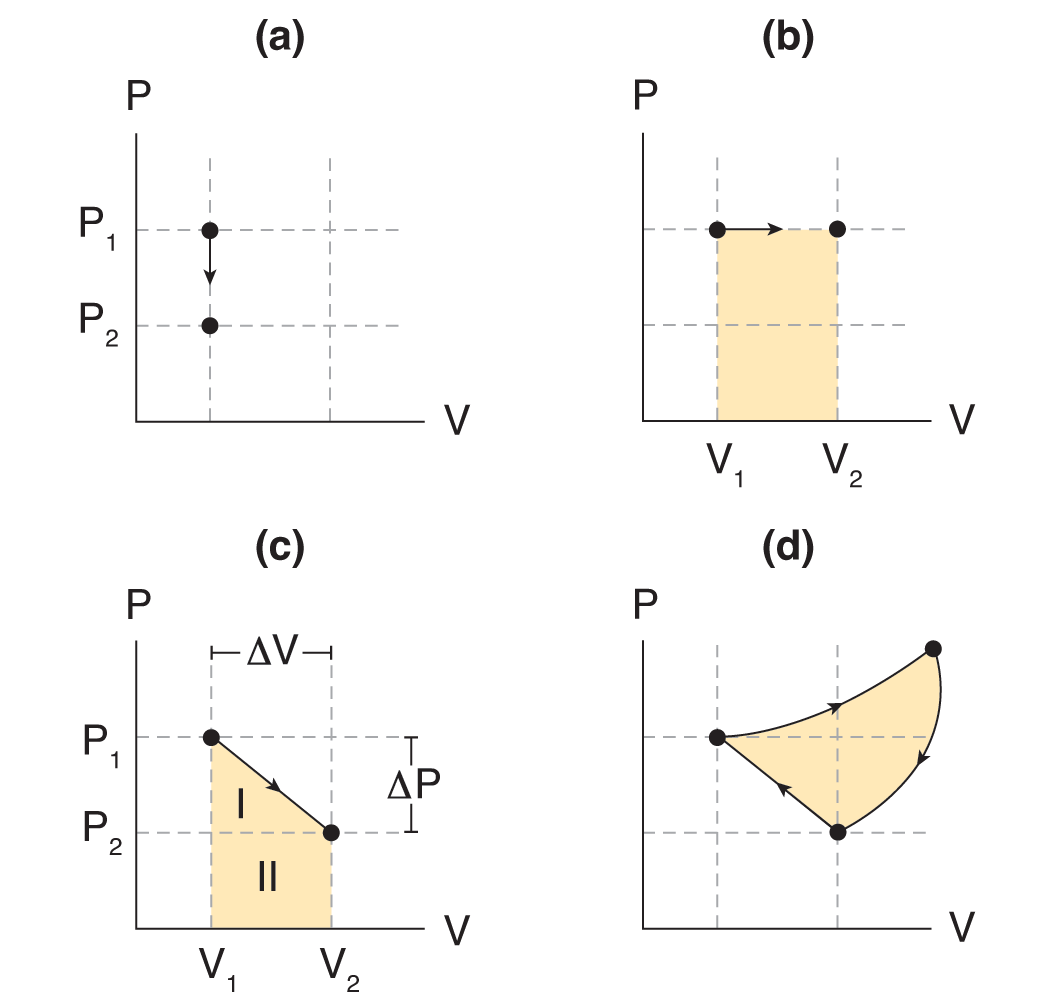
Figure 2.2. Pressure–Volume (P–V) Curves The work done on or by a system undergoing a thermodynamic process can be determined by finding the area enclosed by the corresponding pressure–volume curve.
When a gas expands, we say that work was done by the gas and the work is positive; when a gas is compressed, we say that work was done on the gas and the work is negative. There are an infinite number of paths between an initial and final state. Different paths require different amounts of work. You can calculate the work done on or by a system by finding the area under the pressure–volume curve. Note that if volume stays constant as pressure changes (that is, ΔV = 0), then no work is done because there is no area to calculate. This is the case in Figure 2.2a above, and is called an isovolumetric or isochoric process. On the other hand, if pressure remains constant as volume changes (that is, ΔP = 0), then the area under the curve is a rectangle of length P and width ΔV as shown in Figure 2.2b. For processes in which pressure remains constant (isobaric processes), the work can be calculated as
W = PΔV
Equation 2.8
KEY CONCEPT
When work is done by a system (the gas expands), the work is said to be positive. When work is done on a system (the gas compresses), the work is said to be negative. The MCAT will not expect you to calculate the integral of a P–V graph using calculus, but you are expected to be able to calculate the area under a straight-line graph if necessary.
Figure 2.2c shows a process in which neither pressure nor volume is held constant. The total area under the graph (Regions I and II) gives the work done.
Region I is a triangle with base ΔV and height ΔP, so the area is
AI=12ΔVΔP
Region II is a rectangle with base ΔV and height P2, so its area is
AII = P2ΔV
The work done is the sum of the areas of regions I and II:
W = AI + AII
Figure 2.2d shows a closed cycle in which, after certain interchanges of work and heat, the system returns to its initial state. Because work is positive when the gas expands and negative when the gas is compressed, the work done is the area enclosed by the curve. Calculating the work done in this situation would require calculus, but the MCAT does not test calculus-based physics.
Power
Power refers to the rate at which energy is transferred from one system to another. It is calculated with the equation
P=Wt=ΔEt
Equation 2.9
where P is power, W is work (which is equal to ΔE, the change in energy), and t is the time over which the work is done. The SI unit for power is the watt (W), which is equal to Js. In Chapter 6 of MCAT Physics and Math Review, we will identify additional ways to calculate power in electric circuits. For now, note that many of the devices we use every day—toaster ovens, light bulbs, phones, cars, and so on—are quantified by the rate at which these appliances transform electrical potential energy into other forms, such as thermal, light, sound, and kinetic energy.
BRIDGE
Power is calculated in many different situations, especially those involving circuits, resistors, and capacitors. The equation for electric power is P = IV, where P is power, I is current, and V is electrical potential difference (voltage). This equation is discussed in Chapter 6 of MCAT Physics and Math Review. Power is always a measure of the rate of energy consumption, transfer, or transformation per unit time.
Work–Energy Theorem
The work–energy theorem is a powerful expression of the relationship between work and energy. In its mechanical applications, it offers a direct relationship between the work done by all the forces acting on an object and the change in kinetic energy of that object. The net work done by forces acting on an object will result in an equal change in the object’s kinetic energy. In other words:
Wnet = ΔK = Kf – Ki
Equation 2.10
This relationship is important to understand, as it allows one to calculate work without knowing the magnitude of the forces acting on an object or the displacement through which the forces act. If one calculates the change in kinetic energy experienced by an object, then—by definition—the net work done on or by an object is the same. Pressing the brake pedal in your car puts the work–energy theorem into practice. The brake pads exert frictional forces against the rotors, which are attached to the wheels. These frictional forces do work against the wheels, causing them to decelerate and bringing the car to a halt. The net work done by all these forces is equal to the change in kinetic energy of the car.
In more general iterations, the work–energy theorem can be applied to changes in other forms of energy. In fact, the first law of thermodynamics is essentially a reiteration of the work–energy theorem, in which the change in internal energy (ΔU) is equal to the heat transferred into the system (Q) minus the mechanical work done by the system (W).
Example: A lead ball of mass 0.125 kg is thrown straight up in the air with an initial velocity of 30 ms. Assuming no air resistance, find the work done by the force of gravity by the time the ball is at its maximum height.
Solution: The answer could be calculated using kinematics and determining the maximum height of the ball (W = Fd cosθ**), but it is simpler to use the work–energy theorem:
Wnet=Kf−Ki=0−12mvi2=−(12)(18 kg)(30 ms)2=−90016≈−90015=−60 J(actual=−56.25 J)
MCAT CONCEPT CHECK 2.2
Before you move on, assess your understanding of the material with these questions.
- What are the units for work? How are work and energy different?
_________________________________
- Provide three methods for calculating the work done on or by a system.
- _________________________________
- _________________________________
- _________________________________
- While driving a vehicle at constant velocity on a flat surface, the accelerator must be slightly depressed to overcome resistive forces. How does the amount of work done by the engine (via the accelerator) compare to the amount of work done by resistance?
_________________________________
2.3 Mechanical Advantage
LEARNING OBJECTIVES
After Chapter 2.3, you will be able to:
- Explain how work can be lost in a system that is not 100% efficient
- Recall the meaning of mechanical advantage
- Recognize the six simple machines
- Predict the impact of changing effort values on effort distance in a pulley system, assuming work output remains the same:
Would it make a difference whether Sisyphus lifted the rock vertically to its final position or rolled it there along an incline? The difference between these two scenarios is mechanical advantage, a measure of the increase in force accomplished by using a tool. Sloping inclines, such as hillsides and ramps, make it easier to lift objects because they distribute the required work over a larger distance, decreasing the required force. For a given quantity of work, any device that allows for work to be accomplished through a smaller applied force is thus said to provide mechanical advantage. In addition to the inclined plane, five other devices are considered the classic simple machines which are designed to provide mechanical advantage: wedge (two merged inclined planes), wheel and axle, lever, pulley, and screw (rotating inclined plane). Of these, the inclined plane, lever, and pulley are most frequently tested on the MCAT.
Mechanical advantage is the ratio of magnitudes of the force exerted on an object by a simple machine (Fout) to the force actually applied on the simple machine (Fin):
Mechanical advantage=FoutFin
Equation 2.11
The mechanical advantage, because it is a ratio, is dimensionless.
Reducing the force needed to accomplish a given amount of work does have a cost associated with it; however, the distance through which the smaller force must be applied in order to do the work must be increased. Inclined planes, levers, and pulleys do not magically change the amount of work necessary to move an object from one place to another. Because displacement is pathway independent, the actual distance traveled from the initial to final position does not matter, assuming all forces are conservative. Therefore, applying a lesser force over a greater distance to achieve the same change in position (displacement) accomplishes the same amount of work. We’ve already considered the dynamics of inclined planes and levers in Chapter 1 of MCAT Physics and Math Review. Here, we look at the work associated with inclined planes.
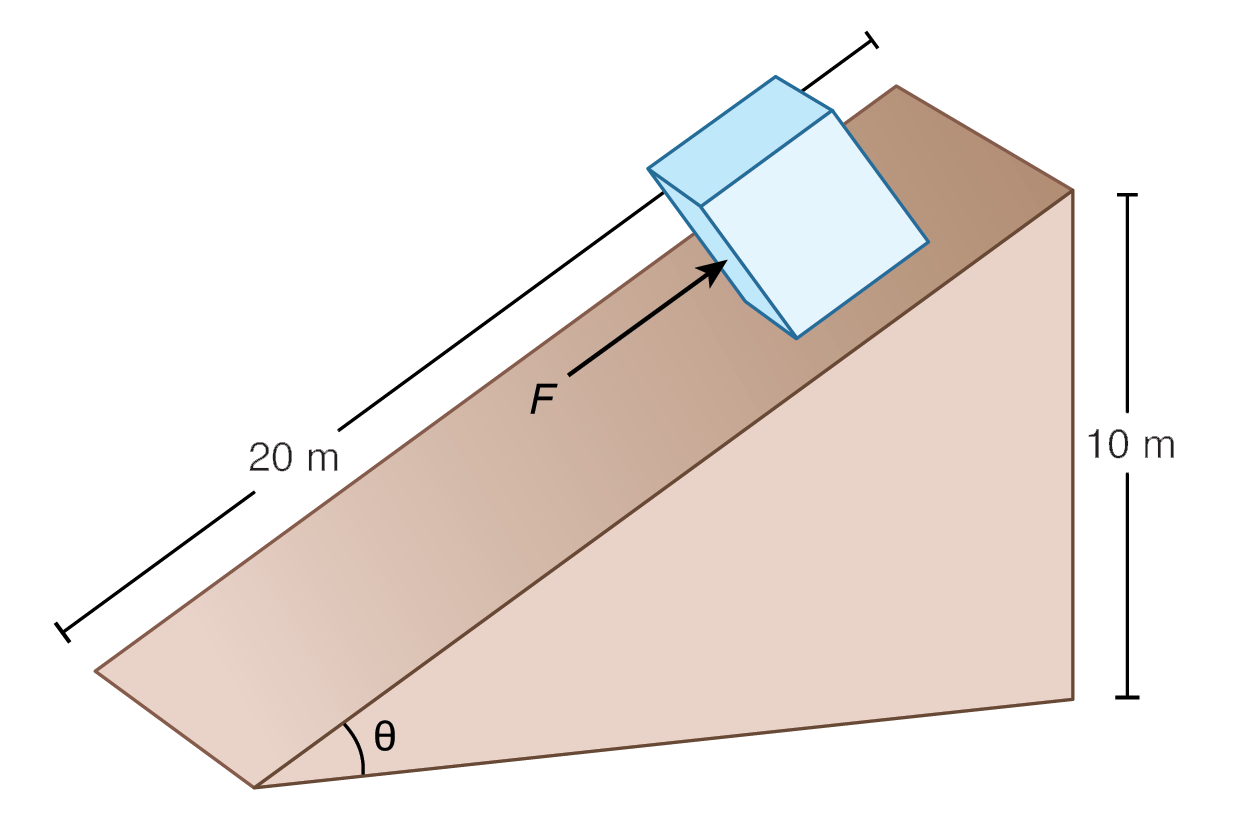
Example: A block weighing 100 N is pushed up a frictionless incline over a distance of 20 m to a height of 10 m as shown below.
Find:
- The minimum force required to push the block
- The work done by the force
- The force required and the work done by the force if the block were simply lifted vertically 10 m
Solution:
- To find the minimum force required to push the block, we must draw a free body diagram of the situation:
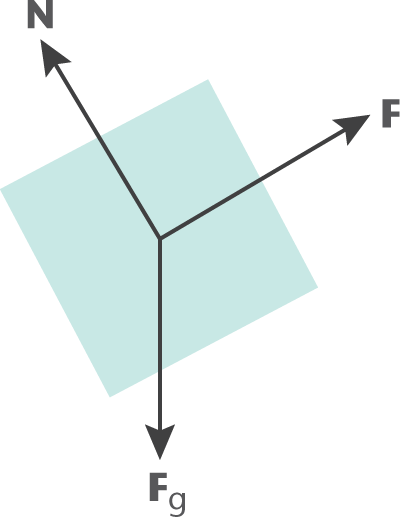
The minimum force needed is a force that will push the block with no acceleration parallel to the surface of the incline. This means the magnitude of the applied force is equal to that of the parallel component of gravity:
F = mg sin θ mg represents the weight of the object, which is 100 N. Using trigonometry, sin θ is ratio of the length of the opposite side to the hypotenuse, which is 1020. Therefore,
F=(100N)(1020)=50N
- The work done by F is
W = Fd cos θ
In this case, θ represents the angle between the force and displacement vectors, not the angle of the inclined plane. Because the force and displacement vectors are parallel, θ = 0 and cos θ = 1. Therefore,
W = (50 N)(20 m)(1) = 1000 J
- To raise the block vertically, an upward force equal to the object’s weight (100 N) would have to be generated. The work done by the lifting force is
W = Fd cos θ = (100 N)(10 m)(1) = 1000 J
The same amount of work is required in both cases, but twice the force is needed to raise the block vertically compared with pushing it up the incline.
Pulleys
Pulleys utilize the same paradigm to provide mechanical advantage as the inclined plane: a reduction of necessary force at the cost of increased distance to achieve a given value of work or energy transference. In practical terms, pulleys allow heavy objects to be lifted using a much-reduced force. Simply lifting a heavy object of mass m to a height of h will require an amount of work equal to mgh—its change in gravitational potential energy. If the displacement occurs over a distance equal to the displacement, then the force required to lift the object will equal mg. If, however, the distance through which the displacement is achieved is greater than the displacement (an indirect path), then the applied force will be less than mg. In other words, we’ve been able to lift this heavy object to the desired height by using a smaller force, but we’ve had to apply that smaller force through a greater distance in order to lift this heavy object to its final height.
Before examining how pulleys create this mechanical advantage, let’s consider first the heavy block in Figure 2.3, suspended from two ropes. Because the block is not accelerating, it is in translational equilibrium, and the force that the block exerts downward (its weight) is cancelled by the sum of the tensions in the two ropes. For a symmetrical system, the tensions in the two ropes are the same and are each equal to half the weight of the block.
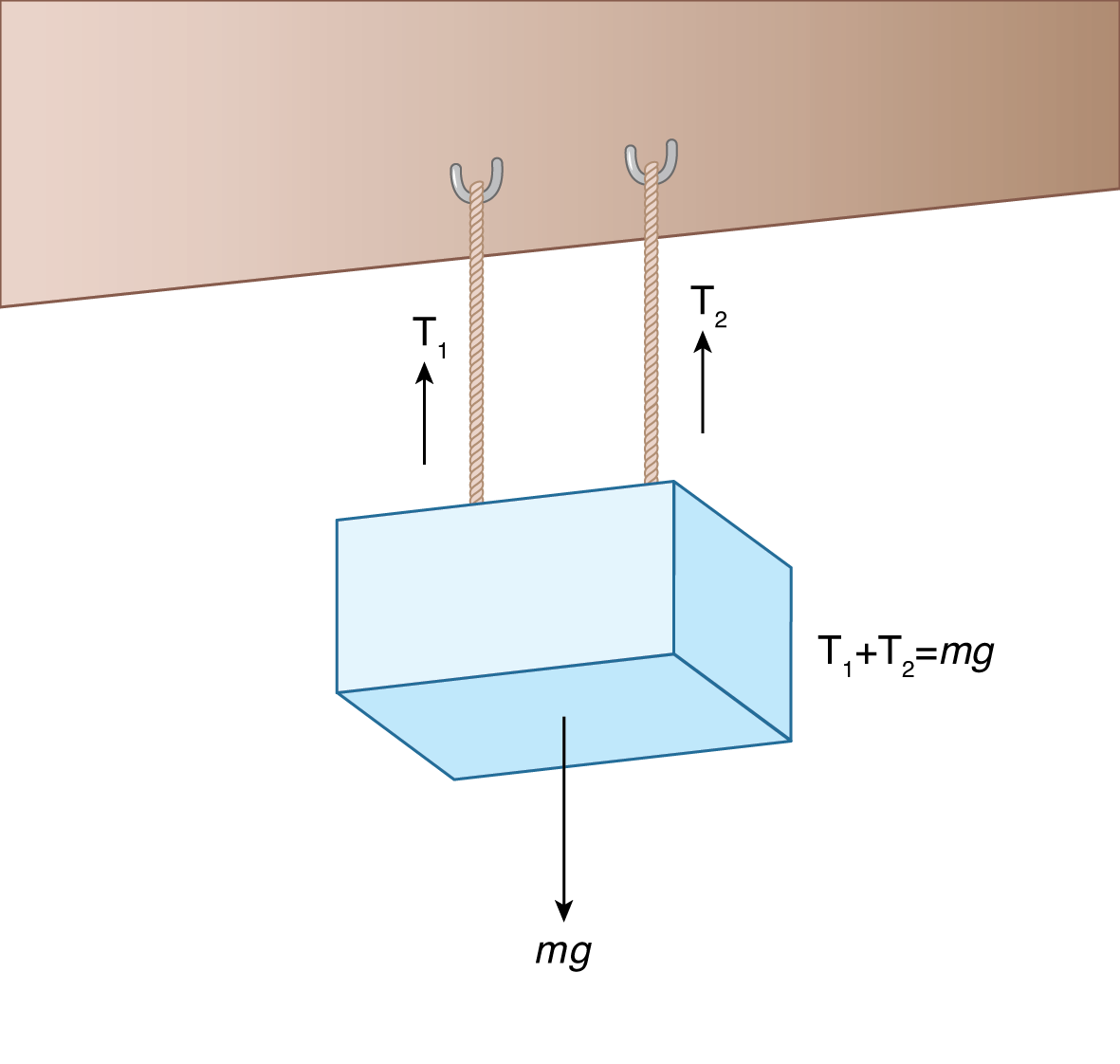
Figure 2.3. Block Suspended by Two Ropes If the block is in translational equilibrium, the tension in each rope is equal to half the weight of the block.
Now let’s imagine the heavy block in Figure 2.4 represents a heavy crate that must be lifted. Assuming that the crate is momentarily being held stationary in midair, we again have a system in translational equilibrium: the weight (the load) is balanced by the total tension in the ropes. The tensions in the two vertical ropes are equal to each other; if they were unequal, the pulleys would turn until the tensions were equal on both sides. Therefore, each rope supports one-half of the crate’s total weight. By extension, only half the force (effort) is required to lift the crate. This decrease in effort is the mechanical advantage provided by the pulley, but as we’ve already discussed, mechanical advantage comes at the expense of distance. To lift an object to a certain height in the air (the load distance), one must pull through a length of rope (the effort distance) equal to twice that displacement. If, for example, the crate must be lifted to a shelf 3 meters above the ground, then both sides of the supporting rope must shorten by 3 meters, and the only way to accomplish this is by pulling through 6 meters of rope.
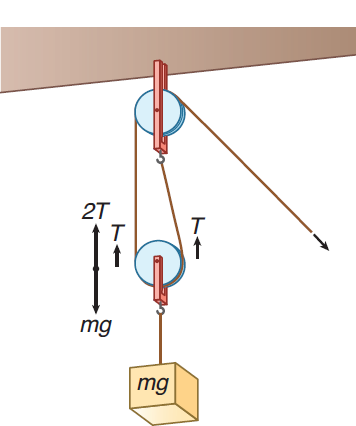
Figure 2.4. Two-Pulley System The block is suspended from two ropes, each of which bears half of the block’s weight.
All simple machines can be approximated as conservative systems if we ignore the (usually) small amount of energy that is lost due to external forces, such as friction. The idealized pulley is massless and frictionless, and under these theoretical conditions, the work put into the system (the exertion of force through a distance of rope) will exactly equal the work that comes out of the system (the displacement of the mass to some height). Real pulleys—and all real machines, for that matter—fail to conform to these idealized conditions and, therefore, do not achieve 100 percent efficiency in conserving energy output to input. We can define work input as the product of effort and effort distance; likewise, we can define work output as the product of load and load distance. Comparing the two as a ratio defines the efficiency of the simple machine:
Efficiency=WoutWin=(load)(load distance)(effort)(effort distance)
Equation 2.12
KEY CONCEPT
When considering simple machines, load and effort are both forces. The load determines the necessary output force. From the output force and mechanical advantage, we can determine the necessary input force.
Efficiency is often expressed as a percentage by multiplying the efficiency ratio by 100 percent. The efficiency of a machine gives a measure of the amount of useful work generated by the machine for a given amount of work put into the system. A corollary of this definition is that the percentage of the work put into the system that becomes unusable is due to nonconservative or external forces.
The pulley system in Figure 2.5 illustrates the fact that adding more pulleys further increases mechanical advantage: for each additional pair of pulleys, we can reduce the effort further still. In this case, the load has been divided among six lengths of rope, so the effort required is now only one-sixth the total load. Remember that we would need to pull through a length of rope that is six times the desired displacement, and that efficiency will decrease due to the added weight of each pulley and the additional friction forces.
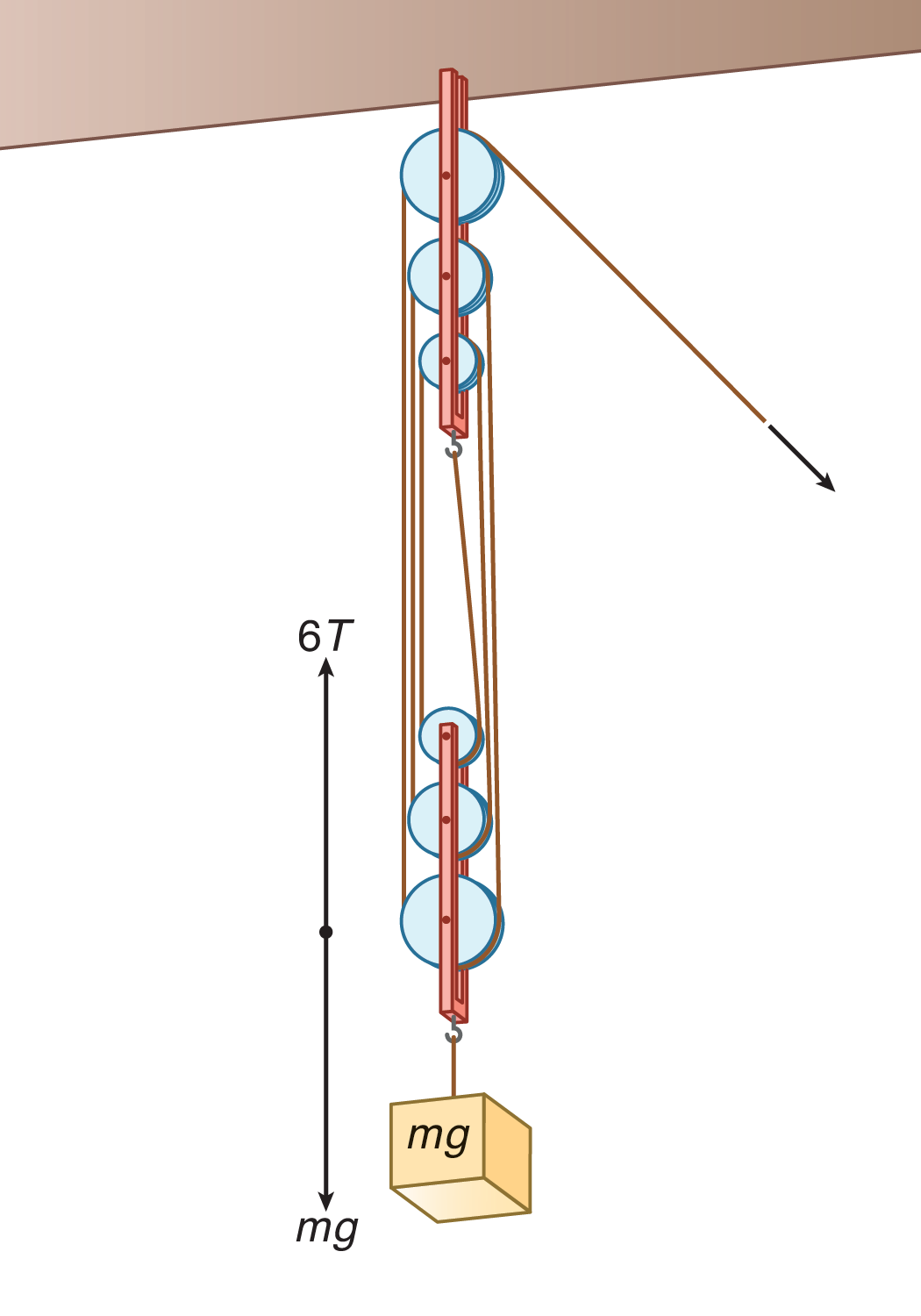
Figure 2.5. System of Six Pulleys Increasing the number of pulleys decreases the tension in each segment of rope; this leads to an increase in the mechanical advantage of the setup.
Example: The pulley system in Figure 2.5 has an efficiency of 80 percent. A person is lifting a mass of 200 kg with the pulley.
Find:
- The distance through which the effort must move to raise the load a distance of 4 m
- The effort required to lift the load
- The work done by the person lifting the load through a height of 4 m
Solution:
- For the load to move through a vertical distance of 4 m, all six of the supporting ropes must also shorten 4 m. This may only be accomplished by pulling 6 × 4 = 24 m of rope through the setup. Therefore, the effort must move through a distance of 24 m.
- To calculate the effort required, the equation for efficiency should be used. The load is the weight of the object being lifted and is equal to the mass of the object times the acceleration due to gravity g. The effort distance, calculated in part A, is 24 m.
Efficiency=(load)(load distance)(effort)(effort distance)0.8=(200 kg×9.8 ms2)(4 m)(effort)(24 m)effort≈2000×40.8×24≈800020=400 N(actual=408 N)
-
The work done by the person is
Win=(effort)(effort distance)=408 N×24≈9600 J(actual=9800 J)
MCAT CONCEPT CHECK 2.3
Before you move on, assess your understanding of the material with these questions.
- As the length of an inclined plane increases, what happens to the force required to move an object the same displacement?
_________________________________
- As the effort decreases in a pulley system, what happens to the effort distance to maintain the same work output?
_________________________________
- What accounts for the difference between work input and work output in a system that operates at less than 100% efficiency?
_________________________________
- What does it mean for a device to provide mechanical advantage?
_________________________________
- Name the six simple machines:
- _________________________________
- _________________________________
- _________________________________
- _________________________________
- _________________________________
- _________________________________
Conclusion
The conceptualization of energy as the capacity to do something or make something happen is a very broad definition. However, such an all-encompassing definition allows us to understand everything from pushing a rock up a hill to melting an ice cube, from stopping a car at an intersection to harnessing the energy of biomolecules in metabolism, to all the forms of energy transfer. Indeed, energy on its own has little significance without considering the transfer of energy, either through work or heat. The work–energy theorem is a powerful expression that will guide our approach to many problems in the Chemical and Physical Foundations of Biological Systems section. We also covered the application of energy and work with simple machines, such as levers, inclined planes, and pulleys. These devices assist us in accomplishing work by reducing the forces necessary for displacing objects.
Preparing for the MCAT is hard (mental) work, but you are well on your way to achieving success on Test Day. This MCAT Physics and Math Review book (and all the materials provided in your Kaplan program) is part of a set of tools—your simple machines, if you will—that will provide you with the mechanical advantage to ease your efforts toward a higher score.
GO ONLINE
You’ve reviewed the content, now test your knowledge and critical thinking skills by completing a test-like passage set in your online resources!
CONCEPT SUMMARY
Energy
- Energy is the property of a system that enables it to do something or make something happen, including the capacity to do work. The SI units for all forms of energy are joules (J).
- Kinetic energy is energy associated with the movement of objects. It depends on mass and speed squared (not velocity).
- Potential energy is energy stored within a system. It exists in gravitational, elastic, electrical, and chemical forms.
- Gravitational potential energy is related to the mass of an object and its height above a zero-point, called a datum.
- Elastic potential energy is related to the spring constant (a measure of the stiffness of a spring) and the degree of stretch or compression of a spring squared.
- Electrical potential energy exists between charged particles.
- Chemical potential energy is the energy stored in the bonds of compounds.
- The total mechanical energy of a system is the sum of its kinetic and potential energies.
- Conservative forces are path independent and do not dissipate the mechanical energy of a system.
- If only conservative forces are acting on an object, the total mechanical energy is conserved.
- Examples of conservative forces include gravity and electrostatic forces. Elastic forces, such as those created by springs, are nearly conservative.
- Nonconservative forces are path dependent and cause dissipation of mechanical energy from a system.
- While total energy is conserved, some mechanical energy is lost as thermal or chemical energy.
- Examples of nonconservative forces include friction, air resistance, and viscous drag.
Work
- Work is a process by which energy is transferred from one system to another.
- Work may be expressed as the dot product of force and displacement, or the product of force and distance traveled with the cosine of the angle between the two.
- Work may also be expressed as the area under a pressure–volume (P–V) curve.
- Power is the rate at which work is done or energy is transferred. The SI unit for power is the watt (W).
- The work–energy theorem states that when net work is done on or by a system, the system’s kinetic energy will change by the same amount. In more general applications, the work done on or by a system can be transferred to other forms of energy as well.
Mechanical Advantage
- Mechanical advantage is the factor by which a simple machine multiplies the input force to accomplish work.
- The six simple machines are the inclined plane, wedge, wheel and axle, lever, pulley, and screw. Simple machines provide the benefit of mechanical advantage.
- Mechanical advantage makes it easier to accomplish a given amount of work because the input force necessary to accomplish the work is reduced; the distance through which the reduced input force must be applied, however, is increased by the same factor (assuming 100% efficiency).
- The load is the output force of a simple machine, which acts over a given load distance to determine the work output of the simple machine. The effort is the input force of a simple machine, which acts over a given effort distance to determine the work input of the simple machine.
- Efficiency is the ratio of the machine’s work output to work input when nonconservative forces are taken into account.
ANSWERS TO CONCEPT CHECKS
**2.1**
- Kinetic energy is the energy of motion. It is related to the mass of an object, as well as its speed squared. Potential energy is energy associated with a given position or intrinsic property of a system; it is stored in gravitational, electrical, elastic, or chemical forms. Gravitational potential energy is directly related to the mass of the object and its height above a reference point.
-
Conservative Forces Nonconservative Forces What happens to total mechanical energy of the system? Remains constant Decreases (energy is dissipated)
Does the path taken matter? No Yes; more energy is dissipated with a longer path
What are some examples? Gravity
Electrostatic forces
Elastic forces (approximately conservative)
Friction
Air resistance
Viscous drag
**2.2**
- The unit of work is the joule, which is also the unit for energy. Work and energy are related concepts. By performing work, the energy of a system is changed. Work, along with heat, is a form of energy transfer.
- Three methods for calculating work discussed in this chapter are:
- W = Fd cos θ (the dot product of the force and displacement vectors)
- W = PΔV (the area under a pressure–volume curve)
- Wnet = ΔK (the work–energy theorem)
- Begin by thinking about how each form of work is affecting the vehicle. While we could try to work through what may be happening in terms of forces and displacements, this gets very tricky when considering moving engine parts. In this case, it is simpler to think about each work in terms of kinetic energy. The work done by the engine increases the kinetic energy of the car, so it’s positive. Conversely, the work done by resistance decreases the kinetic energy of the car, meaning the work done on the car is negative. If the engine does more work than friction, then there is a positive change in kinetic energy. If resistance does more work, then the change is negative. If they do equal amounts of work, then there is no change in kinetic energy. We are given that the vehicle maintains a constant velocity; thus, there is no change in kinetic energy. Therefore, according to the work–energy theorem, the net work must also be zero, and we can infer that the amount of positive work done by the engine must be equal to the amount of negative work done by resistance.
**2.3**
- As the length of an inclined plane increases, the amount of force necessary to perform the same amount of work (moving the object the same displacement) decreases.
- As the effort (required force) decreases in a pulley system, the effort distance increases to generate the same amount of work.
- The decrease in work output is due to nonconservative or external forces that generate or dissipate energy.
- When a device provides mechanical advantage, it decreases the input force required to generate a particular output force. Generally, this is accomplished at the expense of increased distance over which the force must act.
- The six simple machines are: inclined plane, wedge, wheel and axle, lever, pulley, and screw.
SCIENCE MASTERY ASSESSMENT EXPLANATIONS
1. C
Because the weight of the barbell (force acting downward) is mg=275 kg×10 ms2, or about 2750 N, it follows that the weightlifter must exert an equal and opposite force of 2750 N on the barbell. The work done in lifting the barbell is therefore W = Fd cos θ = (2750 N)(2.4 m)(cos 0) ≈ 7000 J. Using the same equation, it follows that the work done to hold the barbell in place is W = Fd cos θ = (2750 N)(0 m)(cos θ) = 0 J. Because the barbell is held in place and there is no displacement, the work done is zero. This is closest to (C).
2. C
The work done by the tractor can be calculated from the equation W = Fd cos θ = (5000 N)(100 m)(cos 30°) = (5000)(100)(0.866) ≈ 5000 × 90 = 450,000 J = 450 kJ. This is closest to (C). Since we estimated by rounding 0.866 up to 0.9, we can expect the actual answer to be less than the calculated answer.
3. B
The work done by the engine is equal to the change in kinetic energy of the car: W=ΔK=12m(vf2−vi2)=12(2000 kg)(900 m2s2−0)=900,000 J. The average power therefore is P=Wt=900,000 J6 s=150,000 W=150 kW.
4. D
Assuming negligible air resistance, conservation of energy states that the total mechanical energy of the block is constant as it falls. At the starting height of 5 m, the block only has potential energy equal to U=mgh≈40 kg×10ms2×5 m=2000 J. Because the kinetic energy at this point is 0 J, the total mechanical energy is 2000 J at any point during the block’s descent.
5. C
An isochoric process, by definition, is one in which the gas system undergoes no change in volume. If the gas neither expands nor is compressed, then no work is performed. Remember that work in a thermodynamic system is the area under a P–V curve; if the change in volume is 0, then the area under the curve is also 0.
6. B
To calculate the tension force in each rope, first draw a free body diagram:
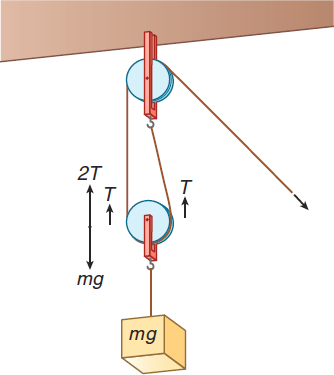
From the force diagram, notice that there are two tension forces pulling the mass up. The net force for this system (Fnet) is equal to 2T – mg. Now we can use Newton’s second law:
Fnet=ma2T−mg=maT=m(a+g)2≈(10 kg)(2 ms2+10 ms2)2=5×12=60 N
7. C
Gravity is a conservative force because it is pathway independent and it does not dissipate mechanical energy. Air resistance and friction—(A) and (B)—are nonconservative forces that dissipate energy thermally. Convection is not a force, but a method of heat transfer, eliminating (D).
8. A
In uniform circular motion, the displacement vector and force vector are always perpendicular; therefore, no work is done. Potential energy is constant for an object in uniform circular motion, whether it is the gravitational potential energy of a satellite orbiting the Earth or the electrical potential energy of an electron orbiting the nucleus of an idealized atom. In both cases, potential energy does not change and does not depend on the position of the object around the circle, eliminating (D).
9. B
The work–energy theorem relates the total work done on an object by all forces to the change in kinetic energy experienced by the same object. While the work done by a force is indeed proportional to the magnitude of the force, it is also proportional to the displacement of the object, eliminating (A). The change in kinetic energy is equal—not proportional—to the total work done on the object; further, it is the net force, not any force, that relates to the work done on an object, eliminating (C). Finally, the change in kinetic energy of the object is equal to the work done by all of the forces acting on the object combined, not just the applied force, which eliminates (D).
10. D
Elastic potential energy, like kinetic energy, is related to the square of another variable, as shown by the equation U=12 kx2. Increasing the displacement by a factor of 2 increases the potential energy by a factor of 22 = 4.
11. A
Sarah will not bounce higher than Josh. Assuming that mechanical energy is conserved, Sarah and Josh will start with a given amount of potential energy, which is converted into kinetic energy, then elastic potential energy, then kinetic energy again with no loss of energy from the system, eliminating (D). By this logic, both individuals should return to the same starting height. Josh starts with U=mgh≈80 kg×10 ms2×20 m=16,000 J of potential energy. At the moment Josh hits the net, all of this potential energy has been converted into kinetic energy. Therefore:
K=12mv2→v=2Km=2×16,00080=400=20 ms
eliminating (B). Josh will experience a greater force upon impact because the net exerts a force proportional to weight; the higher the weight, the larger the force exerted by the net, eliminating (C).
12. B
At terminal velocity, the force of gravity and force of air resistance are equal in magnitude, leading to translational equilibrium. Thus, statement I is true. If these forces have the same magnitude and act over the same displacement, then the work performed is the same as well, making statement III true. Even though the net force is equal to zero, there are still forces acting on the parachutist, making statement II false.
13. B
Mechanical advantage is a ratio of the output force generated given a particular input force. Efficiency is a ratio of the useful work performed by a system compared to the work performed on the system.
14. C
In the absence of nonconservative forces, all changes in potential energy must be met by an equal change in kinetic energy. Note that it is the difference in potential energy that is the same as the difference in kinetic energy, not the proportionality, eliminating (B). Both (A) and (D) could be true statements but do not necessarily have to be—the object’s mass could have been quadrupled while its height was halved.
15. A
Horsepower is a unit of power, as evidenced by the name and the conversion factor given in the question stem. Power is a rate of energy expenditure over time. Given unlimited time, both cars are capable of unlimited increases in (kinetic) energy, meaning that they have unlimited maximum velocities. The fact that Car B has a higher power rating means that it will reach any given velocity faster than Car A, eliminating (B). There is not enough information to make any judgments on the efficiency of the cars, eliminating (C). While it may take longer for Car A to reach a given velocity, both cars have unlimited maximum velocities, eliminating (D).
GO ONLINE
Consult your online resources for additional practice.
EQUATIONS TO REMEMBER
(2.1) Kinetic energy: K=12mv2
(2.2) Gravitational potential energy: U = mgh
(2.3) Elastic potential energy: U=12kx2
(2.4) Total mechanical energy: E = U + K
(2.5) Conservation of mechanical energy: ΔE = ΔU + ΔK = 0
(2.6) Work done by nonconservative forces: Wnonconservative = ΔE = ΔU + ΔK
(2.7) Definition of work (mechanical): W = F · d = Fd cos θ
(2.8) Definition of work (isobaric gas–piston system): W = PΔV
(2.9) Definition of power: P=Wt=ΔEt
(2.10) Work–Energy theorem: Wnet = ΔK = Kf – Ki
(2.11) Mechanical advantage: Mechanical advantage=FoutFin
(2.12) Efficiency: Efficiency=WoutWin=(load)(load distance)(effort)(effort distance)
SHARED CONCEPTS
Biochemistry Chapter 6
DNA and Biotechnology
Biochemistry Chapter 9
Carbohydrate Metabolism I
Biochemistry Chapter 12
Bioenergetics and Regulation of Metabolism
General Chemistry Chapter 7
Thermochemistry
Physics and Math Chapter 1
Kinematics and Dynamics
Physics and Math Chapter 3
Thermodynamics