Chapter 4: Previewing the Passage
Chapter 4
Chapter 4. Previewing the Passage

Chapter 4: Previewing the Passage
Chapter 4
Chapter 4, Previewing the Passage
In This Chapter
4.1Timing in the CARS Section
Passage Timing
Timing Strategy
4.2Previewing CARS Passages
Passage Topic
Sentence Structure
Writing Style
Length
Questions
4.3Determining Passage Order
Section Order Strategy
Now vs. Later Strategy
Applied Examples
Concept and Strategy Summary
Introduction
LEARNING OBJECTIVES
After Chapter 4, you will be able to:
- Describe the timing in the CARS section
- Predict the difficulty of a CARS passage
- Determine the order in which to work the passages in a given CARS section
Great writers work with a plan, and so do great test takers. If you’ve ever had to make a plan to finish a project, you’ve already utilized this skill. Great doctors make a plan for the best way to attack a problem, be it large or small: whether in a trauma scenario or deciding on a long-term treatment plan for a patient, doing things in the proper order is a critical skill for any physician. Finding the proper order is equally important for the CARS section of the MCAT. In this chapter, we’ll discuss how to take control of the section as a whole, passage by passage, so that you’re driving the CARS section rather than letting it drive you.
This chapter begins by discussing the timing in the CARS section, common pitfalls in CARS, and how to overcome getting behind on time. Then we discuss how to assess a passage and techniques for knowing how difficult a passage will be for you. Finally, we discuss the order in which you can attack the passages in the CARS section to maximize your score.
4.1 Timing in the CARS Section
As mentioned in the introduction to this chapter, great test takers work with a plan! In particular, CARS requires that the test taker work against both a heavy cognitive challenge and a time challenge. This chapter will discuss the best ways to meet those challenges head on, starting with the time challenge.
The CARS section is the second section that you will encounter on Test Day. In the CARS section, you have 90 minutes to read nine passages and answer 53 questions. The number of questions per passage is variable, but the goal is generally to spend about one minute per question, just like in the science sections.
As you’ve probably already discovered, there are several important differences between passages from the three science sections and those found in CARS. The most apparent difference is that CARS passages contain considerably more words, as well as having no images to break up the monotony of the text. Under the surface, CARS passages are much more variable, both in their range of topics and their diversity of writing styles. Moreover, unlike the science passages, which are nearly always impartial, CARS passages are often written by authors who take sides and express their opinions, although not always in a straightforward manner.
To account for these essential differences, the Kaplan Method for CARS Passages can be refined, and is shown in Figure 4.1. This chapter will focus on the very first step in this method. The remaining steps will be addressed in subsequent chapters of this book.
PREVIEW FOR DIFFICULTY
- Look for the big picture
- Assess the relative difficulty
- Decide to read now or later
CHOOSE YOUR APPROACH
- Highlighting: Best for high difficulty passages or if low on time
- Outlining: Gives a moderate understanding of the passage and allows for more time to work on the questions
- Interrogating: Gives a strong understanding of passage but allows for less time to work on the questions
READ AND DISTILL THE MEANING OF EACH PARAGRAPH
- Recognize keywords to identify the most important and testable content in each paragraph
- Use your approach from the choose step to extract your major takeaways from each paragraph:
- Highlighting—highlight 1–3 key terms and phrases per paragraph you can use to quickly locate information later
- Outlining—create a brief label for each paragraph that summarizes the main idea of that paragraph
- Interrogating—thoroughly examine each major idea presented in the paragraph and determine why and how the author is using the information to build an argument
- Identify the reason the passage was written before moving into the questions
Figure 4.1 The Kaplan Method for CARS Passages
Note: The Kaplan Method for CARS Passages—as well as the Kaplan Method for CARS Questions, CARS Question Types, and Wrong Answer Pathologies—are included as tear-out sheets in the back of this book.
Passage Timing
The CARS section is conveniently timed to take 90 minutes to complete nine passages and their associated questions, which means that, on average, each CARS passage should take 10 minutes to complete. This is not necessarily the case in practice, as some passages will take more than 10 minutes and some will take considerably less. That is why it must be emphasized that 10 minutes per passage is merely an average. The best test takers will organize their approach to the CARS section to deliberately take advantage of those time differences, prioritizing passages with care. Most careful test takers opt to complete passages that will take less time up front and leave the more involved passages for the end of the section, though some may vary this approach slightly based on their individual strengths.
Your time spent within each passage will not be divided evenly, either. As you’ll see in Chapter 6, there are three strategies to choose from that you can deploy to Distill information from the passage. The three methods— Highlighting, Outlining, and Interrogating—take different amounts of time to complete and produce distinct outputs. Nevertheless, each method has been designed to minimize the amount of time and effort you must expend overall in approaching the passage and questions, while maximizing the number of questions you can answer correctly. Based upon which passage method you choose, you’ll divide your time a bit differently between distilling passage information and answering questions. Distilling information from the passage using these methods will be discussed in Chapter 6 of MCAT Critical Analysis and Reasoning Skills Review.
Timing Strategy
So why should you care about timing? Why not just take your time, start from the beginning of the section, go at your own pace, and just focus on getting the questions you encounter correct? Well, consider a common pitfall that occurs before many test takers master timing: you come across a hard passage early and you find yourself spending 15 or 20 minutes on it, but by the time you’re done, you’re not sure you got many questions right or even understood what you read. Now you have to scramble to finish the section on time, which adds to your stress, detracts from your focus, and leaves you susceptible to mistakes you otherwise wouldn’t make. It’s far better to avoid such unnecessary stresses by exercising a little foresight.
MCAT EXPERTISE
Your time on Test Day is valuable, so make sure you’re using it as efficiently as you can. It is not “against the rules” to change your plan if you realize midway that it isn’t working.
Getting a high MCAT score is a numbers game: your sole objective is to get as many questions correct as possible in the time allotted. If you had to choose between an easy passage where you’ll probably get all six questions correct and a difficult passage where you’re more likely to get four out of seven, your best bet is to tackle the easy passage early and get those points before running out of time. Moreover, having those quick points in the bag from tackling easy passages first gives you more confidence and extra time as you work on the harder passages that remain. The MCAT scoring model specifically rewards this type of strategic thinking.
4.2 Previewing CARS Passages
As we discussed in the previous section, using your time effectively means prioritizing easy and quick passages over difficult and time-consuming ones. But how do you know in the first place what’s hard and what’s easy? And how can you make this assessment quickly enough that it doesn’t create its own timing problems? This is what the Preview step of the Kaplan Method for CARS Passages is all about! When you Preview a passage, you’ll be looking out for a few specific factors that you can assess quickly, enabling you to make a swift, sound judgment about the passage’s difficulty. Let’s consider each of these factors in turn.
Passage Topic
The first indication of the difficulty of a passage on the MCAT will be the topic. As shown in Table 1.1 in Chapter 1, passages on the CARS section come in two basic types: social sciences and humanities. Many students find that identifying the broad category for a given passage is a good first filter to determine roughly when in the 90 minute section they should approach the passage.
Social sciences passages are more likely to rely upon empirical research and data, even if they don’t share the heavy focus on controlled experimentation seen in the natural science sections of the MCAT. Also, social sciences passages are more likely to focus on cause and effect relationships and are often (but not always) more logically rigorous than their humanities counterparts. In contrast, humanities passages tend to rely on different types of evidence, such as quotations from famous writers and speakers, thought experiments, or interpretations of historical events. While both types contain jargon, the jargon in the humanities can seem more daunting to many pre-med students, with references to obscure thinkers, terms borrowed from foreign languages, and boatloads of “ism”s with similar-sounding names.
In addition to the broad humanities vs. social sciences distinction, the specific discipline (from among those listed in Table 1.1) of a passage can also be useful information. As you practice with more CARS passages, you might discover some disciplines come more easily for you, perhaps because of your educational background or interests, while other disciplines are more of an ordeal. For example, if you find yourself always struggling with philosophy passages but breezing through literature passages, then your default should be to assume a philosophy passage is hard and a literature passage is easy, at least as a first guess. We recommend compiling and refining your own list of strong and weak topics as you do more CARS practice.
MCAT EXPERTISE
Use caution when approaching a CARS passage on a topic with which you are familiar. Relying upon outside information that may be true, but is not in the passage, is a surefire way to pick an Out of Scope wrong answer.
Sentence Structure
A second important influence on passage difficulty is sentence structure. Some sentences are short. Others are very long and often seem needlessly wordy with the author repeating himself over and over seemingly for no reason at all! Most sentences are somewhere in between these two extremes. Unlike passage topic, which affects difficulty in a way that depends mostly on your personal interests and strengths, sentence structure tends to have a consistent influence: passages with more complex sentence structure are harder for just about everyone.
While the distance between periods (the average sentence length) is one good measure of sentence complexity, rare punctuation marks can also be helpful indicators. A passage strewn with semicolons, dashes, parentheses, or simply an excessive number of commas may suggest an author who is prone to go off on tangents, making the main points harder to follow. Remember on Test Day that you’re trying to Preview passages quickly: it should only take you a few seconds to get a gut feeling of complexity based on sentence length and amount of punctuation. Any more effort than that is overthinking it.
Writing Style
While most CARS passages are standard academic prose, some authors (perhaps most notably those from earlier in history) adopt distinctive writing styles that can make the passage easier or harder to read. The exact effect usually depends on what you personally like to read, but a particularly archaic writing style can be a challenge even for a history buff. Style is not as easy to gauge as sentence structure, but you should nevertheless limit yourself to a gut-level check: take just a few seconds when assessing writing style.
MCAT EXPERTISE
Just because a style is one you don’t enjoy reading doesn’t mean that you won’t be successful reading it on Test Day. Don’t avoid passages with simpler structures just because you find their topics or styles boring.
Length
The length of the passage is perhaps the most obvious clue that you should use to identify difficulty: longer passages take more time to read. MCAT CARS passages are typically 500–600 words in length, though apparent length can be distorted based on paragraphing: a passage with a greater number of shorter paragraphs will seem longer than one with the same word count but with fewer, longer paragraphs. Paragraph length, as well, has its own impact on difficulty; it’s easier to get lost when in the middle of a long paragraph that never seems to end. Both overall passage length and average paragraph length are quick and easy to assess, but be careful not to let them be the only factors shaping your judgment of difficulty.
Questions
The last noteworthy influence on passage difficulty is the number of questions associated with the passage. Remember that questions appear only one at a time in the Test Day interface. However, you can easily determine the number of questions associated with a given passage because each passage will list the range of associated question numbers, for example, “Question 32–37.” You may be tempted to think more questions necessarily means a harder, more time consuming passage. But remember: passages with more questions are also worth more points!
MCAT EXPERTISE
At the top of every passage on Test Day there will be a label that tells you the range of questions associated with that passage. Using that detail makes it easy to flip between passages using the test’s navigation tools. It’s a good idea to make a note of the question that starts each passage on your noteboard booklet to hop easily between passages in the order that suits you.
4.3 Determining Passage Order
Whether you’ve worked in a hospital, volunteered in a clinic, served as a medic in the military, or just watched episodes of any medical television show, you have probably heard the word triage. The idea behind triaging patients is that the sickest patients get to “skip the line” so that the physician can address the most urgent needs first, minimizing further damage and fatalities among patients waiting for treatment. The same idea can be applied to the MCAT and the CARS section. But instead of triaging to save lives, you’ll be triaging to gain points, prioritizing passages to let you correctly answer as many questions as possible in the time you have. We will examine a few different ways to approach this triaging—and we recommend you experiment with each approach until you find the one that works best for you.
MCAT EXPERTISE
There will be stressful points during your exam; but try not to let these moments of stress “get in your head” and ruin the section as a whole. If a passage was more difficult than you expected, take a moment after you finish it to close your eyes, breathe deeply, and refocus before attacking the next passage.
Section Order Strategy
One proven technique is to order the entire section by difficulty at the start of the section. Every passage on the MCAT will have a label at the top indicating the passage number and range of questions (e.g., Passage 1 [Questions 1–7]). This label can help you to navigate the section efficiently by jumping between the first question of each passage using the Navigator tool, discussed in Chapter 2 of Kaplan MCAT CARS Review. You’ll need to be able to navigate between passages quickly to use the section order strategy effectively.
To use this strategy, you’ll need to find a place in your noteboard booklet to list a few pieces of information, as can be seen in Figure 4.2. For each passage, write down the passage number, the number of its first question, and your triaging decision. For your triaging decision, you have a few options for how much information you want to include. You will certainly want to record your perception of the passage’s difficulty. Most students prefer to record difficulty as either Easy, Medium, or Hard. However, some students prefer to simplify the decision by recording only Easy or Hard. After recording the passage’s difficulty, some students also prefer to execute the Choose step by deciding whether to Highlight, Outline, or Interrogate the passage. Because the Choose step often depends heavily on passage difficulty, pairing Choose with Preview is one potential way to increase your efficiency. However, other students prefer to save the Choose decision until they have committed to a passage. Regardless of how much or how little information you prefer to record with your triaging decision, give yourself just a few seconds to decide and jot down your decision. Then use the Navigator tool to jump to the next passage (see Chapter 2), and take a few seconds to record similar information for that passage. Triaging the section in this way should take around two minutes and not more than three.
MCAT EXPERTISE
In addition to your triaging decision, you can also write down a one-word clue about the passage’s topic if you’d like a way to help keep the passages distinct in your mind. This can make it easier, for example, to decide which of those Hard passages to tackle first.
Once you’ve made your decisions for every passage (and have recorded something on your noteboard booklet that looks like one of the examples in Figure 4.2), then move in order of increasing difficulty: Easy passages first, then Medium (if any), and finally Hard. This approach lets you attack all of the easiest (and fastest) passages first and maximize the number of questions you answer. Further, starting with the easiest passages and slowly increasing difficulty can help you to manage stress within the section, and ensure you reach the hardest passages still full of energy. You can scratch out each passage as you complete it to have a visual representation of how much is left to do in the section.
MCAT EXPERTISE
When reviewing a practice CARS section that you’ve completed, don’t just consider how many points you got, but take some time to evaluate your triaging decisions. Did a passage you thought would be easy turn out to be hard for reasons you didn’t originally anticipate? Adjust future triaging decisions in light of your analysis.
The section order strategy is a time investment. You’ll need to spend a couple minutes upfront, but the payoff will come when you move more quickly between passages as you complete them. The hard decisions primarily come at the start of the section, and then you can just focus on getting things done.
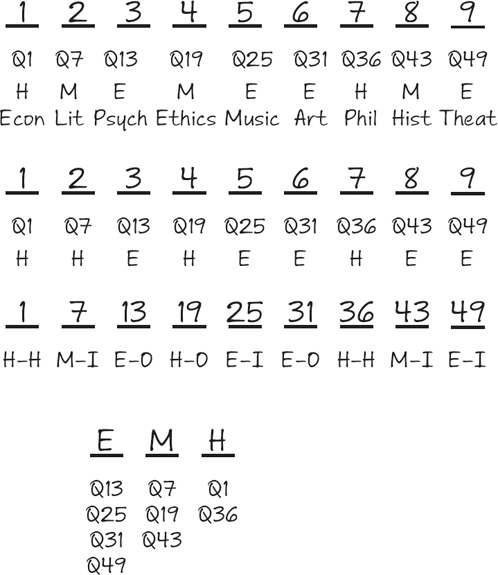
Figure 4.2 Section Order Strategy Scratch Work From the top: example scratch work with 3 levels of difficulty, passage type, passage, and question number; example scratchwork with 2 levels of difficulty, passage, and question number; example scratch work with 3 levels of difficulty, question number, and Choose step approach; and example scratchwork with 3 levels of difficulty and question number
Now vs. Later Strategy
An alternative to the section order strategy is the Now vs. Later strategy. This strategy amounts to triaging as you work through the section, instead of doing all of your triaging upfront. If you use the Now vs. Later strategy, you’ll still perform the Preview step (perhaps combined with the Choose step) when you first encounter a passage. You’ll still assign a difficulty rating to the passage. And you’ll still record the passage number, difficulty, first question number, and other important details in your scratch work. The difference is, with the Now vs. Later strategy, you’ll immediately complete any passage you decide is Easy before moving on to the next passage. Those you triage as Hard (or Medium, if you use that label too) you will save for Later. See Figure 4.3 for examples of how your noteboard booklet should look with this strategy.
MCAT EXPERTISE
While our default recommendation is to work in order of increasing difficulty, some students find they prefer to structure the section like a hill, starting and ending with Easy passages and working the Hard passages in the middle. But regardless of which approach you adopt, you should always start with an Easy passage: data indicates that starting with a Hard passage first can negatively affect your performance across the entire section.
For students who are particularly concerned about timing, an alternate version of Now vs. Later involves working both the Easy and Medium difficulty passages “now”, and saving only the Hard passages for a second pass. In this version, your scratch work will be minimal, because you will only need to make note of those Hard passages that you’re saving for the end. While this variant of the strategy is a great fit for many students, be warned that it may not be the best fit for everyone; some students might find that they become less efficient and more stressed when they force themselves to work through passages of moderate difficulty too early in the section.
In short, experiment with each version of the triaging strategy. You’ll quickly find the version that best suits your own personality. If you like having a detailed plan for the section clearly laid out at the start, you might prefer doing all your triaging up front with the Section Order version. On the other hand, if you suffer from decision fatigue trying to assign difficulty ratings to each and every passage, you might prefer to triage as you go with the Now vs. Later version of the strategy. The key is optimizing the triaging strategy to work for you.
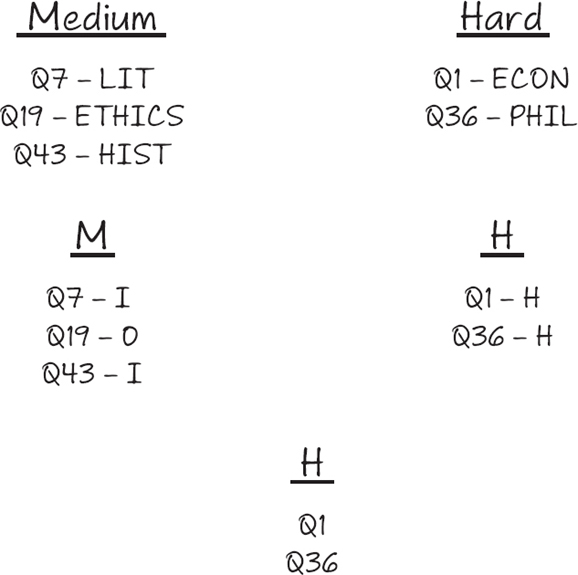
Figure 4.3 Now vs. Later Strategy Scratch Work From the top: example scratch work with 2 levels of difficulty, question number, and topic; example scratch work with 2 levels of difficulty, question number, and Choose method; and example scratch work with 1 level of difficulty and question number
Applied Examples
Now let’s practice some of these triaging strategies with some applied examples. The following pages feature two test-like CARS passages. We’ve already set in bold important lines from each passage (ones that should stand out when completing the Preview step) to help aid your decisions. Remember that your goal is only to evaluate the difficulty of the passage for you; don’t bother reading the whole thing!
Passage 1
The world of contemporary art is characterized by a growing number of artists experiencing an entrepreneurial venture. Especially in the context of performing arts, this has been lived both as a necessary and a voluntary solution to the severe shortage of funds affecting the world of public institutions. Thus a new actor emerges, represented by the artist-entrepreneur who lives a hybridization of roles and competences. But who are the artists- entrepreneurs? And how do they live the possible tensions emerging from the encounter of worlds that have been reputed as radically different for so long?
Artists-entrepreneurs’ activity can be identified as a particular kind of “cultural entrepreneurship.” This practice has been traditionally investigated adopting two main perspectives, based on different meanings of culture.
As a first meaning, culture refers to the sociological frame of reference identifying a set of habits, customs, traditions, and beliefs which constitute a shared way of life in a specific historical and political context. As a second meaning, culture identifies a complex set of processes, products, and actors involved in the design, production, and distribution of cultural and artistic goods and services.
Descending from the first sociological perspective, cultural entrepreneurship represents “the skill of certain entrepreneurs to use culture as a toolkit for constructing resonant identities and motivating resource-holding audiences to allocate their resources.” Therefore, cultural entrepreneurship is instrumentally identified in the process of storytelling that gives shape and legitimates new ventures. Not referring to a specific industry, the adjective cultural is used to identify the process of legitimization that entrepreneurs sustain, giving shape to the story of their personal and professional life.
In a second perspective, cultural entrepreneurship identifies a set of processes through which a growing number of artists and cultural professionals assume an entrepreneurial role. Cultural entrepreneurship thus identifies the activity of conceiving, producing and marketing “cultural goods and services, generating economic, cultural and social opportunities for creators while adding cultural value for consumers.” The artists-entrepreneurs combine their artistic attitudes with a deep sense of business, economically sustaining the cultural enterprise in coherence with their cultural vision.
Upon investigation, what emerges with more emphasis is the tough and complex relationship between the artistic and the entrepreneurial dimensions faced by the artists-entrepreneurs. The interdependence between the two spheres emerges as a matter of fact, emphasizing the dual nature of the cultural enterprise. But duality means adopting an integral perspective that results from an intense dialogue between the two languages.
Adapted from Clacagno, M., Balzarin, L. 2016. The Artist-Entrepreneur Acting as a Gatekeeper in the Realm of Art. Venezia Arti, 25. http://doi.org/10.14277/2385-2720/VA-25-16-3
As discussed earlier, the Preview step should take just a few seconds and should really be a “gut-check” decision. As we Preview this passage, we can see that it’s a humanities passage, specifically one about art. Sentence structure is moderately complex, without tons of unusual punctuation and with an average sentence length of about two lines. The writing style is a bit unusual and the author uses some humanities jargon, but there seems to be a recognizable structure to some of the paragraphs (e.g., paragraphs 4 and 5 each deal with one of a pair of “perspectives”). The passage isn’t extensively long, nor are its paragraphs, so the length is manageable. This is probably a Medium passage for most students, but students who struggle with art passages would likely triage this as Hard.
Now try the Preview step with a second passage, also featuring selective use of bold to help focus your assessment.
Passage 2 Bauls are a religious group living primarily in the rural areas of West Bengal (India) and Bangladesh. They come from a variety of backgrounds, including Hindu and Muslim, and span the castes, though most are low caste. Although their roots extend more deeply, Bauls have been around at least a century. In practice and belief, they have been influenced by local traditions of the more orthodox Gauriya (Bengali) Vaishnavism, the Tantric-influenced Buddhist and Hindu Sahajiyas, and Sufism. However, unlike many other religious groups, Bauls intentionally reverse a number of orthodox practices. They argue that the Divine is within all humans and thus people should respect and worship humans instead of going to the temple, mosque, or church to worship something that cannot be seen. Bauls sing and compose songs that critique societal divisions and allude to their philosophy and practice. They spread their messages door to door, on trains, and in performances at large public venues.
I sought the lived experiences and perspectives of Baul women.
In [the] first 18 months of work, I carefully framed how I presented my research to my interlocutors in order to avoid the usual pitfalls of my predecessors, such as having to exchange money or prestige for information, taking initiation, or losing integrity in my research methods in other ways.
[My interaction with the Baul] brings to the forefront the postcolonial predicament concerning the relationship between ethnographers and “informants,” in which the ethnographer collects “data,” which is then analyzed and presented for academic scrutiny.
I have argued elsewhere that as they traverse a Baul path, those who take the teachings seriously gradually adopt cognitive and spiritual models that shift their own understanding of the world around them. Thus, they learn (or aim to learn) to recognize the ways in which society creates divisions that lead to discrimination, and to recognize the divine in all human beings, regardless of caste, gender, or religion. By listening to their explanations about the micro- and macrocosmos, by hearing their songs, and by traveling with them, they expected that I, too, would experience these shifts in understanding. The cultural specifics of their experiences may not carry home, but elements of hierarchy, discrimination, and the inherent value of all human beings are as real and important in my American communities as they are in their Bengali ones. For Bauls, issues of hierarchy and domination are religiously meaningful, and knowledge of these realities constitutes important aspects of their religious experiences.
In these and other ways, the Baul women I worked with expected me to participate in their world, particularly when they knew I shared their views. Although moments of connection have shifted my own perspectives, [a specific Baul woman’s] critiques ring loudest. In demanding that I (and the many Bengalis and foreigners who enjoy her singing) support her, she refuses to let me be a complacent ethnographer. She demands dignity, and she is right to do so. Several years later, her proclamations are forcing me to rethink my ethnographic work and to reveal, as a tentative step, that I have been moved, that I have taken their words and lifeworlds seriously.
Maybe language is inadequate to explain religious experience. Bauls would certainly say so, since they insist that one can only trust and know what is personally experienced. Perhaps, then, I should acknowledge moments of connection, for instance, when [the Baul] and I discussed our views of the world, its beauty and faults, and our struggle to make sense of suffering and find ways to improve the lives of those discriminated against. Maybe it’s enough for me and my interlocutors to share meaningful experiences and conversations, to be open to being inspired and transformed in the field and also back home, and to be willing to put some of those ideas into action.
Knight, L. I. (2016). “I Will Not Keep Her Book in My Home”: Representing Religious Meaning among Bauls. Asianetwork Exchange: A Journal for Asian Studies in the Liberal Arts, 23(1), 30–46. DOI: http://doi.org/10.16995/ane.159
This is a social sciences passage on studies of diverse cultures, or perhaps anthropology. The topic specifically concerns religion (which is a humanities topic) but references to social sciences jargon like “ethnographers” and “informants” indicate that the passage is not exactly a humanities passage. Sentence structure is again moderately complex, without tons of unusual punctuation and with an average sentence length of about 2 or 3 lines. However, unlike the art passage, the writing style is more conversational, being more of a narrative account of the author’s experiences with this culture. Regarding length: both the paragraphs (with a few exceptions) and the passage itself are longer than we saw in Passage 1, but the conversational writing style might make this an Easy passage for many students. If you struggle with studies of diverse cultures, though, you might label this one Medium or even Hard.
Previewing and triaging are skills that require practice—to establish mastery, you’ll need to repeat this process over and over, any time you work on a CARS passage. Break the habit (if you have it) of doing the passages in order. Try variations of both the section order strategy and the Now vs. Later strategy, and reflect on their effectiveness until you find the approach that works best for you. On Test Day, the higher score you’re able to earn will be worth the effort!
Conclusion
Managing your timing, Previewing effectively, and triaging efficiently are all vital skills for Test Day that can help you “punch above your weight,” and get more points on the CARS section. Practice these skills, along with those covered in the remaining chapters of this book, and you’ll be well on your way to Test Day success!
The next three chapters continue the discussion of the Kaplan Method for CARS Passages with a more thorough examination of the Read and Distill steps.
Concept and Strategy Summary
Timing in the CARS Section
- You have, on average, 10 minutes per passage on the CARS Section of the MCAT.
- The AAMC rewards students who think strategically and approach the passages out of order.
Previewing CARS Passages
- The Preview step is a quick determination of the difficulty of the passage; it should be a gut-level check that takes only a few seconds.
- Several factors influence a passage’s difficulty:
- Passage Topic
- Sentence Structure
- Writing Style
- Length
- Questions
Determining Passage Order
- There is no single correct way to order a section. The most successful students will experiment with the different strategies and choose the option that is most effective for them.
- Practice is essential to learn how to triage effectively and efficiently.
- There are two basic triaging strategies:
- Section Order Strategy: Go through the entire section, determining the difficulty of each passage. Then, work the passages from easiest to hardest or in the order most optimal for you.
- Now vs. Later Strategy: Go through the section, stopping and working any Easy passages you encounter. Write down the difficulty of other passages and return to them later, working the Hard passages last.