Chapter 5: Reading the Passage
Chapter 5
Chapter 5. Reading the Passage

Chapter 5: Reading the Passage
Chapter 5
Chapter 5, Reading the Passage
In This Chapter
5.1Reading Strategically with Keywords
Reading for Content
Reading for Purpose
Reading for Reasoning
Reading and Keywords
5.2Relation Keywords
Continuation
Contrast
More Complex Relationships
5.3Logic Keywords
Evidence and Conclusion
Refutation
5.4Author Keywords
Positive vs. Negative
Extreme
Moderating
Accounting for Opposition
Concept and Strategy Summary
Introduction
LEARNING OBJECTIVES
After Chapter 5, you will be able to:
- Apply keyword strategies within a passage to locate important themes and elements
- Identify the relationship of a sentence to its surrounding context using Relation keywords
- Connect evidence and conclusions within a passage by identifying Logic keywords
- Use Author keywords to associate author tone and opinion with text
One of the biggest mistakes you can make as a student is to think that learning how to read is a one-time occurrence, like a switch that, once flipped, fully illuminates the darkened recesses of illiteracy and ignorance. It is always possible to improve your ability to read, both by refining your current approach and by broadening your comfort with a range of texts in a variety of settings. Would you read a novel for pleasure the same way you would read a textbook for homework? Once you recognize that there are many ways to analyze the written word, you can learn to customize your reading approach to fit your purpose, whether it be relaxing with a piece of fiction or reaching for that higher score on the MCAT!
In Chapter 3, we explored the nature of CARS passages by discussing the key components of rhetoric and argument. In Chapter 5, we’ll explore strategies that will leverage keywords as a mechanism for better understanding passage structure and will build toward your ability to complete the Read and Distill step of the Kaplan Method for CARS passages. First, we will discuss the different modes of reading (reading for content, reading for purpose, and reading for reasoning) and their utility when analyzing a passage. We will then discuss keywords and their ability to clarify complex passages as part of your Read and Distill steps.
KEY CONCEPT
Keywords are words and phrases commonly employed in CARS passages that serve as valuable clues for answering the accompanying questions. They fall into three broad categories: Relation, Logic, and Author.
5.1 Reading Strategically with Keywords
When it comes to reading dense academic prose—and this describes just about every passage in the CARS section—there are at least three ways to approach the text; that is, there are three distinct levels on which it might be appreciated. The first of these modes, content, is what you’re most likely accustomed to looking for, whether reading for work or pleasure. On Test Day, you will want to pay attention to informational content, but you’ll also want to broaden your approach to encompass the two other modes of reading: purpose and reasoning. Building on the concepts discussed in Chapter 3: Rhetoric and Arguments, reading for purpose involves identifying rhetorical components, while reading for reasoning involves identifying components of arguments.
KEY CONCEPT
Any CARS passage can be understood in three different ways, which we call the modes of reading. Each mode answers at least one vital question:
- Content—What does the text say?
- Purpose—What does a particular sentence do? Why does the author write?
- Reasoning—How are claims supported? How are claims challenged?
Reading for Content
Before jumping into new ways to read CARS passages, let’s briefly discuss what you are likely already familiar with, reading for content. Reading for content is focused on extracting the information from the text, discovering precisely what is being said. It is important to note that you will never be expected to have preexisting familiarity with the content of a passage in the CARS section; all information necessary to answer the questions is contained within the passage itself. This situation is in stark contrast to passages in the three science sections, in which you are expected to integrate outside knowledge with any new information provided in the passage.
When reading for the content, the question you should be trying to answer is What is the author saying? With that said, reading for content has its limitations for CARS passages, as it is unlikely that you will be a member of the passage’s intended audience. Meaning, it’s likely that you will not have the content background to fully understand the concepts presented in some of the harder CARS passages on Test Day. When this happens, don’t panic! Instead, turn your attention toward rhetoric and arguments by reading for purpose and reasoning.
Reading for Purpose
Although there are many ways to talk about “purpose,” we are specifically answering the question, why did the author do that? This general question can be applied to various portions of the passage and consequently reveal different aspects of the passage and author, such as:
- Why did the author use a particular word or phrase?
- Why did the author include this sentence? What does this sentence do?
- Why did the author include this paragraph? What does this paragraph do?
- Why did the author write this passage?
As you can see, we can get very specific when reading for purpose (possibly evaluating every word!), and although reading for purpose provides great insight, exploring each of these questions at every opportunity requires substantial amounts of time. Thus, it’s vital to build efficient habits to ensure that reading for purpose will serve you on Test Day. As a general rule, determining the purpose of specific terms and sentences should be done when those components are major parts of the argument being built. Keywords will help you to establish when and where identifying the purpose of a portion of the passage is something you should spend time on. In contrast, determining the purpose of paragraphs and the passage as a whole should be done consistently, and is the focus of each of the Distill options in the Kaplan Method for CARS passages.
BRIDGE
The amount of time you spend reading for purpose when focused on a CARS passage will depend on the Distill method you’ve selected for that passage as part of your Choose step. If you’re Distilling by Highlighting, you will likely do very little reading for purpose, and largely rely on keywords to identify components to highlight. If you are Distilling by Outlining, you will determine the purpose of each paragraph and write it down as part of your outline. If you are Distilling by Interrogating, you will focus on the purpose of separate chunks throughout the passage on a more granular level than once per paragraph. You will always consider the purpose of the passage overall, no matter the method you have chosen. The Distill methods, and their application in the Kaplan CARS Passage Strategy, are discussed in Chapters 6 and 7.
Purpose of a Particular Word or Phrase
Each CARS passage contains hundreds of words, so it is not worth your time to consider the author’s intentions with every single word. Instead, you should only focus a particular term when the questions require it. Definition-in-Context questions (covered in Chapter 9) require you to focus on particular words and phrases, but they ask you for the meanings of terms (their content), not their purposes. In contrast, Function questions (covered in Chapter 10) focus exclusively on the author’s intentions and will sometimes point to a brief phrase or even a single word. When assessing the purpose of a term, move outward, first thinking about how the specific sentence that contains the term functions in the larger paragraph, and then about how that paragraph functions in the passage as whole. If the term is consistent with these larger purposes, you need only look for the answer choice that best reflects the main themes of the passage. However, if something unexpected is introduced with the term, ask yourself why the author seems to be going in a different direction. Pay special attention to language that conveys feeling, whether in the term itself or in the surrounding context. If nothing else, awareness of emotionally-laden language can help you to eliminate answer choices that contain the wrong sentiments.
Purpose of a Particular Sentence
Some question types, such as Function questions, will sometimes ask about specific sentences instead. Again, if you know the larger purpose of the paragraph that contains the sentence, as well as how that paragraph functions to accomplish the author’s larger purpose in the passage, then such questions will be more straightforward. When you’re confused about the author’s larger purposes, though, you can still use context to infer the author’s intentions. Consider the following example:
The notion of realism in literature is based largely on the implicit belief that writers can accurately transform common objects or ideas from life into words on a page while maintaining an accurate representation of the object or idea. If an author writes a novel which seems believable, meaning that a reader can imagine events in the novel actually happening, then that book is often considered a “realistic” work of literature.
This is a dense paragraph, consisting of two convoluted sentences. But even if you had difficulty unpacking the meaning, you can still look at the general structure of each sentence to gather information about the author’s intentions. The first sentence begins with the phrase, The notion of realism in literature is based largely on …, with a long string of words following. While it may be difficult to unpack the last two-thirds of the sentence, the first third tells us that the author is explaining the basis of literary realism or, in other words, giving us the definition of that concept. Thus, the first sentence functions as an introduction and definition of a particular concept.
The second sentence, in contrast, is structured as a big if-then statement. You may have noticed the author’s use of quotation marks with “realistic” in the then portion of the statement. This sentence is effectively saying, “if a book’s author does X, then that book is realistic.” In other words, this sentence is again aiming to explain what it means to have realism in literature. Since the author already gave a definition in the first sentence, the second sentence functions as an elaboration upon, or perhaps a clarification of, that definition. While the second sentence doesn’t include any “transition words” (a term you may have learned about in high school or college English), the author could easily have started with a phrase like “to clarify” or “in other words” without changing the meaning or purpose of the sentence.
Often authors will include Relation keywords, covered later in this chapter, to emphasize these relationships between sentences. You may have learned about these in high school English or first year composition courses as “transition words” because they facilitate the movement (or transition) between sentences. In the previous example, phrases like To clarify or For example could have been used to start the second sentence. Determining the purpose of a sentence assists with reading strategically, and it also helps provide a clear prediction for Function questions (covered in Chapter 10).
Purpose of a Paragraph
Reading for purpose is particularly high yield at the level of paragraphs. While Function questions commonly ask you about the purpose of specific paragraphs, you will generally find it worthwhile to investigate each paragraph’s purpose as you read, irrespective of the questions. Knowledge of how each paragraph fits into the larger whole can better enable you to eliminate answer choices for a wide variety of question types, which means more points. In Chapter 6, we will explore Kaplan’s three distillation approaches to CARS passages: Highlighting, Outlining, and Interrogating. Each of these approaches includes examination of paragraph purposes, but with varying levels of specificity.
When determining a paragraph’s purpose, try to get a sense of it from the opening sentence. While CARS authors are less likely than many writers to open with a topic sentence, they are occasionally straightforward, and when they aren’t, you can still often pick up a few clues from that first sentence. Watch out for keywords (discussed later in this chapter) that suggest a particular transition from the previous paragraph (if there is one). Look out for changes in direction in the sentences that follow, paying particular attention again to the concluding sentence, which may contain its own transition to a following paragraph. If the paragraph goes as expected, then your initial guess at its purpose is likely accurate. But if anything surprises you, take a moment to figure out why the author would include that unexpected element. In the end, find a good answer to one of these questions: Why did the author include this paragraph? What does this paragraph do for the passage?
Purpose of the Passage
Chapter 3 on Rhetoric and Arguments first introduced the concept of a passage’s overall purpose or goal. Indeed, a major focus of rhetoric is the study of author intentions, of what authors hope to accomplish with their writing. Regardless of which approach you choose when reading a CARS passage, it will always be worth your time to seek out the passage’s goal. Make a guess about this goal as early in the passage as you can, modifying this guess if you encounter anything you didn’t expect. When you finish the passage, be sure to take a moment and reflect on what you read. Ask yourself: Did the passage accomplish what I expected it to? If not, what was the author actually trying to do? Your answers to these questions will enable you to articulate the passage’s goal in your own words, which, in turn, will translate to points on Main Idea questions and other CARS question types.
Reading for Reasoning
The final mode of reading is reading for reasoning, which focuses on the structure of arguments. Chapter 3 introduced the topic of arguments, so return there if you need a more thorough review of the topic. For present purposes, recall that an argument, at its most basic level, consists of evidence (one or more supporting statements) and a conclusion (a supported statement). When you read for reasoning, you’re on the lookout for these support relationships, as well as for refutations (also discussed in Chapter 3) that challenge particular claims.
When you read for reasoning, you should ask yourself questions like the following: What is the author trying to convince the audience to believe? Does the author give any reasons to believe this sentence is true? Does this new claim make a previous one more plausible, or does it perhaps challenge an earlier one? What evidence or refutations does the author provide for this opinion? Which claims in the passage are given the most support? Logic keywords, discussed later this chapter, can assist you in identifying the structure of arguments in a passage.
In addition to looking out for conclusions, evidence, and refutations within paragraphs, you should also consider whether the author uses a larger argument to structure the entire passage. For example, an author might introduce a controversial claim in the first paragraph, and then provide a few different types of evidence for that claim in each of the paragraphs that follows. Alternatively, an author may introduce a claim in one paragraph, support it in the next with some evidence, and then offer additional support (sub-evidence) for that evidence in a third paragraph. At other times, an author will present a claim, perhaps even give a little evidence for it, and then go on to refute the claim in subsequent paragraphs. Being mindful of these and similar argument structures can help you better understand a wide variety of passages.
Reading and Keywords
Keywords are words and short phrases that reveal a passage’s structure and its author’s intentions. Keywords are the connective tissue of a text, holding ideas together in a particular way that allows the passage to do what its author wants. Keywords do not refer to a passage’s major ideas (its content), but are instead common words that many readers pay little attention to: conjunctions and other transition words, prepositions, adjectives, and adverbs. Paying attention to these often-overlooked words can give you an advantage on Test Day by enhancing your understanding of even the most difficult passages.
The following sections of this chapter will introduce Relation, Logic, and Author keywords, as well as advice on using them to read strategically. At the surface level, keywords can tell you what is important in a passage, letting you know where in a passage you should be focusing your attention. Toward this end, one useful approach is to assign colors to different categories of keywords: green, yellow, and red. In this traffic light system, green keywords indicate that you should keep moving (expecting to see more of the same), yellow keywords indicate that you should slow down and look out for author opinions or shifts in the direction of the passage, and red keywords suggest “Stop! There is something important to be found.”
KEY CONCEPT
The way the traffic light system should be applied to different types of keywords is discussed throughout the rest of Chapter 5. Generally speaking, Continuation keywords will be green lights, Contrast and Author keywords will be yellow lights, and Logic keywords will be red lights. However, there are exceptions to these rules, so review the following material carefully.
5.2 Relation Keywords
When tackling a CARS passage, it is essential to recognize how what you’re reading now fits into the text as a whole. Relation keywords are words and phrases that reveal specific kinds of relationships between ideas. While there are many ways in which ideas can be related, the vast majority of Relation keywords will fall into one of two subcategories: Continuation or Contrast.
Continuation
Continuation keywords indicate that the coming material is an extension of a previous statement and include and, also, moreover, furthermore, and so on. In addition, phrases that indicate examples (such as, for instance, and take the case of) fall into this category, as do demonstrative pronouns (this, that, these, and those). Generally speaking, when a sentence or clause begins with a Continuation keyword, it will be continuing in the same vein as what came before. In other words, it won’t be saying anything particularly new. As a consequence, if you understood the preceding material, you can generally read a clause that follows a Continuation keyword quickly, briskly moving through the text until a new keyword signals something different. On the other hand, if you struggled to understand a particular sentence, but see a Continuation keyword at the beginning of the next sentence, keep moving forward—the author is likely to continue with the same idea but may rephrase it in easier words. Thus, in our traffic light analogy, Continuation keywords would be green lights, signaling you to keep going!
Even though they are not technically keywords, certain punctuation marks can also indicate that a similar idea is coming up. Most notably, colons (:) and semicolons (;) are commonly employed to function as the verbal equivalent of the equals sign (=). The use of dashes—such as the ones surrounding this clause—and parentheses (the marks enclosing this phrase) also tend to indicate elaboration upon the same general theme. Finally, keep an eye out for quotation marks (“”): while quotes can serve a variety of functions, one of the most common is to use another person’s voice to restate the point the author just made.
Contrast
On the other hand, Contrast keywords will usually merit additional attention when you encounter them, as they tend to suggest more interesting (and therefore testable) relationships than Continuity keywords. Common Contrast keywords such as but, yet, however, although, and otherwise signal a change in the direction of the text. Like Continuation keywords, Contrast keywords serve as transitions between sentences, but they can also indicate deeper conceptual relations—the contrast between two solutions to a political problem, a point of disagreement between various critics of a literary work, or a rapid change in opinion from one time period to another, to give just a few examples. The connections between ideas are among the most commonly tested aspects of CARS passages, so strive to understand these relationships with as much specificity as the given clues allow. To this end, view Contrast keywords as yellow lights in our traffic light analogy. When you come across a Contrast keyword, be prepared to slow down and read carefully to ensure you follow the author’s transition of thought.
MCAT EXPERTISE
When you encounter a Contrast keyword, slow down your reading or (if needed) even stop! These keywords signify a change in the author’s focus or a direct contrast between two things; either way, we need to know how the trajectory of the passage is changing to keep a step ahead of the author.
While punctuation symbols often indicate continuation, this is not always true. If a punctuation symbol is accompanied by another type of keyword, the actual word or phrase generally takes precedence in determining the relationship (for example, a semicolon followed by yet usually suggests a point of contrast rather than continuation). This points out the greater importance of anticipating while you read; a great score in CARS depends on your ability to be a critical reader rather than a passive reader. When we passively read for pleasure, we tend to glide over text and often only understand the superficial message of the written work. In critical reading, we are continuously questioning the text and setting expectations for where the author will go with an idea. Even if they are not met, it is still worthwhile to set these expectations. In fact, when an author takes a starkly different route in a part of the passage than we expect, the test makers are more likely to ask about the sudden contrast in the text. That which is rhetorically unusual in the passage and frustrates expectations becomes excellent material for MCAT questions.
More Complex Relationships
While the keywords considered under this heading might broadly count as Contrast keywords, they designate special types of difference and are especially ripe for CARS questions. While by no means exhaustive of the types of relations you might see on Test Day, Oppositions, Sequences, and Comparisons are three of the most common.
Oppositions
Words and phrases like not, never, on the contrary, and as opposed to indicate not merely a contrast but an outright Opposition or conflict between ideas.
Many authors of passages used in CARS like to create dichotomies, which are divisions of entities into two categories. These categories are considered mutually exclusive, meaning that they don’t overlap. The use of either … or, on the one hand … on the other hand, and similar parallel phrase constructions are good indications of this phenomenon. Often, but not always, these dichotomies will be depicted as exhaustive, meaning that everything falls into one of the two categories. For example, an author writing about human behavior might claim that all actions are either free choices or involuntary reflexes, leaving no space for shades of gray. Because these dichotomies are frequently tested on the MCAT, treat Opposition keywords as yellow lights. Slow down to determine why the author is presenting this opposition and how it affects their overall argument.
Sequences
Some Relation keywords suggest a series of events advancing in time: initially, first, second, third, next, subsequently, before, after, last, and finally. These words will usually be spaced relatively evenly throughout the passage, or at least throughout a paragraph or two, so note how they organize the text into chunks. Sequences are something of a hybrid between Continuation and Contrast, with each word suggesting not only a connection to a larger process but also a departure from the other steps in the series. Generally, you’re better off taking your time with these, at least until you have a good idea of how the sequence will unfold. However, you will often find Sequence keywords require less of a “slow down” than other yellow light keywords.
Some sequences can set up a clear contrast between time periods. Historically, traditionally, used to, originally, and—when used in comparison to a later time— initially and before can be used as time-based Contrast keywords when contrasted with words like now, currently, modern, later, and after. Such a setup often implies that new information was learned or discovered in the intervening time: the traditional interpretation vs. a more modern understanding or historically, we thought vs. but now, we know.
Comparisons
Sometimes, authors will evaluate ideas and rank them relative to other ideas. More often than not, authors will consider only two concepts at a time, contrasting them through the use of Comparison keywords like more, less, better, and worse. That said, occasionally authors will compare three or more items, or offer vague judgments of superiority (or inferiority) of one item over all others, reflected by superlatives such as most, least, best, and worst. When revealing attitudes, Comparison keywords function more like Author keywords, further explained later in the chapter.
In our traffic light analogy, Comparison keywords require more attention than most Contrast keywords and should be viewed as yellow lights. You should slow down and notice what entities are being compared and the author’s opinion on them. A common wrong answer trap in CARS is to suggest that the author makes a comparison between two entities from the passage that were not actually directly compared. By taking special note of the comparisons the author does make, you can avoid such traps.
Table 5.1 lists examples of Relation keywords in each category. Note that some words can fit into more than one category; for example, not reveals a contrast, but it can also indicate a direct opposition.
Table 5.1 Common Relation Keywords
Continuation Contrast Opposition
and
but
not/never/none
also
yet
either … or
moreover
however
as opposed to
furthermore
although
on the contrary
like
(even) though
versus (vs.)
same/similar
rather (than)
on the one hand … on the other hand
that is
in contrast
otherwise
in other words
on the other hand
Sequence
for example
otherwise
before/after
take the case of
nevertheless
earlier/later
for instance
whereas
previous/next
including
while
initially/subsequently/finally
such as
different
first/second/third/last
in addition
unlike
historically/traditionally/used to
plus
notwithstanding
now/currently/modern
at the same time
another
Comparison
as well as
instead
better/best
equally
still
worse/worst
this/that/these/those
despite
less/least
: [colon]
alternatively
more/most
; [semicolon]
unless
–er/–est
— [dash]
not
primarily
( ) [parentheses]
conversely
especially
“ ” [quotes]
contrarily
above all
MCAT EXPERTISE
Simply memorizing lists of keywords is not sufficient to extract all of the information from a passage. A Contrast keyword can serve slightly different functions depending on the context in which the word is found. Recognize that MCAT CARS success is not about memorizing the fact that but, yet, and however are Contrast keywords, but is instead about understanding how Contrast keywords reveal changes in direction in a passage.
5.3 Logic Keywords
Reading for reasoning is perhaps the most difficult of the reading modes because the one-way support relationship between a conclusion and its evidence is among the most complex you’ll encounter on Test Day. Logic keywords are words and phrases that signal these support (and refutation) relationships. Unfortunately, they tend to be relatively rare, occurring less frequently than either Relation or Author keywords in most passages. Notwithstanding these difficulties, Logic keywords are a powerful tool: once you gain proficiency in recognizing them and understanding what they entail, you’ll find the many CARS questions on reasoning much less daunting.
Evidence and Conclusion
In Chapter 3: Rhetoric and Arguments, we defined an argument as a relationship between two claims, a conclusion and its evidence. To review, a conclusion is a claim that the author (or whomever the author is speaking for) is trying to convince the audience to believe, while pieces of evidence are the reasons that are given for believing it. Determine whether the conclusion is one that the author would endorse or whether it is intended to represent some other viewpoint by paying attention to nearby Author keywords (discussed later) and other clues.
MCAT EXPERTISE
Having trouble figuring out what part of the argument a Logic keyword is indicating? Try this simple substitution test: If you can replace the word or phrase with because or because of, then whatever follows is a piece of evidence. If, instead, therefore would preserve the meaning, the subsequent claim is a conclusion.
Typical examples of Evidence keywords are because, since, if, why, the reason is, for example, on account of, due to, as a result of, is justified by, and after all. There is a bit less variety in Conclusion keywords, which also tend to occur less frequently than Evidence keywords. The most important conclusion words to know are therefore, thus, then, so, consequently, leading to, resulting in, argue, and conclude.
MCAT EXPERTISE
Sometimes Evidence and Conclusion keywords are used to signal cause-and-effect relationships, rather than arguments. This most commonly occurs in scientific and historical explanations of phenomena. Fortunately, while causation differs from argumentation in important ways, they share a consistent relationship to the Logic keyword subcategories. When used for causation, Evidence keywords will always indicate a cause and Conclusion keywords will always indicate an effect.
In our traffic light analogy, both Conclusion and Evidence keywords should be viewed as red lights. When you encounter Evidence keywords, stop and ask yourself, What is this supporting? Where is the conclusion? When you encounter Conclusion keywords, take note of whose conclusion it is (the author’s or some other view’s) and be on the lookout for its evidence (if any is provided).
Refutation
Refutation keywords will not always be included in the presentation of an argument, but they are effectively the opposite of evidence—countervailing reasons for rejecting a conclusion. They include words such as despite, notwithstanding, challenge, object, counter, critique, conflict, and problem. Given the opinionated nature of Refutation keywords, you should consider why the author included the refutation. Was it is to attack an idea that the author has a negative view on? Or perhaps the author intentionally put forward a weak refutation only to later refute the refutation, thus supporting the original contention. No matter the purpose of the refutation, it is important that you notice it and consider its purpose—refutations are relatively rare, so if a passage features one or more of them, expect to see questions on them. For this reason, Refutation keywords should be viewed as red lights, as with the other Logic keywords.
Table 5.2 lists examples of Logic keywords in each category.
Table 5.2 Common Logic Keywords
Evidence Conclusion Refutation
because (of)
therefore
despite
since
thus
notwithstanding
if
then
challenge
for example
so
undermined by
why
consequently
object/objection
the reason is
leading to
counter(argument)
as a result of
resulting in
critique/criticize
due to
argue
conflict
as evident in
conclude
doubt
justified by
imply
problem
assuming
infer
weakness
after all
suggest
called into question by
5.4 Author Keywords
Author keywords can be among the most subtle clues that you’ll encounter on Test Day, but they are crucial for answering the many questions you’ll face that ask about the author’s attitudes, whether directly or indirectly. Authors of passages used in CARS rarely say I believe or it seems to me (and if you do find this language, it’s more often in the humanities than the social sciences). Instead, they are more likely to hint at their opinions by selecting verbs, nouns, adjectives, and adverbs that carry a particular emotional valence—a connotation of either approval or disapproval. Moreover, authors will use characteristic words and short phrases to make their claims more extreme (indicating emphasis and strengthening ideas), as well as others that moderate their claims (qualifying or limiting what they are saying and weakening ideas).
Given the importance of establishing the author’s tone and opinions, it may seem appropriate to make them red lights in our traffic light analogy. However, because Author keywords are so common, they are typically best viewed as yellow lights: slow down and take notice, particularly noting the context of the keyword so you know who feels a certain way and about what topic. In passages with multiple arguments or viewpoints, you may have to treat some Author keywords as red lights, simply because their context is complicated enough to require you to stop and clarify which perspective holds what opinion.
Positive vs. Negative
Understanding the author’s attitude becomes a much simpler matter if we employ a metaphor taken from the sciences. Just as an atom or molecule might possess an electrostatic charge, so too can a word or phrase contain a kind of emotional charge that may be positive or negative. Because most of the language in CARS passages tends to be “uncharged” or neutral, you’ll predominantly pay attention to the exceptions—those cases in which terms have clear positive or negative connotations.
Positive keywords include nouns such as masterpiece, genius, and triumph; verbs such as excel, succeed, and know; adjectives such as compelling, impressive, and elegant; and adverbs such as correctly, reasonably, and fortunately. Among Negative keywords would be nouns such as disaster, farce, and limitation; verbs such as miss, fail, and confuse; adjectives such as problematic, so-called, and deceptive; and adverbs such as questionably, merely, and purportedly.
MCAT EXPERTISE
Most CARS passages contain strong, but not necessarily extreme, opinions. For example, a typical CARS passage might provide several refutations to challenge a particular theory, but its author likely wouldn’t claim that the theory is “utter nonsense.” Passages with neutral authors, such as might be found in a typical textbook, are not usually selected for the CARS section because they feature less testable material.
Keep in mind that, just as there is a difference between a cation with a +1 charge and one with a +3 charge, so too is there a difference between a moderately positive opinion and an extremely positive one. For instance, an author probably approves more strongly of a novelist described as a masterful artist than one portrayed merely as a quality writer. Consequently, it may be helpful to think of the author’s attitude as varying along a spectrum or continuum, with extremely positive opinions on the one end and extremely negative on the other, as in Figure 5.1. Note that most authors’ attitudes in CARS fall in a comfortable middle ground between being too extreme and being too moderate, as implied by the relative widths of the sections in the diagram.

Figure 5.1 The Spectrum of Author Attitudes (Linear)
Note that in addition to positive, negative, or neutral, an author can also be ambivalent. Ambivalence literally means feeling both ways, and it is as different from impartiality—having no strong opinion one way or another—as the set of 1 and -1 is from the number 0. Continuing the analogy with an electrostatic charge, an ambivalent attitude is like an amino acid in its zwitterionic form, with both a positively charged and a negatively charged end, and an impartial attitude is like an uncharged, unpolarized atom. Describing the net zero charge of a zwitterion as merely “neutral” would mean neglecting its distinctive properties. The MCAT won’t let you get away with such oversimplifications!
KEY CONCEPT
While they are both neutral overall, these two attitudes are very different:
- Ambivalent = having both a positive and negative opinion
- Impartial = having neither a positive nor negative opinion
Extreme
Placing a particular idea on the author-attitude spectrum above becomes easier by paying attention to Extreme keywords, a type of Author keyword that you can imagine as enhancing the charge of what the author is saying, forcing the author into one or the other extreme. These words and short phrases are functionally equivalent to exclamation points (!), offering insight into what the author feels passionately about and regards as important.
Examples of Extreme keywords include indeed, very, really, quite, primarily, especially, obviously, foremost, always, in fact, above all, and it is clear that. Note that words that indicate necessity, like need and must, also serve as Extreme keywords, as do words that indicate value judgments like should and ought—these tend to be rare in CARS passages, so they deserve special consideration when they do appear.
Moderating
Authors will sometimes modify the strength of their claims in the other direction by using qualifying language, also known as hedging. Moderating keywords are those words that set limits on claims in order to make them easier to support (because a stronger statement is always more difficult to prove than a weaker one). For example, it would be an extreme claim to say that human beings are motivated only by greed. Though some might agree with this formulation, the bulk of MCAT authors would sooner water it down by saying something like in many aspects of life, humans are predominantly motivated by greed, or even further limit it to a subset of human beings, such as investment bankers are often motivated by greed. Such modifications transform a controversial claim into one that is much more plausible.
Among the most important Moderating keywords are those that use the language of possibility, such as can, could, may, and might. Claims about what is possible are always weaker than claims about what is definitely true. Other Moderating keywords include limits on time or place, whether stated specifically or in vague phrases such as now, here, at times, in some cases, and in this instance. Still others will impose general constraints on meaning; examples include in this sense, according to this interpretation, and in a manner of speaking.
Accounting for Opposition
One final consideration when working with Author keywords is contradiction or opposition, a special type of Contrast keyword mentioned above. It can be particularly tricky to figure out the authors’ attitudes in CARS when they use double negatives (or worse!). The key is to remember that the opposite of an extreme statement will typically be a moderate statement of the reverse charge. In the diagram below, which is just a slight rearrangement of the author attitude spectrum presented in Figure 5.2, a word of opposition will typically serve to flip the author’s view 180 degrees.
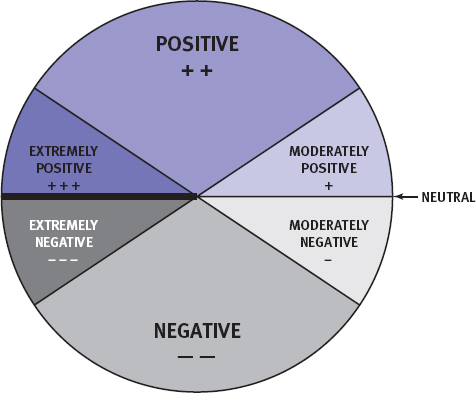
Figure 5.2 The Spectrum of Author Attitudes (Circular)
So, if an author were to claim that a particular event is impossible, this statement would fall somewhere in the extremely negative range. On the other hand, suggesting the situation was not impossible would be making a moderately positive claim, effectively saying that it was possible. Be aware, however, that some words retain their strength even when accompanied with not or some other word of opposition—for instance, must is extremely positive in charge, while must not is extremely negative in charge.
Table 5.3 lists examples of Author keywords in each category.
Table 5.3 Common Author Keywords
Positive Negative Extreme Moderating
masterpiece
disaster
must
can/could
genius
farce
need/necessary
may/might
triumph
limitation
always
possibly
excel
miss
every
probably
succeed
fail
any
sometimes
know
confuse
only
on occasion
compelling
problematic
should/ought
often
impressive
so-called
indeed
tends to
elegant
deceptive
very
here
correctly
questionably
especially
now
reasonably
merely
obviously
in this case
fortunately
purportedly
above all
in some sense
Conclusion
We began this chapter with a discussion of the modes of reading and finished with a discussion of keywords, but these two topics are closely interrelated. Reading for purpose is aided by close attention to Relation and Author keywords, while reading for reasoning is made simpler when authors use Logic keywords. As you continue your CARS practice, try the reading strategies discussed in this chapter (the modes of reading, the keyword categories, and the traffic light system) until you have a solid grasp of them. In conjunction with the other Kaplan strategies, they’ll help you get that higher score in CARS. The next chapter focuses on another CARS strategy: distilling passage information.
Concept and Strategy Summary
Reading Strategically with Keywords
- Keywords are words and short phrases that reveal passage structure and author intentions.
- When we read for content, we ask, What does the text say?
- You are never expected to have prior familiarity with the content of a passage in CARS.
- When reading for content is a struggle, reading for purpose and for reasoning can help you make sense of the passage.
- When we read for purpose, we ask, Why does the author include this? and Why does the author write?
- Reading for purpose is guided by Relation keywords and Author keywords.
- When we read for reasoning, we ask, What is the conclusion? How are claims supported? and How are claims challenged?
- Reading for reasoning is guided by Logic keywords.
- Differentiating between conclusions, evidence, and refutations can help you make sense of the author’s larger argument in the passage.
- Keywords serve as signs that indicate where you should focus your attention. As an analogy, you can consider different categories of keywords to be different colors of a traffic light (green, yellow, and red).
Relation Keywords
- Relation keywords are words and phrases that reveal specific kinds of relationships between ideas.
- Continuation keywords indicate that the following material continues in the same vein as the preceding material (green light).
- Contrast keywords signal a change in the trajectory of the passage (yellow light).
- Opposition keywords are particularly strong Contrast keywords that create a dichotomy, or divisions of entities into two categories (yellow light).
- Mutually exclusive categories do not overlap.
- When dichotomies are exhaustive, all relevant entities fit into one or the other category.
- Sequence keywords suggest a series of events advancing in time. They may also be used to set up a contrast between two time periods (yellow light).
- Comparison keywords rank ideas relative to each other (yellow light).
Logic Keywords
- Logic keywords indicate relationships of support and refutation (all types are red lights).
- Conclusion keywords signal what the author is trying to convince the audience to believe.
- Evidence keywords indicate reasons why the audience should believe the author’s claim.
- Refutation keywords signal reasons for rejecting a conclusion.
Author Keywords
- Author keywords indicate the author’s feelings or opinions about a topic (yellow light).
- Positive and Negative keywords indicate whether an author likes, agrees with, or supports a topic, or dislikes, disagrees with, or opposes a topic. An absence of either type suggests an author is neutral with respect to a topic.
- An author with an ambivalent attitude has both positive and negative opinions on a topic.
- An author with an impartial attitude has neither positive nor negative opinions on a topic.
- Extreme keywords enhance the charge of what the author is saying.
- Moderating keywords permit the author to qualify a claim, or hedge.
- The opposite of an extreme statement tends to be a moderate statement with the opposite charge.