Chapter 4: Fluids

Chapter 4: Fluids
Science Mastery Assessment
Every pre-med knows this feeling: there is so much content I have to know for the MCAT! How do I know what to do first or what’s important?
While the high-yield badges throughout this book will help you identify the most important topics, this Science Mastery Assessment is another tool in your MCAT prep arsenal. This quiz (which can also be taken in your online resources) and the guidance below will help ensure that you are spending the appropriate amount of time on this chapter based on your personal strengths and weaknesses. Don’t worry though— skipping something now does not mean you’ll never study it. Later on in your prep, as you complete full-length tests, you’ll uncover specific pieces of content that you need to review and can come back to these chapters as appropriate.
How to Use This Assessment
If you answer 0–7 questions correctly:
Spend about 1 hour to read this chapter in full and take limited notes throughout. Follow up by reviewing all quiz questions to ensure that you now understand how to solve each one.
If you answer 8–11 questions correctly:
Spend 20–40 minutes reviewing the quiz questions. Beginning with the questions you missed, read and take notes on the corresponding subchapters. For questions you answered correctly, ensure your thinking matches that of the explanation and you understand why each choice was correct or incorrect.
If you answer 12–15 questions correctly:
Spend less than 20 minutes reviewing all questions from the quiz. If you missed any, then include a quick read-through of the corresponding subchapters, or even just the relevant content within a subchapter, as part of your question review. For questions you got correct, ensure your thinking matches that of the explanation and review the Concept Summary at the end of the chapter.
- Objects A and B are submerged at a depth of 1 m in a liquid with a specific gravity of 0.877. Given that the density of object B is one-third that of object A and that the gauge pressure of object A is 3 atm, what is the gauge pressure of object B? (Note: Assume atmospheric pressure is 1 atm and g=9.8 ms2.)
- 1 atm
- 2 atm
- 3 atm
- 9 atm
- An anchor made of iron weighs 833 N on the deck of a ship. If the anchor is now suspended in seawater by a massless chain, what is the tension in the chain? (Note: The density of iron is 7800 kgm3 and the density of seawater is 1025 kgm3.)
- 100 N
- 724 N
- 833 N
- 957 N
- Two wooden balls of equal volume but different density are held beneath the surface of a container of water. Ball A has a density of 0.5 gm3, and ball B has a density of 0.7 gcm3. When the balls are released, they will accelerate upward to the surface. What is the relationship between the acceleration of ball A and that of ball B?
- Ball A has the greater acceleration.
- Ball B has the greater acceleration.
- Balls A and B have the same acceleration.
- It cannot be determined from information given.
- Water flows from a pipe of diameter 0.15 m into one of diameter 0.2 m. If the speed in the 0.15 m pipe is 8 ms, what is the speed in the 0.2 m pipe?
- 3 ms
- 3.7 ms
- 4.5 ms
- 6 ms
- A hydraulic lever is used to lift a heavy hospital bed, requiring an amount of work W. When the same bed with a patient is lifted, the work required is doubled. How can the cross-sectional area of the platform on which the bed is lifted be changed so that the pressure on the hydraulic lever remains constant?
- The cross-sectional area must be doubled.
- The cross-sectional area must be halved.
- The cross-sectional area must be divided by four.
- The cross-sectional area must remain constant.
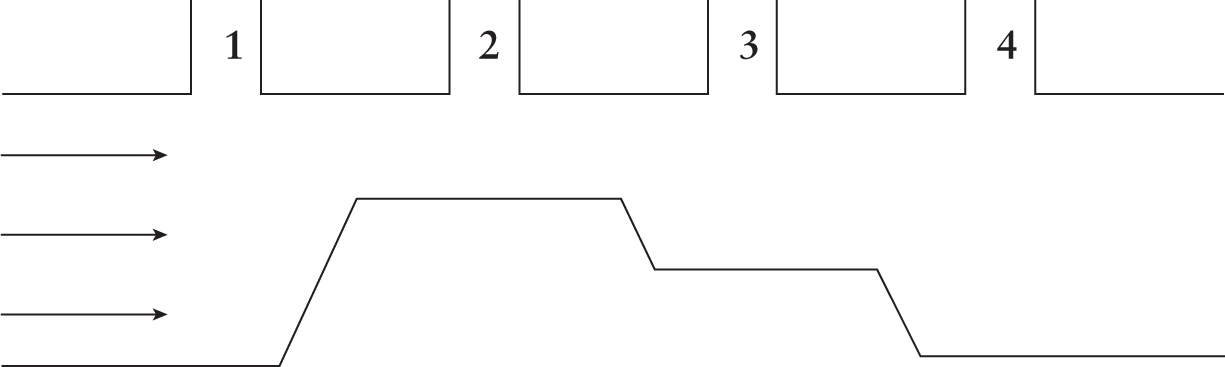
- The figure shown represents a section through a horizontal pipe of varying diameters into which four open vertical pipes connect. If water is allowed to flow through the pipe in the direction indicated, in which of the vertical pipes will the water level be lowest?
- Pipe 1
- Pipe 2
- Pipe 3
- Pipe 4
- The speed of blood in the aorta is much higher than the speed of blood through a capillary bed. How can this fact be explained using the continuity equation, assuming that we are interested in average flow and that there is no net fluid loss?
- The aorta is located higher than the capillary bed.
- The pressure in the aorta is the same as the pressure in the capillary bed.
- The cross-sectional area of all the capillaries added together is much greater than the cross-sectional area of the aorta.
- The cross-sectional area of a capillary is much smaller than the cross-sectional area of the aorta.
- Which of the following data sets is sufficient to determine the linear speed through an area of a rigid pipe?
- The cross-sectional area in another segment of pipe and the cross-sectional area in the region of interest
- The Reynolds number, viscosity of the fluid, density, and diameter of the pipe
- The radius of the pipe, pressure gradient, viscosity, and length of the pipe
- The absolute pressure and density
- An object with a density of 2 g/cm3 is submerged to a depth of 25 cm in a container of dichloromethane. If the specific gravity of dichloromethane is 1.33, what is the total pressure exerted on the submerged object?
- 3.3 kPa
- 104 kPa
- 332 kPa
- 433 kPa
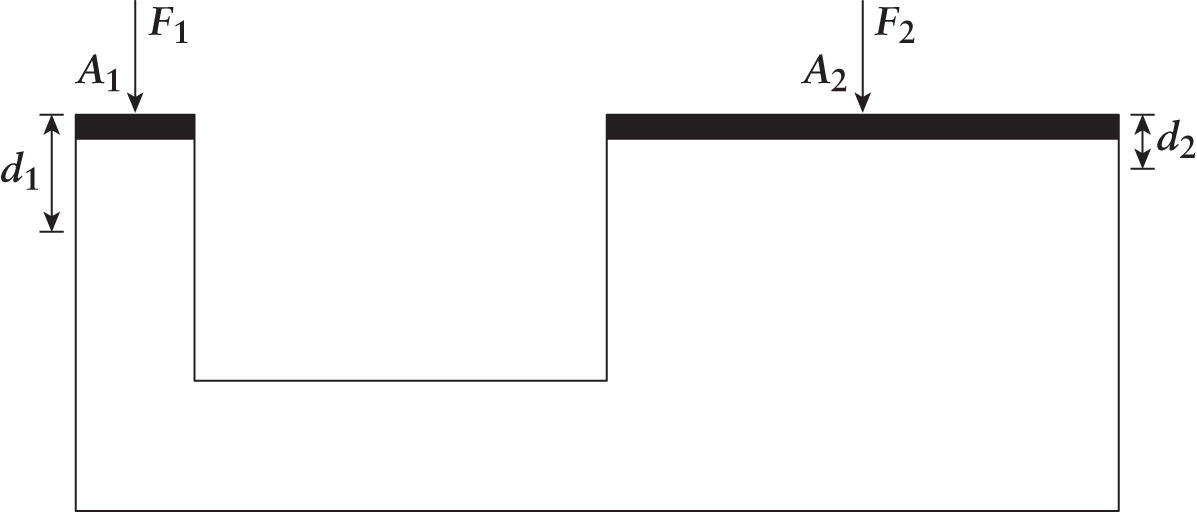
- A hydraulic system is designed to allow water levels to change depending on a force applied at the top of the tank as shown. If a force, F1, of 4 N is applied to a square, flexible cover where A1 = 16, and the area A2 = 64, what force must be applied to A2 to keep the water levels from changing?
- 4 N
- 16 N
- 32 N
- No force needs to be applied.
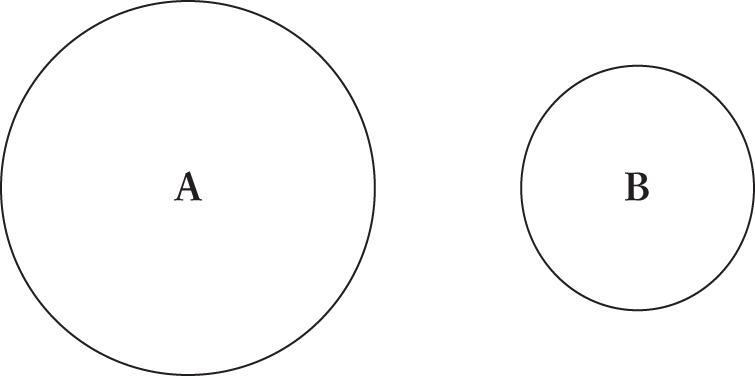
- Balls A and B of equal mass (shown below) are fully submerged in a swimming pool. Which ball will produce the greater buoyant force?
- Ball A
- Ball B
- The forces will be equal.
- It is impossible to know without knowing the exact volume of each ball.
- Which of the following correctly describes blood flow through the circulatory system?
- The flow rate is constant.
- Pressure created by the heart moves blood through venous circulation.
- The volume of blood entering and exiting the heart in a single cycle is equal.
- The resistance of an artery is greater than the resistance of an arteriole.
- A low-pressure weather system can decrease the atmospheric pressure from 1 atm to 0.99 atm. By what percent will this decrease the force on a rectangular window from the outside? (Note: Assume the window is 6 m by 3 m and the glass is 3 cm thick.)
- 1%
- 10%
- 13%
- 30%
- Two fluids, A and B, have densities of x and 2x, respectively. They are tested independently to assess absolute pressure at varying depths. At what depths will the pressure below the surface of these two fluids be equal?
- Whenever the depth of fluid A is one-half that of fluid B
- Whenever the depth of fluid A equals that of fluid B
- Whenever the depth of fluid A is 2 times that of fluid B
- Whenever the depth of fluid A is 4 times that of fluid B
- A water tower operator is interested in increasing the pressure of a column of water that is applied to a piston. The operator hopes that increasing the pressure will increase the force being applied to the piston. The only way to increase the pressure is to alter the speed of the water as it flows through the pipe to the piston. How should the speed of the water be changed to increase the pressure and force?
- Increase the speed
- Decrease the speed
- Release water intermittently against the pipe
- The speed of water will not change pressure at the piston.
Answer Key
- C
- B
- A
- C
- A
- B
- C
- C
- B
- B
- A
- C
- A
- C
- B
Chapter 4: Fluids
CHAPTER 4
FLUIDS
In This Chapter
4.1 Characteristics of Fluids and Solids
Density
Pressure
4.2 Hydrostatics
Pascal’s Principle
Archimedes’ Principle
Molecular Forces in Liquids
4.3 Fluid Dynamics
Viscosity
Laminar and Turbulent Flow
Streamlines
Bernoulli’s Equation
4.4 Fluids in Physiology
Circulatory System
Respiratory System
Concept Summary
CHAPTER PROFILE
The content in this chapter should be relevant to about 10% of all questions about physics on the MCAT.
This chapter covers material from the following AAMC content categories:
4B: Importance of fluids for the circulation of blood, gas movement, and gas exchange
4E: Atoms, nuclear decay, electronic structure, and atomic chemical behavior
Introduction
Hidden beneath the waves of the Mediterranean Sea, at depths of more than 4,000 meters, lie three lakes. The water in these “seas under the sea” is so salty—five to ten times saltier than the seawater that sits above it—that its extreme density prevents it from mixing with the ocean water above, forming a layer of separation not unlike that between the oil and vinegar in a bottle of salad dressing. These underwater lakes behave eerily like their more common cousins found at sea level. They have tides, shore lines, beach ridges, and swash zones. When deep sea exploratory vessels set down on their surfaces, the vessels bob up and down, causing ripples to emanate outward like a stone dropped in a pond.
Suboceanic lakes and rivers present a particularly fascinating opportunity to illustrate the physics of fluids and solids. This chapter covers the important concepts and principles of fluid mechanics as they are tested on the MCAT. We will begin with a review of some important terms and measurements, including density and pressure. Our next topic will be hydrostatics, the branch of fluid mechanics that characterizes the behavior of fluids at rest. We’ll then turn our attention to fluid dynamics, including Bernoulli’s equation and the aerodynamics of flight. Finally, the chapter concludes with a discussion of fluid dynamics in physiology, examining the properties that motivate the movement of blood and air within the body.
4.1 Characteristics of Fluids and Solids
LEARNING OBJECTIVES
After Chapter 4.1, you will be able to:
- Predict when gauge pressure will be equal to fluid pressure for a column of fluid
- Relate weight and density for an object
- Recall the common units for pressure, as well as the equations for gauge pressure and absolute pressure
Fluids are characterized by their ability to flow and conform to the shapes of their containers. Solids, on the other hand, do not flow and are rigid enough to retain a shape independent of their containers. Both liquids and gases are fluids. The natural gas (methane) that many of us use to cook flows through pipes to the burners of our stove and ovens, and the air that we breathe flows in and out of our lungs, filling the spaces of our respiratory tract and the alveoli.
Fluids and solids share certain characteristics. Both can exert forces perpendicular to their surface, although only solids can withstand shear (tangential) forces. Fluids can impose large perpendicular forces; falling into water from a significant height can be just as painful as falling onto a solid surface.
Density
All fluids and solids are characterized by the ratio of their mass to their volume. This is known as density, which is a scalar quantity and therefore has no direction. The equation for density is
ρ=mV
Equation 4.1
where ρ (rho) represents density, m is mass, and V is volume. The SI units for density are kgm3, but you may find it convenient to use gmL or gcm3, both of which may be seen on the MCAT. Remember that a milliliter and a cubic centimeter are the same volume. A word of caution: students sometimes assume that if the mL and the cm3 are equivalent, then so must be the liter and the m3. This is absolutely not the case; in fact, there are 1000 liters in a cubic meter. For the MCAT, it is important to know the density of water, which is 1 gcm3= `1000 kgm3.
The weight of any volume of a given substance with a known density can be calculated by multiplying the substance’s density by its volume and the acceleration due to gravity. This is a calculation that appears frequently when working through buoyancy problems on Test Day:
Fg = ρVg
Equation 4.2
The density of a fluid is often compared to that of pure water at 1 atm and 4 °C, a variable called specific gravity. It is at this combination of pressure and temperature that water has a density of exactly 1 gcm3. The specific gravity is given by
SG=ρ1 gcm3
Equation 4.3
This is a unitless number that is usually expressed as a decimal. The specific gravity can be used as a tool for determining if an object will sink or float in water, as described later in this chapter.
MCAT EXPERTISE
If an object’s density is given in gcm3, its specific gravity is simply its density as a dimensionless number. This is because the density of water in gcm3 is 1.
Example: Find the specific gravity of benzene, given that its density is 877 kgm3.
Solution: The ratio of the density of benzene to the density of water is the specific gravity. Either the numerator must be converted to gcm3 or the denominator (the density of water) must be given in kgm3:
SG=ρ1000 kgm3=8771000=0.877
Pressure
Pressure is a ratio of the force per unit area. The equation for pressure is
P=FA
Equation 4.4
where P is pressure, F is the magnitude of the normal force vector, and A is the area. The SI unit of pressure is the pascal (Pa), which is equivalent to the newton per square meter (1 Pa=1 Nm2). Other commonly used units of pressure are millimeters of mercury (mmHg), torr, and the atmosphere (atm). Millimeters of mercury and torr are identical units. The unit of atmosphere is based on the average atmospheric pressure at sea level. The conversions between Pa, mmHg, torr, and atm are as follows:
1.013 × 10⁵ Pa = 760 mmHg ≡ 760 torr = 1 atm
MCAT EXPERTISE
If you ever forget the units of a variable, you can derive them from equations. You know that pressure equals force over area. Because you know the units of force (N) and area (m2), you can solve for the base units of pascal by plugging these units into the equation: Nm2.
Pressure is a scalar quantity, and therefore has a magnitude but no direction. It is easy to assume that pressure has a direction because it is related to a force, which is a vector. However, note that it is the magnitude of the normal force that is used. No matter where one positions a given surface, the pressure exerted on that surface within a closed container will be the same, neglecting gravity. For example, if we placed a surface inside a closed container filled with gas, the individual molecules, which are moving randomly within the space, will exert pressure that is the same at all points within the container. Because the pressure is the same at all points along the walls of the container and within the space of the container itself, pressure applies in all directions at any point and, therefore, is a scalar rather than a vector. Of course, because pressure is a ratio of force to area, when unequal pressures are exerted against objects, the forces acting on the object will add in vectors, possibly resulting in acceleration. It’s this difference in pressure that causes air to rush into and out of the lungs during respiration, windows to burst outward during a tornado, and the plastic covering a broken car window to bubble outward when the car is moving. Note that when gravity is present, this also results in a pressure differential, which we will explore with hydrostatics later in this chapter.
Example: The window of a skyscraper measures 2.0 m by 3.5 m. If a storm passes by and lowers the pressure outside the window to 0.997 atm while the pressure inside the building remains at 1 atm, what is the net force pushing on the window?
Solution: Because the pressures are different on the two sides of this window, there will be a net force pushing on it in the direction of the lower pressure (outside the window). The difference in pressure itself can be used to determine the net force:
Fnet=PnetA=(Pinside−Poutside)A=(1−0.997 atm)(1.013×10⁵ Pa1 atm)(2.0 m×3.5 m)≈(0.003)(105)(7.0)=(3×10⁻³)(105)(7.0)=21×102=2100 N(actual=2128 N)
Absolute Pressure
At this very moment, countless trillions of air molecules are exerting tremendous pressure on our bodies, with a total force of about 2 × 10⁵ N! Of course, we don’t actually feel all this pressure because our internal organs exert a pressure that perfectly balances it.
Atmospheric pressure changes with altitude. Residents of Denver (5280 feet above sea level) experience atmospheric pressure equal to 632 mmHg (0.83 atm), whereas travelers making their way through Death Valley (282 feet below sea level) experience atmospheric pressure equal to 767 mm Hg (1.01 atm). Atmospheric pressure impacts a number of processes, including hemoglobin’s affinity for oxygen and the boiling of liquids.
Absolute (hydrostatic) pressure is the total pressure that is exerted on an object that is submerged in a fluid. Remember that fluids include both liquids and gases. The equation for absolute pressure is
P = P0 + ρgz
Equation 4.5
where P is the absolute pressure, P0 is the incident or ambient pressure (the pressure at the surface), ρ is the density of the fluid, g is acceleration due to gravity, and z is the depth of the object. Do not make the mistake of assuming that P0 always stands for atmospheric pressure. In open air and most day-to-day situations P0 is equal to 1 atm, but in other fluid systems, the surface pressure may be higher or lower than atmospheric pressure. In a closed container, such as a pressure cooker, the pressure at the surface may be much higher than atmospheric pressure. This is, in fact, exactly the point of a pressure cooker, which allows food to cook at higher temperatures. This is because the increased pressure raises the boiling point of water in the food, thus reducing the cooking time and preventing loss of moisture.
REAL WORLD
A useful way to remember the two parts of the absolute pressure equation is to think of diving into a swimming pool. At the surface of the water, the absolute pressure is usually equal to the atmospheric pressure (P0). But if you dive into the pool, the water exerts an extra pressure on you (ρgz), in addition to the surface pressure. You feel this extra pressure on your eardrums.
Gauge Pressure
When you check the pressure in car or bike tires using a device known as a gauge, you are measuring the gauge pressure, which is the difference between the absolute pressure inside the tire and the atmospheric pressure outside the tire. In other words, gauge pressure is the amount of pressure in a closed space above and beyond atmospheric pressure. This is a more common pressure measurement than absolute pressure, and the equation is:
Pgauge = P – Patm = (P0 + ρgz) – Patm
Equation 4.6
Note that when P0 = Patm, then Pgauge = P – P0 = ρgz at a depth z.
Example: A diver in the ocean is 20 m below the surface. What is the gauge pressure at that depth? What is the absolute pressure the diver experiences? (Note: The density of sea water is 1025 kgm3.)
Solution: Since the pressure at the surface (Po) is equal to atmospheric pressure (Patm), we can first solve for gauge pressure using the equation:
Pgauge=ρgz=(1025 kgm3)(9.8 ms2)(20 m)≈(1000)(10)(20)=2×10⁵ Pa(actual=2.01×10⁵ Pa)
Then, we can solve for absolute pressure using the absolute pressure equation:
P = Patm + Pgauge = 1.013 × 10⁵ Pa + 2.01 × 10⁵ Pa = 3.02 x 10⁵ Pa
MCAT CONCEPT CHECK 4.1
Before you move on, assess your understanding of the material with these questions.
- How does gauge pressure relate to the pressure exerted by a column of fluid?
_________________________________
_________________________________
- What is the relationship between weight and density?
_________________________________
_________________________________
- What is the SI unit for pressure? What are other common units of pressure?
- SI unit:
_________________________________
- Other units:
_________________________________
- True or False: Density is a scalar quantity.
4.2 Hydrostatics
LEARNING OBJECTIVES
After Chapter 4.2, you will be able to:
- Distinguish between cohesion and adhesion
- Predict the appearance of the meniscus of a fluid given knowledge of its cohesive and adhesive properties
- Calculate the buoyant force acting on an object
- Apply the concept of specific gravity
- Solve hydraulic lift problems using Pascal’s principle:
Hydrostatics is the study of fluids at rest and the forces and pressures associated with standing fluids. A proper understanding of hydrostatics is important for the MCAT because the testmakers frequently include passages and questions on hydraulics and buoyancy.
Pascal’s Principle
For fluids that are incompressible—that is, fluids with volumes that cannot be reduced by any significant degree through application of pressure—a change in pressure will be transmitted undiminished to every portion of the fluid and to the walls of the containing vessel. This is Pascal’s principle. For example, an unopened carton of milk could be considered an incompressible fluid in a closed container. If one were to squeeze the container, exerting an increased pressure on the sides of the milk carton, the applied pressure would be transmitted through the entire volume of milk. If the cap were to suddenly pop off, the resulting geyser of milk would be evidence of this increased pressure.
REAL WORLD
When the air pressure changes above a large body of water, the water level rises or falls to re-establish pressure equilibrium between the air and the water. The surface of a water body directly below a high-pressure air pocket forms a very small but measurable valley of water. A low-pressure air system has the opposite effect, creating a hill of water.
One application of Pascal’s principle can be seen in hydraulic systems. These systems take advantage of the near-incompressibility of liquids to generate mechanical advantage, which, as we’ve seen in our discussion of inclined planes and pulleys in Chapter 2 of MCAT Physics and Math Review, allows us to accomplish a certain amount of work more easily by applying reduced forces. Many heavy machines use hydraulics, including car brakes, bulldozers, cranes, and lifts.
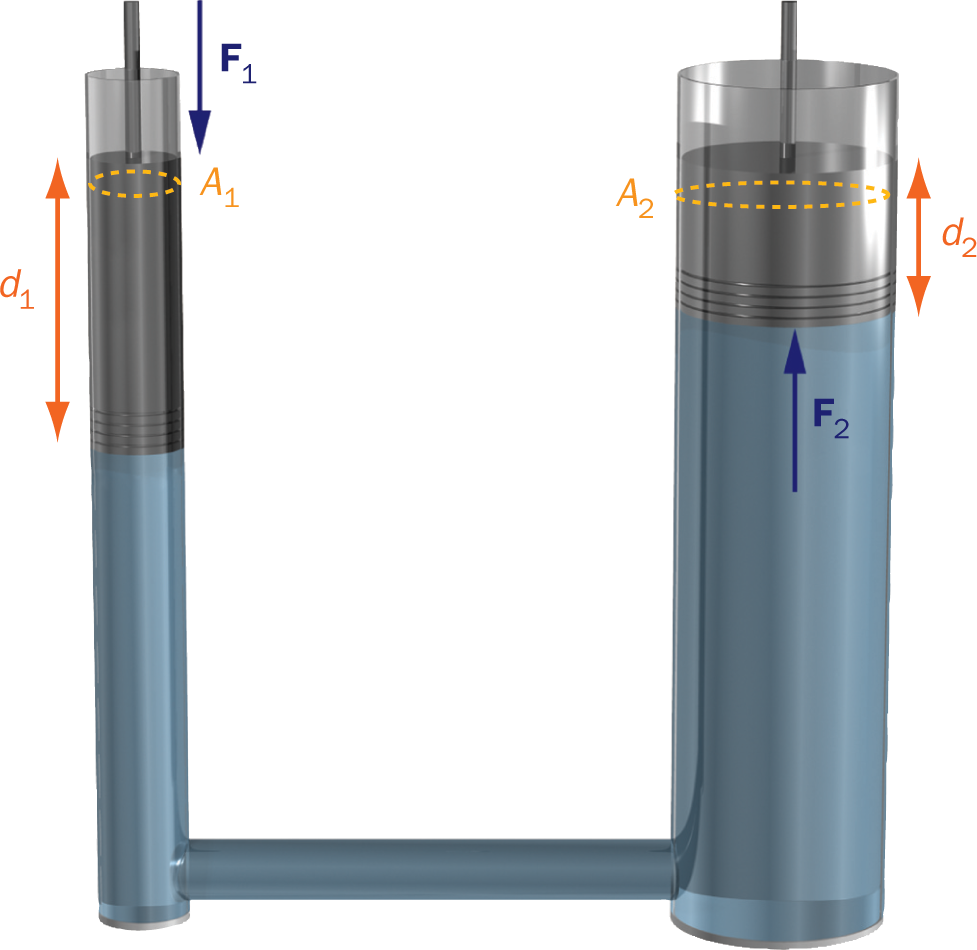
Figure 4.1 shows a simple diagram of a hydraulic lift. Let’s determine how such a lift could allow an auto mechanic to raise a heavy car with far less force than the weight of the car. We have a closed container that is filled with an incompressible liquid. On the left side of the lift, there is a piston of cross-sectional area A1. When this piston is pushed down the column, it exerts a force with a magnitude equal to F1 and generates a pressure equal to P1. The piston displaces a volume of liquid equal to A1d1 (the cross-sectional area times the distance gives a volume). Because the liquid inside is incompressible, the same volume of fluid must be displaced on the right side of the hydraulic lift, where we find a second piston with a much larger surface area, A2. The pressure generated by piston 1 is transmitted undiminished to all points within the system, including to A2. As A2 is larger than A1 by some factor, the magnitude of the force, F2, exerted against A2 must be greater than F1 by the same factor so that P1 = P2, according to Pascal’s principle.
P=F1A1=F2A2F2=F1(A2A1)
Equation 4.7
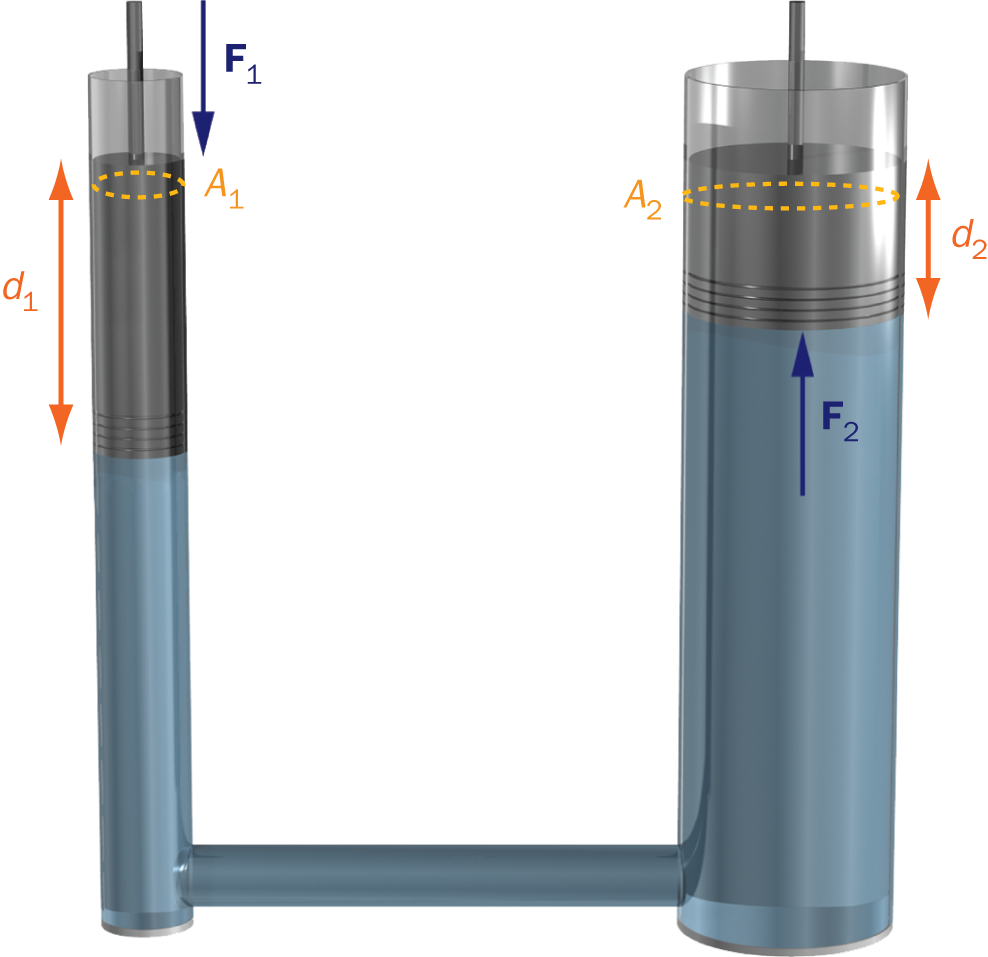
Figure 4.1. Hydraulic Lift
What this series of equations shows us is that hydraulic machines generate output force by magnifying an input force by a factor equal to the ratio of the cross-sectional area of the larger piston to that of the smaller piston. This does not violate the law of energy conservation; an analysis of the input and output work in a frictionless system reveals that there is indeed conservation of energy. As mentioned above, the volume of fluid displaced by piston 1 is equal to the volume of fluid displaced at piston 2.
V=A1d1=A2d2d2=d1(A1A2)
Combining the equations for pressure and volume, we can generate an equation for work as the product of constant pressure and volume change, as this is an isobaric process.
W=PΔV=F1A1(A1d1)=F2A2(A2d2)=F1d1=F2d2
This shows us the familiar form of work as the product of the magnitude of force and displacement (times the cosine of the angle between them, which is 0° in this case). Because the factor by which d1 is larger than d2 is equal to the factor by which F2 is larger than F1, we see that no additional work has been done or unaccounted for; the greater force F2 is moving through a smaller distance d2. Therefore, an auto mechanic needs only to exert a small force over a small area through a large distance to generate a much larger force over a larger area through a smaller distance.
KEY CONCEPT
Remember when applying Pascal’s principle that the larger the area, the larger the force, although this force will be exerted through a smaller distance.
Example: A hydraulic press has a piston of radius 5 cm, which pushes down on an enclosed fluid. A 50 kg weight rests on this piston. Another piston in contact with this system has a radius of 20 cm. Taking g=10ms2, what force is needed on the larger piston to keep the press in equilibrium?
Solution: Use Pascal’s principle:
P=F1A1=F2A2F2=F1A2A1=m1gπr22πr12=m1gr2r12F2=(50 kg)10 ms220 cm5 cm2=50042=50016=8000 N
Archimedes’ Principle
You may have heard some version of this story before: Archimedes, a physicist in ancient Greece, was tasked by his king to determine the metallic composition of a certain crown given to the king as a gift. Archimedes knew that he could do this by finding the crown’s volume and mass, which would allow him to find its density and compare that density to those of known metals. Weighing the crown would be easy enough, but he was having trouble finding a way to measure its volume without melting it down and ruining its workmanship. Then one day, while getting into his bath, the water that overflowed from the tub gave him the idea to submerge the crown in water and measure the volume of the displaced liquid—Eureka!
The principle that derives from the story is one of Archimedes’ lasting contributions to the field of physics. Archimedes’ principle deals with the buoyancy of objects when placed in a fluid. It helps us understand how ships stay afloat and why we feel lighter when we’re swimming. The principle states that a body wholly or partially immersed in a fluid will be buoyed upwards by a force equal to the weight of the fluid that it displaces.
Just as Archimedes’ body and his crown caused the water level to rise in the tub, any object placed in a fluid will cause a volume of fluid to be displaced equal to the volume of the object that is submerged. Because all fluids have density, the volume of fluid displaced will correspond to a certain mass of that fluid. The mass of the fluid displaced exerts a force equal to its weight against the submerged object. This force, which is always directed upward, is called the buoyant force, and its magnitude is given by:
Fbuoy = ρfluidVfluid displacedg = ρfluidVsubmergedg
Equation 4.8
MCAT EXPERTISE
The most common mistake students make using the buoyancy equation is to use the density of the object rather than the density of the fluid. Remember always to use the density of the fluid itself.
When an object is placed in a fluid, it will sink into the fluid only to the point at which the volume of displaced fluid exerts a force that is equal to the weight of the object. If the object becomes completely submerged and the volume of displaced fluid still does not exert a buoyant force equal to the weight of the object, the object will accelerate downward and sink to the bottom. This will be the case if an object is more dense than the fluid it’s in—a gold crown will sink to the bottom of the bathtub because it is denser than water. On the other hand, an object that is less dense than water, such as a block of wood or an ice cube, will stop sinking (and start floating) because it is less dense than water. These objects will submerge enough of their volume to displace a volume of water equal to the object’s weight.
KEY CONCEPT
An object will float if its average density is less than the average density of the fluid it is immersed in. It will sink if its average density is greater than that of the fluid.
One way to conceptualize the buoyant force is that it is the force of the liquid trying to return to the space from which it was displaced, thus trying to push the object up and out of the water. This is an important concept because the buoyant force is due to the liquid itself, not the object. If two objects placed in a fluid displace the same volume of fluid, they will experience the same magnitude of buoyant force even if the objects themselves have different masses.
How can one determine how much of a floating object lies below the surface? To do this, one can make comparisons of density or specific gravity. Remember that an object will float, no matter what it is made of and no matter how much mass it has, if its average density is less than or equal to the density of the fluid into which it is placed. If we express the object’s specific gravity as a percent, this directly indicates the percent of the object’s volume that is submerged (when the fluid is pure water). For instance, the density of ice is 0.92 gcm3, so its specific gravity is 0.92. An ice cube floating in a glass of water has 92 percent of its volume submerged in the water—only 8 percent is sitting above the surface. Therefore, any object with a specific gravity less than or equal to 1 will float in water and any object with a specific gravity greater than 1 will sink in water. A specific gravity of exactly 1 indicates that 100 percent of the object will be submerged but it will not sink.
REAL WORLD
At first it may seem strange that cruise ships, constructed of dense metals and weighing thousands of kilograms, can float on water. But remember that any object will float if its average density is less than that of water. The steel hull of the ship would sink by itself, but all the air submerged beneath the water level, between the ship’s lower decks, lowers the ship’s average density to be less than that of water.
Example: A wooden block floats in the ocean with half its volume submerged. Find the density of the wood ρb. (Note: The density of sea water is 1025 kgm3.)
Solution: The magnitude of the weight of the block of total volume Vb is
Fg,b = mbg = ρbVbg
The weight of the displaced seawater is the buoyant force and is given by
Fbuoy = mwaterg = ρwaterVwaterg
Vwater is the volume of displaced water, which is also the volume of the part of the block that is submerged (Vb2). Because the block is floating, the buoyant force equals the block’s weight:
Fg,b=FbuoyρbVbg=ρwater(Vb2)gρb=ρwater2=1025 kgm32=512.5 kgm3
REAL WORLD
The Dead Sea is the deepest hypersaline lake in the world. Having a salt content of about 35 percent, it is almost nine times saltier than the ocean. All of this dissolved salt makes for some of the densest water on the surface of the Earth, with a specific gravity of 1.24. Humans have a specific gravity around 1.1; thus, in most bodies of water, we have a tendency to sink—but in the Dead Sea, one is unable to do anything but float.
Molecular Forces in Liquids
Water striders are insects that have the ability to walk on water. Water striders are able to glide across the water’s surface without sinking, even though they are denser than water, because of a special physical property of liquids at the interface between a liquid and a gas. Surface tension causes the liquid to form a thin but strong layer like a “skin” at the liquid’s surface. Surface tension results from cohesion, which is the attractive force that a molecule of liquid feels toward other molecules of the same liquid. Consider the intermolecular forces between the separate molecules of liquid water. For those molecules below the surface, there are attractive intermolecular forces coming from all sides; these forces balance out. However, on the surface, the molecules only have these strong attractive forces from the molecules below them, which pulls the surface of the liquid toward the center. This establishes tension in the plane of the surface of the water; when there is an indentation on the surface (say, caused by a water strider’s foot), then the cohesion can lead to a net upward force.
REAL WORLD
Remember that cohesion occurs between molecules with the same properties. In a container of both water and oil, the water molecules will be cohesive with other water molecules, and the oil will be cohesive with other oil molecules.
Another force that liquid molecules experience is adhesion, which is the attractive force that a molecule of the liquid feels toward the molecules of some other substance. For example, adhesive forces cause water molecules to form droplets on the windshield of a car even though gravity is pulling them downward. When liquids are placed in containers, a meniscus, or curved surface in which the liquid “crawls” up the side of the container a small amount, will form when the adhesive forces are greater than the cohesive forces. A backwards (convex) meniscus (with the liquid level higher in the middle than at the edges) occurs when the cohesive forces are greater than the adhesive forces. Mercury, the only metal that is liquid at room temperature, forms a backward meniscus when placed in a container. Both types of menisci are shown in Figure 4.2.
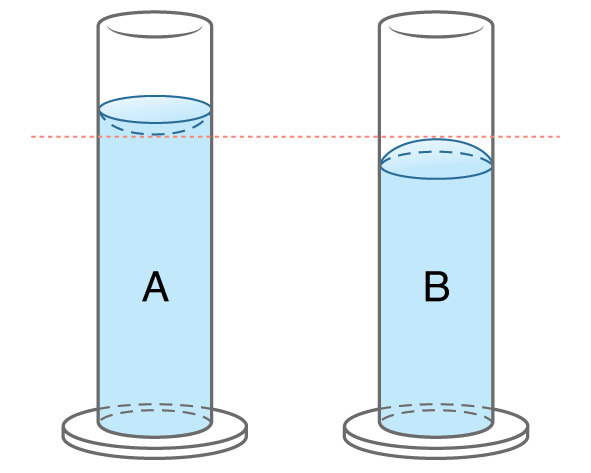
Figure 4.2. Types of Menisci (A) A concave meniscus (more common); (B) A convex (backwards) meniscus. The dotted line indicates where measurements of depth or volume should be taken with each type of meniscus.
MCAT CONCEPT CHECK 4.2
Before you move on, assess your understanding of the material with these questions.
- Contrast cohesion and adhesion.
- Cohesion:
_________________________________
- Adhesion:
_________________________________
- What would the meniscus of a liquid that experiences equal cohesive and adhesive forces look like?
_________________________________
- A block is fully submerged three inches below the surface of a fluid, but is not experiencing any acceleration. What can be said about the displaced volume of fluid and the buoyant force?
_________________________________
- True or False: To determine the volume of an object by fluid displacement it must have a specific gravity greater than 1.
- To which side of a hydraulic lift would the operator usually apply a force—the side with the larger cross-sectional area, or the side with the smaller cross-sectional area? Why?
_________________________________
4.3 Fluid Dynamics
LEARNING OBJECTIVES
After Chapter 4.3, you will be able to:
- Describe laminar flow, turbulent flow, dynamic and static pressure, pitot tubes, and viscosity
- Predict the behavior of fluids using the continuity equation, Bernoulli’s equation, and the Venturi effect
- Recall the variables involved in flow rate
As the term suggests, fluid dynamics is the study of fluids in motion. This is perhaps one of the most fascinating areas of physics because its applications to real life are everywhere. Many aspects of our world, from water delivery to our homes to blood flow through our arteries and veins, can be analyzed and explained (at least in part) by the principles of fluid dynamics. The MCAT presents a relatively simplified version of the topic, making important assumptions such as rigid-walled containers and uniform density of fluids.
Viscosity
Some fluids flow very easily, while others barely flow at all. The resistance of a fluid to flow is called viscosity (η). Increased viscosity of a fluid increases its viscous drag, which is a nonconservative force that is analogous to air resistance. Thin fluids, like gases, water, and dilute aqueous solutions, have low viscosity and so they flow easily. Objects can move through these fluids with low viscous drag. Whole blood, vegetable oil, honey, cream, and molasses are thick fluids and flow more slowly. Objects can move through these fluids, but with significantly more viscous drag.
All fluids (except superfluids, which are not tested on the MCAT) are viscous to one degree or another; those with lower viscosities are said to behave more like ideal fluids, which have no viscosity and are described as inviscid. Because viscosity is a measure of a fluid’s internal resistance to flow, more viscous fluids will “lose” more energy while flowing. Unless otherwise indicated, viscosity should be assumed to be negligible on Test Day, thus allowing Bernoulli’s equation (explained later in this chapter) to be an expression of energy conservation for flowing fluids.
The SI unit of viscosity is the pascal–second (Pa⋅s = N⋅ sm2).
KEY CONCEPT
Low-viscosity fluids have low internal resistance to flow and behave like ideal fluids. Assume conservation of energy in low-viscosity fluids with laminar flow.
Laminar and Turbulent Flow
When a fluid is moving, its flow can be laminar or turbulent. Laminar flow is smooth and orderly, and is often modeled as layers of fluid that flow parallel to each other, as shown in Figure 4.3.
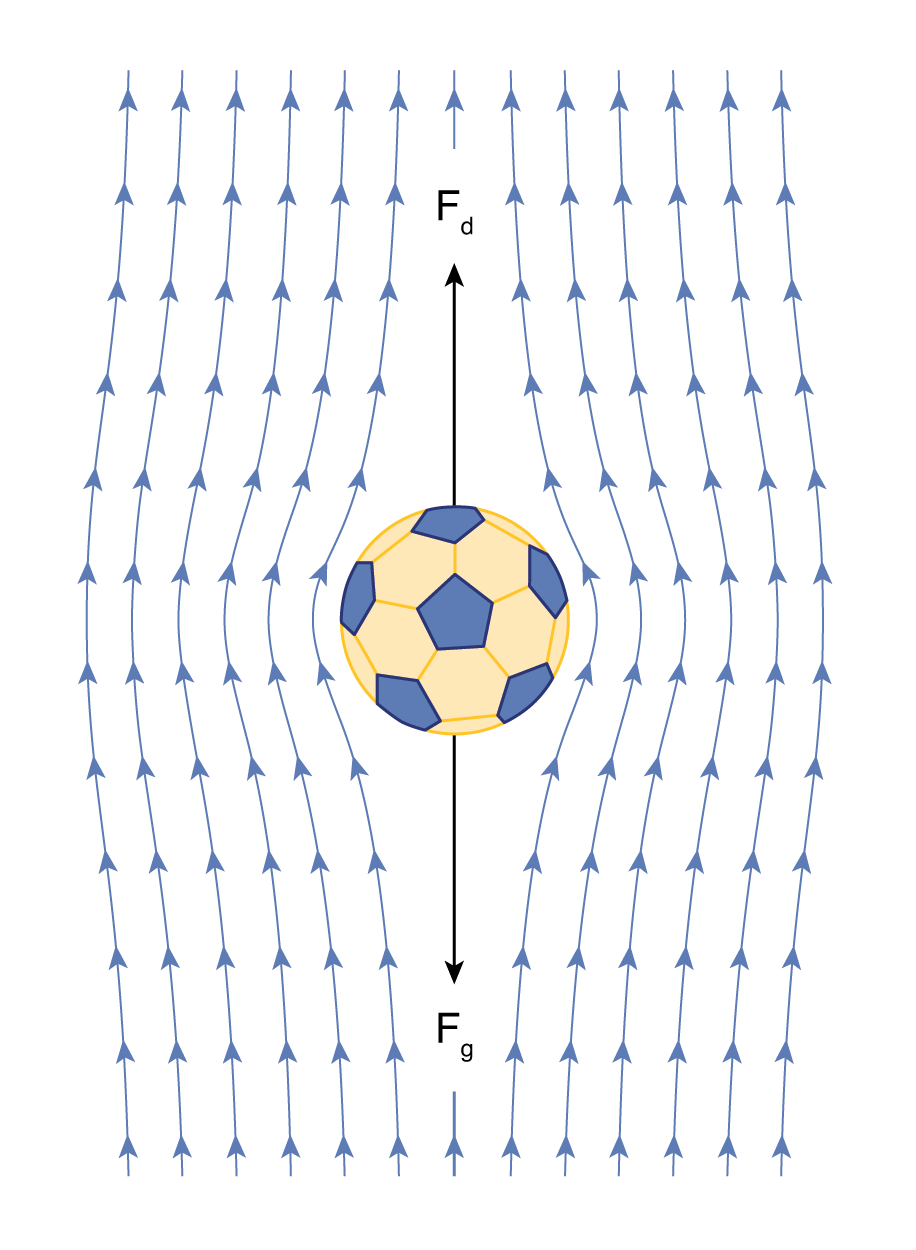
Figure 4.3. Laminar Flow around an Object in a Fluid When the gravitational force is larger than the buoyant force, an object will sink. Laminar flow is characterized by smooth flow lines around the object.
The layers will not necessarily have the same linear speed. For example, the layer closest to the wall of a pipe flows more slowly than the more interior layers of fluid.
Poiseuille’s Law
With laminar flow through a pipe or confined space, it is possible to calculate the rate of flow using Poiseuille’s law:
Q=πr4ΔP8ηL
Equation 4.9
where Q is the flow rate (volume flowing per time), r is the radius of the tube, ΔP is the pressure gradient, η (eta) is the viscosity of the fluid, and L is the length of the pipe. This equation is rarely tested in full; most often, MCAT passages and questions focus on the relationship between the radius and pressure gradient. Note that the relationship between the radius and pressure gradient is inverse exponential to the fourth power—even a very slight change in the radius of the tube has a significant effect on the pressure gradient, assuming a constant flow rate.
Turbulence and Speed
Turbulent flow is rough and disorderly. Turbulence causes the formation of eddies, which are swirls of fluid of varying sizes occurring typically on the downstream side of an obstacle, as shown in Figure 4.4.
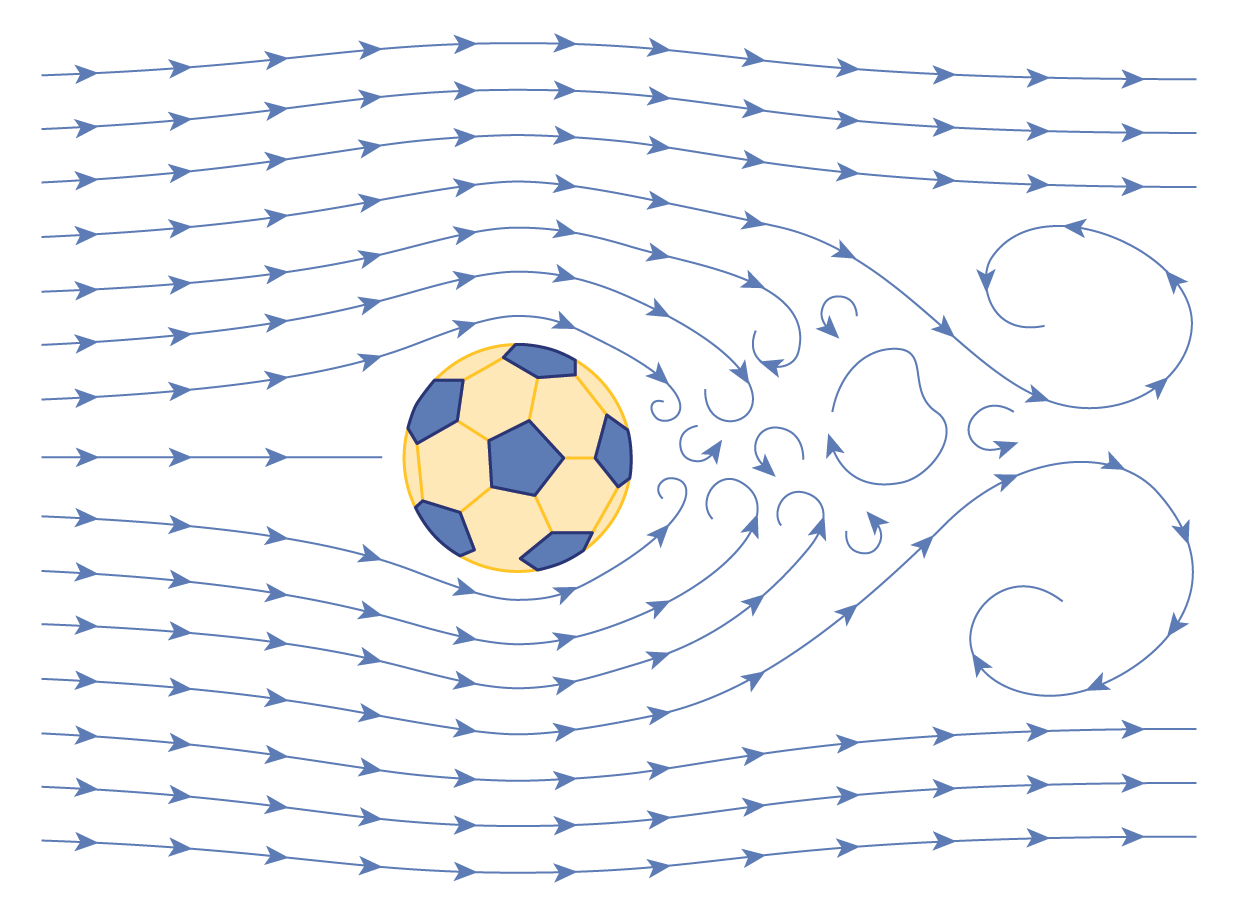
Figure 4.4. Turbulent Flow around an Object in a Fluid Eddy formation downstream of an object obstructing laminar flow.
In unobstructed fluid flow, turbulence can arise when the speed of the fluid exceeds a certain critical speed. This critical speed depends on the physical properties of the fluid, such as its viscosity and the diameter of the tube. When the critical speed for a fluid is exceeded, the fluid demonstrates complex flow patterns, and laminar flow occurs only in the thin layer of fluid adjacent to the wall, called the boundary layer. The flow speed immediately at the wall is zero and increases uniformly throughout the layer. Beyond the boundary layer, however, the motion is highly irregular and turbulent. A significant amount of energy is dissipated from the system as a result of the increased frictional forces. Calculations of energy conservation, such as Bernoulli’s equation, cannot be applied to turbulent flow systems. Luckily, the MCAT always assumes laminar (nonturbulent) flow for such questions.
For a fluid flowing through a tube of diameter D, the critical speed, vc, can be calculated as
vc=NRηρD
Equation 4.10
where vc is the critical speed, NR is a dimensionless constant called the Reynolds number, η is the viscosity of the fluid, and ρ is the density of the fluid. The Reynolds number depends on factors such as the size, shape, and surface roughness of any objects within the fluid.
Streamlines
Because the movement of individual molecules of a fluid is impossible to track with the unaided eye, it is often helpful to use representations of the molecular movement called streamlines. Streamlines indicate the pathways followed by tiny fluid elements (sometimes called fluid particles) as they move. The velocity vector of a fluid particle will always be tangential to the streamline at any point. Streamlines never cross each other.
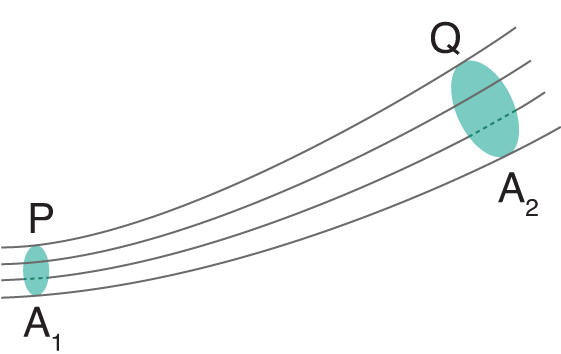
Figure 4.5. Streamlines The stream’s cross-sectional area increases from P to Q.
Figure 4.5 shows a fluid within an invisible tube as it passes from P to Q. The streamlines indicate some, but not all, of the pathways for the fluid along the walls of the tube. You’ll notice that the tube gets wider toward Q, as indicated by the streamlines that are spreading out over the increased cross-sectional area. This leads us to consider the relationship between flow rate and the cross-sectional area of the container through which the fluid is moving. Once again, we can assume that the fluid is incompressible (which means that we are not considering a flowing gas). Because the fluid is incompressible, the rate at which a given volume (or mass) of fluid passes by one point must be the same for all other points in the closed system. This is essentially an expression of conservation of matter: if x liters of fluid pass a point in a given amount of time, then x liters of fluid must pass all other points in the system in the same amount of time. Thus, we can very clearly state, without any exceptions, the flow rate (that is, the volume per unit time) is constant for a closed system and is independent of changes in cross-sectional area.
While the flow rate is constant, the linear speed of the fluid does change relative to cross-sectional area. Linear speed is a measure of the linear displacement of fluid particles in a given amount of time. Notably, the product of linear speed and cross-sectional area is equal to the flow rate. We’ve already said that the volumetric rate of flow for a fluid must be constant throughout a closed system. Therefore:
Q = v1A1 = v2A2
Equation 4.11
where Q is the flow rate, v1 and v2 are the linear speeds of the fluid at points 1 and 2, respectively, and A1 and A2 are the cross-sectional areas at these points. This equation is known as the continuity equation, and it tells us that fluids will flow more quickly through narrow passages and more slowly through wider ones. Therefore, in Figure 4.5 earlier, while the flow rate at points P and Q are the same, the linear speed is faster at point P than point Q.
KEY CONCEPT
While flow rate is constant in a tube regardless of cross-sectional area, linear speed of a fluid will increase with decreasing cross-sectional area.
Bernoulli’s Equation
Before we cover Bernoulli’s equation itself, let’s approach a flowing fluid from two perspectives that we’ve already discussed. First, the continuity equation arises from the conservation of mass of fluids. Liquids are essentially incompressible, so the flow rate within a closed space must be constant at all points. The continuity equation shows us that for a constant flow rate, there is an inverse relationship between the linear speed of the fluid and the cross-sectional area of the tube: fluids have higher speeds through narrower tubes.
Second, fluids that have low viscosity and demonstrate laminar flow can also be approximated to be conservative systems. The total mechanical energy of the system is constant if we discount the small viscous drag forces that occur in all real liquids.
Combining these principles of conservation, we arrive at Bernoulli’s equation:
P1+12ρv12+ρgh1=P2+12ρv22+ρgh2
Equation 4.12
where P is the absolute pressure of the fluid, ρ is the density of the fluid, v is the linear speed, g is acceleration due to gravity, and h is the height of the fluid above some datum. Some of the terms of Bernoulli’s equation should look vaguely familiar. The term 12ρv2 is sometimes called the dynamic pressure, and is the pressure associated with the movement of a fluid. This term is essentially the kinetic energy of the fluid divided by volume (ρ=mV). The term ρgh looks like the expression for gravitational potential energy, and is essentially the pressure associated with the mass of fluid sitting above some position. Finally, let’s consider how the absolute pressure fits into this conservation equation. If one multiplies the unit of pressure (Nm2) by meters over meters, we obtain N⋅mm3=Jm3. Pressure can therefore be thought of as a ratio of energy per cubic meter, or energy density. Systems at higher pressure have a higher energy density than systems at lower pressure. Finally, the combination of P + ρgh gives us the static pressure, and is the same equation as that for absolute pressure (although h is used here to imply height above a certain point, whereas z was used earlier to imply depth below a certain point). Bernoulli’s equation states, then, that the sum of the static pressure and dynamic pressure will be constant within a closed container for an incompressible fluid not experiencing viscous drag. In the end, Bernoulli’s equation is nothing other than a statement of energy conservation: more energy dedicated toward fluid movement means less energy dedicated toward static fluid pressure. The inverse of this is also true—less movement means more static pressure. One example of this principle that you may have previously encountered is how the shape of an airplane’s wing helps generate lift, as shown in Figure 4.6.
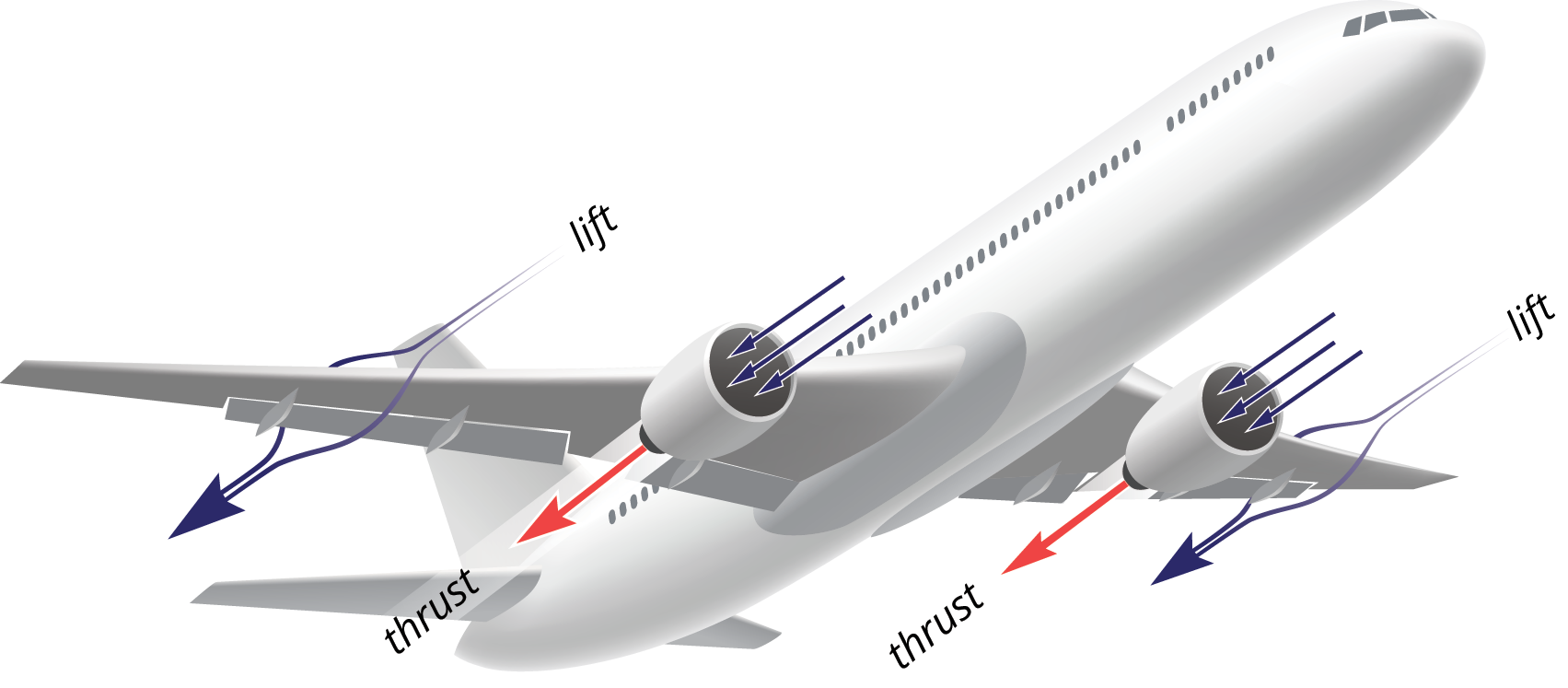
Figure 4.6. Aerodynamics of an Airplane
Propeller and jet engines generate thrust by pushing air backward. In both cases, because the wing top is curved, air streaming over it must travel farther and thus faster than air passing underneath the flat bottom. According to Bernoulli’s equation, the slower air below exerts more force on the wing than the faster air above, thereby lifting the plane. Another example of Bernoulli’s equation in action is the use of pitot tubes. These are specialized measurement devices that determine the speed of fluid flow by determining the difference between the static and dynamic pressure of the fluid at given points along a tube.
A common application of Bernoulli’s equation on the MCAT is the Venturi flow meter, as shown in Figure 4.7.
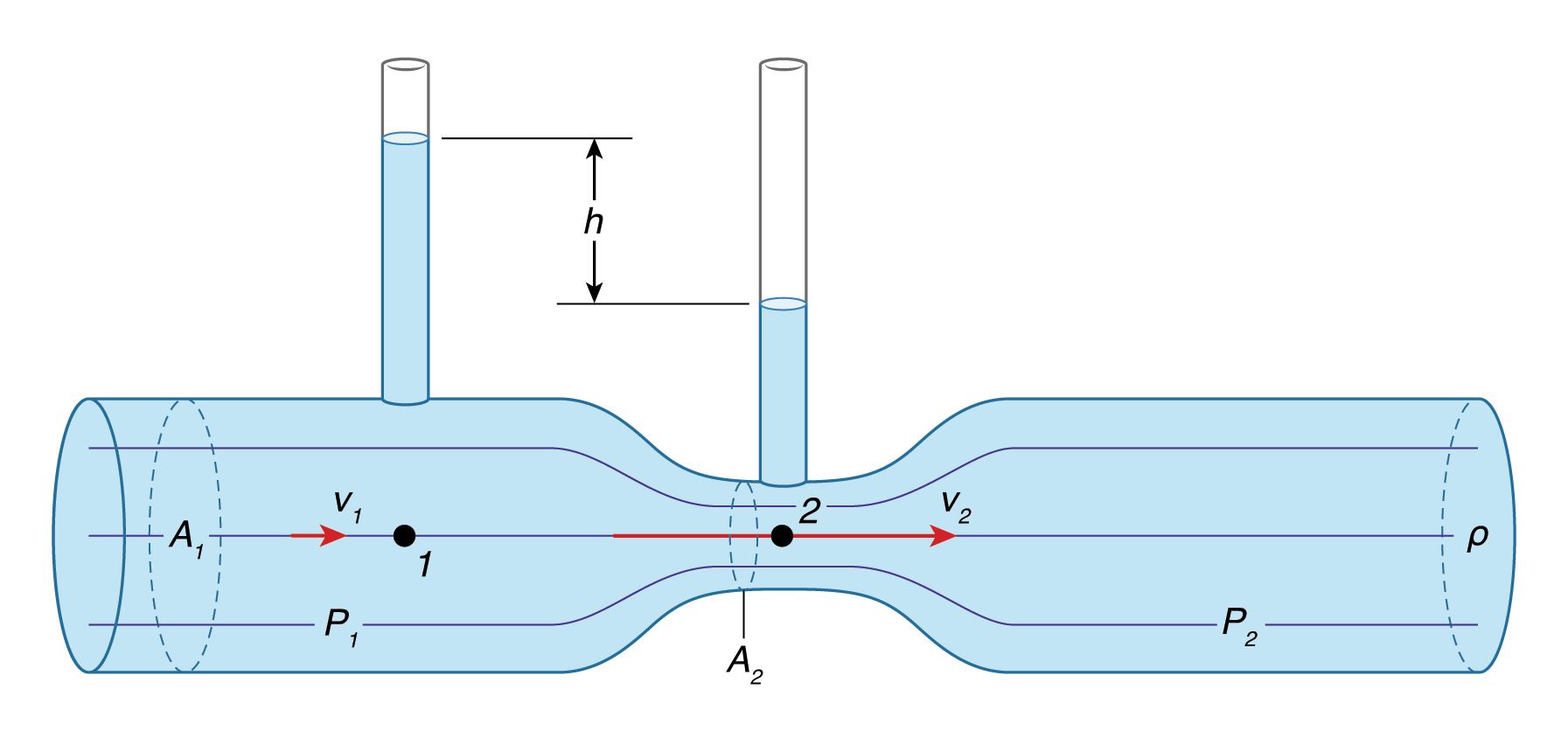
Figure 4.7. Venturi Flow Meter As the tube narrows, the linear speed increases at point 2. Thus, the pressure exerted on the walls decreases, causing the column above the tube to have a lower height at point 2.
When considering Bernoulli’s equation in this example, start by noting that the average height of the tube itself remains constant. Therefore, the ρgh term remains constant at points 1 and 2. Note that the h shown in Figure 4.7 is the difference in height between the two columns at points 1 and 2, not h from Bernoulli’s equation, which corresponds to the average height of the tube above a datum. As the cross-sectional area decreases from point 1 to point 2, the linear speed must increase according to the continuity equation. Then, as the dynamic pressure increases, the absolute pressure must decrease at point 2. With a lower absolute pressure, the column of fluid sticking up from the Venturi tube will be lower at point 2. This phenomenon is often called the Venturi effect.
Example: An office building with a bathroom 40 m above the ground has its water supply enter the building at ground level through a pipe with an inner diameter of 4 cm. If the linear speed at the ground floor is 2 ms and at the bathroom is 8 ms, determine the cross-sectional area of the pipe in the bathroom. If the pressure in the bathroom is 3 × 10⁵ Pa, what is the required pressure at ground level?
Solution: The cross-sectional area of the pipe in the bathroom is calculated using the continuity equation, where point 1 is the ground level and point 2 is the bathroom:
A1v1=A2v2→A2=A1v1v2A2=(πr12)v1v2=(π)(2×10⁻² m)2(2 ms)(8 ms)=(π)(4×10⁻⁴)(2)8=3.14×10⁻⁴ m2
The pressure can be found from Bernoulli’s equation:
P1+12ρv12+ρgh1=P2+12ρv22+ρgh2P1=P2+ρ[v22−v122+g(h2−h1)]=3×10⁵ Pa+(1000 kgm3)[(8 ms)2−(2 ms)22+(9.8 ms2)(40 m)]≈3×10⁵+(1000)[64-42+400]=3×10⁵+(1000)(430)=3×10⁵+4.3×105=7.3×10⁵ Pa (actual=7.22×10⁵ Pa)
MCAT CONCEPT CHECK 4.3
Before you move on, assess your understanding of the material with these questions.
- Define the following terms:
- Dynamic pressure:
_________________________________
- Static pressure:
_________________________________
- Pitot tube:
_________________________________
- Viscosity:
_________________________________
- Laminar flow:
_________________________________
- Turbulence:
_________________________________
- How do the following concepts relate to one another: Venturi effect, Bernoulli’s equation, and continuity equation? What relationship does each describe?
_________________________________
- What effect would increasing each of the following have on flow rate: the radius of the tube, pressure gradient, viscosity, and length of the tube?
_________________________________
4.4 Fluids in Physiology
LEARNING OBJECTIVES
After Chapter 4.4, you will be able to:
- Recall the conditions in which the continuity equation applies to human circulation
- Describe how total resistance of the airways changes during exhalation
- Compare flow volume and flow rate in different areas of the circulatory system
As a future student of medicine, you may feel that the abstract application of physics and math can often seem unimportant or tedious. However, these disciplines are exceptionally important in physiology. The movement of blood, lymph, and air throughout the body and lungs follow basic principles of fluid dynamics and pressure, with some minor alterations. We will focus primarily on the circulatory system, but also briefly discuss pressure and flow as they relate to gas exchange.
Circulatory System
The circulatory system is a closed loop that has a nonconstant flow rate. This nonconstant flow is a result of valves, gravity, the physical properties of our vessels (elasticity, in particular), and the mechanics of the heart. In particular, the nonconstant flow can be felt and measured as a pulse. In addition to these features, there is a loss of volume from the circulation as a result of a difference between osmotic (oncotic) and hydrostatic pressures. This fluid is eventually returned to the circulation as a result of lymphatic flow, but it is problematic for applications of the continuity equation. An important point to note is that despite these differences, blood volume entering the heart is always equal to blood volume leaving the heart during a single cycle.
As blood flows away from the heart, each vessel has a progressively higher resistance until the capillaries; however, the total resistance of the system decreases because the increased number of vessels are in parallel with each other. Like parallel resistors in circuits, the equivalent resistance is therefore lower for the capillaries in parallel than in the aorta. Return flow to the heart is facilitated by mechanical squeezing of the skeletal muscles, which increases pressure in the limbs and pushes blood to the heart, and the expansion of the heart, which decreases pressure in the heart and pulls blood in. Finally, the pressure gradients created in the thorax by inhalation and exhalation also motivate blood flow. Venous circulation holds approximately three times as much blood as arterial circulation. Heart murmurs, which result from structural defects of the heart, are heard because of turbulent blood flow.
Respiratory System
The respiratory system is also mediated by changes in pressure, and follows the same resistance relationship as the circulatory system. During inspiration, there is a negative pressure gradient that moves air into the lungs. During expiration, this gradient reverses. An additional point to note is that when air reaches the alveoli, it has essentially no speed.
MCAT CONCEPT CHECK 4.4
Before you move on, assess your understanding of the material with these questions.
- Under what conditions could the continuity equation be applied to human circulation?
_________________________________
_________________________________
- During exhalation, how does the total resistance of the encountered airways change as air leaves the alveoli to escape the nose and mouth?
_________________________________
_________________________________
_________________________________
- How does flow in the venae cavae relate to flow in the main pulmonary artery?
_________________________________
_________________________________
Conclusion
The behavior of fluids impacts every moment of our lives. Even if we are nowhere near an ocean or a lake, we are quite literally submerged in a vast expanse of fluid, a mix of gases known as the atmosphere, which exerts forces on all of the surfaces of our bodies. Whenever we take a bath or submerge an object in water, we experience the effect of buoyant forces exerted by the displaced fluid. When we water our gardens, take a shower, or ride in a car with open windows, we experience the speeds, forces, and pressures of a fluid on the move. In the world of medicine, one must consider fluids, flowing and at rest, when evaluating the function of the respiratory and circulatory systems: conditions as varied as asthma and heart murmurs are related to the way in which the body causes fluids to flow. The balance of hydrostatic and oncotic pressures is important for maintaining the proper balance of fluid in the peripheral tissues of the body.
Now that you have the basic concepts of hydrostatics and fluid dynamics, learn to apply them to MCAT passages and questions through your Kaplan practice materials. Don’t be intimidated by the seeming complexity of buoyant force problems and applications of Bernoulli’s equation. Remember that all fluids, whether liquid or gas, exert buoyant forces against objects that are placed in them as a function of the weight of the fluid displaced. Remember that incompressible fluids demonstrate an inverse relationship between their dynamic pressure (as a function of speed) and their static pressure. This chapter concludes the section of this book focusing on mechanics; in the next two chapters, we’ll turn our attention to electrostatics and electricity.
GO ONLINE
You’ve reviewed the content, now test your knowledge and critical thinking skills by completing a test-like passage set in your online resources!
CONCEPT SUMMARY
Characteristics of Fluids and Solids
- Fluids are substances that have the ability to flow and conform to the shape of their containers.
- Fluids can exert perpendicular forces, but cannot exert shear forces.
- Liquids and gases are the two phases of matter that are fluids.
- Solids do not flow and they retain their shape regardless of their containers.
- Density is the mass per unit volume of a substance (fluid or solid).
- Pressure is defined as a measure of force per unit area; it is exerted by a fluid on the walls of its container and on objects placed in the fluid.
- It is a scalar quantity; its value has magnitude only, and no direction.
- The pressure exerted by a gas against the walls of its container will always be perpendicular (normal) to the container walls.
- Absolute pressure is the sum of all pressures at a certain point within a fluid; it is equal to the pressure at the surface of the fluid (usually atmospheric pressure) plus the pressure due to the fluid itself.
- Gauge pressure is the name for the difference between absolute pressure and atmospheric pressure. In liquids, gauge pressure is caused by the weight of the liquid above the point of measurement.
Hydrostatics
- Pascal’s principle states that a pressure applied to an incompressible fluid will be distributed undiminished throughout the entire volume of the fluid.
- Hydraulic machines operate based on the application of Pascal’s principle to generate mechanical advantage.
- Archimedes’ principle governs the buoyant force. When an object is placed in a fluid, the fluid generates a buoyant force against the object that is equal to the weight of the fluid displaced by the object.
- The direction of the buoyant force is always opposite to the direction of gravity.
- If the maximum buoyant force is larger than the force of gravity on the object, the object will float. This will be true if the object is less dense than the fluid it is in.
- If the maximum buoyant force is smaller than the force of gravity on the object, the object will sink. This will be true if the object is more dense than the fluid it is in.
- Fluids experience cohesive forces with other molecules of the same fluid and adhesive forces with other materials; cohesive forces give rise to surface tension.
Fluid Dynamics
- Fluid dynamics is a set of principles regarding actively flowing fluids.
- Viscosity is a measurement of a fluid’s internal friction. Viscous drag is a nonconservative force generated by viscosity.
- Fluids can move with either laminar flow or turbulent flow.
- The rate of laminar flow is determined by the relationships in Poiseuille’s law.
- On the MCAT, incompressible fluids are assumed to have laminar flow and very low viscosity while flowing, allowing us to assume conservation of energy.
- The continuity equation is a statement of the conservation of mass as applied to fluid dynamics.
- Bernoulli’s equation is an expression of conservation of energy for a flowing fluid. This equation states that the sum of the static pressure and the dynamic pressure will be constant between any two points in a closed system.
- For a horizontal flow, there is an inverse relationship between pressure and speed, and in a closed system, there is a direct relationship between cross-sectional area and pressure exerted on the walls of the tube known as the Venturi effect.
Fluids in Physiology
- The circulatory system behaves as a closed system with nonconstant flow.
- Resistance decreases as the total cross-sectional area increases.
- Arterial circulation is primarily motivated by the heart.
- Venous circulation has three times the volume of arterial circulation and is motivated by the skeletal musculature and expansion of the heart.
- Inspiration and expiration create a pressure gradient not only for the respiratory system, but for the circulatory system as well.
- Air at the alveoli has essentially zero speed.
ANSWERS TO CONCEPT CHECKS
**4.1**
- Gauge pressure is equal to the pressure exerted by a column of fluid plus the ambient pressure above the fluid, minus atmospheric pressure. When atmospheric pressure is the only pressure above the fluid column, then gauge pressure equals the fluid pressure.
- Weight is density times volume and acceleration due to gravity.
- The SI unit of pressure is the pascal. Other common units include mmHg, torr, and atm.
- True. Density is directionless, and is thus a scalar quantity.
**4.2**
- Cohesion is the attractive force experienced by molecules of a fluid for one another. Adhesion is the attractive force experienced by molecules of a fluid for a different material (usually a solid).
- If adhesive and cohesive forces are equal, then no meniscus would form and the liquid surface would be flat.
- The displaced volume is equal to the volume of the block. The buoyant force is equal to the weight of the block, and is equal to the weight of the displaced fluid. By extension, the block and the fluid in which it is immersed must have the same density.
- False. A fluid with a low specific gravity can be used instead of water to determine volumes of objects that would otherwise float in water.
- The operator usually applies a force to the side with the smaller cross-sectional area. Because pressure is the same on both sides of the lift, a smaller force can be applied on the smaller surface area to generate the desired pressure.
**4.3**
- Dynamic pressure is the pressure associated with flow, and is represented by 12 ρv2. Static pressure is the pressure associated with position; static pressure is sacrificed for dynamic pressure during flow. A pitot tube is a device that measures static pressure during flow to calculate speed. Viscosity is a measure of the resistance of a liquid to flow. Laminar flow is flow in which there are no eddies and in which streamlines roughly parallel each other. Turbulence is the presence of backflow or current eddies.
- The continuity equation describes the relationship of flow and cross-sectional area in a tube, while Bernoulli’s equation describes the relationship between height, pressure, and flow. The Venturi effect is the direct relationship between cross-sectional area and pressure, and results from the combined relationships of the Bernoulli and continuity equations.
- Flow rate would increase when increasing either the radius of the tube or the pressure gradient, but would decrease with increasing viscosity or length of the tube.
**4.4**
- The continuity equation cannot be applied to human circulation. The presence of pulses, the elasticity of the vessels, and the nature of the pressure gradient preclude this type of analysis. Poiseuille’s law should instead be used for isolated segments.
- Total resistance increases as the air exits the body despite the increase in the diameter of the airways. This is because there are fewer airways in parallel with each other.
- In theory, there should be equal flow in the venae cavae and the main pulmonary trunk. In reality, the flow in the venae cavae is actually slightly less than in the pulmonary trunk because some of the blood entering the right side of the heart is actually from cardiac (coronary) circulation, not systemic circulation.
SCIENCE MASTERY ASSESSMENT EXPLANATIONS
1. C
The absolute and gauge pressures depend only on the density of the fluid, not on that of the object. When the pressure at the surface is equal to atmospheric pressure, the gauge pressure is given by Pgauge = ρgz, where ρ represents the density of the fluid, not the object. These objects are also at the same depth, so they must have the same gauge pressure.
2. B
The tension in the chain is the difference between the anchor’s weight and the buoyant force because the object is in translational equilibrium: T = Fg – Fbuoy. The object’s weight is 833 N, and the buoyant force can be found using Archimedes’ principle. The magnitude of the buoyant force is equal to the weight of the seawater that the anchor displaces:
Fbuoy = ρwVwg
Because the anchor is submerged entirely, the volume of the water displaced is equal to the volume of the anchor, which is equal to its mass divided by its density (VA=mAρA). We are not given the anchor’s mass, but its value must be the magnitude of the weight of the anchor divided by g. Putting all of this together, we can obtain the buoyant force:
Fbuoy=ρwVwg=ρwVAg=ρw(mAρA)g=ρw(FgρAg)g=Fg(ρwρA)=833 N(1025 kgm37800 kgm3)≈100 N(actual=109 N)
Lastly, we can obtain the tension from the initial equation T = Fg – Fbuoy:
T = 833 N − 109 N = 724 N
The key to quickly solving this problem on Test Day is recognizing that the answer choices contain an outlier (A), a value slightly less than the weight of the anchor (B), the weight of the anchor (C), and a value slightly higher than the weight of the anchor (D). Since buoyant force is in the same direction as tension and their sum must equal the weight of the anchor, (B) is the most likely answer.
3. A
Using Newton’s second law, Fnet = ma, we obtain the following equation:
Fbuoy − mg = ma
Thus,
a=Fbuoy− mgm=Fbuoym−g
Both balls experience the same buoyant force because they are in the same liquid and have the same volume (Fbuoy = ρVg). Thus, the ball with the smaller mass experiences the greater acceleration. Because both balls have the same volume, the ball with the smaller density has the smaller mass (m = ρV), which is ball A.
4. C
It is known that water flows faster through a narrower pipe. The speed is inversely proportional to the cross-sectional area of the pipe because the same volume of water must pass by each point at each time interval. Let A be the 0.15 m pipe and B the 0.20 m pipe, and use the continuity equation:
νAAA = νBAB
where ν is the speed and A is the cross-sectional area of the pipe. Because ν is inversely proportional to the cross-sectional area, and the area is proportional to the square of the diameter A=πr2=πd24, we obtain the following:
vB=vA(πdA24)(πdB24)=vA(dAdB)2vB=(8)(0.150.20)2=(8)(34)2vB=(8)(916)=92=4.5 ms
5. A
This question tests our understanding of Pascal’s principle, which states that a change in pressure applied to an enclosed fluid is transmitted undiminished to every portion of the fluid and to the walls of the containing vessel. We are told that the work required to lift the bed with the patient is double the work needed to lift just the bed. In other words, the force required doubles when both the bed and the patient have to be lifted. To maintain the same pressure, we must double the cross-sectional area of the platform of the hydraulic lever on which the patient and the bed are lifted.
6. B
It is not necessary to do any calculations to answer this question. The open vertical pipes are exposed to the same atmospheric pressure; therefore, differences in the heights of the columns of water in the vertical pipes are dependent only on the differences in hydrostatic pressures in the horizontal pipe. Because the horizontal pipe has variable cross-sectional area, water will flow the fastest and the hydrostatic pressure will have its lowest value where the horizontal pipe is narrowest; this is called the Venturi effect. As a result, pipe 2 will have the lowest water level.
7. C
The continuity equation states that the flow rate of a fluid must remain constant from one cross-section to another. In other words, when an ideal fluid flows from a pipe with a large cross-sectional area to one that is narrower, its speed increases. This can be illustrated through the equation A1ν1 = A2ν2. If blood flows much more slowly through the capillaries, we can infer that the cross-sectional area is larger. This might seem surprising at first glance, but given that each blood vessel divides into thousands of little capillaries, it is not hard to imagine that adding the cross-sectional areas of each capillary from an entire capillary bed results in an area that is larger than the cross-sectional area of the aorta.
8. C
The data given in (C) are sufficient to determine the flow rate through Poiseuille’s law, which can then be used to determine the linear speed by dividing by the cross-sectional area (which could be determined from the radius, as well). (A) would be sufficient if we also knew the flow rate in the other segment of pipe; one could use the continuity equation to determine the linear speed. The data in (B) could be used to determine the critical speed at which turbulent flow begins, but there is no indication that there is turbulent flow. The data in (D) could be used to determine the depth of an object in a fluid.
9. B
To calculate the total pressure, use the hydrostatic pressure formula: Ptot = Patm + ρgz. The unit of depth in this equation is meters, so first convert 25 cm to 0.25 m. The specific gravity is equal to the density of a medium divided by the density of water, so, with a specific gravity of 1.33, the density of dichloromethane is 1,330 kg/m3. Finally, plug in these values and solve for total pressure: Ptot = 101 kPa + (1,330 kg/m3)(0.25 m)(10 m/s2) = 104 kPa, matching (B).
10. B
This is a basic restatement of Pascal’s principle that a force applied to an area will be transmitted through a fluid. This will result in changing fluid levels through the system. The relationship is stated as F2=F1A2A1. Plugging in the numbers gives an answer of 16 N.
11. A
The buoyant force (Fbuoy) is equal to the weight of water displaced, which is quantitatively expressed as
Fbuoy = mfluid displacedg = ρfluidVfluid displacedg
The volume of displaced fluid is equal to the volume of the ball. The density of the fluid remains constant. Therefore, because ball A has a larger volume, it will displace more water and experience a larger buoyant force.
12. C
The volume of blood entering and exiting the heart is always equal in a single cardiac cycle, supporting (C) as the correct answer. By contrast, the flow rate of blood through the circulatory system is not constant, as some fluids exit the circulation in tissue and is later returned via the lymphatic system, eliminating (A). Furthermore, the contraction of the heart pushing blood through arterial circulation creates an uneven flow rate which can be observed as the pulse, eliminating (B). Finally, as the diameter of the vessels decreases, resistance increases, and therefore arteries have significantly less resistance to blood flow compared to arterioles, eliminating (D).
13. A
This question is a simple application of the definition of pressure, which is force per area. If pressure decreases 1 percent and area does not change, the force will be decreased by 1 percent. Note that the other measurements given do not play a role in our calculations.
14. C
The equation for absolute (hydrostatic) pressure is P = P0 + ρgz, where P0 is the pressure at the surface, ρ is the density of the fluid, g is acceleration due to gravity, and z is the depth in the fluid. If the density of fluid B is twice that of fluid A, then the depth in fluid A will have to be twice that in fluid B to obtain the same absolute pressure:
P0+ρAgzA=P0+ρBgzB(x)gzA=(2x)gzBzA=2zB
15. B
This is a basic interpretation of Bernoulli’s equation that states, at equal heights, speed and pressure of a fluid are inversely related (the Venturi effect). Decreasing the speed of the water will therefore increase its pressure. An increase in pressure over a given area will result in increased force being transmitted to the piston.
GO ONLINE
Consult your online resources for additional practice.
EQUATIONS TO REMEMBER
(4.1) Density: ρ=mV
(4.2) Weight of a volume of fluid: Fg = ρVg
(4.3) Specific gravity: SG=ρ1gcm3
(4.4) Pressure: P=FA
(4.5) Absolute pressure: P = P0 + ρgz
(4.6) Gauge pressure: Pgauge = P – Patm = (P0 + ρgz) – Patm
(4.7) Pascal’s principle: P=F1A1=F2A2F2=F1(A2A1)
(4.8) Buoyant force: Fbuoy = ρfluidVfluid displacedg = ρfluidVsubmergedg
(4.9) Poiseuille’s law: Q=πr4ΔP8ηL
(4.10) Critical speed: vc=NRηρD
(4.11) Continuity equation: Q = v1A1 = v2A2
(4.12) Bernoulli’s equation: P1+12ρv12+ρgh1=P2+12ρv22+ρgh2
SHARED CONCEPTS
Biology Chapter 6
The Respiratory System
Biology Chapter 7
The Cardiovascular System
Biology Chapter 8
The Immune System
General Chemistry Chapter 8
The Gas Phase
Physics and Math Chapter 2
Work and Energy
Physics and Math Chapter 3
Thermodynamics