Chapter 5: Electrostatics and Magnetism

Chapter 5: Electrostatics and Magnetism
Science Mastery Assessment
Every pre-med knows this feeling: there is so much content I have to know for the MCAT! How do I know what to do first or what’s important?
While the high-yield badges throughout this book will help you identify the most important topics, this Science Mastery Assessment is another tool in your MCAT prep arsenal. This quiz (which can also be taken in your online resources) and the guidance below will help ensure that you are spending the appropriate amount of time on this chapter based on your personal strengths and weaknesses. Don’t worry though— skipping something now does not mean you’ll never study it. Later on in your prep, as you complete full-length tests, you’ll uncover specific pieces of content that you need to review and can come back to these chapters as appropriate.
How to Use This Assessment
If you answer 0–7 questions correctly:
Spend about 1 hour to read this chapter in full and take limited notes throughout. Follow up by reviewing all quiz questions to ensure that you now understand how to solve each one.
If you answer 8–11 questions correctly:
Spend 20–40 minutes reviewing the quiz questions. Beginning with the questions you missed, read and take notes on the corresponding subchapters. For questions you answered correctly, ensure your thinking matches that of the explanation and you understand why each choice was correct or incorrect.
If you answer 12–15 questions correctly:
Spend less than 20 minutes reviewing all questions from the quiz. If you missed any, then include a quick read-through of the corresponding subchapters, or even just the relevant content within a subchapter, as part of your question review. For questions you got correct, ensure your thinking matches that of the explanation and review the Concept Summary at the end of the chapter.
Questions 1–3 refer to the figure below, in which F represents the electrostatic force exerted on charged particle S by charged particle R.
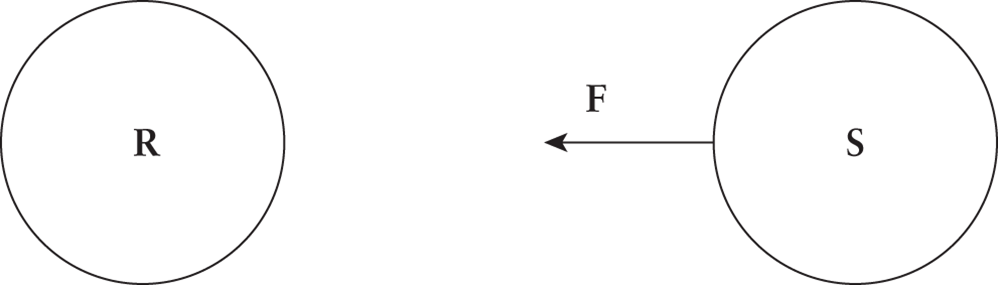
- In the figure, the magnitude of the electric force on R due to S is:
- F2.
- F.
- 2F.
- 4F.
- If the distance between the centers of the spheres is halved, the magnitude of the force on S due to R will be:
- F2.
- F4.
- 2F.
- 4F.
- Assume the direction of F is the same direction as the electric field between R and S. If an electron were placed midway between R and S, the resultant electric force on the electron would be:
- toward R.
- toward S.
- upward in the plane of the page.
- downward in the plane of the page.
- If the electric field at a distance r away from charge Q is 36 NC, what is the ratio of the electric fields at r, 2r, and 3r ?
- 9:3:1
- 36:9:4
- 36:18:9
- 36:18:12
- A positive charge of +Q is fixed at point R a distance d away from another positive charge of +2Q fixed at point S. Point A is located midway between the charges, and point B is a distance d2 from +2Q, as shown below. In which direction will a positive charge move if placed at point A and point B, respectively?
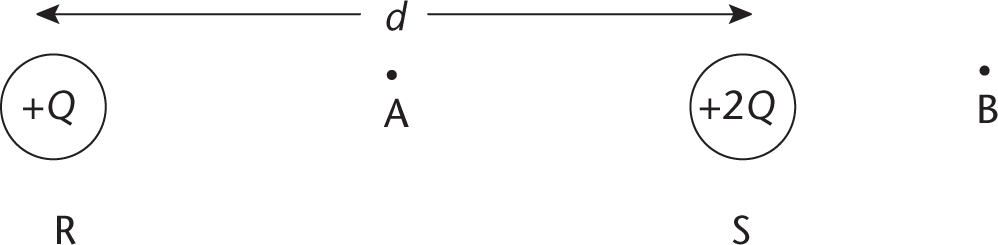
- Toward the +Q charge for both
- Toward the +2Q charge for both
- Toward the +Q charge at point A, and toward the right at point B
- Toward the +2Q charge at point A, and toward the right at point B
- Two parallel conducting plates are separated by a distance d. One plate carries a charge +Q and the other carries a charge −Q. The voltage between the plates is 12 V. If a +2 μC charge is released from rest at the positive plate, how much kinetic energy does it have when it reaches the negative plate?
- 2.4 × 10⁻⁶ J
- 4.8 × 10⁻⁶ J
- 2.4 × 10⁻⁵ J
- 4.8 × 10⁻⁵ J
- The negative charge in the figure below (−1 μC) moves from y = −5 to y = +5 and is made to follow the dashed line. What is the work required to move the negative charge along this dashed line?
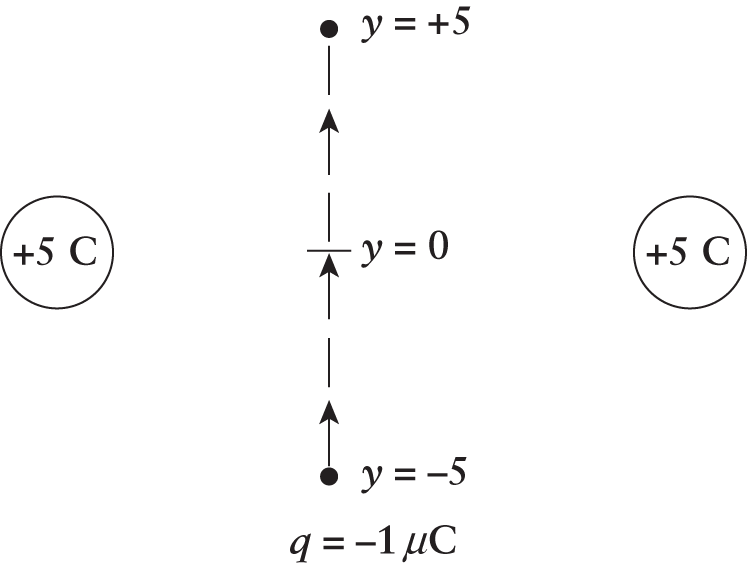
- –10 J
- −5 J
- 0 J
- 10 J
- If the magnetic field a distance r away from a current-carrying wire is 10 T, what will be the net magnetic field at r if another wire is placed a distance 2r from the original wire (with r in the middle) and has a current twice as strong flowing in the opposite direction?
- 0 T
- 15 T
- 20 T
- 30 T
- Given an electric dipole, the electric potential is zero:
- only at the midpoint of the dipole axis.
- anywhere on the perpendicular bisector of the dipole axis and at infinity.
- anywhere on the dipole axis.
- only for points at infinity.
- An electron is accelerated over a distance d by an electric potential V. The electric potential applied to this electron is then increased by a factor of 4 and the electron is accelerated over the same distance d. The speed of the electron at the end of the second trial will be larger than at the end of the first trial by a factor of:
- 16.
- 8.
- 4.
- 2.
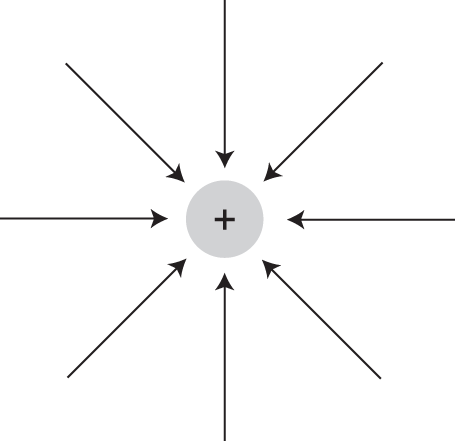
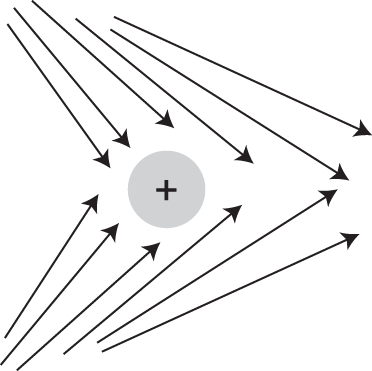
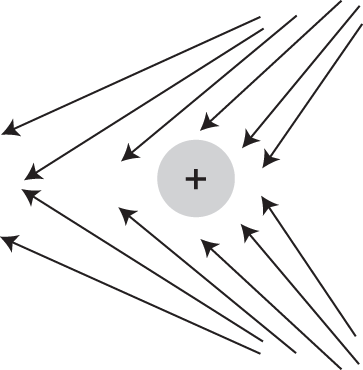
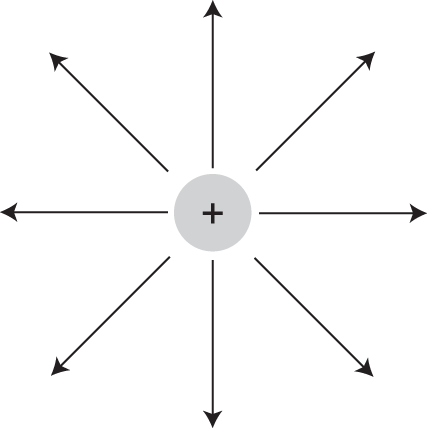
- Which of the following accurately depicts the field lines created by a proton that is moving toward the right on this page?
-
-
-
-
- A certain 9 V battery is used as a power source to move a 2 C charge. How much work is done by the battery?
- 4.5 J
- 9 J
- 18 J
- 36 J
- To increase the capacitance of a given capacitor, a dielectric is inserted between the two plates. Dielectrics are materials that block the flow of charge. Which of the following materials would be the best dielectric?
- Salt water
- Steel, an alloy primarily composed of iron
- Glass, an oxide of silica
- Copper
- A moving negative charge placed in an external magnetic field circulates counterclockwise in the plane of the paper. In which direction is the magnetic field pointing?
- Into the page
- Out of the page
- Toward the center of the circle
- Tangent to the circle
- Many kinases have divalent cation cofactors to stabilize their interaction with ATP. If the electric potential energy of the cation and ATP is –3.3 × 10⁻¹⁹ J, how would the electric potential energy change if the distance between the cation and ATP were doubled?
- Increase by a factor of 2
- Increase by a factor of 4
- Decrease by a factor of 2
- Decrease by a factor of 4
Answer Key
- B
- D
- B
- B
- C
- C
- C
- D
- B
- D
- D
- C
- C
- B
- A
Chapter 5: Electrostatics and Magnetism
CHAPTER 5
ELECTROSTATICS AND MAGNETISM
In This Chapter
5.1 Charges
Insulators and Conductors
5.2 Coulomb’s Law
Electric Field
5.3 Electric Potential Energy 5.4 Electric Potential 5.5 Special Cases in Electrostatics
Equipotential Lines
Electric Dipoles
5.6 Magnetism
Magnetic Fields
Magnetic Forces
Concept Summary
CHAPTER PROFILE
The content in this chapter should be relevant to about 7% of all questions about physics on the MCAT.
This chapter covers material from the following AAMC content category:
4C: Electrochemistry and electrical circuits and their elements
Introduction
Electrostatics is the study of stationary charges and the forces that are created by and which act upon these charges. Without electrical charge, we would not be able to do many of the activities that we enjoy or consider essential to basic living. But living with electrical charge can also be dangerous and even deadly: magnify the small shock you receive from a doorknob after walking across a carpet, and you have the equivalent of a lightning bolt strong enough to stop a heart. This same concept can be used in life-saving therapy as well: cardioversion and defibrillation create a strong electrical current through the heart’s conduction system that attempts to resynchronize a pulse.
In this chapter, we will review the basic concepts essential to understanding charges and electrostatic forces including conductors and insulators. We will review Coulomb’s law, which describes the attractions and repulsions between charged objects. Next, we will describe the electric fields that all charges create, which allow them to exert forces on other charges. After we’ve discussed how charges set up these fields, we’ll observe the behavior of charges that are placed into these fields. In particular, we will note the motional behavior of these test charges inside a field in relation to the electrical potential difference, or voltage, between two points in space. We can then determine the change in electric potential energy as the charge moves from a position of some electric potential to another. Next, we will describe the electric dipole and solve a problem involving one of the molecular dipoles most important to life on this planet: the water molecule. Finally, we will explore the topic of magnetic fields and forces.
5.1 Charges
LEARNING OBJECTIVES
After Chapter 5.1, you will be able to:
- Contrast the behavior of protons and electrons in charged environments
- Categorize materials, including glass and copper, as conductors or insulators
- Recognize the charge of an electron in coulombs
Charged subatomic particles come in two varieties. One, the proton, has a positive charge; the other, the electron, has a negative charge. While opposite charges exert attractive forces, like charges—those that have the same sign—exert repulsive forces. Unlike the force of gravity, which is always an attractive force, the electrostatic force may be repulsive or attractive depending on the signs of the charges that are interacting.
MCAT EXPERTISE
While many of the particles we discuss in electrostatics are very, very tiny, do not forget that they still do have mass. We can use equations such as the kinetic energy equation when solving problems with charged particles, and the MCAT will sometimes require us to do just that.
Most matter is electrically neutral, as a balance of positive and negative charges ensures a relative degree of stability. When charges are out of balance, the system can become electrically unstable. Even materials that are normally electrically neutral can acquire a net charge as result of friction. When you shuffle your feet across the carpet, negatively charged particles are transferred from the carpet to your feet, and these charges spread out over the total surface of your body. The shock that occurs when your hand gets close enough to a metal doorknob allows that excess charge to jump from your fingers to the knob, which acts as a ground—a means of returning charge to the earth. Static charge buildup or static electricity is more significant in drier air because lower humidity makes it easier for charge to become and remain separated.
The SI unit of charge is the coulomb, and the fundamental unit of charge is
e = 1.60 × 10⁻¹⁹ C
A proton and an electron each have this amount of charge, although the proton is positively charged (q = +e), while the electron is negatively charged (q = −e). Even though the proton and the electron share the same magnitude of charge, they do not share the same mass; the proton has a much greater mass than the electron.
KEY CONCEPT
The fundamental unit of charge is e = 1.60 × 10⁻¹⁹ C. A proton and an electron each have this amount of charge; the proton is positively charged (q = +e), while the electron is negatively charged (q = −e).
Like mass and energy, electric charge is governed by a law of conservation of charge. This law states that charge can neither be created nor destroyed.
Insulators and Conductors
Insulators and conductors vary in their ability to both hold and transfer charges. An insulator will not easily distribute a charge over its surface and will not transfer that charge to another neutral object very well—especially not to another insulator. On a molecular level, the electrons of insulators tend to be closely linked with their respective nuclei. By extension, most nonmetals are insulators. Experimentally, insulators serve as dielectric materials in capacitors, as well as in isolating electrostatic experiments from the environment to prevent grounding.
In contrast, when a conductor is given a charge, the charges will distribute approximately evenly upon the surface of the conductor. Conductors are able to transfer and transport charges and are often used in circuits or electrochemical cells. Conductors are often conceptualized as nuclei surrounded by a sea of free electrons that are able to move rapidly throughout the material and are only loosely associated with the positive charges. Conductors are generally metals, although ionic (electrolyte) solutions are also effective conductors. Figure 5.1 demonstrates the behaviors of an insulator and a conductor when a negative charge is placed on them.
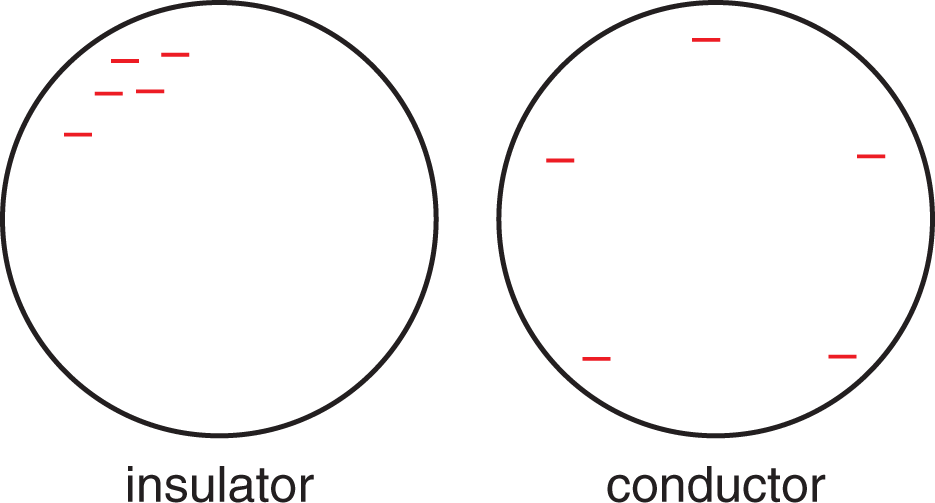
Figure 5.1. A Negatively Charged Insulator and Conductor Insulators will not distribute charge over their surface; conductors will.
MCAT CONCEPT CHECK 5.1
Before you move on, assess your understanding of the material with these questions.
- When placed one meter apart from each other, which will experience a greater acceleration: one coulomb of electrons or one coulomb of protons?
_________________________________
- Categorize the following materials as either conductors or insulators: blood, hair, copper, glass, iron, sulfuric acid, and distilled water
- Conductors:
_________________________________
- Insulators:
_________________________________
- What is the net charge of an object with one coulomb of electrons and 3 moles of neutrons?
_________________________________
5.2 Coulomb’s Law
LEARNING OBJECTIVES
After Chapter 5.2, you will be able to:
- Calculate the electric field that a charge generates and the electric force between it and another charge
- Recall the direction in which a negative or a positive electrostatic force will move two charges relative to one another
- Relate distance and charge quantities to electrostatic force and electrostatic field magnitudes
- Apply direction conventions to draw electric fields generated by a charged object:
Coulomb’s law quantifies the magnitude of the electrostatic force Fe between two charges:
Fe=kq1q2r2
Equation 5.1
where Fe is the magnitude of the electrostatic force, k is Coulomb’s constant, q1 and q2 are the magnitudes of the two charges, and r is the distance between the charges. Coulomb’s constant (also called the electrostatic constant) is a number that depends on the units used in the equation. In SI units, k=14πε0=8.99×10⁹ N ⋅ m2C2, where ε0 represents the permittivity of free space, 8.85×10⁻¹²C2N⋅m2. The direction of the force may be obtained by remembering that unlike charges attract and like charges repel. The force always points along the line connecting the centers of the two charges.
Example: A positive charge is attracted to a negative charge a certain distance away. The charges are then moved so that they are separated by twice the distance. How has the force of attraction changed between them?
Solution: Coulomb’s law states that the force between two charges varies as the inverse of the square of the distance between them. Therefore, if the distance is doubled, the square of the distance is quadrupled, and the force is reduced to one-fourth of what it was originally. Note that it was not necessary to know the distance or the units being used.
A close examination of Coulomb’s law reveals that it is remarkably similar in form to the equation for gravitational force. In the electrostatic force equation, the force magnitude is proportional to the charge magnitudes, and this is similar to the proportional relationship between gravitational force and mass. In both equations, the force magnitude is inversely proportional to the square of the distance of separation. These similarities ought to help you remember both equations on Test Day.
BRIDGE
Notice how Coulomb’s law looks very similar to the gravitational force equation, but with a different constant and using charge rather than mass. It is this fact that should remind us that this equation is dealing with electrostatic force between two charges, just as the gravitation equation is dealing with the gravitational force between two bodies of mass. The gravitation equation is discussed in Chapter 1 of MCAT Physics and Math Review.
Example: Negatively charged electrons are electrostatically attracted to positively charged protons. Because electrons and protons have mass, they will be gravitationally attracted to each other as well. What is the ratio of the electrostatic force to the gravitational force between an electron and proton? (Note: mp=1.67×10⁻²⁷ kg, me=9.11×10⁻³¹ kg,e=1.60×10⁻¹⁹ C, k=8.99×10⁹ N⋅m2C2, and G=6.67×10⁻¹¹ N⋅m2kg2)
Solution: Both Coulomb’s law and the universal law of gravitation state that the attractive forces between the electron and proton vary as the inverse of the square of the distance between them. The ratio between these forces can be calculated by dividing their magnitudes:
FeFg=[kq1q2r2][Gm1m2r2]=kq1q2Gm1m2
Now the values can be plugged in:
FeFg=(8.99×10⁹ N⋅m2C2)(1.60×10⁻¹⁹ C)(1.60×10⁻¹⁹ C)(6.67×10⁻¹¹ N⋅m2kg2)(1.67×10⁻²⁷ kg)(9.11×10⁻³¹ kg)≈(9)(1.6)(1.6)(10-29)(6.67)(1.6)(9)(10-69)=1.66.67×1040 ≈ 1.66.4× 1040= 0.25 × 1040=2.5×1039(actual = 2.27 × 1039)
Note that the electrostatic attraction between the electron and proton is stronger than the gravitational attraction by a factor of almost 1040. Also, note that setting up all of the variables before working out the math simplifies the process because a number of the variables cancel out during the division.
Electric Field
Every electric charge sets up a surrounding electric field, just like every mass creates a gravitational field. Electric fields make their presence known by exerting forces on other charges that move into the space of the field. Whether the force exerted through the electric field is attractive or repulsive depends on whether the stationary test charge q (the charge placed in the electric field) and the stationary source charge Q (which actually creates the electric field) are opposite charges (attractive) or like charges (repulsive).
KEY CONCEPT
Electric fields are produced by source charges (Q). When a test charge (q) is placed in an electric field (E), it will experience an electrostatic force (Fe) equal to qE.
The magnitude of an electric field can be calculated in one of two ways, both of which can be seen in the definitional equation for the electric field:
E=Feq=kQr2
Equation 5.2
where E is the electric field magnitude in newtons per coulomb, Fe is the magnitude of the force felt by the test charge q, k is the electrostatic constant, Q is the source charge magnitude, and r is the distance between the charges. The electric field is a vector quantity, and we will discuss the process of determining the direction of the electric field vector in a moment. Look closely: you can see that this equation for the electric field magnitude is derived simply by dividing both sides of Coulomb’s law by the test charge q. In doing so, we arrive at two different methods for calculating the magnitude of the electric field at a particular point in space. The first method is to place a test charge q at some point within the electric field, measure the force exerted on that test charge, and define the electric field at that point in space as the ratio of the force magnitude to test charge magnitude (Feq). One of the disadvantages of this method of calculation is that a test charge must actually be present in order for a force to be generated and measured. Sometimes, however, no test charge is actually within the electric field, so we need another way to measure the magnitude of that field.
KEY CONCEPT
By dividing Coulomb’s law by the magnitude of the test charge, we arrive at two ways of determining the magnitude of the electric field at a point in space around the source charge.
The second method of calculating the electric field magnitude at a point in space does not require the presence of a test charge. We only need to know the magnitude of the source charge and the distance between the source charge and point in space at which we want to measure the electric field (kQr2). In this method, we need to know the value of the source charge to be able to calculate the electric field.
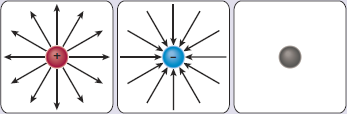
By convention, the direction of the electric field vector is given as the direction that a positive test charge would move in the presence of the source charge. If the source charge is positive, then the test charge would experience a repulsive force and would accelerate away from the positive source charge. On the other hand, if the source charge is negative, then the test charge would experience an attractive force and would accelerate toward the negative source charge. Therefore, positive charges have electric field vectors that radiate outward (that is, point away) from the charge, whereas negative charges have electric field vectors that radiate inward (point toward) the charge. These electric field vectors may be represented using field lines, as shown in Figure 5.2.
Figure 5.2. Field Lines around a Positive, a Negative, and a Neutral Source Charge
Field lines are imaginary lines that represent how a positive test charge would move in the presence of the source charge. The field lines are drawn in the direction of the actual electric field vectors and also indicate the relative strength of the electric field at a given point in the space of the field. When drawn on a sheet of paper, field lines look like the metal spokes of a bicycle wheel: the lines are closer together near the source charge and spread out at distances farther from the charge. Where the field lines are closer together, the field is stronger; where the lines are farther apart, the field is weaker. Because every charge exerts its own electric field, a collection of charges will exert a net electric field at a point in space that is equal to the vector sum of all the electric fields.
KEY CONCEPT
Field lines are used to represent the electric field vectors for a charge. They point away from a positive charge and point toward a negative charge. The denser the field lines, the stronger the electric field. Note that field lines of a single charge never cross each other.
Because electric field and electrostatic force are both vector quantities, it is important to remember the conventions for their direction. If the test charge within a field is positive, then the force will be in the same direction as the electric field vector of the source charge; if the test charge is negative, then the force will be in the direction opposite to the field vector of the source charge.
MCAT CONCEPT CHECK 5.2
Before you move on, assess your understanding of the material with these questions.
- What is the electric field midway between two negative charges in isolation?
_________________________________
- What direction does a negative electrostatic force point? What direction does a positive electrostatic force point?
- Negative electrostatic force:
_________________________________
- Positive electrostatic force:
_________________________________
- Draw the field lines for the electric field generated by an alpha particle (H24e2+).
- How do distance and charge relate to electrostatic force and electric field?
- Electrostatic force:
_________________________________
- Electric field:
_________________________________
5.3 Electric Potential Energy
LEARNING OBJECTIVES
After Chapter 5.3, you will be able to:
- Describe how a change in electric potential energy will affect the stability of a system
- Calculate electric potential energy
- Compare and contrast electric potential energy with electrostatic force, conceptually and mathematically
- Predict change in electric potential energy given a change in distance
We have already defined potential energy as stored energy that can be used to do something or make something happen. There are different types of potential energy; gravitational, elastic, and chemical are three forms that you will need to know for Test Day. A fourth form is electric potential energy. Similar to gravitational potential energy, this is a form of potential energy that is dependent on the relative position of one charge with respect to another charge or to a collection of charges. Electric potential energy is given by the equation
U=kQqr
Equation 5.3
If the charges are like charges (both positive or both negative), then the potential energy will be positive. If the charges are unlike (one positive and the other negative), then the potential energy will be negative. Remember that work and energy have the same unit (the joule), so we can define electric potential energy for a charge at a point in space in an electric field as the amount of work necessary to bring the charge from infinitely far away to that point. Because Fe=kQqr2 and W = Fd cos θ, if we define d as the distance r that separates two charges and assume the force and displacement vectors to be parallel, then:
ΔU=W=Fdcosθ=Fr×1=(kQqr2)r=kQqr
Consider two charges: a stationary negative source charge and a positive test charge that can be moved. Because these two charges are unlike, they will exert attractive forces between them. Therefore, the closer they are to each other, the more stable they will be. Opposite charges will have negative potential energy, and this energy will become increasingly negative as the charges are brought closer and closer together. Increasingly negative numbers are actually decreasing values because they are moving farther to the left of 0 on the number line. This decrease in energy represents an increase in stability.
KEY CONCEPT
Electric potential energy is the work necessary to move a test charge from infinity to a point in space in an electric field surrounding a source charge.
Now let’s consider two positive charges. As like charges, these will exert repulsive forces, and the potential energy of the system will be positive. Because like charges repel each other, the closer they are to each other, the less stable they will be. Remember that unlike gravitational systems, the forces of electrostatics can be either attractive or repulsive. In this case, the like charges will become more stable the farther apart they move because the magnitude of the electric potential energy becomes a smaller and smaller positive number.
KEY CONCEPT
The electric potential energy of a system will increase when two like charges move toward each other or when two opposite charges move apart. Conversely, the electric potential energy of a system will decrease when two like charges move apart or when two opposite charges move toward each other.
Example: If a charge of +2e and a charge of −3e are separated by a distance of 3 nm, what is the potential energy of the system? (Note: e is the fundamental unit of charge equal to 1.6 × 10⁻¹⁹ C, and k is the electrostatic constant equal to 8.99×10⁹ N⋅m2C2.)
Solution: The equation for potential energy is U=kQqr. From the question stem, we know that the charges are +2e and −3e, and r = 3 nm = 3 × 10⁻⁹ m. Plugging into the equation, we get:
U=(8.99×10⁹ N⋅m2C2)(2×1.6×10−19 C)(−3×1.6×10−19 C)3×10⁻⁹ m≈−45×10−20 J=−4.5×10⁻¹⁹ J(actual=−4.6×10⁻¹⁹ J)
MCAT CONCEPT CHECK 5.3
Before you move on, assess your understanding of the material with these questions.
- How does a change in electric potential energy from –4 J to –7 J reflect on the stability of a system?
_________________________________
_________________________________
- Compare the relationship between electric potential energy and Coulomb’s law to the relationship between gravitational potential energy and the universal law of gravitation.
_________________________________
_________________________________
_________________________________
- How does electric potential energy change between two particles as the distance between them increases?
_________________________________
_________________________________
_________________________________
- By what factor would electric potential energy change if the magnitude of both charges were doubled and the distance between them was halved?
_________________________________
5.4 Electric Potential
LEARNING OBJECTIVES
After Chapter 5.4, you will be able to:
- Calculate electric potential
- Distinguish between electric potential and voltage
- Predict the movement of a charge relative to a source charge, given the electric potential of the test charge’s location
- Relate electric potential to electric potential energy, electric field, and Coulomb’s law
Electric potential, discussed here, and electric potential energy, discussed previously, sound like the same (or nearly the same) thing. They are not, although they are very closely related. In fact, electric potential is defined as the ratio of the magnitude of a charge’s electric potential energy to the magnitude of the charge itself. This can be expressed as:
V=Uq
Equation 5.4
where V is the electric potential measured in volts (V) and 1 V=1 JC. Even if there is no test charge q, we can still calculate the electric potential of a point in space in an electric field as long as we know the magnitude of the source charge and the distance from the source charge to the point in space in the field. By dividing U=kQqr by q, we get:
V=kQr
Equation 5.5
Electric potential is a scalar quantity, and its sign is determined by the sign of the source charge Q. For a positive source charge, V is positive, but for a negative source charge, V is negative. For a collection of charges, the total electric potential at a point in space is the scalar sum of the electric potential due to each charge.
MCAT EXPERTISE
Fe=kQqr2 U=kQqr
E=kQr2 V=kQr
These are essential equations for Test Day. Know how they relate to each other and when to use them. By memorizing Coulomb’s law, you should be able to recreate the table through mathematical manipulation. From left to right, multiply by r; from top to bottom, divide by q.
Because electric potential is inversely proportional to the distance from the source charge, a potential difference will exist between two points that are at different distances from the source charge. If Va and Vb are the electric potentials at points a and b, respectively, then the potential difference between them, known as voltage, is Vb – Va. From the equation for electric potential above, we can further define potential difference as:
ΔV=Vb−Va=Wabq
Equation 5.6
where Wab is the work needed to move a test charge q through an electric field from point a to point b. The work depends only on the potentials at the two points a and b and is independent of the actual pathway taken between a and b. Like gravitational force, the electrostatic force is a conservative force.
MNEMONIC
The “plus” end of a battery is the high-potential end, and the “minus” end of a battery is the low-potential end. Positive charge moves from + to – (the definition of current) while negative charge moves from – to +.
We’ve already seen that charges, if allowed, will move spontaneously in whatever direction results in a decrease in electric potential energy. For a positive test charge, this means moving from a position of higher electric potential to a position of lower electric potential. The voltage, ΔV = Vb – Va, is negative in this case; because q is positive (for a positive test charge), thus, Wab must be negative, which represents a decrease in electric potential energy.
KEY CONCEPT
Electric potential is the ratio of the work done to move a test charge from infinity to a point in an electric field surrounding a source charge divided by the magnitude of the test charge.
Now let’s consider a negative test charge. A negative test charge will spontaneously move from a position of lower electric potential to a position of higher electric potential. The voltage, ΔV = Vb – Va, is positive in this case; because q is negative (for a negative test charge), Wab must also be negative, which again represents a decrease in electric potential energy. The takeaway: positive charges will spontaneously move in the direction that decreases their electric potential (negative voltage), whereas negative charges will spontaneously move in the direction that increases their electric potential (positive voltage)—yet, in both cases, the electric potential energy is decreasing.
BRIDGE
Create analogies between mechanics and electrostatics to familiarize yourself with these concepts. Electric field is like a gravitational field, and it exerts forces on charges much like a gravitational field exerts forces on masses. A test charge has a particular electric potential energy at a given electric potential, depending on the magnitude of its charge, much like a mass has a particular gravitational potential energy, depending on the magnitude of its mass. These mechanics concepts are discussed in Chapters 1 and 2 of MCAT Physics and Math Review.
MCAT CONCEPT CHECK 5.4
Before you move on, assess your understanding of the material with these questions.
- What is the difference between electric potential and voltage?
_________________________________
_________________________________
_________________________________
- How will a charge that is placed at a point of zero electric potential move relative to a source charge?
_________________________________
_________________________________
_________________________________
- True or False: The units of electric potential energy and electric potential are different.
5.5 Special Cases in Electrostatics
LEARNING OBJECTIVES
After Chapter 5.5, you will be able to:
- Describe equipotential lines and electric dipoles
- Recall the electrical potential at points along the bisector of dipole
- Predict the voltage at two distinct points on an equipotential line
- Predict the behavior of a dipole when exposed to an external field:
In this section, we will explore some of the unique setups in electrostatics that are common on the MCAT.
Equipotential Lines
An equipotential line is a line on which the potential at every point is the same. That is, the potential difference between any two points on an equipotential line is zero. Drawn on paper, equipotential lines may look like concentric circles surrounding a source charge. In three-dimensional space, these equipotential lines would actually be spheres surrounding the source charge. From the equation for electrical potential, we can see that no work is done when moving a test charge q from one point on an equipotential line to another. Work will be done in moving a test charge q from one line to another, but the work depends only on the potential difference of the two lines and not on the pathway taken between them. This is entirely analogous to the displacement of an object horizontally on a level surface. Because the object’s height above the ground has not changed, its gravitational potential energy is unchanged. Furthermore, a change in the object’s gravitational potential energy will not depend on the pathway taken from one height to another but only on the actual vertical displacement.
BRIDGE
Because the work to move a charge from one equipotential line to another does not depend on the path between them, we know that we are dealing only with conservative forces when moving the charge. Conservative and nonconservative forces are discussed in Chapter 2 of MCAT Physics and Math Review.
Example: In the diagram below, an electron goes from point a to point b in the vicinity of a very large positive charge. The electron could be made to follow any of the paths shown. Which path requires the least work to get the electron charge from a to b?
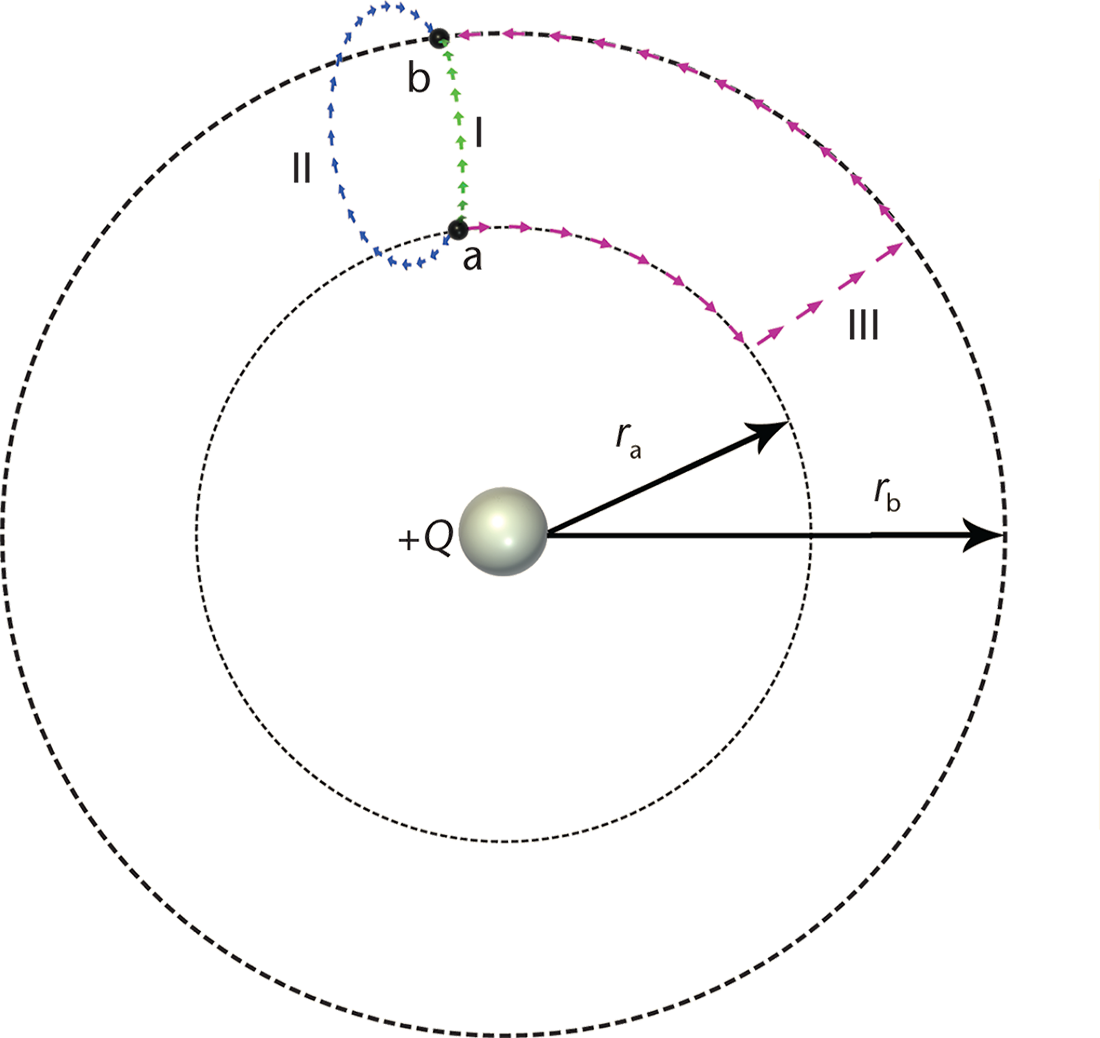
Solution: As stated, the work depends only on the potential difference and not on the path, so any of the paths shown would require the same amount of work in moving the electron from a to b. Note that because the source charge is positive, point b is at a lower electrical potential than point a. However, because the test charge is negative, the electrical potential energy is higher at point b than point a. This should make sense: the electron will have to gain energy to be moved farther away from positive source charge.
Electric Dipoles
Much of the reactivity of organic compounds is based on separation of charge. The electric dipole, which results from two equal and opposite charges being separated a small distance d from each other, can be transient (as in the case of the moment-to-moment changes in electron distribution that create London dispersion forces) or permanent (as in the case of the molecular dipole of water or the carbonyl functional group).
The electric dipole can be visualized as a barbell: the equal weights on either end of the bar represent the equal and opposite charges separated by a small distance, represented by the length of the bar. We’ll analyze the generic dipole in Figure 5.3 and then work through the specific example of one of the most important electric dipoles, the water molecule.
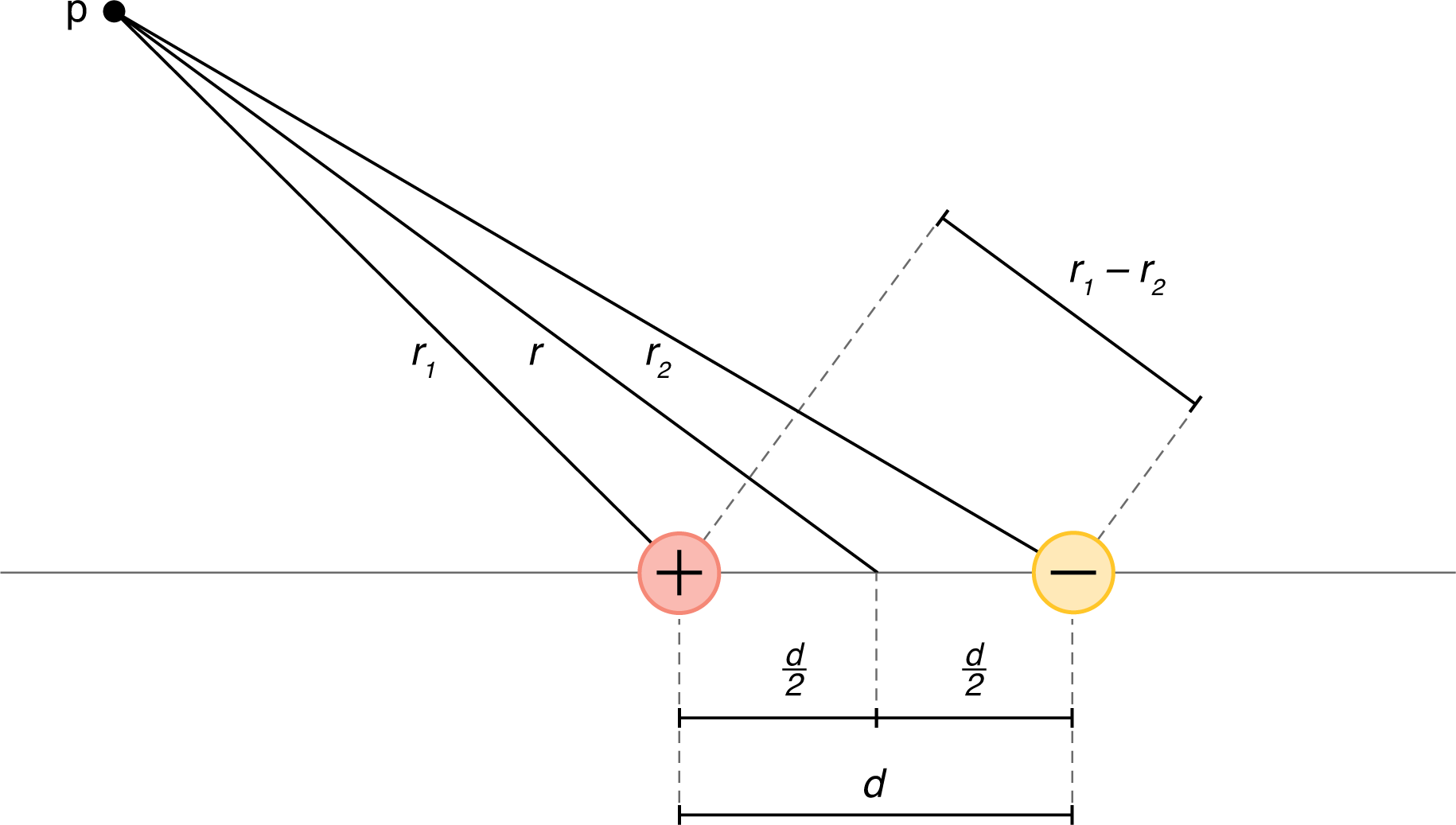
Figure 5.3. A Generic Dipole
The dipole in Figure 5.3 has charges +q and –q separated by a distance d. Notice that +q and –q are source charges, even though they are written in lowercase. Given the dipole, we may want to calculate the electrical potential at some point P near the dipole. The distance between the point in space and +q is r1; the distance between the point in space and –q is r2; the distance between the point in space and the midpoint of the dipole is r. We know that for a collection of charges, the electrical potential P is the scalar sum of the potentials due to each charge at that point. In other words:
V=kqr1−kqr2=kq(r2−r1)r1r2
For points in space relatively distant from the dipole (compared to d), the product of r1 and r2 is approximately equal to the square of r, and r1 – r2 is approximately equal to d cos θ. When we plug these approximations into the equation above, we get
V=kqdr2cosθ
Equation 5.7
The product of charge and separation distance is defined as the dipole moment (p) with SI units of C · m:
p = qd Equation 5.8
The dipole moment is a vector, but its direction is defined differently by physicists and chemists. Physicists define the vector along the line connecting the charges (the dipole axis), with the vector pointing from the negative charge toward the positive charge. Chemists usually reverse this convention, having p point from the positive charge toward the negative charge. Sometimes, chemists draw a crosshatch at the tail end of the dipole vector to indicate that the tail end is the positive charge.
Example: The H2O molecule has a dipole moment of 1.85 D. Calculate the electrical potential due to a water molecule at a point 89 nm away along the axis of the dipole. (Note: k=8.99×10⁹ N⋅m2C2 and 1 D (debye) = 3.34 × 10⁻³⁰ C · m)
Solution: Because the question asks for the potential along the axis of the dipole, the angle θ is 0°. Substitute the values into the equation for the dipole potential and multiply 1.85 D by 3.34 × 10−30 to convert it to C · m:
V=kqdr2cosθ=kpr2cosθ=(8.99×10⁹ N⋅m2C2)(1.85 D)(3.34×10⁻³⁰ C⋅m1 D)(89×10−9 m)2≈(9)(2)(3)(10-21)(9×10⁻⁸)2=(9)(2)(3)(10-21)(9)(9)(10-16)=(2×10⁻²¹)(3×10⁻¹⁶)=0.67×10⁻⁵ V=6.7×10⁻⁶ V(actual=7.01×10⁻⁶ V)
One very important equipotential line to be aware of is the plane that lies halfway between +q and –q, called the perpendicular bisector of the dipole. Because the angle between this plane and the dipole axis is 90° (and cos 90° = 0), the electrical potential at any point along this plane is 0. The magnitude of the electric field on the perpendicular bisector of the dipole can be approximated as
E=14πε0×pr3
Equation 5.9
The electric field vectors at the points along the perpendicular bisector will point in the direction opposite to p (as defined directionally by physicists).
MCAT EXPERTISE
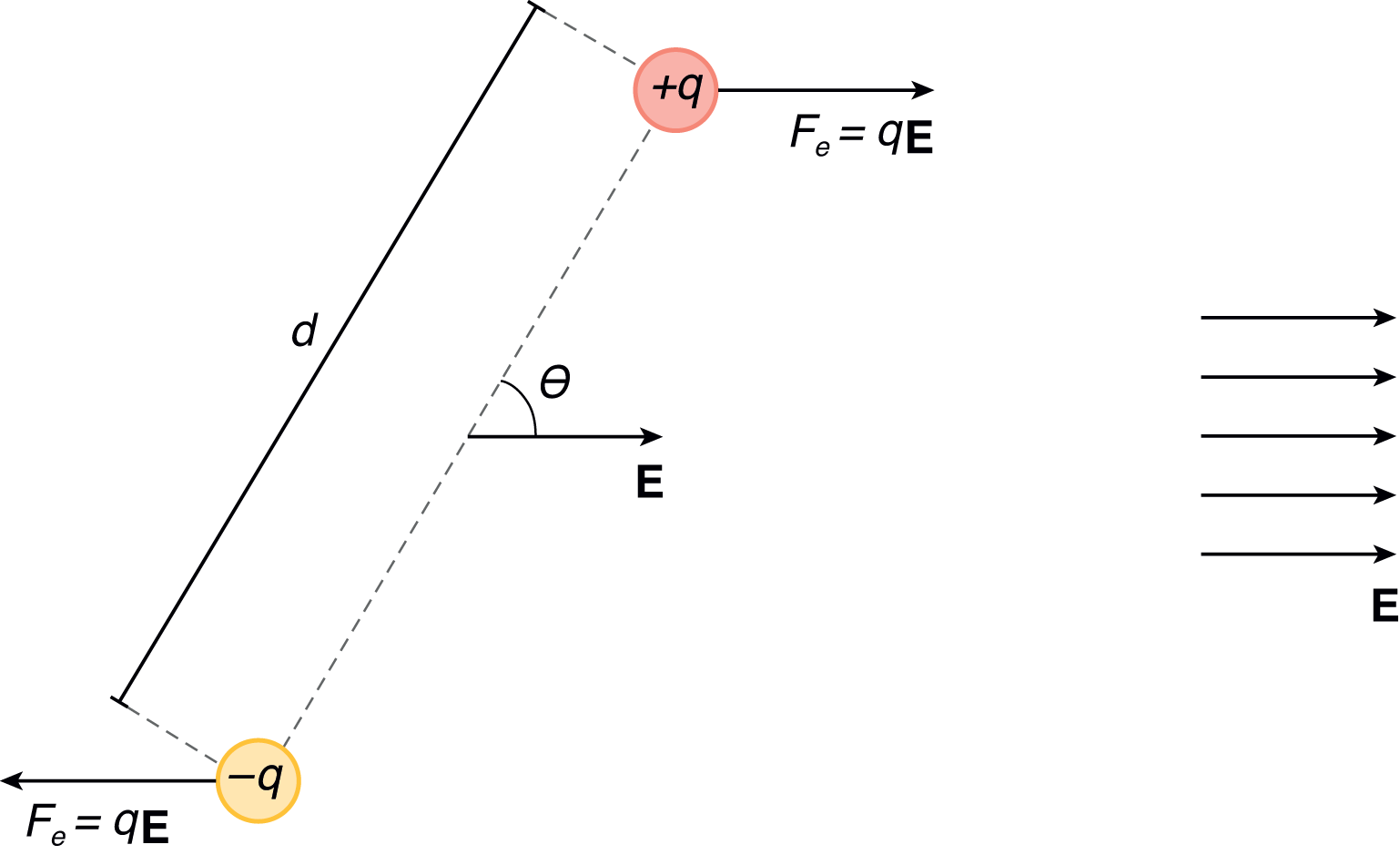
The dipole is a great example of how the MCAT can test kinematics and dynamics in an electrostatics setting. For a dipole at some angle in an external electric field, there will be translational equilibrium, but not rotational equilibrium. This is because the forces are in opposite directions (left and right in Figure 5.4), but the torques are in the same direction (clockwise for both).
The dipole is a classic example of a setup upon which torques can act. In the absence of an electric field, the dipole axis can assume any random orientation. However, when the electric dipole is placed in a uniform external electric field, each of the equal and opposite charges of the dipole will experience a force exerted on it by the field. Because the charges are equal and opposite, the forces acting on the charges will also be equal in magnitude and opposite in direction, resulting in a situation of translational equilibrium. There will be, however, a net torque about the center of the dipole axis:
τ=(d2)Fesinθ+(d2)Fesinθ=dFesinθ=d(qE)sinθ=pEsinθ
Thus, the net torque on a dipole can be calculated from the equation
τ = pE sin θ
Equation 5.10
where p is the magnitude of the dipole moment (p = qd), E is the magnitude of the uniform external electric field, and θ is the angle the dipole moment makes with the electric field. This torque will cause the dipole to reorient itself so that its dipole moment, p, aligns with the electric field E, as shown in Figure 5.4.
MCAT EXPERTISE
The electric dipole is most likely to be tested qualitatively or in the context of a passage or reaction on Test Day. It is unlikely that these mathematical relations will be presented or tested without background.
Figure 5.4. Torque on a Dipole from an External Electric Field
MCAT CONCEPT CHECK 5.5
Before you move on, assess your understanding of the material with these questions.
- Define the following terms:
- Equipotential lines:
_________________________________
- Electric dipole:
_________________________________
- What is the voltage between two points on an equipotential line? Will this voltage cause a charge to move along the line?
_________________________________
- Why is the electrical potential at points along the perpendicular bisector of a dipole zero?
_________________________________
- What is the behavior of an electric dipole when exposed to an external electric field?
_________________________________
5.6 Magnetism
LEARNING OBJECTIVES
After Chapter 5.6, you will be able to:
- Recall the requirements to have a nonzero electric field, a nonzero magnetic field, or a nonzero magnetic force
- Predict the impact of a magnetic field on a nearby object
- Calculate the magnitudes of a magnetic field and the magnetic force exerted by the field
- Predict the direction of a magnetic force using the right-hand rule:
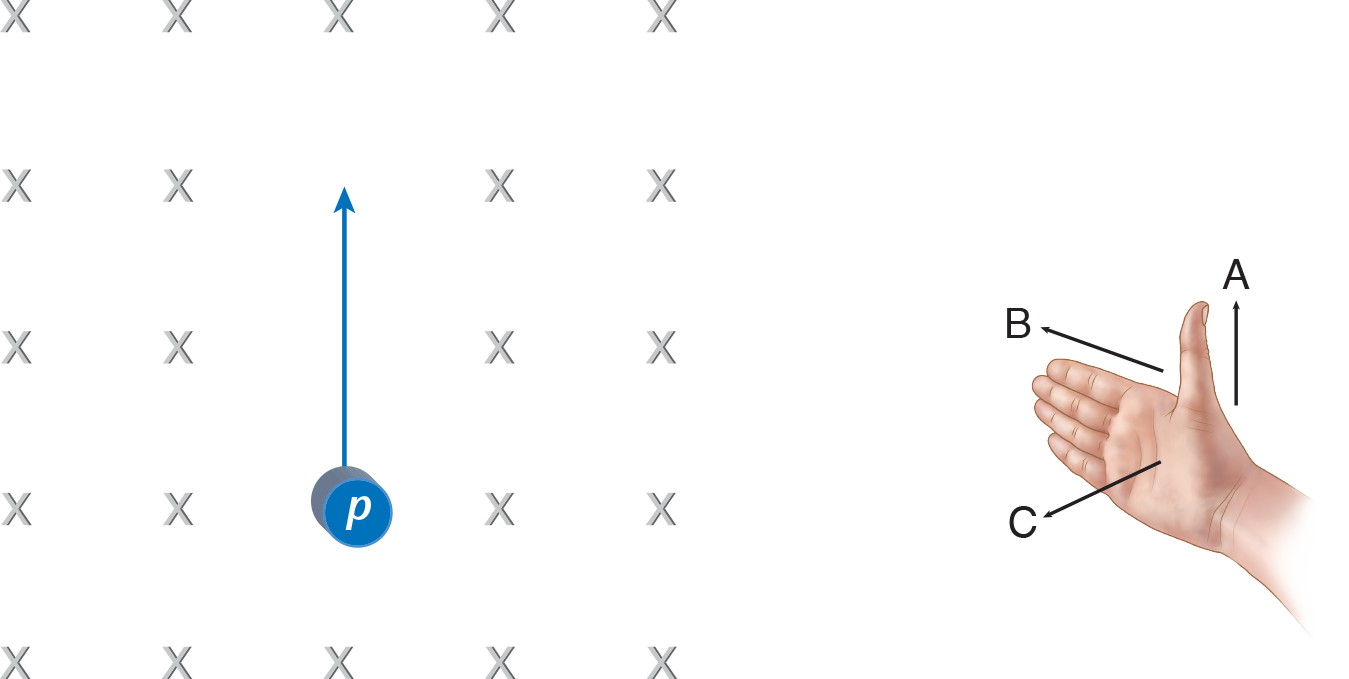
Any moving charge creates a magnetic field. Magnetic fields may be set up by the movement of individual charges, such as an electron moving through space; by the mass movement of charge in the form of a current though a conductive material, such as a copper wire; or by permanent magnets. The SI unit for magnetic field strength is the tesla (T), where 1T=1 N⋅sm⋅C. The size of the tesla unit is quite large, so small magnetic fields are sometimes measured in gauss, where 1 T = 104 gauss.
KEY CONCEPT
Any moving charge, whether a single electron traveling through space or a current through a conductive material, creates a magnetic field. The SI unit for magnetic field strength is the tesla (T).
All materials can be classified as diamagnetic, paramagnetic, or ferromagnetic. Diamagnetic materials are made of atoms with no unpaired electrons and that have no net magnetic field. These materials are slightly repelled by a magnet and so can be called weakly antimagnetic. Diamagnetic materials include common materials that you wouldn’t expect to get stuck to a magnet: wood, plastics, water, glass, and skin, just to name a few.
The atoms of both paramagnetic and ferromagnetic materials have unpaired electrons, so these atoms do have a net magnetic dipole moment, but the atoms in these materials are usually randomly oriented so that the material itself creates no net magnetic field. Paramagnetic materials will become weakly magnetized in the presence of an external magnetic field, aligning the magnetic dipoles of the material with the external field. Upon removal of the external field, the thermal energy of the individual atoms will cause the individual magnetic dipoles to reorient randomly. Some paramagnetic materials include aluminum, copper, and gold.
Ferromagnetic materials, like paramagnetic materials, have unpaired electrons and permanent atomic magnetic dipoles that are normally oriented randomly so that the material has no net magnetic dipole. However, unlike paramagnetic materials, ferromagnetic materials will become strongly magnetized when exposed to a magnetic field or under certain temperatures. Common ferromagnetic materials include iron, nickel, and cobalt. Bar magnets are ferromagnetic materials with a north and south pole. Field lines exit the north pole and enter the south pole. Because magnetic field lines are circular, it is impossible to have a monopole magnet. If two bar magnets are allowed to interact, opposite poles will attract each other, while like poles will repel each other.
Magnetic Fields
Because any moving charge creates a magnetic field, we would certainly expect that a collection of moving charges, in the form of a current through a conductive wire, would produce a magnetic field in its vicinity. The configuration of the magnetic field lines surrounding a current-carrying wire will depend on the shape of the wire. Two special cases that are commonly tested on the MCAT include a long, straight wire and a circular loop of wire (with particular attention paid to the magnetic field at the center of that loop).
For an infinitely long and straight current-carrying wire, we can calculate the magnitude of the magnetic field produced by the current I in the wire at a perpendicular distance, r, from the wire as:
B=μ0I2πr
Equation 5.11
where B is the magnetic field at a distance r from the wire, µ0 is the permeability of free space (4π×10−7T⋅mA), and I is the current. The equation demonstrates an inverse relationship between the magnitude of the magnetic field and the distance from the current. Straight wires create magnetic fields in the shape of concentric rings. To determine the direction of the field vectors, use a right-hand rule. (This is one of two right-hand rules used in magnetism.) Point your thumb in the direction of the current and wrap your fingers around the current-carrying wire. Your fingers then mimic the circular field lines, curling around the wire.
For a circular loop of current-carrying wire of radius r, the magnitude of the magnetic field at the center of the circular loop is given as:
B=μ0I2r
Equation 5.12
You’ll notice that the two equations are quite similar—the obvious difference being that the equation for the magnetic field at the center of the circular loop of wire does not include the constant π. The less obvious difference is that the first expression gives the magnitude of the magnetic field at any perpendicular distance, r, from the current-carrying wire, while the second expression gives the magnitude of the magnetic field only at the center of the circular loop of current-carrying wire with radius r.
Example: Suppose a wire is formed into a loop that carries a current of 0.25 A in a clockwise direction, as shown here:
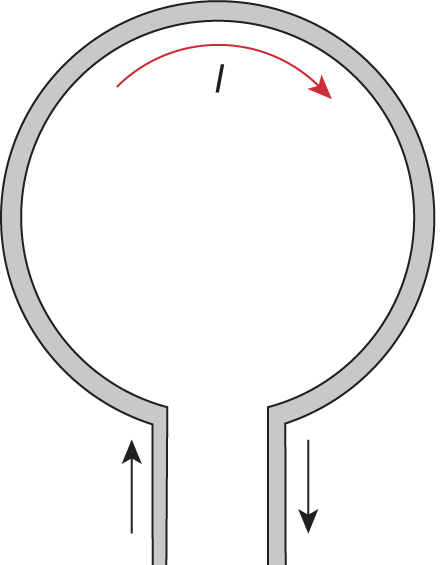
Determine the direction of the magnetic field produced by this loop within the loop and outside the loop. If the loop has a diameter of 1 m, what is the magnitude of the magnetic field at the center of the loop?
Solution: Use the right-hand rule to determine the direction of the magnetic field within and outside the loop, as shown here:
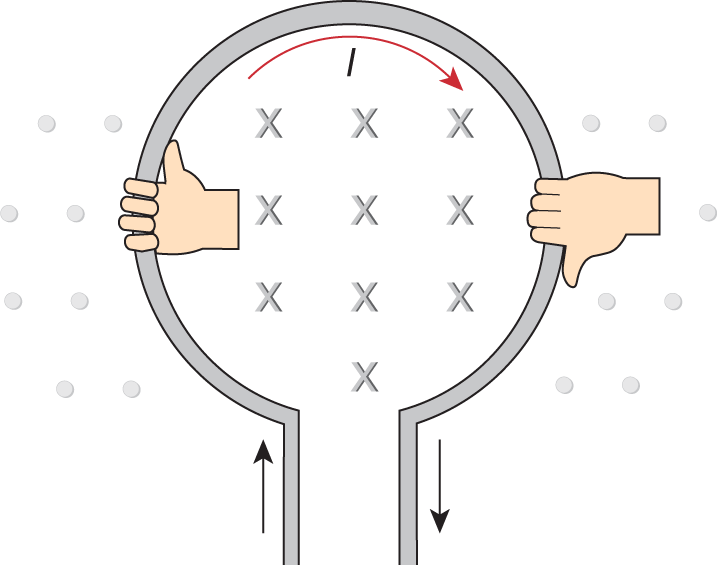
Align your right thumb with the current at any point in the loop. When you encircle the wire with the remaining fingers of your right hand, your fingers should point into the page within the loop and out of the page outside of the loop.
To determine the magnitude of the magnetic field at the center, use the equation for a loop of wire:
B=μ0I2r=(4π×10−7 T⋅mA)(0.25 A)2×0.5 m≈3.14×10⁻⁷ T=3.14×10⁻³gauss
Magnetic Forces
Now that we’ve reviewed the ways in which magnetic fields can be created, let’s examine the forces that are exerted by magnetic fields on moving charges. Magnetic fields exert forces only on other moving charges. That is, charges do not “sense” their own fields; they only sense the field established by some external charge or collection of charges. Therefore, in our discussion of the magnetic force on moving charges and on current-carrying wires, we will assume the presence of a fixed and uniform external magnetic field. Note that charges often have both electrostatic and magnetic forces acting on them at the same time; the sum of these electrostatic and magnetic forces is known as the Lorentz force.
Force on a Moving Charge
When a charge moves in a magnetic field, a magnetic force may be exerted on it, the magnitude of which can be calculated as follows:
FB = qvB sinθ
Equation 5.13
where q is the charge, v is the magnitude of its velocity, B is the magnitude of the magnetic field, and θ is the smallest angle between the velocity vector v and the magnetic field vector B. Notice that the magnetic force is a function of the sine of the angle, which means that the charge must have a perpendicular component of velocity in order to experience a magnetic force. If the charge is moving parallel or antiparallel to the magnetic field vector, it will experience no magnetic force.
KEY CONCEPT
Remember that sin 0° and sin 180° equal zero. This means that any charge moving parallel or antiparallel to the direction of the magnetic field will experience no force from the magnetic field.
Here we will introduce the second right-hand rule that you should practice in anticipation of Test Day. To determine the direction of the magnetic force on a moving charge, first position your right thumb in the direction of the velocity vector. Then, put your fingers in the direction of the magnetic field lines. Your palm will point in the direction of the force vector for a positive charge, whereas the back of your hand will point in the direction of the force vector for a negative charge.
MNEMONIC
Parts of the right-hand rule for magnetic force:
- Thumb—velocity (indicates direction of movement, like a hitchhiker’s thumb)
- Fingers—field lines (fingers are parallel like the uniform magnetic field lines)
- Palm—force on a positive charge (you might give a “high five” to a positive person)
- Back of hand—force on a negative charge (you might give a backhand to a negative person)
Example: Suppose a proton is moving with a velocity of 15 ms toward the top of the page through a uniform magnetic field of 3.0 T directed into the page, as shown here:
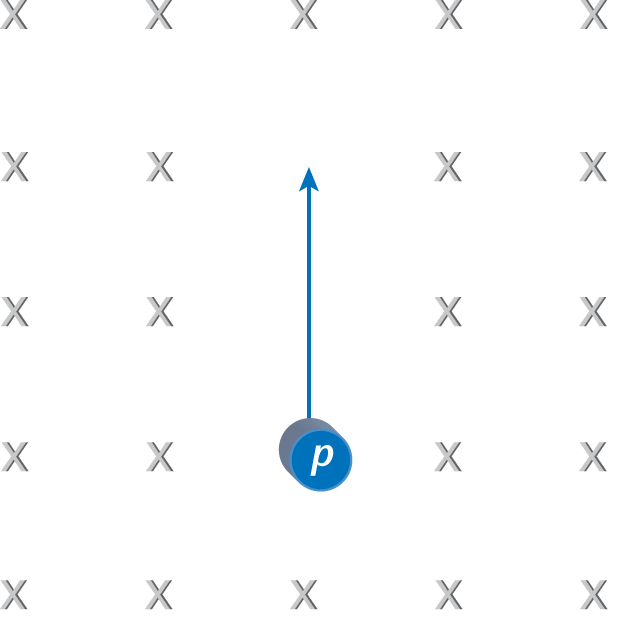
What is the magnitude and direction of the magnetic force on the proton? Describe the motion that will result from this setup. (Note: The charge of a proton is 1.60 × 10⁻¹⁹ C, and its mass is 1.67 × 10⁻²⁷ kg.)
Solution: Start by determining the magnitude of the force:
FB=qvBsinθ=(1.60×10⁻¹⁹ C)(15 ms)(3.0 T)sin90°=7.2×10⁻¹⁸ N
To determine the direction, use the right-hand rule. Your thumb should point up the page in the direction of v. Your fingers should point into the page in the direction of B. Protons are positively charged; thus the force, FB, is in the direction of your palm, which is to the left. Note that v and FB will always be perpendicular to each other; this implies that uniform circular motion will occur in this field, with FB pointing radially inward toward the center of the circle.
If the centripetal force is the magnetic force, then we can set these two equations equal to each other:
Fc=FBmv2r=qvBsinθmv=qBrsin90°r=mvqB=(1.67×10⁻²⁷ kg)(15 ms)(1.60×10⁻¹⁹ C)(3.0 T)≈5×10⁻⁸ m(actual=5.2×10⁻⁸ m)
Thus, the proton will move in a circle with a radius of 52 nm.
Force on a Current-Carrying Wire
We’ve just examined the force that can be created by a magnetic field when a point charge moves through the field, so it should not come as a surprise that a current-carrying wire placed in a magnetic field may also experience a magnetic force. For a straight wire, the magnitude of the force created by an external magnetic field, FB, is:
FB = ILB sinθ
Equation 5.14
where I is the current, L is the length of the wire in the field, B is the magnitude of the magnetic field, and θ is the angle between L and B. The same right-hand rule can be used for a current-carrying wire in a field as for a moving point charge; just remember that current is considered the flow of positive charge.
Example: Suppose a wire of length 2.0 m is conducting a current of 5.0 A toward the top of the page and through a 30 gauss uniform magnetic field directed into the page. What is the magnitude and direction of the magnetic force on the wire?
Solution: Because 1 T = 104 gauss, 1 gauss = 10−4 T, and 30 gauss = 30 × 10−4 T = 3 × 10⁻³ T. The wire is conducting current toward the top of the page, and the magnetic field points into the page; therefore, the current is perpendicular to the magnetic field. The angle between them is θ = 90°. Now, plug into the equation:
FB=ILBsinθ=(5.0A)(2.0m)(3×10⁻³T)(sin90°)=30×10−3=3×10⁻²N
To determine the direction, use the right-hand rule. Your thumb should point up the page in the direction of L. Your fingers should point into the page in the direction of B. Current is a flow of positive charge; thus, the force, FB, is in the direction of your palm, which is to the left.
MCAT CONCEPT CHECK 5.6
Before you move on, assess your understanding of the material with these questions.
- What are the requirements to have a nonzero electric field? A nonzero magnetic field? A nonzero magnetic force?
- Nonzero electric field:
_________________________________
- Nonzero magnetic field:
_________________________________
- Nonzero magnetic force:
_________________________________
- Which would experience a larger magnetic field: an object placed five meters to the left of a current carrying wire, or an object placed at the center of a circle with a radius of five meters? (Note: Assume the current is constant; μ0=4π×10−7T⋅mA)
_________________________________
- For each of the following combinations of velocity and magnetic field directions, determine the direction of the magnetic force on the given particle:
v B Particle F
Up the page Left Electron
Into the page Out of the page Proton
Right Into the page Proton
Out of the page Left Electron
Down the page Right Neutron
Conclusion
In this chapter, we reviewed the very notion of charge, reminding ourselves that charge comes in two varieties: positive and negative. We also explored the fact that charges travel differently within insulators and conductors. We learned that charges establish electric fields through which they can exert forces on other charges. We relied on similarities between electrical and gravitational systems to better understand Coulomb’s law and the nature of the forces that exist between charged particles. Don’t forget that electrical forces can be repulsive as well as attractive, which is one of the differences between electrical and gravitational systems. Charges contain electrical potential energy, which we defined as their energy of position with respect to other charges. Charges move within an electric field from one position of electrical potential to another; they will move spontaneously through an electrical potential difference, or voltage, in whichever direction results in a decrease in the charge’s electrical potential energy. Then, we considered the geometry of the electric dipole and derived the equation for calculating the electrical potential at any point in space around the dipole. Finally, we considered magnetic fields and forces. In the next chapter, we’ll examine moving charges as they interact with circuit elements and complete our understanding of electricity.
GO ONLINE
You’ve reviewed the content, now test your knowledge and critical thinking skills by completing a test-like passage set in your online resources!
CONCEPT SUMMARY
Charges
- The SI unit of charge is the coulomb.
- Protons have a positive charge and electrons have a negative charge.
- Both protons and electrons possess the fundamental unit of charge (e = 1.60 × 10⁻¹⁹ C).
- Protons and electrons have different masses.
- Opposite charges exert attractive forces, and like charges exert repulsive forces.
- Conductors allow the free and uniform passage of electrons when charged.
- Insulators resist the movement of charge and will have localized areas of charge that do not distribute over the surface of the material.
Coulomb’s Law
- Coulomb’s law gives the magnitude of the electrostatic force vector between two charges. The force vector always points along the line connecting the centers of the two charges.
- Every charge generates an electric field, which can exert forces on other charges.
- The electric field is the ratio of the force that is exerted on a test charge to the magnitude of that charge.
- Electric field vectors can be represented as field lines that radiate outward from positive source charges and radiate inward to negative source charges.
- Positive test charges will move in the direction of the field lines; negative test charges will move in the direction opposite of the field lines.
Electric Potential Energy
- Electric potential energy is the amount of work required to bring the test charge from infinitely far away to a given position in the vicinity of a source charge.
- The electric potential energy of a system will increase when two like charges move toward each other or when two opposite charges move farther apart.
- The electric potential energy of a system will decrease when two opposite charges move toward each other or when two like charges move farther apart.
Electric Potential
- Electric potential is the electric potential energy per unit charge.
- Different points in the space of an electric field surrounding a source charge will have different electric potential values.
- Potential difference (voltage) is the change in electric potential that accompanies the movement of a test charge from one position to another.
- Potential difference is path independent and depends only on the initial and final positions of the test charge.
- The units for both electric potential and voltage are volts.
- Test charges will move spontaneously in whichever direction results in a decrease in their electric potential energy.
- Positive test charges will move spontaneously from high potential to low potential.
- Negative test charges will move spontaneously from low potential to high potential.
Special Cases in Electrostatics
- Equipotential lines designate the set of points around a source charge or multiple source charges that have the same electric potential.
- Equipotential lines are always perpendicular to electric field lines.
- Work will be done when a charge is moved from one equipotential line to another; the work is independent of the pathway taken between the lines.
- No work is done when a charge moves from a point on an equipotential line to another point on the same equipotential line.
- Two charges of opposite sign separated by a fixed distance, d, generate an electric dipole.
- In an external electric field, an electric dipole will experience a net torque until it is aligned with the electric field vector.
- An electric field will not induce any translational motion in the dipole regardless of its orientation with respect to the electric field vector.
Magnetism
- Magnetic fields are created by magnets and moving charges.
- The SI unit for the magnetic field is the tesla (T; 1 T = 10,000 gauss).
- Diamagnetic materials possess no unpaired electrons and are slightly repelled by a magnet.
- Paramagnetic materials possess some unpaired electrons and become weakly magnetic in an external magnetic field.
- Ferromagnetic materials possess some unpaired electrons and become strongly magnetic in an external magnetic field.
- Magnets have a north and a south pole; field lines point from the north to the south pole.
- Current-carrying wires create magnetic fields that are concentric circles surrounding the wire.
- External magnetic fields exert forces on charges moving in any direction except parallel or antiparallel to the field.
- Point charges may undergo uniform circular motion in a uniform magnetic field wherein the centripetal force is the magnetic force acting on the point charge.
- The direction of the magnetic force on a moving charge or current-carrying wire is determined using the right-hand rule.
- The Lorentz force is the sum of the electrostatic and magnetic forces acting on a body.
ANSWERS TO CONCEPT CHECKS
**5.1**
- The electrons will experience the greater acceleration because they are subject to the same force as the protons but have a significantly smaller mass.
- Conductors: blood, copper, iron, sulfuric acid; insulators: hair, glass, distilled water
- The net charge will be –1 C; neutrons do not contribute charge.
**5.2**
- The electric field would be 0 because the two charges are the same. In this case, the fields exerted by each charge at the midpoint will cancel out and there will be no electric field.
- For a pair of charges, a negative electrostatic force points from one charge to the other (attractive), while a positive electrostatic force points from one charge away from the other (repulsive).
-
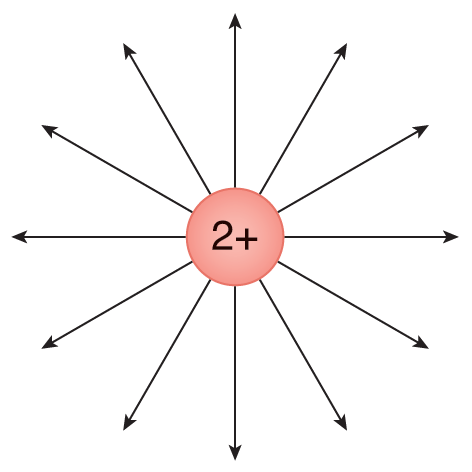
- Electrostatic force is directly related to each charge and related to the distance by an inverse square relationship. Electric field is unrelated to test charge but is still related to distance by an inverse square relationship. Note that it is the source charge that creates the electric field—not the test charge—so we cannot use the equation E=Feq to determine a relationship.
**5.3**
- A decrease in potential energy indicates that the system has become more stable. Keep in mind that negative numbers with larger absolute values are more negative, and represent a decrease in value from negative numbers with smaller absolute values (that is, –4 > −7 even though |−4| < |−7|).
- Electrical potential energy is Coulomb’s law multiplied by distance, whereas gravitational potential energy is the universal law of gravitation multiplied by distance.
- If both particles have the same charge, the electrical potential energy decreases as distance increases. If the two particles have opposite charges, then the electrical potential energy increases as distance increases.
- As given by the equation U=kQqr, the electric potential energy would increase by a factor of eight if both charges are doubled and the radius is halved.
**5.4**
- Electrical potential is the ratio of a charge’s electrical potential energy to the magnitude of the charge itself. Voltage, or potential difference, is a measure of the change in electrical potential between two points, which provides an indication of the tendency toward movement in one direction or the other.
- A charge will move in such a way to minimize its potential energy. Placing a charge at a point of zero electrical potential does not indicate that there is zero potential difference, so the charge may or may not move—and if it moves, it may move toward or away from the source charge depending on the sign of the source charge and test charge.
- True. Electrical potential energy is measured in joules (J), while electrical potential and potential difference (voltage) are measured in volts (V).
**5.5**
- Equipotential lines are the sets of points within space at which the potential difference between any two points is zero. This is best visualized as concentric spheres surrounding a source charge. An electric dipole is the separation of charge within a molecule such that there is a permanent or temporary region of equal and opposite charges at a particular distance.
- There is no voltage between two points on an equipotential line, so there will be no acceleration along the line. However, there is a potential difference between different sets of equipotential lines, which can cause particles to move and accelerate.
- The perpendicular bisector of an electric dipole is an equipotential plane that is perpendicular to the axis of the dipole. As such, the equation V=kqdr2cosθ is necessarily equal to 0 because cos 90° = 0.
- A dipole will rotate within an external electric field such that its dipole moment aligns with the field.
**5.6**
- To create an electric field, one needs a charge. To create a magnetic field, one needs a charge that must also be moving. To create a magnetic force, one needs an external electric field acting on a charge moving any direction except parallel or antiparallel to the external field.
- We need not determine the actual values of the magnetic fields in these two cases and can compare the two equations instead. The magnetic field created by the current-carrying wire is given by B=μ0I2πr; the magnetic field created by the loop of wire is given by B=μ0I2r and μ0, I, and r are the same in both equations. Therefore, the magnetic field at the center of the loop must be larger because the denominator in that equation does not include π.
-
v B Particle F
Up the page Left Electron Into the page
Into the page Out of the page Proton None (sin 180° = 0)
Right Into the page Proton Up the page
Out of the page Left Electron Up the page
Down the page Right Neutron None (q = 0)
SCIENCE MASTERY ASSESSMENT EXPLANATIONS
1. B
According to Newton’s third law, if R exerts a force on S, then S exerts a force with equal magnitude but opposite direction back on R. Therefore, the magnitude of the force on R due to S is F.
2. D
The force is inversely proportional to r2. Cutting the distance in half will therefore multiply the force by 22, making it four times its original value:
Fold∝1r2Fnew∝1(r2)2=4r2=4×Fold
3. B
An electric field’s direction at a given point is defined as the direction of the force that would be exerted on a positive test charge in that position. Because electrons are negatively charged particles, they will therefore feel a force in the opposite direction of the electric field’s vector. In this case, because the force points to the left (toward R), an electron will feel a force pointing to the right (toward S) if E is in the same direction as F.
4. B
The first step in answering this question is to remember that the magnitude of the electric field is inversely proportional to the square of the distance:
E=kQr2→E∝1r2
Therefore, if the electric field at radius r, *E**r, is 36 NC, then the electric field at radius 2r* will be
E2r∝1(2r)2=14r2=Er4=(36 NC)4=9 NC
Similarly, the electric field at radius 3r is equal to
E3r∝1(3r)2=19r2=Er9=(36 NC)9=4 NC
Therefore, the ratio of Er:E2r:E3r is 36:9:4.
5. C
A positive charge placed at A will experience two forces: a force to the left due to +2Q and a force to the right due to +Q. Because point A is the same distance from +Q and +2Q, the force due to +2Q will be larger than that due to +Q, and there will be a net force to the left (toward +Q). At point B, the forces from both +Q and +2Q will point to the right, so there will be a net force to the right.
6. C
Recall that the change in potential energy, ΔU, and the change in potential, ΔV, are related by W = ΔU = qΔV. Therefore, ΔU = (2 × 10⁻⁶ C) × (–12 V) = –2.4 × 10⁻⁵ J. The positive charge is moving from the positive to the negative plate, and is therefore decreasing in potential energy; this is reflected by the fact that the voltage is –12 V rather than +12 V. The potential energy that is lost is converted into kinetic energy, so the charge must gain 2.4 × 10⁻⁵ J of kinetic energy.
7. C
There will be work done in moving the negative charge from its initial position to y = 0. However, in moving the negative charge from y = 0 to the final position, the same amount of work is done but with the opposite sign. This is because the force changes direction as the electron crosses y = 0. Therefore, the two quantities of work cancel each other out. This argument depends crucially on the symmetry of the initial and final positions.
8. D
The safest way to answer this question is to quickly draw a diagram:
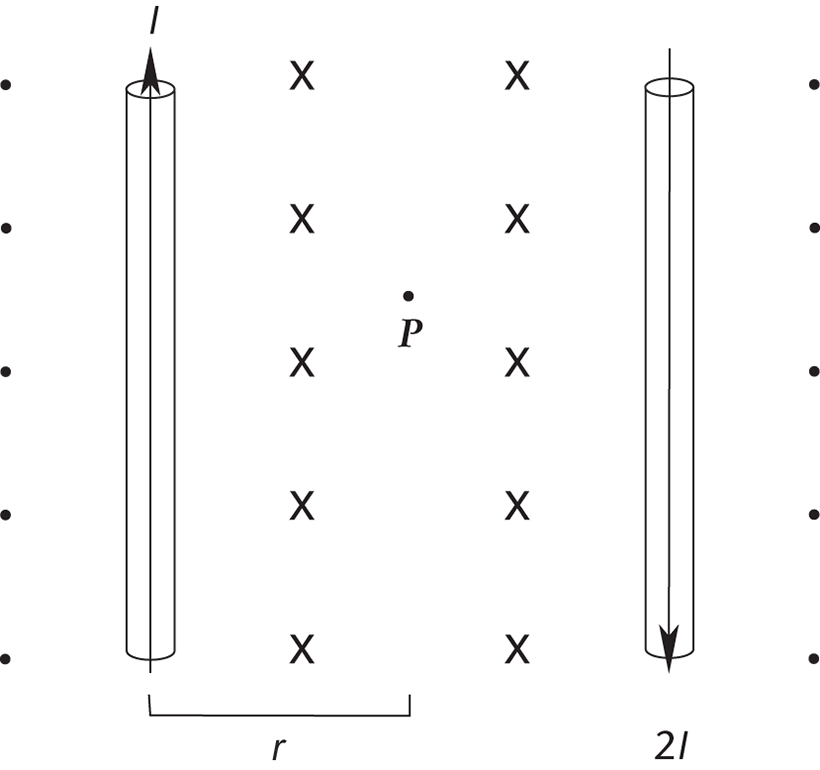
Notice right away that between the two wires, the direction of the magnetic field is the same: into the page. Therefore, because the vector direction is the same, we can just focus on the magnitudes of the two magnetic fields. We know that B1 = 10 T at a distance r. Consider the relationships in the equation B=μ0I2πr. Magnetic field and current are directly proportional, whereas magnetic field and distance are inversely proportional. Therefore, doubling the current will result in double the magnetic field of the first wire, or 20 T. The overall magnitude of the magnetic field is 10 T + 20 T = 30 T into the page.
9. B
Potential is a scalar quantity. The total potential is the sum of the potentials of the positive and negative charges:
VT=V++V−=+kqr++(−kqr−)
where r+ and r– represent the distances from the positive and negative charge, respectively. The sum of these terms will be zero at any point where r+ = r–. This will be at any point along the perpendicular bisector of the dipole axis, as well as at infinity.
10. D
The electric potential (V) is equal to the amount of work done (W) divided by the test charge (q). This means that the potential is directly proportional to the amount of work done, which is equal to the amount of energy gained by the particle; therefore, the overall amount of energy increases by a factor of 4. Because energy is directly proportional to the square of the speed (according to 12mv2), the speed must increase by a factor of 2.
11. D
You should know that the field lines for a positively charged particle will always point away from the particle in a radial pattern, regardless of the direction in which the particle is moving. This is because field lines point in the direction a positive test charge would move in that field (that is, the direction that a force would be exerted on a positive test charge in that field).
12. C
Voltage (ΔV) is equal to the quotient of the amount of work done (W) divided by the charge of the particle on which the work is done (q), according to the equation V=ΔUq=Wq. Because the voltage equals 9 V and the charge equals 2 C, the work done must equal 9 V × 2 C = 18 J.
13. C
To prevent the flow of charge between the two plates, the dielectric should be an insulative material. Insulative materials contain atoms that tightly bind to their electrons, often nonmetals. Glass is composed of two nonmetals, silicon and oxygen, and would be the best insulator, supporting choice (C). On the other hand, while pure water itself can be an insulator, the presence of ions greatly increases the conductivity of salt water, eliminating (A).
14. B
This problem is an application of the right-hand rule. The velocity vector v is always tangent to the circle. The magnetic force must always point radially toward the center of the circle. Consider when the negative charge is at the “12 o’clock” position in its circle and apply the right-hand rule. Your thumb points to the left, tangent to the circle at this point. The back of your hand, which represents the force on a negative charge, points down the page, radially toward the center of the circle. Your fingers must point out of the page to get your hand into this position. Therefore, the direction of the magnetic field must be out of the page.
15. A
Often, with potential energy, it can be easier to think in terms of common sense, rather than in terms of rigorous mathematical formulas: opposite charges attract. When oppositely charged species like ATP and a cation are moved apart, their potential energy will increase, reflecting the fact that these oppositely charged species would like to move back to a closer distance. Furthermore, the formula for electric potential energy is U = kQq/r. From this formula, observe that the relationship between U and r is given by U ∝ 1/r, meaning that if r is changed by a factor of 2, then U will also change by a factor of 2, and not by a factor of 4. These observations together are enough to justify (A) as the correct answer.
For a more mathematically rigorous explanation, consider that the opposite charges of ATP and the cation will cause the output of the formula U = kQq/r to be negative. Then, when the distance between these two charges is doubled, this expression becomes U = kQq/2r, which is half as large in magnitude. However, because U is negative for oppositely charged species, a smaller negative value actually means that U has increased! (Consider: though the magnitude is smaller, a temperature of -5oC is actually warmer than a temperature of -25oC. Similarly, a U with a smaller negative magnitude actually means higher energy.) In short, doubling the radius means that the energy is also doubled when the charged species have opposite charges.
GO ONLINE
Consult your online resources for additional practice.
EQUATIONS TO REMEMBER
(5.1) Coulomb’s law: Fe=kq1q2r2
(5.2) Electric field: E=Feq=kQr2
(5.3) Electric potential energy: U=kQqr
(5.4) Electric potential (from electric potential energy): V=Uq
(5.5) Electric potential (from source charge): V=kQr
(5.6) Voltage: ΔV=Vb−Va=Wabq
(5.7) Electric potential near a dipole: V=kqdr2cosθ
(5.8) Dipole moment: p = qd
(5.9) Electric field on the perpendicular bisector of a dipole: E=14πε0×pr3
(5.10) **Torque on a dipole in an electric field: *τ** = pEsinθ*
(5.11) Magnetic field from a straight wire: B=μ0I2πr
(5.12) Magnetic field from a loop of wire: B=μ0I2r
(5.13) Magnetic force on a moving point charge: FB = qvB sinθ
(5.14) Magnetic force on a current-carrying wire: FB = ILB sinθ
SHARED CONCEPTS
General Chemistry Chapter 1
Atomic Structure
General Chemistry Chapter 3
Bonding and Chemical Interactions
General Chemistry Chapter 12
Electrochemistry
Physics and Math Chapter 1
Kinematics and Dynamics
Physics and Math Chapter 2
Work and Energy
Physics and Math Chapter 6
Circuits