Chapter 7: Waves and Sound

Chapter 7: Waves and Sound
Science Mastery Assessment
Every pre-med knows this feeling: there is so much content I have to know for the MCAT! How do I know what to do first or what’s important?
While the high-yield badges throughout this book will help you identify the most important topics, this Science Mastery Assessment is another tool in your MCAT prep arsenal. This quiz (which can also be taken in your online resources) and the guidance below will help ensure that you are spending the appropriate amount of time on this chapter based on your personal strengths and weaknesses. Don’t worry though— skipping something now does not mean you’ll never study it. Later on in your prep, as you complete full-length tests, you’ll uncover specific pieces of content that you need to review and can come back to these chapters as appropriate.
How to Use This Assessment
If you answer 0–7 questions correctly:
Spend about 1 hour to read this chapter in full and take limited notes throughout. Follow up by reviewing all quiz questions to ensure that you now understand how to solve each one.
If you answer 8–11 questions correctly:
Spend 20–40 minutes reviewing the quiz questions. Beginning with the questions you missed, read and take notes on the corresponding subchapters. For questions you answered correctly, ensure your thinking matches that of the explanation and you understand why each choice was correct or incorrect.
If you answer 12–15 questions correctly:
Spend less than 20 minutes reviewing all questions from the quiz. If you missed any, then include a quick read-through of the corresponding subchapters, or even just the relevant content within a subchapter, as part of your question review. For questions you got correct, ensure your thinking matches that of the explanation and review the Concept Summary at the end of the chapter.
- An opera singer has two precisely identical glasses. The singer produces as pure a tone as possible and shatters the first glass at a frequency of 808 Hz. The singer then sings a frequency of 838 Hz in the presence of the second glass. The second glass will likely:
- shatter after a longer amount of time because the applied frequency is higher.
- shatter after a shorter amount of time because the applied frequency is higher.
- not shatter because the applied frequency is not equal to the natural frequency of the glass.
- not shatter because higher-frequency sounds are associated with more attenuation.
- A child is practicing the first overtone on a flute. If the child’s sibling covers one end of the flute for a brief second, how will the sound change, assuming that the new pitch represents the first overtone in the new setup?
- The pitch of the sound will go up.
- The pitch of the sound will go down.
- The pitch of the sound will not change.
- The change in the pitch depends on the starting pitch.
- Which of the following is necessarily true regarding frequency, angular frequency, and period of a given wave?
- The magnitude of the angular frequency is larger than the magnitude of the period.
- The product of the frequency and period is equal to the angular frequency.
- The magnitude of the angular frequency is larger than the magnitude of the frequency.
- The product of the angular frequency and period is 1.
- Ultrasound machines calculate distance based upon:
- intensity of the reflected sound.
- travel time of the reflected sound.
- angle of incidence of the sound.
- the detected frequency of the sound.
- The period for a certain wave is 34 ms. If there is a Doppler shift that doubles the perceived frequency, which of the following must be true?
- The detector is moving toward the source at a velocity equal to the speed of sound.
- The source is moving toward the detector at a velocity equal to half the speed of sound.
- The perceived period is 17 ms.
- The perceived period is 68 ms.
- III only
- I and IV only
- II and III only
- I, II, and IV only
- If the speed of a wave is 3 ms and its wavelength is 10 cm, what is its period?
- 0.01 s
- 0.03 s
- 0.1 s
- 0.3 s
- What is the angular frequency of the third harmonic in a pipe of length 1.5 m with one closed end? (Note: The speed of the sound is approximately 340 ms.)
- 170 radians per second
- 170π radians per second
- 340 radians per second
- 340π radians per second
- A certain sound level is increased by 20 dB. By what factor does its intensity increase?
- 2
- 20
- 100
- log 2
- In some forms of otosclerosis, the stapedial foot plate, which transmits vibrations from the bones of the middle ear to the fluid within the cochlea, can become fixed in position. This limits the displacement of the stapedial foot plate during vibration. Based on this mechanism, which of the following symptoms would most likely be seen in an individual with otosclerosis?
- An increase in the perceived volume of sounds
- A decrease in the perceived volume of sounds
- An increase in the perceived pitch of sounds
- A decrease in the perceived pitch of sounds
- If two waves with the same frequency are 180° out of phase, what is the amplitude of the resultant wave if the amplitudes of the original waves are 5 cm and 3 cm?
- 2 cm
- 3 cm
- 5 cm
- 8 cm
- A student is measuring sound frequencies from the side of a road while walking east. For which of the following situations could the student determine that the difference between the perceived frequency and the actual emitted frequency is zero?
- A plane flying directly above the student from east to west
- A police car passing the student with its siren on
- A person playing piano in a house on the street
- A dog barking in a car that moves east
- In which of the following media does sound travel the fastest?
- Vacuum
- Air
- Water
- Glass
- Shock waves have the greatest impact when the source is traveling:
- just below the speed of sound.
- exactly at the speed of sound.
- just above the speed of sound.
- well above the speed of sound.
- As a teacher approaches a student who is studying with the radio playing loudly nearby, the teacher experiences the Doppler effect. Which of the following statements remains true while the teacher moves closer to the student?
- The apparent frequency of the music is increased.
- The same apparent frequency would be produced if the teacher were stationary and the student approached at the same speed.
- The apparent velocity of the wave is decreased.
- I only
- II only
- I and III only
- I, II, and III
- Ignoring attenuation, how does the intensity of a sound change as the distance from the source doubles?
- It is four times as intense.
- It is twice as intense.
- It is half as intense.
- It is one-quarter as intense.
Answer Key
- C
- B
- C
- B
- A
- B
- D
- C
- B
- A
- D
- D
- B
- A
- D
Chapter 7: Waves and Sound
CHAPTER 7
WAVES AND SOUND
In This Chapter
7.1 General Wave Characteristics
Transverse and Longitudinal Waves
Describing Waves
Phase
Principle of Superposition
Traveling and Standing Waves
Resonance
7.2 Sound
Production of Sound
Frequency and Pitch
Intensity and Loudness of Sound
Standing Waves
Ultrasound
Concept Summary
CHAPTER PROFILE
The content in this chapter should be relevant to about 11% of all questions about physics on the MCAT.
This chapter covers material from the following AAMC content categories:
4A: Translational motion, forces, work, energy, and equilibrium in living systems
4D: How light and sound interact with matter
Introduction
As a species, our interactions with sound are amazingly complex. The human ear developed as a means of detecting longitudinal waves carried in the air—this likely served an evolutionary purpose. A rustle in the leaves could indicate not only a potential meal, but also a potential predator. Our brains are highly attuned to analyze the sounds around us, as discussed in Chapter 2 of MCAT Behavioral Sciences Review. This includes not only the normal auditory pathway from the pinna through the tympanic membrane, ossicles, cochlea, and vestibulocochlear nerve to the temporal lobe, but also secondary structures such as the superior olive, which helps localize sound, and the inferior colliculus, which is involved in the startle reflex.
Language is also inextricably linked to sound. Through changes in pitch and timbre, we can imply or evoke dozens of complex feelings. Through music, our relationship with sound becomes even more profound. As E.T.A. Hoffman, a musicologist and pedagogue, wrote in his vivid description of Beethoven’s opening motif for Symphony No. 5 in C minor, op. 67:
Radiant beams shoot through this region’s deep night, and we become aware of gigantic shadows which, rocking back and forth, close in on us and destroy everything within us except the pain of endless longing—a longing in which every pleasure that rose up in jubilant tones sinks and succumbs, and only through this pain, which, while consuming but not destroying love, hope, and joy, tries to burst our breasts with full-voiced harmonies of all the passions, we live on and are captivated beholders of the spirits.
Indeed, sound can create entire worlds that we can explore. This chapter, however, aims only to lay the foundation for understanding wave phenomena. The general properties of waves will be introduced, including a discussion of wavelength, frequency, wave speed, amplitude, and resonance. We will also review the interactions of waves meeting at a point in space through constructive and destructive interference and examine the mathematics of standing waves—the means by which musical instruments produce their characteristic sounds. The subject of sound is reviewed as a specific example of the longitudinal waveform with a focus on wave phenomena such as the Doppler effect. Finally, we provide a brief discussion of the use of ultrasound and shock waves in medicine.
7.1 General Wave Characteristics
LEARNING OBJECTIVES
After Chapter 7.1, you will be able to:
- Define key terms applying to waves and sound, such as frequency, pitch, and amplitude
- Distinguish between common examples of transverse and longitudinal waves
- Predict the impact of applying a force at the natural frequency of a given system
- Predict the relative amplitude of a resultant wave created by two interfering waves:
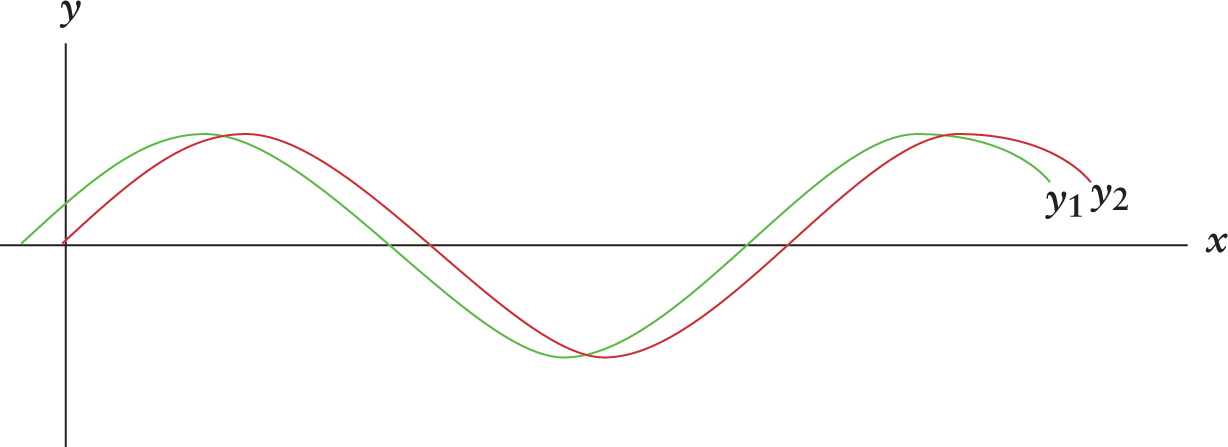
It is important to use a common language when describing waves. We’ll establish the terminology associated with wave phenomena, and then spend the rest of this chapter looking at the application of wave principles to sound. In the next chapter, we’ll shift our focus to electromagnetic waves.
Transverse and Longitudinal Waves
The MCAT is primarily concerned with sinusoidal waves. In these waves, which may be transverse or longitudinal, the individual particles oscillate back and forth with a displacement that follows a sinusoidal pattern. Transverse waves are those in which the direction of particle oscillation is perpendicular to the propagation (movement) of the wave. To visualize this, consider “The Wave” in a stadium. While “The Wave” moves around the stadium, individuals in the stands do not run around the stadium themselves. Rather, they move perpendicular to the direction of “The Wave”—by standing up and sitting down. More common examples on the MCAT include electromagnetic waves, such as visible light, microwaves, and X-rays. You could also form a transverse wave by attaching a string to a fixed point, and then moving your hand up and down, as is demonstrated in Figure 7.1a. In any waveform, energy is delivered in the direction of wave travel, so we can say that for a transverse wave, the particles are oscillating perpendicular to the direction of energy transfer.
Longitudinal waves are ones in which the particles of the wave oscillate parallel to the direction of propagation; that is, the wave particles are oscillating in the direction of energy transfer. Sound waves are the classic example of longitudinal waves, but because we can’t see sound, this waveform is a little more difficult to picture. Figure 7.1b helps us visualize what a longitudinal waveform traveling through air would look like. In this case, the longitudinal wave created by the person moving the piston back and forth causes air molecules to oscillate through cycles of compression and rarefaction (decompression) along the direction of motion of the wave. You could also form a longitudinal wave by laying a Slinky flat on a table top and tapping it on the end.
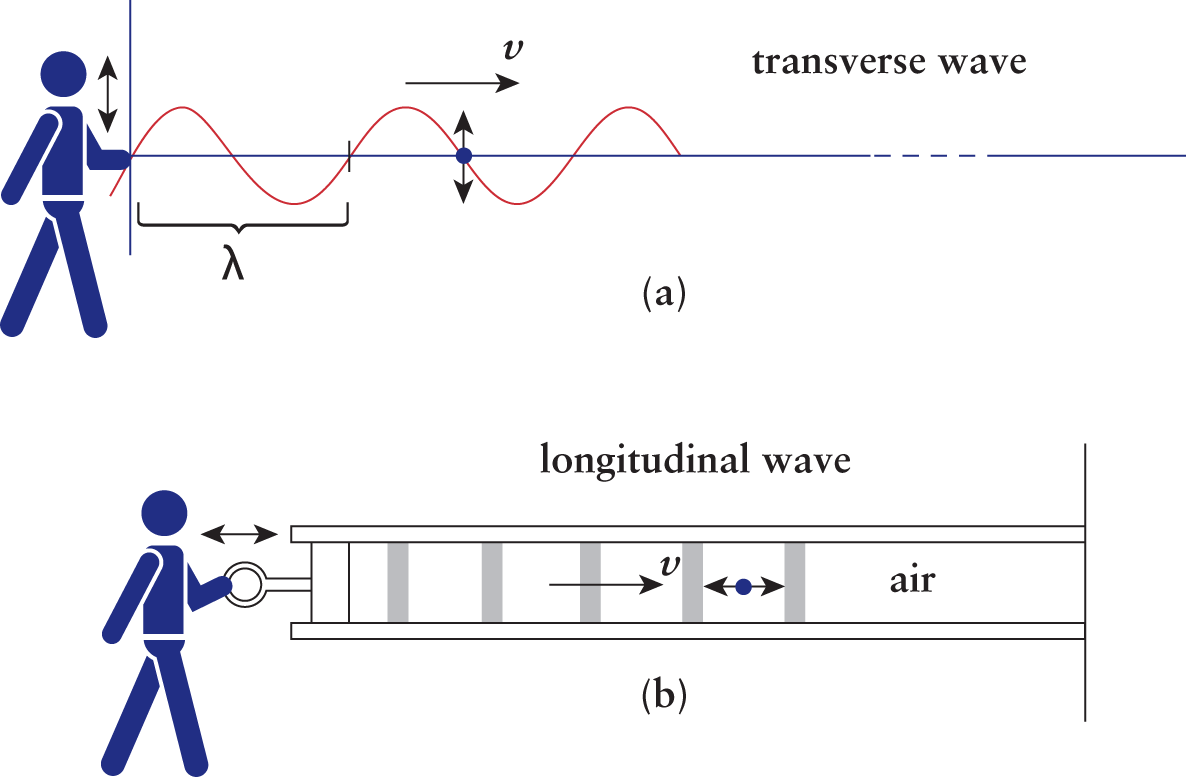
Figure 7.1. Wave Types (a) Transverse: particles oscillate perpendicular to the direction of propagation; (b) Longitudinal: particles oscillate parallel to the direction of propagation.
KEY CONCEPT
Transverse waves have particle oscillation perpendicular to the direction of propagation and energy transfer. Longitudinal waves have particle oscillation parallel to the direction of propagation and energy transfer.
Describing Waves
Waves can be described mathematically or graphically. To do so, we must first assign meaning to the physical quantities that waves represent. The distance from one maximum (crest) of the wave to the next is called the wavelength (λ). The frequency (f) is the number of wavelengths passing a fixed point per second, and is measured in hertz (Hz) or cycles per second (cps). From these two values, one can calculate the propagation speed (ν) of a wave:
ν = fλ
Equation 7.1
If frequency defines the number of cycles per second, then its inverse—period (T)—is the number of seconds per cycle:
T=1f
Equation 7.2
Frequency is also related to angular frequency (ω), which is measured in radians per second, and is often used in consideration of simple harmonic motion in springs and pendula:
ω=2πf=2πT
Equation 7.3
Waves oscillate about a central point called the equilibrium position. The displacement (x) in a wave describes how far a particular point on the wave is from the equilibrium position, expressed as a vector quantity. The maximum magnitude of displacement in a wave is called its amplitude (A). Be careful with the terminology: note that the amplitude is defined as the maximum displacement from the equilibrium position to the top of a crest or bottom of a trough, not the total displacement between a crest and a trough (which would be double the amplitude). These quantities are shown in Figure 7.2.
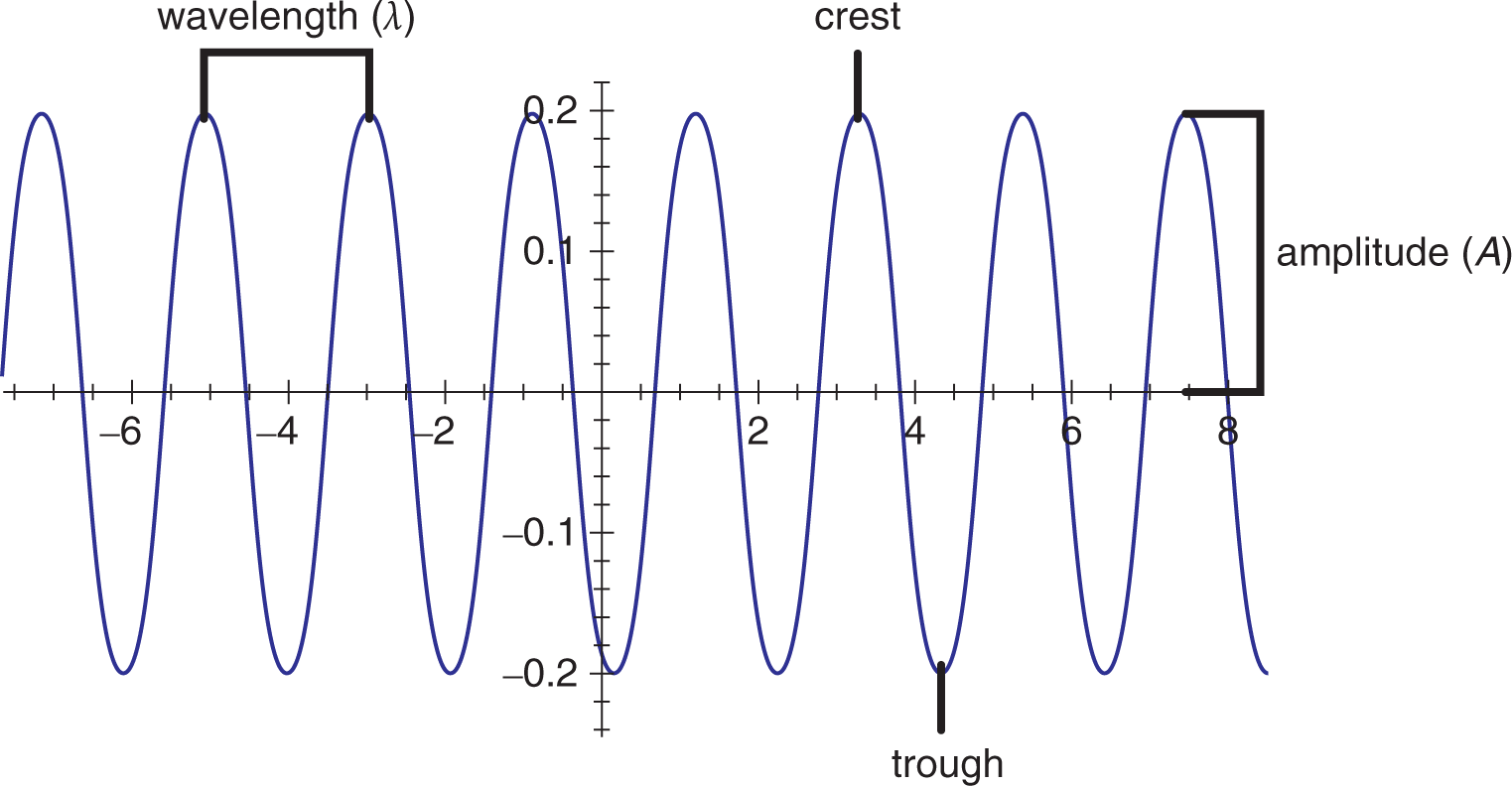
Figure 7.2. Anatomy of a Wave
MCAT EXPERTISE
Even if simple harmonic motion in springs and strings (pendula) are not on the formal content lists for the MCAT, it is still important to be familiar with the jargon of wave motion because sound and light (electromagnetic radiation) are on those content lists!
Transverse sinusoidal waves can be mathematically described using a wave function in the context of the position x of the wave and at time t, as shown below in Equation 7.4. In this equation, A represents the wave amplitude, λ represents the wavelength, f represents the wave frequency, and φ represents the phase difference (described in the next section). While this equation can show up on Test Day, it will be more important to recognize the individual components of the equation rather than have it memorized.
y(
x, t
)=A sin[ 2n(
x λ
± t f
+φ
) ]
Equation 7.4
Phase
When analyzing waves that are passing through the same space, we can describe how “in step” or “out of step” the waves are by calculating the phase difference. If we consider two waves that have the same frequency, wavelength, and amplitude and that pass through the same space at the same time, we can say that they are in phase if their respective crests and troughs coincide (line up with each other). When waves are perfectly in phase, we say that the phase difference is zero. However, if the two waves travel through the same space in such a way that the crests of one wave coincide with the troughs of the other, then we would say that they are out of phase, and the phase difference would be one-half of a wave. This could be expressed as λ2 or, if given as an angle, 180° (one cycle = one wavelength = 360°). Of course, waves can be out of phase with each other by any other fraction of a cycle, as well.
Principle of Superposition
The principle of superposition states that when waves interact with each other, the displacement of the resultant wave at any point is the sum of the displacements of the two interacting waves. When the waves are perfectly in phase, the displacements always add together and the amplitude of the resultant is equal to the sum of the amplitudes of the two waves. This is called constructive interference. When waves are perfectly out of phase, the displacements always counteract each other and the amplitude of the resultant wave is the difference between the amplitudes of the interacting waves. This is called destructive interference.
KEY CONCEPT
If two waves are perfectly in phase, the resultant wave has an amplitude equal to the sum of the amplitudes of the two waves. If two equal waves are exactly 180 degrees out of phase, then the resultant wave has zero amplitude.
If waves are not perfectly in phase or out of phase with each other, partially constructive or partially destructive interference can occur. As shown in Figure 7.3a, two waves that are nearly in phase will mostly add together. While the displacement of the resultant is simply the sum of the displacements of the two waves, the waves do not perfectly add together because they are not quite in phase. Therefore, the amplitude of the resultant wave is not quite the sum of the two waves’ amplitudes. In contrast, Figure 7.3b shows two waves that are almost perfectly out of phase. The two waves do not quite cancel, but the resultant wave’s amplitude is clearly much smaller than that of either of the other waves.
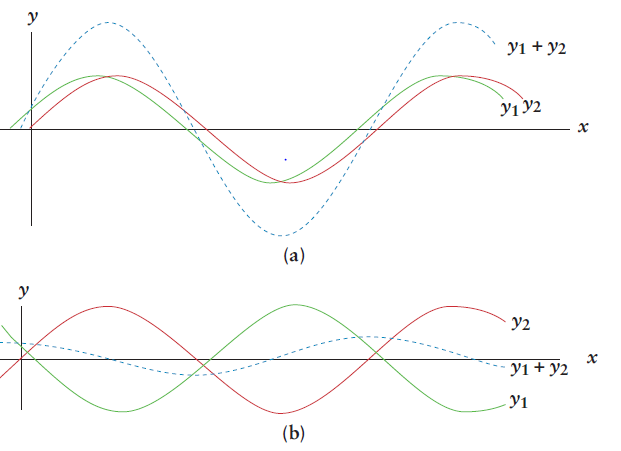
Figure 7.3. Phase Difference (a) In phase with a difference of almost zero; (b) Out of phase with a difference of almost 180 degrees (λ2)
REAL WORLD
In noise-canceling headphones, pressure waves from noise are canceled by destructive interference. The speaker creates a wave that is 180 degrees out of phase and of similar amplitude. Many frequencies are usually present in the noise, so it is difficult to get perfect noise cancellation.
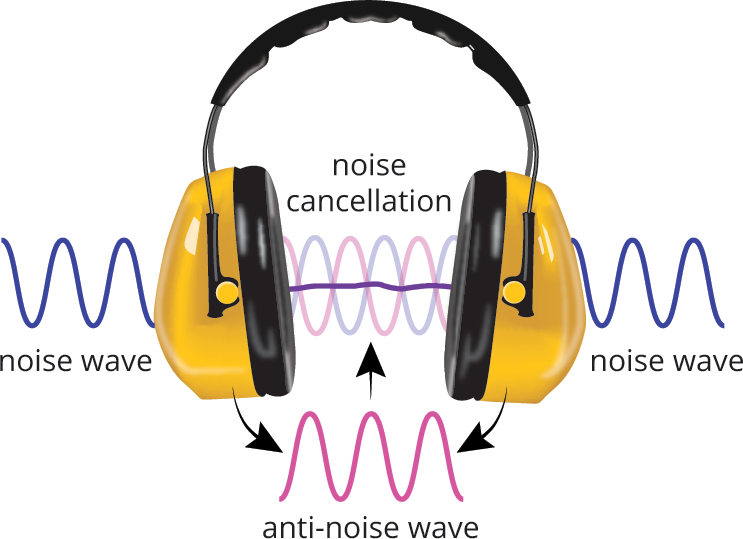
Noise-canceling headphones operate on the principle of superposition. They do not simply muffle sound, but actually capture the environmental noise and, using computer technology, produce a sound wave that is approximately 180 degrees out of phase. The combination of the two waves inside the headset results in destructive interference, thereby canceling—or nearly canceling—the ambient noise.
Traveling and Standing Waves
If a string fixed at one end is moved up and down, a wave will form and travel, or propagate, toward the fixed end. Because this wave is moving, it is called a traveling wave. When the wave reaches the fixed boundary, it is reflected and inverted, as shown in Figure 7.4. If the free end of the string is continuously moved up and down, there will then be two waves: the original wave moving down the string toward the fixed end and the reflected wave moving away from the fixed end. These waves will then interfere with each other.
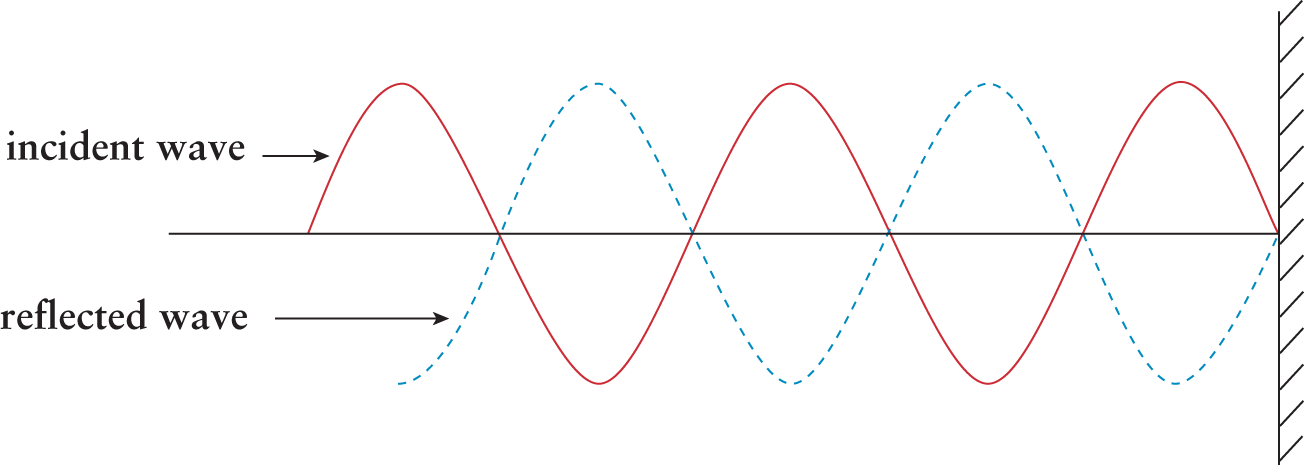
Figure 7.4. Traveling Wave
Now consider the case when both ends of the string are fixed and traveling waves are excited in the string. Certain wave frequencies will cause interference between the traveling wave and its reflected wave such that they form a waveform that appears to be stationary. In this case, the only apparent movement of the string is fluctuation of amplitude at fixed points along the length of the string. These waves are known as standing waves. Points in the wave that remain at rest (where amplitude is constantly zero) are known as nodes. Points midway between the nodes fluctuate with maximum amplitude and are known as antinodes. In addition to strings fixed at both ends, pipes that are open at both ends can support standing waves, and the mathematics relating the standing wave wavelength and the length of the string or the open pipe are similar. Pipes that are open at one end and closed at the other can also support standing waves, but because the closed end contains a node and the open end contains an antinode, the mathematics are different. Standing waves in strings and pipes are discussed in more detail later, within the context of sound, because standing wave formation is integral to the formation of sound in certain contexts.
Resonance
Why are clarinets, pianos, and even half-filled wine glasses considered musical instruments, but not pencils, chairs, or paper? This discrepancy has much to do with the natural (resonant) frequencies of these objects. Any solid object, when hit, struck, rubbed, or disturbed in any way will begin to vibrate. Tapping a pencil on a surface will cause it to vibrate, as will hitting a chair or crumpling a piece of paper. Blowing air pressure between a clarinet reed and a mouthpiece, striking a taut piano string, and creating friction on a wine glass’s surface will also cause vibration. If the natural frequency is within the frequency detection range of the human ear, the sound will be audible. The quality of the sound, called timbre, is determined by the natural frequency or frequencies of the object. Some objects vibrate at a single frequency, producing a pure tone. Other objects vibrate at multiple frequencies that have no relation to one another. These objects produce sounds that we do not find particularly musical, such as tapping a pencil, hitting a chair, or crumpling paper. These sounds are called noise, scientifically. Still other objects vibrate at multiple natural frequencies (a fundamental pitch and multiple overtones) that are related to each other by whole number ratios, producing a richer, more full tone. The human brain perceives these sounds as being more musical, and all nonpercussion instruments produce such overtones. Of note for the MCAT, the frequencies between 20 Hz and 20,000 Hz are commonly audible to young adults, and high-frequency hearing generally declines with age.
The natural frequency of most objects can be changed by changing some aspect of the object itself. For example, a set of eight identical glasses can be filled with different levels of water so that each vibrates at a different natural frequency, producing the eight notes of a diatonic musical scale. Strings have an infinite number of natural frequencies that depend on the length, linear density, and tension of the string.
If a periodically varying force is applied to a system, the system will then be driven at a frequency equal to the frequency of the force. This is known as forced oscillation. If the frequency of the applied force is close to that of the natural frequency of the system, then the amplitude of oscillation becomes much larger. This can easily be demonstrated by a child on a swing being pushed by a parent. If the parent pushes the child at a frequency nearly equal to the frequency at which the child swings back toward the parent, the arc of the swinging child will become larger and larger: the amplitude is increasing because the force frequency is nearly identical to the swing’s natural frequency.
If the frequency of the periodic force is equal to a natural (resonant) frequency of the system, then the system is said to be resonating, and the amplitude of the oscillation is at a maximum. If the oscillating system were frictionless, the periodically varying force would continually add energy to the system, and the amplitude would increase indefinitely. However, because no system is completely frictionless, there is always some damping, which results in a finite amplitude of oscillation. In general, damping or attenuation is a decrease in amplitude of a wave caused by an applied or nonconservative force. Furthermore, many objects cannot withstand the large amplitude of oscillation and will break or crumble. A dramatic demonstration of resonance is the shattering of a wine glass by loudly singing the natural frequency of the glass. This is actually possible with a steady, loud tone—the glass will resonate (oscillate with maximum amplitude) and eventually shatter.
MCAT CONCEPT CHECK 7.1
Before you move on, assess your understanding of the material with these questions.
- Define the following terms:
- Wave speed:
_________________________________
- Frequency:
_________________________________
- Angular frequency:
_________________________________
- Period:
_________________________________
- Equilibrium position:
_________________________________
- Amplitude:
_________________________________
- Traveling wave:
_________________________________
- Standing wave:
_________________________________
- If two waves are out of phase at any interval besides 180 degrees, how does the amplitude of the resultant wave compare to the amplitudes of the two interfering waves?
_________________________________
- True or False: Sound waves are a prime example of transverse waves.
- How does applying a force at the natural frequency of a system change the system?
_________________________________
7.2 Sound
LEARNING OBJECTIVES
After Chapter 7.2, you will be able to:
- Explain how sound is produced and transmitted
- Connect amplitude and frequency to their corresponding properties in a sound wave
- Predict changes in apparent frequency based on the movement of two objects in relation to one another
- Calculate key values for sound, including intensity, frequency, apparent frequency, and wavelength in Doppler and pipe systems
Sound is a longitudinal wave transmitted by the oscillation of particles in a deformable medium. As such, sound can travel through solids, liquids, and gases, but cannot travel through a vacuum. The speed of sound is given by the equation
v=Bρ
Equation 7.5
where B is the bulk modulus, a measure of the medium’s resistance to compression (B increases from gas to liquid to solid), and ρ is the density of the medium. Because the bulk modulus increases disproportionately more than density as one goes from gas to liquid to solid, sound travels fastest through a solid and slowest through a gas. The speed of sound in air at 20 °C is approximately 343 ms.
KEY CONCEPT
The speed of sound is fastest in a solid with low density, and slowest in a very dense gas.
Production of Sound
Sound is produced by the mechanical disturbance of particles in a material along the sound wave’s direction of propagation. Although the particles themselves do not travel along with the wave, they do vibrate or oscillate about an equilibrium position, which causes small regions of compression to alternate with small regions of rarefaction (decompression). These alternating regions of increased and decreased particle density travel through the material, allowing the sound wave to propagate.
Because sound involves vibration of material particles, the source of any sound is ultimately a mechanical vibration of some frequency. Sound waves can be produced by the vibration of solid objects or the vibration of fluids, including gases. Solid objects that can vibrate to produce musical sound include strings (on a piano, violin, guitar, and so on), metal (bells), or wood bars (xylophone or marimba). Vibration of air within certain objects, including all woodwinds and brass instruments, pipe organs, and even a soda bottle, can also create musical sound. The pitch (frequency) at which the air column within the instrument vibrates is determined by the length of the air column, which can be changed either by covering holes in the instrument or directly changing its length.
The human voice is no less a musical instrument than any of those listed above. Sound is created by passing air between the vocal cords, which are a pair of thin membranes stretched across the larynx. As the air moves past the cords, they vibrate like the double reed of an oboe or bassoon, causing the air to vibrate at the same frequency. The pitch of the sound is controlled by varying the tension of the cords. Adult male vocal cords are often larger and thicker than those of adult females; thus, male voices are commonly lower in pitch.
Frequency and Pitch
We’ve discussed frequency as the rate at which a particle or wave completes a cycle. Our perception of the frequency of sound is called the pitch. Lower-frequency sounds have lower pitch, and higher-frequency sounds have higher pitch. On the MCAT, sound frequencies are usually within the normal range of human hearing, from 20 Hz to 20,000 Hz. Sound waves with frequencies below 20 Hz are called infrasonic waves, and those with frequencies above 20,000 Hz are called ultrasonic waves. Both dog whistles, which emit frequencies between 20 and 22 kHz, and medical ultrasound machines, which emit frequencies in excess of 2 GHz, are examples of ultrasonic waves.
Doppler Effect
We’ve all witnessed the Doppler effect: an ambulance or fire truck with its sirens blaring is quickly approaching from the other lane, and as it passes, one can hear a distinct drop in the pitch of the siren. This phenomenon affecting frequency is called the Doppler effect, which describes the difference between the actual frequency of a sound and its perceived frequency when the source of the sound and the sound’s detector are moving relative to one another. If the source and detector are moving toward each other, the perceived frequency, f′, is greater than the actual frequency, f. If the source and detector are moving away from each other, the perceived frequency is less than the actual frequency. This can be seen from the Doppler effect equation:
f′=f(v±vD)(v∓vS)
Equation 7.6
where f′ is the perceived frequency, f is the actual emitted frequency, ν is the speed of sound in the medium, νD is the speed of the detector, and νS is the speed of the source. Note the unusual signs in the equation. If memorized in this form, the upper sign should be used when the detector or source is moving toward the other object. The lower sign should be used when the detector or source is moving away from the other object.
BRIDGE
The Doppler effect applies to all waves, including light. This means that if a source of light is moving toward the detector, the observed frequency will increase. This is called blue shift because blue is at the high-frequency end of the visible spectrum. If the source is moving away from the detector, the observed frequency will decrease, causing red shift. Light and electromagnetic waves are discussed in Chapter 8 of MCAT Physics and Math Review.
MNEMONIC
Sign convention in the Doppler equation:
- Top sign for “toward”
- Bottom sign for “away”
This sign convention is usually the most confusing part of the Doppler effect equation, so let’s take a closer look. Imagine the situation presented earlier: you’re driving down the street when you hear an ambulance approaching from behind. In this scenario, you are the detector and the ambulance is the sound source. At this time, you would say that you are driving away from the ambulance; even though the ambulance is moving faster and getting closer to you, the direction in which you are driving is still away from the ambulance. By this logic, the lower sign (–) should be used in the numerator, which relates to the detector. The driver of the ambulance, on the other hand, would say that the ambulance is driving toward you. By this logic, the top sign (–) should be used in the denominator, which relates to the source. In this case, the Doppler effect equation would look like this:
f′=f(v−vD)(v−vS)
Because νS > νD, we know that f′ > f.
Now imagine that the ambulance has passed you and continues to speed down the road. At this point, you would say that you are driving toward the ambulance (top sign in the numerator, +), even if you are not going as fast as it is. The ambulance driver would say that the ambulance is driving away from you (bottom sign in the denominator, +) and the corresponding Doppler effect equation would be:
f′=f(v+vD)(v+vS)
Here, because νS > νD, f′ < f. This change in f′ from being greater than f to being less than f is perceived as a drop in pitch.
The Doppler effect can be visualized by considering the sound waves in front of a moving object as being compressed, while the sound waves behind the object are stretched out, as shown in Figure 7.5.
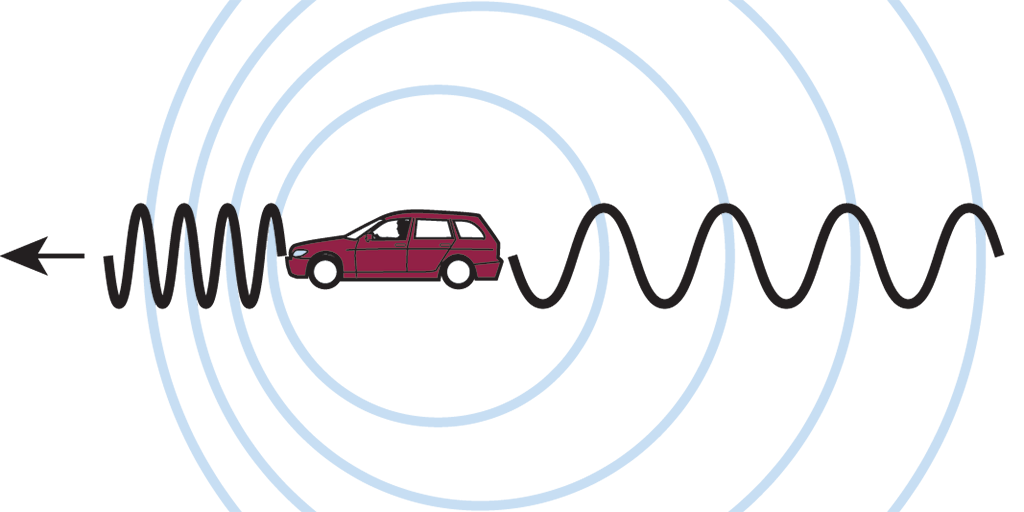
Figure 7.5. The Doppler Effect The black arrow indicates the direction of motion for the car. In front of the car, crests of the sound wave are compressed together, increasing the frequency (pitch). Behind the car, crests of the sound wave are stretched apart, decreasing the frequency.
The Doppler effect can be used by animals through the process of echolocation. In echolocation, the animal emitting the sound (usually a dolphin or bat) serves as both the source and the detector of the sound. The sound bounces off of a surface and is reflected back to the animal. How long it takes for the sound to return, and the change in frequency of the sound, can be used to determine the position of objects in the environment and the speed at which they are moving.
Example: A train traveling south at 216kmhr is sounding its whistle while passing by a stationary observer. The whistle emits sound at a frequency of 1400 Hz. What is the frequency heard by the stationary observer when the train is moving toward the observer, and when the train has passed the observer? (Note: The speed of sound in air is approximately 340 ms.)
Solution: To solve this problem, the speed of the train (vS) must first be converted to ms:
vS=216 kmhr[1hr3600s][1000 m1 km]=60 ms
When the train is moving toward the stationary observer, the top sign should be used in the denominator. The numerator is simply v because vD = 0. This gives
f’=fvv−vS=(1400 Hz)(340 ms340 ms−60 ms)=1400(340280)=1400(1714)=1700 Hz
When the train is moving away from the observer, the sign in the denominator changes. The numerator remains unchanged because the observer is still stationary:
f’=fvv+vS=(1400 Hz)(340 ms340 ms+60 ms)=1400(340400)=1400(1720)=1190 Hz
Shock Waves
In a special case of the Doppler effect, an object that is producing sound while traveling at or above the speed of sound allows wave fronts to build upon one another at the front of the object. This creates a much larger amplitude at that point. Because amplitude for sound waves is related to the degree of compression of the medium, this creates a large pressure differential or pressure gradient. This highly condensed wave front is called a shock wave, and it can cause physical disturbances as it passes through other objects. The passing of a shock wave creates very high pressure, followed by very low pressure, which is responsible for the phenomenon known as a sonic boom. Unlike its depiction in movies and television, a sonic boom can be heard any time that an object traveling at or faster than the speed of sound passes a detector, not just at the point that the speed of sound is exceeded (Mach 1). Once an object moves faster than the speed of sound, some of the effects of the shock wave are mitigated because all of the wave fronts will trail behind the object, destructively interfering with each other.
Intensity and Loudness of Sound
The loudness or volume of a sound is the way in which we perceive its intensity. Perception of loudness is subjective, and depends not only on brain function, but also physical factors such as obstruction of the ear canal, stiffening of the ossicles, or damage to cochlear hair cells by exposure to loud noises or with age. Sound intensity, on the other hand, is objectively measurable. Intensity is the average rate of energy transfer per area across a surface that is perpendicular to the wave. In other words, intensity is the power transported per unit area. The SI units of intensity are therefore watts per square meter (Wm2). Intensity is calculated using the equation
I=PA
Equation 7.7
where P is the power and A is the area. Rearranging this equation, we could consider that the power delivered across a surface, such as the tympanic membrane (eardrum), is equal to the product of the intensity I and the surface area A, assuming the intensity is uniformly distributed.
The amplitude of a sound wave and its intensity are also related to each other: intensity is proportional to the square of the amplitude. Therefore, doubling the amplitude produces a sound wave that has four times the intensity.
Intensity is also related to the distance from the source of the sound wave. As sound waves emanate outward from their source, it is as though the waves are pushing against the interior wall of an ever-expanding spherical balloon. Because the surface area of a sphere increases as a function of the square of the radius (A = 4πr2), sound waves transmit their power over larger and larger areas the farther from the source they travel. Intensity, therefore, is inversely proportional to the square of the distance from the source. For example, sound waves that have traveled 2 meters from their source have spread their energy out over a surface area that is four times larger than that for identical sound waves that have traveled 1 meter from their source.
The softest sound that a typical human ear can hear has an intensity equal to about 1×10⁻¹²Wm2. The mechanical disturbance associated with the threshold of hearing is remarkably small—the displacement of air particles is on the order of one billionth of a centimeter. At the other end of the spectrum, the intensity of sound at the threshold of pain is 10Wm2 and the intensity that causes instant perforation of the eardrum is approximately 1×10⁴Wm2. This is a huge range, which would be unmanageable to express on a linear scale. To make this range easier to work with, we use a logarithmic scale, called the sound level (β), measured in decibels (dB):
β=10 log II0
Equation 7.8
where I is the intensity of the sound wave and I0 is the threshold of hearing (1×10⁻¹² Wm2), which is used as a reference intensity. When the intensity of a sound is changed by some factor, one can calculate the new sound level by using the equation
βf=βi+10 log IfIi
Equation 7.9
where IfIi is the ratio of the final intensity to the initial intensity.
BRIDGE
We use logarithms with scales that have an extremely large range. The MCAT will mostly deal with base-ten logarithms (common logarithms). As an example, log 1000 = 3 because 103 = 1000. As another example, log 1 = 0 because 100 = 1. Logarithms are discussed in Chapter 10 of MCAT Physics and Math Review.
The sound levels and relative intensities of several sound sources and thresholds are shown in Table 7.1.
Table 7.1 Sound Level and Intensity of Sound Sources and Important Thresholds
SOUND SOURCE SOUND LEVEL (DB) INTENSITY (WM2)
(Threshold of Hearing) 0 1 × 10⁻¹²
Rustling Leaves 10 1 × 10⁻¹¹
Whisper 20 1 × 10⁻¹⁰
Quiet Room at Night 30 1 × 10⁻⁹
Quiet Library 40 1 × 10⁻⁸
Moderate Rainfall 50 1 × 10⁻⁷
Conversational Speech at 1 m 60 1 × 10⁻⁶
Vacuum Cleaner at 1 m 70 1 × 10⁻⁵
Door Slamming 80 1 × 10⁻⁴
Lawn Mower at 1 m 90 1 × 10⁻³
Jackhammer at 1 m 100 1 × 10⁻²
Loud Rock Concert 110 1 × 10⁻¹
Thunder 120 1 × 100
(Threshold of Pain) 130 1 × 101
Rifle at 1 m 140 1 × 10²
Jet Engine at 30 m 150 1 × 10³
(Eardrum Perforation) 160 1 × 10⁴
Example: A detector with a surface area of 1 square meter is placed 1 meter from a blender. It measures the average power of the blender’s sound as being 10−3 W. Find the intensity and sound level of the blender, and the ratio of the intensities of the blender and a jet engine. (Note: Assume βjet = 150 dB.)
Solution: Intensity is defined as the power per area:
I=PA=10−3W1m2=10−3 Wm2
The sound level can then be calculated from the intensity:
β=10 log II0=10 log (10−3 Wm210−12 Wm2)=10 log 109=90 dB
Finally, the ratio of two sound intensities can be found from the difference of their sound levels:
βjet=βblender+10 log IjetIblender150 dB=90 dB+10 log IjetIblender6=log IjetIblender106=IjetIblender
Thus, the jet engine’s sound is 1,000,000 times more intense than the blender’s sound.
Attenuation
Sound is not transmitted undiminished. Even after the decrease in intensity associated with distance, real world measurements of sound will be lower than those expected from calculations. This is a result of damping, or attenuation. Oscillations are a form of repeated linear motion, so sound is subject to the same nonconservative forces as any other system, including friction, air resistance, and viscous drag.
MCAT EXPERTISE
Like nonconservative forces, attenuation is generally negligible on Test Day. If it is important for answering a question, the MCAT will make it clear that you should consider the effects of damping (attenuation) on an oscillating system.
The presence of a nonconservative force causes the system to decrease in amplitude during each oscillation. Because amplitude, intensity, and sound level (loudness) are related, there is a corresponding gradual loss of sound. Note that damping does not have an effect on the frequency of the wave, so the pitch will not change. This phenomenon, along with reflection, explains why it is more difficult to hear in a confined or cluttered space than in an empty room: friction from the surfaces of the objects in the room actually decreases the sound waves’ amplitudes. Over small distances, attenuation is usually negligible.
Beat Frequency
Sound volume can also vary periodically due to interference effects. When two sounds of slightly different frequencies are produced in proximity, as when tuning a pair of instruments next to one another, volume will vary at a rate based on the difference between the two pitches being produced. The frequency of this periodic increase in volume can be calculated by the equation:
fbeat=f1 – f2
Equation 7.10
where f1 and f2 represent the two frequencies that are close in pitch, and fbeat represents the resulting beat frequency.
Standing Waves
Remember that standing waves are produced by the constructive and destructive interference of a traveling wave and its reflected wave. More broadly, we can say that a standing wave will form whenever two waves of the same frequency traveling in opposite directions interfere with one another as they travel through the same medium. Standing waves appear to be standing still—that is, not propagating—because the interference of the wave and its reflected wave produce a resultant that fluctuates only in amplitude. As the waves move in opposite directions, they interfere to produce a new wave pattern characterized by alternating points of maximum displacement (amplitude) and points of no displacement. The points in a standing wave with no fluctuation in displacement are called nodes. The points with maximum fluctuation are called antinodes.
MNEMONIC
Nodes are places of No Displacement
Not every frequency of traveling wave will result in standing wave formation. The length of the medium dictates the wavelengths (and, by extension, the frequencies) of traveling waves that can establish standing waves. Objects that support standing waves have boundaries at both ends. Closed boundaries are those that do not allow oscillation and that correspond to nodes. The closed end of a pipe and the secured ends of a string are both considered closed boundaries. Open boundaries are those that allow maximal oscillation and correspond to antinodes. The open end of a pipe and the free end of a flag are both open boundaries.
Strings
Consider a string, such as a guitar or violin string, or a piano wire, fixed rigidly at both ends. Because the string is secured at both ends and is therefore immobile at these points, they are considered nodes. If a standing wave is set up such that there is only one antinode between the two nodes at the ends, the length of the string corresponds to one-half the wavelength of this standing wave, as shown in Figure 7.6a. This is because on a sine wave, the distance from one node to the next node is one-half of a wavelength. If a standing wave is set up such that there are two antinodes between the ends, there must be a third node located between the antinodes, as shown in Figure 7.6b. In this case, the length of the string corresponds to the wavelength of this standing wave. Again, the distance on a sine wave from a node to the second consecutive node is exactly one wavelength. This pattern suggests that the length L of a string must be equal to some multiple of half-wavelengths (L=λ2, 2λ2, 3λ2, and so on).
The equation that relates the wavelength λ of a standing wave and the length L of a string that supports it is:
λ=2Ln
Equation 7.11
where n is a positive nonzero integer (n = 1, 2, 3, and so on) called the harmonic. The harmonic corresponds to the number of half-wavelengths supported by the string. From the relationship that f=vλ where ν is the wave speed, the possible frequencies are:
f=nv2L
Equation 7.12
The lowest frequency (longest wavelength) of a standing wave that can be supported in a given length of string is known as the fundamental frequency (first harmonic). The frequency of the standing wave given by n = 2 is known as the first overtone or second harmonic. This standing wave has one-half the wavelength and twice the frequency of the first harmonic. The frequency of the standing wave given by n = 3 is known as the second overtone or third harmonic, as shown in Figure 7.6c. All the possible frequencies that the string can support form its harmonic series.
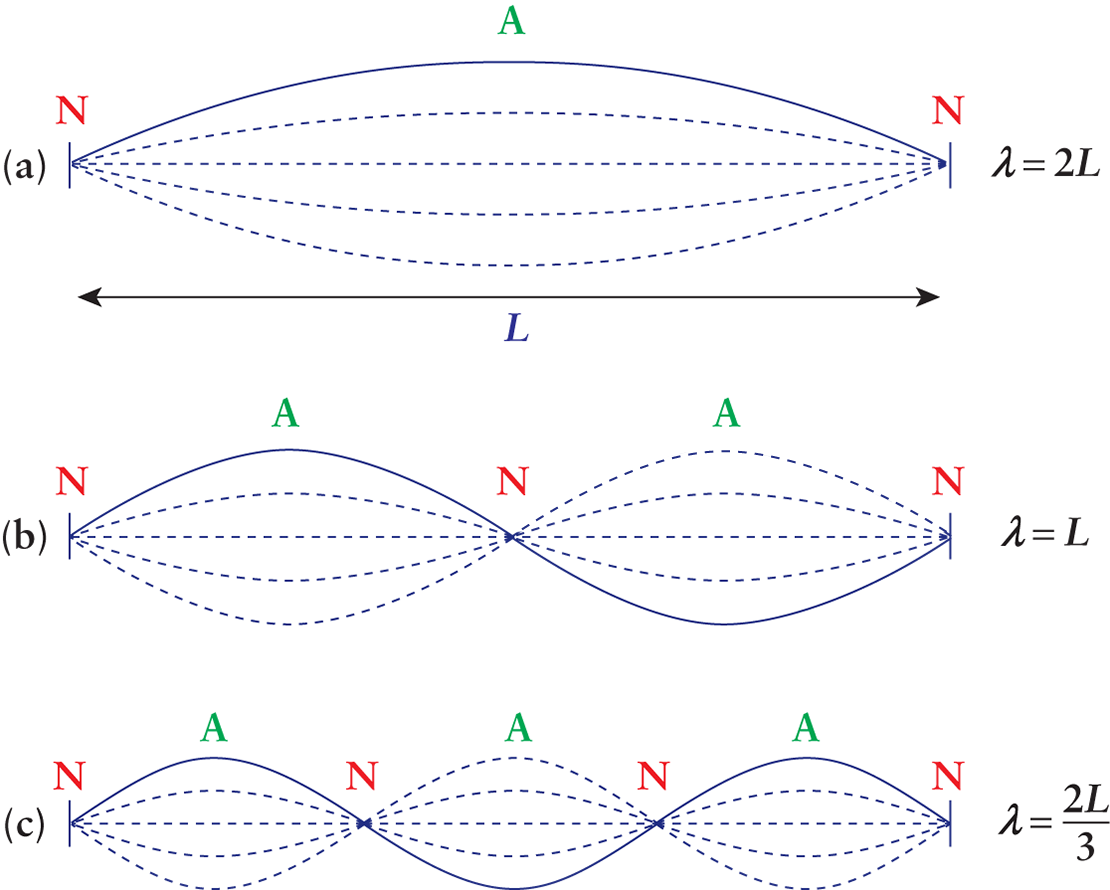
Figure 7.6. First, Second, and Third Harmonics of a String The harmonic is given by the number of half-wavelengths supported by the string. N = node; A = antinode.
MCAT EXPERTISE
As a shortcut, for strings attached at both ends, the number of antinodes present will tell you which harmonic it is.
Open Pipes
Pipes can support standing waves and produce sound as well. Many musical instruments are straight or curved tubes within which air will oscillate at particular frequencies to set up standing waves. The end of a pipe can be open or closed. If the end of the pipe is open, it will support an antinode. If it is closed, it will support a node. One end of the pipe must be open at least slightly to allow for the entry of air, but sometimes these openings are small and covered by the musician’s mouth—in these cases, they function as a closed end. Pipes that are open at both ends are called open pipes, while those that are closed at one end (and open at the other) are called closed pipes. The flute functions as an open pipe instrument, while the clarinet and brass instruments are closed pipe instruments. If you are a musician, this may be counterintuitive. The distal end of a flute is open, but the proximal end is closed; however, the mouthpiece of a flute is close enough to this closed end for it to function as an open end. Similarly, while air must pass through the mouthpiece of a reed or brass instrument, the opening is sufficiently small to function as a closed end.
An open pipe, being open at both ends, has antinodes at both ends. If a standing wave is set up such that there is only one node between the two antinodes at the ends, the length of the pipe corresponds to one-half the wavelength of this standing wave, as shown in Figure 7.7a. This is analogous to a string except that the ends are both antinodes instead of nodes. The analogy continues throughout: the second harmonic (first overtone) has a wavelength equal to the length of the pipe, as shown in Figure 7.7b. The third harmonic (second overtone) has a wavelength equal to two-thirds the length of the pipe, as shown in Figure 7.7c. Again, an open pipe can contain any multiple of half-wavelengths; the number of half-wavelengths corresponds to the harmonic of the wave. The relationship between the wavelength λ of a standing wave and the length L of an open pipe that supports it is λ=2Ln, and the possible frequencies of the harmonic series are f=nv2L, just like a string.
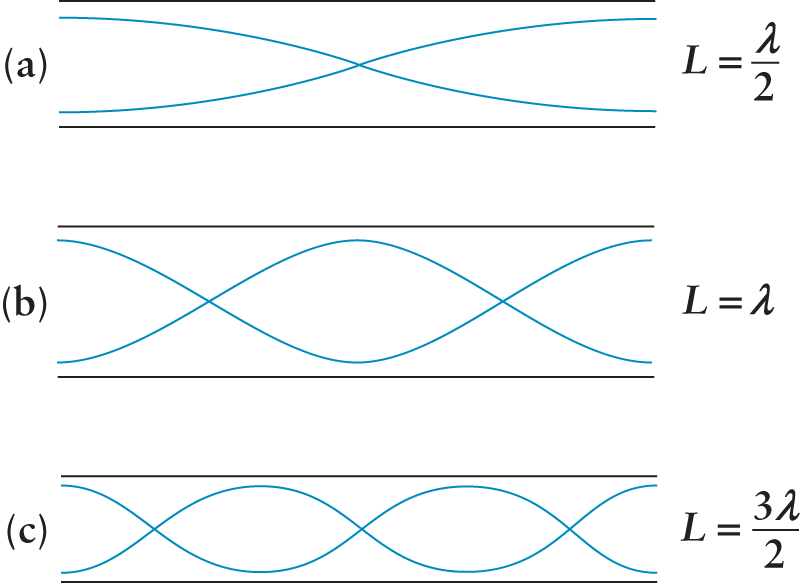
Figure 7.7. First, Second, and Third Harmonics of an Open Pipe The harmonic is given by the number of half-wavelengths supported by the pipe.
MCAT EXPERTISE
As a shortcut, for open pipes, the number of nodes present will tell you which harmonic it is.
It is worthwhile to note that Figure 7.7 is really a symbolic representation of the first three harmonics in an open pipe. We use the term symbolic because the conventional way of diagramming standing waves is to represent sound waves as transverse, rather than longitudinal, waves (which are much harder to draw).
Closed Pipes
In the case of a closed pipe, the closed end will correspond to a node, and the open end will correspond to an antinode. The first harmonic in a closed pipe consists of only the node at the closed end and the antinode at the open end, as shown in Figure 7.8a. In a sinusoidal wave, the distance from a node to the following antinode is one-quarter of a wavelength. Indeed, unlike strings or open pipes, the harmonic in a closed pipe is equal to the number of quarter-wavelengths supported by the pipe. Because the closed end must always have a node and the open end must always have an antinode, there can only be odd harmonics. This is because an even number of quarter-wavelengths would be an integer number of half-wavelengths—which would necessarily have either two nodes or two antinodes at the ends. The first harmonic has a wavelength that is four times the length of the closed pipe. The third harmonic (first overtone) has a wavelength that is four-thirds the length of the closed pipe, as shown in Figure 7.8b. The fifth harmonic (second overtone) has a wavelength that is four-fifths the length of the closed pipe, as shown in Figure 7.8c. The equation that relates the wavelength λ of a standing wave and the length L of a closed pipe that supports it is:
λ=4Ln
Equation 7.13
where n can only be odd integers (n = 1, 3, 5, and so on). The frequency of the standing wave in a closed pipe is:
f=nv4L
Equation 7.14
where ν is the wave speed.
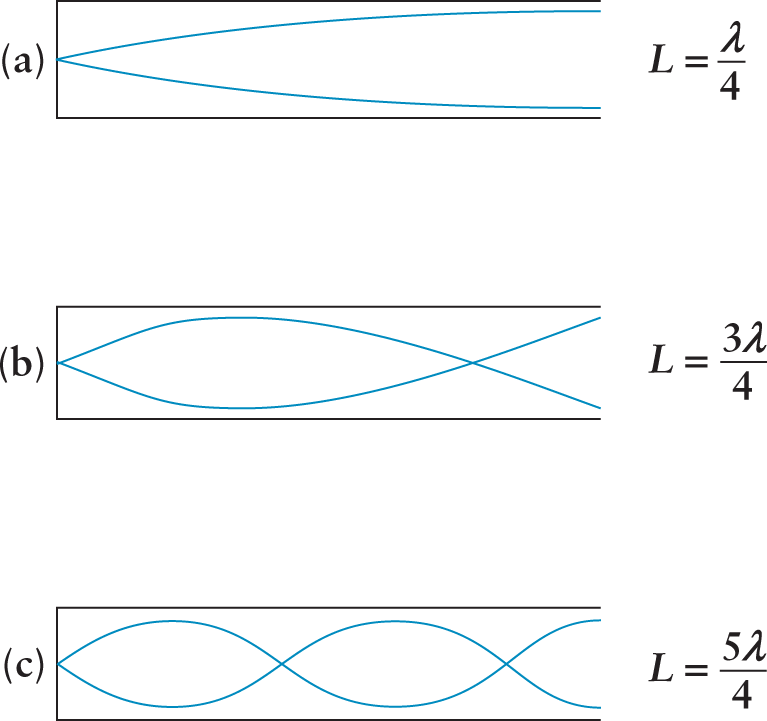
Figure 7.8. First, Third, and Fifth Harmonics of a Closed Pipe The harmonic is given by the number of quarter-wavelengths supported by the pipe.
MCAT EXPERTISE
Unlike strings and open pipes, one cannot simply count the number of nodes or antinodes to determine the harmonic of the wave in closed pipes. Therefore, when presented with a closed pipe, make sure to actually count the number of quarter-wavelengths contained in the pipe to determine the harmonic.
Ultrasound
Until this point we’ve focused on sound in the audible range; however, in medicine we can also use sound waves to visualize organs, anatomy, and pathology. This imaging modality can be used for prenatal screening, or to diagnose gallstones and breast or thyroid masses, or for needle guidance in a biopsy. Ultrasound uses high frequency sound waves outside the range of human hearing to compare the relative densities of tissues in the body. An ultrasound machine consists of a transmitter that generates a pressure gradient, which also functions as a receiver that processes the reflected sound, as seen in Figure 7.9. Because the speed of the wave and travel time is known, the machine can generate a graphical representation of borders and edges within the body by calculating the traversed distance. Note that ultrasound ultimately relies on reflection; thus, an interface between two objects is necessary to visualize anything. Reflection will be discussed further in the next chapter.
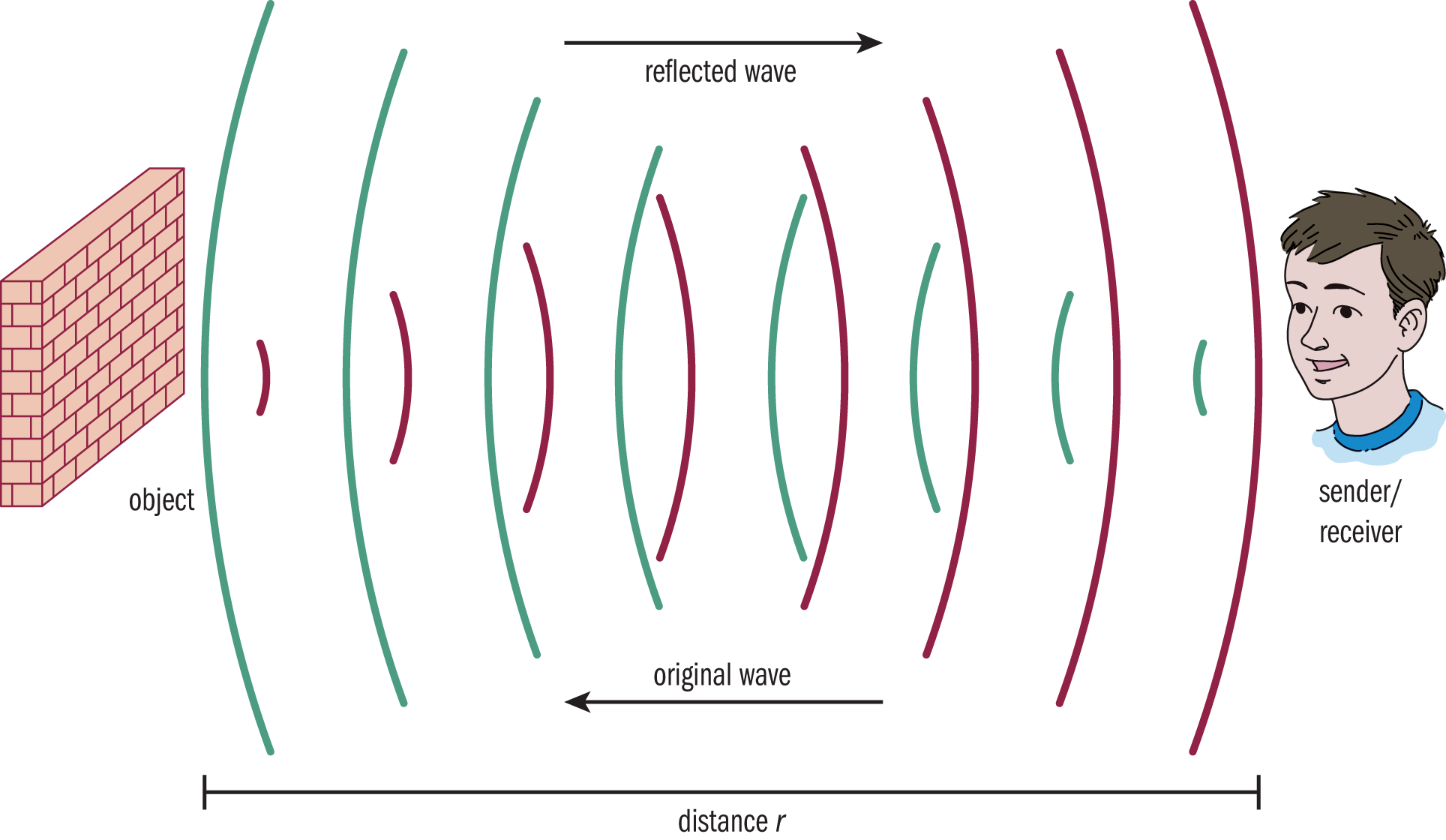
Figure 7.9. Ultrasound The transmitter (sender) generates a wave, which reflects off of an object and returns to the transmitter (which also functions as a receiver).
Most ultrasound transmitters and receivers are packaged in a single unit. The transmitter and receiver do not function simultaneously, however, because one of the objectives of the system is to reduce interference. In addition to the standard ultrasound, most modern ultrasound machines also have a Doppler mode. Doppler ultrasound is used to determine the flow of blood within the body by detecting the frequency shift that is associated with movement toward or away from the receiver.
Ultrasound can also be used therapeutically. Ultrasound waves create friction and heat when they act on tissues, which can increase blood flow to a site of injury in deep tissues and promote faster healing. Focused ultrasound also has a range of applications. Focusing a sound wave using a parabolic mirror causes constructive interference at the focal point of the mirror. This creates a very high-energy wave exactly at that point, which can be used to noninvasively break up a kidney stone (lithotripsy) or ablate (destroy) small tumors. Ultrasound can also be used for dental cleaning and destruction of cataracts (phacoemulsification). In each case, the ultrasound waves are applied for a sufficient time period to achieve the desired effect.
MCAT CONCEPT CHECK 7.2
Before you move on, assess your understanding of the material with these questions.
- How is sound produced and transmitted?
_________________________________
- To which properties of a sound wave do amplitude and frequency correspond?
- Amplitude:
_________________________________
- Frequency:
_________________________________
- If two objects are traveling toward each other, how does the apparent frequency differ from the original frequency? What if two objects are traveling away from each other? What if one object is following the other?
- Toward each other:
_________________________________
- Away from each other:
_________________________________
- One object follows the other:
_________________________________
- What phenomena can be detected or treated using ultrasound?
_________________________________
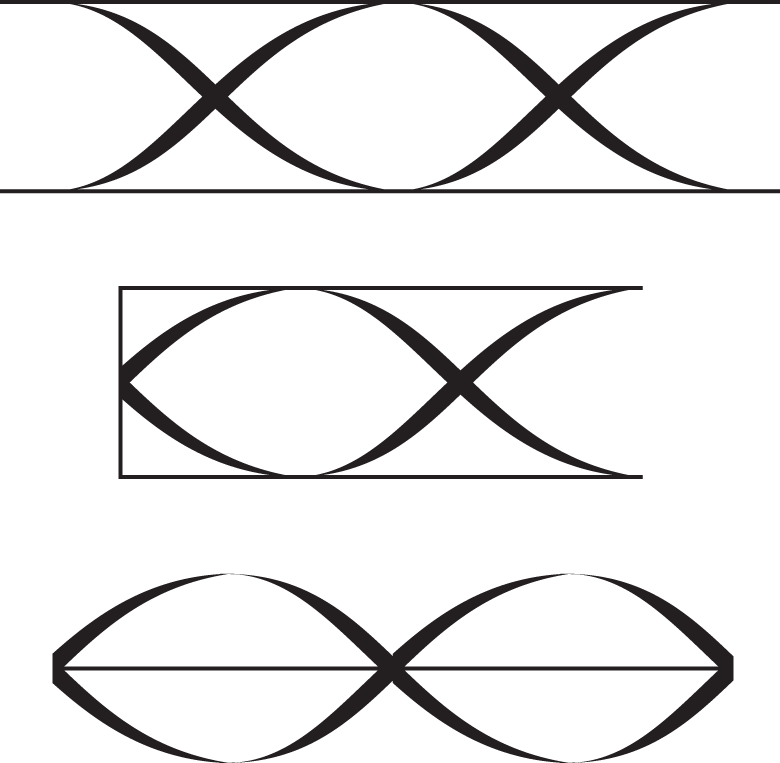
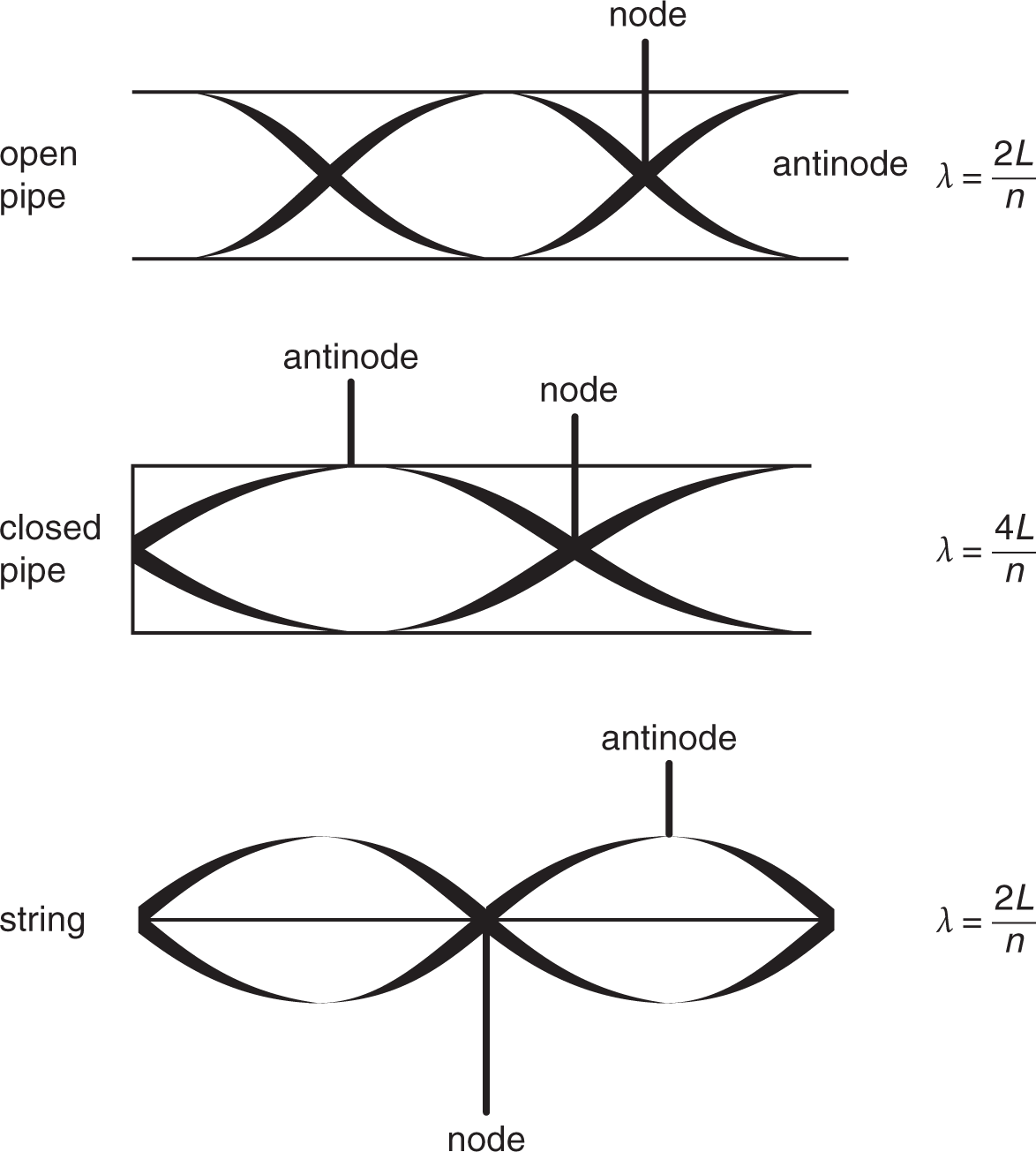
- For each of the following diagrams, label the type of pipe or string it represents, a node and antinode, and the relevant equation relating λ and L:
Conclusion
In this chapter, we reviewed the general characteristics of waves, including the phenomena of interference and resonance, and analyzed the characteristics and behaviors of sound as an example of a longitudinal waveform. Sound is the mechanical disturbance of particles creating oscillating regions of compression and rarefaction parallel to the direction of wave movement. The intensity of a sound wave is perceived as the sound level (loudness) of the sound and is measured in decibels. The decibel scale is a logarithmic scale used to describe the ratio of a sound’s intensity to a reference intensity (the threshold of human hearing). We also reviewed the Doppler effect and a special case with shock waves. We then reviewed the mathematics governing the formation of standing waves, which are important in the formation of musical sounds in strings, open pipes, and closed pipes. Finally, we discussed a medical application of sound that incorporates many of these topics: ultrasound.
Continue to review these MCAT topics—it’s easy to think about sound if you listen to music when you study! Whether you turn on Top 40, smooth jazz, or rococo fugues, the principles of sound production and propagation are key to your enjoyment of these harmonious sounds. Sound, of course, is not the only waveform tested on the MCAT. Light waves (and electromagnetic radiation in general) are heavily tested topics on Test Day—we’ll review them in the next chapter.
GO ONLINE
You’ve reviewed the content, now test your knowledge and critical thinking skills by completing a test-like passage set in your online resources!
CONCEPT SUMMARY
General Wave Characteristics
- Transverse waves have oscillations of wave particles perpendicular to the direction of wave propagation (e.g., “The Wave,” electromagnetic waves).
- Longitudinal waves have oscillations of wave particles parallel to the direction of wave propagation (e.g., sound waves).
- Displacement (x) in a wave refers to how far a point is from the equilibrium position, expressed as a vector quantity.
- The amplitude (A) of a wave is the magnitude of its maximal displacement.
- The maximum point of a wave (point of most positive displacement) is called a crest.
- The minimum point of a wave (point of most negative displacement) is called a trough.
- The wavelength (λ) of a wave is the distance between two crests or two troughs.
- The frequency (f) of a wave is the number of cycles it makes per second. It is expressed in hertz (Hz).
- The angular frequency (ω) is another way of expressing frequency and is expressed in radians per second.
- The period (T) of a wave is the number of seconds it takes to complete a cycle. It is the inverse of frequency.
- Interference describes the ways in which waves interact in space to form a resultant wave.
- Constructive interference occurs when waves are exactly in phase with each other. The amplitude of the resultant wave is equal to the sum of the amplitudes of the two interfering waves.
- Destructive interference occurs when waves are exactly out of phase with each other. The amplitude of the resultant wave is equal to the difference in amplitude between the two interfering waves.
- Partially constructive and partially destructive interference occur when two waves are not quite perfectly in or out of phase with each other. The displacement of the resultant wave is equal to the sum of the displacements of the two interfering waves.
- Traveling waves have continuously shifting points of maximum and minimum displacement.
- Standing waves are produced by the constructive and destructive interference of two waves of the same frequency traveling in opposite directions in the same space.
- Antinodes are points of maximum oscillation.
- Nodes are points where there is no oscillation.
- Resonance is the increase in amplitude that occurs when a periodic force is applied at the natural (resonant) frequency of an object.
- Damping is a decrease in amplitude caused by an applied or nonconservative force.
Sound
- Sound is produced by mechanical disturbance of a material that creates an oscillation of the molecules in the material.
- Sound propagates through all forms of matter (but not a vacuum).
- Sound propagates fastest through solids, followed by liquids, and slowest through gases.
- Within a medium, as density increases, the speed of sound decreases.
- The pitch of a sound is related to its frequency.
- The Doppler effect is a shift in the perceived frequency of a sound compared to the actual frequency of the emitted sound when the source of the sound and its detector are moving relative to one another.
- The apparent frequency will be higher than the emitted frequency when the source and detector are moving toward each other.
- The apparent frequency will be lower than the emitted frequency when the source and detector are moving away from each other.
- The apparent frequency can be higher, lower, or equal to the emitted frequency when the two objects are moving in the same direction, depending on their relative speeds.
- When the source is moving at or above the speed of sound, shock waves (sonic booms) can form.
- Loudness or volume of sound (sound level) is related to its intensity.
- Intensity is related to a wave’s amplitude.
- Intensity decreases over distance and some energy is lost to attenuation (damping) from frictional forces.
- Strings and open pipes (open at both ends) support standing waves, and the length of the string or pipe is equal to some multiple of half-wavelengths.
- Closed pipes (closed at one end) also support standing waves, and the length of the pipe is equal to some odd multiple of quarter-wavelengths.
- Sound is used medically in ultrasound machines for both imaging (diagnostic) and treatment (therapeutic) purposes.
ANSWERS TO CONCEPT CHECKS
**7.1**
- Wave speed is the rate at which a wave transmits the energy or matter it is carrying. Wave speed is the product of frequency and wavelength. Frequency is a measure of how often a waveform passes a given point in space. It is measured in Hz. Angular frequency is the same as frequency, but is measured in radians per second. Period is the time necessary to complete a wave cycle. The equilibrium position is the point with zero displacement in an oscillating system. Amplitude is the maximal displacement of a wave from the equilibrium position. Traveling waves have nodes and antinodes that move with wave propagation. Standing waves have defined nodes and antinodes that do not move with wave propagation.
- If two waves are perfectly in phase, the amplitude of the resulting wave is equal to the sum of the amplitudes of the interfering waves. If two waves are perfectly out of phase, the amplitude of the resulting wave is the difference of the amplitudes of the interfering waves. Therefore, if the two waves are anywhere between these two extremes, the amplitude of the resulting wave will be somewhere between the sum and difference of the amplitudes of the interfering waves.
- False. Sound waves are the most common example of longitudinal waves on the MCAT.
- The object will resonate because the force frequency equals the natural (resonant) frequency. The amplitude of the oscillation will increase.
**7.2**
- Sound is produced by mechanical vibrations. These are usually generated by solid objects like bells or vocal cords, but occasionally can be generated by fluids. Sound is propagated as longitudinal waves in matter, so it cannot propagate in a vacuum.
- The amplitude of a wave is related to its sound level (volume). The frequency of a wave is related to its pitch.
- When two objects are traveling toward each other, the apparent frequency is higher than the original frequency (f’=f(v + vD)(v − vS)). When two objects are traveling away from each other, the apparent frequency is lower than the original frequency (f’=f(v − vD)(v + vS)). When one object follows the other, the apparent frequency could be higher, lower, or equal to the original frequency depending on the relative speeds of the detector and the source (f’=f(v + vD)(v + vS) or f’=f(v − vD)(v − vS)).
- Ultrasound can be used for prenatal screening or to diagnose gallstones, breast and thyroid masses, and blood clots. It can be used for needle guidance in a biopsy, for dental cleaning, and for treating deep tissue injury, kidney stones, certain small tumors, and cataracts, among many other applications.
-
SCIENCE MASTERY ASSESSMENT EXPLANATIONS
1. C
If these two glasses are perfectly identical, then the fact that the first glass shattered at 808 Hz tells us that this is very close (if not identical) to the natural (resonant) frequency of the glass. If the singer produces a frequency that is not equal (or very close) to the natural frequency, then the applied frequency will not cause the glass to resonate, and there will not be the increase in wave amplitude associated with resonating objects. Attenuation will increase with increased frequency because there is more motion over which nonconservative forces can damp the sound wave; however, even if sound level was matched to that which shattered the first glass when accounting for attenuation, the glass would still not shatter for the reasons described above, eliminating (D).
2. B
This question is testing our understanding of pipes open at one or both ends. To begin, remember that high-frequency sounds have a high pitch and low-frequency sounds have a low pitch. The pipe in this example begins as one that is open on both ends, and then one end is closed off. Our task, therefore, is to determine how the frequency of the second harmonic differs between a pipe that is open at both ends from one of equal length that is open at only one end. For a pipe of length L open at both ends, the wavelength for the second harmonic (first overtone) is equal to L:
λ=2Ln=2L2=L
In contrast, for a pipe open at one end and closed at the other, the wavelength is equal to 4L3:
λ=4Ln=4L3
Keep in mind that the first overtone for a closed pipe corresponds to the third harmonic, not the second. Thus, when the sibling covers one end of the flute, the wavelength increases. Given that the wavelength and the frequency of a sound are inversely proportional, an increase in wavelength corresponds to a decrease in frequency. Therefore, when the sibling covers one end of the flute, the sound produced by the instrument will be slightly lower in pitch than the original sound.
3. C
The angular frequency is related to the frequency through the equation ω = 2πf. Therefore, the magnitude of the angular frequency will always be larger than the magnitude of the frequency. The magnitude of the angular frequency may or may not be larger than the magnitude of period; these variables are inversely proportional, eliminating (A). The product of the frequency and the period is always 1 because these two are inverses of each other, eliminating (B). Finally, the product of the angular frequency and period will always be 2π because ω=2πf=2πT, eliminating (D).
4. B
Although intensity, (A), could be used to measure distance, time of travel is an easier indication and most commonly used by ultrasound machines. Apparent frequency, (D), is only used in Doppler ultrasound, but is not used to calculate distance. Angle of incidence, (C), can be used to position various structures on the screen of an ultrasound, but is not used to calculate distance.
5. A
Period is inversely related to frequency. Because the perceived frequency is doubled, the perceived period must be halved, from 34 ms to 17 ms. While either condition I or II would cause a doubling of the perceived frequency, neither condition must necessarily be true because the opposite could be true instead.
6. B
This question is testing our understanding of traveling waves. We know that frequency and wavelength are related through the equation ν = fλ. Frequency and period are inverses of each other, so this equation could be rearranged to solve for period:
v=(1T)λ→T=λv=(0.1 m)(3 ms)=0.03 s
7. D
The angular frequency is related to the frequency of a wave through the formula ω = 2πf. Thus, our initial task is to calculate the frequency of the wave. Knowing its speed, we determine the frequency of the wave by first calculating wavelength (ν = fλ). For the third harmonic of a standing wave in a pipe with one closed end, the wavelength is
λ=4Ln=4 (1.5 m)3=2 m
The frequency of the wave is therefore
f=vλ=340 ms2m=170 Hz
Finally, obtain the angular frequency by multiplying the frequency of the wave by 2π:
ω = 2πf = 340π radians per second
8. C
Let Ii be the intensity before the increase and If be the intensity after the increase. Using the equation that relates sound level to intensity, obtain the ratio of Ii to If:
βf=βi+10 log IfIi→βf−βi=10 log IfIi20dB=10 log IfIi 2=log IfIi 100=IfIi
9. B
Saying that the stapedial footplate has limited displacement during vibration is another way of stating that the amplitude of the vibration has been decreased. Because amplitude is related to intensity, and intensity is related to sound level, the perceived sound level (volume) will be decreased as well. Pitch, described in (C) and (D), is related to the frequency of a sound, not its amplitude.
10. A
When two waves are out of phase by 180°, the resultant amplitude is the difference between the two waves’ amplitudes. In this case, the resulting wave will have an amplitude of 5 cm – 3 cm = 2 cm.
11. D
This question is testing you on your understanding of the Doppler effect. A difference of zero between the perceived and the emitted frequencies implies that the source of the sound is not moving relative to the student. If the car in (D) is moving at the same speed as the student, then the relative motion between them could be 0. In all of the other cases, the student and the sound source are necessarily moving relative to each other.
12. D
Sound is a mechanical disturbance propagated through a deformable medium; it is transmitted by the oscillation of particles parallel to the direction of the sound wave’s propagation. As such, sound needs matter to travel through, eliminating (A). The speed of propagation is fastest in solid materials, followed by liquids, and slowest in gases.
13. B
Shock waves are the buildup of wave fronts as the distance between those wave fronts decreases. This occurs maximally when an object is traveling at exactly the same speed as the wave is traveling (the speed of sound). Once an object moves faster than the speed of sound, some of the effects of the shock wave are mitigated because all of the wave fronts will trail behind the object, destructively interfering with each other.
14. A
Here, an observer is moving closer to a stationary source. The applicable version of the Doppler effect equation is f′=f(ν+νD)v where ν is the speed of the sound. Because the numerator is greater than the denominator, f′ will be greater than f; therefore, statement I is true. The scenario described in statement II will produce a similar, but not identical, frequency for the teacher: the frequency formula would be f′=fv(v−vS). The apparent frequency will increase, but the increase will not be exactly the same as if the teacher had been moving. Statement III is false because we already know the frequency increases for the teacher—a decrease in velocity would be associated with a decrease in frequency.
15. D
Intensity is equal to power divided by area. In this case, area refers to the surface area of concentric spheres emanating out from the source of the sound. This surface area is given by 4πr2, so as distance (r) doubles, the intensity will decrease by a factor of four.
GO ONLINE
Consult your online resources for additional practice.
EQUATIONS TO REMEMBER
(7.1) Wave speed: ν = fλ
(7.2) Period: T=1f
(7.3) Angular frequency: ω=2πf=2πT
(7.4) Transverse waves:
y(
x, t
)=A sin[ 2n(
x λ
± t f
+φ
) ]
(7.5) Speed of sound: v=Bρ
(7.6) Doppler effect: f’=f(v ± vD)(v ∓ vS)
(7.7) Intensity: I=PA
(7.8) Sound level: β=10logII0
(7.9) Change in sound level: βf=βi+10logIfIi
(7.10) Beat frequency: fbeat=f1-f2
(7.11) Wavelength of a standing wave (strings and open pipes): λ=2Ln
(7.12) Frequency of a standing wave (strings and open pipes): f=nv2L
(7.13) Wavelength of a standing wave (closed pipes): λ=4Ln
(7.14) Frequency of a standing wave (closed pipes): f=nv4L
SHARED CONCEPTS
Behavioral Sciences Chapter 2
Sensation and Perception
General Chemistry Chapter 8
The Gas Phase
Physics and Math Chapter 1
Kinematics and Dynamics
Physics and Math Chapter 2
Work and Energy
Physics and Math Chapter 8
Light and Optics
Physics and Math Chapter 10
Mathematics