Chapter 6: Identity and Personality

Chapter 6: Identity and Personality
SCIENCE MASTERY ASSESSMENT
Every pre-med knows this feeling: there is so much content I have to know for the MCAT! How do I know what to do first or what’s important?
While the high-yield badges throughout this book will help you identify the most important topics, this Science Mastery Assessment is another tool in your MCAT prep arsenal. This quiz (which can also be taken in your online resources) and the guidance below will help ensure that you are spending the appropriate amount of time on this chapter based on your personal strengths and weaknesses. Don’t worry though—skipping something now does not mean you’ll never study it. Later on in your prep, as you complete full-length tests, you’ll uncover specific pieces of content that you need to review and can come back to these chapters as appropriate.
How to Use This Assessment
If you answer 0–7 questions correctly:
Spend about 1 hour to read this chapter in full and take limited notes throughout. Follow up by reviewing all quiz questions to ensure that you now understand how to solve each one.
If you answer 8–11 questions correctly:
Spend 20–40 minutes reviewing the quiz questions. Beginning with the questions you missed, read and take notes on the corresponding subchapters. For questions you answered correctly, ensure your thinking matches that of the explanation and you understand why each choice was correct or incorrect.
If you answer 12–15 questions correctly:
Spend less than 20 minutes reviewing all questions from the quiz. If you missed any, then include a quick read-through of the corresponding subchapters, or even just the relevant content within a subchapter, as part of your question review. For questions you answered correctly, ensure your thinking matches that of the explanation and review the Concept Summary at the end of the chapter.
- Each of the following is considered a part of a person’s self-concept EXCEPT:
- the past self.
- the ought self.
- the future self.
- self-schemata.
- As a gender identity, androgyny is defined as:
- low femininity, low masculinity.
- high femininity, low masculinity.
- low femininity, high masculinity.
- high femininity, high masculinity.
- A high school student struggles consistently with math and feels that no amount of studying will help because “I just don’t get it.” Which of the following is the most likely short-term result with respect to the student’s ability to do math?
- Low self-esteem
- Low self-efficacy
- Learned helplessness
- An external locus of control
- A district attorney with an internal locus of control wins an important court trial. Which of the following best represents the lawyer’s attribution of the events?
- “I won because I made great arguments and had more experience than the defense.”
- “I won because the jury was on my side from the beginning and believed my arguments.”
- “I won because the defense did not adequately present their side of the case.”
- “I shouldn’t have won because I don’t deserve to be successful.”
- A person keeps an extremely tidy desk and becomes very nervous whenever things are disorganized or out of place. In which of the following stages would a psychodynamic therapist say this person had become fixated?
- The oral stage
- The anal stage
- The phallic stage
- The genital stage
- According to Erikson’s stages of psychosocial development, which of the following would be the most important for a recent college graduate to accomplish?
- Figuring out what identities are most important personally
- Feeling like a contributing member of society
- Forming an intimate relationship with a significant other
- Finding a feeling of accomplishment in life
- Matt and Cati discuss the reasons why they avoid driving above the speed limit. Matt cites wanting to avoid a traffic fine, while Cati says that speeding is dangerous and, if everyone did it, there would be more accidents and people would get hurt. According to Kohlberg, which of the following describes the phases of moral reasoning demonstrated by Matt and Cati, respectively?
- Preconventional; conventional
- Preconventional; postconventional
- Conventional; preconventional
- Postconventional; conventional
- A child cannot make an origami swan alone, but is able to do so when observing and being assisted by an adult. This scenario is described in the ideas of which of the following theorists?
- Albert Bandura
- Alfred Adler
- B. F. Skinner
- Lev Vygotsky
- Which of the following is a conclusion that can be made from research in role-taking and observational learning?
- Young children will only model actions performed by their parents.
- Celebrities and athletes are an adolescent’s most important role models.
- Children who role-take identities that are not gender typical are more likely to take on those roles later in life.
- A female child is more likely to model the behavior of another female than a male.
- A person feels extremely guilty after having an extramarital affair. According to the psychodynamic perspective, which of the following is responsible for this anxiety?
- The id
- The ego
- The superego
- The libido
- A woman advances through the ranks of a company, eventually becoming the CEO. Which of the following Jungian archetypes reflects this woman’s drive to be successful within the company?
- The persona
- The anima
- The animus
- The shadow
- Researchers discover that polymorphisms in the DRD2 gene can be associated with thrill-seeking behavior, and that individuals with certain forms of the gene are more likely to become extreme athletes and have more dangerous hobbies. Which of the following theories is supported by this discovery?
- The social cognitive perspective
- The behavioral perspective
- The biological perspective
- I only
- III only
- I and III only
- II and III only
- A person who works as an EMT identifies as a bit of a rebel, but is highly sociable and is able to keep calm in an emergency. This person would likely score in the lower range of which of the following traits?
- Psychoticism
- Neuroticism
- Extraversion
- Conscientiousness
- Stockholm syndrome is a phenomenon in which people who are kidnapped or held hostage may begin to identify with or even feel affection for their captors. A psychoanalyst might explain Stockholm syndrome by citing which of the following defense mechanisms?
- Reaction formation
- Regression
- Projection
- Displacement
- Having struggled for years through an economic recession, a young professional begins to buy lottery tickets every Friday. “If I won the lottery,” the individual reasons, “I’d finally have the life I’ve always wanted. All my stress would go away and I could live comfortably.” These thoughts regarding winning the lottery are most representative of:
- a cardinal trait.
- fictional finalism.
- functional autonomy.
- unconditional positive regard.
Answer Key
- B
- D
- B
- A
- B
- C
- A
- D
- D
- C
- C
- C
- B
- A
- B
Chapter 6: Identity and Personality
CHAPTER 6
IDENTITY AND PERSONALITY
In This Chapter
6.1 Self-Concept and Identity
Types of Identity
Self-Evaluation
6.2 Formation of Identity
Freud: Psychosexual Development
Erikson: Psychosocial Development
Kohlberg: Moral Reasoning
Vygotsky: Cultural and Biosocial Development
The Influence of Others on Identity
6.3 Personality
The Psychoanalytic Perspective
The Humanistic Perspective
The Type and Trait Perspectives
Other Theories of Personality
Concept Summary
CHAPTER PROFILE
The content in this chapter should be relevant to about 7% of all questions about the behavioral sciences on the MCAT.
This chapter covers material from the following AAMC content categories:
7A: Individual influences on behavior
8A: Self-identity
Introduction
Social psychologists are concerned with how our social lives influence the ways in which we perceive ourselves. Specifically, researchers have focused on the influence that other people’s views, our social roles, and our group memberships have on our perceptions of who we are.
Who are you? If you’re like most people, you could probably answer that question in many different ways. You might list your physical characteristics, your family relationships, your emotional tendencies, or your skills and talents. In fact, many introductory psychology courses include an exercise in which students are asked to make a list of answers to the question Who am I? Completing this list gives each student a glimpse into their identity and personality. These ideas form the core of the study of psychology, in which the central goal is explaining our thoughts and behaviors. In this chapter, we’ll discuss this and review the key theorists and their approaches to answering the question of who we are.
6.1 Self-Concept and Identity
LEARNING OBJECTIVES
After Chapter 6.1, you will be able to:
- Distinguish between self-concept and identity
- Recall the factors that contribute to different types of identity, such as gender and ethnicity
- Predict how a person would explain an event to themselves based on their locus of control
When you look in the mirror, whom do you see? If you’re studying to take the MCAT, chances are some descriptors that come to mind include student, intelligent, future doctor, and so on. Our awareness of ourselves as distinct from others and our own internal list of answers to the question Who am I? form our self-concept. Many of the ways in which we define ourselves fall under the classification of a self-schema; that is, a self-given label that carries with it a set of qualities. For example, the athlete self-schema usually carries the qualities of youth, physical fitness, and dressing and acting in certain ways, although these qualities may change depending on culture, socioeconomic status, and personal beliefs. The idea of self-concept goes beyond these self-schemata; it also includes our appraisal of who we used to be and who we will become.
Sometimes the terms self-concept and identity are used interchangeably, but psychologists generally use them to refer to two different but closely related ideas. Social scientists define identity as the individual components of our self-concept related to the groups to which we belong. Whereas we have one self-concept, we have multiple identities that define who we are and how we should behave within any given context. Religious affiliation, sexual orientation, personal relationships, and membership in social groups are just a few of the identities that sum to create our self-concept. In fact, our individual identities do not always need to be compatible. Are you the same person when interacting with your friends as you are when you interact with coworkers or family? For most people the answer is no; they take on particular identities in different social situations.
Types of Identity
While there are many different types of identity, the MCAT—for historical or social reasons—tends to focus on some forms of identity more than others.
Gender Identity
Gender identity describes people’s appraisals of themselves on scales of masculinity and femininity. While these concepts were long thought to be two extremes on a single continuum, theorists have reasoned that they must be two separate dimensions because an individual can achieve high scores on scales of both masculinity and femininity. Androgyny is defined as the state of being simultaneously very masculine and very feminine, while those who achieve low scores on both scales are referred to as undifferentiated. An initial sense of gender identity is usually established by age three, although it may morph and change over time. Some theories, such as the theory of gender schema, hold that key components of gender identity are transmitted through cultural and societal means.
REAL WORLD
Individuals who are transgender are those for whom gender identity does not match sex assigned at birth. They have been a heavily stigmatized group in American culture. In fact, it was not until the publication of the DSM-5 in 2013 that gender identity disorder was formally removed as a diagnosis. The DSM-5 includes the diagnosis gender dysphoria, which is given only to individuals for whom gender identity causes significant psychological stress.
Keep in mind that gender identity is not necessarily tied to biological sex or sexual orientation, although in many cultures these concepts are seen as closely related. While it is typical of many cultures to view gender as a strictly binary concept, some cultures recognize three or more genders. For example, some peoples of Samoa refer to androgynous but phenotypically male individuals as fa’afafine. To these Samoans, the fa’afafine are seen as an important social caste and are accepted as equals, although this is not always the case for all genders across all cultures.
Ethnic and National Identity
Ethnic identity refers to the part of one’s identity associated with membership in a particular racial/ethnic group. Members in a given ethnic group often share a common ancestry, cultural heritage, and language. Many social psychologists study the ways in which our ethnic identity influences our perspectives of ourselves. In a 1947 study, Kenneth and Mamie Clark explored ethnic self-concepts among children who were ethnically White and Black using a doll preference task: the experimenter showed each child a Black doll and a White doll and asked the child a series of questions about how the child felt about the dolls. The majority of children, both White and Black, preferred the White doll. This study was important because it highlighted the negative effects of racism and underrepresented group status on the self-concept of Black children at the time. However, subsequent research using improved methodology (for example, randomizing the ethnicity of the experimenter), has shown that children who are Black hold more positive views of their own ethnicity; this may also represent societal changes at large.
While ethnicity is largely an identity into which we are born, nationality is based on political borders. National identity is the result of shared history, media, cuisine, and national symbols such as a country’s flag. Nationality need not be tied to one’s ethnicity or even to legal citizenship. Symbols play an important role in both ethnic and national identity. Some examples of symbols, representing American nationality, are shown in Figure 6.1.

Figure 6.1. Examples of National Symbols Symbols commonly associated with residents of the United States of America
Other Types of Identity
Of course, there are many more categories through which we evaluate our identity. We compare ourselves to others in terms of age, class, religious affiliation, sexual orientation, and so on. Aspects of these other identities are explored in other parts of MCAT Behavioral Sciences Review.
It is important to know that there are several factors that determine which identity will be enacted in particular situations. It is believed that our identities are organized according to a hierarchy of salience, such that we let the situation dictate which identity holds the most importance for us at any given moment. For instance, male and female college students in same-gender groups are less likely to list gender in their self-descriptions than students in mixed-gender groups. Furthermore, researchers have found that the more salient the identity, the more we conform to the role expectations of the identities. Salience is determined by a number of factors, including the amount of work we have invested into the identity, the rewards and gratification associated with the identity, and the amount of self-esteem we have associated with the identity.
Self-Evaluation
Our individual self-concept plays a very important role in the way we evaluate and feel about ourselves. This evaluation begins with self-identification, which is defined as one’s ability to recognize one’s own appearance. Next, self-discrepancy theory maintains that each of us has three selves and that perceived differences between these selves lead to negative feelings. Our self-concept makes up our actual self, the way we see ourselves as we currently are. Our ideal self is the person we would like to be, and our ought self is our representation of the way others think we should be. Generally, the closer these three selves are to one another, the higher our self-esteem or self-worth will be.
BRIDGE
Remember that esteem is one of Maslow’s hierarchy of needs (#4 in priority). This model is discussed in Chapter 5 of MCAT Behavioral Sciences Review.
Those with low self-esteem don’t necessarily view themselves as worthless, but they will be far more critical of themselves. As a result, they take criticism from others poorly and typically believe that people will only accept them if they are successful. Research also shows that they are more likely to use drugs, to be pessimistic, and to give up when facing frustration than their counterparts with high self-esteem.
While self-esteem is the measure of how we feel about ourselves, self-efficacy is our belief in our ability to succeed. Self-efficacy can vary by activity for individuals; we all can think of situations in which we hold the belief that we are able to be effective and, conversely, those in which we feel powerless. Of course, we are more motivated to pursue those tasks for which our self-efficacy is high, but we can get into trouble when it is too high. Overconfidence can lead us to take on tasks for which we are not ready, leading to frustration, humiliation, or sometimes even personal injury. On the other hand, self-efficacy can also be depressed; an individual can develop a perceived lack of control over the outcome of a situation, a phenomenon called learned helplessness. Learned helplessness has been found to be strongly related to clinical depression.
Locus of control is another core self-evaluation that is closely related to self-concept. Locus of control refers to the way we characterize the influences in our lives. People with an internal locus of control view themselves as controlling their own fate, whereas those with an external locus of control feel that the events in their lives are caused by luck or outside influences. For example, a runner who loses a race may attribute the cause of the loss internally (I didn’t train hard enough) or externally (My shoes didn’t fit and the track was wet).
Comparison of ourselves with others can also influence the way we self-evaluate. Social comparison theory describes the idea that individuals evaluate themselves by comparing themselves to others. Within this theory, there are three types of social comparisons: upward social comparison, where individuals compare themselves to someone they perceive as better; lateral social comparison, where individuals compare themselves to someone they believe to be comparable to them; and finally, downward social comparison, where individuals compare themselves to someone they believe is not as good as they are. This theory suggests that comparing oneself to others can affect self-esteem and our views of ourselves, either in positive or negative ways.
Another concept that relates to self-evaluation is metacognition, defined as the awareness of one’s own thoughts and emotions. Sometimes referred to as “thinking about thinking,” metacognition is an important method by which people critically analyze their own thinking and learning patterns, which can facilitate their self-improvement.
BRIDGE
Locus of control and cognitive dissonance are integral to attribution theory. In order to preserve self-esteem, we often see our successes as a direct result of our efforts and our failures as the result of uncontrollable outside influences. Attribution theory is discussed in Chapter 10 of MCAT Behavioral Sciences Review.
All of these ideas work hand-in-hand to influence the way we feel about ourselves. The happiest among us are those who have high self-esteem, view themselves as effective people, feel that they are in control of their destinies, and see themselves as living up to their own expectations of who they would like to be.
MCAT EXPERTISE
Effective MCAT students review full-length exams with an internal locus of control: What can I do to prepare myself better for the next practice test? An external locus of control prevents students from actually gaining anything from their practice: Oh, that was just a stupid question.
MCAT CONCEPT CHECK 6.1
Before you move on, assess your understanding of the material with these questions.
- What is the difference between self-concept and identity? ____________________________
- List three factors that contribute to a person’s ethnic identity. How are these factors different from those that determine national identity?
- _________________________
- _________________________
- _________________________
_________________________
- National identity:
- A high school student fails a history test. How might a student with an internal locus of control interpret this event? What about a student with an external locus of control?
_________________________
- Internal:
_________________________
- External:
6.2 Formation of Identity
LEARNING OBJECTIVES
After Chapter 6.2, you will be able to:
- Identify the three major phases of Kohlberg’s theory of moral development and their central tenets
- Explain, and distinguish between, the theories of identity of Erikson, Freud, Vygotsky, and Kohlberg
Psychologists generally agree that we are not born with our self-concept and identity in place and fully developed. As young children, our identities are largely defined by our relationship to our caregivers. As we move into adolescence, we begin to develop into unique individuals, deciding who we want to be when on our own. Several theorists have proposed stages through which we develop. They vary in scope with respect to both the aspects of our identity they describe and their time span, but they all have one thing in common: the MCAT loves to test your mastery of these theories!
Freud: Psychosexual Development
Sigmund Freud was a pioneer in charting personality and emotional growth. For Freud, human psychology and human sexuality were inextricably linked. In fact, Freud made the assertion that far from lying dormant until puberty, the libido (sex drive) is present at birth. Freud believed that libidinal energy and the drive to reduce libidinal tension were the underlying dynamic forces that accounted for human psychological processes.
MCAT EXPERTISE
Though revolutionary at the time, Freud’s theories have largely been discredited. They do, however, provide an interesting window into the history of personality theory. Expect the MCAT to test these ideas from a historical context, usually prefaced by According to Freud’s theory of psychosexual development . . .
Freud hypothesized five distinct stages of psychosexual development, summarized in Table 6.1 at the end of this section. In each stage, children are faced with a conflict between societal demands and the desire to reduce the libidinal tension associated with different erogenous zones of the body. Each stage differs in the manner in which libidinal energy is manifested and the way in which the libidinal drive is met. Fixation occurs when a child is overindulged or overly frustrated during a stage of development. In response to the anxiety caused by fixation, the child forms a personality pattern based on that particular stage, which persists into adulthood as a functional mental disorder known as a neurosis.
BRIDGE
Freud’s stages of psychosexual development are based on the same principles as drive reduction theory, as discussed in Chapter 5 of MCAT Behavioral Sciences Review: libidinal energy creates internal tension, which we aim to reduce through certain behaviors.
The first stage is the oral stage, spanning from 0 to 1 year of age. During this stage, gratification is obtained primarily through putting objects into the mouth, biting, and sucking. Libidinal energy is centered on the mouth. An adult who is orally fixated would be expected to exhibit excessive dependency.
Next is the anal stage, from 1 to 3 years, during which the libido is centered on the anus and gratification is gained through the elimination and retention of waste materials. Toilet training occurs during this stage. Fixation during this stage would lead to either excessive orderliness (anal-retentiveness) or sloppiness in the adult.
The phallic stage, sometimes known as the Oedipal stage, is the third of Freud’s stages of psychosexual development. Generally, children aged 3 to 5 years are in this developmental stage. This stage centers on resolution of the Oedipal conflict for male children or the analogous Electra conflict for female children. In Freud’s view, the male child envies his father’s intimate relationship with his mother and fears castration at his father’s hands. He wishes to eliminate his father and possess his mother, but the child feels guilty about these wishes. To successfully resolve the conflict, he deals with his guilty feelings by identifying with his father, establishing his sexual identity, and internalizing moral values. Also, the child to a large extent de-eroticizes, or sublimates his libidinal energy. This may be expressed through collecting objects or focusing on schoolwork. Freud did not elaborate much on the Electra conflict, although he theorized a similar desire. Because females cannot have castration fear (instead, they are theorized to have penis envy), female children are expected to exhibit less stereotypically female behavior and to be less morally developed in this theory.
Once the libido is sublimated, the child has entered the latency stage, which lasts until puberty is reached.
For Freud, the final stage is the genital stage, beginning in puberty and lasting through adulthood. According to Freud, if prior development has proceeded correctly, the person should enter into healthy heterosexual relationships at this point. Freud claimed, however, that if sexual traumas of childhood have not been resolved, such behaviors as homosexuality, asexuality, or fetishism may result.
Table 6.1. Freud’s Stages of Psychosexual Development
STAGE DESCRIPTION
Oral Libidinal energy centered on the mouth; fixation can lead to excessive dependency
Anal Toilet training occurs during this time; fixation can lead to excessive orderliness or messiness
Phallic Oedipal or Electra conflict is resolved during this stage
Latency Libido is largely sublimated during this stage
Genital Begins at puberty; in theory, if previous stages have been successfully resolved, the person will enter into heterosexual relationships
Erikson: Psychosocial Development
Erik Erikson’s theory of psychosocial development theorizes that personality development is driven by the successful resolution of a series of social and emotional conflicts. For example, the first such conflict is that of trust vs. mistrust, which occurs during the first year of life. Newborn humans are quite helpless and unsure of their environment. A newborn depends on their caregivers for support. So, the psychosocial conflict that a newborn faces is whether or not to trust caregivers to reliably provide that support. If caregivers do reliably care for the newborn, then the newborn will learn trust, which is a social skill. In different circumstances, the newborn could fail to learn to trust. However, according to Erikson’s theory, such an individual may nevertheless move on to the next stage of psychosocial development, and may even learn trust later in life.
This example illustrates three key features of Erikson’s theory. First, the conflicts that Erikson describes arise because an individual lacks some critical social or emotional skill. Each conflict therefore represents an opportunity to learn a new social or emotional skill, which, according to Erikson, is the mechanism for psychosocial development. Second, each conflict has either a positive or negative resolution. For example, a newborn can learn to be mistrustful. This outcome does represent a resolution of the trust vs. mistrust conflict. However, this outcome would be a negative outcome and, in Erikson’s view, would represent a failure to develop. Psychosocial development means not only resolving each conflict, but obtaining a positive resolution. However, the third key idea is that, in Erikson’s theory, an individual who fails to obtain a positive resolution at one stage can still advance to later stages and, later in life, may even learn the skill that they failed to learn during the developmental conflict.
The second conflict is autonomy vs. shame and doubt (1 to 3 years), where children begin to explore their surroundings and develop their interests. The favorable outcome here is feeling able to exert control over the world and to exercise choice as well as self-restraint. However, if children are overly controlled and criticized, the unfavorable outcome is a sense of doubt and a persistent external locus of control.
The next conflict confronted is initiative vs. guilt (3 to 6 years), in which children learn basic cause and effect principles in physics, and starting and finishing out tasks for a purpose. Favorable outcomes include a sense of purpose, the ability to initiate activities, and the ability to enjoy accomplishment. If guilt wins out, children will be so overcome by the fear of punishment that they may either unduly restrict themselves or may overcompensate by showing off.
Next is the conflict of industry vs. inferiority (6 to 12 years), where pre-adolescents are becoming aware of themselves as individuals. If resolved favorably, children will feel competent, be able to exercise their abilities and intelligence in the world, and be able to affect the world in the way that they desire. Unfavorable resolution results in a sense of inadequacy, a sense of inability to act in a competent manner, and low self-esteem.
During adolescence (12 to 20 years), individuals experience identity vs. role confusion. During this conflict, adolescents explore their independence to determine who they are and what their purpose is in society. At this stage, individuals either form a single identity or become unsure about their place in society. The favorable outcome is fidelity, the ability to see oneself as a unique and integrated person with sustained loyalties. Unfavorable outcomes are confusion about one’s identity and an amorphous personality that shifts from day to day.
REAL WORLD
The conflict of identity vs. role confusion has some positive effects: teenagers identifying their interests, gravitating toward friends who share these interests, and creating a sense of who they want to be. On the other hand, this conflict can lead to the formation of cliques, bullying, and significant peer pressure. The increase of online and in-person bullying among adolescents has led to a number of programs to ease this crisis, such as StopBullying.gov and the It Gets Better campaign.
The main crisis of young adulthood (20 to 40 years) is intimacy vs. isolation, where people focus on creating long-lasting bonds with others. Favorable outcomes are love, the ability to have intimate relationships with others, and the ability to commit oneself to another person and to one’s own goals. If this crisis is not favorably resolved, there will be an avoidance of commitment, alienation, and distancing of oneself from others and one’s ideals. Isolated individuals are either withdrawn or capable of only superficial relationships with others.
The conflict of middle age (40 to 65 years) is generativity vs. stagnation, where the focus is on advancing present and future society. The successful resolution of this conflict results in an individual capable of being a productive, caring, and contributing member of society. If this crisis is not overcome, one acquires a sense of stagnation and may become self-indulgent, bored, and self-centered with little care for others.
Finally, old age (above 65 years) brings about the crisis of integrity vs. despair, where the focus tends to be reflective and contemplative. If favorably resolved, we will see wisdom, which Erikson defined as detached concern with life itself, with assurance in the meaning of life, dignity, and an acceptance of the fact that one’s life has been worthwhile, along with a readiness to face death. If not resolved favorably, there will be feelings of bitterness about one’s life, a feeling that life has been worthless, and at the same time, fear over one’s own impending death.
Table 6.2. Erikson’s Stages of Psychosocial Development
ERIKSON’S STAGE (CRISIS) AGE EXISTENTIAL QUESTION
**Trust vs. mistrust** 0 to 1 year Can I trust the world?
**Autonomy vs. shame and doubt** 1 to 3 years Is it okay to be me?
**Initiative vs. guilt** 3 to 6 years Is it okay for me to do, move, and act?
**Industry vs. inferiority** 6 to 12 years Can I make it in the world of people and things?
**Identity vs. role confusion** 12 to 20 years Who am I? What can I be?
**Intimacy vs. isolation** 20 to 40 years Can I love?
**Generativity vs. stagnation** 40 to 65 years Can I make my life count?
**Integrity vs. despair** 65 years to death Is it okay to have been me?
Kohlberg: Moral Reasoning
Lawrence Kohlberg’s theory of personality development focuses not on urges or on resolving conflicts, but rather on the development of moral thinking. For this reason, this theory is often called Kohlberg’s theory of moral reasoning. Kohlberg reasoned that, as our cognitive abilities grow, we are able to think about the world in more complex and nuanced ways, and this directly affects the ways in which we resolve moral dilemmas and perceive the notion of right and wrong.
Kohlberg’s observations about moral reasoning were based on responses of subjects to hypothetical moral dilemmas. One often-cited example is the Heinz dilemma. In this scenario, a man named Heinz has a wife who is dying of a rare disease. There is a druggist in the town who invented a drug that could cure the disease. It costs him $200 to produce, yet he sells it for $2000. Heinz cannot afford this price, so he goes to the druggist and asks him if he would lower the price, a request that the druggist refuses. Desperate to save his wife, Heinz breaks into the druggist’s office one night and steals the medication. Kohlberg presented dilemmas such as this one to volunteers and asked them to explain whether the characters in the story acted morally and why or why not. Kohlberg wasn’t interested in the participants’ appraisal of the actions as right or wrong, as he believed either answer could be justified. Instead, he was far more interested in the reasoning behind the appraisal. Based on the participants’ responses, Kohlberg organized moral reasoning into six distinct stages ranging from the concrete to the abstract. He then organized these stages into three phases consisting of two stages each. Kohlberg’s stages are summarized in Table 6.3.
Preconventional morality, the first of these phases, is typical of preadolescent thinking and places an emphasis on the consequences of the moral choice. Stage one (obedience) is concerned with avoiding punishment (If I steal the drug, I’ll go to jail), while stage two (self-interest**) is about gaining rewards (I need to save my wife because I want to spend more of my life with her). Stage two is often called the instrumental relativist stage because it is based on the concepts of reciprocity and sharing: I’ll scratch your back, you scratch mine.
The second phase is conventional morality, which begins to develop in early adolescence when individuals begin to see themselves in terms of their relationships to others. This phase is based on understanding and accepting social rules. Stage three (conformity) places emphasis on the “nice person” orientation in which an individual seeks the approval of others (I should not steal the drug because stealing is wrong). Stage four (law and order) maintains the social order in the highest regard (If everyone stole things they couldn’t afford, people who produce those items would not be able to continue their business).
KEY CONCEPT
Conventional morality corresponds to average adult moral reasoning. Preconventional is therefore expected in children, and postconventional is expected in a smaller subset of adults with more advanced moral reasoning skills than the average population.
The third phase is postconventional morality, which describes a level of reasoning that Kohlberg claimed not everyone was capable of and is based on social mores, which may conflict with laws. Stage five (social contract) views moral rules as conventions that are designed to ensure the greater good, with reasoning focused on individual rights (Everyone has a right to live; businesses have a right to profit from their products). Finally, stage six (universal human ethics) reasons that decisions should be made in consideration of abstract principles (It is wrong for one person to hold another’s life for ransom).
Kohlberg viewed these stages as a progression in which each stage is adopted and then abandoned for the next as the individual progresses. In other words, we all begin in stage one and progress to varying degrees as our thinking matures.
Kohlberg is not without his critics. Some argue that postconventional morality describes views that are more prevalent in individualistic societies and is therefore biased against collectivist cultures. Similarly, Kohlberg’s research was only performed using male subjects, which may cloud differences in reasoning patterns that may exist between genders.
Table 6.3. Kohlberg’s Stages of Moral Development
PHASE AGE STAGES
Preconventional morality Preadolescence 1: Obedience 2: Self-interest
Conventional morality Adolescence to adulthood 3: Conformity 4: Law and order
Postconventional morality Adulthood (if at all) 5: Social contract 6: Universal human ethics
Vygotsky: Cultural and Biosocial Development
BRIDGE
Kohlberg and Vygotsky’s theories of cognitive development were both heavily influenced by Piaget’s work in this area, discussed in Chapter 4 of MCAT Behavioral Sciences Review.
Like Kohlberg, Lev Vygotsky’s work was focused on understanding cognitive development. For Vygotsky, the engine driving cognitive development was the child’s internalization of various aspects of culture: rules, symbols, language, and so on. As the child internalized these various interpersonal and cultural rules, cognitive activity developed accordingly.
Vygotsky is known for his concept of the zone of proximal development, referring to those skills and abilities that have not yet fully developed but are in the process of development. Gaining these skills successfully requires the help of a “more knowledgeable other,” typically an adult. For example, children may struggle to ride a bicycle on their own, but with the help and guidance of an adult may be successful. Vygotsky would say that this skill is currently within the children’s zone of proximal development.
Vygotsky recommended a process of guided learning that would later be called scaffolding. Like a scaffold used in construction, scaffolding in education provides temporary support to help learners build new skills and knowledge. This support, often provided by a more knowledgeable other, enables learners to tackle tasks within their zone of proximal development. As the learner progresses, the support is gradually reduced, much like a scaffold is removed once the building is complete.
The Influence of Others on Identity
Our personalities do not form in a vacuum; we are as much a product of those around us as a product of our own internal growth and development. Albert Bandura, who was also the psychologist behind the Bobo doll experiment described in Chapter 3 of MCAT Behavioral Sciences Review, claimed that observational learning contributes greatly to our future behaviors.
Young children observe and encode the behaviors they see in others, and may later imitate these behaviors. Children are more likely to imitate behaviors performed by someone who is like them: for example, young children will reliably mimic behaviors performed by their same-gender siblings. Children’s first models are their caregivers, but as children grow and form more relationships, other role models emerge. Siblings, teachers, and the media all play an important role in modeling behavior for a developing child, but by adolescence, peers become the most important role models in a person’s life.
As children grow, they become more able to see the identities of others as different from their own. They might experiment with other identities by taking on the roles of others, such as when children play house or school. Such role-taking is good practice for later in life, when a child begins to understand the perspectives and roles of others. Eventually, children become able to see how others perceive them and to imagine themselves from the outside. The ability to sense how another’s mind works—for example, understanding how a friend is interpreting a story while you tell it—is referred to as theory of mind. Once we develop a theory of mind, we begin to recognize and react to how others think about us. We become aware of judgments from the outside world and react to these judgments. Our reactions to how others perceive us can be varied—maintaining, modifying, downplaying, or accentuating different aspects of our personality. Our understanding of how others see us, which relies on perceiving a reflection of ourselves based on the words and actions of others, is appropriately called the looking-glass self.
A related concept is a reference group, the group that we use as a standard to evaluate ourselves. Our self-concept often depends on whom we are comparing ourselves to. For example, in 2012, the average annual salary for a physician in the United States was about $200,000. Compared to the national median household salary (approximately $50,000), these individuals were quite well off. However, only 11 percent considered themselves “rich.” Why? Many physicians live in higher socioeconomic areas and regularly interact with other physicians, and their responses may thus be biased by comparison to those around them.
MCAT CONCEPT CHECK 6.2
Before you move on, assess your understanding of the material with these questions.
- Each of the following theorists evaluates an individual and determines that the person has failed in completing one of the theorist’s developmental stages. What would each say is the most likely outcome for this person?
_________________________
- Freud:
_________________________
- Erikson:
_________________________
- Kohlberg:
- Name and briefly describe the three major phases of Kohlberg’s theory of moral development.
Phase Description
- How could Vygotsky’s concept of zone of proximal development be applied to standardized test preparation? _________________________
6.3 Personality
LEARNING OBJECTIVES
After Chapter 6.3, you will be able to:
- Describe how personality is defined by the psychoanalytic, humanistic, type, behaviorist, social cognitive, biological, and trait perspectives
- List the traits described by Eysenck’s PEN theory
- List the Big Five personality traits
- Recall the roles of the id, ego, and superego in the psychoanalytic perspective of personality
We’ve seen that identity is the way we define ourselves. Personality, while similar, describes the set of thoughts, feelings, traits, and behaviors that are characteristic of an individual across time and location. In a way, identity describes who we are, while personality describes how we act and react to the world around us. There are many different theories of personality, and different theorists within each category espouse sometimes conflicting views in an attempt to describe behavior. Like the various theories of development discussed earlier in this chapter, some of these ideas have been discredited, and so will only be tested on the MCAT from a historical perspective.
We can categorize theories of personality into four areas: psychoanalytic (psychodynamic), humanistic (phenomenological), type and trait, and behaviorist. There are great differences between and within these divisions in how personality is defined and how abnormal personalities are explained.
The Psychoanalytic Perspective
The psychoanalytic or psychodynamic theories of personality contain some of the most widely varying perspectives on behavior, but they all have in common the assumption of unconscious internal states that motivate the overt actions of individuals and determine personality. The most noteworthy supporter of the psychoanalytic theory is Freud.
MCAT EXPERTISE
The psychoanalytic perspective, much like other Freudian and Jungian theories within psychology, is not backed by more modern understandings of personality and has fallen from use in professional circles, though it remains prevalent in popular culture. However, the psychoanalytic perspective is useful as a contrast to other theories of personality, and is included within testable materials as laid out by the AAMC.
Sigmund Freud
Freud’s contribution to the study of personality was his structural model, which involved three major entities: the id, ego, and superego, illustrated in Figure 6.2.
The id consists of all the basic, primal, inborn urges to survive and reproduce. It functions according to the pleasure principle, in which the aim is to achieve immediate gratification to relieve any pent-up tension. The primary process is the id’s response to frustration based on the pleasure principle: obtain satisfaction now, not later. Mental imagery, such as daydreaming or fantasy, that fulfills this need for satisfaction is termed wish fulfillment.
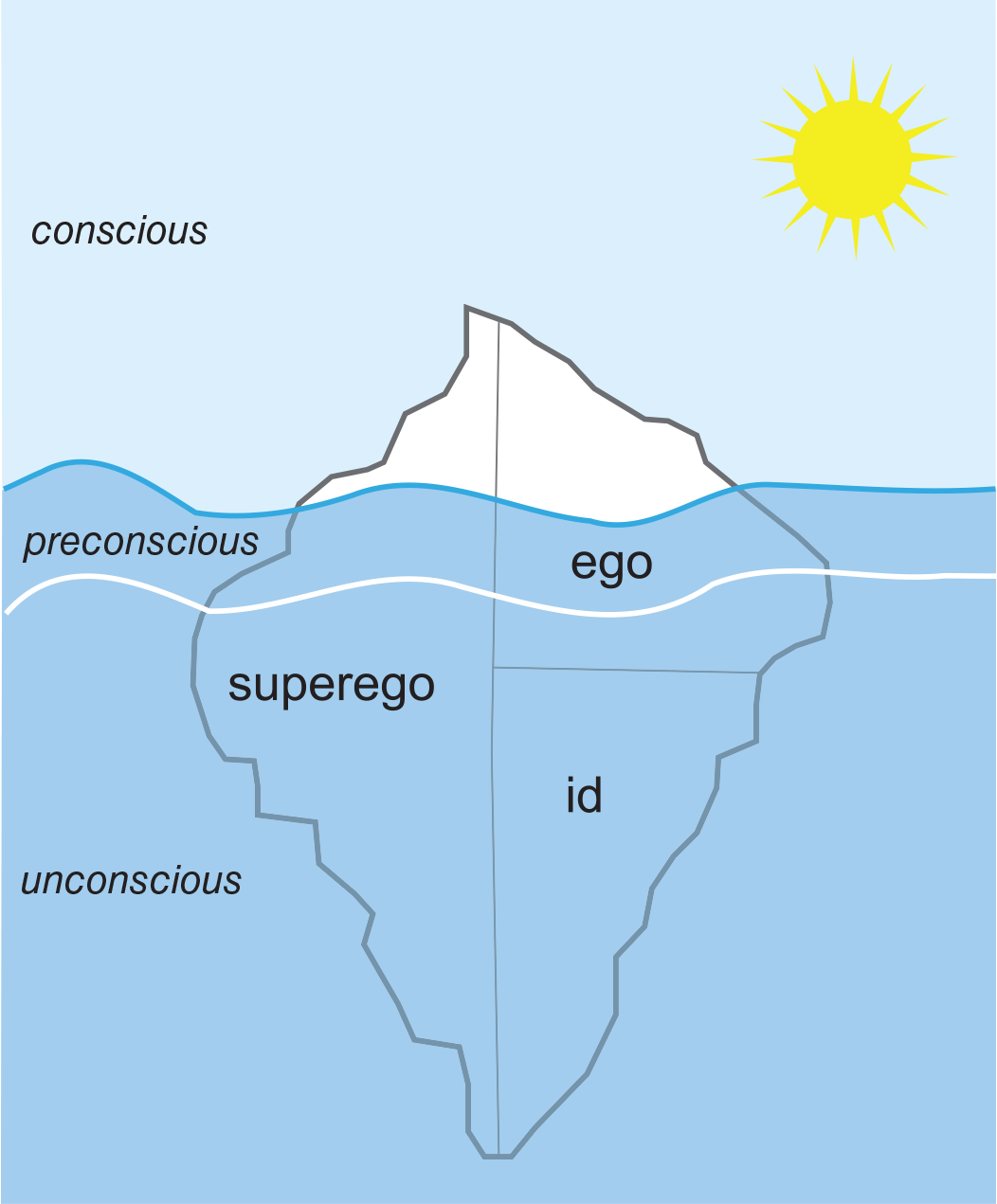
Figure 6.2. Freud’s Topographic Model of the Mind
REAL WORLD
If a person is hungry and food is unavailable, wish fulfillment—fantasizing or daydreaming about food—helps relieve some of the tension created by the pleasure principle.
Because this mental image cannot effectively reduce tension on a permanent basis, the ego comes into play. The ego operates according to the reality principle, taking into account objective reality as it guides or inhibits the activity of the id and the id’s pleasure principle. This guidance is referred to as the secondary process. The aim of the reality principle is to postpone the pleasure principle until satisfaction can actually be obtained. It must be emphasized that while the ego suspends the workings of the primary process, it does so only to meet the demands of objective reality. The mutual give and take of the ego and reality promotes the growth of perception, memory, problem solving, thinking, and reality testing. The ego can be understood to be the organizer of the mind: it receives its power from—and can never be fully independent of—the id.
REAL WORLD
When stuck in traffic, our id may desire to honk loudly at the cars in front of us, or to even pull over to the shoulder of the highway and drive recklessly past the congestion. Our ego knows that this would be unwise, and may advise us to breathe deeply and change the radio station to something calming instead.
The ego is also responsible for moderating the desires of the superego. Whereas the id’s desires are basic needs, those of the superego are refined and focused on the ideal self. The superego is the personality’s perfectionist, judging our actions and responding with pride at our accomplishments and guilt at our failures. The superego can be divided into two subsystems, both of which are a reflection of the morals taught to children by their caregivers. The conscience is a collection of the improper actions for which a child is punished, and the ego-ideal consists of those proper actions for which a child is rewarded. Ultimately, a system of right and wrong substitutes for caregivers’ rewards and punishments.
Freud also stated that our access to the id, ego, and superego falls into three main categories: thoughts to which we have conscious access, thoughts that we aren’t currently aware of (preconscious), and thoughts that have been repressed (unconscious). Note that the term subconscious is often erroneously used to refer to Freud’s unconscious mind.
Freud postulated that our behaviors are also influenced by instincts. To Freud, an instinct is an innate psychological representation of a biological need. Instincts are the propelling aspects of Freud’s dynamic theory of personality and fall into two types: life and death instincts. Life instincts, referred to as Eros, promote an individual’s quest for survival through thirst, hunger, and sexual needs. Death instincts, referred to as Thanatos, represent an unconscious wish for death and destruction. Thanatos was proposed by Freud as a response to his observations of victims of trauma reenacting or focusing on their traumatic experiences.
The ego’s recourse for relieving anxiety caused by the clash of the id and superego is through defense mechanisms. All defense mechanisms have two common characteristics: first, they deny, falsify, or distort reality; second, they operate unconsciously. There are eight main defense mechanisms: repression, suppression, regression, reaction formation, projection, rationalization, displacement, and sublimation.
Repression is the ego’s way of forcing undesired thoughts and urges to the unconscious and underlies many of the other defense mechanisms, the aim of which is to disguise threatening impulses that may find their way back from the unconscious. While repression is mostly an unconscious forgetting, suppression is a more deliberate, conscious form of forgetting.
KEY CONCEPT
While repression is unconscious forgetting (such as that which may occur after traumatic events), suppression is a conscious form of forgetting: I’m not going to think about that right now.
Regression is reversion to an earlier developmental state. Faced with stress, older children may return to earlier behaviors such as thumb sucking, throwing temper tantrums, or clinging to their caregivers.
Reaction formation occurs when an individual suppresses urges by unconsciously converting these urges into their exact opposites. For example, a person pining after an inaccessible celebrity may outwardly express hatred for the celebrity as a way of reducing the stress caused by these unrequited feelings.
Projection is the defense mechanism by which individuals attribute their undesired feelings to others. I hate my parents might, for example, turn into My parents hate me. Projection is an important part of personality analysis. Tests that make use of projection to gain insight into a client’s mind are common in psychoanalytic therapy. For example, the Rorschach inkblot test, shown in Figure 6.3, relies on the assumption that clients project their unconscious feelings onto the shape.

Figure 6.3. Card #10 from the Rorschach Inkblot Test
Similarly, the thematic apperception test consists of a series of pictures that are presented to the client, who is asked to make up a story about each one. The story, presumably, will elucidate the client’s own unconscious thoughts and feelings.
Rationalization is the justification of behaviors in a manner that is acceptable to the self and society. Drivers who engage in reckless feats such as the Cannonball Run (a cross-country race from Los Angeles to New York) might justify their dangerous pursuits by saying, both to themselves and others: I’m in complete control, and besides, there are plenty of dangerous drivers on the road. What difference will one more make?
Displacement describes the transference of an undesired urge from one person or object to another. Someone angry at a supervisor at work may remain quiet there but snap at a family member at home.
Finally, sublimation is the transformation of unacceptable urges into socially acceptable behaviors. Freud might say that pent-up sexual urges may be sublimated into a drive for business success or artistic creativity.
The descriptions of the most commonly tested defense mechanisms, as well as examples, are provided in Table 6.4.
Table 6.4. Commonly Tested Defense Mechanisms
DEFENSE MECHANISM DESCRIPTION EXAMPLE
Repression Unconsciously removing an idea or feeling from consciousness A person who survived six months in a concentration camp cannot recall anything about life during that time period
Suppression Consciously removing an idea or feeling from consciousness A terminally ill cancer patient puts aside feelings of anxiety to enjoy a family gathering
Regression Returning to an earlier stage of development A person speaks to a significant other in “baby talk” when relaying bad news
Reaction formation An unacceptable impulse is transformed into its opposite Two coworkers fight all the time because they are actually very attracted to each other
Projection Attribution of wishes, desires, thoughts, or emotions to someone else A person who has committed adultery is convinced the spouse is cheating, despite a lack of evidence
Rationalization Justification of attitudes, beliefs, or behaviors A murderer who claims that, while killing is wrong, this particular victim “deserved it”
Displacement Changing the target of an emotion, while the feelings remain the same When sent to their room as punishment, children begin to punch and kick their pillows
Sublimation Channeling of an unacceptable impulse in a socially acceptable direction A boss who is attracted to an employee becomes that employee’s mentor and advisor
Carl Jung
Later psychoanalytic theories have given more emphasis to interpersonal, sociological, and cultural influences, while maintaining their link with the psychoanalytic tradition. Carl Jung preferred to think of libido as psychic energy in general, not just psychic energy rooted in sexuality. Jung identified the ego as the conscious mind, and he divided the unconscious into two parts: the personal unconscious, similar to Freud’s notion of the unconscious, and the collective unconscious. The collective unconscious is a powerful system that is shared among all humans and considered to be a residue of the experiences of our early ancestors. Its building blocks are images of common experiences, such as having caregivers as children. These images invariably have an emotional element, and are referred to as archetypes in Jung’s theory. You can see an example of two archetypal images in Figure 6.4: God and the Devil.

Figure 6.4. Jungian Archetypes: God and the Devil Archetypes are underlying forms or concepts that give rise to archetypal images, which may differ somewhat between cultures.
There are several important Jungian archetypes. The persona is likened to a mask that we wear in public, and is the part of our personality that we present to the world. Like our identity, Jung described the persona as adaptive to our social interactions, emphasizing those qualities that improve our social standing and suppressing our other, less desirable qualities. The anima (feminine) and the animus (masculine) describe gender-inappropriate qualities—in other words, feminine behaviors in males and masculine behaviors in females. For example, in Jung’s theory, the anima is the suppressed female quality in males that explains emotional behavior (described by Jung as a man’s inner woman), while the animus is the analogous male quality of females that explains power-seeking behavior (a woman’s inner man). The shadow archetype is responsible for the appearance of unpleasant and socially reprehensible thoughts, feelings, and actions experienced in the unconscious mind.
KEY CONCEPT
Important Jungian archetypes:
- Persona—the aspect of our personality we present to the world
- Anima—a “man’s inner woman”
- Animus—a “woman’s inner man”
- Shadow—unpleasant and socially reprehensible thoughts, feelings, and actions experienced in the unconscious mind
The self, to Jung, was the point of intersection between the collective unconscious, the personal unconscious, and the conscious mind. The self strives for unity. Jung symbolized the self as a mandala (Sanskrit: “circle”), shown in Figure 6.5. Jung saw the mandala, a symbol of the universe in Buddhism and Hinduism, as the mythic expression of the self: the reconciler of opposites and the promoter of harmony. Jung also developed word association testing to assess how unconscious elements may be influencing the conscious mind and thus the self. In word association testing, patients respond to a single word with the first word that comes to mind. Jung believed that patient responses, in combination with evaluating mood and speed of response, would reveal elements of the unconscious.

Figure 6.5. Tibetan Mandala Jung saw the self as a mandala: the promoter of unity, balance, and harmony between the conscious mind, personal unconscious, and collective unconscious.
Jung described three dichotomies of personality:
- Extraversion (E, orientation toward the external world) vs. introversion (I, orientation toward the inner, personal world)
- Sensing (S, obtaining objective information about the world) vs. intuiting (N, working with information abstractly)
- Thinking (T, using logic and reason) vs. feeling (F, using a value system or personal beliefs)
In most individuals, both sides of each dichotomy are present to some degree, but one tends to dominate. Jung’s work laid the groundwork for creation of the Myers–Briggs Type Inventory (MBTI), a classic personality test. Each of Jung’s three dichotomies, and a fourth—judging (J, preferring orderliness) vs. perceiving (P, preferring spontaneity)—is labeled as a specific personality type, as shown in Figure 6.6.

Figure 6.6. Myers–Briggs Type Inventory Personality Types
Other Psychoanalysts
As with most psychological movements, psychoanalysis gained a following of theorists who learned from and often disagreed with its original tenets. In opposition to many of Freud’s key ideas, later psychoanalysts often emphasized social rather than sexual motivations for behavior. Jung can be counted among these, as can Alfred Adler, whose theory focused on the immediate social imperatives of family and society and their effects on unconscious factors.
Adler was the originator of the concept of the inferiority complex: an individual’s sense of incompleteness, imperfection, and inferiority both physically and socially. According to Adler, striving for superiority drives the personality. This striving enhances the personality when it is oriented toward benefiting society, but yields disorder when it is selfish.
The notions of the creative self and style of life were also important to Adler’s theory. The creative self is the force by which individuals shape their uniqueness and establish their personality. Style of life represents the manifestation of the creative self and describes a person’s unique way of achieving superiority. The family environment is crucial in molding the person’s style of life.
Another important concept in Adler’s theory of personality is fictional finalism. This is the notion that individuals are motivated more by their expectations of the future than by past experiences. According to Adler, human goals are based on the subjective or fictional estimate of life’s values rather than objective data from the past. Fictional finalism can often be summed up by the phrase Life would be perfect if only...
Notice the difference between Freud, Jung, and Adler. Whereas Freud’s major assumption is that behavior is motivated by inborn instincts and Jung’s principal axiom is that a person’s conduct is governed by inborn archetypes, Adler assumes that people are primarily motivated by striving for superiority.
Karen Horney, another dissenting student of Freud’s, likewise argued that personality is a result of interpersonal relationships, and adamantly disagreed with many of Freud’s assumptions about women, such as the concept of penis envy. Horney postulated that individuals with neurotic personalities are governed by one of ten neurotic needs. Each of these needs is directed toward making life and interactions bearable. Examples of these neurotic needs are the need for affection and approval, the need to exploit others, and the need for self-sufficiency and independence. While healthy people have these needs to some degree, Horney emphasized that these needs become problematic if they fit at least one of four criteria: they are disproportionate in intensity, they are indiscriminate in application, they partially disregard reality, or they have a tendency to provoke intense anxiety. For instance, someone with a neurotic need for self-sufficiency and independence would go to great extremes to avoid being obligated to someone else in any way. As the central focus of the person’s life, it would be a neurotic need and not a healthy one.
Horney’s primary concept is that of basic anxiety. This is based on the premise that children’s early perception of self is important and stems from their relationship with their caregivers. Inadequate caregiving can cause vulnerability and helplessness, which Horney termed basic anxiety, while neglect and rejection cause anger known as basic hostility. To overcome basic anxiety or basic hostility and attain a degree of security, children use three strategies in their relationships with others: moving toward people to obtain the goodwill of people who provide security; moving against people, or fighting them to obtain the upper hand; and moving away, or withdrawing, from people. These three strategies are the general headings under which the ten neurotic needs fall. Healthy people use all three strategies, depending on the situation. However, the highly threatened child will use one of these strategies rigidly and exclusively, and carries this strategy into adulthood.
Object relations theory also falls under the realm of psychodynamic theories of personality. In this context, object refers to the representation of caregivers based on subjective experiences during early infancy. These objects then persist into adulthood and impact our interactions with others, including the social bonds we create and our predictions of others’ behavior.
The Humanistic Perspective
In direct contrast to the psychoanalysts, who focus on “sick” individuals and their troubling urges, humanistic or phenomenological theorists focus on the value of individuals and take a more person-centered approach, describing those ways in which healthy people strive toward self-realization. Humanism is often associated with Gestalt therapy, in which practitioners tend to take a holistic view of the self, seeing each individual as a complete person rather than reducing the person to individual behaviors or drives. For the humanists, our personality is the result of the conscious feelings we have for ourselves as we attempt to attain our needs and goals.
Kurt Lewin’s force field theory puts very little stock in constraints on personalities such as fixed traits, habits, or structures such as the id, ego, and superego. Further, Lewin focused little on an individual’s past or future, focusing instead on situations in the present. Lewin defined the field as one’s current state of mind, which was simply the sum of the forces (influences) on the individual at that time. If the focus of humanistic psychology is exploring how an individual reaches self-realization, then these forces could be divided into two large groups: those assisting in our attainment of goals and those blocking the path to them.
Abraham Maslow, whose hierarchy of needs is discussed in Chapter 5 of MCAT Behavioral Sciences Review, was a humanist who studied the lives of individuals such as Ludwig van Beethoven, Albert Einstein, and Eleanor Roosevelt, who he felt were self-actualizers and had lived rich and productive lives. He identified several characteristics that these people had in common, including a nonhostile sense of humor, originality, creativity, spontaneity, and a need for some privacy. According to Maslow, self-actualized people are more likely than people who are not self-actualized to have what he called peak experiences: profound and deeply moving experiences in a person’s life that have important and lasting effects on the individual.
George Kelly used himself as a model to theorize about human nature, and set aside the traditional concepts of motivation, unconscious emotion, and reinforcement in his descriptions of personal construct psychology. Kelly thought of the individual as a scientist, a person who devises and tests predictions about the behavior of significant people in the individual’s life. The individual constructs a scheme of anticipation of what others will do, based on knowledge, perception, and relationships with these other people. Thus, the anxious person, rather than being the victim of inner conflicts and pent-up energy (as in psychodynamic theory), is one who is having difficulty constructing and understanding the variables in the environment. According to Kelly, psychotherapy is a process of insight whereby people acquire new constructs that will allow them to successfully predict troublesome events. Then, the individual will be able to integrate these new constructs into already existing ones.
Carl Rogers is most known for his psychotherapy technique known as client-centered, person-centered, or nondirective therapy. Rogers believed that people have the freedom to control their own behavior, and are neither slaves to the unconscious (as the psychoanalysts would suggest), nor subjects of faulty learning (as the behaviorists would say). Rather than providing solutions or diagnoses, the person-centered therapist helps clients reflect on problems, make choices, generate solutions, take positive action, and determine their own destiny. Rogers was the originator of the concepts of the real and ideal self discussed earlier in the chapter, and his therapeutic techniques aimed to help clients reconcile the differences between the various selves and reduce stress-inducing incongruence. Rogers also pioneered the concept of unconditional positive regard, a therapeutic technique by which the therapist accepts the client completely and expresses empathy in order to promote a positive therapeutic environment.
The Type and Trait Perspectives
The type and trait theorists were also borne out of dissatisfaction with psychoanalysis. Type theorists attempt to create a taxonomy of personality types, while trait theorists prefer to describe individual personality as the sum of a person’s characteristic behaviors. For our purposes, we will consider them together.
Early attempts at personality types are generally discredited today. The ancient Greeks, for example, devised personality types based on humors or body fluids, an imbalance of which could lead to various personality disorders, as shown in Figure 6.7.
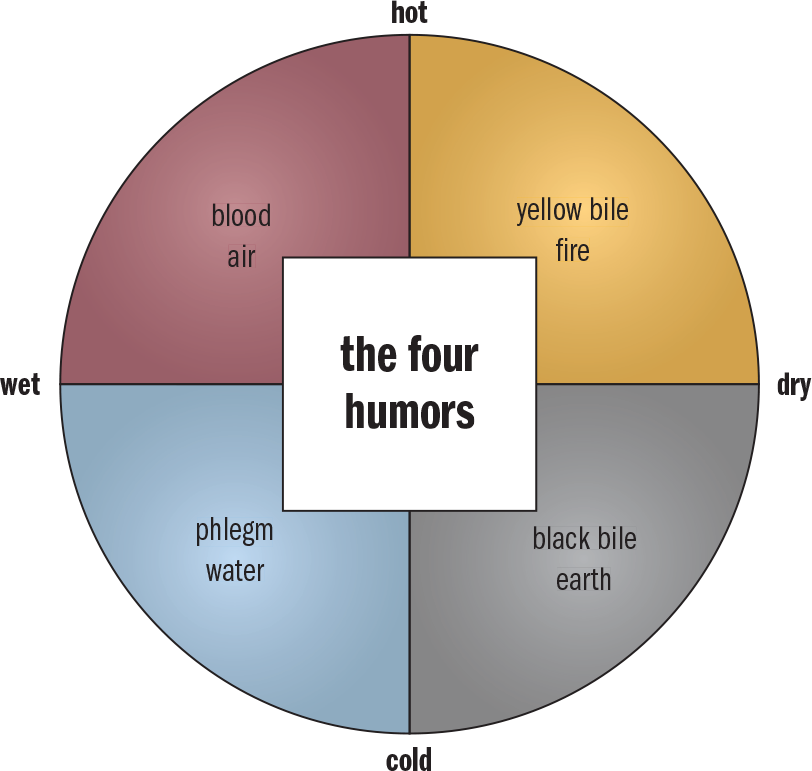
Figure 6.7. The Four Humors Each humor was correlated with an element, an imbalance of which could lead to different personalities: blood (sanguine; impulsive and charismatic), bile (choleric; aggressive and dominant), black bile (melancholic; depressive and cautious), and phlegm (phlegmatic; relaxed and affectionate).
In the early 20th century, William Sheldon proposed personality types based on body type called somatotypes. Sheldon presumed that all short, stocky people were jolly, all tall people were high-strung and aloof, and people in between were strong and well-adjusted. One well-known type theory divides personalities into Types A and B. Individuals with Type A personalities are characterized by behavior that tends to be competitive and compulsive, while someone described as Type B is generally laid-back and relaxed. Not surprisingly, people with Type A personalities are more prone to heart disease than those with Type B personalities, although there is not much evidence to suggest that people with Type A personalities have a higher mortality rate.
The Myers–Briggs Type Inventory, described earlier in this chapter, also stands as a well-known example of a type theory.
Trait theorists instead use clusters of behaviors to describe individuals. Hans and Sybil Eysenck used factor analysis to group behaviors that typically occur together and assigned labels to those groups. These groups of behaviors are often also called traits. For example, people who are more reserved and less outspoken in groups also tend to enjoy solitary activities and avoid overstimulation. These behaviors fall under the label of introversion. The Eysencks described three traits in the PEN model: Psychoticism is a measure of nonconformity or social deviance. Extraversion is a measure of tolerance for social interaction and stimulation. Neuroticism is a measure of emotional arousal in stressful situations.
Negative affect, though not directly included in the PEN model, is related to neuroticism and describes how a person thinks of themselves and experiences negative emotions. High negative affect corresponds with neuroticism and anxiety, and is associated with several mood disorders. The Eysencks reasoned that people could be distinguished from one another based on where they fell in each of these three dimensions. More recently, the PEN theory has been expanded to what is known as the Five Factor Model, the Big Five, which as the name would suggest, uses dimensions of five traits: openness, conscientiousness, extraversion, agreeableness, and neuroticism. In this theory, openness describes openness to experience, or willingness to engage with the world and desire to try new things. Low openness is associated with persevering in tasks and difficulty with abstraction. Conscientiousness is in some ways analogous to self control, with high conscientiousness associated with high impulse control and low conscientiousness associated with spontaneity. Agreeableness refers to the degree to which a person is concerned about maintaining peace and harmony in their interactions with others.
MNEMONIC
The Big Five Traits of Personality: OCEAN
- Openness
- Conscientiousness
- Extraversion
- Agreeableness
- Neuroticism
Gordon Allport, primarily a trait theorist, listed three basic types of traits or dispositions: cardinal, central, and secondary. Cardinal traits are traits around which people organize their lives. For instance, Mother Teresa’s cardinal trait may have been self-sacrifice. While not everyone develops a cardinal trait, everyone does have central and secondary traits. Central traits represent major characteristics of the personality that are easy to infer, such as honesty or charisma. Secondary traits are other personal characteristics that are more limited in occurrence: aspects of one’s personality that only appear in close groups or specific social situations. A major part of Allport’s theory is the concept of functional autonomy, in which a behavior continues despite satisfaction of the drive that originally created the behavior. A hunter, for example, may have originally hunted to obtain food to eat. However, the hunter may continue even after there is enough food simply for the enjoyment of the hunt: that which began as a means to obtain a goal became the goal itself.
David McClelland identified a personality trait that is referred to as the need for achievement (N-Ach). People who are rated high in N-Ach tend to be concerned with achievement and have pride in their accomplishments. These individuals avoid high risks (to avoid failing) and low risks (because easy tasks will not generate a sense of achievement). Additionally, they set realistic goals, and stop striving toward a goal if success is unlikely.
BEHAVIORAL SCIENCES GUIDED EXAMPLE WITH EXPERT THINKING
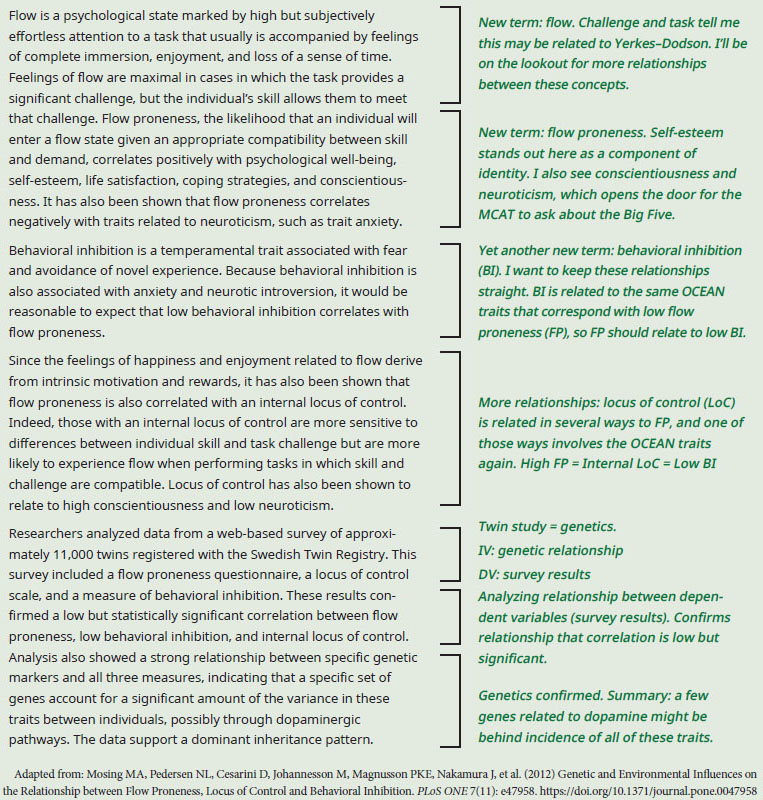
Which theory of personality is most supported by this experiment, and in what way do concepts from the study of both identity and personality contribute to this support?
The question demands that we integrate the data from the study with our outside knowledge of theories of personality. This passage blends quite a few topics together, so we’ll want to read strategically and identify where and when new topics are introduced and explained; any time the passage alludes to content that we’ve studied we want to be ready to answer at least one question about that topic, so it’s worth taking a few seconds to remind ourselves of what we know. Trait theory is definitely included, since the passage makes explicit reference to two of the Big Five: conscientiousness, which is the tendency to be organized, self-disciplined, and achievement focused; and neuroticism, the tendency to be prone to psychological stress and quickness to experience unpleasant emotions such as anger and anxiety. Two more Big Five traits are hinted at in the discussion of behavioral inhibition, which mentions avoidance of novel experience (low openness to experience) and introversion (the opposite of extraversion). If we’re careful to look for these types of links as we read the first time, it will save us quite a lot of time on Test Day.
The passage also mentions self-esteem and locus of control, two ideas related to self-concept, and states that they are related to the traits discussed. With all this talk of traits, it would be reasonable to think that the passage is supporting trait theory, but the phrasing of the question stem is key here. We are asked about the experiment specifically, which is only located in the last paragraph of the study. In fact, while we’ve included a lot of analysis for the sake of completeness, a particularly astute test taker might even avoid some of this analysis and focus solely on analyzing the experiment to answer this question. By tying genetics to personality traits, the experiment in the passage most strongly supports the biological perspective. Overall, the results demonstrate a correlation between the genes regulating dopamine and reward pathways and the traits relating to rewards such as discipline, motivation, and locus of control. Then those traits are linked to the tendency in question in the study, flow proneness.
In summary, while the passage discusses other theories of personality and does provide some support for trait theory, the experiment and data provided most directly support the biological perspective of personality theory.
Other Theories of Personality
Of course, entire textbooks can be (and in fact are) devoted to personality theorists and their ideas. The MCAT tests only the key ideas of each theory, or the concepts that overlap heavily with other topics in this text.
The behaviorist perspective, championed by B. F. Skinner, is based heavily on the concepts of operant conditioning, discussed in Chapter 3 of MCAT Behavioral Sciences Review. Skinner reasoned that personality is simply a reflection of behaviors that have been reinforced over time. Therapy, then, should focus on learning skills and changing behaviors through operant conditioning techniques. Token economies, for example, are often used in inpatient therapeutic settings: positive behavior is rewarded with tokens that can be exchanged for privileges, treats, or other reinforcers.
The social cognitive perspective takes behaviorism one step further, focusing not just on how our environment influences our behavior, but also on how we interact with that environment. Albert Bandura’s concept of reciprocal determinism is a central idea to this perspective. Reciprocal determinism refers to the idea that our thoughts, feelings, behaviors, and environment all interact with each other to determine our actions in a given situation. People choose environments that suit their personalities, and their personalities determine how they will feel about and react to events in those environments. Locus of control is another important concept in the social cognitive perspective: some people feel more in control of their environment while others feel that their environment controls them. For a social cognitive theorist, the best predictor of future behavior is past behavior in similar situations.
On the other end of the spectrum lies the biological perspective, which holds that personality can be explained as a result of genetic expression in the brain. The biological and trait perspectives are closely linked, as biological theorists maintain that many traits can be shown to result from genes or differences in brain anatomy.
The dichotomy presented by the social cognitive and biological perspectives of personality is similar to another debate in psychology: whether behavior is primarily determined by an individual’s personality (the dispositional approach) or by the environment and context (the situational approach). This division is investigated in depth in the section on attribution theory in Chapter 10 of MCAT Behavioral Sciences Review.
MCAT CONCEPT CHECK 6.3
Before you move on, assess your understanding of the material with these questions.
- For each of the following perspectives, briefly describe how each would define personality.
____________________________
- Psychoanalytic:
____________________________
- Humanistic:
____________________________
- Type:
____________________________
- Trait:
____________________________
- Behaviorist:
____________________________
- Social cognitive:
_________________________
- Biological:
- What are the roles of the id, ego, and superego, according to the psychoanalytic perspective?
____________________________
- Id:
____________________________
- Ego:
_________________________
- Superego:
- What are the traits described by the Eysencks’ PEN theory, and what does each describe?
____________________________
- P:
____________________________
- E:
_________________________
- N:
- What are the Big Five personality traits?
- _________________________
- _________________________
- _________________________
- _________________________
- _________________________
Conclusion
In this chapter, we discussed two concepts that are central to the study of psychology: identity, which describes who we are, and personality, which describes the set of thoughts, feelings, traits, and behaviors that are characteristic of each of us across time and different locations. We discussed a variety of approaches to both, each with their own theorists and critics. The ideas presented in this chapter are ripe for the MCAT to test; expect questions on Test Day to ask you to identify the various perspectives and the differences between them as they apply to behavior and research.
Many of the theories of personality focus on problems in everyday life: how we cope with stresses, anxiety, and depression. In medical school, your focus will be primarily on these pathologic states of mind, or psychological disorders. It is to this extremely important topic—abnormal psychology—that we turn our attention in the next chapter.
GO ONLINE!
You’ve reviewed the content, now test your knowledge and critical thinking skills by completing a test-like passage set in your online resources!
CONCEPT SUMMARY
Self-Concept and Identity
- Self-concept is the sum of the ways in which we describe ourselves: in the present, who we used to be, and who we might be in the future.
- Our identities are individual components of our self-concept related to the groups to which we belong. Religious affiliation, sexual orientation, and ethnic and national affiliations are examples of identities.
- Self-esteem describes our evaluation of ourselves. Generally, the closer our actual self is to our ideal self (who we want to be) and our ought self (who others want us to be), the higher our self-esteem will be.
- Self-efficacy is the degree to which we see ourselves as being capable at a given skill or in a given situation. When placed in a consistently hopeless scenario, self-efficacy can be diminished to the point where learned helplessness results.
- Locus of control is a self-evaluation that refers to the way we characterize the influences in our lives. People with an internal locus of control see their successes and failures as a result of their own characteristics and actions, while those with an external locus of control perceive outside factors as having more of an influence in their lives.
Formation of Identity
- Freud’s psychosexual stages of personality development are based on the tensions caused by the libido. Failure at any given stage leads to fixation that causes personality disorders. Freud’s phases (oral, anal, phallic [Oedipal], latent, and genital) are based on the erogenous zones that are the focus of each phase of development.
- Erikson’s stages of psychosocial development stem from conflicts that occur throughout life (trust vs. mistrust, autonomy vs. shame and doubt, initiative vs. guilt, industry vs. inferiority, identity vs. role confusion, intimacy vs. isolation, generativity vs. stagnation, integrity vs. despair). These conflicts are the result of decisions we are forced to make about ourselves and the environment around us at each phase of our lives.
- Kohlberg’s stages of moral development describe the approaches of individuals to resolving moral dilemmas. Kohlberg believed that we progress through six stages divided into three main phases: preconventional, conventional, and postconventional.
- Vygotsky described development of language, culture, and skills. He proposed the idea of the zone of proximal development, which describes those skills that a child has not yet mastered and require a more knowledgeable other to accomplish.
- Imitation and role-taking are common ways children learn from others. Children first reproduce the behaviors of role models, and later learn to see the perspectives of others and practice taking on new roles.
- Our self-concept depends in part on our reference group, or the group to which we compare ourselves. Two individuals with the same qualities might see themselves differently depending on how those qualities compare to their reference groups.
Personality
- The psychoanalytic perspective views personality as resulting from unconscious urges and desires.
- Freud’s theories are based on the id (base urges of survival and reproduction), the superego (the idealist and perfectionist), and the ego (the mediator between the two and the conscious mind). The ego makes use of defense mechanisms to reduce stress caused by the urges of the id and the superego.
- Jung assumed a collective unconscious that links all humans together. He viewed the personality as being influenced by archetypes.
- Other psychoanalysts such as Adler and Horney have distanced themselves from Freud’s theories, claiming that the unconscious is motivated by social rather than sexual urges.
- The humanistic perspective emphasizes the internal feelings of healthy individuals as they strive toward happiness and self-realization. Maslow’s hierarchy of needs and Rogers’s therapeutic approach of unconditional positive regard flow from the humanistic view of personality.
- Type and trait theorists believe that personality can be described as a number of identifiable traits that carry characteristic behaviors.
- Type theories of personality include the ancient Greek notion of humors, Sheldon’s somatotypes, division into Types A and B, and the Myers–Briggs Type Inventory.
- The Eysencks identified three major traits which could be used to describe all individuals. The acronym for these traits is PEN: psychoticism (nonconformity), extraversion (tolerance for social interaction and stimulation), and neuroticism (arousal in stressful situations). Later trait theorists expanded these traits to the Big Five: openness, conscientiousness, extraversion, agreeableness, and neuroticism.
- Allport identified three basic types of traits: cardinal, central, and secondary. Cardinal traits are the traits around which people organize their lives; not everyone develops a cardinal trait. Central traits represent major characteristics of the personality and secondary traits are more personal characteristics and are limited in occurrence.
- McClelland identified the personality trait of the need for achievement (N-Ach).
- The social cognitive perspective holds that individuals interact with their environment in a cycle called reciprocal determinism. People mold their environments according to their personalities, and those environments in turn shape our thoughts, feelings, and behaviors.
- The behaviorist perspective, based on the concept of operant conditioning, holds that personality can be described as the behaviors one has learned from prior rewards and punishments.
- Biological theorists claim that behavior can be explained as a result of genetic expression.
ANSWERS TO CONCEPT CHECKS
**6.1**
- Self-concept describes the sum of all of the phrases that come to mind when we think of who we are, who we used to be, and who we may become in the future. Identity, on the other hand, describes a set of behaviors and labels we take on when in a specific group.
- Ethnic identity is determined by common ancestry, cultural heritage, and language, among other similarities. Rather than being determined by birth, national identity is determined by the political borders of where one lives and the cultural identity of that nation.
- A student with an internal locus of control will look for internal factors, such as not having studied hard enough. A student with an external locus of control will blame external factors such as bad luck or the test being too difficult.
**6.2**
- Freud would say that the individual has become fixated in that stage and will display the personality traits of that fixation for life. Erikson would say that the individual will still move through subsequent phases, but will be lacking the skills and virtues granted by successful resolution of that stage. Kohlberg would say that the individual was incapable of reasoning at the level of failure, and that the individual would use the reasoning described in previous stages to resolve moral dilemmas.
-
Phase Description Preconventional Reasoning is based on individual rewards and punishments
Conventional Reasoning is based on the relationship of the individual to society
Postconventional Reasoning is based on abstract principles
- Zone of proximal development does not just apply to children, but rather the acquisition of new skills and abilities at any age. Standardized tests require students to utilize many skills that they may not yet have fully developed, but are in the process of development. This is why results can be improved by getting the help of those with more knowledge about the exam, such as expert instructors and authors.
**6.3**
Humanistic: Personality comes from conscious feelings about oneself resulting from healthy striving for self-realization. Type: Personalities are sets of distinct qualities and dispositions into which people can be grouped. Trait: Personalities are assembled from having different degrees of certain qualities and dispositions. Behaviorist: Personality is the result of behavioral responses to stimuli based on prior rewards and punishments. Social cognitive: Personality comes from the interactions between individuals and their environment. Biological: Personality is based on genetic influences and brain anatomy.
- Psychoanalytic: Personality is the result of unconscious urges and desires.
- The id is the sum of our basic urges to reproduce and survive, while the superego is our sense of perfectionism and idealism. The ego mediates the anxieties caused by the actions of the id and superego by using defense mechanisms.
Extraversion: tolerance for social interaction and stimulation Neuroticism: emotional arousal in stressful situations
- Psychoticism: nonconformity or social deviance
- The Big Five personality traits are openness, conscientiousness, extraversion, agreeableness, and neuroticism.
SCIENCE MASTERY ASSESSMENT EXPLANATIONS
1. B
Self-concept is defined as the sum of all of the ways in which we see ourselves, including who we are, as in (D), who we were in the past, (A), and who we may become in the future, (C). The ought self, while closely related to self-esteem, is our appraisal of how others see us and is not a part of our self-concept.
2. D
Androgyny is defined as scoring highly on scales of both femininity and masculinity. Achieving a low score on both scales, (A), would be considered undifferentiated, while (B) and (C) would be described as feminine and masculine, respectively.
3. B
Because there is nothing in the question stem to suggest that this situation will fundamentally change this student’s attitudes in the short term, (A) and (D) can be eliminated. (C) is unlikely in the short term, as learned helplessness requires a repeated inability to have any effect on a situation over a long period of time and is much more severe, usually manifesting as depression. It is far more likely that the student will simply feel ineffective when it comes to math, which is low self-efficacy.
4. A
Because we know the lawyer has an internal locus of control, we expect belief in being in control of the events happening in life. Both (B) and (C) attribute success to outside factors, representing an external locus of control. While (D) perhaps represents an attribution that could correlate to low self-esteem, it is not indicative of locus of control.
5. B
Both excessive organization and excessive sloppiness are indicative of fixation in the anal stage of psychosexual development—what is commonly referred to as anal-retentiveness.
6. C
As a postadolescent young adult, this person would be described by Erikson as experiencing the conflict of intimacy vs. isolation, and so forming significant relationships with others would be a primary goal. (B) and (D) represent the next two stages in life (generativity vs. stagnation and integrity vs. despair, respectively), while (A) is the conflict that Erikson would say should have been resolved in adolescence (identity vs. role confusion).
7. A
Matt’s reasoning reflects a desire to avoid punishment, which reflects stage one in Kohlberg’s preconventional phase (obedience). Cati’s reasoning takes into account social order, reflecting stage four in the conventional phase (law and order).
8. D
This situation is best described by Lev Vygotsky’s zone of proximal development theory, which holds that children are often unable to perform tasks by themselves, but can complete the task with the help of a more knowledgeable other.
9. D (C) has no support from role-taking research and can be eliminated. (A) and (B) are both inaccurate; the Bobo doll experiment shows young children modeling behavior not performed by their parents, and teens are most influenced by their peers, not celebrities and athletes. The research does suggest, however, that children are more likely to engage in behavior modeled by individuals who are like themselves; thus, a female child is more likely to imitate behavior by another female.
10. C
The superego is responsible for moral guilt when we do not live up to our ideals. While the id and the libido, (A) and (D), may be responsible for the urge to have an affair, the superego is responsible for the anxiety one feels afterward.
11. C
Jung saw the drive for power and success as typically male traits, so Jung would say this woman is exercising her “inner man.” The animus is the archetype that most closely reflects this quality.
12. C
This research supports a link between genetic expression and behavior, which is a central tenet of the biological perspective. The social cognitive perspective also holds that people’s behaviors and traits shape their environments, which in turn have an effect on their identity, so the discovery also supports this perspective. Behaviorism is not supported, as the discovery is not related to rewards and punishments.
13. B
As a rebel and a sociable person, this individual would score highly on both psychoticism and extraversion, respectively. Neuroticism is associated with high emotional arousal in stressful situations, so being able to keep calm in an emergency is a sign of low neuroticism. Conscientiousness, a trait associated with being hardworking and organized instead of impulsive, is not described by the question stem.
14. A
Reaction formation is a defense mechanism that converts unwanted feelings into their exact opposite. A psychodynamic theorist would say that the terror and hatred victims feel toward their captors might be unconsciously turned into affection in an effort to reduce the stress of the situation.
15. B
Fictional finalism is comprised of internal, idealistic beliefs about the future. The assumption that winning the lottery will solve all of life’s problems is representative of this form of thinking. Cardinal traits, (A), are the traits around which individuals organize their entire life. Functional autonomy, (C), is when a behavior continues after the drive behind the behavior has ceased; for example, if this young professional continued purchasing lottery tickets after winning simply for enjoyment, then this behavior would have gained functional autonomy. Unconditional positive regard, (D), is used in some forms of humanistic therapy in which the therapist believes in the internal good of the client and does not judge the client negatively for any words or actions.
GO ONLINE
Consult your online resources for additional practice.
SHARED CONCEPTS
Behavioral Sciences Chapter 3
Learning and Memory
Behavioral Sciences Chapter 4
Cognition, Consciousness, and Language
Behavioral Sciences Chapter 5
Motivation, Emotion, and Stress
Behavioral Sciences Chapter 7
Psychological Disorders
Behavioral Sciences Chapter 9
Social Interaction
Behavioral Sciences Chapter 10
Social Thinking