Chapter 9: Social Interaction

Chapter 9: Social Interaction
SCIENCE MASTERY ASSESSMENT
Every pre-med knows this feeling: there is so much content I have to know for the MCAT! How do I know what to do first or what’s important?
While the high-yield badges throughout this book will help you identify the most important topics, this Science Mastery Assessment is another tool in your MCAT prep arsenal. This quiz (which can also be taken in your online resources) and the guidance below will help ensure that you are spending the appropriate amount of time on this chapter based on your personal strengths and weaknesses. Don’t worry though—skipping something now does not mean you’ll never study it. Later on in your prep, as you complete full-length tests, you’ll uncover specific pieces of content that you need to review and can come back to these chapters as appropriate.
How to Use This Assessment
If you answer 0–7 questions correctly:
Spend about 1 hour to read this chapter in full and take limited notes throughout. Follow up by reviewing all quiz questions to ensure that you now understand how to solve each one.
If you answer 8–11 questions correctly:
Spend 20–40 minutes reviewing the quiz questions. Beginning with the questions you missed, read and take notes on the corresponding subchapters. For questions you answered correctly, ensure your thinking matches that of the explanation and you understand why each choice was correct or incorrect.
If you answer 12–15 questions correctly:
Spend less than 20 minutes reviewing all questions from the quiz. If you missed any, then include a quick read-through of the corresponding subchapters, or even just the relevant content within a subchapter, as part of your question review. For questions you answered correctly, ensure your thinking matches that of the explanation and review the Concept Summary at the end of the chapter.
- Which of the following best describes the sociological definition of a status?
- The emotional state of a social interaction
- Expectations that are associated with a specific title in society
- A position in society used to classify an individual
- A means to describe one’s peers
- Becoming a college graduate requires hard work and diligence in academics. As such, being a college graduate could be considered a(n):
- ascribed status.
- achieved status.
- master status.
- cardinal status.
- A bureaucracy is a specific example of a(n):
- immediate network.
- primary group.
- organization.
- reference group.
- Which of the following is NOT characteristic of a bureaucracy?
- Rigidly defined work procedures
- Requirement for officials to hold an advanced degree
- Regular salary increases
- Election by constituents
- Which of the following is a form of verbal communication?
- Facial expressions
- Eye contact
- Written text
- Body language
- Which of the following best describes the impression management strategy of aligning actions?
- Adhering to the behaviors that are expected for a given role in society
- Relieving tension brought about by holding conflicting views in one’s head
- Providing socially acceptable reasons to explain unexpected behavior
- Dictating that members of a group should follow similar practices to one another
- While on the phone, a friend says: “A good friend would let me borrow the bike.” This friend is using which impression management strategy?
- Managing appearances
- Alter-casting
- Ingratiation
- Self-disclosure
- Which of the following is an example of a Gesellschaft?
- A large corporation
- A small rural neighborhood
- Members of the same family
- An ethnic enclave in a large city
- In some cultures, it is considered taboo for one to show too much sadness at a funeral. In other cultures, wailing and crying loudly is expected. These cultures differ in their:
- characteristic institutions.
- display rules.
- authentic selves.
- peer groups.
- Which of the following is NOT a dimension of the system for multiple level observation of groups (SYMLOG)?
- Friendliness vs. unfriendliness
- Dominance vs. submission
- Conformity vs. contrast
- Instrumentally controlled vs. emotionally expressive
- Political campaign ads often focus on “exposing” an opposing candidate’s negative characteristics. In the dramaturgical approach, one would describe this as:
- bringing the front stage self to the back stage.
- bringing the back stage self to the front stage.
- removing the front stage self.
- removing the back stage self.
- In the context of impression management, which of the following selves is most similar to the ought self?
- The ideal self
- The tactical self
- The authentic self
- The presented self
- The evolutionary role of emotions has been used as support for which model(s) of emotional expression?
- The basic model only
- The social construction model only
- Both the basic model and social construction model
- Neither the basic model nor the social construction model
- Which of the following is an example of intraspecific animal communication?
- A dog who barks when a stranger enters the house
- An anglerfish that uses a bioluminescent appendage to attract prey
- Bats using echolocation to detect the surrounding environment
- A cat who uses scent glands to mark his territory for other cats
- Primary groups differ from secondary groups in that:
- primary groups are shorter-lived than secondary groups.
- primary groups are larger than secondary groups.
- primary groups are formed of stronger bonds than secondary groups.
- primary groups are assigned while secondary groups are chosen.
Answer Key
- C
- B
- C
- D
- C
- C
- B
- A
- B
- C
- B
- B
- A
- D
- C
Chapter 9: Social Interaction
CHAPTER 9
SOCIAL INTERACTION
In This Chapter
9.1 Elements of Social Interaction
Statuses
Roles
Groups
Networks
Organizations
9.2 Self-Presentation and Interacting with Others
Expressing and Detecting Emotions
Impression Management
Verbal and Nonverbal Communication
Animal Signals and Communication
Concept Summary
CHAPTER PROFILE
The content in this chapter should be relevant to about 7% of all questions about the behavioral sciences on the MCAT.
This chapter covers material from the following AAMC content categories:
7B: Social processes that influence human behavior
8C: Social interactions
Introduction
Every day, you present yourself to others and interact with society. You interact with others in a number of ways, using emotional expression, verbal communication, and cultural norms. You may also interact with nonhuman animals on a day-to-day basis. This interaction can be just as complex and meaningful to your emotional state and life experience. What shapes and molds your interactions? How do you know the appropriate way to connect with other members of society?
9.1 Elements of Social Interaction
LEARNING OBJECTIVES
After Chapter 9.1, you will be able to:
- Identify the meaning of social interaction terms such as status, role, group, network, and organization
- List the three types of status and provide an example of each
Society has developed out of necessity for human beings to survive and develop. Social interaction is the basis of social life and helps humans reach their full potential. Social interaction is facilitated by preexisting commonalities between individuals and shared understanding or experiences, such as a shared language. Through our social interactions, we develop culture.
Statuses
In most human societies, people do not view every individual as an equal. Instead, we create a hierarchical structure with inequalities of material goods, social opportunities, social acceptance, and skills. Some are wealthy, and some are impoverished; some are talented in sports, while others are not. Some are admired by others, most are liked, and some are disliked or even stigmatized. Social statuses are perceived positions in society that are used to classify individuals. Being a premed student, for example, is considered a status. Most statuses exist in relation to other statuses: being a premed student does not have meaning unless there are other statuses with which to compare it, such as medical student or resident. It is important to note that not all personal characteristics are considered to be social statuses. For example, being left-handed is not considered a status.
There are three key types of statuses: ascribed, achieved, and master statuses. An ascribed status is one that is given involuntarily (usually at birth), due to such factors as race, ethnicity, sex, and family background. An achieved status is a status that is gained as a result of one’s efforts or choices, such as being a doctor. A person can hold multiple statuses at the same time (collectively known as one‘s status set), but one’s master status is the status by which a person is most identified. This status is typically the most important status the individual holds and affects all aspects of that person’s life. It is also generally how people view themselves and often holds a symbolic value. Master statuses can also cause pigeonholing: we may view individuals only through the lens of their master status, without regard to any other personal characteristics (such as with a president or other major political figure). Finally, status inconsistency refers to when an individual has multiple social positions that are of varying prestige. An example of status inconsistency would be a lawyer who also works as a low-wage employee at a fast-food company.
KEY CONCEPT
Types of statuses:
- Ascribed—given involuntarily, based on race, ethnicity, sex, family background, and so on
- Achieved—gained as a result of one’s efforts or choices
- Master—status by which one is most identified; is pervasive in that person’s life
Roles
Each status is associated with roles, or sets of beliefs, values, attitudes, and norms that define expectations for those who hold the status. Role performance is the carrying out of behaviors associated with a given role. Individuals can vary in how successful they are at performing a role. For example, part of a doctor’s role is to translate medical information into language their patients can understand; however, some doctors are far better at this skill than others. Role performance can also change depending on the social situation and context of the interaction. When doctors interact with each other, the pertinent parts of their roles are quite different than when interacting with patients. Behaviors and expectations thus change as a result of the role partner—the person with whom one is interacting. Doctors have many role partners: patients, nurses, patients’ relatives, other doctors, residents, and hospital administration. The various roles associated with a status are referred to as a role set.
Through our lives, we each take on numerous statuses, each of which may contain a variety of roles. Additionally, we are often playing several roles at one time. Due to the complex nature of statuses and role sets, it is not surprising that conflict, challenges, uncertainty, and ambivalence arise as we try to navigate the many expectations of day-to-day life. Role conflict is the difficulty in satisfying the requirements or expectations of multiple roles, whereas role strain is the difficulty in satisfying multiple requirements of the same role. Role exit is the dropping of one identity for another.
REAL WORLD
A great example of role conflict is a single parent who also works a full-time job. Both of these roles carry a very large set of expectations, which are often at odds with each other.
Groups
Another major component of social interaction involves groups. In sociological terms, a group (also known as a social group) consists of two or more people who share any number of similar characteristics as well as a sense of unity. The simplest of social groups is called a dyad (two people), followed by a triad (three people). As group size increases, the group trades intimacy for stability. Social groups are more complex than a group of individuals who happen to be in the same physical space. For example, people waiting to cross the street at a crosswalk do not constitute a social group. Common characteristics shared by social groups include values, interests, ethnicity, social background, family ties, and political representation. Many sociologists see social interaction as the most important characteristic that strengthens a social group.
We center most of our lives around social groups, from the camaraderie of teammates to the complexity of governments. Social groups also meet many of the needs we have; these groups provide an opportunity to belong and be accepted and they offer protection, safety, and support. Many people also learn, earn a living, and practice religion in groups. Groups can also be a source of conflict, including discrimination, persecution, oppression, and war. These conflicts sprout from the relationships within and between groups.
An in-group is a social group with which a person experiences a sense of belonging or identifies as a member. An out-group, on the other hand, refers to a social group with which an individual does not identify. An in-group can form based on a variety of identifying characteristics, including but not limited to race, culture, gender, religion, profession, or education. Out-groups can sometimes compete with or oppose in-groups, creating group conflict. Notably, negative feelings toward an out-group are not necessarily based on a sense of dislike toward the characteristics of the out-group; rather, they can be based on favoritism for the in-group and the absence of favoritism for the out-group.
A peer group is a group that consists of self-selected equals associated by similar interests, ages, or statuses. Peer groups provide an opportunity for friendship and feelings of belonging. A family group, by contrast, is not self-selected but determined by birth, adoption, and marriage. It joins members of various ages, genders, and generations through emotional ties. The family group can be filled with conflict at times; this is often true in adolescence when peer groups begin to compete with family groups for time and loyalty. Family groups may also struggle with cultural gaps and social differences between generations, such as speaking in different languages.
Another important type of group is a reference group. These are groups that individuals use as a standard for evaluating themselves. For example, to determine how strong a medical school applicant you are, you might compare yourself to the reference group of all medical school applicants.
Primary and Secondary Groups
Groups can also be categorized into primary and secondary groups. In a primary group, interactions between members of the group are direct, with close bonds providing warm, personal, and intimate relationships to members. These groups often last a long period of time and may include a core circle of friends, a tightly knit family, or members of a team. In a secondary group, the interactions are impersonal and businesslike, with few emotional bonds and with the goal of accomplishing a specific purpose. Secondary groups typically last for a short period of time, and they form and dissolve without any special significance to those involved, an example being students working together on a group project.
Community and Society
The German sociologist Ferdinand Tönnies distinguished two major types of groups. His theory is known as Gemeinschaft und Gesellschaft, which translates to community and society. Gemeinschaft (community) refers to groups unified by feelings of togetherness due to shared beliefs, ancestry, or geography. Families and neighborhoods are examples of Gemeinschaften. Gesellschaft (society) refers to less personal groups that are formed out of mutual self-interests working together toward the same goal. Companies and countries are examples of Gesellschaften.
Observing and Analyzing Groups
Group size may vary; the smallest size a group can be is two people. Smaller group sizes, like dyads or triads, allow individuals to present more of themselves to the group. Interaction process analysis is a technique for observing, classifying, and measuring the interactions within small groups. In the 1970s, it was revised to the system for multiple level observation of groups (SYMLOG), which is based on the belief that there are three fundamental dimensions of interaction: dominance vs. submission, friendliness vs. unfriendliness, and instrumentally controlled vs. emotionally expressive.
Extensive research on groups has revealed that a group holds power over its members, creating group pressure that can ultimately shape members’ behaviors. This is called group conformity; individuals are compliant with the group’s goals, even when the group’s goals may be in direct contrast to the individual’s goal. Individuals conform in an attempt to fit in and be accepted by the group. Individuals will often participate in behaviors they normally would not.
Groupthink is related to group conformity and occurs when members focus on reaching a consensus at the cost of critical evaluation of relevant information. This can lead to groups not exploring all sides of an issue and may limit the group’s options or views; further, group members may self-censor by not expressing their beliefs. A more extensive discussion of the effects of groups on individual behavior (social action) and group dynamics is explored in Chapter 8 of MCAT Behavioral Sciences Review.
Networks
The term network is used to describe the observable pattern of social relationships among individuals or groups. Patterns of relationship can be determined by mapping the interactions between individual units, the nature of which can be highly variable. For example, a sociologist may look at the patterns in the interactions between friends, family members, or societal institutions. Researchers often display networks with maps containing a series of points, with each point representing a unit in the network. They connect the points with lines to display the interactions between units, as shown in Figure 9.1. Not all contact points within a network are necessarily unique. If there are overlapping connections with the same individual, it is referred to as network redundancy. Network analysis can be used to gain understanding of the actions of individuals and groups and to study the broader social structure.

Figure 9.1. Example of a Social Network Diagram
Individuals in networks face the demands and expectations of other members, constraining what they are able to do. They also may have access to resources through the network. An example of a network is a university’s alumni association: the members are held to certain standards and commitments, but also may reap the benefits of the network when searching for a job. Immediate networks are dense with strong ties, whereas distant networks are looser and contain weaker ties; immediate networks may be composed of friends, whereas distant networks may include acquaintances. The combination of immediate and distant networks provide the most benefit to individuals, which is augmented if the networks work complementarily to provide different resources.
BRIDGE
A genetic pedigree can be thought of as a specific type of network map, in which geneticists can track genetic patterns. The lines in genetic pedigrees represent mating patterns, parent–child relationships, and other familial structures. While pedigree analysis does not appear on the MCAT, the related topic of genetics is discussed in Chapter 12 of MCAT Biology Review.
Organizations
In sociology, organizations are complex secondary groups that are set up to achieve specific goals and are characterized by having a structure and a culture. We have all been members of multiple organizations, such as schools, companies, music groups, sports teams, fraternities and sororities, political organizations, community action committees, and so on. The study of organizations is at the heart of sociology because of the importance that organizations have throughout a person’s life.
The modern formal organization developed during the Industrial Revolution as a way to maximize efficiency. The formal aspect derives from the explicit goals that guide the members and their activities. Furthermore, formal organizations have enforcement procedures that seek to control the activities of their members. Lastly, these organizations are characterized by the hierarchical allotment of formal roles or duties to members. Formal organizations can be quite large.
The basic organization of society is found in its characteristic institution. Throughout history this has changed. In prehistoric times, the characteristic institution was primarily the kin, clan, or sib. In modern times, as we have transformed our cities into urban centers of trade and commerce, we have moved to bureaucracy as the characteristic institution. A bureaucracy is a rational system of political organization, administration, discipline, and control. Generally, a bureaucracy has these six characteristics: paid, nonelected officials on a fixed salary; officials who are provided rights and privileges as a result of making their careers out of holding office; regular salary increases, seniority rights, and promotions upon passing exams or milestones; officials who enter the organization by holding an advanced degree or training; responsibilities, obligations, privileges, and work procedures rigidly defined by the organization; and responsibility for meeting the demands of one’s position. Due to these characteristics, bureaucracies are often slow to change and less efficient than other organizations.
Bureaucracies have been criticized over time. The iron law of oligarchy states that democratic or bureaucratic systems naturally shift to being ruled by an elite group. This shift is due to a number of factors, including the necessity of a core body of individuals to carry out the day-to-day activities of the organization, increased need for specialization, and leadership characteristics of certain members of the group. Thus, even a group established with democratic principles and complete egalitarianism will ultimately centralize, placing power in the hands of a few key leaders.
McDonaldization is commonly used to refer to a shift in focus toward efficiency, predictability, calculability, and control in societal practices. While the original model for McDonaldization was, of course, the fast-food restaurant and its push towards efficiency, examples of these same characteristics can be seen in many other institutions. For example, 24-hour news channels, which feature running footers of the latest news stories as “bite-size” headlines, demonstrate efficient and predictable sources of information. Corporations may mine “big data” to make business decisions using controlled, standardized methods, allowing the business to focus on the calculable outcomes of a choice such as profit and loss analysis and market share.
MCAT CONCEPT CHECK 9.1
Before you move on, assess your understanding of the material with these questions.
- List the three types of statuses and provide an example of each:
Status Example
- For each of the sociological terms below, provide a brief definition:
________________________________
- Status:
________________________________
- Role:
________________________________
- Group:
________________________________
- Network:
_________________________
- Organization:
9.2 Self-Presentation and Interacting with Others
LEARNING OBJECTIVES
After Chapter 9.2, you will be able to:
- Classify forms of communication as verbal or nonverbal
- Distinguish between front-stage self and back-stage self
- Identify examples of body language, facial expression, visual display, scent, and vocalization in communication
To Erving Goffman, the sociologist who developed the dramaturgical perspective, every interaction we have with other people is a theatrical performance in which we consciously or unconsciously use the “scene,” our “costume,” and the role that we “perform” to influence the way others think or feel. Whenever we try to influence others’ perception with respect to a person, object, or event, we are engaging in impression management. One form of impression management is self-presentation, the process of displaying ourselves to society both visually (through clothing, grooming, etc.) and through our actions, often to make sure others see us in the best possible light.
Expressing and Detecting Emotions
Expressed emotions include both verbal and nonverbal behaviors that communicate internal states. We can express emotions with or without conscious awareness.
The basic model of emotional expression was first established by Charles Darwin. Darwin stated that emotional expression involves a number of components: facial expressions, behaviors, postures, vocal changes, and physiological changes. Darwin claimed that expression is consistent with his theories on evolution and should be similar across cultures. Darwin also stated that primates and animals exhibit rudimentary muscle actions that are similar to those used by humans for facial expressions. Since Darwin, many researchers have found that a number of basic human emotions are universally experienced and that their corresponding facial expressions are universally recognized. The appraisal model is closely related, and accepts that there are biologically predetermined expressions once an emotion is experienced, but that there is a cognitive antecedent to emotional expression.
BRIDGE
Paul Ekman’s work with universal emotions, as detailed in Chapter 5 of MCAT Behavioral Sciences Review, was a key development in the basic model of emotional expression. Individuals knowledgeable about Ekman’s work are capable of detecting very subtle and transient facial expressions that may indicate that an individual is trying to be deceptive about the emotions being conveyed.
Three of the primary models that describe individual emotion (James–Lange, Cannon–Bard, and Schachter–Singer) were discussed in Chapter 5 of MCAT Behavioral Sciences Review. In this chapter, we will look at how emotions are shaped by social context and culture.
The social construction model assumes that there is no biological basis for emotions. Instead, emotions are based on experiences and the situational context alone. It also suggests that certain emotions can only exist within social encounters and that emotions are expressed differently—and thus play different roles—across cultures. In this model, one must be familiar with social norms for a certain emotion to perform the corresponding emotional behaviors in a given social situation.
Culture provides the foundation to understand and interpret behaviors. Studies have suggested that cultural differences can lead to very different social consequences when emotions are expressed. Cultural expectations of emotions are often referred to as display rules. For example, in Utkuhikhalik Inuit society, anger is rarely expressed; individuals who demonstrate anger are considered social pariahs. Display rules govern which emotions can be expressed and to what degree. They may differ as a function of the culture, gender, or family background of an individual. Emotional expressions can be managed in several different ways: by simulating feelings one does not actually feel; by qualifying, amplifying, or deamplifying feelings; by masking an emotion with another emotion; or by neutralizing any emotional expression whatsoever.
A cultural syndrome is a shared set of beliefs, attitudes, norms, values, and behaviors among members of the same culture that are organized around a central theme. Cultural syndromes influence the rules for expressing or suppressing emotions and can even influence the ways emotions are experienced. For example, happiness is generally considered a positive emotion across cultures. However, in countries with more individualistic cultural syndromes, like the United States, happiness is viewed as infinite, attainable, and internally experienced. In contrast, in countries with a more collectivist cultural syndrome, such as Japan, happiness is a very rational emotion and generally applied to collective experiences more than to individual successes or experiences. This difference is illustrated in the contrast between the phrases I am happy and I am sharing happiness with others.
Gender can also play an important role in emotional expression. Research on the expression of emotion in the United States has shown that women are expected to express anger in public less often than men, while men are expected to repress the expression of sadness. Research also supports the conclusion that women are better at detecting subtle differences in emotional expression than men.
Impression Management
Impression management refers to our attempts to influence how others perceive us. This is done by regulating or controlling information we present about ourselves in social interactions. Impression management is often used synonymously with self-presentation. When describing impression management, theorists describe three “selves”: the authentic self, the ideal self, and the tactical self. The authentic self describes who the person actually is, including both positive and negative attributes. The ideal self, as described in Chapter 6 of MCAT Behavioral Sciences Review, refers to who we would like to be under optimal circumstances. The tactical self refers to who we market ourselves to be when we adhere to others’ expectations of us. This is similar to the ought self described in Chapter 6 of MCAT Behavioral Sciences Review.
People use a number of impression management strategies when in the presence of others. Some common strategies are summarized in Table 9.1, with examples of each.
Table 9.1. Impression Management Strategies
STRATEGY DEFINITION EXAMPLE(S)
Self-disclosure Giving information about oneself to establish an identity Disclosing that you are a premedical student
Managing appearances Using props, appearance, emotional expression, or associations with others to create a positive image Wearing a white coat, keeping calm while dealing with a difficult patient, mentioning associations with important researchers during an interview
Ingratiation Using flattery or conforming to expectations to win someone over Blindly agreeing to someone else’s opinion, complimenting a friend before asking for a favor
Aligning actions Making questionable behavior acceptable through excuses Justifications for missing deadlines, blaming a bad grade on too little sleep
Alter-casting Imposing an identity onto another person Any example in this course that says As a good MCAT student, you should… in which Kaplan is assigning you the role of good MCAT student
Erving Goffman described impression management through the dramaturgical approach, using the metaphor of a theatrical performance to describe how individuals create images of themselves in various situations. In this analogy, Goffman relates a person’s attempts to manage the impressions of others to an actor’s performance in a play. A person’s front stage self is the persona they present to an audience. A person will adapt their front stage self depending on the social situation, similar to an actor on stage in front of an audience performing according to the setting, role, and script of the play. In contrast, when an actor is back stage, the actor is hidden from the audience and is free to act in ways that may not be congruent with the actor’s character in the play. According to Goffman, the back stage self is the persona adopted when not in a social situation and there is no concern about upholding the performance of a desired public image.
MCAT EXPERTISE
Many of the sociological theories tested on the MCAT are far more extensive than the knowledge base the AAMC expects of test takers. The dramaturgical approach, for example, describes over twenty sociological concepts in theatrical terms; however, the MCAT only expects you to know front stage vs. back stage self.
Another theory comes from George Herbert Mead, who described the self in two parts called the Me and the I. The part of self that is developed through interaction with society is the Me. The development of the Me comes from considering the generalized other, which is based on a person’s established perceptions of the expectations of society. Any time that a person tries to imagine what is expected of them in a social situation, they are taking on the perspective of the generalized other. And by considering the perspective of the generalized other and adapting one’s behavior appropriately, the Me develops. By contrast, the I is the individual’s own impulses. However, the I is not totally independent of the Me. Rather, a person’s impulses are shaped by their interpretation of society’s expectations. In short, the Me shapes the I.
BRIDGE
Mead’s description of Me and I formed the foundation for the sociological theory of symbolic interactionism, which is described in Chapter 11 of MCAT Behavioral Science Review.
BEHAVIORAL SCIENCES GUIDED EXAMPLE WITH EXPERT THINKING
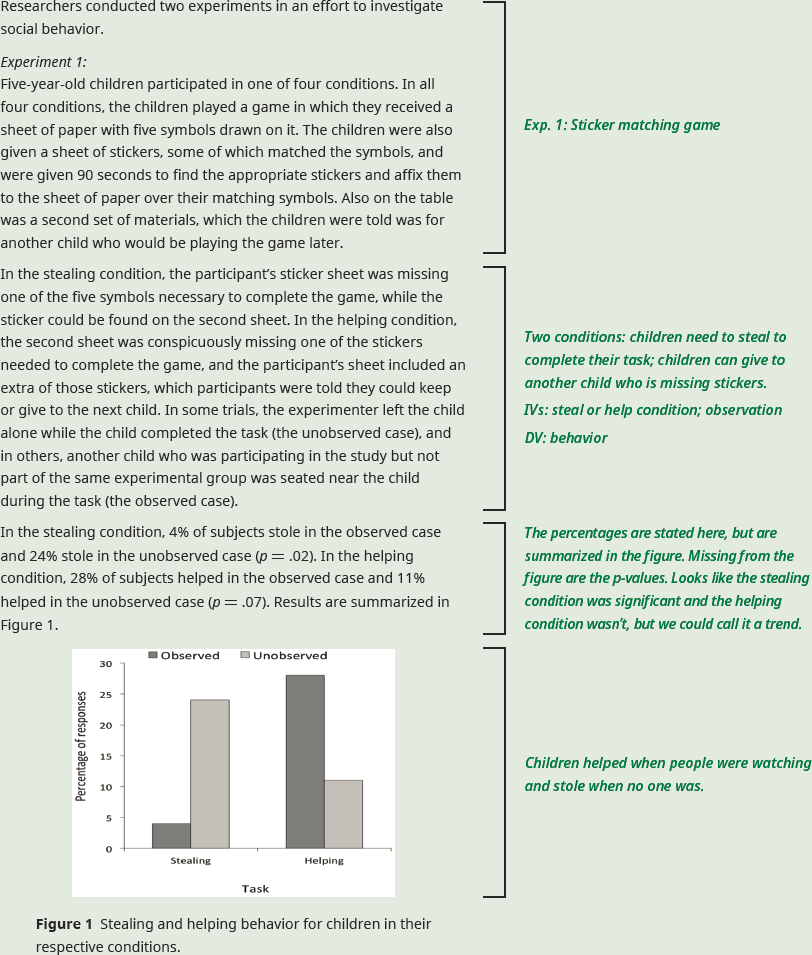
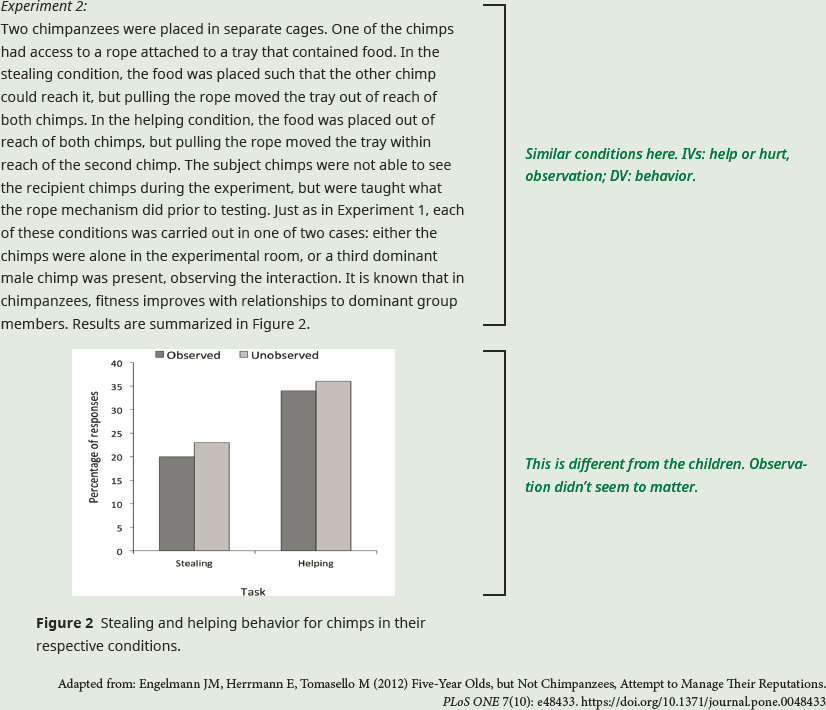
What conclusion can be drawn based on these studies about the differences between human children and chimpanzees in social settings?
The question asks for a conclusion, so our plan should be to summarize the results of the studies and relate them to outside knowledge. Fortunately, once we understand the design of the two studies, the results aren’t difficult to interpret. In Experiment 1, it looks like the children were more likely to steal when they were alone and more likely to help when they were being observed. From the p-values, it looks like that first result is statistically significant and the second result would count as merely a trend. Chimpanzees, on the other hand, showed no such concern for the presence of others. If this were a multiple-choice question, we would look for an answer that explained both results.
Knowing exactly what bit of content to tie these results to might be tricky without answer choices, but the passage does provide a clue. In Experiment 2, we’re told that it is adaptive for chimpanzees to gain the favor of dominant group members, so these researchers are likely interested in the way individuals may change their behavior in order to gain the favor of others. This could be called self-presentation, reputation management, or impression management.
Applying this concept to the results of the study, we can conclude that children have at least some capacity for acting in a prosocial manner to manage impressions, but chimpanzees in the given situation are incapable of or unconcerned with doing the same.
Verbal and Nonverbal Communication
Communication is the ability to convey information by speech, writing, signals, or behavior. It is the foundation of social interaction and is often used to elicit changes, generate action, create understanding, share a point of view, or inform. Effective communication occurs when the desired message is received by the recipient.
BRIDGE
Strong communication skills are tested everywhere on the MCAT, but are particularly important in the Critical Analysis and Reasoning Skills section. See Chapter 2 of MCAT Critical Analysis and Reasoning Skills Review for a discussion of analyzing rhetoric.
Verbal communication is the transmission of information via the use of words, whether spoken, written, or signed. It is tied to nonverbal communication and is often dependent on nonverbal cues for the receiver to understand the sender’s full meaning. While face-to-face conversations are rich with nonverbal communication, even phone conversations include nonverbal means of communication, such as pauses and changes in tone.
Nonverbal communication refers to how people communicate, intentionally or unintentionally, without words. Some examples of nonverbal communication are facial expressions, tone of voice, body position and movement, touches, and eye positioning. Gestures involving the hands and other parts of the body are often nonverbal, but the formal signs of a sign language count as verbal communication. Nonverbal cues serve a number of functions in communication, including expression of emotions, as shown in Figure 9.2, conveyance of attitudes and personality traits, and facilitation of verbal communication. Nonverbal communication is often dictated by culture. For example, in US culture, people can be suspicious of someone who does not make eye contact, as this is sometimes considered to be a sign of lying. However, in many other cultures, direct eye contact is used far less often than in the United States. For example, many children in Thailand are taught not to make eye contact with teachers and adults in order to show respect. Some types of verbal and nonverbal communication are listed in Table 9.2.

Figure 9.2. Human Body Language Sadness is associated with drooping upper eyelids, staring into the distance, frowning, and slumping of shoulders, the last of which is seen here.
Table 9.2. Verbal and Nonverbal Communication
VERBAL NONVERBAL
Spoken language Facial expressions
Written language (print and electronic) Body language (posture)
Sign languages (American Sign Language) Gestures
Tactile languages (Braille alphabet) Tone of voice (prosody)
Eye contact
Amount of personal space
Animal Signals and Communication
We not only communicate with other people, but also with other living creatures. Animal communication is defined as any behavior of one animal that affects the behavior of another.
Nonhuman animals communicate with one another in order to convey information such as emotions, intent, status, health, and the location of resources. They communicate with one another through a variety of nonverbal means, including body language, rudimentary facial expressions, visual displays, scents, and vocalizations.
The use of body language is common across a number of species. Body language can indicate that an animal is frightened, as shown in Figure 9.3, aggressive, relaxed, or even embarrassed; dogs often tuck their tails between their legs when scolded or fearful. Body language can also have significance for reproduction, as many animals will get into certain positions to signify readiness to mate.

Figure 9.3. Animal Body Language When surprised or scared, cats will recoil, crouch, and remain relatively motionless.
While humans possess far finer motor control of the muscles of facial expression, many animals (especially mammals) use facial expressions to indicate similar emotions to body language. It is noteworthy, however, that facial expressions appear to be more highly conserved between species than body language. For example, baring teeth and lunging forward, as shown in Figure 9.4, are perceived almost universally as signs of aggression or readiness to attack.

Figure 9.4. Animal Facial Expressions Baring teeth and lunging forward are recognized by many animals as signs that an attack is imminent.
Animals may also use visual displays for communication. This is common for sex discrimination in birds; females are often less colorful than males because it permits them a greater degree of camouflage and protection when caring for their young. However, this also serves as communication between birds, as sex is readily apparent from the bird’s appearance. Other visual displays include bioluminescence (the production of light), colorful plumage (as in peacocks), and dancing. Bees are well-known for communicating through dancing, as shown in Figure 9.5.
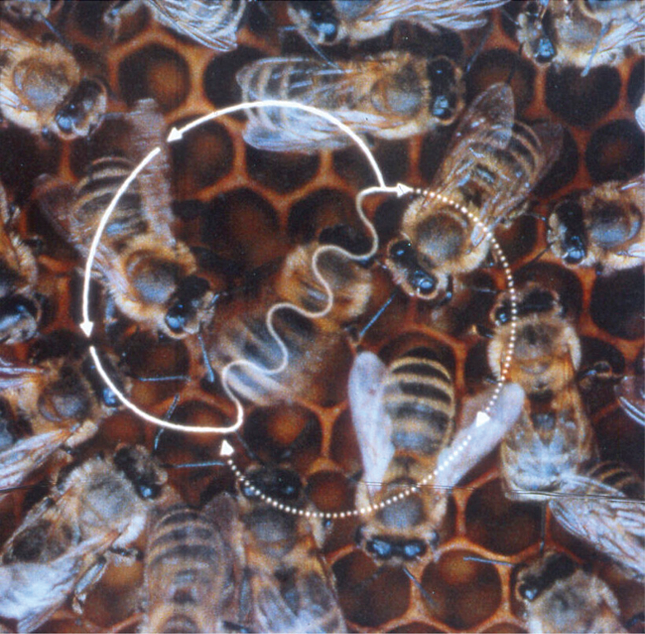
Figure 9.5. Bee Communication through Movement The “waggle dance,” illustrated here, indicates the location of food relative to the hive.
Many animals use scents to communicate both intraspecifically (between members of the same species) and interspecifically (between members of different species). Pheromones are a common example and are given off by members of a species to attract a mate. Scents can be used to mark an animal’s territory or as a method of defense, such as in skunks.
BRIDGE
It is debatable if pheromones actually have an effect on humans because we lack many of the genes necessary for function of the vomeronasal organ, an accessory olfactory organ seen in other animals. Olfaction and scent detection is discussed in Chapter 2 of MCAT Behavioral Sciences Review.
Finally, animals also communicate through vocalizations with various levels of sophistication. For example, research has shown that prairie dogs have different “words” for specific predators, and can even create new words for novel objects. Bird calls are species specific and are used to attract a mate or warn of a threat.
In addition to interacting in the wild, humans use both verbal and nonverbal communication when interacting with domesticated animals, as is often seen between owners and their pets. Dog owners may use vocal commands to tell their pets to come, stay, or sit. Additionally, just as tone of voice can express joy or anger to a person, it can communicate the same information to a pet. Pets can be scolded with a look or a gesture. Communication works in the opposite direction as well, as a pet’s body language and expressions convey information to its owner.
Communication between humans and animals is not confined strictly to pets. One of the most famous examples of animal communication is Koko, a gorilla who was able to communicate with humans through the use of American Sign Language. Koko’s vocabulary included more than one thousand words.
MCAT CONCEPT CHECK 9.2
Before you move on, assess your understanding of the material with these questions.
- Classify the following forms of communication as verbal or nonverbal:
- American Sign Language
Verbal Nonverbal
- Turning your body away from another person
Verbal Nonverbal
- Text messages
Verbal Nonverbal
- Giving a “high five”
Verbal Nonverbal
- Frowning
Verbal Nonverbal
- What is the front stage self? The back stage self?
________________________________
- Front stage self:
________________________________
________________________________
- Back stage self:
_________________________
- For each of the methods of animal communication below, provide one example:
Method of Communication Example Body language Facial expressions Visual displays Scents Vocalizations
Conclusion
Skunks are unique in how they communicate with other animals they perceive as threats. Their anal glands are capable of producing high concentrations of thiol-containing compounds, which create a distinctive malodorous scent. But it is noteworthy that skunks only carry five or six sprays’ worth of material at a time—thus, they tend to use other forms of animal communication, such as body language, hissing, and foot stamping before resorting to spraying. The spray, however, is an ultimate defense: intense, caustic, and very sticky. Animals who are sprayed quickly learn that the skunk is not an animal to mess with.
Humans also use many methods of communication. While they may certainly not follow the same patterns as skunks, humans use combinations of vocalization, body language, facial expressions, and gestures to interact with each other socially. The field of sociology flows from these interactions as we create groups, networks, and organizations; organize our society into hierarchies with statuses; and fulfill the roles dictated by our statuses. We put much of our energy into controlling how we communicate with others, trying to create the optimal image of ourselves through impression management.
The content of this chapter plays a large role in your day-to-day life. Every day you interact with other people, and how you interact is largely determined by the culture and society in which you live. In the next chapter, we begin to analyze specific types of interactions, like attraction and altruism, and then examine the dark side of human society: bias, prejudice, discrimination, and stereotypes.
GO ONLINE
You’ve reviewed the content, now test your knowledge and critical thinking skills by completing a test-like passage set in your online resources!
CONCEPT SUMMARY
Elements of Social Interaction
- A status is a perceived position in society used to classify individuals.
- An ascribed status is involuntarily assigned to an individual based on race, ethnicity, gender, family background, and so on.
- An achieved status is voluntarily earned by an individual.
- A master status is the status by which an individual is primarily identified.
- A role is a set of beliefs, values, and norms that define the expectations of a certain status in a social situation.
- Role performance refers to carrying out the behaviors of a given role.
- A role partner is a person with whom one is interacting who helps define the roles within the relationship.
- A role set contains all of the different roles associated with a status.
- Role conflict occurs when one has difficulty in satisfying the requirements of multiple roles simultaneously; role strain occurs when one has difficulty satisfying multiple requirements of the same role simultaneously.
- Groups are made up of two or more individuals with similar characteristics that share a sense of unity.
- A peer group is a self-selected group formed around similar interests, ages, or statuses.
- A family group is the group into which an individual is born, adopted, or married.
- An in-group is a social group with which a person experiences a sense of belonging or identifies as a member.
- An out-group is a social group with which an individual does not identify.
- Group conflict occurs when an out-group competes with or opposes an in-group.
- A reference group is a group to which individuals compare themselves.
- Primary groups are those that contain strong, emotional bonds.
- Secondary groups are often temporary and contain fewer emotional bonds and weaker bonds overall.
- Gemeinschaft (community) is a group unified by feelings of togetherness due to shared beliefs, ancestry, or geography.
- Gesellschaft (society) is a group unified by mutual self-interests in achieving a goal.
- Groupthink occurs when members begin to conform to one another’s views without critical evaluation.
- A network is an observable pattern of social relationships between individuals or groups.
- Organizations are bodies of people with a structure and culture designed to achieve specific goals.
Self-Presentation and Interacting with Others
- Various models have been proposed for how we express emotion in social situations.
- The basic model states that there are universal emotions, along with corresponding expressions that can be understood across cultures.
- The social construction model states that emotions are solely based on the situational context of social interactions.
- Display rules are unspoken rules that govern the expression of emotion.
- A cultural syndrome is a shared set of beliefs, norms, values, and behaviors organized around a central theme, as is found among people sharing the same language and geography.
- Impression management refers to the maintenance of a public image, which is accomplished through various strategies.
- Self-disclosure is sharing factual information.
- Managing appearances refers to using props, appearance, emotional expression, or associations to create a positive image.
- Ingratiation is using flattery or conformity to win over someone else.
- Aligning actions is the use of excuses to account for questionable behavior.
- Alter-casting is imposing an identity onto another person.
- The dramaturgical approach says that individuals create images of themselves in the same way that actors perform a role in front of an audience.
- The front stage is where individuals are seen by the audience and where they strive to preserve their desired image.
- The back stage is where individuals are not in front of an audience and where they are free to act outside of their desired image.
- Communication includes both verbal and nonverbal elements.
- Verbal communication is the conveyance of information through spoken, written, or signed words.
- Nonverbal communication is the conveyance of information by means other than the use of words, such as body language, prosody, facial expressions, and gestures.
- Animal communication takes place not only between nonhuman animals, but between humans and other animals as well. Animals use body language, rudimentary facial expressions, visual displays, scents, and vocalizations to communicate.
ANSWERS TO CONCEPT CHECKS
**9.1**
-
Status Example Ascribed Any status given involuntarily, due to factors such as race, ethnicity, gender, and family background
Achieved Any status that is gained as a result of one’s efforts or choices
Master Any status by which a person would be most readily identified and that pervades all aspects of an individual’s life
- Statuses are perceived positions in society used to classify individuals. Roles are the behaviors and expectations associated with a status in a particular context. A group is a collection of at least two individuals. A network is a more formal illustration of the relationships between individuals, usually through graphic representation. An organization is a body with a specific set of goals, a structure, and a culture; organizations are complex secondary groups that are set up to achieve specific goals.
**9.2**
Nonverbal: turning your body away (body language), giving a “high five” (gesture), frowning (facial expression)
- Verbal: American Sign Language, text messages
- The front stage self refers to when we are on stage and performing. This requires us to live up to the roles and expectations assumed by our status. The back stage self is when we are away from others and may include behaviors that would not be appropriate or consistent with the front stage self.
- Examples may vary.
Method of Communication Example Body language Dogs: tail between the legs
Facial expressions Various animals: baring teeth
Visual displays Peacocks: colorful plumage
Scents Insects (and others): pheromones
Vocalizations Birds: birdcalls
SCIENCE MASTERY ASSESSMENT EXPLANATIONS
1. C
A status is a position in society used to classify a person and exists in relation to other statuses. The specific behaviors associated with this status, (B), best describe a role.
2. B
An achieved status is one that is acquired through personal efforts. This is in contrast to an ascribed status, (A), in which the status is involuntarily given based on race, ethnicity, gender, family background, and so on. A master status, (C), is one that influences all aspects of an individual’s life. While being a college graduate is an important aspect of day-to-day life, it does not usually pervade every part of one’s life.
3. C
A bureaucracy is an example of an organization, specifically one with the goal of performing complex tasks as efficiently as possible. Immediate networks and primary groups, (A) and (B), are characterized by strong, intimate bonds, which are not commonly seen in bureaucracies. Reference groups, (D), are those groups to which we compare ourselves for various characteristics.
4. D
Generally, bureaucracies are marked by six characteristics: paid officials on a fixed salary; nonelected officials who are provided rights and privileges as a result of making their career out of holding office; regular salary increases, seniority rights, and promotions upon passing exams or milestones, (C); officials who enter the organization by holding an advanced degree or training, (B); responsibilities, obligations, privileges, and work procedures rigidly defined by the organization, (A); and responsibility for meeting the obligations of the office one holds.
5. C
Verbal communication uses words (whether spoken, written, or signed). Nonverbal communication uses other means of signaling emotions or ideas, such as body language, (D), facial expressions, (A), eye contact, (B), prosody, and personal space. Hand gestures and other bodily movements are also often nonverbal communication, but can be verbal when used as part of a sign language.
6. C
Aligning actions is an impression management technique in which one provides socially acceptable reasons for unexpected behavior. This may manifest as providing an excuse for poor performance or laughing off an inappropriate comment as a joke. Tension created from having conflicting thoughts or opinions, as mentioned in (B), refers to cognitive dissonance.
7. B
Imposing a role on another person (in this case, “good friend”) is the hallmark of alter-casting. This example is also the opposite of ingratiation, (C), because the implication behind the statement is that not lending the bike makes one a “bad friend”; ingratiation is the use of flattery or conformity to win over someone else.
8. A
A Gesellschaft (society) is one in which individuals are working toward the same goal, such as a company or country. Gemeinschaften (communities), on the other hand, are those that are bonded together by beliefs, ancestry, or geography.
9. B
Display rules are those that dictate cultural expectations of emotion. In some cultures, sadness is considered personal and internal; in others, sadness is shared externally with the community.
10. C
SYMLOG is a method for analyzing group dynamics and considers groups along three dimensions: dominant vs. submissive, friendliness vs. unfriendliness, and instrumentally controlled vs. emotionally expressive.
11. B
If a candidate is “exposed,” then personal characteristics that are usually shielded from public view have been brought in front of the public. This would be pulling aspects of the back stage self to the front stage. It would not be considered removing the front stage self, (C), because the candidate still has a public image, even if it has been tarnished.
12. B
The ought self is who others think we should be: the expectations imposed by others on us. This is most similar to the tactical self, which is the self we present to others when we adhere to their expectations. The presented self, (D), is a combination of the authentic, ideal, and tactical selves.
13. A
The basic model of emotion, as proposed by Charles Darwin, states that emotions serve an evolutionary purpose and thus are similar across cultures. The seven universal emotions have also been used as support for this theory. The social construction model states that emotions are always a product of the current social situation and does not posit any biological basis for emotions, implying a lack of a role for emotions in evolution.
14. D
Intraspecific communication refers to communication between members of the same species. Interspecific communication, on the other hand, refers to communication between members of different species. Echolocation, (C), is not an example of intraspecific communication because the sender of the signal and the recipient are the same organism; this would be considered autocommunication.
15. C
Primary groups have direct and close bonds between members, providing warm, personal, and intimate relationships to its members. Secondary groups, in contrast, form superficial bonds and tend to last for a shorter period of time.
GO ONLINE
Consult your online resources for additional practice.
SHARED CONCEPTS
Behavioral Sciences Chapter 3
Learning and Memory
Behavioral Sciences Chapter 5
Motivation, Emotion, and Stress
Behavioral Sciences Chapter 6
Identity and Personality
Behavioral Sciences Chapter 8
Social Processes, Attitudes, and Behavior
Behavioral Sciences Chapter 10
Social Thinking
Behavioral Sciences Chapter 11
Social Structure and Demographics