Chapter introduction
ANSWERS TO THOUGHT QUESTIONS
CHAPTER 1
1.1 The minimum size of most microbial cells is about 0.2 μ>m. Could even smaller cells be discovered? What factors may determine the minimum size of a cell?
ANSWER: The smallest cells that are well studied, about 0.2 μm in length, are cell wall–less bacteria called mycoplasmas; for example, Mycoplasma pneumoniae, a causative agent of pneumonia. Bacteria smaller than 0.2 μm have been discovered by passing stream water through a filter of that pore size. It is hard to see how their cell components, such as ribosomes (about a tenth this size), could fit inside such a small cell. The volume required for DNA and the apparatus of transcription and translation probably sets the lower limit on cell size.
1.2 If viruses are not functional cells, are they “alive”?
ANSWER: A traditional definition of a life form includes the capability for metabolism and homeostasis (maintaining internal conditions of its cytoplasm), as well as reproduction and response to its environment. Viruses direct their own replication and respond to the environment of the host cell, but they lack both metabolism and homeostasis outside their host cell. Nevertheless, viruses such as herpesviruses contain numerous metabolic enzymes that participate in the metabolism of the host.
Certain large viruses, such as the mimivirus, appear to have evolved from cells. Some microbiologists argue that viruses should be considered alive if reproduction is the main criterion and if the viral “environment” is considered the inside of the host cell.
1.3 Why do you think it took so long for humans to connect microbes with infectious disease? What innovations helped make the connection?
ANSWER: For most of human history, we were unaware that microbes existed. Even after microscopy had revealed their existence, the incredible diversity of the microbial world and the difficulties in isolating and characterizing microbial organisms made it difficult to discern the specific effects of microbes. All healthy people contain microbes, and most disease-causing microbes are indistinguishable from normal microbiota by light microscopy. Not all microbial diseases can be transmitted directly from human to human; they may require complex cycles with intermediate hosts, such as the fleas and rats that carry bubonic plague.
1.4 How could you use Koch’s postulates (Fig. 1.19) to demonstrate the causative agent of influenza? What problems not encountered with anthrax would you need to overcome?
ANSWER: Using Koch’s postulates to demonstrate the causative agent of influenza would require an animal
model host. Secretions from diseased patients could be applied to different animal species, such as monkeys and mice, in order to find an animal showing signs of the disease. To determine the causative agent of disease, the patient’s secretions could be filtered in order to separate bacteria and viruses. Only the filtrate would cause disease, because it contains viruses (relevant to Koch’s postulates 1 and 3). Viruses, however, are more difficult to isolate in pure culture than are bacteria (postulate 2)—a problem Koch did not address. Furthermore, some viruses, such as HIV (human immunodeficiency virus), have no animal model; they grow only in human cells. Today, viruses are usually isolated in a tissue culture. Once isolated, the virus could be used to inoculate a new host animal (if an animal model exists) or a tissue culture and determine whether infection results (postulates 3 and 4). Another problem Koch did not address was the detection of infectious agents too small to be observed under a microscope. Today, antibody reactions are used to determine whether an individual has been exposed to a putative pathogen. An antibody test could be used to determine whether healthy and diseased individuals have been exposed to the isolated virus.
1.5 The original formulation of Koch’s first postulate stated, “The microbe is found in all cases of disease but is absent from healthy individuals.” Why do you think subsequent medical researchers modified this postulate?
ANSWER: Many microbes that cause disease are found also in individuals who show no sign of disease. For example, Staphylococcus aureus is a Gram-positive bacterium that causes impetigo and deep skin abscesses; methicillin-resistant S. aureus (MRSA) is especially dangerous. Yet some healthy people can harbor these S. aureus strains without harm, despite transmitting them to people who then get sick. We now recognize that infectious disease depends upon the host as well as the infectious agent.
1.6 Why do you think some pathogens generate immunity readily, whereas others evade the immune system?
ANSWER: Some pathogens (microbes that cause disease) have external coat proteins that strongly stimulate the immune system and induce the production of antibodies. Other pathogens have evolved to avoid the immune system by changing the identity of their external proteins. Immunity also varies greatly with the host’s status. The very young and very old generally have weaker immune systems than do people in the prime of life. Some pathogens, such as HIV, will directly attack the host’s immune system, limiting the immune response to the pathogen.
1.7 How do you think microbes protect themselves from the antibiotics they produce?
ANSWER: Microbes protect themselves from their antibiotics by producing their own resistance factors. As discussed in later chapters, microbes may synthesize pumps to pump the antibiotics out; or they may make altered versions of the target macromolecule, such as the ribosomal subunit; or they may produce enzymes to cleave the antimicrobial substance.
1.8 Why don’t all living organisms fix their own nitrogen? Consider the structure of a dinitrogen molecule, N≡N.
ANSWER: Nitrogen fixation requires a tremendous amount of energy, about 30 molecules of ATP per dinitrogen molecule converted to ammonia (discussed in Chapter 15). In a community containing adequate nitrogen sources, organisms that lose the nitrogen fixation pathway make more efficient use of their energy reserves than do those that spend energy to fix nitrogen from the atmosphere. Another consideration is that nitrogenase is an oxygen-sensitive enzyme, whereas plants, animals, and fungi are aerobes. In order to fix nitrogen, aerobic organisms need to develop complex mechanisms to keep oxygen away from nitrogenase.
1.9 Could endosymbiosis occur today; that is, could a small microbe be engulfed by a larger one and evolve into an endosymbiont, and then into an organelle? Explain.
ANSWER: There are many examples today of endosymbiotic associations that look like evolution of an interdependent relationship. For example, a paramecium can acquire internalized chlorella algae that conduct photosynthesis and provide nutrients for the protozoan host. However, in the dark, where light is unavailable, the paramecium may instead digest the chlorella for food. Other bacteria, such as Wolbachia species, have evolved as endosymbionts of insect cells. In some cases, the insect absolutely requires bacterial endosymbionts to provide amino acids but digests the endosymbiont when the nutrients are no longer needed. Still other insects host permanent endosymbiotic bacteria such as Buchnera, which are transmitted vertically (from parent to offspring). These permanent endosymbionts may be on their way to evolving into organelles.
1.10 What arguments support the classification of Archaea as a third domain of life? What arguments support the classification of archaea and bacteria together, as prokaryotes, distinct from eukaryotes?
ANSWER: The sequence of 16S rRNA (small-subunit rRNA) and other fundamental genes differs as much between archaea and bacteria as it does between archaea and eukaryotes. The composition of archaeal cell walls and phospholipids is completely
distinct from that of bacteria and eukaryotes. Some aspects of gene expression, such as the RNA polymerase complex, are more similar between archaea and eukaryotes than between archaea and bacteria. On the other hand, archaeal and bacterial cells are prokaryotic; they both lack nuclei and complex membranous organelles. Archaeal metabolism and lifestyles are more similar to those of bacteria than to those of eukaryotes. Some archaea and bacteria sharing the same environment, such as high-temperature springs, have undergone horizontal transfer of genes that encode traits such as heat-stable membrane lipids.
1.11 State an argument in favor of patenting a microbial isolate or a gene sequence. What argument can be made against patenting microbes or genes?
ANSWER: A microbe can be patented if it is genetically modified from the “natural” state, and if it has a commercial use or application. Mere discovery of a pollutant-eating organism from nature is not patentable, but modifying an organism for commercial use constitutes technology. If a microorganism consists of a complex of molecules, then modifying the organism is legally equivalent to modifying a drug molecule or other industrial chemical. An argument against patenting organisms might be that life has a special status, in that organisms have their own agency to proliferate.
Living organisms have a special spiritual status in the worldview of most major religions. Therefore, it would be inappropriate to patent a microbe or a mouse—or a human being treated by gene modification therapy.
CHAPTER 2
2.1 As shown in Figure 2.2, the image passing through your cornea and lens is inverted on your retina. Why, then, does the world appear right side up?
ANSWER: The human brain interprets the image from the retina. Based on this interpretation, the brain knows that the image is upside down and inverts it to appear right side up. Researchers have tested what happens if an experimental subject wears special glasses that invert the image before the retina. At first, the brain sees everything upside down. After several days, the brain inverts the image perceived through the glasses, so it appears right side up. When the glasses are removed, the brain again takes time to restore its perception to right side up.
2.2 (refer to Fig. 2.7) You have discovered a new kind of microbe, never observed before. What kinds of questions about this microbe might be answered by light microscopy? What questions would be better addressed by electron microscopy?
ANSWER: Light microscopy could answer questions such as: What is the overall shape of this cell? Does it form individual cells or chains? Is the organism motile? Only light microscopy can visualize an organism alive. Electron microscopy can answer questions about internal and external subcellular
structures. For example, does a bacterial cell possess external filamentous structures, such as flagella or pili? If the dimensions of the unknown microbe are smaller than the lower limits of a light microscope’s resolution, EM may be the only way to observe the organism. Viruses are often characterized by shape, and this shape is observed by electron microscopy.
2.3 Explain what happens to the refracted light wave as it emerges from a piece of glass of even thickness. How do its new speed and direction compare with its original (incident) speed and direction?
ANSWER: The part of the wavefront that emerges first travels faster than the portion still in the glass, causing the wavefront to bend toward the surface of the glass. Ultimately, the wave travels in the same direction and with the same speed as it did before entering the glass. The path of the emerging light ray is parallel to the path of the light ray entering the glass and is shifted over by an amount dependent on the thickness of the glass. This refraction will alter the path of the beam of light and decrease the amount of light reaching the lens of the microscope. Immersion oil has the same refractive index as glass and will limit the amount of light lost in this way.
2.4 (refer to Fig. 2.13) For a single lens, what angle θ might offer magnification even greater than 100×? What practical problem would you have in designing such a lens to generate this light cone?
ANSWER: In theory, an angle θ (theta) of 90° would produce the highest resolution—even greater than 100°. However, a 90° angle θ generates a cone of 180°, which would require the object to sit in the same position as the objective lens—in other words, to have a focal distance of zero. In practice, the cone of light needs to be somewhat less than 180°, to allow room for the object and to avoid substantial aberrations (light-distorting properties) in the lens material.
2.5 Under starvation, a soil bacterium such as Bacillus subtilis packages its cytoplasm into a spore, leaving behind an empty cell wall. Suppose, under a microscope, you observe what appears to be a hollow cell. How can you tell whether the cell is indeed hollow or is simply out of focus?
ANSWER: You can tell whether the cell is out of focus or actually hollow by rotating the fine-focus knob to move the objective up and down while observing the specimen carefully. If the hollow shape appears to be the sharpest image possible, it is probably a hollow cell. If the hollow shape turns momentarily into a sharp, dark cell, it was probably out of focus before. Alternatively, you could use a confocal microscope to visualize the center of the hollow cell.
2.6 What experiment could you devise to determine the order of events in Bacillus subtilis DNA replication?
ANSWER: One way to track the movement of DNA during DNA replication would be to stain the DNA with a dye such as DAPI at various stages of cell division. Alternatively, green fluorescent protein (GFP) fused to a DNA-binding protein could be used to label a specific sequence of DNA and track its position. A way to determine the order of events in sporulation could be to observe mutant strains of bacteria that contain defects in different proteins of the replication process. (DNA replication is discussed further in Chapter 7.)
2.7 Like a light microscope, an electron microscope can be focused at successive powers of magnification. At each level, the image rotates at an angle of several degrees. Given the geometry of the electron beam (see Fig. 2.36), why do you think the image rotates?
ANSWER: The image rotates because the electron beam is not straight, as for photons, but travels in a spiral through the magnetic field lines. As magnification increases, the spiral expands, and it reaches the image plane at a slightly different angle than before.
2.8 What kinds of research questions could you investigate using SEM? What questions could you answer using TEM?
ANSWER: SEM could be used to examine the surface of cells: Do the cells possess a smooth surface? Does their surface contain protein complexes or
bulges that serve special functions? How do pathogens attach to the surface of cells? TEM can be used to determine the intracellular structure of attachment sites and of internal organelles. TEM can also visualize the shapes of macromolecular complexes such as flagellar motors or ribosomes.
2.9 How could you use atomic force microscopy to study the effect of an antibiotic on Pseudomonas aeruginosa contamination of medical catheters?
ANSWER: Bacteria colonize catheters by forming a biofilm, a structure of cells that grow attached to each other and to the substrate. The height and volume of a biofilm can be measured by AFM. As shown in Figure 2.46, deflection of the tip of the cantilever indicates very precise measurements of thickness of a biofilm, allowing three-dimensional mapping. An antibiotic can be added at various concentrations, and the height and volume of the biofilm can be measured over time. This procedure will indicate how an antibiotic affects biofilm formation on a catheter.
CHAPTER 3
3.1 Which chemicals do we find in the greatest number in a bacterial cell? The smallest number? Why does a cell contain 100 times as many lipid molecules as strands of RNA?
ANSWER: The chemicals that occur in the greatest number in a prokaryotic cell are inorganic ions (250 million/cell). They are also the smallest in size. DNA molecules are found in the lowest number (one large molecule, branched during replication). A prokaryotic cell contains 100 times as many lipid molecules as strands of RNA because lipids are small structural molecules, highly packed. They are a major component of the cellular membrane. RNA molecules are long macromolecules that either are packed into complexes (such as ribosomal RNA) or are temporary information carriers (messenger RNA), present only as needed to make proteins.
3.2 Suppose we wish to isolate multidrug efflux pumps, which are protein complexes that span the envelope from inner membrane to outer membrane. How might we modify the cell fractionation procedure to achieve such isolation?
ANSWER: A multidrug efflux complex such as AcrAB- TolC crosses the entire envelope, in order to completely expel antibiotics. The complex has subunits that span both inner and outer membranes, complicating the cell fractionation. It is
possible that the complex might associate more strongly with one membrane or the other, so it could be found primarily in one of the membrane fractions. A fluorescent antibody could identify fractions that contain the complex. Mild-detergent treatment of the fractions could strip away the membrane. Alternatively, the whole-membrane prep could be treated with mild detergent. The protein fraction could then be centrifuged through a sucrose gradient; because the subunits of the complex have very specific size and density, they would be concentrated in distinct fractions. Electron microscopy could confirm the fraction containing the subunits, which could be reconstituted as a complex.
3.3 Amino acids have acidic and basic groups that can dissociate. Why are they not membrane-permeant weak acids or weak bases? Why do they fail to cross the phospholipid bilayer?
ANSWER: At neutral pH, an amino acid has both a positively charged amine and a negatively charged carboxylate; that is, it can act as either a weak acid or a weak base. Charged ions will not freely pass through a plasma membrane (unless the molecule has an extremely hydrophobic group). In an amino acid, if either charged group becomes neutralized by acid or base, the other group remains charged, so the molecule as a whole will never cross the membrane.
3.4 What genetic experiments could you propose to test the model of envelope expansion shown in Figure 3.13?
ANSWER: Use mutagenesis (treatment with a mutagen) to generate E. coli strains containing point mutations in rodA or rodZ. Observe growth of the mutant cells. Prediction: Some of the rodA or rodZ mutants will have defective RodA or RodZ proteins that cause inefficient cell wall synthesis. The mutant cells grow slowly, as bulging, blob-shaped cells, not as rods. Now test the question, How does RodA or RodZ interact with other components of the envelope extension complex? Introduce new mutations in genes encoding proteins of the peptidoglycan extension complex (Fig. 3.13), such as mreB and pbp2. With the newly introduced mutations, we find that some of the rodZ mutants revert to normal rod-shaped growth. Thus, altered MreB or Pbp2 proteins might compensate for the alteration in RodZ. This result suggests that the RodZ protein could interact with MreB and Pbp2 in the extension complex. For research published on these questions, see Daisuke Shiomi et al. 2013. Mol. Microbiol. 87 :1029.
3.5 What other ways can you imagine that bacteria might mutate to become resistant to vancomycin?
ANSWER: A common means of resistance to antibiotics is to pump them out of the cell. A protein
pump that exports other molecules might mutate to capture vancomycin and export it from the cell. Another possibility is that an enzyme could modify the vancomycin by adding phosphoryl groups or acetyl groups, which would prevent the antibiotic from binding the alanine dipeptide. Still another possibility is that the bacteria might evolve a thicker cell wall that would exclude the vancomycin from the inner layers of peptidoglycan.
3.6 Figure 3.15 highlights the similarities and differences between the cell envelopes of Gram-negative and Gram-positive bacteria. What do you think are the advantages and limitations of a cell having one layer of peptidoglycan (Gram-negative) versus several layers (Gram-positive)?
ANSWER: Having multiple layers of peptidoglycan increases the cell’s resistance to osmotic shock, to desiccation stress, and to enzymes that cleave the cell wall. On the other hand, to build the layers of peptidoglycan requires more energy and biomass. In addition, a thick cell wall can slow the uptake of nutrients. The mycobacteria, which have exceptionally thick cell walls, grow very slowly.
3.7 Why would laboratory culture conditions select for evolution of cells lacking an S-layer?
ANSWER: Degeneration of protective traits is a common problem when conducting research on microbes that can produce 30 generations overnight. Their rapid reproductive rate gives ample
opportunity for spontaneous mutations to accumulate over an experimental timescale. In the case of the S-layer, in a laboratory test tube free of predators or viruses, mutant bacteria that fail to produce the thick protein layer would save energy compared to S-layer synthesizers, and would therefore grow faster. Such mutants would quickly take over a rapidly growing population.
3.8 Why would proteins be confined to specific cell locations? Why would a protein not be able to function everywhere in the cell?
ANSWER: Proteins have evolved one or more specific functions often optimized for a specific part of the cell. For example, water-conducting porins are found solely in the inner membrane (cell membrane), which is otherwise impermeable to water. The outer membrane, which is water permeable, is the sole location for specific porins that transport small peptides and sugars. The sugars then need to be taken across the inner membrane by transport proteins that have evolved to function best in this location. Similarly, different chaperones (proteins that aid peptide folding) have evolved to function best in the environment of the cytoplasm or periplasm, membrane-enclosed regions that differ substantially in pH and ion concentrations. In a different chemical environment of the cell, a protein may denature and lose its functional structure. A
protein may be active only as part of a complex of proteins. If the protein is placed in a different location within the cell, its protein partners may be absent, rendering the protein nonfunctional.
3.9 Suppose a cell has a defect in its ftsZ gene. What might happen to the cell during growth? How could such a mutant strain be maintained in the laboratory?
ANSWER: A cell with a defective ftsZ gene will fail to septate. As the cell grows, it expands and replicates its DNA, but no septum forms, and the daughter cells do not separate. Eventually, the cell’s nucleoids will entangle, and the long, filamented cell chain will die. There are several ways to maintain an ftsZ mutant in a viable state. One is to use a temperature-sensitive mutant, in which the FtsZ protein is functional at the permissive temperature but nonfunctional at the nonpermissive temperature. Another way is to maintain a copy of the ftsZ gene fused to a promoter that can be turned on or off by the presence of an inducer molecule such as a sugar (discussed in Chapter 10).
3.10 Figure 3.31 presents data from an experiment that allows the function of the TipN protein of Caulobacter to be visualized by microscopy. Can you propose an experiment with mutant strains of Caulobacter to test the hypothesis that one of the proteins shown in Figure 3.32 is required for one of the cell changes shown?
ANSWER: The diagram of Figure 3.32 proposes that PodJ protein is required for a pole to develop a flagellum. Suppose we construct a mutant strain with a deletion of the gene podJ. This podJ mutant fails to express PodJ protein. When the podJ mutant is supplied with nutrients, the stalked cells should grow and fission, but the progeny from the plain pole should fail to grow a flagellum. The stalked progeny will continue to divide, producing a stalked cell and a cell with plain poles, lacking flagellum or stalk. Other results are possible, but the result described would be consistent with a requirement of PodJ for flagellar development.
3.11 Could two bacteria share protein complexes via nanotubes? What about hydrogen molecules (H 2) as electron donors?
ANSWER: The motility apparatus requires 50 different genes generating different protein components. Cells that acquire mutations eliminating expression of the motility apparatus gain an energy advantage over cells that continue to invest energy in motors. In a natural environment, the nonmotile cells lose out in competition for nutrients, despite their energetic advantage; but in the laboratory, cells are cultured in isotropic environments such as a shaking test tube, where motility confers no advantage. These culture conditions lead to evolutionary degeneration of motility, as they do for the S-layer (see Thought Question 3.7). In order to maintain a motile strain, bacteria are cultured on a soft agar medium containing an attractant nutrient. As cells consume the attractant, they generate a gradient, and chemotaxis leads them to swim outward. By subculturing only bacteria from the leading edge of swimming cells, one can maintain a motile strain.
CHAPTER 4
4.1 In a mixed ecosystem of autotrophs and organotrophs, what happens if the autotroph begins to outgrow the organotroph, producing more and more organic food?
ANSWER: As the organotroph begins to grow on the organic material, the growth of the organotroph might overtake and outpace the growth of the autotroph, using the carbon sources faster than the autotroph can make them. As the organic carbon sources diminish through consumption, growth of the organotrophs decreases, but the CO 2 formed by the organotrophs will allow the autotroph to grow and make more organic carbon. Ultimately, the ecosystem comes into balance.
4.2 How could a symport transporter produce electroneutral coupled transport?
ANSWER: Coupled transport can be electroneutral if molecules of opposite charge are being transported; for example, Na + flux together with Cl −.
4.3 How might mutations in transporter gene sequences influence bacterial survival under different conditions; for example, normal versus very low glucose concentrations?
ANSWER: A mutation that eliminates the glucose transporter or destroys its function will produce a mutant cell that cannot use glucose. It will die if an alternative carbon source is not available or if a
transport system for that carbon source is not present. A mutation in a glucose transport protein that increases the transporter’s affinity for glucose will yield a cell that can grow in very low glucose concentrations. This mutant will outcompete a cell with a normal transporter when glucose concentrations are very low.
4.4 Describe the phenotype (growth characteristic) of a cell that lacks the trp genes (genes required for the synthesis of tryptophan). What would be the phenotype of a cell missing the lac genes (genes whose products catabolize the carbohydrate lactose)?
ANSWER: The difference lies in the function of the two pathways. The trp operon is a biosynthetic operon. Errors in the biosynthetic pathway will lead to a failure to produce tryptophan. Therefore, a trp auxotrophic mutant will grow on defined medium only if tryptophan is added. The lactose operon involves the catabolism of a carbon source, lactose. If any of these genes are damaged, the cells are no longer able to use lactose as a carbon source. A lac mutant will not grow on defined medium with lactose as the sole carbon source.
4.5 If lactose were left out of MacConkey medium (Fig. 4.15), would lactose-fermenting E. coli bacteria grow, and if so, what color would their colonies be?
ANSWER: Even without lactose in the medium, E. coli would grow nonfermentatively on the peptides
present. The colonies would appear white because without lactose, the cells do not make acidic products needed to bring neutral red into the colony.
4.6 You want to determine the concentration of Shigella flexneri cells in a liquid culture and use a Petroff-Hausser chamber to do so. Use the following information to calculate the concentration of cells per milliliter in that culture. Each small square of the slide’s etched grid is 0.0025 mm 2 in size. You add a drop of the culture to the slide and cover it with a coverslip. The distance of the coverslip from the grid is 0.2 mm. With a microscope, you count 10 cells evenly spread over 16 squares. Calculate the concentration of cells in the original culture.
ANSWER: 1.25 × 10 6 bacteria per milliliter.
SOLUTION: Each small square is 0.0025 mm 2 in size, and the depth from coverslip to surface is 0.2 mm.
0.0025 mm 2 × 0.2 mm = 0.0005 mm 3 (1 mm 3 = 1 μl). Each square defines a volume of 0.0005 μl.
10 cells observed over 16 squares averages to 0.625 bacteria/0.0005 μl, or 0.625 bacteria/square.
0.625 bacteria/0.0005 μl = 1.25 × 10 3 cells/μl = 1.25 × 10 6 cells/ml.
4.7 A virus such as influenza virus might produce 800 progeny virus particles from one host cell infected by one virus. How would you mathematically represent the exponential growth of the virus? What practical factors might limit such growth?
ANSWER: In theory, the growth rate of the virus would be proportional to 800 n. In practice, however, it is unlikely that the 800 virus particles released from one host cell will find 800 different host cells to infect. Furthermore, it turns out that only a small proportion of the influenza virus progeny are viable (see Chapter 11).
4.8 Suppose one cell of the nitrogen fixer Sinorhizobium meliloti colonizes a plant root. After 5 days (120 hours), there are 10,000 bacteria fixing N 2 within the plant cells. What is the bacterial doubling time?
ANSWER: 9 hours. Note that this generation time is much longer than it would be if these same organisms were grown in a test tube containing suitable medium. In a suitable laboratory medium, the generation time is about 1.5 hours.
4.9 It takes 40 minutes for a typical E. coli cell to completely replicate its chromosome and about 20 minutes to prepare for another round of replication. Yet the organism enjoys a 20-minute generation time growing at 37°C in complex medium. How is this possible? Hint: How might the cell overlap the two processes?
ANSWER: After the DNA is replicated about halfway around the chromosome, each daughter half- chromosome initiates a second round of replication, so the time needed to divide from one cell to two is effectively halved. Most cells in a log-phase culture in rich medium actually have four copies of the DNA
origin of replication, each with a separate attachment site on the cell envelope, the future midpoint of a cell two generations ahead (see Chapter 3).
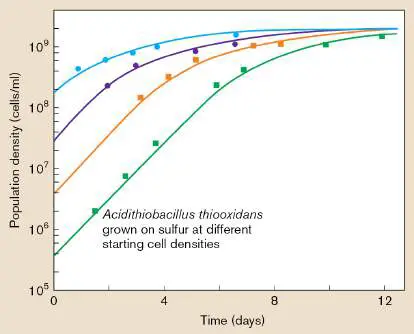
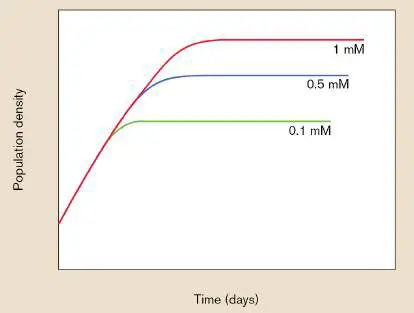
4.10 The bacterium Acidithiobacillus thiooxidans is an extremophile that grows using sulfur as an energy source. (a) Draw the approximate growth curves that you would expect to see, extending from log phase to stationary phase, if four cultures with different starting numbers of bacteria were grown in the same concentration of sulfur. Use Figure 4.22B as the model and 4 × 10 5, 4 × 10 6, 4 × 10 7, and 4 × 10 8 as the starting cell densities. Maximum growth yield is 10 9 cells per milliliter. (b) Draw a second graph showing how the curves would change if the initial population density were constant but the concentration of sulfur varied.
ANSWER: (a)
(b)
4.11 What can happen to the growth curve when a culture medium contains two carbon sources: one a preferred carbon source of growth-limiting concentration and the other a nonpreferred source?
ANSWER: There are two possibilities. If the enzyme systems needed to utilize both carbon sources are always made, the growth curve will look normal because both will be used simultaneously. Usually, the enzyme system for the nonpreferred carbon source is not produced until the preferred source is used up. In this case, a second lag phase will interrupt the exponential phase. This is called a diauxic growth curve and is commonly seen when
cells are grown on both glucose and lactose. Lactose is the nonpreferred carbon source and is used second. The second lag phase marks the exhaustion of one nutrient and the gearing up by the cell to use the other (see Fig. 10.12).
4.12 How would you modify the equations describing microbial growth rate to describe the rate of death?
ANSWER: The death rate applies to a period of declining cell numbers. Therefore, the logarithm of the cell number ratio of N 1 to N 0 will be a negative number, and this factor will need to be preceded by a negative sign to convert it to a positive “halving time,” or half-life of the culture.
4.13 Why are cells in log phase larger than cells in stationary phase?
ANSWER: Cells strive to maintain a certain DNA/mass ratio. In so doing, they balance the number of biochemical processes needed to sustain viability. If the cell mass becomes large relative to the number of copies of a given critical gene, the amount of enzyme produced may not be sufficient to keep the cell alive and growing. In addition, the DNA/mass ratio serves as a signal to trigger cell division. Thus, when a cell divides faster than it replicates its chromosome, it must start a second round of replication before it finishes the first. This type of replication ensures that at least one chromosome
duplication will be complete at the time of division. Because fast-growing cells contain more than one chromosome, they will increase in size to maintain the desired DNA/mass ratio. If the ratio were not maintained, cell division would not occur when needed.
4.14 How might members of the Actinomycetales such as Streptomyces species avoid “committing suicide” when they make their antibiotics?
ANSWER: Bacteria that produce antibiotics need to make defenses against the antibiotic within their own cytoplasm. For example, their genes can express an altered form of the target molecule, such as a ribosomal subunit; or they can make pumps to pump the antibiotic out of the cell.
CHAPTER 5
5.1 Why haven’t cells evolved so that all their enzymes have the same temperature optimum? If they did, wouldn’t they grow even more rapidly?
ANSWER: An enzyme’s function is not determined by temperature alone. There are other physical and chemical constraints according to the variety and complexity of functions that different enzymes must carry out. The thousands of different enzyme molecules must work in a coordinated fashion to support the basic functions of life. Having some enzymes work below or above their optimal temperatures will alter the rates of the reactions they catalyze. A population’s evolution is based on an entire organism’s ability to reproduce, not the speed at which each individual chemical reaction is carried out. The primary goal of a microbe is not just to grow fast but also to survive. Growing too fast could deplete food sources and produce toxic by- products too quickly.
5.2 If microbes lack a nervous system, how can they sense a temperature change?
ANSWER: Most bacteria respond to outside stimuli, such as heat, by altering their gene expression. They sense heat by monitoring the concentration of misfolded proteins, a consequence of excessively
high temperature. The mechanism does not perceive heat per se, but recognizes the deleterious effects of moving outside the optimal growth temperature range so that the cell can launch an emergency response. The same mechanisms can sense other environmental stresses that misfold proteins, such as acid stress. see Chapter 10.
5.3 Predict how hyperthermophilic microorganisms colonize a newly formed hydrothermal vent (black smoker), which is sterile at its formation. How do the microbes get there through ice-cold water (0°C–3°C)?
ANSWER: Experimental data for colonization do not exist, but a hypothetical scenario can be proposed. Hyperthermophiles can persist, if not grow, in low- temperature seawater for long periods, probably because of a cold-adaptation program analogous to heat shock. Hyperthermophilic microbes floating in the ocean could, by chance, encounter a thermal vent, attach to its surface, and form a biofilm.
5.4 How might the concept of water availability be used by the food industry to control spoilage?
ANSWER: Food preservation traditionally includes water exclusion by salt, as seen in hams, back bacon, and salted fish, or by high concentration of sugar, as in canned fruit or jellies. The lower a w prevents microbial growth. Dehydrating foods will also prevent microbial growth.
5.5 Recall from Section 4.2 that an antiporter couples movement of one ion down its concentration gradient with movement of another molecule uphill, against its gradient. For Na + /H + symporters, that means more sodium inside than outside and more protons outside than inside. If this is true, how could a Na + /H + antiporter work to bring protons into a haloalkaliphile growing in high salt at pH 10? Hint: In this situation (high-salt and high-pH media), there will be more sodium outside than there is inside and more H + inside than outside—the opposite of what you’d think the cell would need. Both ions would have to move AGAINST their concentration gradients: Sodium moves out, protons move in.
ANSWER: In this situation the cell has to expend some energy to make the antiporter work. The energy involved is rooted in the charge difference between the inside of the cell (negative charge) and the outside of the cell (positive charge), called delta psi, Δψ (see Chapter 14). Delta psi is expended to drive Na + out and, thus, H + in. The antiporter in this case must also exchange a different number of Na + and H + ions, maintaining an electrical charge difference across the membrane; for example, export 2 Na + and import 1 H + to keep delta psi negative inside.
5.6 If anaerobes cannot live in oxygen, how do they incorporate oxygen into their cell components?
ANSWER: Obligate anaerobes incorporate oxygen from their carbon sources (for example, CO 2 and
carbohydrates such as glucose), all of which contain oxygen. This form of oxygen will not damage the cells.
5.7 How can anaerobes grow in the human mouth, where there is so much oxygen?
ANSWER: A synergistic relationship exists between facultatives and anaerobes within a tooth biofilm. The facultative anaerobes consume oxygen within the biofilm microenvironment, thereby allowing the anaerobes to grow underneath them.
5.8 What evidence led people to think about looking for anaerobes? Hint: Look up “Spallanzani,” “Pasteur,” and “spontaneous generation” on the Internet.
ANSWER: The Italian priest Lazzaro Spallanzani (1729–1799), during his quest to disprove spontaneous generation, said: “Every beast on Earth needs air to live, and I am going to show just how animal these little animals are by putting them in a vacuum and watching them die.” He dipped a glass tube into a culture, sealed one end, and attached the other to a vacuum. He was astonished to find that the microbes lived for weeks. He then wrote: “How wonderful this is. For we have always believed there is no living being that can live without the advantages air offers it.” Fifty years later, Louis Pasteur observed that air could kill some organisms. After looking at a drop of liquid from a fermentation
culture, he wrote: “There’s something new here—in the middle of the drop they are lively, going every which way.... But here at the edge they’re not moving, they’re lying round stiff as pokers.”
5.9 Given a mixture of two microbes, A and B—where organism A can utilize limiting phosphate more efficiently than organism B, but organism B can utilize limiting nitrogen better than organism A—what would happen to the relative growth of the two organisms placed in a limiting nitrogen and phosphate medium if excess nitrogen were added to the mixed culture? What about adding both excess phosphate and excess nitrogen?
ANSWER: Excess nitrogen would give microbe A a nutrient advantage because it is already better than microbe B at using the limiting phosphate in the medium. Organism A might outgrow microbe B. However, adding excess P and N would favor neither strain. In that case, other factors, such as relative growth rates, relative abilities to use alternative carbon sources, and so on, would play more dominant roles.
5.10 Bacteriostatic antibiotics do not kill bacteria; they only inhibit their growth. Why are they nevertheless effective at treating bacterial infections? Hint: Is the human body a quiet bystander during an infection?
ANSWER: The bacteriostatic agent stops growth of the bacteria and allows the host immune response to kill them.
5.11 If a disinfectant is added to a culture containing 1 × 10 6 colony-forming units (CFUs) per milliliter and the D-value of the disinfectant is 2 minutes, how many viable cells will be left after 4 minutes of exposure?
ANSWER: 1 × 10 4 CFUs/ml (90% killed after 2 min = 1 × 10 5; 90% killed after another 2 min = 1 × 10 4 ).
5.12 How would you test the killing efficacy of an autoclave?
ANSWER: Construct a death curve by measuring survival of a known quantity of spores (for example, for Bacillus stearothermophilus) after autoclaving for various lengths of time. Spores should be used because they are more resistant to heat than is any vegetative cell. Typically, autoclaves are regularly checked with spore strips that change color once the endospores are no longer viable.
CHAPTER 6
6.1 Suppose a certain virus depletes the population of an algal bloom. What will happen if some of the algae are genetically resistant?
ANSWER: If some algae are resistant to the virus, they will reproduce and avoid infection. But their population growth will still face competition from other algal species that were never hosts of the virus. Furthermore, if the resistant algae form another bloom, eventually some other viral species will infect them and cut their population again. The result is an evolutionary “arms race.”
6.2 Search the Internet for specific viruses: Can you find viruses that have a narrow host range and others that have a broad host range?
ANSWER: Examples of viruses with a narrow host range include poliovirus (poliomyelitis), which infects only humans and chimpanzees; smallpox virus, which infects only humans; and feline leukemia virus, which infects only cats. Examples of viruses with a broad host range include rabies virus, which infects numerous species of mammals; and influenza strains, which show preference for particular species but can jump between various mammals and birds.
6.3 What will happen if a virus particle remains intact within a host cell and fails to release its genome?
ANSWER: In most cases, a virus particle that fails to release its genome will be unable to reproduce, because DNA polymerases cannot reach its genome for reproduction and RNA polymerase cannot transcribe its genes to make gene products. An exception is double-stranded RNA viruses, which keep their genome partly enclosed in order to protect it from recognition by the host cell immune system.
6.4 For a viral capsid, what is the advantage of an icosahedron (20-sided solid), as shown in Figure 6.8, instead of some other polyhedron, such as a cube or a tetrahedron?
ANSWER: With 20 faces, the icosahedron is the largest convex polyhedron whose faces are equilateral triangles. Thus, the icosahedron turns out to be the largest and most economical form to enclose space by use of a small repeating unit. Natural selection probably favors viruses that can build the largest capsid from the smallest amount of genetic information.
6.5 Giant viruses show evidence of integrating many genes from cellular hosts, such as genes that specify transfer RNA (tRNA). What kind of fitness advantage might favor acquisition of host genes?
ANSWER: Integrating genes from a host leads to a genome of larger size. A larger genome may lead to formation of larger virus particles. The larger virus particles are more effectively phagocytosed by host amebas. Another possible advantage of acquiring cellular genes, such as tRNA genes, is that the viral homologs may evolve into variant components of biosynthetic machinery that more effectively produce virus components.
6.6 When two different viruses infect a cell, how might viruses with different kinds of genomes (RNA versus DNA) combine and share genetic content in their progeny?
ANSWER: DNA viruses require messenger RNA intermediates to express their proteins. In a rare event, a DNA virus could mutate and evolve the ability to package its RNA transcript, rather than its DNA, in a capsid. Alternatively, RNA retroviruses form DNA intermediates within their host cell; these DNA intermediates might recombine with the DNA genome of another virus.
6.7 What are the relative advantages and disadvantages (to a virus) of the slow-release strategy, compared with the strategy of a temperate phage, which alternates between lysis and lysogeny?
ANSWER: A disadvantage of slow release is that the phages can never reproduce progeny phages as rapidly as in a lytic burst. The drain on resources of the host cell infected by a slow-release virus causes
it to grow more slowly compared with uninfected cells; in contrast, a lysogenized cell suffers little or no reproductive deficit compared with uninfected cells. An advantage of reproduction by slow release is the continuous release of phage, while avoiding the possibility of releasing all particles into an environment where no other host cell exists.
6.8 How else, besides Acr proteins, might a phage evolve resistance to the CRISPR host defense (outlined in Fig. 6.24 )?
ANSWER: The phage could have a mutation in its DNA sequence that was previously cleaved to form the spacer. Now when the Cas-crRNA complex forms, the crRNA will no longer base-pair correctly with the phage DNA and will not cleave the DNA of the infecting phage.
6.9 How might humans undergo natural selection for resistance to coronavirus SARS-CoV-2 infection? Is such evolution likely? Why or why not?
ANSWER: Resistance to SARS-CoV-2 infections might evolve through a mutation in the host gene encoding ACE2. The mutation would have to prevent coronavirus binding without impairing the human functions of ACE2. ACE2 is an enzyme that cleaves the hormone angiotensin, to maintain low blood pressure and avoid blood clots throughout the body. Evolution of an altered ACE2 is unlikely because of the complexity of its function. Also, coronavirus
infection has a low death rate; thus, there is little selection pressure for the host to evolve inherited resistance. Note, however, that the immune system rapidly generates immunity to particular strains of coronavirus. Epidemiologists predict that over a lifetime, most individuals will acquire immunity to some coronavirus strains but remain susceptible to others.
6.10 From the standpoint of a virus, what are the advantages and disadvantages of replication by the host polymerase compared with replication by a polymerase encoded by the virus’s own genome?
ANSWER: An advantage of using the host polymerase is energetic: The virus avoids the energetic cost of manufacturing a polymerase to package with each virion. This is an advantage to the virus because its reproductive potential is limited by the energy resources of its host cell. Furthermore, because DNA and RNA polymerases are so central to cell function, the host species is unlikely to evolve a mutant form of the polymerase that resists the virus. On the other hand, the advantage of the virus making its own polymerase is that the viral polymerase can evolve traits that better meet the needs of its own replication, such as high speed and low accuracy to generate frequent variants. One disadvantage of a DNA virus using the host cell DNA polymerase is that the virus must gain access to the host cell
nucleus where the polymerase is. In addition, if the host cell is fully differentiated, it has exited the cell cycle and is not replicating. If it is not replicating, a DNA polymerase may not be available unless the virus can force the host cell to start going through the cell cycle. These are two problems that the virus will not have to overcome if it brings in its own DNA polymerase.
6.11 Why does bacteriophage reproduction give a step curve, whereas cellular reproduction generates an exponential growth curve? (Compare Fig. 6.37 with Fig. 4.22.) Could you design an experiment in which viruses generate an exponential replication curve? Under what conditions does the growth of cellular microbes give rise to a step curve?
ANSWER: Lytic viruses appear to make a step curve because the number of progeny per infected cell is 100 or more, released simultaneously. After two or three generations the cell cycles would fall out of synchrony, and the curve would smooth out, but the later cell cycles are rarely observed in practice because by then, the supply of host cells is exhausted. If, however, an extremely low ratio of viruses to host cells is provided, the growth of virus particles will eventually generate an exponential curve. By contrast, the growth of cellular microbes is rarely observed during the first few doublings. By the time we measure the population, the cells are all
undergoing different stages of division, and the population growth overall generates a smooth exponential curve. But if we observe the growth of a synchronized population of cells, we see a step curve of cell division too.
6.12 What kinds of questions about viruses can be addressed in tissue culture, and what questions require infection of an animal model?
ANSWER: Questions that can be answered using tissue culture would be how a virus binds to cell- surface receptors, and how it replicates progeny virions within a cell. Questions of viral transmission, however, would require the organ system of an animal, where the virions must undergo transport within and escape the immune system. Often, a virus passaged through tissue culture, such as influenza virus, will accumulate mutations that allow faster growth in the laboratory but poor infection of an animal host.
CHAPTER 7
7.1 Before the studies by Avery, Hershey, and others, some scientists believed that, unlike plants and animals, bacteria lacked genes. Considering what little was known about the modes of reproduction and the recombination of alleles in bacteria, why was this a reasonable, albeit incorrect, assumption?
ANSWER: No mode of mating was apparent for microbes, and there was no segregation of traits (alleles) in the offspring. Some leading scientists at the time believed that the microbial cell was simply a “dynamic reaction network” that did not require genes to account for cellular activity.
7.2 What do you think happens to two single-stranded DNA molecules isolated from different genes when they are mixed together at very high concentrations of salt? Hint: High salt concentrations favor bonding between hydrophobic groups.
ANSWER: In high salt conditions, the stacking of hydrophobic bases is so strongly favored that two single strands of DNA will form a duplex no matter what the sequence of base pairs is.
7.3 How do the kinetics of denaturation and renaturation depend on DNA concentration?
ANSWER: The speed of denaturation does not depend on DNA concentration, but the speed of renaturation does. The higher the concentration of single-
stranded DNA, the more likely it is that complementary sequences will find each other and the faster the duplex can re-form.
7.4 DNA gyrase is essential to cell viability. Why, then, are nalidixic acid–resistant cells that contain mutations in gyrA still viable?
ANSWER: The gyrA mutations alter only the nalidixic acid–binding site on GyrA, not its gyrase activity. In other words, active DNA gyrase is still made, but the drug cannot bind to it.
7.5 Bacterial cells contain many enzymes that can degrade linear DNA. How, then, do linear chromosomes in organisms like Borrelia burgdorferi (the causative agent in Lyme disease) avoid degradation?
ANSWER: DNA-digesting exonucleases act on free 5′ or 3′ ends. The Borrelia linear chromosomes possess covalently closed hairpin ends called telomeres and do not possess free 5′ or 3′ groups.
7.6 Would you expect to find genes encoding Topo IV, XerC, and XerD in prokaryotes with exclusively linear chromosomes? Why or why not?
ANSWER: Genes for Topo IV are present in Streptomyces with linear genomes. They are not essential for survival, but mutants lacking this enzyme have severe growth defects, suggesting that, like circular chromosomes, linear chromosomes form knots during replication that are optimally resolved by the Topo IV enzyme. However, genes
encoding XerC and XerD are not found in the Streptomyces genome. This may not be surprising: While an odd number of recombination events produce chromosome dimers in circular chromosomes, recombination does not result in dimers in linear chromosomes.
7.7 Individual cells in a population of E. coli typically initiate replication at different times (asynchronous replication). However, depriving the population of a required amino acid can synchronize reproduction of the population. Ongoing rounds of DNA synthesis finish, but new rounds do not begin. Replication stops until the amino acid is once again added to the medium—an action that triggers simultaneous initiation in all cells. Why is this replication synchronized?
ANSWER: Initiation requires synthesis of the initiator protein DnaA. Depriving the population of an amino acid prevents protein synthesis, which precludes synthesis of DnaA. Because DnaA is not required to complete already-initiated rounds of replication, all rounds already started are completed, but reinitiation cannot occur. Adding the amino acid once again will allow all cells to simultaneously make DnaA, so initiation is triggered in every cell at the same time.
7.8 The antibiotic rifampin inhibits transcription by RNA polymerase, but not by primase (DnaG). What happens to DNA synthesis if rifampin is added to a synchronous culture?
ANSWER: Initiation of DNA synthesis requires primer transcription at the origin by RNA polymerase, an enzyme sensitive to rifampin. Primase (DnaG), which synthesizes RNA primers in the lagging strand throughout DNA synthesis, is resistant to rifampin. So adding rifampin to a synchronized culture will prevent new rounds of DNA replication but will not affect already-initiated rounds.
7.9 How would you demonstrate that a gene is essential?
ANSWER: One method to establish that a gene is essential is to construct a complete loss-of-function (null) allele of that gene and show that the organism cannot survive without it. As one might imagine, this is a challenging prospect because, by definition, the organism cannot survive once the mutation is in place. One trick is to conditionally express the gene, such that it can be turned on to let the cells grow in culture, but can be turned off by the researcher’s manipulation of the growth conditions to see whether its loss kills the cells. Mechanisms of gene regulation and genetic engineering are described in Chapters 10 and 12. Ideally, multiple environmental conditions are tested such that the gene is found to be essential in as many conditions as possible. Some genes are obviously essential, such as genes that encode RNA polymerase and the ribosomal proteins, because
these are single-copy genes in the genome, and their products function in processes essential for cell growth. For other genes, their absolute requirement may be less obvious and require more rigorous testing for confirmation. For instance, the cell has genes that encode several different DNA polymerases, but it is unclear how many of these polymerases are essential for cell growth.
7.10 How might you interpret the discovery of genes for photosynthesis in the metagenome of the human gut? Could it indicate a possible error in the analysis or could something else be going on?
ANSWER: Photosynthesis does not occur in the gut, because of the absence of a light source, but genes could be present in photosynthetic microbes (bacteria and/or eukaryotes) that came to the gut as a food source or a food contaminant. Though unable to colonize the gut, these microbes might be present long enough to contribute their DNA to the metagenome. Alternatively, it is possible that the photosynthesis genes could be used in a later, sun- exposed stage in the life cycle of the organism, once it leaves the gut and before it colonizes a new human host. Finally, it is also possible that the genes only resemble photosynthesis genes and, through evolution, have changed to functions that are independent of light.
7.11 Suppose you are conducting a metagenomic analysis of soil sampled from different parts of a wetland. Would you use one DNA extraction method or multiple methods?
ANSWER: The advantage of using one DNA extraction method is that it will maximize information about the differences between communities from different parts of the wetland. The advantage of multiple extraction methods applied to a given sample is that they will maximize the detection of diversity within a sample. Your choice of method (or a compromise design) may depend on how different you expect the microhabitats to be within the overall wetland.
CHAPTER 8
8.1 Figure 8.1 illustrates an operon and its relationship to transcripts and protein products. Imagine that a mutation generates a stop codon about midway through the DNA sequence that encodes gene A. What would happen to the production of the gene A and gene B proteins?
ANSWER: The part of the gene A protein only up until the stop codon would be made. The complete mRNA transcript, however, would be made and would include gene B (there are some rare exceptions). Because gene B has its own translation start codon, the complete gene B protein could still be produced.
8.2 If each sigma factor recognizes a different promoter, how does the cell manage to transcribe genes that respond to multiple stresses, each involving a different sigma factor?
ANSWER: In these situations, a given gene has multiple promoters. Each promoter is recognized by a different sigma factor and begins transcription at different distances from the start codon of the gene.
8.3 Imagine two different sigma factors with different promoter recognition sequences. What would happen to the overall gene expression profile in the cell if one sigma factor were artificially overexpressed? Could there be a detrimental effect on growth?
ANSWER: Because sigma factors compete for the same site on core polymerase, overexpression of one sigma factor could displace the other sigma
factors from the RNA polymerase population and compromise expression of those target genes. If those genes were important to survival, the cell could die.
8.4 Why might some genes contain multiple promoters, each one specific for a different sigma factor?
ANSWER: The gene might need to be expressed under multiple conditions at different levels. If a given condition increases expression of an alternate sigma factor, the target gene will need a promoter that the new sigma factor can recognize. As the need disappears and the sigma factor diminishes in concentration, a promoter that uses the housekeeping sigma factor will be needed. For example, the gene for DnaK heat-shock protein has promoters for RpoH (sigma-32) and RpoD (sigma- 70), the housekeeping sigma factor. The level of protein needed during normal growth is supplied by sigma-70. Upon encountering heat stress, the RpoH sigma factor level increases and mediates an increase in DnaK production.
8.5 If rifamycins target bacterial RNA polymerase, why don’t they also kill their producer, the bacterium Amycolatopsis rifamycinica?
ANSWER: The RNA polymerase of A. rifamycinica has evolved to be naturally resistant to this class of antibiotic. Unfortunately, pathogens such as
Mycobacterium tuberculosis, the causative agent of tuberculosis, can similarly evolve a rifampicin- resistant RNA polymerase under selection with the antibiotic.
8.6 How might the redundancy of the genetic code be used to establish evolutionary relationships between different species? Hints: 1. Genomes of different species have different overall GC content. 2. Within a given genome, one can find segments of DNA sequence with a GC content distinctly different from that found in the rest of the genome.
ANSWER: The codon preferences of different microorganisms are based in part on their GC content. Thus, an organism with an AT-rich genome will preferentially use codons for a given amino acid that have A’s and T’s over those with G’s and C’s. Evolutionarily, finding a long AT-rich region that encodes mRNA with AT codon bias within a chromosome that is otherwise GC-rich suggests that the AT-rich region was inherited by horizontal DNA transfer from another species (see Chapter 9).
8.7 How might one gene code for two proteins with different amino acid sequences?
ANSWER: One gene can code for two proteins with different amino acid sequences by having two different translation start sites in different reading frames. While this is not a common occurrence, it happens. Hepatitis B virus is one example.
8.8 Why involve RNA in protein synthesis? Why not translate directly from DNA?
ANSWER: Because transcription enables the cell to amplify the gene sequence information into multiple copies of RNA. Amplification means that more ribosomes can be engaged in translating the same protein, causing the concentration of the protein to rise more quickly than if only a single gene were used. The transcriptional process also provides an additional location to regulate the production of a protein.
8.9 Codon 45 of a 90-codon gene was changed into a translation stop codon, producing a shortened (truncated) protein. What kind of mutant could produce a full-length protein from the gene without removing the stop codon? Hint: What molecule recognizes a codon?
ANSWER: If a tRNA gene sequence corresponding to an anticodon is altered by mutation so that the anticodon of the tRNA “sees” the stop codon as an amino acid codon, then the mutant cell can produce a full-length protein from the gene. The mutated tRNA molecule will transfer its amino acid to the peptide chain. The stop codon is still there, but now it can direct the addition of an amino acid. The attached amino acid can be used to bridge the gap caused by the stop codon, and a full-length protein is made. These modified tRNAs are called suppressor
tRNAs because they suppress the mutant phenotype.
8.10 While working as a member of a pharmaceutical company’s drug discovery team, you find that a soil microbe snatched from the jungles of South America produces an antibiotic that will kill even the most deadly, drug-resistant form of Enterococcus faecalis, which causes bacterial endocarditis. Your experiments indicate that the compound stops protein synthesis. How could you more precisely determine the antibiotic’s mode of action? Hint: Can you use mutants resistant to the antibiotic?
ANSWER: One way is to take a culture of bacteria susceptible to the antibiotic and isolate resistant mutants (bacteria that are not killed by the antibiotic), purify their ribosomes, and separate the 30S and 50S ribosomal subunits. Cross-mix subunits from sensitive and resistant cells (for example, mix 30S subunits from sensitive cells with 50S subunits from resistant cells). Then measure the ability of the hybrid ribosome to carry out protein synthesis with and without the drug. If resistance is due to an altered ribosomal protein or RNA, the subunit mix containing the altered component will make protein regardless of whether the drug is present. Once identified, the responsible ribosomal subunits from resistant and sensitive cells can be broken down further into their component parts, reconstituted in hybrid form, and again tested for an ability to make protein in the presence of the drug. This reductive
approach will likely, but not always, uncover the target ribosomal protein or rRNA.
8.11 Why do you think evolution by natural selection favors changes in codons, rather than in anticodons?
ANSWER: Changes to codons change the sequence of a single protein, whereas changes to anticodons (in tRNA) change the code itself and can change the sequence of many proteins simultaneously. It is likely that not all of the changes will be adaptive, and some could be lethal.
8.12 A major way that bacteria acquire new functions is through the acquisition and expression of genes from other microbes via horizontal gene transfer (see Chapters 9 and 17). How would this mechanism of innovation be affected if the recipient bacterium changed its genetic code?
ANSWER: A change in the recipient’s genetic code should not affect transcription of the imported genes, but it will change the amino acid sequence of the genes’ proteins compared to their sequences in the donor organism. As a result, nonfunctional proteins of no value to the recipient could be produced, thus limiting the benefit of horizontal gene transfer.
8.13 The incorporation of pyrrolysine and selenocysteine into the genetic code involved stop-to-sense changes, rather than sense-to-sense. Why do you think this was the case?
ANSWER: This change is unlikely to be due to chance. Of the 64 possible codons in the standard code, only 3 are nonsense, and nonsense codons were reassigned in both cases where the code was expanded. Perhaps, as the initial evolutionary event progresses toward code expansion, changes from stop to sense are less harmful to the cell than are changes from (an old) sense to (a new) sense. In fact, for many genes, additional stop codons using one of the other two stop codon sequences are located downstream of the first; these can provide “backup” signals for translation termination in the event that an amino acid is misincorporated at the first stop codon.
8.14 While some organisms have alternative genetic codes, they still use codons composed of three bases. Why is it unlikely that organisms will evolve to use a codon composed of four or more bases?
ANSWER: To switch from a three- to four-base codon system, anticodons within each tRNA would have to be modified to recognize the new codons. Additionally, the ribosome structure may have to be modified to accommodate these larger codon- anticodon pairings during translation. Finally, a four- base codon genetic code would provide 4 × 4 × 4 × 4, or 256, possible combinations. Given a 20-amino- acid alphabet for proteins, switching from 64 to 256
codons would not provide any obvious selective advantages during evolution.
CHAPTER 9
9.1 How could frameshift mutations be used to confirm that codons consist of three bases, versus two or four? Hint: Think of how a series of “like” frameshifts (for example, single-base-pair additions) along a gene would affect the reading frame.
ANSWER: Francis Crick and colleagues performed experiments in which one, two, or three base pairs were added within the reading frame of a gene. They discovered that three “like” frameshifts (for example, three single-base-pair additions) along a protein maintained some protein activity, whereas one or two frameshifts resulted in no protein activity. (Protein activity was measured as an indicator of whether the newly made protein was fully synthesized and folded properly.) Their results provided evidence that each codon is made up of a triplet of bases. The addition of three bases results in one new codon and hence one more amino acid in the protein. Only the addition (or subtraction) of three bases (or a multiple of three bases) maintains the reading frame. Adding one or two bases shifts the reading frame and shuffles the amino acid sequence.
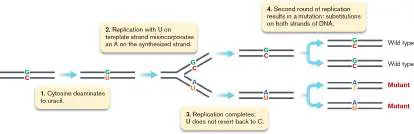
9.2 Does deamination of cytosine to uracil lead to a transition mutation or a transversion mutation? Work this out in a drawing, and use Figure 9.4 as a guide.
ANSWER: Figure 9.5 shows that deamination of cytosine generates a uracil. Uracil cannot base-pair with guanine, as cytosine does. Thus, in the next round of replication the uracil will bind adenine, and eventually an AT base pair will form where a GC base pair once was, as the figure below shows. This is a transition mutation.
9.3 Would mutants that lack Dam have a mutator phenotype? Explain why or why not. What about mutants that overexpress Dam?
ANSWER: Both types of mutants have mutator phenotypes. Mutants lacking Dam are unable to discriminate between new and old strands during mismatch repair. Mutants that overexpress Dam have an increased mutation rate because the newly synthesized DNA becomes methylated faster, giving the mismatch repair system less time to find and repair the mutations.
9.4 It has been reported that hypermutable bacterial strains are overrepresented in clinical isolates. Out of 500 isolates of Haemophilus influenzae, for example, 2%–3%
were mutator strains having mutation rates 100–1,000 times higher than those of lab reference strains. Why might the mutator phenotype be beneficial to pathogens?
ANSWER: The mutator strains may speed microbial evolution, which could help the microbe outwit the immune system or escape the effects of administered antibiotics.
9.5 Transfer of an F factor from an F + cell to an F − cell converts the recipient to F +. Why doesn’t transfer of an Hfr do the same?
ANSWER: The last piece of an Hfr to transfer is the F factor and oriT. Only rarely will an entire chromosome transfer from one cell to another, so most Hfr transfers do not result in transfer of oriT and thus cannot initiate conjugation.
9.6 In a transductional cross between an A + B + C + genotype donor and an A − B − C − genotype recipient, 100 A + recombinants were selected. Of those 100, 15 were also B +, while 75 were C +. Is gene B or gene C closer to gene A?
ANSWER: Gene C is closer to gene A, because gene C was cotransduced with A at the higher frequency.
9.7 Evolutionarily speaking, why might it be advantageous for a transposon to utilize replicative transposition? Why might nonreplicative transposition be advantageous?
ANSWER: Replication has the advantage of increasing the number of transposon copies, thereby enabling the transposon to proliferate within a genome and
increase its chances of invading new genomes via horizontal gene transfer if its host genome serves as donor. Nonreplicative transposition may have an advantage because the transposon can move to a location that is more beneficial, or at least less costly, to the host than its current location. By improving fitness of the host, the transposon can therefore increase its own abundance when the host replicates its chromosome.
9.8 Gene homologs of dnaK encoding the heat-shock chaperone HSP70 exist in all three domains of life. All bacteria contain HSP70, but only some species of archaea encode a dnaK homolog. The archaeal homologs are closely related to those of bacteria. Knowing this information, how do you suppose dnaK genes arose in archaea?
ANSWER: The dnaK gene may have moved by some type of horizontal gene transfer mechanism from the domain Bacteria to some members of the domain Archaea.
9.9 Every strain of Prochlorococcus examined to date has a unique cluster of genes that modifies the chemical properties of the cell surface. What sort of selective pressure(s) might account for the high degree of variation in cell-surface properties for this marine bacterium?
ANSWER: Probably there is strong selective pressure to avoid being eaten by protozoan grazers or being attacked by bacteriophages. By changing its surface chemistry, Prochlorococcus might be able to “taste”
different to grazers or either remove or mask an attachment site of the bacteriophages.
CHAPTER 10
10.1 Why is scanning along the DNA molecule more efficient than a random search within the cell’s cytoplasm for the high-affinity DNA target sequences?
ANSWER: Scanning along the DNA strand reduces search space to one dimension, compared to a three-dimensional search within the contents of the cytoplasm.
10.2 Knowing that the affinity of regulators for DNA depends on the DNA sequence, propose how evolution could result in the ability of a preexisting regulator to now regulate a newly acquired gene. Why might it be critical that the sequence encoding the regulator itself does not change during this evolutionary step?
ANSWER: The DNA near the promoter of the newly acquired gene could change such that the regulator would now bind with high affinity. If instead the new gene was unchanged but the regulator was mutated to recognize the gene’s promoter, the regulator’s ability to regulate other genes might be affected, with possibly dire consequences for the cell.
10.3 Operators and repressors were discovered before promoters (the DNA sequences recognized by the sigma factor of RNA polymerase). Why do you think it took longer to discover the promoters? Hint: Finding elements of transcription initiation using genetics involves analysis of mutants; think about the phenotype of a repressor mutant compared to that of a promoter mutant.
ANSWER: Loss-of-function promoter mutations would have the same phenotype as loss-of-function mutations in the open reading frame, and would therefore be difficult to distinguish. They would also be a rare class of mutation, because the promoter region is a much smaller target than the open reading frame. In contrast, loss-of-function mutations in the operator or repressor derepress the operon, such that the phenotype is the gain in expression of the gene, which would be much easier to identify.
10.4 The transmembrane sensor kinase could have a direct role in gene expression, if its cytoplasmic domain has the ability to bind DNA. Why, then, might it be advantageous for the cell to use the response regulator as an intermediate in this signaling process? Hint: Consider the spatial organization of the cell.
ANSWER: If the transmembrane receptor were also the transcription factor, it would have to be able to contact the promoter of the gene it regulates. Thus, the chromosomal region for the promoter needs to be able to move to the membrane. In addition, if there are more copies of the response regulator protein than of the sensor kinase, the signal can be amplified because each sensor kinase could activate multiple response regulators. Finally, a single transmembrane receptor can control many genes (in a regulon) if it activates multiple copies of the
response regulators that each bind to a different operon.
10.5 Null mutations completely eliminate the function of a given mutated gene. Predict the effects of the following null mutations on the induction of beta-galactosidase by lactose, and predict whether the lacZ gene is expressed at high or low levels in each case. The inactivated, mutant genes to consider are lacI, lacO, lacP, crp, and cya (the gene encoding adenylyl cyclase). What effects will those mutations have on catabolite repression?
ANSWER: Loss of LacI repressor will lead to constitutive expression of lacZ and will partially affect catabolite repression. [Explanation: Because LacI is missing, allolactose inducer is not required, so the glucose effect on the LacY permease is irrelevant. What remains relevant is that the mechanism by which glucose transport reduces cAMP synthesis remains. Thus, decreased cAMP levels resulting from growth on glucose will cause a decrease in cAMP-CRP-dependent activation of lac operon expression.] A lacO mutant will not bind LacI repressor, so the phenotype will mimic that of a lacI mutation. A lacP mutation will prevent expression of lacZYA because RNA polymerase will not bind. Mutations in crp or cya will partially prevent catabolite repression (see preceding explanation), but lacZYA induction by lactose will be normal. Without the cAMP-CRP complex, however, expression can never achieve maximal levels.
10.6 Predict what will happen to the expression of lacZ when a second copy of the lac operon region containing various mutations is present on a plasmid. The genotypes of these partial diploid strains are presented as chromosomal genes/plasmid gene. (a) lacI − lacO + P + Z + Y + A + /plasmid lacI +; (b) lacO − lacI + P + Z + Y + A + /plasmid lacO +; (c) crp − lacI + O + P + Z + Y + A + /plasmid crp +.
ANSWER: (a) The lacI + gene on the plasmid will produce LacI repressor protein that can diffuse through the cytoplasm, bind chromosomal lacO, and repress the lacZYA operon. Because the complementing gene and the mutant gene are on different DNA molecules, the gene is said to work in trans. (b) Because the lacO gene does not produce a diffusible product (for example, protein or RNA), the plasmid lacO + cannot complement a lacO mutation in trans, and the strain will not make beta-galactosidase. Thus, the lacO gene functions only in cis; that is, when it resides next to the gene it regulates. (c) The crp gene produces a diffusible protein product, so it can function in trans and complement a crp mutation. The strain will make beta-galactosidase to the highest level in the presence of inducer lactose.
10.7 Researchers often use isopropyl-β- D - thiogalactopyranoside (IPTG) rather than lactose to induce the lacZYA operon. IPTG resembles lactose, which is why it can interact with the LacI repressor, but it is not degraded by beta-galactosidase. Why do you think the use of IPTG is preferred in these studies?
ANSWER: There are at least two reasons IPTG is used. First, the level of IPTG inducer will not change, but the level of lactose inducer will continually decrease as it is consumed, affecting the kinetics of induction. Second, the act of degrading lactose produces glucose and galactose. Glucose, as the preferred carbon source, will catabolite-repress the lacZYA operon, once again affecting the kinetics of induction.
10.8 When the lacI gene of E. coli is missing because of mutation, the lacZYA operon is highly expressed regardless of whether lactose is present in the medium. Judging by the illustration of arabinose operon expression in Figure 10.13, what do you think would happen to araBAD expression if AraC were missing? Why?
ANSWER: The operon would be poorly expressed because contact between AraC and RNA polymerase is needed to activate transcription.
10.9 In a newly discovered bacterium, an operon encoding enzymes suspected to synthesize an amino acid has what appears to be the following leader sequence: 5′- ATGCCCTTCTTCAGTTGA-3′. Assuming the microbe uses the standard genetic code (see Fig. 8.12), predict which amino acid is synthesized by the enzymes encoded in the operon.
ANSWER: The leader sequence is translated to fMet- Pro-Phe-Phe-Ser-Stop. Because the most frequent codon codes for phenylalanine, it is likely that the
operon’s products are involved in synthesizing phenylalanine.
10.10 The relationship between the small RNA RyhB, the iron regulatory protein Fur, and succinate dehydrogenase is shown in Figure 10.23. Given this regulatory circuit, will a fur mutant grow on succinate?
ANSWER: No. Without Fur, RyhB is made whether or not iron is present, and RyhB sRNA causes the continual degradation of the sucCDAB mRNA. Succinate dehydrogenase cannot be made, so the cell cannot grow on succinate.
10.11 What would be the outcome if purified autoinducer were experimentally provided to a low-density culture?
ANSWER: These cells would make light, because autoinducer concentration, and not cell abundance per se, dictates expression of the lux operon.
10.12 Genes encoding luciferase can be used as “reporters” of gene expression when placed under the regulatory control of other genes. Luminometers are machines that can quantify light production (luminescence) from luciferase. From the discussion in Section 9.2, propose an experiment to confirm that RecA is induced during the SOS response.
ANSWER: You could fuse the luciferase gene to the recA promoter and use a luminometer to demonstrate a real-time increase in luminescence after treatment with a mutagen, such as ultraviolet irradiation, that triggers the SOS response.
10.13 What would happen if a culture were coinoculated with Vibrio (Aliivibrio) fischeri luxI and luxA mutants, neither of which produces light?
ANSWER: The luxI mutant would cause the bacterium to glow, and the luxA mutant would still make autoinducer as the bacterium grew. This autoinducer would accumulate in the culture medium and then diffuse and enter the luxI mutant cells, where it would trigger induction of the lux operon and the production of luciferase.
10.14 Figure 10.35 illustrates the process of transformation in Streptococcus pneumoniae. Would a mutant of Streptococcus lacking ComD be able to transform DNA?
ANSWER: No. The membrane sensor ComD detects the competence stimulation peptide (CSP) and initiates a cascade of events leading to transformasome construction. A lack of ComD would mean no transformasome and no DNA transformation.
10.15 While viewing Figure 10.41, imagine the phenotype of a cell in which fljA has been deleted but fljB is still expressed. Would cells be motile? What type of flagella would be produced? Would the cells undergo phase variation? What would happen if fliC alone were deleted?
ANSWER: A fljA mutant lacks the repressor needed to turn off fliC. Thus, cells undergoing phase variation will switch back and forth from making only H1 flagellin to making both H1 and H2 flagellins. A fliC
mutant, however, will switch from being motile to nonmotile. In one orientation, the invertible element will allow H2 flagellin to be made, but in the opposite orientation no flagellin will be made, at which point the cell will not be motile.
CHAPTER 11
11.1 Plaques from phage lambda quickly fill with resistant lysogens. Could there be a different way for the host cells to become resistant to infection, without forming lysogens?
ANSWER: A gene encoding a host product essential for phage infection could mutate within the host bacteria. A common source of resistance is loss of the phage receptor, a host cell-surface protein. In the case of phage lambda, the receptor protein would be maltose porin. Other ways to become resistant could include specific cleavage of the phage DNA as it enters the cell, failure to interact with phage replication components, and the CRISPR- Cas memory defense system.
11.2 What advantages does rolling-circle replication offer a phage, compared with bidirectional replication?
ANSWER: An advantage of rolling-circle replication is that many genome copies are made quickly from a single template. No proofreading occurs, and no methylation step distinguishes “old” from “new” DNA. Because viral genomes are relatively small, viruses tolerate a higher error rate per base pair than for cellular genomes.
11.3 A researcher adds phage lambda to an E. coli population whose cells fail to express maltose porin. After several days, the E. coli are now lysed by phage. What could be the explanation?
ANSWER: Various answers are possible. In practice, the most common explanation is that phage populations contain genetic variants, some of which can occasionally infect E. coli by binding a different porin for a different sugar. Such rare events lead to evolution of lambda mutants now adapted to bind a different receptor.
11.4 Suppose a mutant lambda phage lacks holin and endolysin. What will happen when this mutant infects E. coli ?
ANSWER: The phage can undergo a lytic cycle, filling the E. coli cell with progeny phage particles. But the particles are trapped inside the cell wall. They cannot emerge to infect new host cells.
11.5 Could the influenza genome change by recombination of segments, rather than by reassortment? What about the lambda phage genome?
ANSWER: The RNA segments of the influenza genome are unlikely to recombine with segments of another genome, because the single-stranded RNA has no mechanism for maintaining homology with another strand. The lambda phage genome can recombine with the genome of a coinfecting phage by using the host cell’s protein complex for homologous recombination (discussed in Chapter 9 ).
11.6 How could swine play a role in generating a pandemic strain of influenza? How could avian influenza strain H7N9 become a pandemic strain endangering many people?
ANSWER: Strain H7N9 is highly virulent in humans, but the transmission rate among humans is low. Transmission between birds is high because birds have the appropriate receptors in their upper respiratory tract. Poultry can spread H7N9 rapidly among many birds. If birds are reared adjacent to swine, then a mutant form of H7N9 might infect the swine. Suppose H7N9 were to infect a swine that was simultaneously infected with strain H1N1. The H1N1 strain is transmitted between humans with high efficiency. During coinfection of swine, the H7N9 strain might acquire segments from H1N1 that enable efficient transmission to humans. The reassortant strain might then escape into humans and spread, causing deadly disease.
11.7 How do attachment and entry of HIV resemble attachment and entry of influenza virus? How do attachment and entry differ between these two viruses?
ANSWER: Attachment of HIV requires the envelope spike proteins to bind receptors in the host plasma membrane, just as the influenza envelope protein hemagglutinin binds the sialic acid protein in the host membrane. However, the entry processes differ between the two viruses. Influenza virus induces formation of an endocytic vesicle, whose acidification triggers membrane fusion and release of
the core contents into the host cytoplasm. HIV virions, however, do not induce endocytosis and do not require acidification to induce fusion of the membrane and release of the core into the cytoplasm. In both cases, receptor binding signals the major rearrangement of a viral envelope protein so that a fusion peptide is inserted into the host membrane. For HIV, it is the plasma membrane; for influenza virus, it is the endocytic membrane.
11.8 What do you think are the arguments for or against lentivectors editing the germ line?
ANSWER: Parents who carry two copies of a deleterious allele such as that for sickle-cell disease might wish to have their sperm or egg cells edited to replace the bad allele, thus enabling production of healthy children. It could be argued that the human genome is full of retroviral modifications that accumulated gradually during the history of our species, so why not intentionally add another one? As a practical matter, it is hard to know what would happen to the lentivector sequences in a germ line. Perhaps the process of sperm or egg maturation and embryogenesis would activate the viral sequences in unexpected ways. The future child would have no choice about this procedure. In addition, parents have the alternative of producing children by selecting a sperm or egg donor.
11.9 Compare and contrast the fate of the HSV genome with that of the HIV genome.
ANSWER: HSV-1 contains a DNA chromosome, which is transported to the nuclear membrane within an intact capsid. HIV contains two RNA chromosomes, which are released in the cytoplasm upon dissolution of the capsid. The RNA chromosomes of HIV are copied to double-stranded DNA for transport into the nucleus. In HSV-1, the DNA chromosome circularizes and generates concatemeric duplicates by rolling- circle replication. In HIV, the replicated DNA circularizes but immediately integrates into the host chromosome. In both cases, the viral DNA can persist for decades as a latent infection.
CHAPTER 12
12.1 The movie associated with Figure 12.1 shows bacilli tethered to a glass slide by one of their flagella. Several bacteria rotate in opposite directions as their flagellar rotors switch from clockwise to counterclockwise rotation and back again (see Fig. 12.3). Which way will a bacillus rotate when an attractant is added? What would the rotating phenotypes be if you tethered the knockout mutants cheY, cheA, cheZ, and cheR to the slide and then added attractant?
ANSWER: When an attractant is added to the slide, the rotor will turn counterclockwise for smooth swimming (CheA becomes less active, so there is less CheY-P and there are less frequent tumbles; thus, motor rotation is biased to counterclockwise). But because the flagellum is fixed to the slide, the bacillus will rotate in the opposite direction (clockwise). You would expect the following rotating phenotypes from mutants fixed to slides: For mutant cheY, the rotor will turn mostly counterclockwise because there is no CheY-P, so there will be longer runs, but fixed cells will turn mostly clockwise. Mutant cheA will have the same phenotype as cheY (no CheY-P, longer runs). For mutant cheZ, the rotor will turn mostly clockwise, because there is more CheY-P (so there will be frequent tumbles and shorter runs), but the fixed cells will turn counterclockwise. For mutant cheR, no methylation
of MCPs will lead to reactivation of CheA kinase after attractant is added, so there will be less CheY-P; therefore, the rotor will more frequently switch to clockwise, but fixed cells will turn counterclockwise.
12.2 How would a magnetotactic species have to behave if it were in the Southern Hemisphere instead of the Northern Hemisphere?
ANSWER: In the Northern Hemisphere, the field lines for magnetic north point downward; in the Southern Hemisphere, the opposite is true. Thus, if downward direction is the aim of magnetotaxis, bacteria existing in the two hemispheres would have to respond oppositely to the magnetic field; in the Southern Hemisphere, anaerobic magnetobacteria swim toward magnetic south. Near the equator, the proportions of north-seeking and south-seeking bacteria are roughly equal.
12.3 What property of fatty acids makes them useful chemoattractants for surface motility, compared to sugars or amino acids that often serve as chemoattractants for swimming motility?
ANSWER: Their hydrophobic nature keeps them adhered to the surface, allowing gradients to form and persist.
12.4 Why do you think Pseudomonas aeruginosa regulates flagella at both the transcription and posttranslation levels during the transition from surface attachment to biofilm formation?
ANSWER: Posttranslation-level regulation immediately stops the rotation of existing flagella, as motility becomes no longer useful once microcolonies form. Transcription-level regulation prevents formation of additional flagella that would serve no purpose in sessile biofilm structures and, if left free to function, may even disrupt biofilm structures as they form.
12.5 Escherichia coli has several DNA methyltransferases, such as Dam (see Chapter 7), that methylate many bases in the genome. If a researcher wishes to transfer a plasmid from E. coli into a new species, the presence of which type(s) of restriction-modification systems in the new species might prompt a researcher to use a Dam-minus mutant of E. coli?
ANSWER: Because type IV restriction systems target methylated DNA, the researcher might get higher transfer efficiency if the plasmid were replicated in a Dam-minus mutant of E. coli rather than in the wild- type E. coli.
12.6 What would happen with the toggle switch shown in Figure 12.27 if the genetic engineer could set repressor 1 and repressor 2 protein levels to be exactly equal? Imagine that this is done without either inducer present.
ANSWER: In a perfect system, both proteins would remain at the same level, but any small deviation in condition that tilts the balance between the two proteins by even a small amount will eventually lock the cell into either GFP on or GFP off. Because of
intrinsic noise in the system, the population of cells could be half on and half off.
CHAPTER 13
13.1 Consider glucose catabolism in your blood, where the sugar is completely oxidized by O 2 and converted to CO 2:
C 6 H 12 O 6 + 6O 2 → 6CO 2 + 6H 2 O
Do you think this reaction releases greater energy as heat or by change in entropy? Explain.
ANSWER: At first glance, the breakdown of glucose to six molecules of carbon dioxide seems to incur a large increase in entropy. But the reaction also consumes six molecules of oxygen, so the entropy gain is small. Furthermore, the oxidation reaction is associated with a large release of heat (enthalpy change Δ H). So, which form of energy change is larger, Δ H or − T Δ S? The enthalpy change for glucose breakdown is approximately Δ H °′ = −2,540 kJ/mol. (The degree symbol followed by prime connotes biochemical standard conditions.) At 37°C, the temperature- entropy term − T Δ S °′ = −(310 K)(0.973 kJ/mol/K) = −302 kJ/mol. The overall value of free energy change Δ G °′ = −2,540 kJ/mol − 302 kJ/mol = −2,842 kJ/mol. Thus, the entropy term yields some energy, but less than an eighth as much as the enthalpy (Δ H °′) term.
13.2 The bacterium Lactococcus lactis was voted the official state microbe of Wisconsin because of its importance for cheese production. During cheese production, L. lactis ferments milk sugars to lactic acid:
C H O → 2C H O ⇌ 2C H O − + 2H +
6 12 6 3 6 3 3 5 3 Large quantities of lactic acid are formed, with relatively small increase in bacterial biomass. Why do you think biomass is limited? Cheese making usually runs more efficiently at high temperature; why?
ANSWER: The lactic acid fermentation reaction does not involve a strong oxidant, but only breakdown of sugar to smaller molecules, so a larger proportion of the free energy yield is in the entropy term − T Δ S. The overall energy yield is low, so a large amount of sugar must be cycled to lactic acid (lactate) for a relatively small amount of bacterial growth, as compared to bacterial growth with oxygen. Because fermentation depends on entropy change (− T Δ S), the free energy yield can be increased by increasing the temperature.
13.3 When ATP phosphorylates glucose to glucose 6-phosphate, what is the net value of Δ G °′? What if ATP phosphorylates pyruvate? Can this latter reaction go forward without additional input of energy? (See Table 13.3.)
ANSWER: Table 13.3 shows that the phosphorylation of glucose by ATP is composed of the following two reactions:
Reaction ΔG°′ (kJ/mol) −31 ATP + H O → ADP + P + H +
2 i
+14 Glucose + P + H + → Glucose 6-
i
P + H 2 O −17 Sum: ATP + glucose → ADP + glucose 6-P The net energy lost is −17 kJ/mol, so the phosphorylation of glucose can go forward. To phosphorylate pyruvate, however, the Δ G °′ of ATP hydrolysis (−31 kJ/mol) must be subtracted from the value of phosphoenolpyruvate formation (+62 kJ/mol), giving a net value of +31 kJ/mol. Because Δ G °′ is positive, this reaction cannot go forward without additional energy.
13.4 Linking an amino acid to its cognate transfer RNA (tRNA) is driven by ATP hydrolysis to AMP (adenosine monophosphate) plus pyrophosphate. Why does it release PP i instead of P i?
ANSWER: The formation of aminoacyl-tRNA must be irreversible until the ribosome is ready to release the tRNA. The pyrophosphate from ATP is immediately cleaved into 2 P i by a pyrophosphatase, preventing the reversal of aminoacyl-tRNA formation.
13.5 In the microbial community of the bovine rumen, the actual Δ G value has been calculated for glucose fermentation to acetate:
C H O + 2H O → 2C H O − + 2H + + 4H
6 12 6 2 2 3 2
2 + 2CO 2 Δ G = –318 kJ/mol
If the actual Δ G for ATP formation is +44 kJ/mol and each glucose fermentation yields 4 ATP, what is the thermodynamic efficiency of energy gain? Where does the lost energy go?
ANSWER: The energy efficiency is (4 × 44 kJ/mol)/(318 kJ/mol) × 100 = 55%. The remaining energy is dissipated as heat.
13.6 What would happen to the bacterial cell if pyruvate kinase catalyzed PEP conversion to pyruvate but failed to couple this reaction to ATP production?
ANSWER: If the bacterial cell were to convert PEP to pyruvate without coupling to ATP production, it would lose much of the energy available from
glucose and other food substrates converted to glucose. The energy would be lost as heat.
13.7 Some bacteria make an enzyme, dihydroxyacetone kinase, that phosphorylates dihydroxyacetone to dihydroxyacetone phosphate (DHAP). How could this enzyme help the cell yield energy?
ANSWER: Bacteria can obtain dihydroxyacetone from their environment using a transporter protein. The bacterial kinase can then phosphorylate the substrate to DHAP and direct it into glycolysis (Fig. 13.17). Some bacteria can grow on dihydroxyacetone as a sole carbon source.
13.8 Explain why the ED pathway generates only 1 ATP, whereas the EMP pathway generates 2 ATP. What is the consequence for cell metabolism?
ANSWER: The EMP pathway primes the six-carbon sugar with two phosphoryl groups. The sugar then splits into two three-carbon units (glyceraldehyde 3- phosphate; G3P), each of which generates two ATPs for one of the original ATPs. By contrast, the ED pathway phosphorylates the sugar only once before it splits in two. The phosphorylated end yields G3P, which enters the EMP pathway to generate ATP, ending up as pyruvate. The unphosphorylated three- carbon unit yields pyruvate directly, with no ATP. The consequence for cell metabolism is that the ED pathway needs to cycle more substrate in order for a cell to grow the same amount of biomass as it would
with the EMP pathway. Bacteria growing with the ED pathway may produce greater amounts of a valuable product such as ethanol.
13.9 If a cell respiring on glucose runs out of oxygen and other electron acceptors, what happens to the electrons transferred from the catabolic substrates?
ANSWER: The electrons from the catabolic substrates are transferred to NADH and FADH 2 during glycolysis and the TCA cycle. Without a terminal electron acceptor, the cytoplasmic electron carriers cannot use the electron transport system. Instead, they must transfer their electrons back onto pyruvate, acetate, and other products of catabolism in order to complete the reactions of fermentation.
13.10 Compare the reactions catalyzed by pyruvate dehydrogenase and by pyruvate formate lyase, the enzyme that converts pyruvate to products of mixed-acid fermentation (Fig. 13.20). What conditions do you think favor each reaction, and why?
ANSWER: The pyruvate dehydrogenase complex (PDC) is favored in the presence of oxygen because the electrons transferred to NADH can enter the electron transport system, eventually combining with oxygen to release energy. In the absence of oxygen, pyruvate formate lyase is favored to yield fermentation products that can be excreted from the cell without reducing more energy carriers. At high pH, formate and acetate production is especially
favorable because the extra acid counteracts alkalinity.
13.11 Suppose a cell is radiolabeled briefly with 14 C-acetate (pulse-labeled, then chased with unlabeled acetate). Can you predict what will happen to the level of radioactivity observed in isolated TCA intermediates? Plot a curve showing your predicted level of radioactivity as a function of the number of rounds of the cycle.
ANSWER: The amount of radioactivity measured in TCA intermediates will rise steeply as labeled acetate is incorporated, and then will decrease by half with each succeeding cycle, as the order of the carbons is randomized by succinate. Succinate is a symmetrical molecule in which the two ends (labeled and unlabeled) are equivalent.
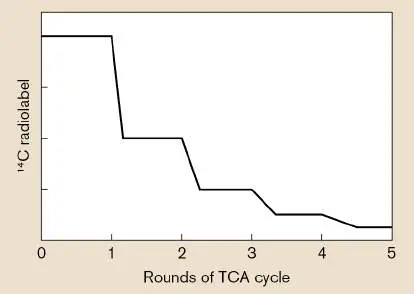
13.12 The thermophilic bacteria Thermus species grow in deep-sea hydrothermal vents at 80°C. It was proposed that they metabolize formate to bicarbonate ion and hydrogen gas: HCOO − + H O → HCO − + H
2 3 2
But the standard Δ G °′ is near zero (−2.6 kJ/mol). Under actual conditions, do you think the reaction yields energy? Assume concentrations of 150 mM for formate, 20 mM for bicarbonate ion, and 10 mM for hydrogen gas.
ANSWER: The ability to gain energy from formate will depend on the temperature and the concentrations of reactants and products. Remember that [H 2 O] equals 1. Consider the following equation: Δ G = Δ G °′ + 2.303 RT log([products]/[reactants]) = −2.6 kJ/mol + 2.303 × [8.315 × 10 −3 kJ/(mol · K)] × (273 K + 80 K) × log([HCO −][H]/[HCO −
3 2 2
][H 2 O]) = −2.6 kJ/mol + 6.760 kJ/mol × log[(0.02 M × 0.01 M)/0.15 M] = −22 kJ/mol The Δ G value is small, but it is enough to drive growth of some species of Thermus. Note that this
simplified treatment omits the role of gas formation. (Data are based on Yun Jae Kim et al. 2010. Nature 467 :352.)
CHAPTER 14
14.1 Pseudomonas aeruginosa, a cause of pneumonia in cystic fibrosis patients, oxidizes NADH with nitrate (NO −)
3
to nitrite (NO −) at neutral pH. What is the value of E °′?
2
ANSWER: To calculate the reduction potential E °′: NADH + H + + NO − → NAD + + NO − + H O
3 2 2
E °′ = 320 mV + 420 mV = 740 mV
14.2 Could a bacterium obtain energy from succinate as an electron donor with nitrate (NO −) as an electron
3
acceptor? Explain.
ANSWER: For nitrate reduction: Succinate + NO − → fumarate + NO − + H O
3 2 2
E °′ = −33 mV + 420 mV = 387 mV Although succinate is a relatively poor electron donor, nitrate is a strong electron acceptor. This reaction should provide energy for bacterial metabolism.
14.3 Use Table 14.1 to write the chemical reaction used by cable bacteria. What is its standard reduction potential? Explain why electrons must travel such a long distance within the bacterial cable.
ANSWER: The equation for sulfide oxidation performed by cable bacteria combines two half reactions from Table 14.1, those of sulfide oxidation and of water formation: 2O + 8e − + 8H + → 4H O E °′ = +820
2 2
mV H S + 4H O → SO 2− + E °′ = −(−220
2 2 4
− + mV) 8e + 10H H S + 2O → SO 2− + 2H +
2 2 4
E °′ = +1,040 mV The reason that electrons must flow over such a distance is that the reduced substrate, sulfide, is buried underneath millimeters or centimeters of sediment in which the oxygen has been depleted by respiring organisms. Thus, in order to conserve energy from the reaction, the bacteria must retain the electrons, avoiding their dissipation until they reach the upper portion of the bacterial cable, where enzymes can transfer them to oxygen. Enzymes couple the energy-yielding reactions to energy- spending reactions of the cell.
14.4 What do you think happens to Δψ as the cell’s external pH increases or decreases? What could happen to the Δ p of bacteria that are swallowed and enter the extremely acidic stomach?
ANSWER: As external pH changes, ΔpH increases or decreases, affecting the magnitude of Δ p. As enteric bacteria enter the stomach, they encounter pH values (pH 1.5–3.0) below their growth range (pH 5.0–9.0). At first, the cell’s transmembrane ΔpH may be very large, as the cell tries to maintain its cytoplasmic pH above 5.0, the limit for viability. But because the cell no longer grows, it loses its energy supply and can no longer spend energy to maintain ΔpH. One way to maintain cytoplasmic pH homeostasis is to reverse the electrical potential Δψ (inside positive) so as to drive out some H + and maintain a small ΔpH. Oppositely directed ΔpH and Δψ enable the cell to keep cytoplasmic pH high enough to survive when external pH is extremely low. On the other hand, when the external pH is raised by pancreatic secretions (alkaline), the cell needs to compensate by inverting its ΔpH and maintaining a relatively large Δψ.
14.5 How could a simple experiment provide evidence that a proton pump in the bacterial cell membrane drives efflux of antibiotics such as tetracycline?
ANSWER: Test the ability of the bacteria to form colonies on media buffered at a range of pH values.
At lower pH, the ΔpH is increased, and thus a larger Δ p is available to pump antibiotics out of the cell. At a higher pH, however, the ΔpH is inverted and actually subtracts from Δ p. Thus, we expect the bacteria to resist greater drug concentrations at low pH than at high pH.
14.6 Suppose that de-energized cells of E. coli (Δ p = 0) with an internal pH of 7.6 are placed in a solution at pH 6. What do you predict will happen to the cell’s flagella? What does this effect demonstrate about the function of Δ p?
ANSWER: The flagella will rotate, driven solely by the ΔpH component of Δ p. This result is consistent with the hypothesis that the transmembrane proton potential Δ p drives flagellar rotation.
14.7 In Figure 14.14, what is the advantage of the oxidoreductase transferring electrons to a pool of mobile quinones, which then reduce the terminal reductase (cytochrome complex)? Why does each oxidoreductase not interact directly with a cytochrome complex?
ANSWER: The mobile quinone pool connects diverse electron donors with diverse electron acceptors. If each oxidoreductase had to interact specifically with a different terminal oxidase, the pathways of electron transport would be limited; for example, NADH might donate electrons only to O 2, whereas succinate might donate electrons only to nitrate. Instead, all potential electron donors can be coupled with all potential acceptors.
14.8 In Figure 14.14, why are most electron transport proteins fixed within the cell membrane? What would happen if they “got loose” in aqueous solution?
ANSWER: If the electron transport proteins came away from the membrane into aqueous solution, they could carry their energized electrons back into the cytoplasm or lose them outside the cell. In either case, they could no longer convert the flow of electrons into a proton gradient.
14.9 Would E. coli be able to grow in the presence of an uncoupler that eliminates the proton potential supporting ATP synthesis?
ANSWER: Yes. E. coli can grow with the proton gradient eliminated, but only with a rich supply of nutrients for substrate phosphorylation to generate ATP (for example, from glycolysis). In addition, the external pH and salt levels must be maintained close to those of the cytoplasm, to minimize the need for ion transport.
14.10 The scheme for uranium removal requires injection of acetate under highly anoxic conditions, with less than 1 part per million (ppm) dissolved oxygen. Why must the acetate be anoxic?
ANSWER: Oxygen is the strongest terminal electron acceptor. If O 2 is present, bacteria will use it preferentially (instead of U 6+) to oxidize the acetate to CO 2.
14.11 What conditions might favor electron transfer by pili versus that by electron shuttles?
ANSWER: Pili would be favored when the bacteria have a medium free of obstacles between the donor bacterium and the electron acceptor. The bacterium could then extend pili to reach the target. Electron shuttles would be favored where a matrix obstructs extension of pili but allows diffusion of shuttle molecules. The disadvantage of the shuttle molecule is that it may be lost in the medium, whereas the pilus may be retracted by the donor bacterium.
14.12 An alternative mechanism for a fuel cell involves the use of a bacterium that receives electrons from an electrode instead of donating electrons. How might this work?
ANSWER: The bacteria would be aerobes that donate electrons to oxygen. They could form a biofilm on the cathode and receive electrons, then donate them to oxygen and form water. An example is that of cable bacteria, which normally oxidize sulfides and reduce oxygen. Cable bacteria are found in some marine benthic fuel cells. In the fuel cell, cable bacteria reduce oxygen with electrons received from the electrode.
14.13 Use Figures 14.14 and 14.15 to propose a pathway for reverse electron flow in an organism that spends ATP from fermentation to form NADH. Draw a diagram of the pathway.
ANSWER: In the ETS shown in Figures 14.14 and 14.15, a proton potential Δ p would be generated by ATP synthase running in reverse as it spent ATP to pump protons out of the cell. The Δ p would drive a cytochrome oxidase complex in reverse to transfer electrons from an electron donor onto quinones, forming quinols (Fig. 14.11D). The quinols would transfer electrons to an NDH complex, using energy from proton influx to reduce NAD + to NADH.
14.14 Hydrogen gas is so light that it rapidly escapes from Earth. Where does all the hydrogen come from to be used for hydrogenotrophy and methanogenesis?
ANSWER: Hydrogen is released from organic substrates as a by-product of fermentation. It may seem surprising that organisms would readily excrete quantities of energy-rich H 2, but in the
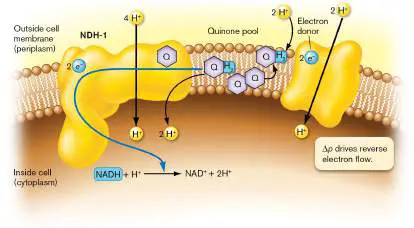
absence of a good electron acceptor (or the enzymes to utilize electron acceptors), hydrogen may be just another waste product. Hydrogen gas trapped underground supports large communities of methanogens and hydrogenotrophs. The human colonic bacteria generate so much hydrogen that all parts of the body show traces of hydrogen gas.
14.15 Suppose you discover bacteria that require a high concentration of Fe 2+ for photosynthesis. Can you hypothesize what the role of Fe 2+ might be? How would you test your hypothesis?
ANSWER: The organism uses reduced iron as an electron donor for its photosystem (Fe 2+ → Fe 3+). To test this hypothesis, illuminate and culture the organism on a defined concentration of Fe 2+. Measure the amount of iron oxidized and the amount of carbon fixed into biomass; if the Fe 2+ is an electron donor for the photosystem, the two numbers should show a linear correlation.
CHAPTER 15
15.1 To run the TCA cycle and glycolysis in reverse, does a cell use the same enzymes or different ones? Explain why some enzymes might be used in both directions, whereas other steps require different enzymes for catabolic and anabolic directions.
ANSWER: Most enzymes are capable of catalyzing a reaction in either direction, depending on the relative amounts of substrates and products and the available energy. In glycolysis and the TCA cycle, many individual steps of catalysis involve very small energy transitions, such as the interconversion of glucose 6-phosphate with fructose 6-phosphate. The direction of such reactions may be determined by the relative concentrations of substrates and products. (The contribution of reactant concentrations to free energy change Δ G is discussed in Chapter 13.) However, certain key steps of catabolism require a different enzyme for reversal, regulated by conditions that require catabolism or biosynthesis, respectively. For example, the catabolic enzyme phosphofructokinase phosphorylates fructose 6-phosphate to fructose 1,6- phosphate, spending ATP. The reversal of this key step requires fructose 1,6-bisphosphatase. These two enzymes are regulated by metabolites that
signal whether the cell has a greater need for energy or for biosynthesis.
15.2 Speculate on why Rubisco catalyzes a competing reaction with oxygen. Why might researchers be unsuccessful in attempting to engineer a Rubisco molecule that lacks the ability to catalyze this reaction?
ANSWER: The oxygenation reaction might have an essential function in regulation of metabolism. For example, it might help prevent excessive reduction of cell components or fixation of too much carbon to be used in biosynthesis. Given the universal existence of the oxygenation reaction in bacterial and chloroplast Rubiscos, it seems unlikely that oxygenation serves no purpose. For this reason, attempts to engineer Rubisco that cannot catalyze oxygenation may not succeed.
15.3 Why does ribulose 1,5-bisphosphate have to contain two phosphoryl groups, whereas the other intermediates of the Calvin cycle contain only one?
ANSWER: Only ribulose 1,5-bisphosphate needs to split into two equivalent molecules (3- phosphoglycerate). Each of the two products needs to have its own phosphoryl group as a tag for the enzymes to recognize it within the cycle.
15.4 Which catabolic pathway (see Chapter 13) includes some of the same sugar-phosphate intermediates that the Calvin cycle has? What might these intermediates in common suggest about the evolution of the two pathways?
ANSWER: The pentose phosphate pathway includes ribulose 5-phosphate, erythrose 4-phosphate, and sedoheptulose 7-phosphate in a similar series of carbon exchanges. Perhaps the pentose phosphate pathway and the Calvin cycle pathway evolved from a common amphibolic pathway of sugar consumption and biosynthesis. Alternatively, the one pathway evolved earlier, and then the sugar intermediates were available for evolution of the second pathway.
15.5 For a given species, uniform thickness of a cell membrane requires uniform chain length of its fatty acids. How do you think chain length may be regulated?
ANSWER: One way to regulate chain length might be that the enzyme fits only a limited length of chain. In E. coli, the chain length of a growing fatty acid appears to be limited by beta-ketoacyl-ACP synthase, which binds only precursor acyl-ACPs shorter than 18 carbons. Thus, only carbon chains of up to 18 carbons are synthesized. An alternative way to limit chain length might be for another enzyme to cleave carbons that extend out too far for the fatty acyl group to fit in a membrane.
15.6 Suggest two reasons why transamination is advantageous to cells.
ANSWER: Ammonia is toxic to cells. Transamination enables cells to store amine groups in nontoxic form,
readily available for biosynthesis. The availability of multiple enzymes of transamination from different amino acids enables cells to quickly recycle existing resources into the amino acids most needed by the cell in a given environment. For example, if a sudden supply of glutamine appears, cells can immediately distribute its amines into all 20 amino acids.
15.7 Which energy carriers (and how many) are needed to make arginine from 2-oxoglutarate?
ANSWER: Arginine biosynthesis requires three ATP molecules and three NADPH molecules (including two for converting two molecules of 2-oxoglutarate to glutamate). An additional ATP is spent converting acetate to acetyl-CoA.
15.8 Why are purines synthesized onto phosphoribosyl diphosphate (PRPP)?
ANSWER: Purines are highly hydrophobic, insoluble in the cytoplasm. The PRPP component has negative charges and is soluble in water. PRPP solubilizes the attached purine, enabling synthesis to occur in the cytoplasm, where the purines are needed to make RNA and DNA.
15.9 Why are the ribosyl nucleotides synthesized first and then converted to deoxyribonucleotides as necessary? What does this order suggest about the evolution of nucleic acids?
ANSWER: Ribonucleic acid is believed to be the original chromosomal material of cells. Cells evolved to synthesize RNA first; then later, as DNA was used, pathways evolved to synthesize it by modification of RNA, which the cell already had the ability to make.
CHAPTER 16
16.1 Why do the lipid components of food experience relatively little breakdown during anaerobic fermentation?
ANSWER: Lipids are highly reduced molecules, largely hydrocarbon with relatively low oxidizing potential. Thus, lipids require a terminal electron acceptor such as oxygen for catabolism. Lipids cannot undergo as many intramolecular redox reactions as do sugars, which readily generate energy through anaerobic fermentation.
16.2 Why does oxygen allow excessive breakdown of food, compared with anaerobic processes?
ANSWER: Oxygen functions as the terminal electron acceptor for the complete breakdown of all kinds of organic molecules yielding water and CO 2. Anaerobic processes, such as yogurt fermentation, lack oxygen or alternative electron acceptors that would support the further breakdown of metabolic products. Thus, fermented foods retain relatively high-energy organic molecules for the human consumer.
16.3 In an outbreak of listeriosis from unpasteurized cheese, only the refrigerated cheeses were found to cause disease. Why would this be the case?
ANSWER: In the cheeses kept at room temperature, other naturally occurring bacteria outgrew the
pathogenic Listeria, whereas in the refrigerator only the Listeria could grow. (Note, however, that many other potential pathogens, such as Salmonella, are inhibited by refrigeration.)
16.4 Cow’s milk contains 4% lipid (butterfat). What happens to the lipid during cheese production?
ANSWER: Lipids undergo little catabolism, because the fermentation conditions are anaerobic. During coagulation, lipid droplets become trapped in the network of denatured protein and are largely retained in the bulk of the cheese. “Low-fat” cheeses are made from skim milk, which eliminates the lipids before fermentation.
16.5 In traditional fermented foods, without a pure starter culture, how could someone control the kind of fermentation that occurs?
ANSWER: The fermentation can be controlled by introduction of a crude starter culture obtained from a previous batch of the food product or from a natural source of a particular microbe; for example, rice straw is a source of Bacillus natto for natto production. The fermentation type can be manipulated by the addition of factors, such as brine, that retard growth of all but a few strains. In pidan, for example, the high concentration of sodium hydroxide limits bacterial growth to alkali- tolerant strains of Bacillus.
16.6 Compare and contrast the role of fermenting organisms in the production of cheese and bread.
ANSWER: In cheese production, fermentation causes major biochemical changes in the food, such as the buildup of acids and the breakdown of proteins to smaller peptides and amino acids. Minor by- products, such as methanethiols and esters, accumulate to levels that confer flavors. In yeast bread, by contrast, the only significant product of fermentation is the carbon dioxide that leavens the dough. The small amount of ethanol produced evaporates during cooking. A form of bread in which extended fermentation does generate flavor is injera, the dough of which ferments for 3 days.
16.7 Compare and contrast the role of low-concentration by-products in the production of cheese and beer.
ANSWER: In both cheese and beer, minor by-products such as esters contribute flavor. Oxidation of various by-products can lead to off-flavors. In cheese, however, the exclusion of oxygen usually prevents off-flavors. In beer, the yeast requires a low level of oxygen; thus, significant amounts of acetaldehyde and diacetyl are produced and must be eliminated by a secondary fermentation.
16.8 Why would bacteria convert trimethylamine oxide (TMAO) to trimethylamine? Would this kind of spoilage be prevented by exclusion of oxygen?
ANSWER: TMAO acts as a terminal electron acceptor; that is, an alternative to oxygen for anaerobic respiration, as discussed in Chapter 14. Exclusion of oxygen inhibits only aerobic bacteria; TMAO respirers continue to grow and can spoil the fish.
16.9 Is it possible for physical or chemical preservation methods to completely eliminate microbes from food? Explain.
ANSWER: Preservation methods either slow microbial growth or induce microbial death. Microbial death follows a negative exponential curve, as discussed in Chapter 5. In theory, the exponential curve never reaches zero, so total exclusion of microbes is impossible. In practice, there is a high probability of totally eliminating microbes if the treatment time extends several “half-lives” beyond the time at which microbial concentration declines to less than one per total volume.
16.10 Why would different industrial strains or species be used to express different kinds of cloned products?
ANSWER: Different industrial strains have biochemical systems that favor different products. Some fungi naturally possess the highly complex pathways to generate antibiotics, as well as regulatory timing to turn on these pathways after the culture has grown to high population density. On the other hand, bacteria such as Bacillus subtilis are the most
genetically tractable and predictable in their growth cycles and the easiest to manipulate to express recombinant products such as human genes.
16.11 What might be the relative advantages and limitations of a live, attenuated virus vaccine, as compared with a messenger RNA vaccine?
ANSWER: A vaccine made from a live, attenuated virus might have the advantage of providing a wider range of diverse antigens than an mRNA vaccine, which provides only one antigenic peptide. However, an mRNA vaccine produces the safer product, under stringent control, with no chance of mutation into an infective virus as in the live, attenuated virus vaccine.
16.12 Why do you think the SIN mutation is important in the lentivector, even though the integrated viral sequence lacks all the genes for virus replication (provided on the original plasmids)?
ANSWER: The human cells containing the integrated lentivector are exposed to other retroviruses, including endogenous retroviruses encoded and expressed by the native human genome. Although highly unlikely, it is possible that a reverse transcriptase from another virus could transcribe the lentivector and recombine with it to constitute an aberrant virus. This unlikely event is made impossible by the self-inactivating (SIN) deletion of the LTR promoter.
CHAPTER 17
17.1 What would have happened to life on Earth if the Sun were of a different stellar class, substantially hotter or colder than it is?
ANSWER: If the Sun were hotter, too much ultraviolet and gamma radiation would reach Earth, breaking chemical bonds of living organisms so rapidly that life could not be sustained. If the Sun were colder, too little radiation with sufficient energy would be available to drive photosynthesis. In either case, life as we know it could not have evolved on Earth.
17.2 In Figure 17.7A, why does the shallow-ocean CO 2 show a positive value of δ 13 C?
ANSWER: The shallow ocean has extremely high productivity of photosynthesis, which rapidly fixes dissolved CO 2 into biomass. Thus, the CO 2 that remains in the water may actually show enrichment for 13 C resulting from the preferential fixation of 12 C.
17.3 Evolution by natural selection is based on competition, yet the earliest fossil life shows organized structures such as a stromatolite built by cooperating cells. How could this be explained?
ANSWER: Individual microbes compete for resources in a given environment. Part of one’s environment consists of other microbes—which may provide
resources or favorable conditions. In the stromatolite, the adherence of cells to each other and to the substrate could help maintain their position in a favorable part of the sea, at an elevation with access to light. In addition, adherent microbes might resist predation. We cannot know the biochemistry of cells from ancient fossils, but some cells could have evolved specialized metabolism that led to cross-feeding. In modern stromatolites, phototrophic bacteria photolyze H 2 S to sulfate, which is then reduced by lower layers of sulfate-reducing bacteria. Overall, the cells of the stromatolite might outcompete cells that grow individually.
17.4 Outline the strengths and limitations of the prebiotic soup model and the RNA world model of the origin of living cells. Which aspects of living cells does each model explain?
ANSWER: The two models are complementary. Each explains aspects of modern cells not addressed by other models. The prebiotic soup model accounts for the major classes of compounds used by cells, such as nucleosides, TCA cycle intermediates, amino acids, and fatty acids. It also suggests the origin of membranes as soap bubble–like micelles. It does not, however, account for the evolution of metabolic pathways and replication of genetic information. The RNA world accounts for the central role of RNA in
living cells; of all molecular classes, RNA and ribonucleotides probably serve the widest range of functions as information carriers, agents of catalysis, and genetic regulators. Most RNA-world models do not address the origin of membranes.
17.5 Suppose a NASA rover discovered living organisms on Mars. How might such a find shed light on the origin and evolution of life on Earth?
ANSWER: If life on Mars showed a completely different basis than that of Earth—for example, it was based on silicon polymers instead of carbon— such a find would support the view that life originated independently on each planet, rather than traveling from one planet to the other, or that both planets were seeded from somewhere else. If life on Mars were based on similar macromolecules, perhaps even showing the same genetic code, this finding would support the view that life arose on Mars first or that both planets were seeded from the same source.
17.6 What kinds of DNA sequence changes have no effect on gene function? (Hint: Refer to the table of the genetic code, Figure 8.12.)
ANSWER: Base substitutions that do not change the amino acid specified by the codon (silent mutations) have no immediate effect on gene function. For example, CUA → CUG still encodes leucine. In addition, a majority of the amino acids in any given
protein can be replaced by an amino acid of similar form (for example, leucine → valine) without significantly affecting gene function. Nevertheless, even silent mutations change the DNA sequence in ways that may enable later substitution of amino acids that alter the function of the product. Silent mutations can substitute rare codons that decrease the level of expression of the protein product.
17.7 What are the major sources of error and uncertainty in constructing phylogenetic trees?
ANSWER: Phylogenetic trees are affected by variability in the number of substitutions, or rate of mutation in different strains. The tree is distorted by errors in sequence alignment and by systematic errors due to failure of the fundamental assumptions of the molecular clock. These assumptions include the constant rate of mutation for all branches, constant generation time, and true orthology of the gene chosen (that is, the encoded product has the same function and hence the same degree of selection pressure in all taxa under consideration).
17.8 What are the limits of evidence for horizontal gene transfer in ancestral genomes? What alternative interpretation might be offered?
ANSWER: Horizontal gene transfer is inferred from the appearance of genes in clade A that are absent from other members of the clade but present in
clade B. The degree of similarity between genes in the two clades, however, must be high enough to exclude the possibility that the genes in question were retained from a common ancestor of the two clades but lost from other members of clade A. This possibility is difficult to exclude in the case of deep- branching clades, where all genes have had a long time to diverge. For example, the large number of archaeal genes present in deep-branching thermophilic bacteria such as Thermotoga may include some inherited from the last common ancestor or they may represent archaeal genes that were horizontally transferred to bacteria sharing the high-temperature habitat.
17.9 In the fitness competition between cells labeled by YFP and CFP, how can we rule out fitness differences associated with the bacterial expression of the two different fluorescent proteins?
ANSWER: For each experiment, conduct two classes of replicates, for which the YFP and CFP labels are reversed; that is, in one case the resistant strain has the YFP label, and in the other case the resistant strain has the CFP label. Fitness differences between the two fluorescent proteins should then cancel each other. This model assumes no interaction between fluorophore effects and the antibiotic resistance phenotype.
17.10 In an evolution experiment, some clones require nutrient molecules produced by other clones. How might the mechanisms of evolution favor the emergence of dependent clones?
ANSWER: The early mutations that arise under selection pressure confer imperfect phenotypes with deleterious side effects, such as excretion of valuable nutrients. Thus, an evolving population is likely to increase the excreted nutrients available in the medium, such as acetate and citrate. The increase of nutrients provides opportunities for new clones to achieve relative fitness within a population that provides the nutrients.
17.11 Besides mitochondria and chloroplasts, what other kinds of entities within cells might have evolved from endosymbionts?
ANSWER: Some of the large “megaplasmids” found in bacteria and protists are as large as genomic chromosomes and contain numerous housekeeping genes. These megaplasmids may have originated as endosymbiotic cells that lost all their membranes through reductive evolution. Similarly, some of the giant viruses, such as mimivirus and smallpox virus, as well as phages such as T4, possess a wide spectrum of housekeeping genes. These viruses may have originated as cellular parasites that underwent reductive evolution.
CHAPTER 18
18.1 What taxonomic questions are raised by the apparent high rate of gene transfer between archaea and thermophilic bacteria?
ANSWER: If gene transfer results in a species containing a quarter of its genes from organisms outside its domain, such a mosaic genome raises questions of how to define the species and the domain. How can a species be defined if its genome contains large portions from distantly related sources? Other interesting questions relate to the means of gene transfer. How do such distantly related organisms as bacteria and archaea maintain a compatible mechanism of gene transfer?
18.2 Which taxonomic groups in Table 18.1 stain Gram-positive, and which stain Gram-negative? Which group contains both Gram-positive and Gram-negative species? For which groups is the Gram stain undefined, and why?
ANSWER: Most Firmicutes stain Gram-positive. These bacteria have a relatively thick cell wall that retains the stain. Actinobacteria also have a thick cell wall, but some have a waxy coat that excludes the stain. The Proteobacteria, Nitrospirae, Bacteroidetes, Verrucomicrobia, and Chlorobi groups stain Gram- negative. The Cyanobacteria have an outer membrane and are considered Gram-negative, although their cell wall is thick. The Deinococcus-
Thermus phylum includes both Gram-positive and Gram-negative members. For Chlamydiae, the Gram stain is irrelevant because they lack the cell wall that retains the stain. For Spirochetes, many species are too narrow to observe the stain under light microscopy.
18.3 Which groups of bacterial species share common structure and physiology within the group? Which groups show extreme structural and physiological diversity?
ANSWER: Cyanobacteria all carry out oxygenic photosynthesis within thylakoid membranes. Their overall cell structure and organization, however, take diverse forms. All spirochetes are a sheathed flexible spiral with internal flagella; most share anaerobic or facultative heterotrophy. Species of the Chlamydiae and Planctomycetes groups each share general structural features. Other groups, particularly Firmicutes and Actinobacteria, show considerable diversity of form and physiology. The Proteobacteria display more extreme diversity of metabolism than any other division of bacteria.
18.4 What are the relative advantages and disadvantages of propagation by hormogonia compared with propagation by akinetes?
ANSWER: Hormogonia are motile, and thus capable of active chemotaxis toward a more favorable environment. On the other hand, hormogonia have active metabolism that requires nutrition; if the
environment lacks nutrients, the hormogonia will die. Akinete cells can persist until environmental conditions improve, but they cannot actively seek out a new location.
18.5 What are the relative advantages and disadvantages of the different strategies for maintaining separation of nitrogen fixation and photosynthesis?
ANSWER: Temporal separation has the advantage that all cells possess the ability to perform both nitrogen fixation and photosynthesis. On the other hand, it eliminates the ability of a chain of cells to conduct both processes simultaneously—the benefit of heterocysts. Heterocysts face the problem of operating in close proximity to photosynthetic cells generating toxic oxygen. This problem may be solved by symbiosis with respiring bacteria. Globular clusters of cells can bury their nitrogen fixers within the cluster; this arrangement effectively excludes oxygen, but it may lack flexibility during environmental change. Endosymbiotic nitrogen fixation within a respiring eukaryote is probably the most effective strategy of all, because the host provides oxygen-removing proteins such as leghemoglobin. Endosymbiosis, however, requires the presence of an appropriate host organism.
18.6 Why would Streptomyces produce antibiotics targeting other bacteria?
ANSWER: Streptomyces species may produce antibiotics to curb the growth of bacterial competitors with smaller genomes and faster rates of reproduction. The lysed cells release nutrients that feed growing mycelia of Streptomyces.
18.7 Why might genes for the proteorhodopsin light-powered proton pump be more likely to transfer horizontally than the genes for bacteriochlorophyll-based photosystems PS I and PS II?
ANSWER: Proteorhodopsin requires only the one gene encoding the pump, plus one or two genes to produce retinal. A relatively small amount of sequence has to be transferred, and the encoded products generate proton potential on their own, without requiring interaction with recipient enzymes. By contrast, PS I and PS II each involves multiple electron carriers that must function together and interact with the recipient electron transport chain.
18.8 Can you hypothesize a mechanism for migration of the daughter nucleoid of Hyphomicrobium through the stalk to the daughter cell? For possibilities, see Chapter 3 and consider the various molecular mechanisms of cell division and shape formation.
ANSWER: One mechanism might involve polar localization similar to that seen in Caulobacter. A DNA-binding protein might pull the nucleoid through the stalk until it binds to a polar localization protein at the end of the daughter cell. Another mechanism
might involve formation of a scaffold of cytoskeletal proteins similar to FtsZ or MreB. The cytoskeleton could act as a track for DNA movement through the stalk, perhaps powered by ATP hydrolysis.
18.9 Why would an herbicide resistance gene be desirable in an agricultural plant? What long-term problems might be caused by microbial transfer of herbicide resistance genes into plant genomes?
ANSWER: Introduction of an herbicide resistance gene allows application of higher amounts of herbicide to crops in order to control growth of weeds. But the higher concentrations of herbicide may also have greater side effects on animals and on human consumers of the crop. In the long run, the herbicide resistance gene is likely to escape into weed plants through natural gene transfer mechanisms. Thus, eventually the weeds may require still higher concentrations of herbicide. While the costs versus benefits of new gene modifications remain poorly understood, it must be recognized that all modern crops today are the product of many generations of genetic manipulation.
18.10 Why do you think it took many years of study to realize that Escherichia coli and other Proteobacteria can grow as a biofilm?
ANSWER: E. coli and its relatives grow exceptionally well in liquid culture. Liquid culture is attractive because it enables quantitative measurement of
defined aliquots of a microbial population. However, repeated subculturing in liquid medium selects for planktonic (nonbiofilm) cells. Eventually, the biofilm- forming property may be lost if nonbiofilm mutants evolve to grow faster than the original genotype in liquid medium.
18.11 Compare and contrast the formation of firmicute endospores, actinomycete arthrospores, and myxococcal myxospores.
ANSWER: An endospore forms as the daughter product (forespore) of a single cell. Within the same cell, endospore development is supported by the mother cell, which disintegrates after release of the endospore. Endospores have tough coatings of calcium dipicolinate; they are heat resistant. By contrast, arthrospores and myxospores are less durable and are not heat resistant, although they can persist in the environment for an extended period. Arthrospores form through binary fission of actinomycete filaments. Myxospores are formed by a multicellular fruiting body. In all three cases, spore formation can be induced by depletion of nutrients, and the spore-producing entity is left behind to die.
CHAPTER 19
19.1 Suppose that two deeply diverging clades each show a wide range of growth temperature. What does this suggest about the evolution of thermophily or psychrophily?
ANSWER: The two clades diverged before temperature adaptation occurred. Adaptations to high or low temperature must have evolved independently in the two clades.
19.2 What might be the advantages of archaellar motility for a hyperthermophile living in a thermal spring or in a black smoker vent? What would be the advantages of growth in a biofilm?
ANSWER: Archaellar motility enables isolated cells to detect a new nutrient source or an appropriate temperature range and approach it through chemotaxis. Growth in a biofilm attached to a substrate prevents the microbes from floating away from the nutrient source or from being carried away in the flow from the vent.
19.3 What problem with cell biochemistry is faced by acidophiles that conduct heterotrophic metabolism?
ANSWER: Heterotrophic metabolism generates fermentation products such as acetate and lactate, which act as permeant acids. Permeant acids become protonated outside the cell, at low pH; the protonated forms then permeate the membrane,
returning into the cell. Given the high transmembrane pH difference maintained by Sulfolobus, one would expect even small traces of fermentation acids to cross the membrane in the protonated form, and then dissociate and accumulate to toxic levels of organic acids. It is unknown how Sulfolobus solves this problem.
19.4 What hypotheses might be proposed about archaeal evolution if viruses of mesophilic archaea are found to have RNA genomes? What if, instead, all archaeal viruses have DNA genomes only?
ANSWER: If mesophilic viruses show RNA genomes but thermophiles do not, then it is likely that only double-stranded DNA is sufficiently stable for viruses to persist in the environment of hyperthermophiles. Finding only double-stranded DNA viruses throughout the archaea would suggest that all archaeal viruses evolved from viruses infecting a common ancestral cell that was a thermophile. The latter hypothesis would require supporting evidence from archaeal cell physiology and phylogeny.
19.5 Anoxic soil contains bacteria and methanogens. What will happen to the microbial populations when the soil is tilled and aerated?
ANSWER: When soil is broken up by tilling, the oxic and anoxic layers become mixed. Overall diversity of the microbial community decreases. The presence of oxygen will limit growth of methanogens and
anaerobic bacteria. There will likely be an increase of aerobic or facultative species such as Actinobacteria and Bacillus species.
19.6 What do the multiple metal requirements suggest about how and where the early methanogens evolved?
ANSWER: The requirement for so many different metals may suggest that methanogens evolved in habitats such as geothermal vents, where superheated water carries up high concentrations of dissolved metal ions.
19.7 Compare and contrast the metabolic options available for Pyrococcus and for the TACK organism Sulfolobus.
ANSWER: Sulfolobus catabolizes sugars and amino acids aerobically, using O 2 as the terminal electron acceptor. Pyrococcus abyssi catabolizes sugars and amino acids anaerobically, using S 0 as the terminal electron acceptor. Pyrococcus abyssi can also reduce sulfur lithotrophically with H 2 to form H 2 S. By contrast, Sulfolobus uses molecular oxygen (O 2) to oxidize sulfur lithotrophically, from S 2 to S 0, SO
3
2−, and ultimately SO 2−.
4 19.8 Compare and contrast sulfur metabolism in Pyrococcus and in Ferroplasma.
ANSWER: Pyrococcus species reduce S 0 with hydrogens from organic substrates, forming HS −
and H 2 S. Ferroplasma species oxidize sulfur in the form of FeS (using oxidant Fe 3+), forming sulfuric
2
acid. The result is extreme acidification of their environment.
CHAPTER 20
20.1 How could you demonstrate that eukaryotic flagella move with a whiplike motion instead of rotary motion? What experiment might you conduct?
ANSWER: In order to track the motion of eukaryotic flagella, you could raise an antibody against a protein subunit of the flagellum. Attach the antibody to a fluorophore. Combine the antibody-fluorophore with a suspension of flagellated protists, at a concentration ratio that allows approximately one fluorescent antibody to attach to a flagellum. Now it should be possible to observe and video-record protists with individual labeled flagella and trace their whiplike motion.
20.2 Why would yeasts remain unicellular? What are the relative advantages and limitations of hyphae?
ANSWER: Yeasts grow in environments with sufficient dissolved nutrients to absorb from the medium. The advantage of forming hyphae is that they can penetrate solid substrates, such as soil or a host organism, and hence provide access to nutrients. On the other hand, hyphae formation limits the rate of dispersal of progeny cells. Because yeasts grow in environments where dissolved nutrients can be absorbed from the medium, they do not need to
produce hyphae and can proliferate more rapidly than mycelial fungi.
20.3 Why would some fungi avoid sexual reproduction? What are the advantages and limitations of sexual reproduction?
ANSWER: The sexual life cycle involves significant genetic and metabolic costs to the organism. Asexual reproduction enables fungi to eliminate an energy drain and produce more offspring, using fewer resources. Reductive evolution leading to loss of sexual reproduction might eliminate an energy drain and perhaps enable greater proliferation with fewer resources. On the other hand, the sexual life cycle provides a valuable means of generating diversity through genetic recombination, so that the population can respond to environmental change. Fungi reproducing asexually must rely on mutation and gene transfer by viruses and mobile sequence elements to generate genetic diversity.
20.4 What are the advantages and limitations of motile gametes, as compared to nonmotile spores?
ANSWER: Motile gametes have the advantage of rapid dispersal on their own and the potential for chemotaxis toward a food source or toward a gamete of the opposite mating type. On the other hand, motility uses up energy that could alternatively be invested in production of a greater
number of nonmotile gametes. Motile gametes are especially useful in a watery habitat but are of little use in a terrestrial habitat, where air currents or animal hosts are required for dispersal.
20.5 Compare the life cycle of an ascomycete (Fig. 20.13C ) with that of a chytridiomycete (Fig. 20.11C). How are they similar, and how do they differ?
ANSWER: Both chytridiomycetes and ascomycetes undergo alternation of generations. Each has an alternative route of an asexual cycle of mitotic cell proliferation. In the chytridiomycete asexual cycle, the diploid form (sporophyte) develops a mycelium, motile zoospores, and cysts. In the ascomycete, however, the haploid form undergoes mitotic divisions. The sexual cycles of the two fungal groups differ structurally. In the chytridiomycete, the zoosporangium forms motile zoospores that develop and release motile gametes, which fertilize each other to form motile zygotes. In the ascomycete, there are no motile forms. Instead of motile gametes, haploid hyphal antheridia undergo cytoplasmic fusion and form fruiting bodies, or asci, within which ascospores develop. The ascospores are not motile; they are carried by wind or water.
20.6 What cellular interactions can happen when an ameba phagocytoses algae?
ANSWER: If light is available, the algae may be retained as endosymbionts providing energy through photosynthesis. For example, Chlorarachnion possesses obligate chloroplast-bearing endosymbionts descended from green algae. Alternatively, the ameba may digest all but the algal chloroplast, which persists for some time, providing photosynthetic products.
20.7 What kind of habitat would favor a flagellated ameba?
ANSWER: A dilute watery habitat would favor flagella, which allow more rapid propulsion than do pseudopods. Pseudopod motility requires a solid substrate, such as debris in the sediment of a pond.
20.8 What are the relative advantages of being unicellular or multicellular?
ANSWER: Single-celled organisms require minimal nutrients to reproduce and can disperse rapidly, avoiding competition. These important advantages serve the vast majority of organisms on Earth, which are unicellular. On the other hand, a multicellular colony can work together to obtain a larger food source (by predation) and protect its cells from rapid changes in the habitat, such as change in salt concentration or pH. A multicellular organism can protect its offspring from predation, as in the case of Volvox. Cell differentiation (for example, nitrogen-
fixing heterocysts) can increase the efficiency of an organism exploiting its environment.
20.9 Compare and contrast the process of conjugation in ciliates and bacteria (see Chapter 9).
ANSWER: Conjugation in ciliates is a completely different process from conjugation in bacteria, although the function (gene transfer) is similar. In ciliates, two cells form a bridge allowing cytoplasm to flow directly between them, along with micronuclei containing chromosomes. In bacteria, a donor cell attaches to another (by pili in some cases), and then a protein complex transfers DNA across both cell envelopes, without direct cytoplasmic contact. In bacterial conjugation, DNA is transferred unidirectionally from the donor cell to the recipient, whereas in ciliates there is reciprocal exchange of DNA. A donor bacterium generally transfers only part of its genome, whereas ciliates exchange entire copies of their respective genomes.
20.10 For ciliates, what are the advantages and limitations of conjugation, as compared with gamete production?
ANSWER: The process of conjugation avoids the necessity of dissolving the intricate cell structure of the ciliate in order to form gametes that fuse or fertilize each other. On the other hand, conjugation requires two diploid organisms to find each other
and make contact for several hours, during which time feeding is suspended and the pair is vulnerable to predation.
CHAPTER 21
21.1 In many ecosystems, the products released by one organism are used as food by another. Can you think of examples of microbes whose products are used by other organisms? Recall Chapter 13.
ANSWER: One example is that in the human gut microbiome, Bifidobacterium species digest complex glycans and peptidoglycan (cell wall material). The bacteria then release cell wall peptides that modulate the host immune system and 4- aminobutanoate (GABA), a major neurotransmitter for the brain. Another example is in soil ecosystems, where fungi break down complex aromatic polymers of lignin from decomposing tree trunks. The fungal catabolism releases benzoates, aromatic molecules that are catabolized by bacteria such as Pseudomonas and Rhodococcus. These bacteria then release molecules that enrich plants. Many other examples may be cited.
21.2 When deciding how to study “active” microbiomes, what are the arguments for or against amplifying genomic DNA that encodes rRNA genes versus amplifying rRNA from functional ribosomes? Does cellular rRNA necessarily represent “active” microbes better than DNA sequence?
ANSWER: The argument for direct measurement of rRNA, instead of the DNA gene that encodes rRNA, is that ribosomes are abundant in actively growing
cells, so the detection of rRNA is more sensitive and more meaningful for microbial activity than detection of the DNA gene. However, the actual ratio of rRNA to DNA varies widely for different taxa and different growth conditions. Furthermore, microbes that are dormant at present, such as endospores, may or may not possess high numbers of ribosomes; also, dormant cells may or may not have potential for growth when conditions change. Therefore, the relationship of ribosome numbers to cell “activity” is very approximate.
21.3 How important is the “species evenness” for assessing sample diversity? For example, does it matter if a sample contains ten species at 10% of the sample each, versus a sample that contains 99% of one species plus a 1% mixture of nine species? Answer this question by considering examples of specific habitats and the possibility of environmental change.
ANSWER: The relative proportions of taxa with different metabolisms could determine the functional quality of the habitat. For example, the uppermost water of a lake should have abundant oxygenic phototrophs such as algae. Another factor to consider, however, is the likelihood of environmental change. A given sample may have a low proportion of nitrogen-fixing bacteria, but if nitrogen becomes scarce, those bacteria will be available to grow and fix nitrogen for the community.
21.4 In Figure 21.4B, how sure can we be that the ARGs showing increased abundance downstream actually came from the wastewater plant? What other experiments might strengthen this conclusion?
ANSWER: We do not know whether the ARG DNA or bacteria carrying the ARG sequences actually came from the wastewater plant. It is possible that some other effects of the effluent, such as nitrogen and phosphorus loading, led to increased abundance of indigenous bacteria that carry the ARGs in their DNA. The water chemistry near the effluent pipe should be tested, as well as the effects of chemistry change on ARG abundance. In addition, the wastewater effluent contents could be tested directly for ARG content and ARG-bearing bacteria to see whether they are the same as those found in the river downstream.
21.5 Suppose you plan to sequence a marine metagenome for the purpose of understanding carbon dioxide fixation and release, to improve our model for global climate change. Do you focus your resources on assembling as many complete genomes as possible, or do you focus on identifying all the community’s enzymes of carbon metabolism?
ANSWER: To maximize your yield of information about carbon flux, you are likely to learn more about the community as a whole by focusing on those enzymes involved in carbon metabolism. However, you will miss novel genes that were not previously
known to participate in carbon flux. If your equipment and computational resources enable genome assembly, it may be informative to learn more about the most abundant species that participate in carbon flux.
21.6 Could you design a metagenome experiment analogous to the oil plume experiment to test which kinds of human gut bacteria digest a certain food, such as hamburger meat? What follow-up experiments would be needed?
ANSWER: Experimental human subjects could be fed a vegetarian diet for several weeks, and then switched to a diet full of hamburgers. The gut metagenome could be sampled before and after the influx of hamburger. We might then observe a shift in the taxon profile to bacteria with increased capability for catabolism of fat and protein rather than plant fiber. As in the petroleum plume investigation, however, the result would provide only a correlation between diet and taxa prevalence. Additional kinds of experiments, such as isotope labeling, are needed to demonstrate functional connections between microbes and a food source.
21.7 How could you determine whether an organism actually performs the functions predicted by your analysis of its genome and transcriptome, such as metabolizing petroleum components?
ANSWER: To demonstrate microbial metabolism of a petroleum component, one approach would be to add a heavy isotope–enriched amendment to the medium of your microbial sample. This experiment requires that the microbe be capable of metabolism in the laboratory; ideally, a cultured organism. For example, 13 C-enriched cyclohexane could be provided to a cultured species of Oceanospirillales, such as Profundimonas piezophila (see Yi Cao et al. 2014. Appl. Environ. Microbiol. 80 :54). The culture medium could then be tested for the presence of 13 C-enriched degradation products, a sign of energy- yielding metabolism. Bacterial proteins could be tested for 13 C enrichment, a sign of biosynthetic incorporation of the cyclohexane carbons.
21.8 From Chapters 13–15, give examples of microbial metabolism that fit patterns of assimilation and dissimilation.
ANSWER: Microbes can assimilate carbon either by reducing carbon dioxide or by oxidizing methane, and they can dissimilate carbon by fermentation and respiration. Nitrogen is assimilated by N 2 fixation and by incorporation of NH + into glutamine and
4
glutamate. Nitrogen is dissimilated by deamination of amino acids and by lithotrophic oxidation.
21.9 How do you think symbiotic rhizobia reproduce? Why do bacteroids develop if they cannot proliferate?
ANSWER: Various answers have been proposed. Not all of the invading bacteria become bacteroids; some continue to undergo cell division, particularly within senescing tissues of the plant. These bacteria benefit from plant growth, which is sustained by the bacteroids whose genes they share. Alternatively, the entire plant-bacteroid system may benefit rhizobia that grow just outside the plant, in the rhizosphere.
21.10 High levels of nitrate or ammonium ion corepress the expression of Nod factors (see Fig. 21.15). What is the biological advantage of Nod regulation?
ANSWER: Nitrate and ammonium ion are the main forms of nitrogen assimilated by plants. If they are abundant in the soil, the plant does not need rhizobial symbionts to fix N 2 —a process that consumes much energy. The energy required to maintain the symbiosis comes from the plant, in the form of sugars and other nutrients; thus, it is more efficient not to have the symbiosis when fixed nitrogen is already available. Therefore, the presence of alternative nitrogen sources inhibits development of the rhizobia-legume symbiosis.
21.11 How does ruminant microbial fermentation provide food molecules that the animal host can use? How is the animal able to obtain nourishment from waste products that the microbes could not use?
ANSWER: The rumen interior is anaerobic. In the absence of oxygen as a terminal electron acceptor, microbes are forced to generate waste products in which the electrons are put back onto the electron donors (fermentation; see Chapter 13). When the short-chain fatty acid wastes enter the animal’s bloodstream, the blood is full of oxygen, which enables complete digestion to CO 2 and water.
21.12 How do you think cattle feed might be altered or supplemented to decrease methane production?
ANSWER: Several methods have been proposed to limit methanogenesis. One is to feed cattle an inhibitor of a process that methanogens (but not bacteria) require. An example would be inhibitors of sodium transport, which methanogens need to maintain a sodium potential. Another approach is to feed cattle an organic electron acceptor for H 2, such as fumarate, which bacteria use to generate short-chain fatty acids instead of methane. These approaches have been used with only partial success—not surprisingly, given the complexity of the system. The most effective method is found to be feeding cattle certain types of red seaweed (see Section 19.4). The red seaweed is metabolized by cattle and contains inhibitors of methanogenesis.
21.13 How could you design an experiment to test the hypothesis that an animal makes use of amino acids synthesized by its gut bacteria?
ANSWER: Select a type of amino acid, such as lysine, that the animal cannot synthesize and that is therefore essential to the diet of the test animal. The diet can then be altered to exclude the essential amino acid but include a nitrogen source labeled with a heavy isotope. (For a short period, the animal can grow without the added amino acid.) The animal’s gut bacteria can be tested for incorporation of the heavy isotope into their amino acids, and the host animal can be tested for protein that incorporates the heavy-isotope-labeled amino acid.
21.14 How do viruses select for increased diversity of microbial plankton?
ANSWER: Because viruses tend to infect only a narrow host range, their existence favors the evolution of a large number of different host species with highly dispersed populations. Highly dispersed populations minimize the chance of viral transmission from one host to another. Over generations, mutations that allow host microbes to “escape” viral infection will be selected for, while viral mutations that allow a virus to infect previously unsusceptible hosts will also be selected.
21.15 Design an experiment to test the hypothesis that the presence of mycorrhizae enhances plant growth in nature.
ANSWER: Such an experiment requires a control based on the natural environment, where various unknown factors may be very different from those in the laboratory. One possibility is to compare the growth of seedlings in natural soil versus sterilized natural soil. However, this experiment would not prove that fungi are the cause of enhanced growth in unsterile soil. The sterilization procedure (usually involving heat and pressure) could break down key nutrients in the soil. A follow-up experiment might be to grow the plants in the presence of a fungus inhibitor in sterilized and unsterilized soil.
21.16 Compare and contrast the processes of plant infection by rhizobia (see Section 21.3) and by fungal haustoria.
ANSWER: Both rhizobial bacteria and fungal haustoria penetrate the volume of a plant cell, but they keep the plant cell membrane intact, its invagination always surrounding the invading cell. Rhizobia establish a complex, highly regulated exchange of nutrients with the host, receiving catabolites and oxygen in exchange for ammonium, and cycling the components of amino acids. By contrast, haustoria establish one-way removal of nutrients such as sucrose, while providing no nutrients in return. Fungal pathogens weaken the structure of the host plant and decrease or halt its growth.
CHAPTER 22
22.1 Why is oxidation state important for microbes to use and cycle compounds? Cite examples based on your study of microbial metabolism (see Chapter 14).
ANSWER: Elements may be present in the environment at oxidation levels different from those needed for biomass. In the case of carbon, autotrophic microbes may fix CO 2 with substantial reduction by NADPH or other hydrogen donors, through photosynthesis or through lithotrophy. The reduced form CH 4, however, cannot be fixed directly into biomass. Instead, methane must be oxidized by methanotrophic bacteria, usually with oxygen as electron acceptor or with sulfate (SO 2−
4
) under anoxic conditions. Nitrogen gas can be assimilated only by nitrogen-fixing bacteria and archaea, with extensive reduction by NADPH. The fully reduced form NH + can be assimilated into
4
biomass by many plants and microbes. Alternatively, with oxygen present, NH + can be oxidized by
4
lithotrophs to various forms for energy, including the fully oxidized form nitrate (NO −).
3 22.2 What would happen if wastewater treatment lacked microbial predators? Why would the result be harmful?
ANSWER: Without predators, too many planktonic bacteria would remain in the wastewater after sedimentation of the sludge. The bacteria could be killed by chlorination, but the treated water would have significant BOD (biochemical oxygen demand) because the bacterial remains provide an organic carbon source for respirers.
22.3 Which kinds of biomolecules can you recall that contain nitrogen? What are the usual oxidation states for nitrogen in biological molecules?
ANSWER: Amino acids, nucleotide bases, polyamines for DNA stabilization, peptidoglycan (both amino sugar and peptide chains), and the heme derivatives of cytochromes, chlorophyll, and vitamin B 12 all include nitrogen (as do many other biochemicals). The oxidation states of nitrogen in living organisms are nearly always reduced: R–NH 2, R=NH, or R– N=R. An exception is the neurotransmitter NO (nitric oxide).
22.4 The nitrogen cycle has to be linked with the carbon cycle, as both contribute to biomass. How might the carbon cycle of an ecosystem be affected by increased input of nitrogen?
ANSWER: One hypothesis is that the injection of nitrogen into an ecosystem accelerates growth of producers (phytoplankton in the ocean or trees in a forest) and therefore facilitates net removal of CO 2
from the atmosphere. Overall, however, the additional fixed carbon ends up dissipated by consumers and decomposers.
22.5 In the laboratory, which bacterial genus would likely grow on artificial medium including NH 2 OH as the energy source: Nitrosomonas or Nitrobacter? Why?
ANSWER: Nitrosomonas is more likely to utilize NH 2 OH, because it performs the intermediate oxidation of NH 2 OH during nitrification of ammonia.
22.6 Compare and contrast the cycling of nitrogen and sulfur. How are the cycles similar? How are they different?
ANSWER: Cycling of both nitrogen and sulfur involves interconversion between different oxidation states. Most of these interconversion reactions are performed solely bacteria and archaea. Examples include nitrification of ammonia and denitrification to N 2, as well as sulfide oxidation and photolysis. In both cases, oxidation produces strong acids (HNO 3, H 2 SO 4). The major sources and sinks differ; nitrogen is obtained primarily from the atmosphere as N 2, whereas sulfur (in the form of sulfate) is at high levels in the ocean and soil. Sulfur is rarely limiting, whereas nitrogen frequently is. Sulfur participates extensively in phototrophy; nitrogen shows little involvement in phototrophy, although
phototrophy based on nitrate reduction has been observed.
22.7 Compare and contrast the cycling of nitrogen and phosphorus. How are the cycles similar? How are they different?
ANSWER: Nitrogen and phosphorus are both limiting nutrients in many ecosystems—marine, freshwater, and terrestrial. Addition of either element into an aquatic system may cause algal bloom and eutrophication. On the other hand, the two elements differ in their major sources: the atmosphere for nitrogen, and crustal rock for phosphate. Within biomass (macromolecules), nitrogen exists almost entirely in reduced form, whereas phosphorus is entirely oxidized. Phosphorus cycles through the biosphere mainly as inorganic or organic phosphates, whereas nitrogen cycles through a broad range of oxidation states, from NH 3 to NO −.
3 22.8 The size of a coronavirus particle is approximately 100 nm (0.1 μm), whereas the minimal pore size of HEPA 13 filters is about 0.3 μm. How is it possible for filters to exclude the virus?
water, leaving viruses present in smaller particles, but experiments show little evidence of coronaviruses passing the filter. It is possible that the virus loses structure and function when it dehydrates. However, other kinds of viable particles such as bacterial endospores survive complete desiccation. Others remain infective upon fomites and building surfaces. This is why epidemiological studies are necessary to assess transmission mechanisms for any given pathogen (discussed in Chapter 28).
CHAPTER 23
23.1 How can an anaerobic microorganism grow on skin or in the mouth, both of which are exposed to air?
ANSWER: Facultative organisms living in proximity to the anaerobes will deplete oxygen in the environment, especially around nooks and crannies (for example, between teeth and gums, in gingival pockets) that would ordinarily prevent anaerobes from growing. These small spaces have limited access to oxygen.
23.2 Why do many Gram-positive microbes that grow on the skin, such as Staphylococcus epidermidis, grow poorly or not at all in the gut?
ANSWER: Bile salts present in the intestine (not on the skin) easily gain access to and destroy cytoplasmic membranes of Gram-positive organisms (unless the organism possesses bile salt hydrolases). Gram-negative microbes have extra protection in the form of an outer membrane and so can survive better in the intestine.
23.3 How might you provide evidence that the intestinal microbiome communicates with the brain via the vagus nerve? Hint: The vagus nerve includes afferent nerves that send information from organs to the brain and efferent nerves that regulate gastrointestinal secretion and gut endocrine activity.
ANSWER: One way to determine whether gut microbiota communicate with the brain via the vagus nerve is to selectively cut the afferent parts of the vagus nerve that enervate the intestine in both gnotobiotic mice and colonized mice. A look at gene expression in the mouse brains would reveal differences between colonized mice that were and were not vagotomized but not between similarly treated gnotobiotic mice.
23.4 Figure 23.21 shows how a neutrophil extracellular trap can ensnare a nearby pathogen. Which bacterial structure might blunt the microbicidal effect of NETs?
ANSWER: Bacterial capsules can prevent direct contact between the NET and the cell.
23.5 Why do defensins have to be so small? Do defensins kill normal microbiota?
ANSWER: Defensins need to be small so that they can penetrate the outer membrane of Gram- negative organisms and the thick maze of peptidoglycan comprising the Gram-positive cell wall. Defensins do kill normal microbiota and, in fact, are part of what keeps levels of the normal intestinal microbiota in check. Research suggests that a decrease in intestinal defensin production can lead to an imbalance of gastrointestinal microbes in both number and species. This imbalance appears to contribute to conditions such as irritable bowel
syndrome (IBS) and inflammatory bowel disease (IBD). Pathogens or normal microbiota that penetrate the intestinal mucosa probably encounter higher concentrations of defensins as they do so.
23.6 As illustrated in Figure 23.35, integrin is important for neutrophil extravasation. Some individuals, however, produce neutrophils that lack integrin. What is the likely consequence of this genetic disorder?
ANSWER: Individuals with neutrophils that lack integrin have leukocyte adhesion deficiency. Their neutrophils are defective in extravasation. These patients are more susceptible to infections because the neutrophils cannot easily get out of the bloodstream.
23.7 What happens to all the neutrophils that enter a site of infection once the infection has resolved?
ANSWER: Once bacteria at the site of infection have been killed, the tissue cells in the area stop making the cytokines and chemokines that attracted neutrophils in the first place, so neutrophils stop coming in, and some wander out. But the majority of neutrophils will undergo a self-programmed cell death (called apoptosis) and be cleared by monocytes in the area through phagocytosis. The average life span of a neutrophil is only 5 days.
23.8 If NK cells can attack infected host cells coated with antibody, can neutrophils do the same?
ANSWER: Neutrophils (PMNs) can attack infected cells coated with antibody, but the killing mechanism is different from that of antibody-dependent cell- mediated cytotoxicity (ADCC). Human neutrophils do not make perforin or the other ADCC-related compounds, called granzymes, used by NK cells to kill target cells. In addition to that difference, NK cells possess a type of Fc receptor not found on neutrophils, which means the intracellular signaling pathways are different between NK cells and neutrophils. Neutrophils can be activated, however, when their Fc receptors bind antibody. Activated neutrophils make reactive oxygen products and can release a variety of peptides, including defensins, cathelicidins, and myeloperoxidase, which can all damage target cells.
23.9 Figure 23.40 shows how the complement cascade can destroy a bacterial cell. Factor H (not shown) is a blood protein that regulates complement activity. Factor H binds host cells and inhibits complement from attacking our cells by accelerating degradation of C3b and C3bBb. How could bacteria take advantage of factor H?
ANSWER: Some pathogens have structures on their cell surfaces that can bind factor H. This binding inhibits the alternative pathway from attacking the microbe.
23.10 If increased fever limits bacterial growth, why do bacteria make pyrogenic toxins?
ANSWER: The pyrogenic toxins have other effects that compromise and damage the host. The toxins can induce cytokines that damage local host cells (helping to provide the pathogen with nutrients) or confuse the immune system (allowing the pathogen to delay detection). Pyrogenic toxins include lipopolysaccharide and protein toxins such as toxic shock syndrome toxin (see Chapter 25).
CHAPTER 24
24.1 Two different stretches of amino acids in a single protein form a 3D antigenic determinant. Will the specific immune response to that 3D antigen also recognize the same two amino acid stretches if they are removed from the whole protein?
ANSWER: Most likely no. It is the 3D shape formed by the two stretches that is recognized as an antigen. Separating the two amino acid stretches from the whole protein will alter their 3D shape, making them “invisible” to antibodies that recognize their 3D shape within the protein. However, other specific immune responses involving different subsets of lymphocytes can recognize the separate amino acid stretches that together form the 3D antigenic determinant. As an analogy, take a computer image of a friend’s face and shuffle the facial features. Turn the nose upside down, exchange the eyes with the mouth, and lower the ears. Since you are programmed to respond to the original facial configuration, you likely would not recognize the rearranged face as a whole. But you might find that the nose looks familiar.
24.2 How does a neutralizing antibody that recognizes a viral coat protein prevent infection by the associated virus?
ANSWER: Neutralizing antibodies usually bind attachment proteins on the virus and sterically
prevent them from binding to host cell receptors (see Fig. 24.7). Unable to attach, the virus cannot enter a cell. Some antibodies of enveloped viruses might trigger the complement cascade (see Section 24.4), thus destroying the virus membrane. The damaged virus membrane stops the virus from entering the host via membrane fusion.
24.3 The attachment proteins of different rhinovirus strains all bind to ICAM-1. How can all these proteins be immunologically different if they find the same target (ICAM-1)? Why won’t antibodies directed against one rhinovirus strain block the attachment of other rhinovirus strains?
ANSWER: The ICAM-1-binding sites on different rhinovirus strains have small but immunologically significant differences. ICAM-1 is “promiscuous” in its binding specificity toward the rhinovirus attachment proteins, whereas antibodies are more specific. Thus, ICAM-1 protein is like a master key that can fit dozens of different locks (different rhinovirus-binding sites). Each lock (virus-binding site) also has a very specific key (antibody) that will not unlock any of the other locks. But the master key (ICAM-1) can turn all locks.
24.4 Can an F(ab′) 2 antibody fragment prevent the binding of rhinovirus to the ICAM-1 receptor on host cells? And can an F(ab′) 2 antibody fragment facilitate phagocytosis of a microbe?
ANSWER: An F(ab′) 2 antibody fragment can prevent binding of rhinovirus to the ICAM-1 receptor on host cell surfaces. The antigen-binding sites will block virus receptor access to ICAM-1. However, an F(ab′) 2 antibody fragment cannot facilitate phagocytosis of a microbe, because an opsonizing antibody needs its Fc region to bind Fc receptors on phagocytes. Thus, an F(ab′) 2 antibody can bind to the microbe antigen but cannot link the microbe to a phagocyte’s cell surface.
24.5 (refer to Fig. 24.9) Because antibodies are proteins, they are also antigens and can stimulate an immune response. What types of antibodies—namely, anti-isotype, anti-allotype, or anti-idiotype—will IgG taken from Sherrie raise when injected into John?
ANSWER: Since both Sherrie and John are human, Sherrie’s IgG will not elicit anti-isotype antibodies in John. Sherrie’s IgG will elicit anti-allotype antibodies and anti-idiotype antibodies in John. Thus, John will develop antibodies that react only to the amino acid differences between John’s and Sherrie’s IgG antibodies.
24.6 The mother of a newborn was found to be infected with rubella, a viral disease. Infection of the fetus could lead to serious consequences for the newborn. How could you determine whether the newborn was infected in utero?
ANSWER: Since maternal IgM antibodies cannot cross the placenta into the fetus, finding IgM antibodies to
rubella antigens in the newborn’s circulation indicates that the fetus was infected and initiated its own immune response. If the newborn had only IgG antibodies (no IgM antibodies) to rubella, then the child was not infected and maternal IgG crossed the placenta.
24.7 B cells in early stages have both IgM and IgD surface antibodies, but the delta region has no switch region. Why does the delta region have no switch region?
ANSWER: B cells in early stages have both IgM and IgD surface antibodies. If the delta region had a switch region, then the B cell could make IgD only after DNA rearrangement. No single B cell could have IgM and IgD at the same time. Recombination at the DNA level is not involved. Alternative RNA- splicing events after transcription determine whether an IgM or IgD molecule is made.
24.8 Why do individuals with type A blood have anti-B and not anti-A antibodies?
ANSWER: The type A individual does not make anti-A antibodies because self A antigens present during B- cell development will trigger the deletion of anti-A antibody-producing B cells. The type A person does not make B antigen, so anti-B antibody-producing B cells are not deleted. Those cells can be stimulated to make anti-B antibodies.
24.9 What would happen to someone lacking CD154 on T FH cells because of a gene mutation?
ANSWER: The person’s T-cell and B-cell numbers would remain normal, but the B cells would not undergo heavy-chain class switching. Thus, any plasma cells produced would make only IgM, causing serum levels of IgM to rise. No other antibody type would be secreted; the result is called hyper IgM syndrome.
24.10 How can a stem cell be differentiated from a B cell at the level of DNA?
ANSWER: DNA recombination at switch regions will have taken place in the B cell but not the stem cell. Thus, the B cell will have fewer segments for each of the V, D, and J regions, while the stem cell will have all of them. PCR techniques can be used to view these differences.
24.11 Transplant rejection is a major consideration in the transplantation of most tissues, because host T C cells can recognize allotypic MHC on donor cells. Why, then, are corneas easily transplanted from a donor to just about any other person?
ANSWER: The cornea is not normally vascularized. So, even though corneal cells express MHC proteins, circulating host T cells do not have an opportunity to interact with them. The cornea will not be rejected. The cornea is thus referred to as an “immune- privileged site.”
24.12 Why does attaching a hapten to a carrier protein enable antihapten antibodies to be produced?
ANSWER: B cells with antihapten surface antibody (as part of the B-cell receptor) can take up hapten but cannot present the hapten to a helper T cell. The same B cell can also take up the hapten bound to a carrier molecule, and because the carrier molecule is larger than the hapten, the B cell will present a part of the carrier epitope carrying the hapten to the helper T cell. The helper T cell stimulates the B cell, which was already programmed to make antihapten antibody, to differentiate into plasma cells and memory B cells.
24.13 Why do immunizations lose their effectiveness over time?
ANSWER: Immunizations gradually become less effective because memory B cells eventually die. Without some exposure to antigen, those memory cells will not be replaced and the antibody already made will turn over within weeks.
24.14 How might you design/construct a more effective vaccine for an antigen (for instance, the Yersinia pestis F1 antigen or hepatitis A) that would harness the power of a Toll-like receptor (TLR)? Hint: Look at TLR5 in Table 23.3.
ANSWER: Recall that flagellin is a MAMP (microbe- associated molecular pattern) that is recognized by TLR5 on dendritic cells. By genetically fusing DNA encoding a hepatitis antigen to DNA encoding
flagellin, you would end up with a chimeric protein that would activate innate immune mechanisms, via TLR5, and improve antigen presentation. The result is a better link between innate and adaptive immune mechanisms.
CHAPTER 25
25.1 Figure 25.5 presents the association between LD 50 and virulence. What does this figure tell you about infectivity?
ANSWER: It doesn’t tell you much. Strain 1 is clearly more lethal (virulent) than strain 2, but strain 2 might still cause nonlethal symptoms of disease at a much lower dose.
25.2 Figure 25.20 illustrates how cholera toxin works to cause diarrhea. To develop a vaccine that generates protective antibodies, which subunit of cholera toxin should be used to best protect a person from the toxin’s effects?
ANSWER: Antibodies to the B subunit will be more protective. Inactivating the B subunit will prevent binding of the toxin to cell membranes. The A- subunit active site is typically sequestered in these toxins and inaccessible to antibody. Furthermore, once the A subunit has entered a host cell, antibodies cannot enter and neutralize it.
25.3 How might you experimentally determine whether a pathogen secretes an exotoxin? (Hint: Where might you find the exotoxin in a culture tube growing the pathogen? How would you determine if the material had toxic activity?)
ANSWER: The microbe can be grown in liquid culture and the cells removed by either centrifugation or filtration. If the organism makes an exotoxin, the
toxin may well be present in the cell-free supernatant. We can determine the presence of a toxin by injecting the supernatant into an animal model (for example, mice) and examining the result (death or altered function). Alternatively, we can administer the supernatant to a layer of tissue culture cells and record the health of the monolayer.
25.4 Would patients with iron overload (excess free iron in the blood) be more susceptible to infection?
ANSWER: With a few exceptions, withholding iron from potential pathogens is a host defense strategy because, when iron is plentiful, the microbe does not have to expend energy to get it and so can readily grow. On the other hand, low iron can also be a signal to express various virulence genes, so for some organisms, high iron might hinder infection.
25.5 Search the Internet to determine which other toxins are related to the cholera enterotoxin A subunit. (Hint: Start by searching “Cholera enterotoxin subunit A protein sequence” in a search engine. Use the FASTA version of the protein sequence to BLAST-search the National Center for Biotechnology website for similar proteins.)
ANSWER: There are several ways to accomplish this. Here is one Internet approach that algorithmically compares the protein sequence of the cholera toxin subunit to all other known proteins. A search for “Cholera enterotoxin subunit A protein sequence” should lead you to the UniProt website and a page
for Cholera enterotoxin subunit A. Scroll down the page to “Sequence” and you will see the protein sequence of Cholera toxin subunit A. Click on the tab marked “FASTA” and copy the sequence that appears. Next, go to the National Center for Biotechnology website (www.ncbi.nlm.nih.gov) and select “Protein” from the “Popular Resources” list. Under “Protein Tools,” select “BLAST.” On the BLAST page, select “Protein BLAST.” Paste the FASTA sequence you copied into the search box. Scroll down to “Program Selection,” select “Quick BLASTP,” and hit the BLAST button. A long list of matches will appear. Scroll down until you see a species other than Vibrio. The labile toxin (LT) of Escherichia coli possesses an A subunit that is about 80% identical to that of cholera.
25.6 Protein and DNA have very different structures. Why would a protein secretion system be derived from a DNA-pumping system? (Hint: Review conjugation in Chapter 9.)
ANSWER: Conjugation systems actually move DNA that is attached to a pilot protein at the 5′ end. A pilot protein is made by the conjugation system, and it then binds to the 5′ end of the DNA to be transferred and “pilots” the DNA through the conjugation structure. So, a modified conjugation system that moves only protein is not as much of a leap as might initially be thought.
25.7 How can you determine whether a bacterium is an intracellular pathogen?
ANSWER: Microscopic examination to see whether bacteria are found within cultured mammalian cells is usually not satisfactory. The difficulty lies in determining whether the organism is inside the host cell or just bound to its surface—or, if it is inside, whether it is a live or dead bacterium. One commonly used approach is to take an infected cell monolayer and add an antibiotic that can kill the microbe but will not penetrate the mammalian cells. The protein synthesis inhibitor gentamicin is typically used. A bacterium that invades a host cell will gain sanctuary from gentamicin and grow intracellularly. Extracellular bacteria, as well as bacteria attached to the outside of the host cell, are killed. Counting viable colony-forming units of bacteria released from the mammalian cells by gentle detergent treatments at various times will reveal whether the organism grew intracellularly. However, this method works only if the microorganism is not an obligate intracellular pathogen. If viable cells do not plate, you could use reverse-transcription PCR to identify RNA in bacteria that are obligate intracellular pathogens.
25.8 Figure 25.30B shows Shigella forming an actin tail at one pole. Why do organisms such as Shigella and Listeria assemble actin-polymerizing proteins at only one pole?
ANSWER: If actin tails formed at both poles, the organism would spin aimlessly throughout the cell and would likely not be able to protrude into and infect an adjacent host cell. The organisms have mechanisms that localize the key bacterial actin polymerization protein at only one pole (the older pole) of the cell. The molecular basis for this unipolar localization remains unclear but is probably related in some way to polar aging (discussed in Chapter 3).
25.9 Why might killing a host be a bad strategy for a pathogen?
ANSWER: The goal of any microbe is to maintain its species. If a microbe did not have an opportunity to easily spread to a new host, killing its host would be tantamount to suicide.
25.10 Can antibodies against a viral E3 ligase stop an infection by that virus? Why or why not? What might be an alternative strategy that does not involve antibodies?
ANSWER: Because antibodies cannot penetrate infected (or uninfected) host cells, circulating antibodies cannot bind to an intracellularly made viral E3 ligase. In addition, viruses circulating in the blood will not carry the enzyme. An alternative strategy might be to design and use a chemical inhibitor that can penetrate the host membrane and bind to the active site of the enzyme. You would
have to be careful that the inhibitor doesn’t interfere with normal host cell E3 ligases.
25.11 How could you use the FRET–beta-lactamase technique to identify chemical inhibitors of type III, IV, or VI translocation?
ANSWER: Microtiter plate wells containing human cell cultures can be used to screen a battery of potential inhibitor compounds collected from the environment or made by rational design in the laboratory. A pathogen capable of translocating a beta-lactamase– effector fusion protein into host cells would be added to the wells in the presence or absence of the potential inhibitor. After incubation you would add the fluorescent probe and scan for fluorescence. Wells in which host cells did not fluoresce would have failed to receive the beta-lactamase–effector fusion protein, suggesting that the compound added to that well may have inhibited the bacterial secretion system. You should add controls to test whether the test compound affects pathogen or host cell viability or beta-lactamase activity.
CHAPTER 26
26.1 Does Staphylococcus aureus have to disseminate through the circulation to produce the symptoms of scalded skin syndrome (SSS)? Explain why or why not.
ANSWER: Because SSS symptoms are caused by an exotoxin, the infection can be in a single location [a focus of infection, such as the nares (nostrils)], but the toxin can disseminate through the circulatory system.
26.2 Why would treatment of some infections require multiple antibiotics?
Answer: Although not typically recommended for simple infections, with some organisms multiple- antibiotic therapy is required to effect a cure. The organisms that require multidrug therapy are very hardy in vivo and able to grow in the presence of single antibiotics. Active infection with Mycobacterium tuberculosis, for example, is typically treated with isoniazid (thought to inhibit the synthesis of mycolic acid) and rifampin (an RNA polymerase inhibitor), and sometimes a third drug, pyrazinamide (which inhibits fatty acid synthesis). Using multiple antibiotics minimizes the chance that the organism will develop resistance to any one antibiotic. Multiple-antibiotic therapy is also recommended for Helicobacter pylori (ulcers, treated
with lansoprazole, amoxicillin, and clarithromycin) and methicillin-resistant Staphylococcus epidermidis (MRSE; treated with vancomycin and gentamicin). MRSE can cause serious infections, such as meningitis.
26.3 How does nontoxic diphtheria toxin (Dtx) conjugated to a capsular antigen facilitate T-cell help?
ANSWER: By 6 months of age, all children should be vaccinated with diphtheria toxoid, which generates Dtx-specific helper T cells. When the child is vaccinated with PCV13, B cells that make antibodies to the pneumococcal capsular antigens will bind to the capsular antigen-Dtx complex via their B-cell receptors. B cells are also antigen-presenting cells, so some of the conjugate is phagocytized and the Dtx part is processed and presented on MHC II complexes. Helper T cells that recognize Dtx can then offer help and stimulate differentiation of the B cells into plasma cells that secrete anticapsular antibodies.
26.4 Why isn’t a dimorphic fungus like Histoplasma easily transmitted from person to person via respiratory droplets?
ANSWER: The infectious forms of Histoplasma capsulatum and other dimorphic fungi are the microconidia produced by mycelial forms of the organism that grow around 25°C, but not at body temperature. As a result, microconidia are not
produced in the lung. Although yeast forms of the organism could be present in respiratory aerosols, they will not be numerous enough or travel deep enough into the lung to cause disease in a potential victim.
26.5 Explain why patient noncompliance (failure to take drugs as directed) is thought to have led to XDR-TB.
ANSWER: In most cases, an organism causing an infection starts out being susceptible to a given antimicrobial agent. However, the more times an organism divides, the more likely it is that a spontaneous mutation producing drug resistance will arise. The amount of the antibiotic and the duration of its use are calibrated so that all organisms are killed—either by the drug itself or by the immune system. Often the drug is given to stop growth of the bacterium so that the immune system has enough time to actually do the killing. If a patient stops taking an antibiotic before the prescribed end of the treatment, the organism can start to replicate again, renewing the chance that a spontaneous drug-resistant variant will be produced. Even if drug therapy is resumed, the resistant organism will continue to grow and cause disease and can be transmitted to other individuals.
26.6 Why do you think most urinary tract infections occur in women?
ANSWER: The major reason is anatomy. Most bladder UTIs come from access through the urethra. Since the male urethra is longer than the female urethra, it usually takes a catheter to introduce bacteria into a male bladder. The trip for the infecting organism in women is much shorter. In people older than age 50, however, UTIs become more common in both men and women with less difference between the sexes. The reason is as yet unclear.
26.7 Urine samples collected from six hospital patients were placed on a table at the nurses’ station awaiting pickup from the microbiology lab. Several hours later, a courier retrieved the samples and transported them to the lab. The next day, the lab reported that four of the six patients had UTIs. Would you consider these results reliable? Would you start treatment based on these results?
ANSWER: Because urine is a good growth medium for many bacteria, the delay of several hours in picking up the samples gave the organisms time to replicate and increase their numbers. Consequently, the lab results should be viewed with suspicion.
26.8 Aside from the CDC guidelines for treating gonorrhea, why else do you suppose the patient in this case was treated with doxycycline (a derivative of tetracycline)?
ANSWER: Because STIs often travel in pairs and because the initial symptomology is similar, the clinician will want to “cover” the patient for possible chlamydia infection. Tetracycline (or azithromycin)
will treat chlamydia infections. Chlamydias are not susceptible to ceftriaxone. The large, single dose of ceftriaxone (as opposed to smaller multiple injections given over days) was given because patients with gonorrhea are often poorly compliant and fail to return for subsequent injections.
26.9 Like the cause of plague, HIV is a blood-borne pathogen. Why, then, do you think fleas and mosquitoes fail to transmit HIV?
ANSWER: When insect vectors take a blood meal, they typically defecate or regurgitate simultaneously. So, theoretically, they could serve as a vector for HIV. Pathogens, such as the West Nile virus, that are transmitted by insect vectors actually grow in their insect hosts; however, HIV does not. Because it is unusually fragile, HIV dies too quickly. There have been no cases of HIV transmitted by insect vectors.
26.10 A patient presenting with high fever and in an extremely weakened state is suspected of having septicemia. Two sets of blood cultures are taken from different arms. One bottle from each set grows Staphylococcus aureus, yet the laboratory report states that the results are inconclusive. New blood cultures are ordered. What would make these results inconclusive?
ANSWER: There must be something different about the two strains of staphylococci grown in the separate bottles. For example, they may have different antibiotic susceptibility patterns when
tested against a battery of antibiotics. One strain may be susceptible to penicillin, while the other strain is resistant. Since the expectation is that a single strain initiated the infection, both isolates should exhibit the same susceptibility pattern. The laboratory suspects contamination of the bottles from separate sources. These organisms are not the source of infection.
26.11 Normal cerebrospinal fluid is usually low in protein and high in glucose. The protein and glucose content does not change much during a case of viral meningitis, but bacterial infection leads to greatly elevated protein and lowered glucose levels. What could account for this difference?
ANSWER: There are several explanations. Bacteria and infiltrating PMNs will consume glucose, and alterations in the blood-brain barrier can lead to decreased transport of glucose into the spinal fluid. As a result, glucose levels plummet. Protein levels increase during bacterial meningitis because inflammatory processes weaken the blood-brain barrier and allow protein to leak from blood into the subarachnoid space. Growth of the bacteria and infiltration of PMNs may also contribute to the increase in CSF protein levels. Viruses do not produce as much inflammation, so the glucose and protein permeability barriers are maintained. In addition, viral meningitis does not cause a great
infiltration of PMNs into the CSF—another reason glucose levels remain high and protein levels remain low.
26.12 Given the symptoms of tetanus, what kind of therapy would you use to treat the disease?
ANSWER: At the first sign of muscle spasm (tetany), antitoxin should be given. If tetany is severe, then muscle relaxants can relieve spasms.
26.13 Figure 26.39 demonstrates that tetanus toxin has a mode of action (spastic paralysis) opposite to that of botulism toxin (flaccid paralysis). Since they have opposing modes of action, can botulism toxin be used to save a patient with tetanus?
ANSWER: When you first think about it, this sounds feasible. Tetanus toxin causes spastic paralysis, while botulinum toxin causes flaccid paralysis. However, the two toxins act at different places in the nervous system. Tetanus toxin produced by Clostridium tetani growing in a wound travels to the central nervous system to exert its effect, whereas botulism toxin works at the periphery. If you administer botulinum toxin intravenously to counteract the whole-body effect of tetanus toxin, then it will affect essentially all neuronal junctions, autonomic and voluntary alike. Thus, the dose of botulinum toxin required to counteract the effect of tetanus toxin on voluntary muscle contraction would likely kill the patient by stopping their breathing.
26.14 How do the actions of tetanus toxin and botulism toxin actually help the bacteria colonize or obtain nutrients?
ANSWER: This is a difficult question to answer. Few scientists have speculated about it. Recall that the toxins are encoded by genes in resident bacteriophages that became part of the clostridial genome through horizontal transfer from some other source. Since the organisms (vegetative, as well as spores) normally reside in soil, the actual function of these toxins may have something to do with survival in that habitat. The toxin’s effect on humans may simply be an unfortunate accident. With tetanus toxin, however, there may be benefit in that muscle spasms could limit oxygen delivery to infected tissues, enabling a more anaerobic environment for growth. Cell death may also release iron or other nutrients useful to Clostridium tetani.
26.15 How would you treat a baby with infant botulism? Why would you avoid using antibiotics to clear C. botulinum from the intestine?
ANSWER: Ventilatory support is very important. However, antiserum produced in animals, which you would give to an adult, is not recommended for babies because of possible anaphylaxis. Something called BabyBIG (botulism immune globulin) is recommended to neutralize the toxin because the antibodies are taken from adult humans immunized with recombinant botulism vaccine. Antibiotics are
not recommended because they would kill bacterial cells, causing the release of more toxin. It is better to let the immune system clear the infection.
CHAPTER 27
27.1 Figure 27.3 illustrates how MICs are determined. Test your understanding of how MICs are measured in the following example. The drug tobramycin is added to a concentration of 1,000 μg/ml in a tube of broth from which serial twofold dilutions are made. Including the initial tube (tube 1), there are ten dilution tubes. All the tubes are inoculated with Listeria monocytogenes, and 24 hours later turbidity is observed in tubes 6–10. What is the MIC?
ANSWER: The MIC is 62.5 μg/ml, the concentration in tube 5, the last tube with no growth. (Relative to tube 1, tube 5 has been diluted 2 4 times—a 16-fold dilution: 1,000 → 500 → 250 → 125 → 62.5.)
27.2 What additional test performed on an MIC series of tubes will tell you whether a drug is bacteriostatic or bactericidal?
ANSWER: The appropriate test is to streak a portion of the broth from the dilution tubes that show no growth onto an agar plate. If the drug is bacteriostatic, colonies will form on the agar plate because during streaking, the bacteria are removed from the presence of the drug. If the antibiotic is bactericidal, no colonies will form, because the organisms are dead before plating. This method determines the minimum bactericidal concentration (MBC) of an antibiotic. The MBC is the lowest dilution that does not yield viable cells.
27.3 A patient with a bacterial lung infection was given the antibiotic represented in Figure 27.6 and was told to take one pill twice a day. The pathogen is susceptible to this drug. Will the prescribed treatment be effective? Explain your answer.
ANSWER: No. Figure 27.6 shows that the antibiotic remains at effective serum levels for about 8 hours. If the patient takes two pills 12 hours apart, there will be two 4-hour periods (a total of 8 hours) during each 24-hour interval when serum levels fall below an effective MIC concentration. Each 4-hour window of low concentration will allow regrowth and a greater opportunity for antibiotic-resistant strains to develop.
27.4 You are testing whether a new antibiotic will be a good treatment choice for a patient with a staph infection. The Kirby-Bauer test using the organism from the patient shows a zone of inhibition of 15 mm around the disk containing this drug. Clearly, the organism is being affected by the drug in vitro. But you conclude from other studies that the drug would be ineffective in the patient. What would make you draw this conclusion?
ANSWER: If the average attainable tissue level of the drug is below the MIC, then the drug will be ineffective.
27.5 Clavulanic acid, tazobactam, and sulbactam are compounds that have no antibiotic activity but are sometimes used in combination with beta-lactam antibiotics. For example, Augmentin is a combination of ampicillin and clavulanic acid. Propose a hypothesis explaining why these mostly inert compounds are used.
ANSWER: The compounds listed are beta-lactamase inhibitors. They are essentially decoy beta-lactam chemicals that beta-lactamase enzymes recognize. They work by one of two mechanisms. Most act as a “suicide inhibitor,” a mechanism by which the inhibitor irreversibly binds to and inactivates the beta-lactamase. Clavulanic acid, tazobactam, and sulbactam are examples. Others work as substrates that bind beta-lactamases at a higher affinity than the real antibiotic, but their binding is reversible. An example is avibactam. In either case, the actual antibiotic is spared destruction and can usually kill the penicillin-resistant pathogen.
27.6 When treating a patient for an infection, why would combining a drug such as erythromycin with a form of penicillin be counterproductive? (Erythromycin is described in Section 8.3.)
ANSWER: Erythromycin, a bacteriostatic drug, will stop growth, which indirectly stops cell wall synthesis and renders the microbe insensitive to penicillin.
27.7 Given the mechanism by which rifampin stops transcription, what limitation does the drug have? Consider initiation versus elongation.
ANSWER: Rifampin binds to the exit channel of RNA polymerase, a length equal to about 14 nucleotides of RNA from the polymerase active center. If the nascent RNA transcript is longer than that, the
nascent RNA blocks the rifampin-binding site in the exit channel. So, rifampin will prevent only the initiation of transcription. An RNA polymerase that has transcribed more than 14 bases is no longer susceptible to rifampin.
27.8 Why might a combination therapy of an aminoglycoside antibiotic and cephalosporin be synergistic?
ANSWER: The two drugs given together could act synergistically because the cephalosporin can weaken the cell wall and allow the aminoglycoside easier access to the cell interior, where it can attack ribosomes. This synergism is especially useful in organisms that have some resistance to both drugs.
27.9 Fusaric acid is a cation chelator that normally does not penetrate the E. coli membrane, which means E. coli is typically resistant to this compound. Curiously, cells that develop resistance to tetracycline become sensitive to fusaric acid. Resistance to tetracycline is usually the result of an integral membrane efflux pump that pumps tetracycline out of the cell. What might explain the development of fusaric acid sensitivity?
ANSWER: Fusaric acid is imported by the tetracycline efflux pump. This phenomenon can be used to isolate mutants with deletions of transposons encoding tetracycline resistance. Transposons, such as Tn 10 that carries tetracycline resistance, can spontaneously delete at a frequency of about 10 −6, but finding one out of a million tetracycline-
susceptible cells is impossible without a positive selection. Fusaric acid provides that positive selection, since the cell with the Tn 10 deletion will be resistant to fusaric acid.
27.10 Mutations in the ribosomal protein S12 (encoded by rpsL) confer resistance to streptomycin. Would a cell containing both rpsL + and rpsL R genes be streptomycin resistant or sensitive? (Recall that genes encoding r ibosome p roteins for the s mall subunit are designated rps, and “+” indicates the wild-type allele, while “R” indicates a gene whose product is resistant to a certain drug.)
ANSWER: This merodiploid cell would contain two sets of ribosomes: One set, containing normal S12, would be sensitive to streptomycin; another set, containing the resistant S12, would be resistant. Because streptomycin causes mistranslation of mRNA on sensitive ribosomes, inappropriate proteins that can kill the cell would still be synthesized. Thus, the cell would remain sensitive to streptomycin. Note, however, that the recessive nature of antibiotic resistance seen in this case is not the norm. Resistance is a dominant trait in the majority of cases.
27.11 A clinician admits a seriously ill patient with sepsis to the hospital. She treats the patient empirically with piperacillin and vancomycin until the lab identifies the infectious agent. The next day the agent is identified as Escherichia coli sensitive to third-generation cephalosporins. What should the clinician do now? Why were piperacillin and vancomycin used initially?
ANSWER: Proper antibiotic stewardship would have the clinician immediately discontinue vancomycin treatment (which was used in case of Gram-positive pathogens, including MRSA) and switch the piperacillin (a broad-spectrum beta-lactam antibiotic) to ceftriaxone, a somewhat more narrow-spectrum third-generation cephalosporin. Initially, the clinician did not know the cause of the infection, so empiric therapy had to cover all possibilities.
27.12 Figure 27.28 shows a colony with a distinctive morphology. Why are the colonies on this agar plate red and mucoid?
ANSWER: MacConkey medium contains lactose. As described in Chapter 4, an organism that ferments lactose acidifies the medium and takes up neutral red, turning the colonies red. Organisms that produce a large capsule form slimy, mucoid colonies. Klebsiella pneumoniae is one such bacterium that also ferments lactose. A well-trained laboratory technician will immediately suspect K. pneumoniae upon seeing these colonies.
27.13 Could genomics ever predict the drug resistance phenotype of a microbe? If so, how?
ANSWER: Yes. If the organism’s genome possesses genes whose deduced protein sequences harbor significant similarity to antibiotic resistance proteins from other organisms, then one can predict a similar
drug resistance. Definitive proof of drug resistance requires actual in vitro testing.
27.14 The text states that cells and viruses would have difficulty developing resistance to antiviral drugs that target host proteins rather than viral proteins. Why would targeting a host protein decrease the likelihood of developing resistance? Propose a mechanism by which the drug could still become ineffective against a virus.
ANSWER: The drug does not bind to a viral protein, so typical drug resistance mutations used by viruses to prevent drug binding are impossible. Likewise, incorporation of a gene in the virus genome that could inactivate the drug is unlikely because the virus would first have to replicate using the targeted host protein (which would be inactivated by the presence of the drug) in order to produce the drug- inactivating enzyme. A mutation in the host that could reduce host protein affinity for the drug is also unlikely because such a mutation would provide a selective advantage only to the virus and not to the host. So, what kind of viral mutation could provide the virus with drug resistance against a drug that targets a host protein? The virus could conceivably mutate so that it no longer needed the original host target protein, perhaps using a different host protein. You may come up with other plausible scenarios.
Chapter 28
28.1 Two blood cultures, one from each arm, were taken from a patient with high fever. One culture grew Staphylococcus epidermidis, but the other blood culture was negative (no organisms grew out). Is the patient suffering from septicemia caused by S. epidermidis?
ANSWER: Probably not. S. epidermidis is a common inhabitant of the skin and could easily have contaminated the needle when blood was taken from the patient. The fact that only one of the two cultures grew this organism supports this conclusion. If the patient had really been infected with S. epidermidis, both blood cultures would have grown this organism.
28.2 A 30-year-old woman with abdominal pain went to her physician. After examining the patient, the doctor asked her to collect a midstream urine sample that would be sent to the lab across town for analysis. The woman complied and handed the standard urine collection cup to the nurse. The nurse placed the cup on a table at the nurses’ station. Three hours later, a courier service picked up the specimen and transported it to the laboratory. The next day the report came back: “Greater than 200,000 CFUs/ml; multiple colony types; sample unsuitable for analysis.” Why was this determination made?
ANSWER: Although the CFU number is high enough to be considered relevant, UTIs are typically caused by a single organism. The fact that the lab found many different colony types suggests a problem with
specimen collection. In this case, lack of refrigeration allowed the small number of urethral contaminants in the sample to overgrow the specimen. When examined quickly after collection, urine obtained using standard urine collection cups, as in this example, is suitable for bacterial culture and sensitivity testing and for analytical dipsticks that test for a variety of metabolites in urine. Today, urine for culture and sensitivity is typically collected in cups that include a bacteriostatic preservative such as boric acid. Viability of bacteria is maintained for about 24 hours in these cups, but the preservative will interfere with dipstick results.
28.3 Use Figure 28.11 to identify the organism from the following case: A sample was taken from a boil located on the arm of a 62-year-old man. Bacteriological examination revealed the presence of Gram-positive cocci that were also catalase-positive, coagulase-positive, and novobiocin resistant.
Answer: The organism is Staphylococcus aureus. The novobiocin test is irrelevant in this situation.
28.4 Why didn’t immunological tests initially identify antibodies to Leptospira in the comatose boy?
ANSWER: The boy had SCID, so his immunocompromised state likely prevented him from making detectible amounts of anti- Leptospira antibodies. DNA, then, was the only way to identify the pathogen. MALDI-TOF MS probably would work if
he had a high enough number of spirochetes in his CSF and if the organism’s profile were in the database.
28.5 Why does finding IgM to West Nile virus indicate a current infection? Why wouldn’t finding IgG indicate the same?
ANSWER: Upon infection with any organism, IgM antibodies are the first to rise. After a short time, the levels of IgM decline as IgG levels rise. IgG, however, can remain in serum for years, making it a poor indicator of current infection. A serum sample that is IgG-positive but IgM-negative for a specific agent probably reflects a past infection.
28.6 If the results in Figure 28.16 came from testing for HIV RNA, then which patient would have the higher viral load in their blood?
ANSWER: Patient 1. The detection threshold was crossed earlier for patient 1 (cycle 10) than for patient 2 (cycle 22), so patient 1’s serum must have a higher number of HIV virus particles in it.
28.7 Why does adding albumin or powdered milk prevent false positives in ELISA?
ANSWER: Antibodies are proteins. They can stick to plastic just as easily as to the antigen being tested. If all the possible binding sites on plastic were not blocked with albumin (a major protein ingredient in milk), any antibody from the patient’s serum could
stick to the plastic instead of to the antigen and react with the secondary enzyme-conjugated antihuman antibody.
28.8 Specific IgG antibodies against an infectious agent can persist for years in the bloodstream, long after the infection resolves. How is it possible, then, that IgG antibody titers can be used to diagnose recently acquired diseases such as infectious mononucleosis? Couldn’t the antibody be from an old infection?
ANSWER: During the course of a disease, the body’s immune system increases the amount of antibody made specifically against the infectious agent. Thus, one can compare the IgG antibody titer in a blood sample taken from a patient in the active, or acute, phase of disease with the IgG antibody titer several weeks later, when the patient is in the recovery, or convalescent, stage. Seeing a greater-than-fourfold rise in a specific antibody titer (for example, in mononucleosis) indicates that the patient’s immune system was responding to the specific agent. Remember, simply finding IgG against an organism or virus in serum indicates only that the patient was exposed to that microbe at some time in the past.
28.9 Methicillin, a beta-lactam antibiotic, is very useful in treating staphylococcal infections. The emergence of methicillin-resistant strains of Staphylococcus aureus (MRSA) is a very serious development because few antibiotics can kill these strains. Imagine a large metropolitan hospital in which there have been eight serious nosocomial infections with MRSA and you are responsible for determining the source of infection so that it can be eliminated. How would you accomplish this task using common bacteriological and molecular techniques?
ANSWER: Samples from all the affected patients and from the hospital staff would be screened for the presence of S. aureus resistant to methicillin. Each strain would then be rapidly sequenced in part (multilocus sequencing) or in whole (whole-genome sequencing), using the techniques described in eAppendix 3. Strains from all the patients would likely have identical restriction patterns or DNA sequences if they came from the same source. The source would then be identified by determining which staff member possesses MRSA with the same pattern. The source might also be inanimate, such as surgical equipment or ventilation apparatus. A connection between patients and specific staff members or instruments would also have to be demonstrated.
28.10 What are some reasons why certain diseases spread quickly through a population while others take a long time?
ANSWER: There are several factors. One is mode of transmission; airborne diseases can spread more quickly than food-borne diseases, for instance. Sexually transmitted infections spread more slowly still. Herd immunity is another factor. Herd immunity is based on the number of individuals within a
population that are resistant to a disease. Someone immune to the disease cannot pass it on. The more immune people there are in a population (or herd), the slower the epidemic spreads to susceptible people. Herd immunity can be achieved if at least 75% of people in a population are vaccinated against a disease.
28.11 On the ProMED-mail web page ( https://promedmail.org), click on the interactive world map to view outbreaks recorded by the WHO. Other than COVID-19, what outbreaks happened throughout the world during the current year?